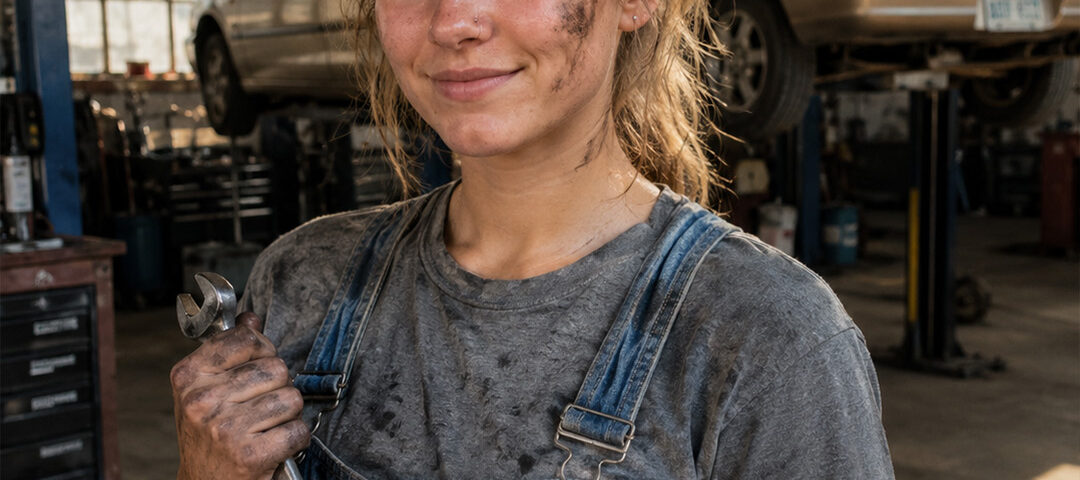
If you ever want to feel like the human equivalent of a spare tire, grow up in a family where your cousin is a premed golden boy and you love engines. My name is Heidi Moses. I’m 24 years old, and in my family, that basically meant I was born wrong.
According to them, I grew up in Joliet, Illinois, with three acceptable life paths: become a doctor like cousin Noah, pretend I wanted to become a doctor like cousin Noah, or get used to being the blurry background extra in every Thanksgiving story they told. Guess which one I picked? Yeah, the wrong one.
I fell in love with engines. Our family wasn’t rich, but you’d never know it from the way they posed for photos. My parents, my uncle Mitch and aunt Lydia, the whole clan. They were obsessed with appearances, suits, titles, who got what for Christmas.
Every small success came with a posed picture, a long caption, and some humble brag in the family group chat. If you could put it in a frame or on Instagram, it mattered. If it smelled like grease or sweat, it didn’t.
So when cousin Noah got into medical school, you’d think the Pope had delivered his acceptance letter while angels livestreamed it. They threw a garden party, catered of course. White tablecloths, rented chairs, floral centerpieces. They gifted him a Rolex, an actual Rolex.
I Googled it under the table. $9,000. My mom whispered that it was a smart investment for a man of his caliber, like the watch could smell anyone with less than a 4.0 GPA and sound an alarm. Meanwhile, I had just finished my two-year program in automotive technology.
I was working nights at a garage just to pay rent and tuition. No party, no speeches, no engraved anything. Honestly, I wasn’t expecting fireworks, but I thought maybe a congrats, a toast, or a handshake that didn’t feel like they were patting a golden retriever.
When I told my parents I’d gotten my mechanic’s degree, my mom blinked like I had just announced I bought a yacht in Arizona. My dad chuckled, leaned back in his chair, and said, “So, you’ll be crawling under rusty buckets now, huh?” Rusty buckets. Noah got a Rolex. I got oxidation humor.
The worst part was they laughed. Uncle Mitch, aunt Lydia, everyone at the table. Like the rusty bucket girl was a character they’d all helped write. The thing is, I’ve been teased my whole life for being the hands-on one.
In high school, I built a go-kart from junk parts and accidentally smoked out the entire back lot. I got suspended for two days. I was thrilled. The engine ran perfectly. When I was 16, I rebuilt a transmission from scratch for a neighbor’s busted van. No manual, just instinct and YouTube.
My mom called it cute. My dad said I was too smart to be crawling under cars for the rest of my life, like being smart and loving engines couldn’t exist in the same person. They never understood that I liked crawling under cars. Down there, things made sense.
There were problems, there were tools, and there was a way through. To them, anything with oil and bolts was beneath the family standard. Unless, of course, it was Noah’s car. I’d fixed Noah’s car twice for free. No photos, no thanks, just a toss of, “You’re a lifesaver, cuz,” before he sped off to his next shadowing opportunity.
The graduation party I got was dinner at Chili’s. My mom wore heels like she was going to a gala. My dad spent the entire evening talking about Noah’s shadowing program at some big hospital in Chicago. “So, what’s next?” my mom asked, sipping her mojito like she was hosting a late-night interview.
“I’ve actually got a few clients already,” I said. “Neighbors, people from school. I’m thinking of renting a small garage and going solo.” She blinked twice. “You mean like a real business?” “Yes,” I said, smiling. “With tools and everything.” Dad laughed. “Just don’t call it Rusty Buckets and Company.”
I smiled politely. Inside, something sharp twisted. Not because they didn’t believe in me. I gave up on that years ago. But because they looked so smug about it, like my future was a punchline. They all already knew the ending to a lesser version of success. Fewer digits, fewer suits, more tetanus.
That night, I went home to my tiny studio apartment above a nail salon. The place smelled like acetone and broken dreams, but it was mine. Four peeling walls, one squeaky fan, and a window that rattled when trucks went by. I lay on my mattress, staring at the cracked ceiling, replaying the word rusty in my head over and over until it lost meaning and became just a color.
My phone buzzed. A text from Noah in the family chat. A selfie in his white coat. Future MD loading. The chat exploded with heart emojis, clapping hands, prayer hands. So proud of you, son. Our genius. Rolex looks great.
Not one of those people had even liked the photo I’d posted three days earlier of my first engine rebuild with the caption, “First solo job done. Smelled like victory and WD-40.” I typed a message in the chat, deleted it. Typed another. Deleted that, too. What was I going to say?
Hey, nobody threw me a party for figuring out how to keep your cars from dying on the highway. Instead, I went back to scrolling through listings for commercial rentals. Most were out of my budget. A couple looked like actual crime scenes. Then I saw it.
A dusty corner unit on Fourth and Bridge View. Two bays, a cracked bathroom sink, a ceiling fan hanging on to life by one screw, and a rent number that didn’t make my stomach flip. I booked a viewing the next morning.
Standing inside that empty garage felt like stepping into a rough draft of the life I actually wanted. The paint was peeling. The bathroom door creaked like a horror movie. The ceiling fans rattled like they were powered by anxiety. But there was room for two lifts, a waiting area, and something else I couldn’t quite name. Something like poetic justice.
I ran my fingers along the dusty wall and imagined my logo up there. Precision Pit Automotive. Engines humming. Laughter in the waiting room. People who looked at me and saw a professional, not a disappointment with a socket wrench.
The landlord slid the lease across a folding table. “You sure about this?” he asked. “Starting a garage is a lot of work.” I thought about Noah’s Rolex. About the way my dad smirked when he said rusty buckets. About my mom calling my degree cute like a hobby. I picked up the pen. “I’m sure,” I said.
Signing that lease felt like proposing to myself and saying yes. I emptied my savings. Two years of night shifts, burnt fingers, missed parties, cold mornings under car frames. No loans, no family money, just me and a spreadsheet that would probably make an accountant cry.
But as I locked the garage door for the first time, keys cold in my hand, a strange calm settled over me. They thought I would come crawling back someday, begging for approval. They thought this was a phase I’d grow out of. They thought engines were beneath me.
They had no idea that this little rattling, half-forgotten unit on Fourth and Bridge View was about to become the place where every rusty bucket joke they’d ever made came back to haunt them. They just didn’t know it yet.
Precision Pit opened two weeks later. Not with a ribbon-cutting ceremony or a catered garden party. Just me, a folding table I found on Facebook Marketplace, a refurbished coffee maker that hissed like it held grudges, and three loyal clients who believed in me before my own family ever did.
Mrs. Applegate from the nail salon downstairs, Mr. Turner, my old high school janitor, and Marcus, who drove a ’98 Ford that backfired like it had unresolved childhood trauma. For the first time in my life, I felt rich. Not in money, not yet, but in purpose.
I’d mop brake fluid off the floor in the mornings, do oil changes at noon, and repaint patches of peeling wall at night. I was exhausted, sweaty, sore, and completely alive. Meanwhile, the family group chat was on fire every day. Noah, white coat fitting today. Noah, practicing stitching synthetic skin. Noah, study group dinner. Future med squad.
I posted one photo, one of the new Precision Pit Automotive logo I hand-painted on the garage door. Not a single family member liked it. Not Mom, not Dad, not Uncle Mitch, not Aunt Lydia. Actually, my barber liked it. That man has been more emotionally supportive than 60% of my blood relatives.
I wasn’t surprised, but it stung anyway. Not because I needed their validation. No, I had given up on that years ago. But there was still this quiet, stubborn part of me that wished my dad would text even three simple words. Proud of you.
Instead, he sent this: “You’re still doing that garage thing? Might be time to think about going back to school.” Yeah, school. Because apparently ambition only counts if it comes with a white coat and six-figure debt.
I could have snapped. I could have sent a long rant about how not all success comes with a Rolex or a stethoscope. About how keeping someone’s car running so they can get to work is just as important as saving a life in an ER. But instead, I sent a thumbs-up emoji. Grease glove and all.
He was the only one who didn’t treat my dream like a joke. Ethan Cruz, my boyfriend of two years, would stop by the garage after his shifts at the distribution center. Six-two, tan skin, forearms that looked carved from warehouse work, and a smile that felt like home. He’d bring me sandwiches, bottled water, or sometimes just himself.
“Don’t forget to eat,” he’d say, brushing dirt from my cheek. “You can’t run a business if you pass out on top of a timing belt.” He never once made me feel small. Never flinched when I talked about torque converters or gasket sealers. Never compared me to Noah.
His ex-girlfriend, a hyper-ambitious, soon-to-be surgeon, still occasionally stalked his socials and posted cryptic Instagram quotes about men who choose mediocrity. Ethan always rolled his eyes and said, “She thinks success is a resume. I think it’s peace.” He chose me. The girl with grease under her nails. Heidi Moses, future owner of a real, honest-to-goodness automotive shop.
And then my mom called, not to ask how I was. Of course not. “Heidi?” She used that polite but disappointed tone that always made me brace. “We’re having a family dinner next week for Noah. He’s visiting before his rotations begin.” “Of course,” I said. “And you want me there?”
A pause. “Well, yes, and maybe you can look at my car after dinner. The check engine light came on.” There it was. Not we miss you. Not we want to celebrate your shop. Not how’s our daughter doing? Just be helpful. The family tool. The wrench with feelings.
I swallowed my irritation. “Sure, Mom.” “That’s my girl,” she chirped. My girl. I wasn’t sure we’d spoken those words since I was twelve. But something in my gut whispered that I should go. Not for them, for the story. Because that dinner was the prologue to a storm they didn’t see coming.
The night of the dinner, I wore my cleanest flannel and boots that didn’t squeak. The dining room looked like it had been staged for a magazine spread. Candles, wine glasses, a centerpiece the size of a toddler, and Noah sat at the head of the table wearing his white coat. He said it was ceremonial.
Aunt Lydia gasped every time he opened his mouth, like he was revealing ancient medical secrets instead of talking about synthetic skin. My dad greeted me with, “You don’t have grease on your hands, do you?” No hello, no hug, just a cleanliness check.
I smiled without humor. “Not today.” I sat three seats down from Noah next to the coat closet. Fitting. He launched into a story about holding a retractor during an appendectomy. Everyone clapped. Someone actually clapped. I ate my dry chicken and tried not to roll my eyes into another dimension.
Halfway through dessert, Mom turned to Noah. “Sweetheart, we still need to get your car serviced before you leave. It always does that.” Noah waved it off. “I think the check engine light is emotional.” They all laughed. Then Mom turned to me.
“Heidi, would you mind taking a quick look? You’re good with tools.” Tools. Not talent, not certification, just tools. I nodded. “Sure.” Noah tossed me his keys like I was a valet.
Outside, I turned the ignition and instantly recognized the shudder. Transmission misfire. Possibly the torque converter. He’d been driving it like that for weeks. When I returned, I said, “I can take care of it this week. Bring it by the shop.”
Mom blinked. “Shop?” “Yeah,” I said casually. “I opened my own garage.” Silence thickened the air. Dad coughed. Uncle Mitch raised a brow. Aunt Lydia forced a smile so tight it looked painful. “That’s cute,” she said.
Cute. They said it like I’d opened a lemonade stand. I let it slide because they weren’t ready. They had no idea that Noah’s car, not his grades or his white coat, would be the thing that snapped the family’s perfect image in half. They had no idea that just a few weeks later, the universe was going to slam the gas pedal on poetic justice.
Two days after the dinner, Noah showed up at Precision Pit, parking his Camry like he’d never parallel parked outside a non-valet location in his life. He stepped out wearing scrubs, even though he wasn’t working that day. He looked around my garage like it was a museum exhibit he didn’t quite understand.
“So, you really went through with this?” He gestured vaguely at everything, my equipment, my lifts, my livelihood. “This,” I echoed calmly, “is my business.” He gave a short laugh. “Huh. Thought it was like a side thing. A hobby.”
A hobby. I motioned toward the giant sign painted across the garage door. Precision Pit Automotive. Honest work. Clean hands. Okay, sometimes. Noah squinted. “That’s your slogan?” “Better than I held a retractor once,” I replied. He didn’t laugh.
Instead, he dropped the keys into my hand like he was doing me a favor. “Text me when it’s done,” he said, then turned and walked out without even looking back. I shook my head, raised the hood, and got to work.
The Camry situation was even worse than I thought. Cracked mounts, misfiring solenoids, a tire so bald it looked like it had been rubbed with sandpaper for sport. I took photos, wrote everything up, and sent him the quote, detailed enough to make a dealership blush.
Two hours later, Noah finally replied, “Lol, are you sure it’s not just the light? Dad might stop by, too. His car is acting up.” And just like that, destiny revved its engine. The Buick that time forgot.
The next morning, I was elbow-deep in gasket sealant when I heard the choking cough of an engine that sounded like it smoked two packs a day. I peeked out and froze. There it was, my father’s ancient ’02 Buick Century. Beige, rust blooming up the wheel wells, a crack in the windshield shaped like a lightning bolt, and a bumper sticker that read, “Still plays with cars.” Ironic, considering the car had clearly lost every game it ever played.
Dad stepped out, hands on his hips, scanning my garage like he expected it to confess to something. “Well,” he said. “This is bigger than I thought.” “The rust?” I asked, poker-faced. “No, the whole thing.” He gestured around the shop. “You really run this place?”
“Lease, licenses, inspections,” I said, ticking them off. “All me.” He nodded slowly. “Hm.” I waited, maybe for a good job, maybe for a proud of you. But instead, he said, “The engine’s knocking and the heater won’t blow. Think you can take a look?”
Not please. Not when you have time. Just think you can take a look. I smiled politely. “Sure. Want me to tow it, or will it make the thirty feet to the lift?” He didn’t laugh.
Rust, regret, and the poetic payback of time. Inside, the Buick was a mechanical disaster zone. Worn belts, cracked hoses, leaking oil pan, rust. So much rust that if I breathed too hard, something might snap off and file for retirement.
I called Dad over. “See this?” I tapped a rusted patch. “This is what happens when you treat a car like a disposable camera.” Dad frowned. “Is it fixable?” I handed him the repair estimate. More than fair. He blinked at the number. “You’re charging family full price?”
I didn’t flinch. “Did you bring a Rolex when Noah fixed your gallbladder?” Dad’s jaw tightened. He muttered, “Do what you can,” and shuffled off to the waiting area, which consisted of a plastic chair, a squeaky fan, and a framed sign I’d put up the week before: Respect the work or walk to work.
He sat under it like karma had personally chosen the seating. Then fate walked through the door wearing work boots. Just as I was loosening a rusted bolt, the shop door chimed. I turned and nearly dropped my wrench.
Walking in was Mr. Randall, owner of Randall Heating and Electric, a man whose fleet of seven work trucks practically kept half the town employed. He looked around my garage, nodding with approval. “Heard from Mike at the trade school a former student opened up shop,” he said. “Didn’t realize it was you, Heidi.”
I wiped my hands on my overalls. “Yep. Three months strong.” “This place looks solid,” he said. “Smells like real work happens here.” I laughed. “We try to keep the drama low and the torque high.” He smiled and pulled out a card.
“I’ve got seven trucks due for inspection next month. Think you can handle it?” Behind him, I saw Dad slowly sit up straighter in the waiting chair. “I’ve got the space, the tools, and the coffee’s free,” I said. “We can stagger the schedule so you’re never short a truck.”
Mr. Randall grinned. “Let’s start with two next week and go from there.” We shook hands right in front of my dad. His eyes followed the handshake like he’d just watched someone crown me queen of the town.
For the first time in my life, I saw something flicker in his expression. Not ridicule, not dismissal. Something closer to, Will my daughter actually be okay without us? He didn’t say it, but I saw it. And the day wasn’t done teaching him lessons.
I finished Dad’s Buick, cleaned up Noah’s Camry, and detailed it, too, because I wanted the message to be unmistakable. I do good work, better than you ever gave me credit for.
Dad came to pick up the Buick that evening. He stood in front of it, hands in his pockets, eyes scanning the polished engine. Then he looked at me. “You really built all this?” he asked quietly. “Every inch.” He nodded. A small nod, barely there. “That’s something.”
Not I’m proud of you. Not sorry we never saw it. Just that’s something. It wasn’t enough. Not after years of being the joke, the background, the spare tire. But it was the first crack in their armor of superiority. And cracks always grow.
Three days later, I was halfway through replacing brake pads on a Silverado when my phone went off like someone had thrown it into a blender. Six texts in two minutes. Mom: “Heidi, honey, Noah’s car just stalled again. Can we bring it to you ASAP?” Dad: “Something’s wrong. Check engine again. We’re bringing it in. Don’t make this worse.” Noah: “Camry won’t start. Stuck near Greenville. Help.”
The last message made me laugh out loud. Don’t make this worse. As if I had personally caused his car to develop abandonment issues. I wiped my hands, set down my wrench, and felt it. The gut-deep whisper. This is it. The moment the universe had been tuning its engine for.
Two hours later, a tow truck rumbled into the lot and dropped Noah’s Camry like a crime scene at my doorstep. But it wasn’t Noah who got out. It was my parents. Mom looked tense, tight-lipped, hands wringing like she was auditioning for a soap opera. Dad looked irritated, the way he always did right before he blamed me for something.
The Camry rolled into bay two. I approached with my clipboard, professional as ever. “Engine light came on again?” I asked, already knowing. Dad nodded stiffly. “Stalled twice. Rattled. Something you didn’t fix right the first time.”
I raised a brow. “You think I botched the job?” “I didn’t say that.” Which, in Dad language, meant, I absolutely said that. Mom jumped in. “Noah mentioned he heard a weird noise yesterday, so he opened the hood.” I froze. “He opened the hood?” I repeated slowly.
“He just checked the oil,” Mom added. “Maybe.” Maybe. I lifted the hood, and there it was. My golden ticket. The oil cap was missing, completely off, sitting wedged behind the engine block like it was hiding from the consequences of its own stupidity.
Oil had splattered everywhere, across the intake, all over the wires, dripping down the sides. It looked like a deep-fried fast-food accident. I turned to them, absolutely serene. “This,” I said, pointing, “is what happens when someone opens something they don’t understand.”
Dad’s eyes narrowed. “You saying it’s his fault?” “I’m saying,” I answered slowly, savoring every syllable, “that when someone removes an oil cap and doesn’t put it back on, things get messy.” They stared at me, silent, completely caught.
I gave them a moment to connect the dots, maybe to apologize. They didn’t. They never do. Mom crossed her arms. “So, can you fix it?” There it was, delivered with no irony, no shame, just the casual entitlement of people who had spent twenty-four years assuming my life existed to fix their problems.
I leaned my hip against the Camry, wiped my hands slowly with a rag, and let the words fall out like a smooth engine purring. “Of course,” I said. “After all, I fix rusty buckets, right?” Dead silence. Dad actually flinched. Mom’s mouth parted like she wanted to defend herself, but nothing came out.
I stayed calm, professional, because that’s what you do when you’ve been underestimated your whole life. You let the truth sting them without raising your voice. I grabbed an estimate form.
“Going to need a new oil cap, an oil flush, wire cleaning, inspection, possibly connectors if the oil reached the sensors,” I said, writing as I spoke. I handed Dad the clipboard. He blinked at the number. Not outrageous. Definitely not free. “You’re charging us full price?” he asked, cautious.
I shrugged. “Unless you brought a Rolex this time.” Mom shot him a look. He said nothing, and they signed. Waiting room humiliation. They sat in the plastic chairs like two kids waiting for the principal. Mom stared at the TV playing Wheel of Fortune, fake-laughing at contestant mistakes.
Dad scrolled through his phone aggressively, as if Google personally offended him. Every so often, they’d peek into the bay watching me work. Not criticizing, not smirking, just watching. Like they were seeing something for the first time. Maybe they were.
When I finally handed over the keys, I walked into the waiting room, wiped my hands, and said, “All good.” Just like that. Oil flushed, cap replaced, sensors cleaned, engine running fine, assuming nobody pops the hood for fun.
Mom took the keys, but didn’t stand. She fiddled with them and looked at me. “Heidi,” her voice softened. Dangerous. “We’ve always wanted the best for you.” There it was. The Swiss Army knife of manipulative parent phrases.
Dad chimed in. “And we never said you weren’t capable. We just thought your potential was somewhere else.” “Like not under a hood?” I replied evenly. Dad swallowed and looked away.
Mom leaned forward, elbows on her knees like this was some heartfelt family therapy moment. “You’ve built something incredible here,” she said. “Really. We didn’t expect it to become this.” I nodded. “No, you didn’t.”
She blinked. “You expected I’d flake out. Patch tires in an alley. Live paycheck to paycheck. Probably borrow gas money from Noah.” “No, we…” “Yes,” I cut her off. Calm, sharp. “It’s why I didn’t get a graduation dinner. It’s why nobody replied to the shop opening post. It’s why every time you said proud, it was never about me.”
The room went still. Dad’s voice dropped. “You have to understand. We were scared. Scared you’d get stuck doing something that wouldn’t take you far.” I smiled. Small, sad. “Funny,” I said. “Because this place has taken me farther than your approval ever did.”
Mom’s eyes glistened, but she blinked it away. Dad rubbed the back of his neck. They were both unraveling. It wasn’t cruel. It was just honest. “So, what now?” Dad finally asked. I took a breath.
“You need a mechanic? I’m here. You need family? Then meet me halfway. Not at Noah’s party. Here.” That landed hard. They stood slowly. Mom looked around the shop again. Really looked. “You really built all this,” she whispered. I nodded. “Every inch.”
They walked out quietly. No dramatic exits, no last jabs, just the soft click of the door. For the first time in years, I felt steady. Not small, not overlooked, just steady. A woman standing in her own space, one she built with her hands, her grit, her stubbornness, and her heart. And this time, they finally saw it.
The shop was quiet after they left. Quiet in a way that felt earned. I stood in the center of the garage, surrounded by tools that actually respected me, engines that listened better than my parents ever had, and the metallic hum of a life I built with my own hands.
But the silence didn’t last long. Two hours later, my phone buzzed. A message from Ethan. “How’s your day, Grease Queen? Need dinner delivered?” I smiled. Really smiled for the first time that day. If my family was a storm, Ethan was the warm garage light that stayed on through any blackout.
He showed up twenty minutes later holding a bag of burgers and two milkshakes. “You look like someone who deserves fries,” he said, kissing my cheek. “You okay?” I leaned against him, letting the steady smell of sawdust and laundry detergent calm the frayed edges of my nerves.
“Long day,” I murmured. “My parents tried to rewrite history again.” Ethan scoffed. “Of course they did. They rewrite faster than my ex posting motivational quotes about choosing partners with ambition.” I snorted. “Told you she was obsessed with credentials.”
“She can keep her credentials,” he said, brushing a smudge from my jaw. “I prefer women who can rebuild a transmission in under two hours.” I shoved him playfully. “Stop flirting.” “Never,” he grinned.
He stayed with me through after-hours cleanup, stacking tools, sweeping floors, quietly existing like he always did. No judgment, no comparisons, no conditions. When he left, the shop was spotless. My mind, less so.
Their words kept echoing. We just wanted what was best for you. We never said you weren’t capable. We were scared you’d get stuck. Every excuse was a polished lie wrapped in parental guilt. They weren’t scared I would fail. They were scared I would succeed without doing it their way.
As I wiped down the workbench, memories spilled in, ones I hadn’t revisited in years. I remembered being twelve, helping Dad change brake pads for the first time. How proud I felt when I tightened a bolt correctly. I remembered him patting my head like a dog. “Cute,” he’d said. “But don’t get too into this stuff. It’s not a girl’s future.”
I remembered Mom telling me to clean up nicely before family gatherings so I wouldn’t embarrass them with grease stains. I remembered being sixteen, working late at the garage, freezing fingers numb while I saved for my school tuition, because my parents had already allocated the education budget to Noah.
Every memory had the same theme. My value was conditional, useful only when they needed something, never when I needed them. And today, today was the first time I didn’t let their excuses wash over me unanswered. Today, I finally answered back.
Then came the unexpected knock. It was close to 10 p.m. when I heard it. Three sharp knocks at the shop door. I frowned. The sign definitely said closed. I opened the door, and there stood Uncle Mitch.
Of all people, he looked uncomfortable, hands stuffed in his pockets, shifting from foot to foot like he was standing on hot pavement. “Heidi,” he said, “can I talk to you?” Every instinct in me said no, but I stepped aside.
He walked in and looked around the shop slowly. The lifts, the tools, the spotless floor, the framed respect the work sign. “This place is impressive,” he murmured. I waited. He cleared his throat.
“I saw your dad earlier,” he hesitated. “He told me what happened about Noah’s car. About the oil thing.” I folded my arms. “Okay.” Uncle Mitch swallowed. “I just wanted to say your parents aren’t good at admitting when they’re wrong. None of us are. Honestly, our family…” He paused. “We’re terrible at letting people be who they are.”
That stunned me more than anger could have. He wasn’t defending them. He wasn’t arguing. He was confessing. “I should have stood up for you years ago,” he said softly. “When everyone made the rusty bucket jokes, when Noah got the Rolex, when you didn’t get so much as a toast.”
I blinked. “I didn’t expect this,” he continued, voice low. “I’m sorry, kiddo. Truly.” My breath hitched. Not because it healed everything, but because it was the first time anyone in my family had ever acknowledged the truth out loud.
I nodded slowly. “Thank you,” I whispered. Uncle Mitch gave a small, sad smile. “They’ll come around. Might take time, but they will.” He turned to leave, then paused at the door. “You built something real here, Heidi. Something solid.” He looked me dead in the eyes. “That’s more than most people ever manage.”
Then he left. Just left. No lecture, no guilt, no minimizing. A simple, genuine apology. The first of my life. And then clarity. I stood alone in the shop, staring at the space where he’d just been.
For years, I thought I needed them to validate me, to clap for me, to see me. But tonight made something crystal clear. I wasn’t the spare tire. I wasn’t the rusty bucket. I was the engine. And engines don’t need applause. They need fuel. Work, drive, purpose. I had all three.
When people ask me what I do, I used to say, “I’m a mechanic.” Now, now I answer with something truer. “I fix things.” Then when they look confused, I add, “Rusty cars, busted expectations, and sometimes people.”
I locked up the shop for the night, flipping the sign to closed. And for the first time since childhood, I felt full, not of anger or resentment or longing, but something steadier. Something like peace.
The next morning, sunlight spilled into the garage through the high windows, hitting the metal surfaces just right, like the universe had switched on a spotlight over my little kingdom of torque and stubborn dreams. Precision Pit smelled like rubber, fresh oil, and quiet triumph.
I walked the floor slowly, fingertips grazing the tool chest, the lift posts, the freshly organized shelves. Every wrench had earned its spot. Every socket had a home. Every smudge on the concrete had a story behind it. This place wasn’t just a garage. It was my proof, my battleground, my refuge, my future.
For years, I’d wondered if maybe I was the problem. Too sensitive, too emotional, too quick to take things personally. Maybe my family wasn’t as dismissive as I remembered. Maybe I’d exaggerated the times they overlooked me.
But memories don’t lie. Not the aching ones. Not the ones replayed under fluorescent lights at 2 a.m. Not the ones held together by WD-40 and sheer stubbornness. No amount of revisionist family history could rewrite what I’d lived.
And standing there now, in the sanctuary I built from calloused hands and late-night hustling, I finally felt the weight lift. I didn’t need their apologies to breathe. I didn’t need their approval to stand tall. I had already built the life the younger me begged for.
On the front desk sat my appointment book. Pages already filled for the next week. Randall’s first two fleet trucks on Monday. Mrs. Applegate’s monthly checkup. A walk-in from a teacher whose husband said, “Find me the honest mechanic.” Marcus again, because his Ford had emotional issues. And I quote.
People trusted me. People depended on me. People chose my work because it mattered. Because I mattered. Then my phone buzzed. It was Ethan. “Morning, Grease Queen. Coffee run. Want your usual?” I texted back, “You know me too well.” He replied, “Nah. You’re just easy to love.”
He had no idea how much those words hit me. After years of being the family’s designated disappointment, hearing easy to love felt like stepping into sunlight after living under a car for too long.
He showed up ten minutes later with two iced coffees, a breakfast sandwich, and a grin that made the shop brighter than the lights ever could. “Big day?” he asked, handing me the coffee. “Yeah,” I said, sipping. “Big life.” He pulled me in, kissed my forehead, and whispered, “You built this. Don’t let anyone tell you different.”
I didn’t realize how badly I needed to hear that until right then. Before Ethan left for work, he paused at the door. “You know,” he said, “if your family never comes around, it’s their loss, not yours.”
I nodded, but I didn’t answer, because deep down, a tiny part of me still hoped they’d learn, grow, change. But whether they did or not, that was no longer my burden. That was theirs.
After a long day of oil changes, diagnostics, a tire rotation, and a surprise walk-in with a Honda that sounded like it had swallowed gravel, I shut down the lift, turned off the air compressor, and dimmed the lights. The garage grew quiet. The kind of quiet that sits deep in your bones and whispers, “You made it.”
I walked to the small mirror near the entrance, the one I’d hung at eye level months ago because I wanted to remember who I was becoming. A girl with oil streaks on her cheek. A woman with grit in her veins. A mechanic with a spine forged from years of being underestimated.
I looked at myself, really looked. Same Heidi, same stubborn heart, same hands that rebuilt engines and rebuilt self-worth at the same time. But now, now I smiled because I wasn’t the spare tire. I wasn’t the background character. I wasn’t the rusty bucket girl they joked about.
I was the one who held her ground. The one who built something from nothing. The one who proved that success doesn’t need a white coat, a Rolex, or a family photo staged for Instagram.
When people ask me what I do now, I say it simply. “I fix things.” They usually look confused, so I add, “Rusty cars, busted expectations, and sometimes myself.”
Then I flip the sign to closed, and I go home. Not to prove anything to anyone. Not to chase their approval. But because tomorrow, the garage will open again. Engines will need me. People will trust me. And I’ll keep doing what I was always meant to do. Build a life that’s mine.