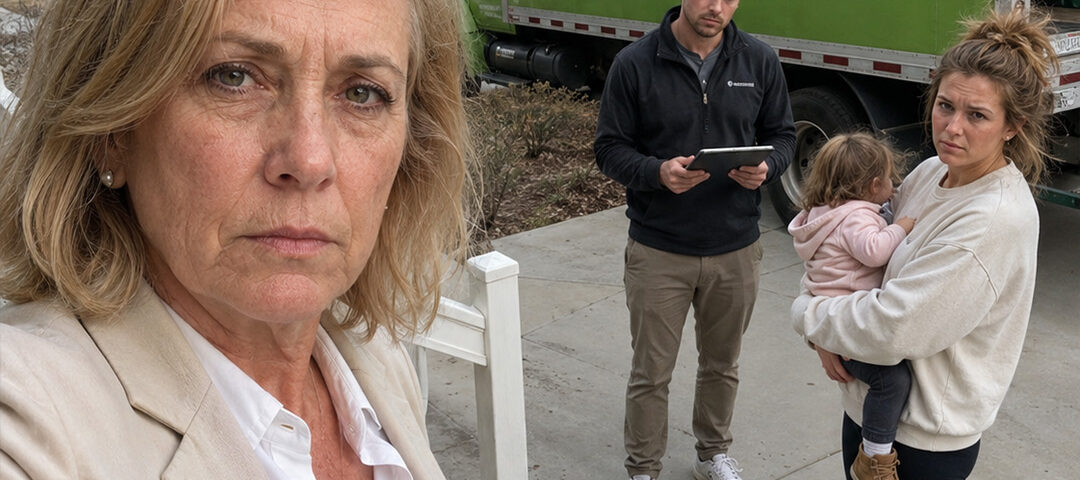
The moving truck backed into my driveway at 11:15 on a Saturday morning, and for one long second I simply watched it crush the edge of my flower bed through the front-door camera, wondering when my son had stopped asking me for help and started assigning me a role in his emergency.
An hour earlier, Ethan had called while I was sitting at my kitchen island with a cup of black coffee and a spreadsheet open on my laptop. I remember the thin winter light across the granite, the quiet hum of my dishwasher, the framed photo of my late husband, Daniel, on the far counter. He had been gone three years by then, but some mornings the house still felt like it was waiting for his keys in the bowl by the door.
“Mom,” Ethan said, without hello, “we’re moving into your guest room today.”
I thought I had misheard him.
“What?”
“The truck is already reserved. Rachel packed most of the apartment last night. We’ll use the guest room and the office for the kids’ stuff until we get settled.”
I set my coffee down.
The cup made a small sound against the counter, much louder than it should have.
“Ethan,” I said carefully, “you are not moving into my house today.”
He gave a short laugh, the kind that had become more familiar over the past few years, dismissive but dressed up as affection. “Mom, don’t make this weird. The housing market is crazy. Our landlord raised the rent again, and we need your square footage more than you do. It’s just simple math.”
Simple math.
I have spent my entire adult life doing the kind of math people do not see until something goes wrong. I am a senior risk specialist for a commercial insurance firm in Boston. I assess exposure. I read contracts. I look at a beautiful building and see exit routes, liability gaps, deferred maintenance, and the one sentence in a policy that will ruin someone’s quarter if it is ignored. I do not deal in vague feelings when hard numbers are available. I deal in patterns, consequences, and the cost of pretending a warning sign is only decoration.
So when my son said simple math, I looked across the kitchen at the house I had bought with my own savings after my husband died, and I knew the math better than he did.
Two bedrooms. One home office. One mortgage in my name. One widowed woman who had spent three years rebuilding a peaceful life after grief hollowed out every room.
Zero permission granted.
“This is not a discussion we are having over the phone,” I said. “You and Rachel may not move into my house.”
There was a pause.
Then his voice sharpened.
“Mom, we have kids.”
“I know you have kids.”
“Then you know we can’t just sleep in a parking lot.”
“That is not what I said.”
“That’s what you’re making happen.”
I closed my eyes.
I loved my grandchildren. Fiercely. Fully. The kind of love that made me keep organic applesauce pouches in the pantry even though they only visited twice a month, the kind that made me learn the dinosaur names Theo loved and the exact lullaby Hannah needed when she was overstimulated. I had cribs folded in the basement, tiny rain boots by the back door, and a drawer full of crayons that had somehow survived every cleaning spree.
But love for children does not give their parents ownership of your life.
“Where is Rachel?” I asked.
“In the car. She’s coordinating with the movers.”
“The movers?”
“Mom, I told you. We’re on a schedule.”
“No,” I said. “You are on a schedule. I am not.”
He exhaled hard. “We’ll be there soon.”
“Do not come here with a moving truck.”
He hung up.
I sat very still for a moment, the phone still in my hand, staring at Daniel’s photograph. He was smiling in that picture, standing on the deck of our old house in the suburbs, sleeves rolled up, holding a pair of tongs like he had personally invented grilling. He had been the softer parent, the one who believed Ethan would grow into responsibility if we simply loved him steadily enough.
“He has a good heart,” Daniel used to say whenever our son borrowed money and forgot the word repayment.
He did have a good heart once.
That was the part that made everything so difficult.
Ethan was twenty-nine now. He had married Rachel four years earlier after a fast engagement and a wedding that cost more than they admitted to either family. They had two toddlers, one lease they could not afford, two cars they justified as necessary, and a habit of treating every financial deadline like a surprise party thrown by reality. For years, I played the supportive mother. I sent quick transfers for “temporary” shortfalls. Three hundred for groceries. Four hundred for an urgent car repair. Nine hundred when their old apartment charged a penalty after they moved out early because Rachel decided the building’s laundry room was “depressing.”
The first year, I told myself young families struggled.
The second year, I began keeping notes.
By the third year, I had a spreadsheet tab labeled Ethan Support History, because I could love my son and still respect data. The total was $6,450, not counting gifts for the children, holiday expenses, or the countless times they came over and left with laundry detergent, diapers, or half the frozen meals I had prepped for myself.
Every time I mentioned repayment, Rachel would sigh.
“Clara, you have a stable corporate salary,” she would say, as if earning my paycheck meant they were entitled to spend around it. “We’re just trying to survive.”
Survival, apparently, included weekend getaways, a luxury stroller, meal delivery subscriptions, and Rachel’s insistence that the kids needed “developmentally appropriate” wooden toys imported from companies that charged like they were building furniture for royalty.
Still, I did not expect the truck.
At 11:15, my phone buzzed with an alert from the front-door camera.
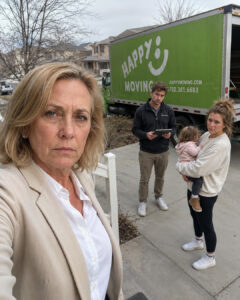
I was about to join a video meeting, blazer over a T-shirt, hair clipped back, coffee reheated for the second time. The notification showed a massive bright green moving truck reversing into my driveway at an angle that made my stomach tighten. Its rear wheels rolled over the damp edge of my lawn and pressed deep tracks into the grass Daniel and I had once argued over because he believed in mowing diagonally and I believed in efficiency.
Behind the truck came Ethan’s silver SUV.
Then Rachel stepped into view, toddler on one hip, phone pressed to her ear, hair in a tight ponytail, sunglasses perched on her head like she had arrived at a job site.
The doorbell rang.
Not once.
Four times.
I opened the camera feed.
Rachel leaned toward the lens. “Open the door, Clara. The movers are on an hourly rate.”
Not Mom. Not please. Not we need to talk.
Clara.
The way she said my name always made me feel less like family and more like a customer service representative who had failed to process her request.
I stood and walked to the front door slowly. My hands felt cold, but my thoughts were becoming very clear.
When I opened the door, Ethan was already pointing two movers toward the porch. They were carrying one end of a gray sectional sofa so large it looked like it belonged in a hotel lobby. Rachel stood beside the walkway with Hannah on her hip and Theo clinging to her leggings, both children confused and tired. The lead mover held a tablet and wore the blank expression of a man who had seen enough domestic chaos to stop being curious.
“What is going on?” I asked.
Rachel stepped toward me with the diaper bag. “We told you. We’re staying here for a couple months while we rebuild.”
“You did not ask.”
“We don’t have time to ask,” she snapped. “Our landlord raised the rent by four hundred dollars. We didn’t renew. This is the only practical option.”
Ethan came up the steps, avoiding my eyes. “Mom, please don’t do this in front of the crew.”
“Do what?”
“Make it embarrassing.”
I looked past him at the truck, the sofa, the stacked boxes visible inside, the movers waiting for direction, the neighbors’ curtains beginning to shift across the street.
“You brought your entire household to my driveway without permission,” I said. “And you’re concerned that I’m making it embarrassing?”
Rachel shifted Hannah higher on her hip. “You always say this place is too quiet.”
“I have never said that.”
“You have an entire guest room sitting empty.”
“It is not empty. It is mine.”
Ethan’s face tightened. “Mom, come on. It’s one bedroom and an office. You don’t need all this space.”
I heard the sentence beneath the sentence.
You do not need your own life.
Something inside me steadied.
The lead mover cleared his throat. “Ma’am, where do you want the sectional?”
“Back in the truck,” I said.
The mover blinked.
Rachel’s mouth fell open. “Excuse me?”
I looked directly at the man holding the tablet. “Do not bring a single item across my threshold. This is my property. I have not authorized delivery or occupancy.”
The mover immediately lowered his end of the sofa. The other man followed, visibly relieved to have a clear instruction that did not involve guessing which family member had legal authority.
Ethan stepped closer. “Mom.”
“No.”
“You can’t just turn us away.”
“I can. I am.”
Rachel’s face flushed. “We have children.”
“Yes,” I said. “And that means you should have made a housing plan before hiring a moving company.”
The words were not loud, but they landed hard. Even Theo stopped tugging at Rachel’s sleeve and looked up at me.
I hated that he heard it. I hated that my grandchildren were standing in my driveway while their parents tried to force an emergency into my home. But I also knew that surrendering my house out of guilt would not protect those children. It would simply teach their parents that my boundaries were decorative.
Ethan looked at the mover, then back at me. “We can’t pay for storage and a new deposit.”
“That is a financial problem,” I said. “Not permission.”
Rachel gave a sharp laugh. “Listen to yourself. You sound like a claims department.”
“I work in risk for a living. You should have expected documentation.”
Her eyes narrowed.
I pulled my phone from my pocket and unlocked it. My hand shook only slightly.
“I am giving you five minutes to redirect this truck to a commercial storage facility or another address. If any belongings are left on my porch, I will call the city’s non-emergency property line and document an unauthorized occupancy attempt. I will also send everything to an attorney Monday morning.”
The lead mover took two steps backward.
“Yeah,” he said to Ethan, “I’m not unloading into a dispute. You tell me where to drive or I take it to storage under your contract.”
Ethan stared at me as if I had become someone he did not recognize.
Maybe I had.
Or maybe he was finally meeting the part of me that had always been there, the part he had never needed to respect because I kept softening myself before he hit it.
“You’re really doing this?” he asked.
“No,” I said. “You did this. I’m refusing to participate.”
Rachel let out a small, bitter sound and turned away. “Enjoy your empty rooms, Clara.”
She carried Hannah back to the SUV. Theo followed, dragging the sleeve of his hoodie under his nose. Ethan stood on the steps for another few seconds, jaw tight, breathing hard. I waited. I did not slam the door. I did not lecture. I did not cry.
He signed the mover’s tablet with a hard swipe, then turned without a word.
The truck pulled away twelve minutes later, leaving deep tire tracks in the wet edge of my lawn.
When the street was quiet again, I closed the door, locked the deadbolt, and leaned my forehead against the wood.
My legs were shaking.
That surprised me more than anything.
In the moment, I had felt composed. Afterward, the adrenaline drained out and left me hollow. I went to the living room and sat on the sofa Daniel and I had bought after moving into this townhouse. I looked at the fireplace mantel, where family photos stood in silver frames: Ethan at high school graduation, Ethan holding Theo in the hospital, Rachel smiling at a baby shower, Daniel and me in Maine the summer before he got sick.
The house was not large. Ethan called it square footage, as if it were a resource sitting idle. But every room had been chosen carefully after grief. The guest room was painted a soft green because Daniel loved the color of sea glass. The office had built-in shelves where I kept my policy manuals, sewing machine, tax files, and the small wooden box containing Daniel’s wedding ring. The kitchen island had become the place where I ate breakfast, reviewed claims reports, wrapped Christmas gifts, and slowly learned to exist without another adult voice in the house.
They had not come to share my home.
They had come to replace me inside it.
The notifications began within twenty minutes.
My younger sister Susan texted first.
Clara, Ethan just called me from a parking lot. How could you turn away your own grandchildren?
Then Rachel’s mother sent an email with the subject line Family Compassion. It was long, emotional, and organized into paragraphs about hospitality, moral duty, and the importance of elders making sacrifices for young families. She used phrases like your abundance and their need, as if my mortgage were a community resource.
A cousin I had not spoken to in months sent a message that read, You know, sometimes being right is not the same as being loving.
I placed the phone facedown.
For an hour, doubt did its quiet work.
That is the trouble with family pressure. It does not always arrive as a shout. Sometimes it comes wearing the voices of people who know exactly where your guilt lives. I thought about Theo’s confused face. Hannah’s little hand around Rachel’s collar. Ethan standing on my porch, tired and angry. I wondered if I had been too rigid, too legalistic, too hardened by widowhood and risk assessments and years of learning how easily one bad decision becomes a liability.
Maybe I should have let them stay one night.
Then I remembered Ethan’s first sentence.
You have thirty days to find a smaller place.
Not Can we stay while we figure this out?
Not We’re scared.
Not Mom, we made a mistake.
He had assigned me an exit date from my own home.
That was the sentence that cleared the fog.
I opened my laptop and began building a file.
Not because I intended to punish my son. Because I knew how stories change when no record exists. By Monday morning, Rachel would be telling everyone they had asked for temporary help and I had shut the door on toddlers. Ethan would say he was stressed and I misunderstood. Susan would add tears. Rachel’s mother would add righteousness. Someone would suggest I was lonely, unstable, cold, or selfish.
I needed facts.
I saved the doorbell footage. I downloaded the driveway camera clip. I took photos of the tire tracks and the flower bed. I created a spreadsheet of every transfer I had sent Ethan and Rachel over the last four years, including dates, amounts, stated reasons, and whether repayment had occurred.
The total was $6,450.
Seeing the number in one cell made something inside me settle.
Not because it was enormous. It was not. But because it represented a pattern, and patterns tell the truth more reliably than apologies do.
By Sunday evening, I had a folder labeled Ethan Housing Incident.
On Monday at nine, I called an attorney.
Robert Milner’s office was downtown, on the fourth floor of a brick building near Government Center, with heavy wooden shelves and a receptionist who spoke softly into a headset. Robert was in his late fifties, silver hair, navy suit, calm in the way people are when they have made a career out of other people’s emergencies.
I told him everything.
The phone call. The truck. The attempt to move in. The statement about thirty days. The prior loans. The family pressure. The fact that Ethan had never lived in my townhouse and received no mail there.
Robert read the text messages and watched the doorbell footage once without interrupting.
Then he removed his glasses and looked at me.
“You did exactly the right thing by stopping them before they crossed the threshold.”
My eyes stung unexpectedly.
“I need to hear that again,” I said.
His expression softened. “You did exactly the right thing. If you had allowed them to stay even briefly, especially with children, and they began receiving mail or claiming your address as their residence, removing them could have become complicated and expensive. What your son attempted was not a family visit. It was an unauthorized move-in.”
The words went through me like warm water.
Unauthorized move-in.
A phrase clean enough to hold the mess.
“What do I do now?” I asked.
“We create a paper trail. A formal notice stating they do not have permission to enter, occupy, store property, receive mail, or represent your home as their address. We send it by certified mail and email. You upgrade your locks if they have ever had keys. You preserve all footage and communications.”
“They’re my family.”
“I understand.”
“It feels harsh.”
“It is not harsh to state reality in writing.”
He slid a legal pad toward himself and began making notes. “You can love your son and still protect your home. Those are not opposing ideas.”
I left his office with a retainer receipt, a draft notice pending, and the first quiet sense of clarity I had felt since the truck appeared.
That evening, I called a locksmith.
By Wednesday, my front door had a new smart deadbolt, my garage keypad had been reset, and two additional cameras covered the side gate and back patio. The technician, a woman named Marisol with a tool belt and a no-nonsense ponytail, showed me how to view every feed from my tablet.
“Looks like a fortress,” she said.
“I hope it won’t need to be.”
She gave me a look that told me she had installed enough locks for enough women to know better than to offer easy reassurance.
“Peace of mind is worth something,” she said.
She was right.
The family group chat exploded after Robert’s letter arrived.
Susan called within minutes.
“A lawyer’s letter, Clara? To your own son?”
“He tried to move his household into my home without permission.”
“He was desperate.”
“He was organized. There is a difference.”
“He has children.”
“I know. That is why I am offering to pay for a financial planning session. Not housing. Planning.”
Susan huffed. “You sound like you’re handling a business claim.”
“No,” I said. “If this were a business claim, I would have cut losses years ago.”
She went quiet.
That was the first time I heard myself say it plainly.
For two weeks, Ethan did not contact me. Rachel did not send photos of the kids. Susan sent one article about multigenerational living, which I did not open. Rachel’s mother mailed me a handwritten note that began with Forgiveness is the foundation of family and ended with a suggestion that Daniel would be disappointed in me.
That one hurt.
I stood in the kitchen holding the letter, staring at Daniel’s photograph.
“Would you be disappointed?” I whispered.
The house, of course, did not answer.
But I knew Daniel. He would have worried for Ethan. He would have softened toward the children. He would have tried to make peace too quickly. But he also loved this townhouse for me before I even bought it. He had sat beside me in a hospital bed three months before he died, scrolling through listings on my tablet because we both knew I would not be able to maintain the old suburban house alone.
“That one,” he had said, pointing to the listing with the granite kitchen and small private patio. “That feels like you. Efficient, but pretty.”
I bought it after the funeral.
Not because I wanted to move on.
Because he had helped me choose it.
No one had the right to push me out of it.
The confrontation I had been avoiding came at my cousin Lily’s graduation barbecue in June.
I almost did not go. The idea of standing in a backyard full of relatives who had been fed Rachel’s version of the story made my stomach tighten. But avoidance lets other people become the only narrators. I had spent too much of my life letting silence be mistaken for agreement.
So I dressed carefully.
Navy slacks. White blouse. Tan blazer. Low heels. Hair smooth. Minimal jewelry. Professional, but warm. I did not want to look like a wounded mother or a defensive villain. I wanted to look like a woman who owned her choices.
Lily’s backyard smelled of grilled chicken, charcoal, sunscreen, and cut grass. Folding tables lined the patio, covered with paper plates, bowls of pasta salad, trays of watermelon, and a sheet cake from the grocery store with blue icing roses. Kids ran through the sprinkler near the fence. Adults gathered in clusters, pausing when they saw me, then resuming conversation slightly too quickly.
Susan avoided my eyes by rearranging hamburger buns.
Rachel stood near the patio furniture, talking loudly to an aunt about their new apartment. “It’s temporary,” she was saying. “The plumbing is terrible, and there’s barely room for the kids’ beds.”
Ethan was by the grill holding a paper plate, thinner than I remembered, with shadows under his eyes.
I walked straight to him.
“Hello, Ethan.”
He looked up, guarded. “Mom.”
“I miss you,” I said.
That was not strategy. It was true.
His face changed, just a little, then closed again. “Didn’t think you’d come.”
“I’m here for Lily.”
“And to inspect your perimeter?”
I let the jab pass. “No. I already know my perimeter is secure.”
He looked away.
Rachel appeared beside him, arms crossed. “Nice. Very warm.”
“Hello, Rachel.”
She gave a tight smile. “Did your attorney approve that greeting?”
Several relatives nearby suddenly became interested in the cooler.
I kept my voice even. “Robert helped me put reality in writing. I don’t need approval to speak to my family.”
“You embarrassed us.”
“You arrived at my home with a moving truck.”
“We had nowhere to go.”
“That was a crisis you created and then delivered to my porch.”
Rachel’s nostrils flared. “You could have let us stay a few weeks.”
“No,” I said. “Because the first sentence Ethan said to me was not a request. It was an eviction notice.”
Ethan’s eyes flicked to mine.
I reached into my purse and removed a folded sheet of paper.
Not legal papers. Not the attorney’s notice. Just a simple list. Dates. Amounts. Reasons. A clean record of four years of “temporary” emergencies.
I held it out to my son.
“I reviewed our history.”
He stared at the paper but did not take it.
I unfolded it myself. “Four years. Six thousand four hundred fifty dollars in direct transfers, not counting gifts, groceries, diapers, holidays, or the months I covered your phone bill after Theo was born.”
Rachel scoffed. “Are you really itemizing help now?”
“Yes,” I said. “Because you kept calling it help, but it became dependence.”
Ethan looked at the grass.
I continued, not unkindly. “This money did not build savings. It did not create stability. It covered gaps while you continued living beyond what your income could support.”
Rachel’s face hardened. “We are doing our best.”
“I believe that you are tired,” I said. “I believe parenting small children is hard. I believe housing costs are painful. I also believe you mistook my home for your final safety net and planned around taking it from me.”
Ethan flinched.
That was when I knew the sentence had found him.
He finally took the paper from my hand. His eyes moved down the list slowly. The anger in his shoulders changed into something heavier.
“I didn’t realize it was that much,” he said.
Rachel turned to him. “Ethan.”
He looked at her, then back at the paper.
“I didn’t.”
The backyard seemed to quiet around us. Not completely. Children still shouted by the sprinkler. Someone still turned chicken on the grill. But near our small circle, the air had thickened.
Rachel’s voice dropped. “We don’t need a public lecture.”
“It is not a lecture,” I said. “It is an audit.”
Susan, who had drifted close enough to hear, looked uncomfortable.
Ethan rubbed his forehead with one hand. “Mom, we’re drowning.”
There it was.
Not entitlement. Not performance.
Fear.
For the first time since the moving truck, my son sounded less like a man repeating someone else’s argument and more like the overwhelmed young father underneath it.
“The debt is everywhere,” he said quietly. “The apartment, the cars, the cards. Every month we think we’re catching up, and then something hits.”
Rachel looked away, jaw tight.
This was the moment where the old version of me would have reached for my checkbook. Not because it solved anything, but because watching my child hurt made my own body feel like it was failing at its oldest job.
But I had learned something at my front door.
Rescue without structure is just delay.
“I will not give you money for rent,” I said. “You are not moving into my townhouse. Those terms are not open.”
Ethan closed his eyes.
“But,” I continued, “I will pay for a certified financial counselor to meet with both of you. I will sit at my kitchen island with you next Saturday and go through a real budget if you bring actual bank statements, credit card balances, loan documents, and lease paperwork. No estimates. No vibes. Numbers.”
Rachel looked stunned, as if I had offered something she could neither reject dramatically nor accept comfortably.
“If you follow that budget for six months,” I said, “and you build real savings, I will match what you save toward a future down payment up to three thousand dollars. Not before. Not instead. With.”
Ethan stared at me.
Rachel whispered, “Three thousand? After all this?”
I looked at her. “Earned structure is different from emergency extraction.”
She had no answer for that.
Ethan folded the paper carefully. “Next Saturday?”
“My kitchen island. Ten in the morning.”
He nodded slowly. “Okay.”
Rachel looked at him sharply. “Ethan—”
“I said okay.”
The first budgeting session was harder than the moving truck.
At least the moving truck was simple. Yes or no. In or out. Permission or no permission.
Numbers are more intimate.
Ethan and Rachel arrived the next Saturday with two laptops, a stack of statements, coffee they had bought on the way even though we had agreed they were cutting unnecessary spending, and faces like people walking into a medical exam. I said nothing about the coffee. Not every lesson needs to be delivered at once.
We sat at the kitchen island where I had taken Ethan’s call weeks earlier.
I had printed categories: housing, utilities, groceries, childcare, transportation, debt, subscriptions, discretionary spending, emergency savings. Rachel rolled her eyes at the headings, but she filled them in.
The first hour was defensive.
The second was ugly.
By the third, nobody was arguing.
The numbers had done what my words could not.
Two car payments. Three credit cards. Delivery food charges that made Ethan put both hands over his face. Subscription services neither could remember signing up for. Rent higher than they could comfortably support. A storage unit they had forgotten to cancel. Late fees. Convenience fees. Small leaks everywhere.
Rachel cried once, silently, angrily, wiping her face with the back of her hand.
“I hate this,” she said.
“I know.”
“I feel stupid.”
“You’re not stupid,” I said. “You’re unstructured.”
She almost laughed despite herself. “That might be worse.”
“It is more fixable.”
They did not become different people overnight. No one does.
There were setbacks. Missed targets. One argument in August when Rachel accused me of treating them like employees because I asked for the actual grocery receipts. Ethan stormed out once, then came back twenty minutes later and apologized without being prompted, which felt like a small miracle. They canceled subscriptions, sold one vehicle, negotiated a payment plan on one card, and learned the ancient adult art of saying no to themselves before the bank said it for them.
The townhouse remained mine.
The guest room remained a guest room.
That boundary never moved.
And because it did not move, something else did.
Ethan began calling without asking for anything. At first, the calls were awkward. He would talk about Theo’s preschool, Hannah’s obsession with blueberries, traffic, the weather, the Red Sox. Ordinary things. I learned to appreciate ordinary things in a way I had once taken for granted.
In October, he came over alone to help me move patio furniture into the garage before the first storm.
He rang the doorbell.
He did not use the old spare key.
That mattered.
“Thought I’d ask before coming in,” he said, half smiling, half ashamed.
I opened the door wider. “Good thought.”
We stacked chairs in the garage, swept leaves from the patio, and had soup afterward at the kitchen island. He looked around the house, at the clean counters, the quiet hallway, the guest room door standing open.
“I get it now,” he said.
I stirred my soup. “Get what?”
“This place isn’t extra.”
I looked at him.
“It’s yours,” he said.
Such a simple sentence.
It took nearly losing him to hear it.
Three months ago, Ethan showed me a savings account balance of $2,400. He sent a screenshot first, then came over with printed statements because he knew I would appreciate the documentation. I wrote the matching check that same afternoon, exactly as promised.
It was the happiest financial transfer I have ever made.
Not because the amount was large. Because it was not a bailout. It was a match. A partnership with effort. A contribution to independence instead of a payment to postpone consequences.
Rachel is still difficult sometimes. So am I, probably. We will never be mother and daughter in the easy way she imagines family should work. But last month, she came over with the kids and stood in my foyer for a second longer than usual.
“Thank you for not letting us move in,” she said.
I was so surprised I almost dropped Hannah’s backpack.
Rachel looked embarrassed. “I would have hated you here.”
“I know.”
“And you would have hated us.”
“I know that too.”
She nodded. “The apartment is still small.”
“But yours.”
She gave a tiny smile. “Unfortunately.”
I laughed.
It felt like something unclenching.
Nearly a year has passed since the green moving truck tried to rewrite my life. The tire marks in the lawn disappeared by summer. The flower bed recovered. The front-door camera still works perfectly. The attorney’s letter remains in a folder in my desk, beside the spreadsheet of transfers and the first budget Ethan and Rachel built at my kitchen island.
I keep it not because I want to hold the past over them.
I keep it because paper remembers clearly when hearts try to blur the story.
My son still struggles. His family still has tight months. But he no longer looks at me like a vending machine disguised as a mother. He looks at me like an adult woman who loves him and owns her own front door.
And I have learned that saying no can feel cruel in the moment and still become the most loving thing anyone in the room has ever done.
A mother is not a spare bedroom.
A grandmother is not a backup mortgage plan.
A widow’s peace is not unused space waiting for someone else’s emergency.
Sometimes love means opening the door.
And sometimes love means standing in front of it, steadying your voice, and refusing to move.
Disclaimer: This story is a work of fiction created for entertainment purposes. Any resemblance to real persons, events, or places is coincidental.