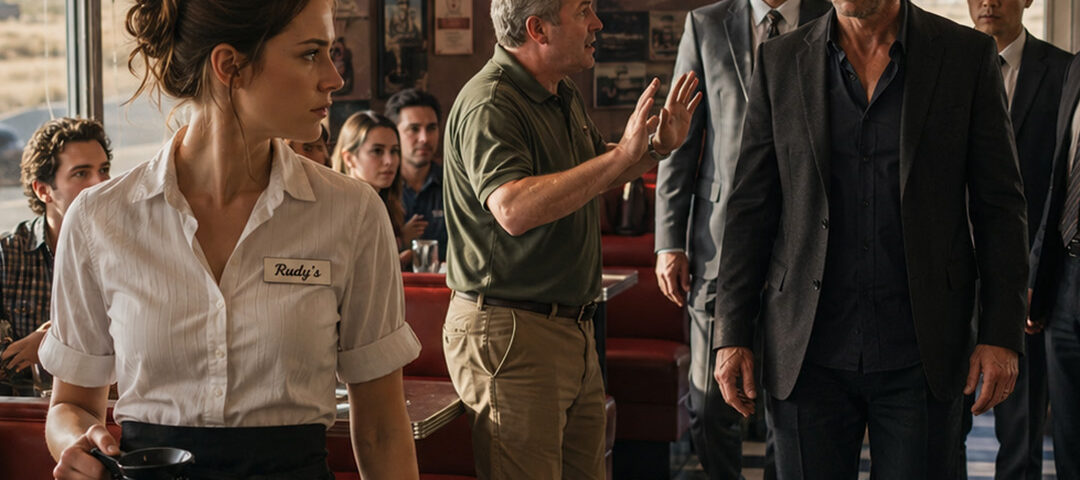
The blood rushed to my ears as Rick’s voice boomed across the diner, silencing every breakfast conversation.
“You know she can’t pay, yet you serve her anyway. Do you want your wages docked?”
His finger jabbed toward my chest, then toward the small yellow-jacketed figure hunched in the corner booth.
Time seemed to stop as 30 pairs of eyes swiveled between us. Construction workers with forks midair. Elderly couples frozen in midbite. Even Martin, the line cook, peering through the service window.
The little girl’s shoulders curled inward, her gaze fixed on the untouched egg sandwich I just delivered. The shame radiating from her tiny frame made my chest physically ache.
In that moment, I knew every single person in that diner saw me for what Rick wanted them to see: a foolish waitress breaking rules for a charity case.
What they couldn’t see was the carefully counted quarters and dimes the girl brought each day, or how she watched the door with frightened eyes as she ate.
My name is Vera. I’m 27 and a waitress working through night school.
This is the story of how I turned a public humiliation into the most unexpected second chance of my life.
For 3 years, I’d arrived at Waverly Diner at 5:00 a.m. to prep for the morning rush. Construction crews, teachers, retirees on fixed incomes.
The pay was barely enough for my studio apartment and student loans, but the morning regulars made it worthwhile. They remembered my birthday, shared classroom stories, split plates to save money, but always tipped generously.
Two weeks earlier, I’d noticed her for the first time: a girl no older than 10 slipping through the door at precisely 7:00 a.m.
Her yellow jacket hung loose on her small frame, backpack clutched protectively against her chest. Without making eye contact, she’d slide into the farthest booth and wait, barely visible above the table.
“Egg sandwich, please,” she’d whisper, voice so soft I had to lean in to hear.
When time came to pay, she’d count out crumpled bills and coins, always coming up short by nearly $2. I covered the difference from my tips and added a glass of milk.
“Growing bones need calcium,” I’d say with a wink.
She never responded, but she ate every bite, eyes constantly darting to the door.
The pattern continued for 2 weeks. 7:00 a.m. Yellow jacket. Quiet order. My discreet help.
She never spoke beyond her order, never smiled, never made eye contact until today, when Rick had decided to make an example of me.
“I asked you a question, Vera,” Rick demanded, his voice cutting through my frozen shock.
Behind him, Dany smirked, already pulling out her phone. I knew my humiliation would be circulating in the staff chat within minutes.
“She’s just a child,” I managed, my voice steadier than I felt. “I can’t let her go to school hungry.”
“Not your problem,” Rick snapped loud enough for the entire diner to hear. “No more freebies, or it comes from your check.”
The little girl abandoned her sandwich, scrambling to gather her backpack. Before I could reach her, she was out the door, a flash of yellow disappearing down the street.
“In my office. Now.”
His cramped back office smelled of cigarettes and cheap cologne. A warning notice lay on his cluttered desk.
“Sign here,” he said without looking up from his invoices. “Consider this your first and only warning about unauthorized discounts.”
“Rick, she’s just a kid trying to—”
“Not our problem.” He cut me off. “Parents should feed their own kids. Sign it.”
I took the pen, my hand trembling slightly. I could explain how the girl counted pennies, how her clothes seemed more worn each day, how she always arrived alone.
Instead, I simply signed.
“Don’t make me regret keeping you on,” Rick added as I turned to leave. “Plenty of people would take your job tomorrow.”
That night, I lay awake in my studio apartment, replaying the day’s events. I couldn’t afford to lose this job. Rent was due. Student loans weren’t going anywhere, and waitressing positions that accommodated night classes were hard to find.
But the thought of turning the girl away made me physically ill.
Morning arrived with a decision. I would pay for the girl’s breakfast myself in full, keeping the transaction completely separate from the diner’s books.
Rick couldn’t object to my serving a legitimate paying customer.
But 7:00 a.m. came and went with no sign of the yellow jacket. By 7:30, I found myself checking the door every few minutes, worry gnawing at my stomach.
Had Rick’s public humiliation scared her away? Was she sick? Or worse, had something happened to her?
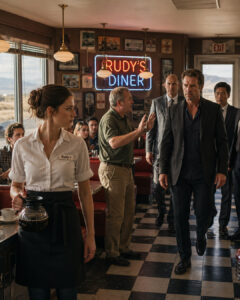
At 8:15, the diner’s atmosphere shifted dramatically. Conversation died mid-sentence as a gleaming black SUV with tinted windows pulled up directly in front of the entrance.
Two men in suits emerged first, scanning the area before opening the rear door.
A tall man in an impeccably tailored black suit stepped out, his presence commanding attention without effort. Two more suited men flanked him as he entered.
The breakfast crowd fell silent. Forks paused midbite.
Rick emerged from the back office, eyes widening. He hurried forward, smoothing his rumpled shirt.
“Good morning, sir. Welcome to Waverly Diner. How can we help you?”
His voice had transformed into something obsequious I’d never heard before.
The man’s sharp, intelligent eyes swept across the diner, ignoring Rick completely.
“I’m looking for the person who’s been helping my daughter,” he stated, his deep voice controlled but revealing nothing about his intentions.
I froze by the coffee station, pitcher in hand.
The four bodyguards positioned themselves strategically around the diner, their posture professional but unmistakably vigilant.
Rick’s smile faltered.
“I’m not sure I understand.”
“My daughter,” the man repeated calmly. “10 years old, yellow jacket. She’s been coming here for breakfast.”
I set down the coffee pitcher and stepped forward, my heart hammering against my ribs.
“That’s me,” I said quietly. “I’ve been serving her.”
The man turned, studying my face for a long moment. His expression shifted from scrutiny to something softer, more vulnerable.
“She hasn’t eaten breakfast outside our home since her mother died,” he said. “You’re the first person she’s spoken a complete sentence to in 3 years.”
The diner remained absolutely silent. Even the kitchen sounds had ceased.
“I didn’t know,” I whispered.
The man approached, extending his hand.
“Nathan Fraser.”
Several gasps rippled through the diner. Even I recognized the name. Nathan Fraser, tech investor and philanthropist whose face occasionally graced business magazines.
“My daughter is Emily,” he continued. “After her mother’s accident, she developed selective mutism. Therapists, specialists, medications. Nothing helped.”
“Then yesterday, she handed her tutor a note about a kind waitress.”
He reached into his jacket and produced a folded paper. I recognized it immediately as the note I’d found under the milk glass the day before.
In large, uneven handwriting: You’re the only one who talks to me without being scared. I like the milk every morning. Thank you, E.
“This is the first time she’s reached out to anyone,” Nathan said, his composure cracking slightly. “I had to find out who you were.”
Rick stepped forward, his demeanor completely transformed.
“Mr. Fraser, I can assure you our establishment always welcomes your daughter. In fact, I personally instructed Miss Sullivan to take special care of her.”
Nathan’s gaze hardened as he turned to Rick.
“Really? Because my security team reviewed your establishment before I entered. They overheard quite a different story from your staff.”
Rick paled visibly.
Behind him, Dany had stopped filming and was slowly backing toward the kitchen.
“Where is Emily today?” I asked, concern overriding my awe.
“At home with a cold,” Nathan answered. “She was upset about missing her breakfast here.”
He turned back to Rick, his tone measured but firm.
“I don’t need your apologies. What I need are people like her.”
He nodded toward me.
“In my organization.”
From his pocket, he removed a business card, handing it to me.
“Miss Sullivan, if you’re interested in opening your own restaurant, I’d like to fully finance it.”
I stared at the card, my vision blurring with tears.
“I don’t understand.”
“You showed kindness to my daughter when she was invisible to everyone else,” Nathan said simply. “I’d like to return that kindness.”
The diner’s entrance chimed. A small figure in a yellow jacket slipped inside, followed by an older woman, who must have been her caretaker.
Emily, no longer anonymous, no longer just the girl, approached me slowly.
For the first time, she looked directly into my eyes.
“Will you still have egg sandwiches?” she asked in a small but clear voice.
I knelt to meet her gaze, tears flowing freely now.
“Every single day if you want them.”
Emily smiled. A tiny, fragile thing, but unmistakably real.
One month later, E and V Mornings opened its doors six blocks from Waverly Diner.
The cozy cafe, its name a combination of Emily and Vera, featured warm lighting, comfortable seating, and a special corner designated for school children.
A small sign on the wall read, “No child turned away. All students welcome.”
I had insisted on keeping prices affordable. The restaurant’s business model included a suspended meal program where customers could prepay for food that would go to someone who couldn’t afford it.
Emily came every morning before school, her yellow jacket now accompanied by a small apron embroidered with the cafe’s logo.
She didn’t speak much, but she helped arrange napkins and wrote the daily specials in her improving handwriting.
Sometimes Nathan joined them, sitting quietly with his laptop while Emily worked alongside me. Other times, he sent the car to pick Emily up afterward, always with a generous tip and a note of thanks.
Rick had sent me a lengthy email apologizing and offering my old job back with a substantial raise.
I didn’t respond.
Several former Waverly Diner regulars now frequented E and V Mornings instead.
Martin, the elderly line cook, had joined my team, bringing his secret hash brown recipe with him.
When local news caught wind of the story, reporters requested interviews. I declined most, but agreed to one brief statement.
“I didn’t do anything extraordinary. I just refused to ignore a child who needed to be seen.”
The reporter pressed for more details about Nathan Fraser’s involvement and the financial arrangement behind the cafe.
I smiled.
“This isn’t about money. It’s about creating a space where kindness is the default, not the exception.”
On quiet afternoons, I sometimes caught Emily watching me with a thoughtful expression.
She was slowly emerging from her shell, not in dramatic bursts, but in small, significant moments.
She now greeted regular customers with nods, occasionally whispered comments to me about the pastry display, and had started keeping a journal of her own.
One morning, Emily arrived with a carefully wrapped package. Inside was a framed photograph of herself, smiling tentatively, holding an egg sandwich.
Beneath it, in her distinctive handwriting: Thank you for the milk when I was thirsty and the kindness when I was hungry.
I hung it behind the counter, a quiet reminder that sometimes the most important acts of kindness are the ones no one else notices.
Last week, I spotted Rick through the cafe window, standing across the street, watching our busy morning service.
Our eyes met briefly before he turned away.
I felt no satisfaction in his discomfort, only gratitude that his public humiliation had led to this unexpected second chance.
Emily tugged at my apron, then pointed to a new customer who had just walked in. A young boy, maybe 12, with worn shoes and careful eyes.
Without a word, she grabbed an egg sandwich and glass of milk from the counter and brought it to his table herself.
As I watched her small act of kindness, I realized something profound.
When we’re publicly shamed for our compassion, we have two choices: retreat into self-protection or double down on kindness.
Emily had taught me to choose the second path, and in doing so, had helped me find not just a new career but a purpose.
The boy looked up at Emily with surprise as she sat down his breakfast.
She didn’t say a word, just gave him a tiny nod of understanding before returning to my side.
Sometimes the quietest voices teach us the loudest lessons about courage, about resilience, and about the unexpected ways justice eventually finds its way back to us all.