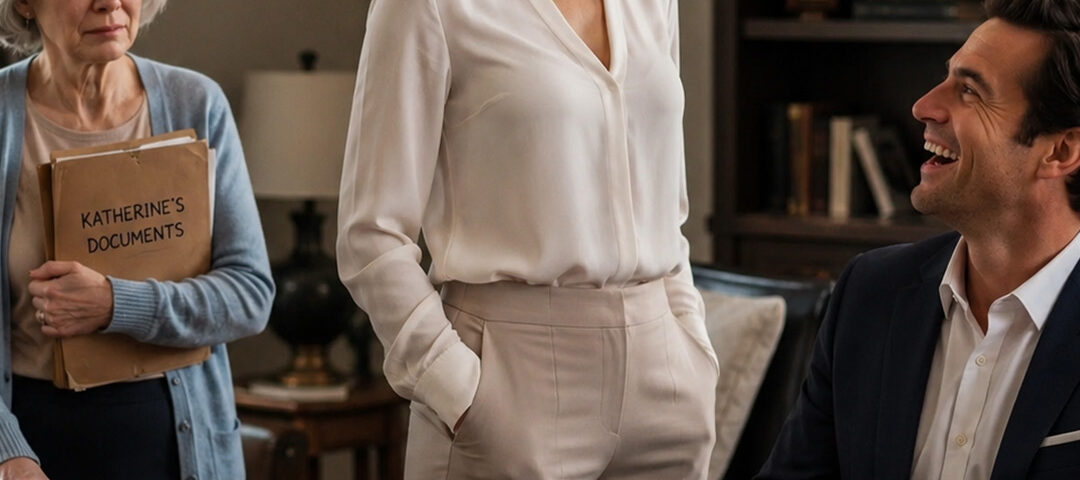
The morning my husband rushed out the door at 6:00 a.m., I already knew he wasn’t going to the office.
I had known for three weeks, but I stood at the kitchen window anyway, coffee in hand, watching his car disappear down the street, and I let him think I believed every word he said.
“Emergency board meeting,” he told me, already straightening his tie in the hallway mirror. “Don’t wait up.”
I didn’t say anything. I just nodded and took a sip of my coffee.
His sister Margaret was sitting at the kitchen table behind me. She watched me watch him leave.
She didn’t say anything either, but when I finally turned around, she gave me a look that said everything.
Neither of us was willing to speak out loud yet.
Margaret was 44. She had multiple sclerosis, diagnosed three years ago, progressing slowly but surely.
She used a cane now. Some mornings were harder than others.
My husband, her brother Daniel, had made it very clear after her diagnosis that he did not want the burden of her care to fall on our household.
He’d actually used that word, burden, at the dinner table in front of her.
I had been the one who invited her to stay with us.
And Daniel had looked at me with that tight smile he used when he disagreed with me but didn’t want to argue in public. And he said, “Of course, whatever you think is best, Clare.”
That was 14 months ago.
In those 14 months, I had learned three things.
First, Margaret was one of the kindest people I had ever met in my life.
Second, my husband was having an affair with a woman named Brooke, who worked as an account manager at his firm.
And third, and this was the one that changed everything, Margaret knew exactly what her brother had been hiding in that company for the past two years.
She hadn’t told me yet, not directly, but I had pieced it together from small things.
A phone call she’d taken in the hallway, her voice dropping when I walked past.
A folder she’d closed too quickly when I came into the living room.
The way she looked at me sometimes was something that felt like guilt and like waiting.
I was 31 years old.
I had spent five years building a life I was proud of.
I had a daughter, Jaime, who was seven and obsessed with marine biology and had recently informed me that dolphins sleep with one eye open.
I had a career I’d worked hard for. I was a senior financial analyst at a healthcare consulting firm.
I had a home I’d poured myself into, a marriage I had genuinely believed in.
And then I found the emails.
I hadn’t been snooping. I want to be clear about that because it matters to me.
I was looking for a restaurant receipt for our shared expense account when I opened the wrong folder on our home computer.
The emails were right there, 47 of them going back eight months between Daniel and Brooke.
I read enough of them to understand what they were. Then I closed the laptop, went upstairs, sat on the edge of our bed, and stared at the wall for a very long time.
Jaime was at school. Margaret was at her weekly physical therapy appointment. The house was completely quiet.
I sat there for two hours.
When I finally stood up, something had settled inside me.
Not anger, or not only anger. Something colder and more deliberate than that.
I thought about what I had, what I didn’t have, what I could prove, and what I needed.
I thought about Jaime and what the next 10 years of her life should look like.
I thought about Margaret and her cane, and the way Daniel had said the word burden without flinching.
And I made a decision.
I would not confront Daniel.
Not yet.
I would not cry or accuse or demand.
I would be patient. I would be smart. And when the moment came, I would ask for only one thing.
The moment came six weeks later.
It was a Sunday afternoon. Jaime was at her best friend’s birthday party.
Margaret was napping.
Daniel came downstairs in a good mood.
Suspiciously good.
The kind of mood he had when something had gone well for him that I wasn’t supposed to know about.
And he poured himself a glass of sparkling water, leaned against the kitchen counter, and said very casually, “I think we should talk about us.”
I sat down at the kitchen table.
“Okay,” I said.
He talked for almost 20 minutes.
He was very careful with his words.
He said things like, “We’ve grown apart,” and, “I think we both know this hasn’t been working,” and, “I want us both to be happy.”
He did not mention Brooke.
He did not mention the 47 emails.
He presented the end of our marriage as a mutual, organic, and entirely reasonable conclusion that two mature adults had simply arrived at together.
I let him finish.
Then I said, “I think you’re right.”
He blinked.
He had clearly expected more resistance.
“I’m not going to fight you on this,” I said. “I don’t want a long, ugly process. I don’t want lawyers screaming at each other for months. I’m willing to keep this simple.”
I folded my hands on the table.
“I have one condition.”
He leaned forward slightly.
“What’s that?”
“I want to take Margaret with me.”
The silence that followed lasted about four seconds.
Then Daniel laughed.
Not cruelly, more like a reflex, like something had genuinely surprised him.
“Clare…”
“I mean it. I’ll waive my claim to the equity in the house. I won’t ask for half your business assets. I want reasonable child support for Jaime, and I want Margaret to come live with me. That’s it.”
He stared at me for a long moment.
I watched the calculations happening behind his eyes.
The house was worth a lot.
His business assets were worth considerably more.
Margaret’s ongoing care cost. The medications, the specialist appointments, the adjustments she’d need as her condition progressed.
Those numbers had already made him flinch more than once at the dinner table.
“You understand her care isn’t cheap?” he said slowly.
“I understand that completely.”
Another pause.
“And you’re sure that’s all you want?”
“That’s all I want.”
He agreed so quickly it almost took my breath away.
He shook my hand.
Actually shook my hand like we’d closed a business deal.
And within four days, we had signed a separation agreement.
And he had transferred $8,000 into my account as a goodwill settlement.
And he was smiling when he did it.
Genuinely smiling.
I remember thinking, “Enjoy it while it lasts.”
Margaret and I moved into a two-bedroom apartment across town.
It was smaller than the house, quieter, full of afternoon light.
Jaime decorated her room with ocean animals she’d cut from magazines and taped carefully to the walls.
Margaret set up her things in the second bedroom, and on her first morning, she came into the kitchen and made us all French toast.
And we sat together at the small table by the window, and nobody said very much, but it felt for the first time in a long time like breathing normally.
Three days later, Margaret asked me to sit down with her after Jaime went to bed.
She had a folder in her lap.
“I’ve been trying to figure out when to tell you this,” she said.
Her hands were very still.
“I should have said something sooner. I want you to know I’m sorry I didn’t.”
I sat across from her.
“Tell me now,” I said.
She opened the folder.
What was inside took me almost an hour to fully process.
For two years, Daniel had been systematically misrepresenting the financial performance of Harrove Consulting, the firm he’d co-founded with a partner named Russell Harrove, to their outside investors.
He had been inflating revenue figures, concealing liabilities, and redirecting funds through a secondary account that Russell knew nothing about.
The money wasn’t disappearing exactly.
It was being used, but not for the business.
Renovations on a property Daniel owned under a different LLC, a car, travel, and I realized as I read, gifts.
Expensive ones.
The kind you give someone you’re trying to impress.
Margaret had discovered it by accident 18 months ago when Daniel had asked her, during a visit before her condition had progressed, to help him organize some files.
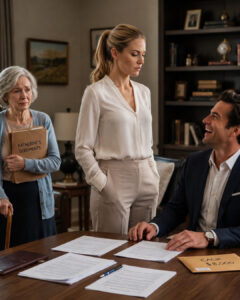
She was sharp and she was thorough, and she understood financial documents, having spent 20 years as a hospital administrator before her diagnosis.
She had seen immediately what she was looking at.
She had confronted him privately.
He had told her she was misreading it.
When she pushed back, he had told her that if she made any of it public, he would make sure she lost access to the health insurance she was dependent on through his plan.
The plan I had been managing for her since she moved in with us.
The plan he’d threatened to remove her from twice already in passing, always framed as just thinking practically about costs.
He had threatened his sick sister into silence.
I sat with that for a long moment.
“You’re not misreading it,” I said finally.
“No,” Margaret said. “I’m not.”
“How much?”
She told me the number.
I nodded slowly.
“And Russell has no idea.”
“None. He thinks the firm is struggling due to market conditions. Daniel has been feeding him a story for two years.”
I looked at the folder in my lap.
Then I looked at Margaret.
“Why are you telling me now?”
“You’re not on his health plan anymore. He can’t threaten you.”
She met my eyes.
“Because you deserve to know before you signed anything. And I was too afraid to tell you before.”
She paused.
“And because what he did to you, what he’s been doing, wasn’t right. None of it was right.”
I reached across and covered her hand with mine.
“Okay,” I said. “Here’s what we’re going to do.”
I want to be clear about something.
I did not go looking for revenge.
That’s not who I am, and it’s not what this was.
What I did was go looking for a lawyer.
Her name was Patricia Oay, and she had been recommended to me by a colleague at work who described her as the kind of person you want in your corner and terrifying to be across from.
I met with her the following Tuesday.
I brought Margaret and the folder.
Patricia read through everything twice, asked us both a series of very precise questions, and then leaned back in her chair and said, “This is securities fraud. This is also breach of fiduciary duty to the partner. And depending on how these investor agreements were structured, potentially wire fraud.”
She looked at me.
“Did you sign a non-disclosure agreement as part of your separation?”
“No.”
“Good.”
She looked at Margaret.
“Are you willing to provide a formal statement?”
Margaret straightened in her chair.
“Yes,” she said. “I am.”
Patricia filed a complaint with the relevant regulatory bodies on a Thursday.
By the following Monday, Russell Hargrove had been contacted.
By Wednesday, his own attorney had launched a parallel civil action.
Within three weeks, Hargrove Consulting’s accounts had been frozen pending investigation, and Daniel had received formal notice that he was the subject of a financial fraud inquiry.
I heard about it from Jaime.
Actually, she’d overheard Daniel on the phone when she was at his place for her weekend visit, and she came home and told me very seriously that Daddy was yelling and his face was really red.
I told her that sometimes adults had stressful situations at work.
She accepted this and went back to her book about sea turtles.
I will not pretend the next several months were easy.
They weren’t.
The investigation dragged on.
There were calls from Daniel’s personal lawyer, initially aggressive and then progressively less so.
There were weeks when I was tired in a way that went bone-deep, and I would sit at the kitchen table after Jaime and Margaret were asleep and just stare at nothing for a while.
But the truth has its own momentum.
Once it starts moving, it doesn’t need you to push it.
Daniel’s relationship with Brooke did not survive the financial collapse of his professional life.
I heard about this secondhand through a mutual friend, who told me with badly concealed excitement that Brooke had quietly removed herself from the situation approximately six weeks after the investigation became public.
Daniel, stripped of the image he’d built so carefully, had apparently not been what she’d signed up for.
I won’t pretend I felt nothing when I heard that, but what I felt wasn’t satisfaction exactly.
It was something quieter.
The recognition that certain things correct themselves, given enough time.
What I felt much more clearly was relief.
Not about Daniel’s life falling apart, but about mine finally not feeling like it was.
Because here is what my life looked like.
Eight months after the separation, I had a job I was good at and a daughter who told me things.
I had an apartment with afternoon light that came through the kitchen window at exactly the right angle in the late afternoon.
I had Margaret, who made French toast on Sunday mornings, and who was teaching Jaime to play rummy, and who had, in ways I was still discovering, become one of the most important people in my life.
Jaime had struggled at first.
I won’t minimize that.
She was seven, and her world had rearranged itself, and she didn’t have the language for what she was feeling.
She was quieter than usual for a while.
She asked me once in the car on the way to school why our family looked different now.
I told her that families come in a lot of different shapes, and that ours was still whole, just arranged differently.
She thought about this.
Then she said that her teacher had told her that starfish can grow back their arms if they lose them.
“That’s true,” I said.
“So we’re okay,” she said.
“We’re okay,” I said.
She went back to looking out the window.
I drove the rest of the way to school with my hands very steady on the wheel and my eyes very carefully on the road.
The civil case was settled 14 months after the investigation began.
I won’t go into the specific numbers, not because I’m protecting Daniel, but because the numbers aren’t really the point.
What I will say is that Patricia was very good at her job, and that the settlement reflected what had actually been taken, and that Jaime’s college fund is no longer something I lie awake worrying about.
Daniel did not go to prison.
The investigation concluded that the fraud, while deliberate, had not risen to the level required for criminal prosecution, a conclusion that frustrated Russell Hargrove’s attorneys considerably.
Daniel paid significant financial penalties, was barred from serving as an officer of any publicly reporting company for seven years, and lost his co-founder stake in Hargrove Consulting, which Russell subsequently rebuilt under new management.
Margaret told me when it was all over that she felt lighter.
I understood exactly what she meant.
Her MS has continued to progress, as it will.
There are harder mornings and easier ones.
She has a new specialist now, one I found after three weeks of research, who is running her on a treatment protocol that has meaningfully slowed the progression.
She has good days. She has bad days.
On both kinds, she is still herself.
Sharp, funny, quietly generous in ways she doesn’t draw attention to.
On a Sunday morning about a year after we moved into the apartment, she and Jaime were playing rummy at the kitchen table while I made coffee.
And Jaime accused Margaret of cheating.
And Margaret said, “I would never,” with such theatrical innocence that Jaime dissolved into laughter.
And I stood at the counter with my back to them both and just listened to the sound of it and thought, “This. This is what I chose. This is what I got.”
Jaime is nine now.
She wants to be a marine biologist, specifically one who works with beluga whales, a preference she developed after watching a documentary and explaining to me at length that belugas are actually very social and communicative and probably have opinions about things.
“Mom,” I told her, “I had no doubt they did.”
She sees her father every other weekend and during school holidays.
It is not a perfect arrangement, and some visits go better than others, but she is loved, and she knows it, and she is becoming visibly and reliably exactly who she’s going to be.
I watch her sometimes the way you watch something important and irreplaceable, with the particular kind of attention that comes from knowing how easily things can be different.
Last spring, she came home from a weekend at Daniel’s and sat down at the kitchen table very quietly.
I knew from the quiet that something had happened.
“You okay?” I asked.
She nodded.
Then she said, “Dad told me that you were the one who got him in trouble with the company stuff.”
I sat down across from her.
I thought carefully about what I wanted to say.
“Your dad made some choices that caused some problems,” I said, “and there were consequences for those choices. That’s how it works.”
She considered this.
She had her grandmother’s, Daniel’s mother’s, eyes, dark and precise.
“Were you mad at him?”
“For a while,” I said honestly.
“Are you still?”
I thought about it.
“No,” I said. “Not really.”
She seemed to accept this.
She was quiet for another moment.
Then she said, “Aunt Margaret said you fought for her when nobody else did.”
I looked at my daughter.
“Aunt Margaret’s important to me.”
“She’s important to me, too,” Jaime said.
Then she got up, grabbed an apple from the bowl on the counter, and went to find Margaret for their rummy rematch with the confidence of someone who had already decided how she felt about things and didn’t need to discuss it further.
I stayed at the table for a while after she left.
The afternoon light was coming through the kitchen window at that particular angle.
The apartment was full of the sounds of Margaret laughing at something Jaime had said.
I hadn’t asked for the house.
I hadn’t asked for the money or the business assets or any of the things that were supposed to matter.
I had asked for a woman with a cane and a folder of documents she’d been too frightened to show anyone.
And I had gotten in return more than I had known how to want.
Daniel had been so relieved when I walked out the door.
I still think about the look on his face when I told him what I wanted, the way the tension left his body, the way he’d shaken my hand.
He thought he was getting away clean.
He didn’t understand that the thing he’d handed me with both hands, grateful, smiling, was the only thing that could have undone him.
And I want to be honest, I didn’t fully understand it either.
Not at first.
I just knew that Margaret mattered, and that she was alone, and that no one had stood up for her when her own brother looked her in the eye and said the word burden without flinching.
I stood up for her, and she, in turn, handed me the truth.
And the truth, as it turned out, was