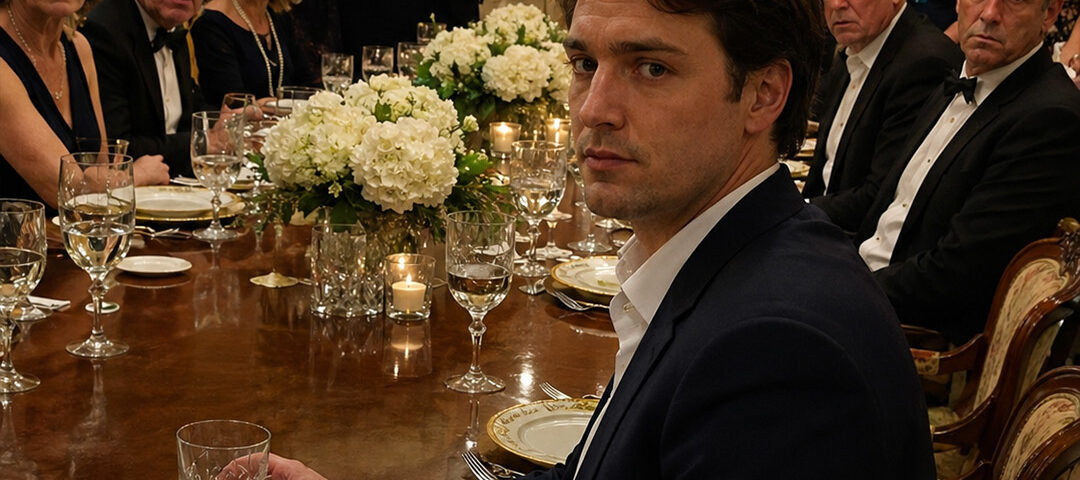
My family told everyone I was a failure.
I sat quietly at my brother’s engagement dinner, letting them pity me. Then his fiancée looked at me and whispered, “Wait. You’re…?” The room froze. Even my mother couldn’t speak.
I am Elias Thorne. I am 32 years old.
5 years ago, my parents threw me out of my childhood home with nothing but a single suitcase and a head full of ideas they called absolute garbage. While I was sitting at my older brother’s lavish engagement dinner, letting my parents and extended family treat me like a total charity case, my mother actually looked across the table and told the guests that I was still finding my way on a meager entry-level salary.
They laughed at me right in front of 50 of Boston’s most elite doctors, corporate lawyers, and real estate developers. But there was one massive thing they did not know. The mysterious founder of the $300 million healthcare technology empire they were all obsessing over was sitting right in front of them. And in a matter of seconds, they were going to realize I held the absolute power to buy out their entire family legacy in cash.
The formal dining room inside my parents’ Beacon Hill estate smelled like roasted duck, expensive vintage red wine, and pure suffocating arrogance. I sat at the absolute far end of the long mahogany table.
I was wearing a simple off-the-rack navy suit I bought years ago from a discount department store. I had intentionally left my custom-tailored Italian suits hanging in the closet of my penthouse back in San Francisco. I wanted to give my family exactly what they expected to see: The prodigal son, the family failure, the ultimate cautionary tale of what happens when you do not follow the Thorn family rule book.
My older brother, Julian, sat at the center of attention, soaking up the admiration of the room like a sponge. Julian was the golden child, the Harvard graduate, the Wall Street investment banker, the man who did every single thing perfectly according to my parents’ master plan. Beside him sat his fiance, Clara. I actually liked Clara from the moment we were introduced earlier in the evening. She was brilliant, down-to-earth, and completely unaware of the toxic swamp of narcissism she was marrying into.
Uncle Philip leaned across the table, swirling his expensive wine glass with a patronizing smirk on his face. He looked at me with that signature Thorn family pity that I had endured my entire life. He loudly asked if I was still struggling out in California, scraping by on whatever entry-level IT salary I could manage to find. He made sure his voice carried over the classical music playing softly in the background so that the surrounding guests could hear.
Aunt Vivien immediately chimed in, adjusting her diamond necklace. She said she heard the real estate market in San Francisco was absolutely brutal right now. She asked if I needed help finding a modest rental apartment in a safer neighborhood. She even offered to have her personal lawyer draft up a co-signer agreement for me, saying that family must always take care of their weakest links.
I took a slow, deliberate sip of my ice water. I told them I was doing just fine. I kept my answers incredibly brief. I told them I worked in healthcare tech handling some back-end data systems.
My mother, Margaret, a renowned pediatric surgeon with an ego the size of Massachusetts, sighed loudly enough for the entire table to register her disappointment. She told everyone that entry-level tech jobs were noble enough. But perhaps Julian could get me an interview at his investment firm if I was finally ready to get serious about my life and stop playing games with computers.
I smiled politely. I let them talk. I let them build their towering monument of condescension brick by brick.
Then the conversation naturally shifted back to Clara. One of the guests asked her about her new career. Clara’s eyes instantly lit up with genuine passion. She worked in healthcare software implementation and she was incredibly devoted to improving patient care. She started talking about a revolutionary new platform her hospital network had just integrated. She explained how it acted as a universal translator for raw medical data, bridging the gap between entirely different hospital networks, saving thousands of lives and cutting down massive amounts of bureaucratic waste.
She proudly called the software Omnisync.
My heart did a slow, heavy beat against my ribs. Omnisync, that was my software, the company I built from nothing.
Clara went on, her voice filled with intense admiration. She told the wealthy table that the company behind the software was a unicorn startup recently valued at over $300 million. She said the founder was a total mystery in the industry, an absolute genius who stayed entirely out of the spotlight, refusing to do press interviews, known to the business world only by his initials, ET. She said the entire healthcare sector was trying to figure out who ET was because the digital architecture he built was completely flawless.
Aunt Vivien waved her manicured hand dismissively. She stated that tech founders were just glorified gamblers playing with venture capital money and that they rarely had any real substance. My father, Richard, a senior partner at a massive corporate law firm, scoffed and immediately agreed with her. He loudly proclaimed that real power came from tangible legacy, from commercial real estate, and from decades of building a solid, reputable family name in high society.
I looked directly at Clara. She was in the middle of explaining a highly specific back-end module of Omnisync to a confused relative. It was a piece of encryption code I wrote at 3 in the morning on a stained mattress in a freezing Oakland apartment 5 years ago.
I casually leaned forward and corrected a tiny, highly guarded technical detail she got wrong about the encryption layer’s data routing.
Clara stopped talking mid-sentence. She blinked rapidly. She looked at me. She really looked at me. I could see the gears turning behind her eyes. She replayed the entire conversation in her head. My name: Elias Thorne. My initials: ET. The way I just casually dropped a piece of proprietary knowledge that only the lead developers and the elusive founder at her company would possibly know.
The color completely drained from her face. Her silver fork clattered against her expensive china plate. The sharp sound echoed like a gunshot in the suddenly quiet dining room. She leaned forward, her voice dropping to a harsh, disbelieving whisper that somehow carried across the silence. “Wait, you are ET? You are the founder of Integrated Health Solutions?”
The entire room froze in absolute shock. Every single pair of eyes locked on to me. My mother’s wine glass stopped halfway to her mouth, her hand trembling slightly. My father stiffened in his custom chair, his face turning a pale shade of gray. Julian’s arrogant smile vanished instantly.
I wiped my mouth with a linen napkin, placed it neatly on the table beside my plate, and looked directly into my mother’s terrified eyes. I always thought the years of being treated like a ghost in my own family would make this eventual moment feel heavy or vindictive. I was incredibly wrong. It felt absolutely magnificent.
To truly understand the absolute suffocating silence in that dining room, you have to understand the daily nightmare of growing up as a Thorn. In Beacon Hill, you are not considered a child. You are considered a corporate asset. You are a line item on a family balance sheet, judged entirely by your future earning potential and your ability to make your parents look good at their weekly country club dinners. My parents did not raise sons. They raised trophies to display to their wealthy friends, and Julian was their absolute masterpiece.
Julian followed every single rule they ever laid out. He brought home straight As, the captain of the debate team. He dated the daughters of other wealthy lawyers. When Julian graduated from Harvard, my father did not just shake his hand and tell him he was proud. He bought him a brand new custom-ordered Porsche. I remember standing in the shadows of our front porch, watching Julian rev the engine in our cobblestone driveway while my parents beamed with a level of pride I had never experienced. That car was not a graduation gift. It was a crown placed upon the head of the golden child.
I was fundamentally different. I was the square peg they kept frantically trying to smash into a round hole. I did not care about prestige, designer clothes, or networking with the children of politicians. I cared about how systems worked.
While Julian was memorizing Latin phrases for his Ivy League applications and attending homeowners association meetings with my father to learn the ropes of neighborhood politics, I was taking apart our home computers, studying circuit boards, and writing rudimentary code in the middle of the night. My mother viewed my curiosity as a behavioral flaw that needed to be eradicated.
During our mandatory Sunday family dinners, the comparisons were ruthless and public. My father would update the entire extended family on Julian’s soaring college fund and his flawless trajectory toward a Wall Street partnership. Then he would slowly turn his cold gaze to me. He would ask why I could not just fall in line and be normal. He constantly reminded me that my college fund and my potential inheritance always felt like a risky, foolish investment to him.
The only person in the entire world who ever understood me was my uncle Silas. Silas was my father’s younger brother. He was a struggling painter. In the Thorn family, choosing a career in the arts was treated like a criminal offense. They treated Silas like a disease they were actively trying to cure, constantly berating him for not contributing to the family legacy.
But Silas’s messy, disorganized art studio was my only sanctuary. I would sit on his paint-splattered floor for hours typing code on a bulky secondhand laptop while he painted on giant canvases. Silas told me something I never forgot. He said, “The world is completely built by people who refused to read the instruction manual.” He told me that my different way of thinking was a superpower, not a sickness.
I desperately tried to play their twisted game for a little while. I applied myself, crammed for tests, and managed to get accepted into MIT. It was a rigorous engineering track, a prestigious, globally recognized name that finally made my parents stop lecturing me at the dinner table. For three miserable semesters, I was the son they could finally tolerate showing off to their friends.
But I was slowly dying inside. The academic curriculum was rigid. It was heavily outdated, focusing on theories from 20 years ago. I saw the absolute future of massive data systems and I knew with certainty it was not being taught in those sterile lecture halls.
Then I got an offer from a small tech startup out west in California. It was not a glamorous position. The salary was practically minimum wage, barely enough to cover rent in a shared apartment. But the work was real. It was revolutionary. They were trying to disrupt the medical data field. I spent a week agonizing over the choice, losing sleep, staring at the ceiling of my dorm room. Finally, I made the only decision I could live with. I formally dropped out of MIT.
The night I drove back to Beacon Hill to tell my parents, the house felt like a powder keg waiting for a match. We were standing in my father’s massive home office. The dark wood walls were lined with expensive leatherbound legal books he probably never read. I stood directly in front of his massive mahogany desk, took a deep breath, and delivered the news. I told them I was leaving for San Francisco. I told them I was taking the startup job and leaving my degree behind.
My mother actually laughed. It was a cold, sharp, terrifying sound. She crossed the room, looked me up and down, and told me I was having a mental breakdown. She stated that no one in their right mind walks away from an MIT engineering degree to go work in a glorified garage on the West Coast. She said I was embarrassing the family name.
My father stood up from his leather chair. He did not yell. He used his calm, terrifying courtroom voice, the exact voice he used to completely destroy hostile witnesses on the stand. He told me I was an absolute disgrace. He told me that if I walked out that heavy oak door, I was dead to him financially and personally. He stated clearly that he would call his estate lawyer the very next morning at 8:00 and strip my name from the family trust entirely. He threatened to drain the remainder of my college fund and redirect every single penny to Julian’s future children.
I looked at the man who was supposed to be my protector, my guide, and I saw absolutely nothing but a ruthless corporate manager firing a defective employee. I looked him dead in the eye. I told him to keep the money. I told him I did not want a single dime of his conditional, suffocating love.
My mother crossed her arms tightly across her chest. She looked at me with pure unadulterated disgust. She pointed her finger at my chest and told me I would fail miserably. She promised me that I would come crawling back within a year, completely broke, begging for a handout, and she swore they would not give it to me. She told me to enjoy my California fantasy while it lasted.
I walked up to my childhood bedroom. I packed exactly two suitcases with my most basic clothes and my laptop. I had exactly $2,500 sitting in my checking account. I did not knock on Julian’s door to say goodbye. I did not look back at my parents. The only person I called was Uncle Silas. He met me in the driveway, gave me a tight hug, and slipped a $100 bill into my coat pocket.
I got in a yellow cab and rode in silence to Logan Airport. While I waited at the terminal, my phone buzzed. It was a text message from Aunt Vivien. It read, “Your mother is heartbroken. Please seek professional help. We are praying for you.” It was the ultimate passive-aggressive parting shot.
I turned my phone off when the commercial plane finally broke through the dense clouds over the Pacific Ocean and I saw the thick fog rolling over the Golden Gate Bridge. I expected to feel pure terror. I expected to feel the crushing weight of my family’s abandonment. But I did not feel fear. I felt a massive, incredible weight lift off my chest. I had absolutely nothing. I was essentially homeless in one of the most expensive cities on earth. But for the very first time in my entire 27 years of life, I completely owned myself.
San Francisco was not a glittering tech fairy tale. It was a brutal, unforgiving meat grinder that tested every single ounce of my sanity. I managed to rent a tiny, windowless studio apartment in a rough neighborhood on the outskirts of the city. The walls were so paper thin, I could hear my neighbors breathing. I slept on a cheap mattress I bought from a thrift store and lived entirely on instant ramen noodles and discount coffee from the local Walmart. I tracked every single penny on a spreadsheet, knowing that one unexpected medical bill or car repair would send me spiraling into total bankruptcy.
The startup job was grueling. I was a junior developer at the very bottom of the corporate food chain, making a pathetic salary. But I did not care about the money. I soaked up every single piece of knowledge I could get my hands on. I studied server architectures, database management, and network security.
My boss, a brilliant but chaotic guy named Harold, was the complete opposite of my father. Harold did not care about my last name, my lack of an Ivy League degree, or the clothes I wore. He only cared about the code. He looked at my early projects and saw the unique way my brain mapped out complex data structures. Harold threw the company rulebook out the window and gave me harder and harder problems to solve, bypassing the senior engineers.
That is exactly when the massive idea for Omnisync hit me. The entire healthcare industry was a catastrophic mess. Massive hospital networks were using dozens of different outdated software systems that simply could not talk to each other. Critical patient records were getting lost in the digital void. People were suffering, surgeries were being delayed, and medications were being mixed up because vital health data was trapped in isolated silos.
Every tech company was trying to build a massive new system to replace the old ones. I realized they were looking at the problem completely backward. You did not need to force hospitals to buy a new system. You needed to build a universal digital translator, a secure layer of code that could sit seamlessly on top of everything and force the legacy systems to communicate instantly.
I started working on the prototype in total secrecy at night. I would finish my exhausting 10-hour day job at 6:00 in the evening, take the bus back to my freezing apartment, and code until the sun came up. I poured my absolute soul into that algorithm. It was brilliant. It was incredibly clean. It was the key to revolutionizing medical care. And then I made the biggest, most devastating mistake of my entire life. I trusted someone.
There was a senior developer at the company named Derek. Derek was an incredibly charismatic guy, a smooth talker who knew how to navigate office politics. When I first joined, he acted like a protective older brother to me. He bought me beers after work, gave me career advice, and listened for hours while I vented about the toxic environment I left behind in Boston. He made me feel like I finally had a real family in California.
When I finally got the core translation algorithm working perfectly, I was so blinded by excitement that I showed it to Derek. I wanted his professional feedback. I wanted him to see the incredible future I had just built.
Derek sat at my desk and looked at the code for a long time. His face remained completely neutral. He patted me on the back, gave a condescending chuckle, and told me it was a fun little side project, but it was too complex. He said it would never scale in the real world. He advised me to delete it and focus entirely on my daily tasks for Harold.
Two weeks later, I walked into the office on a Tuesday morning and Harold immediately called me into the main glass meeting room. He looked completely devastated, rubbing his temples. He told me Derek had unexpectedly resigned over the weekend. Derek had taken a massive financial buyout to become the chief technology officer of a well-funded rival tech startup run by a ruthless CEO named Marcus.
I felt a cold, paralyzing dread pool in the bottom of my stomach. My instincts screamed at me. I sprinted out of the meeting room and ran back to my desk. I bypassed the standard security protocols and dug directly into the company’s internal server logs. I tracked Derek’s digital footprint from his last night in the office. My heart completely stopped. Derek had copied my entire hidden repository. He stole every single line of my Omnisync code onto an external drive before wiping his tracks.
I did not think. I just reacted. I drove my beat-up car straight to the rival company’s sleek modern office building downtown. I ignored the receptionist, stormed past security, and confronted Derek right in the middle of their glass-walled lobby. I yelled at him. I demanded my life’s work back.
Derek just stood there. He adjusted his expensive designer tie and smiled—a slick, lifeless corporate smile. He told me I was completely delusional. He loudly proclaimed to the gathering crowd that he built that code himself over the past year.
And then Marcus, the billionaire CEO, walked up behind him. Marcus was a notorious shark in Silicon Valley. He looked me dead in the eye and delivered a threat that still chills my blood. He told me that if I ever tried to publicly claim ownership of that software, his elite team of corporate lawyers would bury me in a defamation lawsuit so deep I would never see daylight again. He explicitly pointed out that I was a college dropout with zero assets and they were a heavily funded corporation with millions in legal retainers. He told me to walk out the door before he called the police.
I walked out. I drove back to my tiny apartment. I sat on my mattress in the dark for hours. The heavy silence of the room was crushing. My mother’s cruel voice echoed loudly in my head: You will fail. You will come crawling back. I gripped the edge of my cheap desk until my knuckles turned completely white. The betrayal burned through my veins like battery acid. Derek did not just steal my code. He stole my dignity. He stole my one ticket out of the gutter. He proved my parents right.
I gave myself exactly one night to be furious. One single night to feel sorry for myself and mourn the loss of my innocence.
The next morning, I woke up with a mental clarity so sharp and cold it was terrifying. Derek stole my code, but he made a fatal miscalculation. He did not steal my brain. He had version one. I wrote version one, which meant I knew every single hidden flaw, every bottleneck, and every security vulnerability in that architecture. I knew it was clunky when dealing with massive data loads.
I formally quit my job with Harold that afternoon. I went to the grocery store, bought a month’s worth of canned food, and locked myself inside my apartment for three agonizing months. I did not see the sun. I coded for 18 hours a day. I completely scrapped the old framework and built a brand new architecture from absolute scratch. I built version two. It was infinitely faster. It was secured by military-grade encryption. It made Derek’s stolen code look like a fragile child’s toy.
I checked my bank account. I had exactly $600 left to my name. I used $500 of it to buy a visitor’s pass to the biggest healthcare tech convention in Silicon Valley. I did not have a fancy booth, a marketing team, or a glossy presentation. I just had my laptop, dark circles under my eyes, and a burning, undeniable need for justice.
I scoured the convention schedule and found out Marcus and Derek were pitching their stolen product in a private conference room to a group of top-tier venture capitalists. I slipped past the event staff and walked right into the back of that room. I stood in the shadows and watched Derek sweat under the lights. He was fumbling through a complex technical question from an investor about data encryption routing. He did not know the answer because he did not write the foundational logic. He was a fraud and the room was starting to smell it.
When the disastrous presentation ended and the executives began to mingle, I walked straight up to the most intimidating, powerful investor in the room. Her name was Evelyn Vance. She was an absolute legend, a self-made billionaire who crushed weak pitches for breakfast and destroyed mediocre companies for fun. I did not introduce myself with a handshake. I did not give an elevator pitch. I just opened my laptop, turned the glowing screen to face her, and ran a real-time live simulation of my software, bypassing the exact data bottleneck Derek had just humiliated himself over.
Evelyn stopped drinking her coffee. She stared at the screen. She watched the data flow flawlessly. Then she slowly looked up at me, analyzing my cheap clothes and my exhausted face. She asked me who the hell I was. I looked her in the eyes and told her that my software would render Marcus’ company completely obsolete and bankrupt in less than 6 months.
We left the convention center and sat in a quiet hotel lobby for three straight hours. I walked her through every single line of the new architecture. I showed her the impenetrable security protocols. I showed her the exact future of global healthcare. Evelyn Vance did not hesitate. She did not ask to see my college degree. She did not care about my family name. She pulled out her company checkbook and wrote me a seed funding check for $500,000 right there on the glass coffee table.
I incorporated Integrated Health Solutions the very next morning. As I signed the legal paperwork, I remembered the suffocating arrogance of my family in Boston. I remembered the vile betrayal of Derek. I made a firm, unshakable decision right then and there: I would absolutely not put my face or my full name on the company. I would operate entirely in the shadows. I signed all public-facing documents using only my initials, ET. I was going to build an untouchable empire in total deafening silence.
5 years is an absolute lifetime when you are building a corporate empire from the ground up, fueled purely by the desire to prove your worth to a world that discarded you. Version two of Omnisync did exactly what I promised Evelyn Vance it would do. It completely destroyed Marcus and Derek’s stolen inferior product in the open marketplace. Their company folded under the pressure of our superior technology and eventually filed for bankruptcy.
We aggressively signed our first major hospital system within 6 months of launching. By year three, we had 50 massive hospitals relying entirely on our servers. By year 5, the Wall Street Journal reported that Integrated Health Solutions was officially valued at $300 million. I was a multi-millionaire. I had a massive diversified stock portfolio. I had a robust 401k and liquid assets that would make my father’s arrogant country club friends weep with envy. I bought a sprawling modern penthouse overlooking the San Francisco Bay, paying for the prime real estate entirely in cash.

But despite the immense wealth, I lived incredibly quietly. I drove a reliable, unremarkable domestic SUV. I wore plain, unbranded clothes. I ate at local diners. Only my tight-knit executive team and my board of investors knew that Elias Thorne was the mysterious, highly sought-after ET. The tech media endlessly speculated about my identity, but my legal team kept my privacy locked down tighter than a military vault.
As far as my family back in Boston was concerned, I was absolutely nothing. To them, I was still the miserable college dropout who vanished into the California fog, likely drowning in credit card debt. Then on a rainy Tuesday morning, the envelope arrived. It was delivered directly to my penthouse via certified mail. It was made of thick, expensive, cream-colored card stock with the Thorn family crest aggressively embossed in gold ink on the flap. It was an official invitation to my brother Julian’s engagement dinner.
I stood by the massive floor-to-ceiling windows of my living room, looking out at the gray waters of the bay, holding that heavy piece of paper in my hands. I had not spoken a single word to my parents in five long years. I had not heard my brother’s voice since the day I packed my bags. I knew exactly what this invitation was. It was not an olive branch. It was a trap. It was a formal summons back to the courtroom of their judgment. They wanted me there to play my designated role in their stage play. They needed the family failure present to make Julian look even taller, more successful, and more perfect by standing directly next to my supposed misery.
I picked up my phone and called Uncle Silas. He was the only person from my past I had stayed in contact with, the only family member who knew the absolute truth about my staggering success. Silas answered on the second ring. When I told him about the gold-embossed invitation, he let out a long, hearty laugh. He told me it was time. He said I had spent 5 years building an impenetrable fortress of success, and it was finally time to lower the drawbridge and let them see the towering walls. He told me I owed it to the terrified kid who left Boston to return as the king.
I packed a small, unassuming leather overnight bag. I walked past my closet filled with custom-tailored suits, expensive Italian leather shoes, and luxury watches. I intentionally bypassed all of it. I reached into the back of the closet and packed the clothes of a man who was just barely getting by: A cheap navy suit, a slightly worn dress shirt, and scuffed shoes. I was going to walk directly into the dead center of the eye of the storm. I was going to let them unload 5 years of stored-up arrogance and superiority. I wanted them to put every single one of their chips on the table before I revealed my hand.
When my first class flight landed at Logan Airport in Boston, the crisp freezing autumn air hit my face the moment I stepped outside. The city felt entirely different now. It felt smaller. The towering, intimidating shadows of Beacon Hill did not scare me anymore. They were just old brick buildings filled with old, bitter money. I took a standard yellow cab to my parents’ estate, intentionally avoiding booking a black car service.
I walked up the long cobblestone driveway where Julian used to park his beloved Porsche. The massive brick house looked exactly the same. Immaculate window boxes, polished brass door knockers, intimidating, cold, lifeless. I knocked on the heavy oak door. My mother answered. She looked me up and down, her critical eyes taking in my cheap suit and my lack of a luxury watch. Her eyes flashed with a brief, validating satisfaction. She saw exactly what she desperately wanted to see—the defeated, humbled son returning to the castle. She offered a stiff, loveless hug and quickly ushered me inside, warning me not to track dirt on the Persian rugs.
The house was already full of relatives holding crystal champagne flutes—aunts, uncles, cousins, the wealthy vultures of the Thorn family hierarchy. I walked into the grand living room and the silent, crushing judgments began almost immediately. Whispers behind hands, pitying glances. I found my quiet corner by the fireplace. I sipped my sparkling water. I calmly watched the performance unfold.
Julian was holding court by the piano, loudly talking about his upcoming promotions and his real estate portfolio. My father was boasting to a group of lawyers about his enduring legacy and his unmatched influence in the city. And then the caterers announced it was time, and we all sat down for the grand dinner.
I sat quietly at the end of the table, absorbing the passive-aggressive comments about my salary, ignoring the fake, insulting offers of legal help from Aunt Vivien. I was completely, utterly calm. I was a fully loaded gun resting quietly on a velvet cushion. Then Clara, Julian’s beautiful, innocent fiance, started talking passionately about Omnisync. She started talking about the genius of ET. And that is exactly how we ended up here.
With the entire opulent dining room completely frozen in time, staring at me in absolute horror as the truth detonated over the expensive prime rib, I looked at Clara, ignoring the pale, terrified faces of my parents. I offered her a warm, genuine smile. “Yes, Clara,” I said, my voice completely steady, cutting through the dead silence. “I’m ET, and the encryption module you mentioned… you guys are doing an excellent job with the roll out. I am incredibly proud of your team.”
My mother’s silver fork hit the floor. The storm had officially made landfall and I was the one controlling the lightning.
The absolute silence that followed my quiet confirmation was not just your standard awkward quiet. It was a suffocating, heavy, total vacuum that completely sucked every single ounce of oxygen out of that extravagant Beacon Hill dining room. You could vividly hear the heavy brass pendulum of the antique grandfather clock ticking out in the grand hallway. You could hear the autumn rain tapping aggressively against the expensive leaded glass windows. You could practically hear the collective heartbeat of the Thorn family skyrocketing in sheer panic.
My mother, Margaret, a renowned pediatric surgeon, sat completely frozen in her custom upholstered chair. She stared blindly at her heavy silver fork resting on the intricate Persian rug as if it were an alien artifact that had just dropped from the sky. Her perfect, meticulously crafted social mask, the one she had spent three decades perfecting for Boston High Society, was completely shattered into a million jagged pieces. She opened her mouth to speak, to assert control, to issue a command like she always did, but absolutely no sound came out. Her throat was entirely paralyzed by a reality she simply could not process.
Uncle Phillip, the man who just 10 agonizing minutes ago was aggressively mocking my supposed entry-level salary and my lack of ambition, gripped the polished edge of the mahogany dining table. His knuckles turned stark white. The smug, superior expression on his face melted away, rapidly replaced by a deep, blotchy shade of crimson that spread from his neck all the way up to his receding hairline.
Aunt Vivien looked like she had just been physically struck across the face by an invisible hand. The incredibly patronizing offer she had made earlier, the one where she generously offered to have her personal real estate lawyer draft a humiliating co-signer agreement for a cheap California rental apartment, was now hanging thickly in the air. That offer had instantly transformed from a tool of condescension into a massive, humiliating, radioactive joke. She nervously adjusted her diamond necklace, refusing to make eye contact with anyone at the table.
Clara, however, was absolutely beaming. Her bright eyes were wide with genuine, unadulterated awe. She looked at me, then looked around the frozen table, completely and blissfully oblivious to the decades of toxic family history and psychological warfare she had just single-handedly detonated with a casual conversation. She did not sense the suffocating tension. She only saw the brilliant founder of the company she deeply admired.
She leaned forward excitedly and asked a barrage of rapid-fire questions. She asked how I managed to keep such a massive industry-shaking corporate secret from the aggressive tech media. She asked about the highly anticipated upcoming software patch that her implementation team was prepping for.
I did not brush her off. I answered her calmly, speaking directly to her while deliberately ignoring the terrified faces of my parents. I used highly complex technical jargon. I talked about specific data routing algorithms, server load balancing, and military-grade encryption protocols. I spoke at length about our latest venture capital valuations and our aggressive expansion into European healthcare markets. I did this entirely on purpose. I wanted my family to sit there in their expensive formal wear and listen to me speak a language of absolute power and immense wealth that went entirely over the heads of every single wealthy corporate lawyer and elite doctor sitting at that table. I wanted them to realize exactly how microscopic their local country club influence truly was.
It took my father, Richard, exactly two full, excruciating minutes to completely reboot his brain. Richard Thorne was a ruthless corporate shark. He built his entire lucrative legal career on pivoting aggressively during high-stakes multi-million dollar litigation. I watched the absolute unfiltered panic in his eyes slowly recede, immediately replaced by a cold, calculating, terrifying opportunism. He was actively running the numbers in his head. He realized in real time that his discarded, disgraced, highly disappointing son was currently sitting on an uncontested $300 million tech empire.
He cleared his throat. It was a loud, deliberate sound designed to demand attention. He picked up his crystal wine glass, took a slow, measured sip of his vintage red wine, and forced a stiff, highly unnatural smile onto his face. He looked around the long table, attempting to violently reclaim the narrative of the evening. He confidently announced to the breathless guests that the Thorn family always produced exceptional, highly driven men. He actually had the sheer mind-boggling audacity to look me directly in the eye and state that his harsh, unforgiving discipline 5 years ago was exactly the catalyst I desperately needed to build my character. He told the stunned crowd of relatives and family friends that sometimes a loving father has to push his son out of the comfortable nest so he can finally learn how to fly in the real world.
I did not blink. I did not raise my voice in protest. I did not storm out of the room. I just stared at him. The sheer unadulterated level of his narcissistic delusion was genuinely fascinating to witness. He was actively trying to rewrite history to take direct credit for the success he explicitly tried to destroy.
He continued his masterful performance. He leaned forward, resting his tailored elbows on the table, switching seamlessly into his aggressive, high-powered networking mode. He began interrogating me like a hostile witness, but wrapping it in fake fatherly interest. He asked about the exact composition of my corporate board of directors. He asked about my commercial real estate holdings in the San Francisco Bay area. He wanted to know the exact square footage of my corporate headquarters and the specifics of my employee stock option pools.
I gave him short, precise, emotionally detached answers. “Yes, we occupy a massive state-of-the-art glass tower downtown. Yes, the company is highly profitable with zero outstanding corporate debt. Yes, I retain full controlling majority voting rights.”
Then Richard set his ultimate trap. He simply could not stand the fact that I had built something massive, global, and wildly successful without his direct influence or his permission. His ego demanded that he assert dominance. He needed to prove to the entire room that despite my massive bank account, I still desperately required his powerful Boston connections to truly succeed.
He gave a loud, arrogant, booming chuckle. He told me that $300 million was a cute, respectable valuation for a West Coast tech startup, but real, enduring, multigenerational wealth required legacy connections and deep societal roots. He steepled his fingers, leaned back in his chair, and looked at me with an expression of supreme unshakable authority. He proudly stated that he regularly played golf every single Sunday at his exclusive country club with Dr. Sterling Aerys.
Dr. Aerys was the highly respected chief executive officer of the largest, most prestigious, heavily funded hospital network in the entire New England region. My father puffed out his chest, the buttons of his tailored vest straining slightly. He generously offered to make a highly private off-the-record phone call. He offered to call Dr. Aerys personally the very next morning, leverage his decades of legal influence and personal favors, and secure a 15-minute introductory meeting for me so I could try to pitch my little software program to the big leagues. He smiled a wide victorious smile, looking around the table, fully expecting everyone to admire his immense, untouchable power and his incredible generosity toward his prodigal son. He thought he had me backed into a corner. He thought I would be grateful for the breadcrumbs of his influence.
I took a very slow, deliberate sip of my sparkling water. I felt the cold condensation on the glass. I set the glass down silently on the pristine white tablecloth. I looked directly into my father’s arrogant eyes. I kept my voice completely flat and devoid of any emotion.
I told him I was incredibly familiar with Dr. Sterling Aerys. I explained that Dr. Aerys was a remarkably forward-thinking executive who truly understood the desperate need for data integration in modern medicine. My father nodded smugly, taking a sip of his wine, assuming I was agreeing with his assessment and preparing to accept his generous offer of an introduction.
Then I delivered the cold, hard, devastating reality. I informed my father that he absolutely did not need to make any phone calls on my behalf. I stated clearly, ensuring my voice carried to every single corner of that massive dining room, that Dr. Aerys had personally flown out to San Francisco last October. He did not ask for a 15-minute pitch. He sat in my private corporate boardroom for six straight hours. We ordered takeout and mapped out the entire future of his hospital’s digital infrastructure. And before he boarded his private jet to fly back to Boston, Dr. Aerys signed a $50 million 10-year ironclad exclusive contract to integrate Omnisync across every single facility in his entire hospital network.
I watched my father’s face as the numbers registered in his brain. I added, twisting the knife just a fraction of an inch, that Dr. Aerys practically begged my implementation team to expedite the software roll out because their legacy systems, the ones my father thought were so flawless, were failing catastrophically and costing the hospital millions in operational waste. I told my father, looking him dead in the eye, that his weekend golf buddy was currently my largest, most lucrative regional client.
The smug, arrogant, victorious smile completely vanished from my father’s face. It was as if someone had physically wiped it off. The color drained entirely from his cheeks, leaving him looking pale and suddenly very old. He opened his mouth, but he had absolutely no counterargument. His ultimate trump card, his highest level of social influence in the city he thought he owned, was absolutely nothing compared to the quiet, massive empire I had built with my own two hands.
Aunt Vivien let out a small, involuntary, high-pitched gasp. Uncle Philip suddenly found his half-eaten prime rib incredibly interesting and refused to make eye contact with anyone at the table, aggressively cutting his meat in total silence. I looked at my father and politely suggested he should focus on enjoying his expensive vintage wine instead of worrying about my business development pipeline. I told him my corporate calendar was entirely booked solid for the next 2 years and I simply did not have the bandwidth for any country club introductions.
I always thought the initial reveal of my identity would be the most satisfying moment of my life. But I was wrong. Watching my terrifying, domineering father realize in real time that his entire world of influence was microscopic compared to mine was a level of pure, unadulterated vindication I will never ever forget.
The remainder of that engagement dinner dissolved into absolute uncomfortable chaos masquerading as polite society. The extended family simply did not know how to interact with me anymore. The fundamental laws of their universe had been entirely upended. I was no longer the cautionary tale they could use to make themselves feel superior about their own mediocre lives. I was a towering financial giant sitting right in their living room, possessing more liquid capital than everyone at that table combined.
When the expensive dessert plates were finally cleared by the nervous catering staff, people quickly and awkwardly made their excuses to leave. They muttered vague apologies about early mornings and terrible weather. But I knew the truth. They desperately needed to get to the privacy of their luxury cars so they could aggressively gossip about the absolute explosion they had just witnessed.
I stood up from the dining table, ignoring the lingering, terrified stares of my aunts and uncles, and walked quietly toward my father’s dark wood-paneled study. I desperately needed a moment away from the suffocating, toxic tension of the dining room. I walked into the study and stood by the massive floor-to-ceiling bookshelves. I looked at the framed Ivy League degrees, the corporate awards, and the photos with local politicians that my father used to constantly validate his existence.
The heavy oak door clicked shut behind me. I turned around. My mother, Margaret, was standing there. Her face was tight, her posture rigid. The confident, brilliant, untouchable pediatric surgeon was entirely gone. She looked incredibly small. She looked terrified of the stranger standing in her house.
She crossed her arms aggressively over her chest in a deeply defensive posture. She asked me, her voice trembling with a potent mix of fear and barely suppressed anger, why I had intentionally humiliated them in front of the entire family. She demanded to know, with tears of frustration pooling in her eyes, why I had kept my massive corporate success a dark, twisted secret for five long years.
Then she played the ultimate predictable victim card. She stepped closer to me and told me she had spent the last 5 years crying herself to sleep every single night. She claimed she had been sick with physical worry, truly believing her youngest son was living on the dangerous streets of California, ruined by a terrible impulsive decision. She tried to make me the villain of her tragic narrative.
I did not let her finish her dramatic, completely fabricated performance. I stepped forward, closing the distance between us. I looked directly into the eyes of the woman who had pointed her finger at my chest 5 years ago and told me I would come crawling back, begging for scraps. I spoke with absolute chilling clarity. I did not yell. I did not need to.
I told her she never worried about my safety for a single second. I told her she only ever worried about her own pristine reputation in Beacon Hill. I reminded her of the brutal passive-aggressive text messages Aunt Vivien sent me while I was waiting at the airport. I reminded her that she never once picked up the phone to call me in 5 years. She never sent a single email checking on my well-being. She never hired a private investigator to find me, despite having the vast financial resources to do so in an hour.
I told her the absolute truth. She completely erased me from the Thorn family narrative because a struggling college dropout did not fit into her flawless country club image.
She flinched violently, stepping back as if I had physically slapped her. She tried to open her mouth to argue, to deploy another manipulation tactic, but I ruthlessly cut her off. I told her I kept my company a complete secret because I knew exactly what they would do with the information. I told her that if she knew I was a wealthy tech founder, she would have instantly paraded me around Boston as her ultimate prize trophy. She would have aggressively taken credit for my resilience. She would have loudly claimed to her wealthy friends that her harsh, demanding parenting style was exactly what created a tech billionaire.
I told her she absolutely did not earn the right to celebrate my victory because she was the exact person cheering the loudest for my downfall. Tears spilled over her eyelashes and ran down her perfectly powdered cheeks. But they were not tears of regret or sorrow. They were tears of exposed undeniable guilt. She had absolutely no defense. The cold, hard truth was an immovable titanium wall she could not emotionally manipulate or gaslight her way around. She turned around, unable to look at my face, and practically ran out of the study, leaving the door wide open.
I let out a long, exhausted breath. I thought the brutal emotional confrontations for the evening were finally over. I thought I could just call a car service and leave. I was entirely wrong.
The heavy oak door opened again. This time it was Julian, my older brother, the legendary golden child, the flawless, untouchable Wall Street investment banker. He walked into the dim study and quietly closed the door behind him, ensuring no one in the hallway could hear. He looked entirely exhausted. The charismatic, confident posture he maintained all night was completely gone. He walked slowly over to the heavy leather sofa and sat down heavily, resting his elbows on his knees and burying his face in his hands. He did not look like the confident man who was holding court by the piano an hour ago. He looked like a man standing blindfolded on the edge of a massive crumbling cliff.
He slowly looked up at me. His eyes were completely bloodshot and ringed with dark circles. He let out a hollow, bitter, terrifyingly sad laugh. He shook his head slowly. He said he could not believe I actually pulled it off. He said I managed to beat the crushing system, beat the family expectations, and build something incredibly real and entirely my own.
I braced myself. I fully expected him to be furiously, viciously jealous. I expected him to throw his Ivy League credentials in my face, to belittle my software, to try and assert his dominance as the older brother.
Instead, Julian delivered a completely unprompted confession that completely leveled my entire worldview. He leaned forward, his voice cracking with raw emotion. He told me he hated his life. He hated every single agonizing second of it.
I stared at him in pure unfiltered shock. I asked him what the hell he was talking about. I reminded him that he had the perfect lucrative job, the perfect beautiful fiance, and the perfect highly respected Boston legacy.
Julian shook his head aggressively, his hands trembling slightly. He told me it was all an incredibly elaborate, exhausting, soul-crushing illusion. He confessed the brutal, terrifying truth. His massive, highly publicized recent promotion at the investment bank was a complete and utter lie. He told me it was actually a forced lateral move designed to quietly push him out of a high-pressure trading department where he was catastrophically failing to meet his aggressive financial quotas. He told me his supposedly massive salary was entirely eaten alive by astronomical state and federal taxes, mandatory luxury country club dues he was forced to pay to maintain professional appearances, and a staggering, terrifying mountain of hidden consumer debt.
Then he dropped the ultimate, devastating reality check. The brand new custom-ordered Porsche our father bought him for his Harvard graduation, the car I envied for years—he told me it was a cheap lease. Our father put down the initial payment just for the photo opportunity in the driveway, but Julian was legally forced to carry the massive, crippling monthly payments himself. He admitted, his voice dropping to a terrified whisper, that he was currently three full months behind on those payments. He said he was desperately dodging aggressive phone calls from collection agencies every single day. He was absolutely terrified of a looming, highly public lawsuit from his creditors that would absolutely destroy his corporate career and permanently humiliate the Thorn family name.
I stood completely frozen, rooted to the expensive carpet. The invincible, untouchable golden child was secretly drowning in a self-made, inescapable prison of debt and crushing parental expectations. Julian looked at me, tears streaming freely down his face, destroying his perfectly groomed image. He told me he felt like he was constantly suffocating. He said he had spent his entire 35 years of life doing exactly what our demanding parents ordered, terrified of losing their highly conditional love and financial approval. He said he watched me walk out that front door 5 years ago with a single cheap suitcase, and he was consumed with burning toxic, overwhelming jealousy. Not because he thought I would become a tech billionaire, but because I had the incredible, undeniable courage to walk away and be free.
He admitted, staring at the floor, that he was rushing his marriage to Clara, partly because her family had incredibly solid, quiet financial footing, and he was desperately, secretly hoping they could help quietly stabilize his catastrophic bank accounts before everything exploded.
I looked at my older brother. For 32 years, I harbored a deep, burning, acidic resentment toward him. I truly thought he was the ultimate villain holding me down, mocking my failures. But standing in that quiet study, the truth was glaringly, painfully obvious. Julian was not the villain. He was the ultimate tragic victim of the Thorn family machine. They broke his spirit when he was a child and replaced it with a shiny, hollow, incredibly expensive trophy.
I did not gloat. I did not throw my massive verified net worth in his face. I did not mock his leased car. I simply walked over and sat down on the leather sofa right next to him. I looked at him and told him he did not have to live like a terrified hostage anymore.
The atmosphere in that massive historic Beacon Hill House the next morning was completely unrecognizable. The arrogant, dominating, aggressively superior energy of the Thorn family had been entirely stripped away, leaving behind a cold, sterile emptiness. The grand illusion of their absolute supremacy was dead, buried under the weight of my corporate valuation, and they simply did not know how to operate in a reality where they were not in control.
I woke up early in the pristine guest bedroom. I methodically packed my cheap overnight bag. I was not staying another minute in that house. I had already used my phone to book a luxury penthouse suite at the Four Seasons downtown for the remainder of my trip.
I walked down the grand sweeping mahogany staircase, the sound of my footsteps echoing in the quiet house. My father, Richard, was waiting for me in the grand foyer. He was dressed in his expensive, tailored weekend golf attire, desperately attempting to project an aura of casual, unbothered authority. But the rigid, clenched set of his jaw and the slight tremor in his hands completely betrayed his internal spiraling panic.
He saw me carrying my bag and immediately stepped into my path, blocking the heavy front door. He had clearly spent the entire sleepless night strategizing. If he could not violently dominate me like he did when I was 27, he was going to try to systematically absorb me into his sphere of influence.
He forced a warm, incredibly fake fatherly tone. He held his hands up in a placating gesture and told me there was absolutely no need for me to leave so abruptly and check into a sterile hotel. He smoothly suggested we step back into his office, order some expensive imported coffee, and have a mature discussion about the future of my assets. He seamlessly transitioned into talking about the massive, terrifying complexities of managing immense wealth in today’s volatile market. He name dropped his close personal connections with elite wealth management firms and aggressive tax attorneys in Boston.
He strongly, persistently implied that my corporate success out in California was wonderful, but managing a $300 million liquid asset required his highly specific, aggressive legal expertise. He casually, almost smoothly, suggested that we should look into rolling a significant portion of my company shares into a new, heavily protected Thorn family trust fund. He actually had the nerve to use the word inheritance. He said we needed to aggressively protect the Thorn legacy from external threats, market fluctuations, and potential corporate espionage.
I stopped walking. I gripped the handle of my overnight bag. I looked directly at the man who had explicitly threatened to drain my meager college fund and legally disown me 5 years ago simply because I wanted to code software instead of studying old engineering textbooks. I did not yell. The absolute unshakable power of my financial and corporate position meant I never had to raise my voice to be heard again. I spoke with the icy, calculated precision of a billionaire CEO shutting down a hostile corporate takeover.
I told my father that his legal services, his connections, and his advice were entirely, permanently unnecessary. I informed him, watching his eyes widen slightly, that I already retained a massive team of the most ruthless, brilliant, and expensive corporate lawyers in Silicon Valley. I explained that my assets, my majority company shares, my massive real estate holdings, and my investment portfolios were locked tightly inside an ironclad corporate holding company. I told him that this specific legal structure was designed specifically and intentionally to completely insulate my wealth from any external family claims, lawsuits, or demands. I told him in no uncertain terms that my wealth belonged exclusively and forever to me, not to the Thorn family legacy, and he would never see a single penny of it.
He stiffened. The fake, warm, fatherly smile cracked and shattered. He tried to argue, his voice rising in desperation, stammering about the importance of family loyalty and aggressively protecting assets from potential future divorce settlements or unexpected predatory lawsuits.
At that exact moment, Aunt Vivien, who had been lingering nervously near the kitchen doorway, eavesdropping on the conversation, stepped forward. She attempted to deploy the family’s classic emotional manipulation tactics. She placed a manicured hand dramatically over her heart, her face twisted in fake sorrow. She told me that tearing a loving family apart over something as trivial as money was a terrible, unforgivable tragedy. She warned me, her voice dripping with fake concern, that toxic family disputes over massive wealth usually end up in bitter, destructive courtroom battles after a tragic funeral. And she begged me for the sake of my mother’s health not to hold on to childish past resentments.
I slowly turned my head and looked directly at Aunt Vivien. I did not blink. I told her the absolute undeniable truth. “The only people utterly obsessed with my money are the incredibly greedy people currently standing in that grand foyer.” I reminded her, keeping my voice dangerously calm, that exactly 5 years ago, my exact value to this family, to her, and to my parents was absolute zero. I told them they discarded me when I was worthless to their social standing, and they absolutely did not get to suddenly claim ownership, pride, or a percentage of my success just because it was highly profitable.
I turned my attention back to my father. I looked him directly in the eyes, ensuring he understood the absolute finality of my words. I established my absolute, non-negotiable, permanent boundaries.
I told him I was willing to occasionally attend major family events. I was willing to be polite and civil in public settings. But I made a promise to him right there in the foyer: The absolute second anyone in this family attempted to manipulate my business decisions, comment on my personal finances, ask for a loan, or use my corporate name to leverage their own pathetic social standing in Boston, I would cut contact permanently. I would block their numbers. My lawyers would send cease and desist letters. And this time, I would absolutely never return.
My father’s mouth formed a thin, hard, defeated line. He recognized total unmitigated defeat. The high-powered, aggressive corporate lawyer had absolutely no countersuit, no loophole, and no leverage. He was staring point blank at a wall of unyielding titanium, and he knew he could not break it.
I walked past him without another word. I opened the heavy oak front door, stepped out into the crisp, refreshing Boston morning air, and climbed into the waiting black car service idling in the driveway. I rolled down the tinted window and watched my father standing in the doorway, looking small, old, and completely powerless as the luxury car quietly pulled away.
The villains of my story were not destroyed by a dramatic screaming match, physical violence, or a drawn-out legal battle. They were completely destroyed by the simple, undeniable, agonizing reality that they had absolutely zero leverage, zero power, and zero control over my life. They were entirely obsolete.
3 months later, the sky over the city of Boston was a brilliant, crystal clear, unblemished blue. I stood in the sleek, ultramodern, glass-walled lobby of a massive high-rise building located right in the pulsing heart of the city’s financial district. We were officially cutting the ribbon and opening the East Coast corporate headquarters of Integrated Health Solutions.
The massive room was packed shoulder-to-shoulder with top industry executives, powerful hospital administrators, elite tech journalists, and local politicians eager to be seen with the founder of a unicorn startup. Omnisync had completely and irreversibly revolutionized the massive medical data sector. And this incredible new office space was the physical, undeniable proof of our absolute market dominance.
The nervous event coordinator holding a clipboard stepped up and handed me a pair of oversized shiny ceremonial scissors to officially cut the red ribbon, but I did not take them. I turned around and looked out into the sea of expensive suits and flashing cameras. I scanned the crowd until I found the one person in my life who actually deserved to stand in the blazing spotlight with me. I grabbed the microphone and called Uncle Silas up to the front of the room.
Silas looked completely shocked. He hesitated for a moment. He was wearing a slightly wrinkled, paint-stained corduroy blazer, looking completely and wonderfully out of place among the sea of tailored corporate suits and expensive dresses. But he slowly walked up to the podium, a proud, massive, genuine smile breaking across his weathered face.
I handed him the heavy ceremonial scissors. I looked out at the crowd of influential executives and told them the absolute truth. I told them that this multi-million dollar company, this revolutionary software, and this entire corporate empire would absolutely not exist without the brilliant, unconventional, highly creative mind of the artist standing next to me. I told them, “Silas taught me that you have to break the rigid rules of the system if you ever want to build something significantly better.”
Silas beamed with pride and cut the thick red ribbon. The room erupted in massive, deafening applause. Camera flashes went off in a blinding wave. It was a moment of pure, unadulterated, deeply earned triumph.
As the applause died down, I looked toward the very back of the crowded room. My father Richard and my mother Margaret were standing quietly near the exit doors. They were not sitting in the front row VIP section demanding attention. They were not aggressively networking or dictating the schedule to the event staff. They were attending strictly as invited guests, standing on the periphery of a world they did not control.
Over the past 3 months since the explosive engagement dinner, the dynamic of our relationship had permanently, fundamentally shifted. They finally realized after testing the waters a few times that my established boundaries were made of solid, impenetrable steel. They completely stopped making passive-aggressive comments about my lifestyle. They stopped trying to offer unsolicited, manipulative legal or financial advice. When we occasionally spoke on the phone, the conversations were incredibly brief, highly polite, and entirely strictly controlled by me. If they crossed a line, I simply hung up.
They were slowly, painfully learning how to respect me. Not because they magically grew a conscience or deeply wanted to, but because they realized they had absolutely no other choice if they wanted to remain even a tiny footnote in my life.
Julian was standing in the crowd, too. He looked entirely different. The crushing, heavy, toxic weight of his fake perfection was completely gone from his shoulders. After our deeply emotional conversation in the study that night, I quietly and anonymously connected Julian with a discreet, highly aggressive, top-tier financial restructuring lawyer based out of New York. We intentionally did not use any firm connected to my father. We handled it privately. The lawyer aggressively and successfully negotiated down Julian’s crippling consumer credit card debt and successfully prevented the looming, highly public lawsuits from his creditors.
Julian officially broke the incredibly expensive lease on the Porsche, handing the keys back without a fight. He traded it in for a reliable, unassuming used sedan. He was still happily engaged to Clara, but he had finally found the courage to come entirely clean to her about his terrifying financial reality. He laid it all out on the table. Clara, being the incredibly brilliant and supportive woman she is, did not scream, panic, or leave him. She sat down with him at their kitchen table and helped him create a strict, highly realistic financial budget. Julian was finally starting over. He was no longer the golden child. He was just a man completely free from the toxic crushing Thorn family playbook.
After the grand opening ceremony officially concluded and the VIP guests moved to the catered reception area to drink champagne, I slipped away from the crowd. I walked out onto the massive private glass balcony of my new corner corporate office. I leaned against the cold glass railing and looked down at the sprawling historic city of Boston. In the far distance, past the modern skyscrapers, I could just barely see the expensive historic brick rooftops of Beacon Hill. The exact place where I spent my entire childhood being told my life was a worthless, irredeemable failure.
I took a deep, long breath of the cold, crisp city air. I realized something incredibly profound standing alone on that balcony, listening to the muffled sounds of my corporate success behind me. True lasting success is absolutely never measured by a massive bank account, a lucrative corporate salary, a perfectly diversified stock portfolio, or the validation of high society. True, undeniable success is the ultimate unapologetic freedom to exist entirely as your authentic self without requiring the validation, approval, or permission of the people who fundamentally misunderstand you.
I spent the first 32 years of my life desperately trying to decode the complex, highly toxic algorithm of my family’s conditional love. I spent years trying to figure out how to compile the perfect code to make them proud of me. But standing there looking at the skyline, I finally realized the only winning move in their twisted game was to completely rewrite the entire operating system.
I built a massive corporate empire to prove them wrong, to shove my success in their faces. But in the grueling process of building it, I managed to accidentally heal the deeply broken, terrified kid inside of me. I am no longer just a bitter reaction to their emotional abuse. I am the sole architect of my own incredible, unstoppable reality.