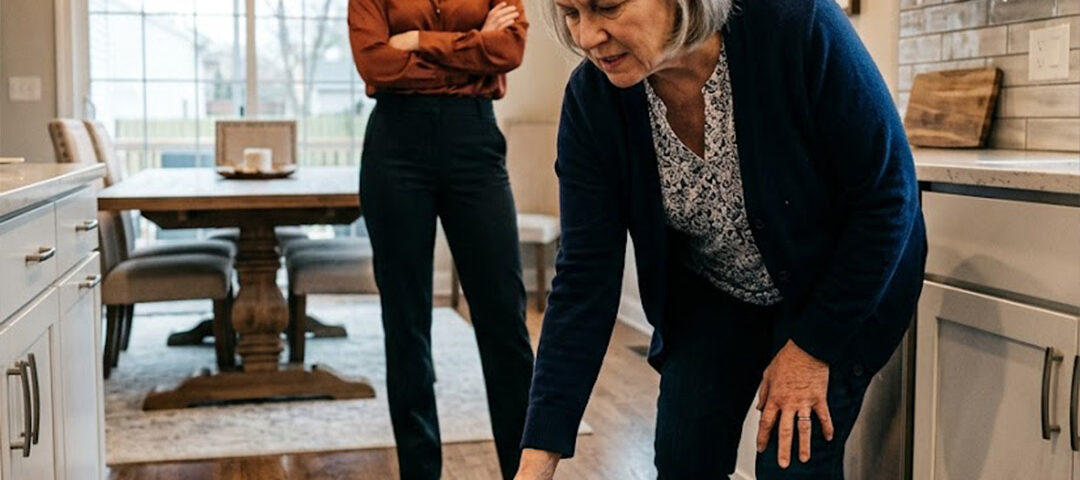
The cleaning cloth landed against my sweater before it slid down onto the polished kitchen floor.
For one second, nobody moved.
Not my son, standing beside the island with his hand still wrapped around a wine glass.
Not Crystal’s parents, seated at the long dining table beneath a chandelier that looked like it belonged in a hotel lobby.
Not Crystal herself, who stood there in her cream silk blouse and perfect makeup, looking at me as if she had tossed a napkin to the hired help instead of a cleaning rag to the woman who had raised her husband.
“Wipe the floor, Margaret,” she said.
Her voice was calm. That made it worse.
A shout would have sounded ugly enough for everyone in the room to recognize. This was worse than shouting. This was polished. Careful. The kind of cruelty that can pass for manners if nobody has the courage to name it.
A ribbon of pasta sauce had splattered near the cabinet after Crystal knocked a serving spoon off the counter. It was not much. Any adult standing two feet away could have bent down and wiped it up in ten seconds.
But Crystal did not reach for the cloth.
She threw it at me.
And my son, Kevin, my only child, the boy I had carried through grief and fevers and school loans and lonely Christmas mornings after his father died, stood there too stunned to defend me.
His mouth opened slightly.
“Crystal,” he said, barely above a whisper.
But that was all.
I looked at him. He looked ashamed before he even looked sorry.
That hurt more than the cloth.
I bent down slowly, picked it up, and wiped the sauce from the floor. Not because Crystal had the right to order me around. Not because I believed for one moment that I belonged on my knees in her kitchen.
I did it because I had learned a long time ago that some rooms show you exactly who people are when they think you have no power.
And Crystal Martinez had no idea that the day before, inside a quiet attorney’s office across from the county courthouse, I had signed the final papers giving my small family investment company controlling ownership of BrightGate Solutions.
Her company.
The company she bragged about at dinner parties.
The company she said would make her a millionaire before she turned thirty-five.
The company she thought was desperate for money from strangers in suits.
She did not know the new controlling shareholder was sitting in her kitchen wearing a cardigan from Kohl’s, driving an old Toyota, and holding back tears over a cleaning cloth.
By Monday morning, everything between us would change.
My name is Margaret Ellis. I am sixty-one years old, and most people who meet me do not look twice.
That has always suited me fine.
I live in a two-bedroom apartment over a pharmacy on the quieter side of downtown Millbrook, Ohio. There is a narrow balcony where I keep three pots of geraniums in the summer, a small kitchen with yellowing cabinets, and an oak table I bought secondhand when Kevin was nine. My car is a fifteen-year-old Toyota Camry with a dent near the passenger door and an engine that starts every morning without drama, which is more than I can say for many people I have known.
I do not dress like money.
I do not talk like money.
I do not enjoy people treating me differently because they think I have some.
My late husband, Robert, understood that about me. He was the kind of man who could fix a furnace, read a balance sheet, and make a scared child laugh with a spoon balanced on his nose. Before he died, he and his older brother owned a small manufacturing firm that made security sensors for hospitals and nursing homes. It was not glamorous work. Nobody wrote magazine profiles about it. But it was good, honest work, and after Robert passed, his shares were sold to a larger company.
Kevin was twelve then.
People assumed the money disappeared into medical bills and grief, and I never corrected them. Most of the money went into a trust, then into boring investments with boring names that only accountants enjoyed saying out loud. I kept my job at the library for years because sitting alone in an apartment all day would have swallowed me whole. I clipped coupons. I bought used furniture. I taught Kevin that comfort was nice, but dignity mattered more.
Maybe I taught him that part too gently.
Maybe I spent so many years protecting him from the weight of our losses that I failed to teach him how to stand firm when love started making him small.
Kevin had always been tenderhearted. As a child, he apologized when the sky rained on a picnic. If another kid forgot lunch money, Kevin split his sandwich without waiting to be asked. He hated conflict the way some people hate spiders. He would rather swallow his own feelings than watch somebody else get upset.
That sweetness became dangerous after he married Crystal.
At first, I tried to like her.
I truly did.
Crystal was beautiful in that expensive, controlled way that made people turn their heads at restaurants. Tall, slender, always in heels, always with her blonde hair pulled back so tight it made her cheekbones look sharper. She worked at BrightGate Solutions, a fast-growing technology company that sold scheduling and security software to senior living facilities, rehab centers, and private home-care agencies. She had started there in marketing, then moved up fast. By the time she married Kevin, she was the company’s chief growth officer and talked like every conversation was a pitch deck.
She could be charming when she wanted something.
That was the part that fooled people.
At their wedding, she held both my hands and told me, “I’m so grateful Kevin has such a devoted mother.”
The photographer caught that moment. In the picture, her smile looked warm. Mine looked relieved.
I did not know then that Crystal used the word devoted the way some people use the word useful.
The first year of their marriage, the little slights came wrapped in tissue paper.
She corrected the way I set silverware at Thanksgiving.
She laughed softly when I brought a casserole in a Pyrex dish with a blue plastic lid.
She told Kevin, right in front of me, that he had “outgrown” the kind of birthday cake I used to make him.
When I gave them a set of handmade Christmas ornaments from a craft fair, Crystal thanked me and placed the box on a side table. I never saw those ornaments on their tree.
Kevin always noticed. I could see it in the way his shoulders tightened. But noticing is not the same as speaking.
“She doesn’t mean it that way, Mom,” he would say later, standing beside my car in the driveway.
And I would tell him, “I know, honey,” because mothers sometimes lie to keep their children from cracking down the middle.
But by the time I drove to their house that Saturday afternoon, I had stopped lying to myself.
The invitation had come from Kevin, not Crystal.
“Mom, can you come over for dinner Saturday?” he had asked. “Just us. Crystal’s making pasta.”
His voice sounded too eager, the way he used to sound when he wanted me to come to a school event and pretend everything was fine.
So I baked cookies.
Chocolate chip, the old recipe with too much butter and a pinch of cinnamon Robert always claimed he could taste. I packed them in a white bakery box I bought at the craft store because Crystal disliked anything that looked homemade in the wrong way.
Then I checked my reflection in the small mirror by my apartment door.
Gray hair brushed smooth. Navy cardigan. Pearl earrings Robert had given me on our tenth anniversary. Nothing fancy. Nothing sloppy. Just me.
My old Toyota looked tiny along the curb outside Kevin and Crystal’s neighborhood. Pine Valley was the kind of subdivision where every mailbox matched the house behind it and the HOA sent letters if someone’s garbage can stayed visible too long after pickup. The lawns looked clipped with scissors. The flower beds curved in perfect lines. American flags hung from porch brackets in a way that looked less patriotic than professionally staged.
Kevin and Crystal’s white house sat at the end of a cul-de-sac, with black shutters, a double garage, and a front porch nobody ever seemed to sit on. It was beautiful, but cold. The kind of house that looked ready for a real estate photo shoot, not for a family to come home tired and kick off shoes by the door.
Kevin opened the door before I knocked.
“Mom,” he said, smiling wide.
For a second, he was six years old again, racing across the kitchen because I had pulled cookies from the oven.
I handed him the box. “Still warm in the middle, I think.”
He lifted the lid and smiled. “You made the cinnamon ones.”
“I know my audience.”
He hugged me tightly, and I felt the worry in him. His back was stiff beneath his crisp shirt.
Inside, the house smelled like garlic, wine, and something earthy I could not name. The living room was all white and gray. White couch. Gray rug. Glass coffee table. Abstract art with no color. No family photos. No books stacked sideways. No afghan folded over a chair. Not one thing that made you feel somebody had lived there on a rainy Sunday with socks on.
“Sit down,” Kevin said. “Want tea? Water? Sparkling water?”
“Regular water is fine.”
He laughed softly. “Crystal says we should call it still water.”
“Then I’ll have the water that’s standing still.”
That made him laugh for real, and for one small moment, I had my son back.
Then Crystal walked in.
“Margaret,” she said, smiling like a hostess greeting someone who had arrived fifteen minutes early. “You made it.”
“I did. Thank you for having me.”
I opened my arms to hug her. She leaned in just enough to make it technically count.
“I brought cookies,” I said.
“How sweet.” Her eyes flicked toward the box. “We already have dessert from Maison Belle, but I’m sure Kevin can take those to work.”
Kevin’s smile faltered. “I was thinking we could have them tomorrow morning.”
“Of course,” Crystal said, in the tone people use when they have no intention of remembering.
I told myself not to take the bait. I had learned that with Crystal. She did not usually attack head-on. She left small hooks in the air and waited for you to snag yourself.
Dinner was not just us.
I learned that fifteen minutes later when Crystal’s parents arrived without warning.
Victor and Elaine Martinez swept in with expensive coats, wine from a private club, and the kind of confidence that made the house feel even less like Kevin’s. Victor kissed Crystal on both cheeks and shook Kevin’s hand as if they were closing a deal. Elaine looked me up and down so quickly that someone less practiced in being underestimated might have missed it.
“Margaret,” Elaine said. “Lovely to see you again.”
“You too.”
Her eyes landed on my purse, then moved away.
Crystal announced that her coworker Sarah would also be stopping by for dessert to discuss “an urgent work matter.” Kevin looked surprised, which told me the evening had not unfolded the way he expected either.
While Crystal returned to the kitchen, Kevin leaned close to me.
“I’m sorry,” he whispered. “I thought it was just us.”
“I know.”
He looked at me then, really looked, and I saw the boy inside the man. The one who wanted peace so badly he kept mistaking silence for it.
Dinner began with wine and a story from Victor about a country club board dispute. Elaine asked Kevin if he and Crystal had decided when to replace the guest bathroom tile.
“We’re doing the whole bathroom now,” Crystal said before Kevin could answer. “Italian tile. Japanese fixtures. Kevin finally understands that cheap updates cost more in the long run.”
I took a sip of water.
Kevin looked at his plate.
“That’s exciting,” I said.
Crystal smiled. “It is. We’re trying to elevate the house. Pine Valley has standards.”
“Every place does,” I said. “Some are just kinder than others.”
Her smile did not move, but her eyes cooled.
The pasta was beautiful, I will give her that. Thin ribbons with mushrooms, herbs, and tiny dots of sauce arranged like artwork. It tasted good too, though I could not help thinking Kevin would have eaten two bowls of my old baked macaroni and been happier.
“Kevin used to love mac and cheese,” I said lightly, trying to bring warmth into the room. “He once asked for it three nights in a row.”
Crystal gave a small laugh. “Yes, he told me. Luckily, I’ve expanded his palate.”
Victor chuckled.
Kevin’s ears reddened.
I set down my fork. “There’s nothing wrong with expanding. As long as you don’t become ashamed of where you started.”
The table went quiet.
Then Elaine said, “Crystal has always had very high standards. We raised her that way.”
“I can see that,” I replied.
Crystal’s phone buzzed beside her plate. She glanced at it, and for the first time all evening, her control slipped.
“Excuse me,” she said.
She walked into the kitchen, but the house was too open and her voice carried.
“What do you mean they delayed?” she hissed. “Sarah, we cannot wait another two weeks. If BrightGate doesn’t secure bridge financing before the board review, Henry will panic and the employee group will start asking questions.”
I looked down at my plate.
Kevin stared toward the kitchen.
“No,” Crystal said. “Kevin doesn’t know how bad it is. And don’t mention M.E. Holdings again. It’s probably some retired dentist playing investor. We need serious money, not sentimental small-town people who want a tour of the office.”
My hand tightened around my napkin.
M.E. Holdings was mine.
Margaret Ellis Holdings.
The attorney had suggested something less obvious years ago. I had refused. My husband’s name had been Ellis. My son’s name was Ellis. If the money ever did anything useful, I wanted our name on it, even if nobody outside the paperwork knew.
BrightGate had come to me through Henry Caldwell, the company’s founder.
Henry had known Robert from the old manufacturing days. He was seventy-two now, widowed, tired, and worried about what his company had become. BrightGate had begun as a practical tool to help nursing homes coordinate staff schedules, door security, medication reminders, and family updates. Somewhere along the way, under pressure from investors and ambitious executives, it had started promising more than it could deliver.
Henry called me three months before that dinner.
“Margaret,” he said, “I need someone patient. Someone who understands older people are not market segments. They’re people.”
I nearly laughed at that. In the business world, people loved saying words like dignity right before cutting the budget for it.
I reviewed the documents. Slowly. Carefully. I brought in my accountant, my attorney, and a retired operations manager I trusted. BrightGate was not worthless. It had good bones, good engineers, and contracts with care facilities that truly needed the service. But the leadership had become reckless. The sales projections were inflated. Employee morale was sinking. Customer support was understaffed. Crystal’s growth department had chased a glossy valuation while the product team begged for breathing room.
I had signed the final purchase agreement Friday afternoon.
By Monday morning, after the paperwork cleared, M.E. Holdings would control fifty-two percent of the voting shares.
Crystal did not know.
Neither did Kevin.
I had planned to tell him once the board transition was settled. I did not want him caught between his wife and me. I did not want him accused of leaking information or choosing sides.
And truthfully, I did not want Crystal to treat me better because she discovered I was useful in a larger way.
I wanted to know who she was when she thought I was just Margaret.
By the end of dinner, I knew.
Sarah arrived during dessert. She was younger than Crystal, with tired eyes, a navy blazer, and a leather folder clutched to her chest. She looked startled when she saw me, then quickly looked away. I wondered if she had seen my name somewhere in the documents and had been told to keep quiet.
Crystal served the bakery cake in thin slices on white plates. Kevin quietly placed two of my cookies on a small dish and slid them toward me with a sheepish smile.
Crystal noticed.
“Kevin,” she said softly, “not with the cake.”
“It’s just a cookie,” he said.
“It’s not about the cookie.”
The sentence sat there like a warning.
I picked up the cookie and broke it in half. “Would anyone like some?”
Victor smiled with polite pity. Elaine shook her head.
Sarah surprised me by taking the other half.
“Thank you,” she said. “My grandmother used to make these.”
Crystal’s eyes flashed.
A few minutes later, while clearing plates, she moved too quickly near the stove. The serving spoon slipped from her hand and hit the tile, splattering sauce across the lower cabinet and floor.
It was a small accident. An ordinary human moment.
But Crystal did not allow herself ordinary human moments.
Her face hardened, and somehow, instead of embarrassment landing where it belonged, it turned outward.
I had stood to help carry my plate to the counter. I was closest to the spill, but not close enough to be responsible for it.
Crystal snatched a cleaning cloth from beside the sink and tossed it at me.
It hit my chest and dropped.
“Wipe the floor, Margaret.”
That was when the room stopped breathing.
Kevin whispered her name.
Only her name.
Not “Don’t speak to my mother that way.”
Not “Pick that up yourself.”
Not “Apologize.”
Just “Crystal,” weak and frightened, as if he were asking permission to object.
I looked at my son, and something inside me settled. It was not anger exactly. Anger burns hot. This was cooler. Clearer.
It was the feeling of a door closing.
I bent down, wiped the sauce, rinsed the cloth in the sink, wrung it out, and folded it neatly on the counter.
Then I picked up my purse.
Kevin stepped toward me. “Mom, wait.”
Crystal gave a brittle laugh. “Oh, don’t be dramatic. It was a spill.”
“No,” I said. “It was not.”
Elaine looked uncomfortable. Victor checked his watch. Sarah stared at the table.
Crystal crossed her arms. “If you’re upset because I asked for help, I’m sorry you misunderstood.”
There it was.
The apology that blames your ears.
I nodded once. “I understood perfectly.”
Kevin followed me to the front door. His face had gone pale.
“Mom, please don’t leave like this.”
“How would you like me to leave?”
He swallowed.
Behind him, Crystal called from the kitchen, “Kevin, let her cool off. She’s obviously sensitive tonight.”
I saw my son flinch.
That flinch broke my heart because it told me he had heard that tone many times when I was not around.
Out on the porch, the air smelled like cut grass and distant rain. The Pine Valley streetlights had just come on, soft gold circles glowing over perfect lawns.
Kevin shut the door halfway behind him.
“I’m sorry,” he said.
“Are you?”
His eyes filled.
“Of course I am.”
“Then say what you’re sorry for.”
He looked confused, like a child asked to solve a problem at the board.
“For how she acted.”
I shook my head gently. “No, Kevin. That is her apology to make. What are you sorry for?”
He looked toward the closed door.
“I froze.”
“Yes,” I said. “You did.”
His mouth tightened. “She’s under so much pressure. The company’s in trouble, and she’s scared, and when Crystal gets scared, she gets sharp.”
“Sharp things still cut.”
“I know.”
“Do you?”
He looked down.
I touched his cheek the way I had when he was small. “I love you more than any person on this earth. But love does not require me to stand in your house and be treated like a servant so your wife can feel powerful.”
He closed his eyes.
“I don’t know how to fix this,” he whispered.
“That is the first honest thing you’ve said tonight.”
I kissed his cheek and walked to my car.
Crystal was watching from the dining room window.
I did not wave.
That night, I did not cry until I got home.
I made it through the drive, through the pharmacy parking lot, up the stairs, and into my little kitchen. I set my purse on the chair. I took off my pearls. I placed the leftover cookie box on the table.
Then I sat in the dark and let the tears come.
Not because Crystal had humiliated me. I had survived worse than a rude woman with expensive countertops.
I cried because my son had watched it happen and stayed quiet.
There is a particular kind of loneliness that comes when your child becomes an adult and you realize you can no longer pull them away from the thing hurting them. You can only stand at the edge and hope they remember where the door is.
My phone buzzed at 10:47.
A text from Kevin.
Mom, I’m so sorry. Please call me tomorrow.
I stared at it for a long time.
Then another text came.
She didn’t mean it the way it sounded.
I put the phone face down.
There it was again. The old habit. The smoothing over. The sanding down of sharp edges until everyone could pretend nobody was bleeding.
I slept badly.
On Sunday morning, I went to church.
Not because I was especially holy that day, but because sometimes I needed to sit in a room where people sang old hymns off-key and nobody cared what car I drove. After the service, I stayed for coffee in the fellowship hall. Mrs. Alvarez from the choir asked if Kevin was doing well. I told her he was busy. That is one of the small lies mothers tell in public.
At home, I reviewed the BrightGate documents one more time.
The board meeting was scheduled for Monday at 9:00 a.m.
Henry Caldwell called at noon.
“Are you still comfortable moving forward?” he asked.
I looked at the folded cleaning cloth in my mind. The sauce on Crystal’s tile. Kevin’s silence.
“Yes,” I said. “More than I was yesterday.”
Henry sighed. “I heard there was some tension.”
“From Sarah?”
“She called me after she left. She said Crystal behaved badly.”
“That is a gentle way to put it.”
“Margaret, I want to be clear. We are not doing this because of a family argument.”
“No,” I said. “We are doing it because the company needs adult supervision.”
He was quiet for a moment.
Then he said, “Robert would have liked that.”
I smiled despite myself. “Robert would have said something less polite.”
On Monday morning, I wore a charcoal dress, low heels, and the pearl earrings again.
I drove my old Toyota to BrightGate’s headquarters, a renovated brick warehouse near the river that had been turned into offices with glass walls, exposed beams, and a lobby full of plants nobody seemed to water enough. A young receptionist looked at me with the polite uncertainty reserved for women who do not fit the expected profile of important visitors.
“Can I help you?”
“I’m here for the board meeting.”
“Name?”
“Margaret Ellis.”
Her eyes dropped to the schedule. Then widened slightly.
“Oh. Yes, Mrs. Ellis. They’re expecting you.”
That was the first time all weekend anyone had used my name as if it carried weight.
Henry met me near the elevator. He looked thinner than the last time I saw him, but his handshake was steady.
“Ready?” he asked.
“No,” I said. “But I’m here.”
“That’s most of business.”
The boardroom overlooked the river. Morning light poured across the long table. Sarah was already seated with her leather folder. Two board members I had met during negotiations sat near the windows. My attorney, David Langford, placed a neat stack of documents in front of me.
At 8:58, Crystal walked in.
She wore a pale blue suit and carried a tablet. Her heels clicked against the floor with the same sharp rhythm I had heard in her kitchen.
Then she saw me.
For the first time since I had known her, Crystal Martinez had no prepared expression ready.
Her eyes moved from me to Henry to the documents in front of my chair.
“What is this?” she asked.
Henry stood. “Good morning, Crystal.”
She did not greet him. “Why is my mother-in-law here?”
David answered before Henry could.
“Mrs. Ellis is here as the managing member of M.E. Holdings.”
Crystal stared at him.
Sarah looked down at her folder.
David continued, calm as a metronome. “As of close of business Friday, M.E. Holdings completed the purchase of a controlling voting interest in BrightGate Solutions. Mrs. Ellis now represents the majority shareholder.”
Crystal’s face changed slowly, like a curtain being pulled from a window.
“No,” she said.
I said nothing.
She laughed once, but there was no humor in it. “Margaret?”
I folded my hands on the table.
“You?”
“Yes.”
“That’s not possible.”
“It is,” David said. “The transaction was executed properly. The funds cleared. The amended voting agreement is in your packet.”
Crystal looked at Henry. “You sold control of this company to Kevin’s mother?”
Henry’s voice was quiet. “I sold control of this company to someone who believes it can still be saved.”
Her cheeks flushed.
“This is because of Saturday night,” she said.
The room went still.
I looked at her then.
“No, Crystal. Saturday night did not create the reports in that folder. It did not create the missed support targets, the inflated client acquisition forecasts, the employee turnover, or the complaints from facilities that were promised features your team knew were not ready. Saturday night simply told me that the culture problem started higher than I feared.”
She opened her mouth, then closed it.
That was satisfying, I admit.
Not because I wanted to hurt her, but because there is relief in finally speaking plainly after years of swallowing polite poison.
David moved the meeting forward.
The board voted on a restructuring plan that had been prepared before the purchase closed. Crystal was removed from her executive authority pending an outside review. She would remain employed during the transition only if she accepted a non-leadership advisory role with no control over staffing, sales projections, or investor communications. Sarah was appointed interim chief operations officer. Henry would stay on as non-executive chair for six months. Customer support would be expanded. The senior care facility contracts would be reviewed one by one, not abandoned for flashier deals.
Nobody shouted.
That made it stronger.
Crystal asked for a recess. She did not get one.
She argued that removing her would scare investors. David explained that the investors had already been notified of the governance changes and that several had expressed relief.
She claimed the staff respected her. Sarah opened her folder and slid forward a summary of anonymous exit interviews.
Crystal did not touch it.
Finally, she turned to me.
“Kevin knows about this?”
“No.”
“You didn’t even tell your own son?”
“I protected him from a conflict of interest.”
“You mean you went behind his back.”
“I mean I did not use my child as a messenger in a business transaction.”
Her lips parted.
For once, no polished insult came out.
The meeting ended at 10:36.
Crystal left the room without looking at anyone. Through the glass wall, I watched her walk down the hallway past employees who suddenly found reasons to study their screens.
Sarah stayed behind.
“Mrs. Ellis,” she said, “thank you.”
“You don’t need to thank me yet. Now you have to fix what’s broken.”
She gave a tired smile. “That sounds fair.”
Henry walked me to the elevator.
“You handled that well,” he said.
“I wiped a floor on Saturday. This was easier.”
He chuckled softly, then grew serious. “Are you all right?”
I thought of Kevin.
“I don’t know yet.”
My phone began ringing before I reached the parking lot.
Kevin.
I let it ring once. Twice. Then I answered.
“Hello, honey.”
“What happened?” His voice was breathless. “Crystal just called me screaming that you destroyed her career.”
“I did not destroy anything.”
“Mom, she said you bought BrightGate.”
“Yes.”
Silence.
A truck rumbled past on the street.
“You bought her company?”
“I bought a controlling share in the company where she works. There is a difference.”
“Why didn’t you tell me?”
“Because you would have been placed in an impossible position.”
He breathed hard into the phone. “I’m already in one.”
“I know.”
“Was this because of dinner?”
“No,” I said. “But dinner told me I had made the right decision.”
He did not answer.
I leaned against my Toyota and looked up at the brick building. “Kevin, I need you to understand something. What happened at that meeting was business. What happened in Crystal’s kitchen was family. The fact that the same person behaved poorly in both places is not my fault.”
His voice cracked. “I should have said something.”
“Yes,” I said softly. “You should have.”
“I hate that I didn’t.”
“That’s a start.”
He asked if he could come over after work. I said yes.
He arrived at six-thirty carrying my cookie box.
He had not changed out of his work clothes. His tie was loose. His eyes were red. He stood in my apartment doorway like a man afraid he had lost permission to enter the only safe place he knew.
“I brought these back,” he said.
I looked at the box. “Did anyone eat them?”
“Sarah took one. I ate three last night after Crystal went upstairs.”
Despite everything, I laughed.
That broke him.
He covered his face with one hand and started crying right there in the hallway.
My son was twenty-nine years old, but when your child cries, age becomes paperwork. I pulled him inside and held him while he shook.
“I’m sorry,” he said again and again. “I’m so sorry, Mom.”
This time, I did not let him stop at the easy words.
We sat at the oak table. I made coffee. He held the mug with both hands.
“Tell me what you’re sorry for,” I said.
He stared down at the steam.
“I’m sorry I let her talk down to you for two years.”
I stayed quiet.
“I’m sorry I kept calling it stress. Or standards. Or personality. I knew what it was.”
“What was it?”
He swallowed. “Cruelty.”
The word hurt him to say. But it also freed something in the room.
“She’s not cruel all the time,” he added quickly.
“Most people aren’t.”
He looked at me.
“That’s what makes it confusing,” I said. “If someone is awful every minute, leaving is easy. It’s the nice mornings and the quiet apologies and the little gifts after a bad night that keep people doubting themselves.”
He nodded slowly.
“She makes me feel stupid,” he said. “Not directly. Not always. Just little things. The way I dress. The food I like. My job. My mom. Our old neighborhood. If I push back, she says I’m insecure or that I’m trying to hold her back.”
I reached across the table and took his hand.
“Your father used to say a person who loves you can challenge you without shrinking you.”
Kevin wiped his face.
“I miss Dad.”
“So do I.”
He looked around my apartment, at the old table, the worn rug, the framed photo of him at eight years old holding a baseball glove too big for his hand.
“Why didn’t you ever tell me about the money?”
“I told you we were okay.”
“That’s not the same as telling me you could buy a company.”
“I did not want you growing up measuring people by what they had. And I did not want people measuring you by what you might inherit.”
He gave a weak laugh. “Well, I definitely didn’t marry Crystal for money.”
“No,” I said. “But she may have married an idea of you that was easier to polish.”
That one landed hard.
He stayed until almost ten. We did not solve his marriage at my kitchen table. Life is rarely that tidy. But he said the things he had been afraid to say, and I listened without grabbing the wheel from him.
Before he left, he asked, “What do I do now?”
“You tell the truth,” I said. “First to yourself. Then to her.”
The next day, Crystal came to my apartment.
She arrived at 11:15 in the morning wearing sunglasses large enough to hide half her face. I knew it was her before she knocked because the pharmacy downstairs had called up to say, “Mrs. Ellis, there’s a very fancy woman asking if you live here.”
I opened the door but did not invite her in.
She removed her sunglasses.
For once, she looked tired.
“Margaret,” she said. “Can we talk?”
“We can talk right here.”
Her eyes flicked past me into the apartment. I saw the judgment appear by reflex, then saw her try to hide it.
“I wanted to apologize for Saturday.”
I waited.
“I was under extreme pressure,” she continued. “Work has been impossible, and I handled things poorly.”
There it was again. The soft cushion placed under the hard truth.
“You threw a cleaning cloth at me and told me to wipe your floor.”
Her jaw tightened.
“Yes,” she said. “That was inappropriate.”
“Inappropriate is using the salad fork for cake. Try again.”
Color rose in her cheeks.
Behind me, the refrigerator hummed. Downstairs, the pharmacy door chimed as someone walked in.
Crystal looked like she wanted to leave. She also looked like she could not afford to.
“It was disrespectful,” she said finally.
“Yes.”
“And I’m sorry.”
“Thank you.”
Relief flashed across her face too quickly.
Then she said, “I’m hoping we can keep personal feelings separate from BrightGate.”
I almost admired the speed of it.
“There it is,” I said.
“What?”
“The real reason you came.”
Her mouth pressed into a line. “My career matters to me.”
“I know.”
“I built that company.”
“You helped grow it.”
“I worked eighty-hour weeks. I sacrificed. I pushed because nobody else had the stomach for what it takes.”
“Pushing people off a ledge is not leadership.”
Her eyes sharpened. “You don’t understand this world.”
“No, Crystal. I understand it better than you think. I understand spreadsheets. I understand debt. I understand payroll. I understand what happens when executives call employees family right before asking them to survive on fear. I understand that a company serving older people should not be run by someone who thinks older women are disposable unless they are useful.”
She stared at me.
For the first time, I saw not just anger in her face, but fear.
“You’re enjoying this,” she said.
“No,” I replied. “That may be the difference between us.”
A voice came from the stairwell.
“Crystal.”
Kevin stood there, one hand on the railing. He must have parked around the back because I had not heard his car. His face was pale but steady.
Crystal turned. “Kevin, good. Please tell your mother this has gone far enough.”
He walked up the last few steps.
“No,” he said.
She blinked. “Excuse me?”
“No,” he repeated. “I’m not doing that anymore.”
The hallway felt very still.
Crystal gave a small laugh. “Doing what?”
“Cleaning up what you break and calling it peace.”
Her face changed.
“Kevin, this is not the place.”
“It wasn’t the place Saturday either, but you didn’t mind humiliating my mother in front of your parents.”
She stepped closer to him. “I already apologized.”
“You apologized because you want something.”
“That’s unfair.”
“Maybe,” Kevin said. “But it’s true.”
I had never been prouder of him. Not because he sounded strong. He did not. His voice shook. His hands shook. Courage often shakes. That does not make it less real.
Crystal looked from him to me.
“So that’s it?” she said. “You two are teaming up against me?”
Kevin exhaled slowly. “No. We’re stepping out from under you.”
She recoiled as if he had slapped her, though he had not raised his voice.
“I’m your wife.”
“And she’s my mother,” he said. “You don’t get to make me choose by treating her badly and then blaming her for noticing.”
Crystal’s eyes filled, but the tears did not soften her. They made her look angrier.
“You’re going to regret this,” she whispered.
Kevin nodded, sad and tired. “Maybe. But I already regret staying quiet.”
She put her sunglasses back on and walked down the stairs.
Nobody followed her.
Two weeks later, BrightGate announced its restructuring.
The announcement was careful and professional. Crystal Martinez would transition out of executive leadership. Sarah Price would serve as interim chief operations officer. The company would pause aggressive expansion, stabilize existing contracts, and invest in customer support for senior care facilities.
The local business journal called it “a surprising governance shift.”
People in Millbrook called it “that thing with the Ellis woman.”
I heard versions of the story at church, at the pharmacy, and once in the produce aisle at Kroger, where a woman I barely knew leaned close and whispered, “Is it true you walked into a boardroom and fired your daughter-in-law?”
“No,” I said, choosing apples. “I walked into a boardroom and did my job.”
That was the truth.
Crystal was not left ruined on the sidewalk. She received a structured exit package, smaller than she wanted and larger than her behavior deserved. The outside review found no crime, just arrogance, pressure, bad decisions, and a trail of people too afraid to speak honestly. That happens more often than the dramatic version. Lives are damaged not only by villains, but by polished professionals who never learned the difference between ambition and entitlement.
Kevin moved into my spare room for eleven days.
He said it was temporary. I told him the room had clean sheets and no expectations.
He and Crystal began counseling, then separated. I did not celebrate that. A mother can dislike her child’s marriage and still grieve the pain of its ending. But I did feel relief when Kevin started laughing again at ordinary things. Burnt toast. Bad weather. A baseball game on television. The pharmacy downstairs putting up Christmas decorations before Thanksgiving.
One Saturday morning in late November, he came into my kitchen wearing sweatpants and an old college sweatshirt Crystal had once told him made him look childish.
He held up the cookie recipe card.
“Teach me,” he said.
“You know the recipe.”
“I know the ingredients. Not the same thing.”
So I taught him.
I showed him how the butter should soften but not melt. How to pack the brown sugar. How to add the cinnamon without measuring too nervously. How to pull the cookies out when they still looked slightly underdone because they would finish on the pan.
He listened carefully, the way he used to listen when he was little and believed I knew everything.
When the first batch came out, he leaned against the counter and said, “I keep thinking about Saturday night.”
“So do I.”
“I keep seeing you bend down.”
I slid the tray onto the cooling rack.
“I wish you hadn’t seen that.”
“I wish I had stopped it.”
“Yes,” I said. “That would have been better.”
He flinched, but he did not look away.
Then I added, “But you are stopping it now.”
He nodded.
Outside, the pharmacy sign blinked in the gray morning light. My Toyota sat in its usual spot by the curb. Across town, in Pine Valley, the big white house with black shutters was probably still spotless. The lawns were still trimmed. The mailboxes still matched. Crystal was probably still beautiful, still sharp, still certain the world had been unfair to her.
Maybe someday she would understand.
Maybe she would not.
That was no longer mine to carry.
A few months after the restructuring, BrightGate held a small lunch for employees in the renovated warehouse lobby. Nothing fancy. Sandwich trays from a local deli, coffee in paper cups, a sheet cake from Costco with too much frosting. Henry gave a short speech. Sarah thanked the support team by name. A nurse administrator from one of the senior living facilities stood up and said the software updates had made her staff feel heard for the first time in a year.
That mattered to me more than any headline.
Afterward, I walked out to the parking lot and found Kevin waiting beside my Toyota.
“What are you doing here?” I asked.
“Taking my mother to lunch.”
“I just ate.”
“Then coffee.”
I looked at him. He looked lighter than he had in years.
We drove to a diner near the courthouse, the kind of place with vinyl booths, coffee strong enough to remove paint, and waitresses who called everybody honey whether they deserved it or not. Kevin ordered pie. I ordered coffee. We split both.
Halfway through, he said, “Did you buy BrightGate because of Dad?”
“In part.”
“Because of me?”
“In part.”
“Because of her?”
I stirred my coffee.
“No,” I said. “Crystal was only the loudest symptom. I bought it because it was worth saving, and because I could. That’s all power should be used for when we’re lucky enough to have it. Not to humiliate. Not to punish. To protect what still has value.”
He looked down at his pie.
“I wish I had known you were that powerful.”
I smiled. “You did know.”
He frowned.
“I raised you alone,” I said. “I buried your father and still got up the next morning to pack your lunch. I fought insurance companies. I sat through parent-teacher conferences after double shifts. I kept a roof over us. I made Christmas happen when I wanted to disappear under the covers. Money is useful, Kevin. But it was never the first proof of my power.”
His eyes filled again, but this time he smiled through it.
“No,” he said. “I guess it wasn’t.”
That evening, when he dropped me off, he carried a small bag of groceries up the stairs without asking. He set them on my kitchen counter, then looked at the floor near the sink.
“What?” I asked.
He shook his head. “Nothing.”
But I knew.
He was remembering the cloth.
So was I.
Only now, the memory no longer ended with me on my knees.
It ended in a boardroom where Crystal had to hear my name read into the record.
It ended in a hallway where my son finally found his voice.
It ended in my kitchen, with fresh cookies cooling on the counter and Kevin washing the mixing bowl without being asked.
A person can spend years being underestimated so quietly that even they begin to mistake it for invisibility. Then one day someone tosses a rag at them, and the whole room learns the difference between humility and weakness.
I still drive my old Toyota.
I still live above the pharmacy.
I still bake cookies in the same small kitchen with the yellowing cabinets.
But nobody in my family has ever asked me to wipe the floor again.
Disclaimer: This story is a work of fiction created for entertainment purposes. Any resemblance to real persons, events, or places is coincidental.