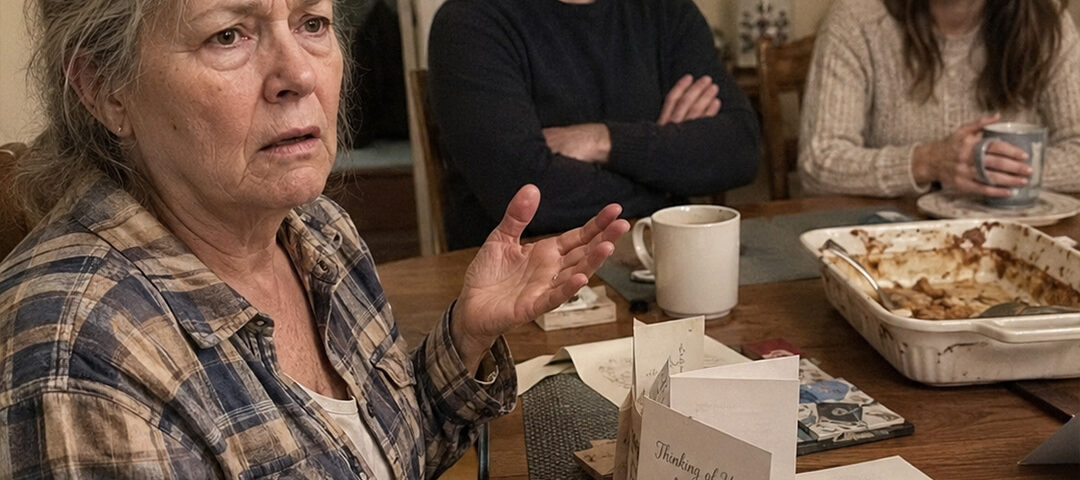
“Two weeks should be enough for you to pack.”
Vanessa said it seven days after my husband’s funeral, while Mason’s coffee mug was still sitting beside the sink because I had not found the strength to move it.
The three of us were gathered around the oak dining table Mason had built during our first year of marriage. Sympathy cards covered the sideboard. A church casserole cooled untouched on the kitchen counter, and the pale lilies from the memorial service had begun curling inward at the edges.
My son, Ethan, sat across from me with his hands folded near his plate.
He did not look surprised by his wife’s words.
That frightened me more than anything Vanessa could have said alone.
“I’m sorry,” I replied. “Pack for what?”
Vanessa leaned back in the chair that had always belonged to Mason.
She wore a cream-colored sweater and small gold earrings. Everything about her looked soft and appropriate for a grieving family dinner. Only her voice revealed that she had arrived with a plan.
“To move,” she said. “Ethan and I have been talking, and we think it’s best to handle the house quickly.”
I looked at my son.
“Handle it?”
Ethan finally raised his eyes.
“Dad owned the house, Mom.”
The room seemed to narrow around us.
“Mason and I lived here for thirty-two years.”
“I know.”
“We raised you here.”
“I know that too.”
“Then explain what you’re saying.”
He glanced at Vanessa before answering.
“Dad always said the house would stay in the family. I’m his only child. Once the estate is settled, it should come to me.”
Vanessa placed one hand over his.
“We’re not trying to make this harder than it already is. The house needs updates, and we’re prepared to invest in it. We’ve already spoken with a contractor about opening the kitchen and converting the den.”
The den was where Mason kept his drafting table.
His pencils were still lined inside the top drawer. His reading glasses rested beside a stack of construction plans he had been reviewing the morning he died.
“You’ve already brought a contractor through my home?”
“Not through it,” Ethan said quickly. “He only looked at the exterior.”
Vanessa gave him a small, correcting glance.
“We need to think practically,” she said. “Grief can make people hold on to places that are too large for them.”
I turned toward her.
“Too large for whom?”
“For someone living alone.”
The sentence landed gently, which somehow made it worse.
Ethan shifted in his chair.
“Mom, we found a condo community near the medical center. It has lawn care, security, and smaller floor plans. You wouldn’t have to worry about maintenance.”
“Did you find it before or after your father’s funeral?”
His face tightened.
“That isn’t fair.”
“Neither is discussing kitchen renovations while his flowers are still in this house.”
Vanessa exhaled through her nose.
“We knew this would become emotional.”
I looked at Ethan again.
The little boy I had once carried through the hallway during thunderstorms was now thirty-five. He had Mason’s dark hair, Mason’s square hands, and none of his father’s expression at that moment.
“What exactly are you asking me to do?”
His gaze dropped to the table.
“Pack what you want to keep. We can arrange movers for the rest.”
“When?”
Vanessa answered.
“Within two weeks.”
The grandfather clock in the living room marked the quarter hour.
Mason had repaired that clock three times rather than replace it because he said a familiar sound mattered more than perfect time.
I listened to it finish.
Then I asked my son one final question.
“Do you believe I have no claim to this home?”
Ethan rubbed his thumb against the edge of his plate.
“The title was in Dad’s name when he bought it. You always said he handled the finances. I’m not trying to be unkind, Mom. I’m telling you what I understand.”
What he understood had already become permission.
Permission to replace the kitchen.
Permission to erase the den.
Permission to move me out of the life I had helped build before anyone had shown him a single legal document.
Vanessa stood and collected her handbag from the chair beside her.
“We’ll give you a few days before we bring boxes.”
I stayed seated.
“You will not bring boxes into this house.”
Her expression barely changed.
“We’ll talk when you’ve had time to process everything.”
She walked toward the front door.
Ethan remained behind for several seconds.
I waited for him to apologize.
I waited for him to kneel beside my chair the way he had when he was young and ask whether I needed anything.
Instead, he touched my shoulder with the careful distance of someone comforting an acquaintance.
“I’ll call tomorrow.”
Then he followed his wife outside.
Their headlights swept across the living-room wall as they reversed down the driveway.
When the house became quiet again, I carried Mason’s mug from the kitchen to the dining table and placed it across from me.
For the first time since the funeral, I allowed myself to feel something besides grief.
Fear.
Not only of losing the house, but of discovering how little I understood about my own life.
My name is Margaret Carter. I was sixty-two when Mason died, and until that week, I had never entered a bank alone to discuss our major accounts.
That admission embarrassed me.
I was not incapable. I had worked for fourteen years as an elementary school secretary before Ethan was born. I managed household schedules, medical appointments, repairs, grocery budgets, and every detail that kept three people moving in the same direction.
But Mason handled investments, taxes, business accounts, property documents, and insurance.
He never forbade me from learning. The arrangement grew slowly, the way habits often do.
Mason understood numbers. I understood people.
He built houses. I built the life inside ours.
We told ourselves that made us a team.
For thirty-two years, it did.
Mason Carter was twenty-nine when I met him at a hardware store outside Wilmington, North Carolina. I was standing in the plumbing aisle holding two fittings I could not distinguish, trying to repair a leaking sink in my first apartment.
He watched me compare them for several minutes before saying, “Neither one fits.”
I looked at him.
“You don’t know what kind of sink I have.”
“You’re holding fittings for an outdoor irrigation line.”
I put them back.
“That explains why they looked wrong.”
He smiled.
Mason was not charming in the polished sense. He spoke slowly, wore work boots nearly everywhere, and spent more time studying a room than filling it with noise.
He helped me find the correct part, drew a diagram on the back of my receipt, and wrote his telephone number beneath it.
“In case the diagram fails,” he said.
“The diagram or the person following it?”
“Could be either.”
I called three days later after turning a small leak into a larger one.
He arrived carrying a toolbox and a paper bag containing two barbecue sandwiches.
We were married eleven months later.
Carter Coastal Construction began in our garage with Mason, one truck, and a borrowed cement mixer. His first projects were porches, roof repairs, and additions for people who paid slowly but recommended him to everyone they knew.
I handled invoices at the kitchen table after work.
Mason built carefully, spoke honestly, and returned calls after other contractors stopped answering.
The company grew because people trusted him.
By the time Ethan entered high school, Carter Coastal employed more than forty people and handled commercial renovations, medical offices, custom homes, and storm-recovery projects across three counties.
Mason never behaved like a man who owned a successful company.
He still packed his own lunch.
He still stopped at job sites to correct uneven trim.
He still came home with sawdust clinging to his sleeves and apologized when it landed on the clean kitchen floor.
When Ethan was young, he followed his father everywhere.
Mason bought him a child-sized tool belt and taught him to measure twice before cutting once. On Saturdays, Ethan sat in the passenger seat of the company truck while Mason checked job sites.
Everyone assumed our son would eventually take over the business.
For a while, Ethan assumed it too.
Then he went to college and discovered he preferred investing to construction. He studied finance, joined a real-estate firm in Charlotte, and began speaking about leverage, passive income, and opportunities Mason considered unnecessarily complicated.
Mason never mocked him.
“You should build the life that fits you,” he said.
But whenever Ethan proposed mixing company money with one of his investment ideas, Mason refused.
“Construction money stays in construction,” he would say.
Ethan interpreted caution as lack of faith.
The distance between them grew quietly.
It became worse after Ethan married Vanessa.
Vanessa came from a family that discussed money with the confidence of people who believed every asset was waiting to be optimized. She worked in luxury home sales and could walk through a room while calculating resale value before noticing the photographs on the walls.
She was attentive when she wanted something and cool when she did not.
I tried to love her because Ethan loved her.
Mason tried too.
During their first year of marriage, Ethan asked his father for thirty thousand dollars to invest in a short-term rental property.
Mason said no.
The following week, he offered to lend them twenty thousand with a written repayment plan.
Ethan accepted the money but complained that formal paperwork between family members showed mistrust.
Mason replied, “Paperwork keeps memory from becoming an argument.”
I remembered that sentence the night Ethan told me the house belonged to him.
After they left, I walked through every room.
Mason’s jacket remained on a hook beside the garage door.
His half-read newspaper rested beneath the lamp in the den.
In our bedroom, one of his slippers had turned sideways beneath the chair, as though he had just removed it and planned to return.
I sat on his side of the bed.
The grief came back with such force that I pressed both hands against my chest.
Losing Mason had felt impossible.
Discovering that Ethan intended to use the emptiness he left behind felt like a second loss hiding inside the first.
Near midnight, I returned to the den.
If Ethan believed everything belonged to him, I needed to understand what everything actually meant.
Mason kept important papers inside a steel file cabinet built into the wall. I knew where he stored tax returns, insurance policies, and property records, but I had never studied them.
The cabinet was locked.
I searched his desk drawers for the key and found nothing.
Then I remembered the small brass key he kept on a ring behind the photograph of us at Cape Lookout.
The key opened the cabinet.
Inside were labeled folders arranged by year.
Taxes.
Insurance.
Equipment.
Property.
Ethan Loans.
I stopped.
The folder was almost two inches thick.
Inside were promissory notes bearing Ethan’s signature. Twenty thousand dollars for the rental property. Twelve thousand for what he described as a temporary cash-flow gap. Twenty-five thousand connected to an investment partnership. Smaller advances followed.
Each document listed interest, due dates, and repayment terms.
Several included handwritten notes from Mason.
Payment deferred at Ethan’s request.
No payment received.
Discussed again. Ethan says after bonus.
The total reached eighty-nine thousand four hundred dollars.
At the bottom of the folder was an email Ethan had sent six months earlier.
Dad, you know this all comes back to me eventually. I don’t understand why you insist on treating family help like a bank transaction.
Mason’s printed reply was clipped behind it.
Because help without responsibility becomes expectation, and expectation becomes entitlement. I love you too much to teach you that nothing has consequences.
My hands began trembling.
Mason had never told me about the full amount.
I found another folder behind it labeled Margaret.
Inside was a single sheet of paper in his handwriting.
Maggie,
If you’re reading this because something happened to me, call Helen Shaw at First Atlantic Bank before signing anything for anyone.
Do not let Ethan explain the estate to you.
Do not let grief make you surrender decisions you are entitled to understand.
Bring the blue binder from the bottom cabinet.
I looked down.
A navy-blue binder rested behind the hanging files.
It was heavier than I expected.
A business card was taped to the front.
Helen Shaw, Senior Private Client Manager.
First Atlantic Bank.
Beneath the card, Mason had written an appointment number and a four-digit code.
My heart pounded as I opened the binder.
The first page contained a photograph of Mason and me taken on our thirtieth anniversary. We were standing near the ocean, both squinting into the sun.
Behind the photograph was a sealed envelope.
For Maggie, when she needs to know.
I did not open it immediately.
Some part of me feared that whatever waited inside would transform Mason from the husband I knew into a stranger who had hidden too much.
Then I remembered Ethan’s calm voice.
Dad owned the house.
I opened the envelope.
Mason’s letter was six pages long.
The first sentence blurred before I could finish it.
I’m sorry if my planning made you feel excluded. Everything I did was meant to make certain that no one—not a creditor, business partner, or even our own child—could leave you without choices.
I sat at his desk until dawn reading every word.
Mason wrote that he began restructuring the company five years earlier, after Ethan requested a large investment using future inheritance as part of his argument.
Mason had become concerned that our son no longer viewed family assets as the result of decades of labor. He viewed them as delayed ownership.
So Mason created the Carter Continuity Trust.
The company’s ownership was transferred into it. Mason served as trustee while alive. I was the sole lifetime beneficiary and successor trustee. After my death, whatever remained would pass to Ethan under conditions requiring financial review and protection from outside claims.
Mason also described investment accounts, certificates of deposit, and a coastal property purchased through the trust.
The final paragraph was written more heavily than the rest.
Maggie, I hope none of these protections are necessary. I hope Ethan is the son we raised when the difficult day arrives. But love should not require you to bet your future on hope. Learn the documents. Ask every question. And remember that kindness is not the same as permission.
At eight thirty the next morning, I called the bank.
Helen Shaw answered personally.
When I gave her my name, she became quiet.
“Mrs. Carter, I’m very sorry about Mason.”
“Did you know him well?”
“I worked with him for nine years.”
“I found his letter.”
Another pause.
“Can you come in today?”
First Atlantic occupied a brick building near the riverfront. Mason and I had used the same bank for decades, but I had never entered the private-client floor.
Helen met me in the lobby.
She was in her late fifties, with short silver hair and a calm expression that made me trust her before I understood why.
She carried no sympathy flowers or polished phrases.
She simply held both of my hands and said, “He talked about you in every meeting.”
That nearly broke me.
Inside her office, she placed a box of tissues beside my chair and asked whether I wanted coffee.
“No. I want to understand whether I’m about to lose my home.”
Her expression changed.
“Who told you that?”
“My son.”
Helen opened a document file.
“You are not losing your home.”
She began with the title.
Eighteen months earlier, Mason and I had signed documents transferring the house into the Carter Family Residence Trust. I remembered the appointment. Mason told me we were updating estate plans and protecting the property from business liability.
A trust attorney had explained the papers, but I had been distracted because Mason was scheduled for a medical test that afternoon. I signed where instructed and trusted him to remember the details.
The trust named both of us as lifetime occupants. After Mason’s death, I became the sole trustee with complete authority to remain, sell, lease, or transfer the property.
Ethan held no current ownership.
“He cannot make you leave,” Helen said.
I pressed my fingers against my lips.
“Does he know?”
“He received a notice that the trust existed after his father died. Whether he read it carefully, I cannot say.”
“He told me the house automatically belonged to him.”
“That is incorrect.”
Helen continued.
There were three certificates of deposit in my name, a managed investment account, and a cash reserve larger than I had ever imagined possessing.
The combined personal accounts exceeded two million dollars.
I stared at the page.
“This cannot be right.”
“It is.”
“Where did it come from?”
“Company distributions, property sales, and income Mason redirected over time.”
“We didn’t live like this.”
“He did not want lifestyle expenses to consume your security.”
The words made perfect sense and no sense at all.
Mason compared grocery prices. He repaired appliances rather than replacing them. He complained when I bought towels at full price.
Meanwhile, he had quietly built a financial life large enough to protect me for decades.
Helen opened the company-trust documents.
Carter Coastal Construction had never been sold.
Mason had told me several years earlier that he was “stepping back” and allowing his longtime foreman, Daniel Brooks, to manage daily operations. I assumed the business had been transferred to senior employees.
Instead, Daniel operated the company under a management agreement while ownership remained inside the trust.
Monthly profits continued flowing into trust accounts.
The business was healthy, with current contracts, equipment, property, and reserves.
As sole beneficiary and successor trustee, I now controlled the ownership interest.
“What am I supposed to do with a construction company?” I asked.
“You do not have to operate it,” Helen said. “Daniel manages the work. The accountant manages finances. Your responsibility is to understand your authority and choose qualified advisers.”
I looked through the glass wall at employees moving quietly along the hallway.
“Mason planned all of this because he didn’t trust Ethan.”
Helen chose her answer carefully.
“He trusted Ethan to be his son. He did not trust him to separate grief, expectation, and financial pressure without safeguards.”
She handed me another folder.
It contained records of Ethan’s loans.
The same documents I had found in the den, along with account transfers and payment histories.
“Has Ethan contacted you?” I asked.
“Not me directly. He contacted the business accountant two days after the funeral and requested access to company statements.”
“Two days?”
“Yes.”
The room became cold despite the sunlight entering through the windows.
“What did he say?”
Helen slid a printed email toward me.
As Mason Carter’s sole heir, I need immediate access to all company accounts and authority over ongoing contracts.
The accountant’s reply was brief.
No authority can be transferred without the successor trustee’s written direction.
Ethan responded:
My mother has never been involved in the company. I will handle this.
I read the sentence twice.
I will handle this.
The same attitude that allowed him to sit at my dining table and schedule my departure had already been carried into Mason’s business.
Helen folded her hands.
“You need an attorney of your own.”
“I’ve never needed one.”
“You need one now.”
She recommended Claire Whitman, an estate and trust attorney who had worked with Mason during the restructuring but represented neither Ethan nor the construction company.
Claire met me that afternoon.
She was direct, warm, and unwilling to let me minimize what had happened.
“Your son attempted to take practical control before determining whether he had legal authority,” she said.
“He may have misunderstood.”
“He may have. But misunderstanding does not require giving his wife two weeks to remove you from your home.”
The sentence brought shame into the room.
Not mine.
His.
Claire reviewed the trust, residence documents, loan agreements, and Mason’s letter.
“Everything appears properly executed,” she said. “We’ll confirm the filings and notify Ethan that all estate-related communication must come through counsel until you are comfortable meeting him.”
“I don’t want to turn my son into an opponent.”
“You did not create the conflict by learning your rights.”
I looked down at my wedding ring.
“What happens to the loans?”
“The company may enforce them, modify them, or forgive them, subject to your fiduciary responsibilities as trustee.”
“Can I simply erase the debt?”
“Possibly, but not before we understand whether doing so would harm the trust or encourage further claims.”
I heard Mason’s voice.
Help without responsibility becomes expectation.
“What would you do?” I asked.
Claire shook her head.
“My job is to make sure the choice is informed and legally sound. The decision belongs to you.”
That was the first of many decisions no one else could make for me.
The next morning, I visited Carter Coastal Construction.
The company office stood behind a row of live oaks near the industrial park. Mason had designed the building himself: pale brick, green metal roof, wide windows, and a front porch because he believed customers trusted a business that looked willing to let people sit down.
Daniel Brooks met me outside.
He was sixty, broad-shouldered, and still wore the same work boots he had worn when Mason hired him twenty-seven years earlier.
He removed his cap.
“Mrs. Carter.”
“Margaret.”
His eyes filled.
“I’m sorry.”
“I know.”
He opened the door for me.
Mason’s office remained untouched. His hard hat sat on a shelf beside framed photographs of completed projects. A coffee stain marked the corner of his desk.
Daniel remained near the doorway.
“He told me not to clean anything until you decided.”
“Did he know?”
“That he was going to pass?”
“No.”
“Then why was he preparing everyone?”
Daniel looked toward the desk.
“Mason prepared for storms on clear days.”
We sat in the conference room with the company accountant, Adrian Cole.
Adrian brought a red binder containing company financials and a second gray folder labeled Ethan Carter.
The number inside matched the bank records.
Eighty-nine thousand four hundred dollars.
“Did Mason expect repayment?” I asked.
“Yes,” Adrian said.
“Why didn’t he collect it?”
“He tried. Ethan repeatedly requested extensions.”
Daniel looked uncomfortable.
“There’s more.”
He opened a file on his tablet.
Over the previous two years, Ethan had visited the company several times without telling me. He asked employees about contract values, equipment ownership, cash reserves, and whether Daniel planned to retire.
“He said Mason wanted him to become more involved,” Daniel explained.
“Did Mason?”
“No.”
“Did you ask him?”
“Every time.”
“What did Mason say?”
Daniel’s expression hardened with memory.
“He said Ethan was welcome to learn the business from the ground up, but he would not receive authority through family name alone.”
Ethan never accepted the offer.
He wanted financial statements, not job-site experience.
Two months before Mason died, he proposed selling the company’s equipment yard to a development group connected to one of his investment partners. The sale would have generated a quick profit but forced Carter Coastal to lease back its own space at a higher cost.
Mason refused.
Ethan accused him of being emotionally attached to outdated assets.
Daniel slid the email exchange toward me.
The final message came from Mason.
A company is not a pile of things waiting to be sold. It is people whose paychecks depend on the decisions made above them.
I touched the paper.
Mason had written the sentence to Ethan.
He had also written it for me.
“What happens if I do nothing?” I asked.
“The company keeps operating,” Adrian said. “Daniel remains manager. I continue reporting to the trust. Profits are distributed according to the existing structure.”
“And if I sell?”
“We conduct a valuation and find a qualified buyer.”
Daniel looked down.
He would accept my decision, but the possibility hurt him.
“I’m not selling today,” I said.
He raised his eyes.
“Thank you.”
“Don’t thank me yet. I need to understand everything.”
A small smile crossed his face.
“That sounds like Mason.”
For the next four days, I read.
Bank statements.
Trust agreements.
Loan documents.
Company reports.
Property deeds.
Insurance policies.
At night, I returned to the house and grieved in pieces.
Sometimes I cried over Mason’s handwriting.
Sometimes I became angry that he had not told me more.
He had protected me, but protection had come wrapped in secrecy. He trusted me to benefit from the plan without asking me to help build it.
I loved him.
I was grateful.
I was also hurt.
Those feelings existed together.
On Sunday afternoon, I found another letter inside the blue binder.
This one was shorter.
Maggie,
You may be angry that I handled too much without you. You should be.
I told myself I was making life easier. Sometimes I was. Other times I was making myself necessary because I liked being the one you relied on.
Do not turn my planning into another reason to doubt yourself. You were always the stronger part of our life. You just carried strength in ways that did not produce statements, deeds, or titles.
The house became a home because of you. The company became a family business because you remembered the names of every spouse and child. Ethan became a good boy because you taught him tenderness.
If the man he became forgets that lesson, do not confuse his forgetting with your failure.
I pressed the letter against my chest.
Mason had seen his own mistakes clearly enough to name them.
Now I had to see mine.
I had excused Ethan too often.
When he borrowed money and missed payments, I told Mason not to pressure him.
When Vanessa complained that our house should be renovated “before it lost value,” I laughed rather than asking why she viewed it as hers.
When Ethan stopped visiting unless he needed advice or money, I told myself he was busy.
I had protected our son from discomfort until he began believing discomfort meant someone else had wronged him.
Five days after the bank meeting, a black SUV pulled into my driveway.
Ethan and Vanessa entered without waiting for an answer to the doorbell.
Ethan carried a laptop bag. Vanessa held a folder.
I was seated at the dining table with Claire beside me.
Daniel and Adrian were not present, but their reports were arranged in three neat stacks.
Ethan stopped.
“Who is this?”
Claire stood.
“Claire Whitman. I represent your mother in matters involving the residence trust, business trust, and related estate questions.”
Vanessa looked at me.
“You hired an attorney?”
“I met with one.”
“Why didn’t you return our calls?”
“Because I was learning what your father actually left behind.”
Ethan placed his bag on a chair.
“Mom, you could have asked me.”
“You told me I had two weeks to leave.”
His eyes moved toward Claire.
“That was a family conversation taken out of context.”
“It was clear enough.”
Vanessa opened her folder.
“We came to resolve this calmly. We’ve already spoken with an estate consultant, and—”
Claire lifted one hand.
“Before you present anything, you should know the house is not part of Mason Carter’s probate estate.”
Vanessa stopped.
“What?”
Claire placed a certified copy of the residence trust on the table.
“The property has been held by the Carter Family Residence Trust for eighteen months. Mrs. Carter is now sole trustee and lifetime beneficiary. She has full authority over occupancy and disposition.”
Ethan stared at the first page.
“That can’t be right.”
“It is recorded with the county.”
“Dad owned the house.”
“The trust owns the house.”
“And Mom controls the trust?”
“Yes.”
Vanessa leaned closer to read.
“What do we receive?”
Claire’s voice remained neutral.
“You have no present interest in the property.”
The air in the room changed.
Ethan pulled out the chair across from me.
“Mom, did you know about this?”
“Not until last week.”
“So Dad hid it from all of us.”
“He prepared it.”
“For you.”
“Yes.”
His expression became wounded.
It might have moved me before the funeral dinner.
Now I recognized the difference between hurt and entitlement.
“You still live alone in a house this size,” Vanessa said. “Legal control doesn’t change the practical issue.”
I looked at her.
“The practical issue is that you told me to leave a home you had no right to claim.”
“We were thinking about the family.”
“You were thinking about renovations.”
Ethan opened the trust document again.
“What about the company?”
Claire placed the second agreement beside it.
“Carter Coastal Construction is owned by the Carter Continuity Trust. Margaret is the sole lifetime beneficiary and successor trustee.”
Ethan’s face emptied.
“No.”
“It was transferred five years ago.”
“I’m Dad’s heir.”
“You may become a future beneficiary after your mother’s lifetime, subject to the trust conditions. You have no current management authority.”
He stood so quickly the chair moved backward.
“I contacted Adrian. He acted like I was some stranger.”
“You asked him to hand you control before the funeral flowers left this house.”
“I was protecting what Dad built.”
Daniel’s report was at the top of the first stack.
I slid it across the table.
“Your father offered you a place in the company. You wanted the accounts, not the work.”
“That is Daniel’s interpretation.”
“These are your emails.”
Ethan glanced at them but did not touch the stack.
Vanessa’s voice became sharper.
“Mason would never deliberately exclude his son.”
“He did not exclude Ethan,” Claire said. “He established a sequence. Margaret controls the assets during her lifetime. Ethan may receive what remains later if the trust terms are followed.”
“What terms?”
“Among other things, repayment of debts owed to the company.”
I opened the gray folder.
Ethan saw his name.
His face changed before I said the number.
“Your unpaid balance is eighty-nine thousand four hundred dollars.”
Vanessa looked at him.
“What debt?”
“It’s not debt in the way she’s making it sound.”
I placed the first signed note on the table.
“You borrowed twenty thousand for the rental property.”
“That was family help.”
“You signed a promissory note.”
“Dad never expected formal repayment.”
I placed Mason’s handwritten payment history beside it.
“He asked you repeatedly.”
Vanessa pulled the document toward her.
“You told me your father gave us that money.”
“He did.”
“Not according to this.”
Ethan’s voice hardened.
“Vanessa, not now.”
Her hand remained on the paper.
“What else did you borrow?”
He did not answer.
I placed the remaining agreements in front of them one by one.
Twelve thousand.
Twenty-five thousand.
Smaller transfers.
Deferred dates.
No repayments.
By the final page, Vanessa had stopped looking at me.
She was looking only at her husband.
“You said your investment losses came from our savings.”
“I used some temporary family money.”
“You said there were no obligations.”
“Dad would have forgiven it.”
The assumption sat on the table beside his signature.
I thought of Mason’s sentence.
Expectation becomes entitlement.
Ethan turned back to me.
“What are you planning to do?”
“I haven’t decided.”
“You’re going to demand repayment from your own son?”
“I’m going to stop pretending the agreements don’t exist.”
His eyes filled with disbelief.
“Dad would not want this.”
“Your father created the paperwork.”
“He loved me.”
“Yes.”
“Then why would he build all of this around you?”
I opened Mason’s letter but did not hand it over.
“Because he loved me too.”
Silence moved through the room.
For the first time, Ethan seemed to understand that his father’s love for him had never meant automatic ownership of everything else.
Vanessa recovered before he did.
“What about the home-equity loan?”
Claire looked toward me, allowing me to answer.
Eighteen months earlier, Mason and I had signed for a substantial line of credit secured by the house. I remembered the papers but believed the funds were intended for company expansion.
The full amount had been placed inside the construction trust.
Company distributions covered the loan payments.
The transaction did not remove my ownership or put me in financial danger. It created liquidity inside the protected trust while keeping long-term control with me.
Vanessa’s brow tightened.
“So the house has debt.”
“Yes.”
“And you think that’s a victory?”
“No. I think it proves you did not understand the property you planned to take.”
She leaned back.
“You’re enjoying this.”
“I buried my husband two weeks ago.”
Her expression shifted.
For one moment, shame appeared.
Then Ethan placed both hands on the table.
“Mom, we made a mistake with the conversation after the funeral.”
“You made a decision.”
“We were under stress.”
“So was I.”
“We thought Dad’s estate would come to me.”
“You did not wait to find out.”
He looked toward the den.
“I’m still your son.”
“Yes.”
“Does that mean nothing now?”
“It means more than the house, company, and money.”
“Then prove it.”
The old version of me would have heard a frightened child beneath those words.
The new version heard a man asking his mother to surrender boundaries as evidence of love.
“No,” I said.
His face tightened.
“No?”
“I will not prove I love you by allowing you to disregard me.”
Vanessa stood.
“This family has become impossible.”
Claire closed her folder.
“This meeting is over.”
Ethan remained seated for a few seconds longer.
Then he looked at me.
“Are you going to make us repay everything?”
“I’m going to review the company’s obligations with professionals and make a lawful decision.”
“Not as my mother?”
“As trustee.”
His mouth twisted.
“That sounds like Dad.”
“I hope so.”
They left without saying goodbye.
The legal challenge arrived three weeks later.
Ethan petitioned for review of the trusts, claiming Mason had lacked full understanding when the documents were created and that I had exercised undue influence.
The accusation hurt more than the dinner.
For thirty-two years, Mason had made his own decisions. He listened, considered, and refused to be rushed by anyone.
To suggest I had manipulated him was not only an attack on me.
It erased him.
Claire warned me that trust disputes were slow and emotionally draining.
“We have strong records,” she said. “Independent counsel prepared the documents. Medical evaluations show Mason was fully capable. The bank, accountant, and witnesses all confirm his intent.”
“Why is Ethan doing this?”
“Because the documents contradict the future he already spent in his mind.”
Depositions followed.
Bankers answered questions.
The trust attorney produced meeting notes.
Daniel described Mason’s repeated concern about giving authority without experience.
Adrian provided the loan records.
Ethan’s attorney argued that Mason had behaved unfairly by failing to communicate his plan openly.
The mediator answered calmly.
“Poor communication does not invalidate a lawful trust.”
The challenge failed.
The residence remained under my control.
The business remained in the continuity trust.
Ethan’s loan obligation remained enforceable.
I could have demanded immediate payment.
Doing so would have forced him to sell investments and perhaps his home. Part of me wanted the clean satisfaction of a deadline.
Then I read Mason’s letter again.
Love should not require you to bet your future on hope.
It did not say love required the harshest available consequence.
I approved a structured repayment plan over seven years. Interest was reduced if every payment arrived on time. Missed payments would restore the original terms.
Ethan signed.
This time, he read every page.
Six months after Mason died, I sold the family house.
Not because Vanessa said it was too large.
Because I no longer wanted every room to carry the sound of what had been lost.
I spent weeks sorting our life.
Mason’s tools went to Mateo, a young carpenter he had mentored through the company’s apprenticeship program. His drafting table moved into Carter Coastal’s conference room.
I gave Ethan the child-sized tool belt Mason had made for him.
He accepted it silently on the front porch.
The house sold to a family with three young children. During the final walk-through, their youngest daughter discovered the window seat in the upstairs hallway and climbed into it immediately.
Mason had built that seat for me when Ethan was an infant because I liked watching summer storms.
The child pressed both hands against the glass.
Her mother apologized.
“Don’t,” I said. “That’s what it’s for.”
The coastal cottage was another surprise.
Mason had purchased it through the trust three years earlier—a modest cedar-shingled home near Oak Island with wide windows, two bedrooms, and a porch facing the marsh.
He had rented it seasonally while making repairs.
Inside the kitchen drawer, I found a postcard in his handwriting.
For Maggie’s next chapter, whenever she is ready.
I moved in during early spring.
The first night, I slept with the windows cracked and listened to the wind moving through marsh grass.
I missed the grandfather clock.
I missed Mason’s breathing beside me.
I missed having someone else remember when the trash needed to go out.
Freedom did not remove grief.
It simply gave grief a place where no one was trying to make decisions around it.
Daniel continued managing Carter Coastal.
I attended monthly ownership meetings and learned to read the reports Mason had once handled alone. Adrian explained cash flow without making me feel foolish. Daniel took me to job sites and introduced me to employees I had known only from holiday parties.
I remembered their spouses, children, and stories.
Mason had been right.
That was part of my strength.
The company established the Mason Carter Apprenticeship Fund for young adults entering skilled trades. The first group included six students. I attended their completion ceremony and handed each one a set of tools engraved with Mason’s favorite rule.
Measure twice. Respect always.
The company remained profitable.
I did not need to sell it.
I also did not need to control daily work to prove I belonged.
Ownership became stewardship rather than power.
Ethan’s first repayment arrived on time.
So did the second.
For five months, our communication remained limited to formal emails and brief updates through Claire.
Then, near the anniversary of Mason’s death, a letter arrived at the cottage.
Ethan’s handwriting appeared on the envelope.
Mom,
I have written this three times and thrown it away twice.
I keep trying to explain why I behaved the way I did, but every explanation sounds like I’m asking you to carry part of the blame.
Vanessa and I had been discussing the house before Dad died. We believed it would solve problems we had not admitted to each other. We had more debt than you knew. I told myself I was protecting the family property, but I was protecting a future I thought I deserved.
When Dad died, I felt grief, fear, and anger that he had not told me everything. Instead of sitting with those feelings, I treated you like an obstacle.
I am ashamed that I gave you two weeks to leave the home where you built my entire childhood.
I understand now why Dad used contracts. He knew I heard help as permission to expect more.
I do not expect forgiveness because I wrote this letter. I will make every repayment. I will stop challenging the trust. If you allow me, I would like to visit one day without talking about money, property, or what happens later.
I’m sorry, Mom.
Ethan.
I read the letter on the porch while evening light moved across the water.
I appreciated the words.
I did not answer that night.
An apology is not a bridge simply because someone places it over the distance. Both people must decide whether it is safe to cross.
Three weeks later, I wrote back.
You may visit on Sunday. Come alone. Lunch at one.
He arrived ten minutes early carrying no folder, laptop, or gift.
For most of his life, Ethan had filled uncomfortable silence with explanations. That afternoon, he waited.
We ate tomato sandwiches at the small kitchen table.
Mason loved them in summer, with too much pepper and barely enough salt.
Ethan looked around the cottage.
“Dad bought this?”
“Yes.”
“Did you know?”
“No.”
“He kept a lot from both of us.”
“Yes.”
“Are you angry with him?”
“Sometimes.”
Ethan seemed surprised.
“I thought you would only be grateful.”
“I am grateful. I am also angry that he protected me without preparing me to understand my own life.”
“He did that to me too.”
“No.”
Ethan looked at me.
“He protected you from receiving too much authority before you were ready. That is different from keeping me outside decisions that already belonged to me.”
He absorbed the distinction.
“I suppose it is.”
We ate in silence.
Then he asked, “Did Dad hate me at the end?”
The question revealed the child beneath the entitlement more clearly than anything else had.
“No.”
“Why did he build the trust that way?”
“Because he saw where your assumptions were leading.”
“That sounds like disappointment.”
“It was concern.”
“That’s not much better.”
“Your father loved you enough to leave consequences where he could have left chaos.”
Ethan looked down at his hands.
“I thought the business was my inheritance.”
“He hoped his values would be.”
The words entered the room and stayed there.
After lunch, we walked to the end of the dock.
Ethan told me Vanessa and he had begun counseling. Their financial situation was more serious than he admitted. They were selling the rental property and reducing expenses.
“Is she angry that I came alone?” I asked.
“Yes.”
“Are you?”
“No.”
He looked toward the marsh.
“I think we’ve both spent years treating other people’s resources as solutions to our choices.”
That sounded like something he had learned rather than something rehearsed.
“Learning is a beginning,” I said.
“Not proof.”
“No.”
He nodded.
Before leaving, he paused beside his car.
“I’m going to keep showing up.”
“I hope so.”
“Do you believe me?”
“Not yet.”
The honesty hurt him.
I saw it.
But he did not argue.
“That’s fair,” he said.
Trust returned in small payments.
Not only the money transferred each month, though those arrived reliably.
Ethan began calling without asking about the company.
He visited Mason’s apprenticeship ceremony and stood near the back without introducing himself as the founder’s son.
When Daniel needed volunteers for a storm-repair project, Ethan spent two Saturdays carrying materials and cleaning job sites. No title. No office. No special treatment.
Vanessa stayed away at first.
Nearly a year passed before she wrote to me.
Her letter was shorter than Ethan’s.
Margaret,
I spoke to you as if losing Mason had made you incapable of knowing what was best for yourself. The truth is that I wanted the house, and I used concern as a polite way to hide that.
I am sorry.
I understand if you do not want a relationship with me. I only wanted to name what I did accurately.
Vanessa.
I invited her to coffee in town.
She arrived nervous and without the confidence she usually wore like jewelry.
“I don’t expect you to like me,” she said.
“I liked you before you decided my grief was a renovation schedule.”
She closed her eyes briefly.
“I deserved that.”
“I’m not trying to wound you.”
“I know.”
“Then tell me why.”
She looked through the café window toward the street.
“Because Ethan and I were falling behind. We hid debt from each other. The house became a solution we both wanted to believe was guaranteed.”
“And I became the problem.”
“Yes.”
“Did you ever consider asking me for help honestly?”
“We assumed Mason had already helped enough.”
“He had.”
“I know.”
Her voice softened.
“I treated inheritance like a plan. I treated you like temporary occupancy.”
The accuracy mattered.
It did not repair everything.
But it allowed the first honest conversation we had ever shared.
Our relationship remained careful.
That was appropriate.
Forgiveness without caution would have been another version of surrender.
Two years after Mason’s death, Ethan completed an operations course through the community college. He asked Daniel whether he could learn more about Carter Coastal.
Daniel called me before answering.
“What do you think?”
“What did he ask for?”
“A chance to learn estimating and project finance. Part-time. No management title.”
“Would you consider him if he were not Mason’s son?”
Daniel thought for several seconds.
“With his finance background and recent field experience, yes. But I’d place him under Rachel Kim in estimating, and she won’t tolerate shortcuts.”
“Then treat him like any qualified applicant.”
Ethan interviewed.
Rachel hired him on a six-month trial.
He arrived early, took notes, and made mistakes.
For the first time, he learned the company from the inside instead of imagining it from above.
One afternoon, he called me from a job site.
“I understand why Dad refused to sell the equipment yard.”
“What happened?”
“We had three deliveries arrive early. If we had been leasing that property, the overflow cost would have been enormous.”
“He saw the full system.”
“I saw only the sale price.”
“That is what experience is supposed to correct.”
“I wish I had asked him to explain.”
“He offered.”
Ethan became quiet.
“I know.”
Regret became useful only when he stopped using it as punishment against himself and began letting it change his behavior.
Three years after Mason died, Ethan finished repaying nearly half the debt ahead of schedule.
He never asked for credit.
At the annual company meeting, Daniel announced that Ethan had developed a forecasting model that reduced material waste across several projects.
Employees applauded.
Ethan looked toward me.
I saw Mason in his expression then.
Not because of achievement.
Because Ethan pointed toward Rachel and the estimating team, making sure everyone understood the work had not been his alone.
That was how Mason measured leadership.
Not by who received the praise, but by who redirected it accurately.
I still live in the cottage.
The marsh changes color with the seasons. Summer mornings are bright and loud with birds. Winter evenings become silver and still.
Mason’s mug sits beside my coffee maker.
I use it now.
For months, I treated it like a museum piece. Then I realized Mason had never saved good things only to look at them.
The residence-trust papers are stored inside a fireproof safe, but I no longer need to read them to remember I am secure.
The greatest protection Mason left was not the company, accounts, or house.
It was evidence that my instincts deserved authority.
He knew I had spent years making room for everyone else’s needs. He feared that after he was gone, Ethan’s certainty would fill the space before I understood I was allowed to occupy it myself.
He was right.
But his plan did more than keep me from being displaced.
It forced me to learn the difference between being protected and being powerless.
For most of our marriage, Mason made the major financial decisions. He did it lovingly, competently, and too quietly.
After he died, I could have spent the rest of my life thanking him for preparing every answer.
Instead, his preparation gave me time to begin asking my own questions.
I learned how trusts worked.
I learned to read company reports.
I learned that ownership did not require knowing how to install a roof or pour a foundation. It required understanding responsibility, choosing qualified people, and refusing to let emotion replace facts.
Most importantly, I learned that motherhood did not require me to rescue my adult son from every consequence.
Ethan and I speak every week now.
Some calls last five minutes. Others last an hour.
We discuss the company, but we also discuss weather, recipes, books, and whether Mason would have approved of the new porch railing.
Ethan thinks the spacing is too narrow.
I think Mason would have measured it twice and found something wrong with both our opinions.
Vanessa visits occasionally.
Trust between us remains a room with the door open but no invitation to rearrange the furniture.
That is enough.
On the fifth anniversary of Mason’s death, Ethan and I went to the cemetery together.
He brought a small wooden box he had made in the Carter Coastal workshop.
Inside was the final payment on his debt.
Not a check.
A copy of the bank confirmation and the original promissory notes marked paid in full.
He placed the box beside Mason’s headstone.
“I should have done this while you were here,” he said.
The wind moved through the long grass.
I touched my son’s shoulder.
“He would be proud that you finished.”
“Would he?”
“Yes.”
“Even after everything?”
“Pride is not the same as pretending the failure never happened.”
Ethan nodded.
“I’m learning that.”
We stood there for a while.
Then he asked whether I planned to leave the company to him someday.
Years earlier, the question would have sounded like proof that nothing had changed.
This time, his voice held no assumption.
“I don’t know,” I said.
“That’s fair.”
“You may receive part of it. The employees may receive part. The apprenticeship fund may receive part. I’m reviewing options.”
“I hope you choose what protects the company.”
I looked at him.
“So do I.”
He did not ask for more.
As we walked toward the car, sunlight moved across the cemetery road. For one brief second, I imagined Mason beside us in his faded work jacket, hands in his pockets, satisfied that the conversation required no intervention from him.
Mason had spent his life constructing things intended to stand after he left.
Homes.
Offices.
Schools.
A company.
A trust.
But his finest work was not built from wood, concrete, or legal language.
It was the boundary he placed around my future until I became strong enough to defend it myself.
My son once sat at our family table and gave me two weeks to disappear from my own life.
Years later, he sat beside me at a graveside and asked what I wanted without assuming the answer belonged to him.
That change did not come from money.
It came from consequences, patience, and the difficult truth that love without respect eventually becomes control.
I did forgive Ethan.
Not on the day he apologized.
Not when the legal challenge ended.
Not when the first payment arrived.
Forgiveness came slowly, through years of watching him become someone who no longer expected trust before earning it.
I forgave Vanessa too, though our closeness has limits.
Forgiveness did not mean giving either of them the keys to everything Mason protected.
It meant I could look at them without carrying the old dinner table inside every conversation.
The original family house belongs to another family now.
Carter Coastal still builds along the Carolina coast.
The trust continues supporting me, the company, and the apprenticeship program.
Mason’s planning created financial freedom.
His honesty created something greater.
He left me permission to stop seeing myself as the person everyone else could move aside.
For thirty-two years, I thought freedom meant having a husband who would always protect me.
After he was gone, I learned the final part of the lesson.
Real freedom meant knowing I could protect myself.
Disclaimer: This story is a work of fiction created for entertainment purposes. Any resemblance to real persons, events, or places is coincidental.