PART ONE
The wedding invitation arrived while I was warming three bottles at two in the morning.
Beneath the printed address, Evan had added a handwritten message:
“I hope you finally learned to be happy for other people.”
Before I could finish reading it, one of my daughters spit warm milk down the sleeve of my Ohio State sweatshirt.
That was how Evan’s grand attempt to ruin my night began.
Not with tears. Not with me collapsing against the kitchen counter. Not with the kind of dramatic heartbreak he had probably imagined while writing that sentence.
Instead, sour formula trickled toward my elbow as I stood in our small kitchen in Westerville, Ohio, wearing compression socks and worn slippers. Three glass bottles clicked softly against the side of a saucepan filled with warm water.
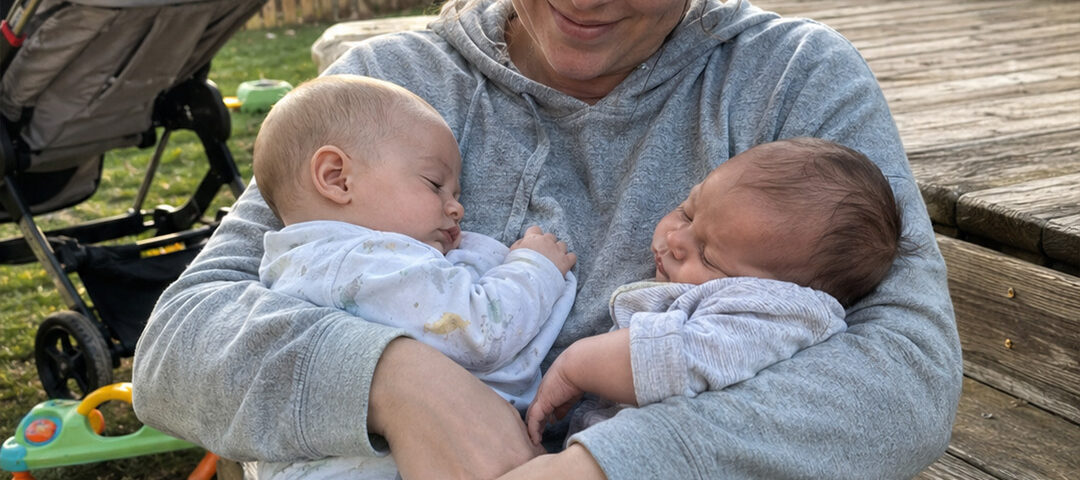
Daniel was asleep on the living room couch with Nora resting on his chest. June had finally stopped crying. Lucy—the one who had spit up on me—was staring at the ceiling fan as though it had personally offended her.
I should have thrown the invitation away.
Instead, I read Evan’s note three times.
Two years earlier, Evan Mercer had ended our engagement in the parking garage beneath Riverside Methodist Hospital.
I was forty-one then. He was forty-two.
We had been together for almost four years and engaged for nine months. We had reserved a ballroom at an upscale hotel in Dublin, Ohio, put down deposits with a photographer and caterer, and spent Sunday afternoons driving through Powell, looking at houses we could not quite afford.
Evan talked about children often.
He wanted two. A boy first, if possible, though he always laughed afterward and said he understood that people could not order babies like lunch.
His mother, Judith, never laughed.
She talked about the Mercer family line as though Evan had descended from European royalty instead of a family that owned a successful office-furniture business outside Columbus.
When my periods became irregular, I blamed stress and age. I had been overseeing a payroll software conversion at Buckeye Fresh Distribution, and I was sleeping five hours a night on a good week.
Still, after six months of trying to become pregnant, I scheduled an appointment at a fertility clinic.
The doctor was a calm woman with silver-framed glasses. She spoke slowly, which I appreciated because Evan had a habit of interrupting professionals the moment he believed he understood them.
She explained that my ovarian reserve was lower than expected and that my left fallopian tube appeared partially blocked.
“My chances of conceiving naturally are reduced?” I asked.
“Yes,” she said. “But reduced is not the same as zero.”
I remember that sentence clearly.
Evan apparently remembered only one word.
“So she’s infertile?” he asked.
The doctor turned toward him.
“Infertility is a broad diagnosis. It does not mean pregnancy is impossible. IVF may still be an option.”
Evan leaned back in his chair.
It was not a dramatic movement. Maybe two inches. But I felt those two inches as clearly as if he had crossed the entire room.
We had both completed testing, though not all the results had been reviewed. The doctor told us the clinic would contact us after the final laboratory work had been processed.
In the elevator, Evan stared at the illuminated floor numbers.
He did not touch my hand.
By the time we reached the parking garage, he was already talking about our life together as though it had become a bad investment.
“I’m forty-two, Clare,” he said. “I can’t spend years chasing something that may never happen.”
“We just received the first set of results. She said IVF. She said we had options.”
He opened his car door but did not get inside.
“I don’t want my whole marriage to become doctor visits, injections, and disappointment.”
I stared at him.
“You said you wanted a family with me.”
“I do want a family.”
There are sentences that take a second to hurt because your mind tries to protect you from what they mean.
“With me?” I asked.
Evan looked toward the concrete wall instead of answering.
Then he removed the key to my condominium from his key ring and placed it in the cup holder between the seats.
That was it.
No long argument. No final embrace. No promise to call after we had both calmed down.
Just a small brass key sitting beside an old parking receipt.
“What about your test results?” I asked.
“They were fine.”
“We haven’t even had the follow-up consultation.”
“My numbers were normal.”
He answered too quickly.
I did not understand the significance of that at the time.
I drove back to my condominium in Worthington with both hands locked around the steering wheel. I do not remember the radio station or the traffic.
I remember missing my exit and realizing I had been driving south for nearly fifteen minutes.
Judith arrived that evening.
She brought two reusable grocery bags filled with Evan’s clothes, his phone charger, shaving kit, and the gray sweater I had bought him for Christmas.
She remained in the doorway.
“I’m sorry it ended this way,” she said.
Her tone suggested she was sorry about the inconvenience.
“The doctor never said I couldn’t have children.”
“Clare, Evan has always wanted a family.”
“So did I.”
“At his age, he cannot spend years hoping a doctor changes her mind.”
“The doctor didn’t change her mind. You weren’t there.”
Judith gave me the patient expression she usually reserved for restaurant servers who brought her salad dressing on the wrong side.
“You’re a lovely woman, but marriage has to offer a man the future he planned for.”
Something inside me went very still.
“And if I can’t give him that?”
She adjusted the handle of one shopping bag.
“A woman who can’t give him a family doesn’t have much use in his future.”
Then she asked me to return the antique cake knife Evan’s grandmother had given us for the wedding.
I shut the door without answering.
For a long time, I sat on the floor beside those grocery bags. The condominium was so quiet that I could hear the kitchen clock ticking from the hallway.
I remember hating that sound.
My mother arrived around nine with her spare key.
Helen was sixty-eight and already having trouble with her right hip. She found me sitting against the wall and carefully lowered herself into a dining chair.
“I can’t get down there without calling the fire department,” she said. “So you’re going to have to come up here.”
I almost laughed.
Instead, I cried so hard that I could not breathe properly.
The weeks afterward were painful in ordinary, undignified ways.
I made a mistake in an insurance deduction at work and had to stay until nearly nine one evening, correcting the payroll records of twenty-seven employees.
I stopped returning calls from friends because everyone wanted details I could not explain without feeling humiliated.
Evan canceled the wedding venue before speaking to me.
Judith began telling people I had concealed my fertility problems until after Evan proposed. Evan claimed the deposits were not worth fighting over.
That sentence finally made me angry.
I pulled bank statements, contracts, and email confirmations. I documented exactly what I had paid and demanded my share back.
It took three weeks and one letter from an attorney, but I recovered every dollar.
It was not revenge.
It was simply the first time I refused to let Evan decide what I deserved.
Six weeks after the breakup, the fertility clinic called while I was eating lunch at my desk.
The nurse said they had been trying to contact Evan about a follow-up consultation. Because of medical privacy rules, she could not discuss his results with me.
Then she asked, “Did Mr. Mercer tell you his testing was complete?”
“He said everything was normal.”
There was a pause.
Not a theatrical pause. Just long enough for me to stop chewing.
“You should request a complete copy of your own chart,” she said.
After we hung up, I stared at my computer screen and thought about how Evan had answered me in the parking garage.
Too quickly.
For the first time, I wondered whether I had been the only person in that examination room carrying difficult news.
I requested my records the following morning.
The clinic sent them through a secure online portal: seventy-three pages of laboratory values, consent forms, insurance codes, and medical phrases that sounded much colder on paper than they had in the examination room.
I read everything twice.
Nowhere did the chart say I was sterile.
It said my ovarian reserve was diminished.
It said natural conception would be difficult.
It said IVF should be discussed because of my age and the partial blockage in my left fallopian tube.
Difficult.
Reduced.
Not impossible.
Evan’s results were not included. Of course they were not. They belonged to him.
But one sentence in the physician’s notes stayed with me:
Male-factor findings pending separate consultation.
I closed my laptop and sat very still.
For six weeks, I had walked around believing my body had ended our engagement.
Evan had allowed me to believe it.
Worse, he had helped other people believe it too.
I wanted to call him immediately. I wanted to ask what he knew and when he had learned it. I wanted to hear him struggle to explain the truth.
I wanted Judith to apologize.
Instead, I called a fertility center in Cincinnati and scheduled a second opinion.
Dr. Anita Shaw did not offer miracles.
I respected her for that.
She reviewed my records, asked detailed questions about my cycles, and explained that fertility treatment at forty-one carried lower success rates and greater medical risks.
She discussed medication, egg retrieval, embryo quality, pregnancy loss, cost, and the possibility that treatment would not work.
Then she folded her hands on the desk.
“No one should have told you motherhood was impossible,” she said. “Difficult, yes. Impossible, no.”
I cried in the parking lot.
Not because she had promised me a baby. She had not.
I cried because someone had finally told me the truth without turning it into a weapon.
At first, I wanted to begin treatment immediately.
I told myself it was because time mattered, and that was true. But during a required counseling appointment, the therapist asked a question I had not expected.
“If your former fiancé never learned whether treatment worked, would you still want to continue?”
I opened my mouth.
Nothing came out.
That silence embarrassed me more than I can explain.
Part of me wanted a child. I had wanted one for years.
But another part of me wanted proof.
Proof that Evan had been wrong.
Proof that Judith’s verdict had not been final.
Proof that I was still a woman with a future.
I postponed treatment for three months.
That was around the time Daniel Reyes came back into my life.
I had met him twice before through a school partnership program at work. He was an assistant principal in Westerville, the kind of man who wore practical shoes and kept two pens in his shirt pocket because one was always being borrowed.
We ran into each other at a CVS on State Street.
Both of us reached for the last box of alcohol wipes.
“You take them,” he said. “You got there first.”
“You’re sure?”
“I work in a high school. I’m used to losing arguments over supplies.”
I laughed before I could stop myself.
He was buying the wipes for his older sister, who was undergoing chemotherapy.
I was buying them because I had not completely abandoned the possibility of fertility treatment.
We talked for five minutes beside the pharmacy counter.
Nothing dramatic happened. He did not ask for my number under the fluorescent lights while someone waited behind us holding cough syrup.
We met again a month later at a community support group.
Daniel was there because his wife had died from ovarian cancer three years earlier.
I was there because my therapist had suggested that I learn how grief worked before I tried to outrun it.
After the meeting, Daniel admitted that he still spoke to his wife while driving.
“I tell her when traffic is bad,” he said, “as if she can do anything about I-270.”
“I still argue with Evan in the shower.”
“Do you ever win?”
“Always. He’s much less convincing when I control both sides of the conversation.”
That was how we started.
Coffee. Breakfast. Walks through Sharon Woods when the weather warmed.
Once, he came with me when I took my mother to an orthopedic appointment because her hip pain had become worse.
He never rushed me.
But he also did not flatter me when I needed honesty.
The first serious disagreement we had happened after I told him I intended to restart IVF.
We were sitting in my car outside a diner in Worthington. The windows had fogged from our coffee.
Daniel stared through the windshield for a moment.
“Can I ask you something without you getting angry?”
“That sentence usually means I’m about to get angry.”
“Do you want a child, or do you want Evan to know he was wrong?”
Heat rushed into my face.
“That’s insulting.”
“I’m not trying to insult you.”
“You think I would bring a child into the world as some kind of revenge project?”
“I think you were hurt badly. Hurt people sometimes confuse healing with winning.”
I reached for the door handle.
“Clare—”
I turned back before he could continue.
“You do not get to decide why I want to become a mother.”
“You’re right.”
“That didn’t sound like agreement.”
Daniel rubbed both hands over his face.
“I buried my wife, Clare. I know life is short. But I can’t build a family with you if part of you is still trying to prove something to him.”
I got out of the car and walked three blocks home in the cold.
We did not speak for almost two weeks.
During that time, I returned to counseling and asked myself questions I did not enjoy.
Would I continue if treatment failed?
Could I accept donor eggs if that became the medical recommendation?
Could I raise a child alone?
Was I trying to fill an empty place, or was I prepared to care for a real human being who would not exist to heal me?
Eventually, I called Daniel.
“I want a child,” I told him. “Not a witness. Not proof. A child.”
He was quiet.
Then he said, “I was afraid you would never call.”
“I was afraid you were right.”
“Those are not the same thing.”
“No. They’re worse.”
We did not rush after that.
We attended counseling together. We talked about money, health, guardianship, my mother, his grief, and whether either of us had enough energy to begin again in middle age.
We married at the Franklin County Courthouse ten months later.
There were eleven people at lunch afterward at Bob Evans.
My mother complained that the biscuits were dry.
Then she ate two of them.
My first IVF cycle failed.
The second produced two embryos suitable for transfer.
Dr. Shaw warned us carefully about the risks. After a long discussion, we chose to transfer both embryos.
One divided.
When the ultrasound revealed three heartbeats, Daniel made a sound somewhere between a laugh and a cough.
Dr. Shaw did not smile.
She immediately began explaining premature delivery, blood-pressure complications, growth restrictions, and the possibility of a long hospital stay.
She was right to be serious.
By twenty-nine weeks, my feet were so swollen that I wore Daniel’s slippers around the house. My hands went numb at night. I had reflux, back pain, and medical appointments nearly every week.
At thirty-two weeks, my blood pressure became dangerously high, and the doctors performed an emergency C-section.
Nora, June, and Lucy went directly to the neonatal intensive care unit.
For weeks, our lives were measured in oxygen readings, feeding tubes, tiny weight gains, and drives to the hospital before sunrise.
When we finally brought all three girls home, I believed nothing from my old life could reach me there.
I was wrong.
Four months later, Evan’s wedding invitation arrived.
It was for the same Dublin hotel where we had once planned our own ceremony.
Daniel read the handwritten message and looked at me.
“That isn’t an invitation,” he said. “That’s a man asking for an audience.”
I was about to tear the card in half when my phone vibrated.
The message came from a woman I had never met.
My name is Lauren Whitmore. I’m marrying Evan. I think he lied to both of us. May I speak with you?
PART TWO
I almost deleted Lauren’s message.
For ten minutes, I stared at my phone while June slept across my lap and Lucy argued with a pacifier she refused to keep in her mouth.
Daniel looked over from the dining table, where he was calculating hospital bills.
“You don’t have to answer.”
“I know.”
“You also don’t have to repair whatever is happening in their relationship.”
“I know that too.”
He nodded once and returned to his calculator.
That was one thing I appreciated about Daniel. He never confused supporting me with making my decisions for me.
I replied with one sentence:
Where would you like to meet?
Three days later, I drove to a Panera Bread in Worthington.
Lauren was already there.
She stood when I approached, then immediately sat again as though she had forgotten how chairs worked.
She looked nothing like the woman I had imagined.
She was not glamorous or cold. She simply looked tired.
A paper coffee cup sat in front of her, its contents clearly long since cold. She kept rubbing the edge of a large manila envelope with her thumb but did not open it.
“Thank you for coming,” she said quietly.
“I almost didn’t.”
“I probably wouldn’t have either.”
For several awkward seconds, neither of us knew where to begin.
Finally, she took a slow breath.
“My fiancé says you’re obsessed with him.”
“That must be disappointing. I haven’t thought about him nearly as much as he believes.”
The corner of her mouth almost lifted.
Almost.
Then she reached into the envelope and slid a folded invoice across the table.
It was from the same fertility clinic.
Evan’s name was printed at the top.
“I found this while we were moving into our house,” she said.
“What did he tell you?”
“First he said it was routine testing. Then he said the clinic had mixed up the paperwork. Then he claimed you had stolen private information.”
She looked directly at me.
“His story changes every time I ask.”
I nodded slowly.
“That sounds familiar.”
Lauren was not looking for gossip.
That became obvious within minutes.
She never asked what Evan’s medical diagnosis was. She did not ask whether he could father children.
Instead, she asked something far simpler.
“Did he blame everything on you?”
The question hung between us.
“Yes.”
She closed her eyes for a second.
“My doctor suggested that both of us repeat fertility testing before we began treatment. Evan refused.”
“What reason did he give?”
“He said I was almost forty and that we should begin with me.”
She laughed once.
It was not amusement. It sounded like someone setting down a plate that had already cracked.
“I’ve had blood drawn four times in six months,” she said. “Ultrasounds. Hormone panels. Every appointment. I went alone because he was always busy.”
I did not know what to say.
Part of me felt sorry for her. Another part wanted to protect myself.
“I can’t tell you anything about Evan’s medical records.”
“I don’t want you to.”
She looked me directly in the eye.
“I only need to know whether he lied to me about you.”
That was different.
I unlocked my phone.
The first thing I showed her was not a text message. It was my own medical summary from Dr. Shaw.
Lauren read silently.
“Diminished ovarian reserve,” she said. “Recommended IVF. No statement that pregnancy was impossible.”
She looked up.
“So you weren’t sterile.”
“No.”
“And he knew that.”
“He was sitting beside me when the doctor explained it.”
Then I opened the old text thread I had never been able to delete and handed her the phone.
She read one message, then another.
Mom thinks it’s better if people believe you hid it.
Several lines later, Evan had written:
No woman wants to marry a man with fertility issues. Don’t make this harder than it has to be.
Lauren continued staring at the screen.
“I was hoping these weren’t real.”
“They’re real.”
She returned the phone without another word.
For almost a minute, we simply listened to the espresso machine behind the counter.
Finally, she spoke.
“I’ve asked him about these messages.”
“What did he say?”
“That you edited them.”
I almost laughed.
“That’s creative.”
“He also told me you would probably try to stop the wedding.”
“I didn’t even know your last name until you contacted me.”
Lauren nodded.
“I believe that now.”
She explained what had happened during the previous month.
Every time she questioned Evan, his explanation changed.
First, he claimed he had never undergone fertility testing.
Then he admitted there had been one appointment.
After that, he insisted the results had been completely normal.
When Lauren asked why he refused to repeat the testing, he became angry and accused her of not trusting him.
“Judith only made things worse,” Lauren said. “She called me three different times.”
“What did she say?”
“She said you were emotionally unstable.”
I could not help smiling.
“That one’s new.”
“She said you couldn’t accept that Evan had moved on.”
I stirred my coffee slowly.
“Did she also tell you I manipulated him into proposing?”
Lauren blinked.
“No.”
“She told one of my coworkers that.”
Lauren sighed.
“I don’t know what to believe anymore.”
I studied her for a long moment before saying the only thing I knew with certainty.
“You don’t need to believe me.”
She frowned.
“You need to decide whether you trust the man you’re about to marry.”
When we stood to leave, I assumed that was the end of it.
It was not.
“Clare.”
I turned.
Lauren took a deep breath.
“I haven’t canceled the wedding.”
I waited.
“I want to ask him one more time in private.”
“That seems reasonable.”
“If he tells me the truth, nobody else ever has to know.”
I respected that.
She was not trying to humiliate him. She was trying to protect her own future.
Then she continued.
“If he lies again, would you come?”
I stared at her.
“To the wedding?”
“To the hotel.”
“Why?”
“Because I think he’ll say you fabricated everything.”
I folded my arms.
“You don’t need me to prove that he’s lying.”
“No.”
She shook her head.
“I need someone there who can tell me I’m not losing my mind.”
That sentence stayed with me for the entire drive home.
Daniel was unloading groceries when I pulled into the driveway. He listened without interrupting.
When I finished, he leaned against the kitchen counter.
“She sounds frightened.”
“She is.”
“Are you going?”
“I don’t know.”
He nodded.
“Good.”
I laughed.
“You’re happy I don’t know?”
“I’d be worried if you decided too quickly.”
The decision was made for me two days later.
Judith called.
I almost ignored it, but curiosity won.
“Clare,” she said sweetly. “I’m so glad you answered.”
“I doubt that.”
“I wanted to make certain you received the invitation.”
“I did.”
“I sincerely hope there are no hard feelings.”
There it was.
The voice she had always used at charity luncheons—soft enough to sound kind and sharp enough to leave a mark.
“I’ll think about attending.”
“Oh, I hope you do.”
She paused.
“One suggestion.”
“Yes?”
“You might feel more comfortable wearing something dark.”
I frowned.
“Why?”
“Dark colors are usually more forgiving.”
She allowed the sentence to linger.
“As women become older…”
My hand tightened around the phone.
She was not finished.
“The photographer has been instructed to capture candid reactions during the ceremony. Those always become everyone’s favorite photographs.”
There it was.
Not an invitation.
A performance.
She wanted photographs of me sitting alone while Evan married someone else.
After we ended the call, I stood in the kitchen without moving.
Daniel looked over.
“She made up your mind, didn’t she?”
I nodded slowly.
“Yes.”
The week before the wedding dissolved into complete chaos.
June developed an ear infection. Lucy emptied an entire bottle into the diaper bag. Daniel strained his shoulder lifting the double stroller into our SUV.
I tried on three dresses that no longer fit after the pregnancy.
One would not zip.
One pressed painfully against my C-section scar.
The third had a milk stain that refused to disappear.
Finally, I bought a simple navy wrap dress at Macy’s.
It was not glamorous. It was merely comfortable enough to wear while carrying babies.
On the morning of the wedding, I sat in the hotel parking lot with one hand still resting on the ignition.
“I don’t think I can do this,” I whispered.
Daniel looked at me.
“We can go home. We genuinely can.”
“We could order pizza.”
I smiled weakly.
“And never speak of these people again.”
He nodded.
Then he added quietly, “But don’t let fear make the decision for you.”
I sat there for another minute.
Finally, I opened the car door.
We entered the hotel lobby together.
Daniel pushed the stroller while I carried Lucy.
Nora had somehow kicked off one tiny shoe before we even reached the entrance.
Across the marble lobby, Evan stood halfway down the grand staircase, talking with two guests.
He looked up.
His smile disappeared.
Judith grabbed the railing.
At that exact moment, the bridal-suite door opened.
Lauren stepped out wearing her wedding gown.
She saw me.
Then she looked at my daughters.
For a second, she simply closed her eyes.
When she opened them again, she said quietly, “He told me you wouldn’t come.”
I met her gaze.
“He’s been wrong before.”
The ballroom did not become silent all at once.
It happened in pieces.
A woman near the guest book stopped in the middle of a sentence. Two men standing beside the bar turned their heads. Someone lowered a champagne glass without taking a sip.
Then the whispers moved across the room like a breeze through tall grass.
Daniel pushed the stroller beside me.
Nora was missing one shoe. June had a pink pacifier clipped crookedly to her dress. Lucy was chewing the corner of the wedding program with both hands.
I had imagined this entrance too many times during the drive.
In some versions, I walked inside perfectly composed, my dress fitting as though it had been made for me.
In others, Evan took one look at the girls and instantly understood everything he had lost.
Reality was less polished.
My hair had begun to frizz in the July humidity. There was dried formula near the hem of my navy dress, and I could feel my compression garment rolling downward beneath it.
I looked exactly like what I was: a forty-three-year-old mother of premature triplets who had slept four hours and had nearly stayed home.
Evan crossed the lobby before Lauren could reach us.
His face had turned pale, but his voice remained controlled.
“What are you doing here?”
I looked at him.
“You invited me.”
His gaze moved from my face to Daniel and then to the stroller.
“You brought three babies to my wedding.”
“The invitation said families were welcome.”
He stepped closer and lowered his voice.
“You think this is going to make me jealous?”
“No, Evan.”
I adjusted Lucy against my hip.
“I brought my family because you invited us.”
His jaw tightened.
Then he looked at the girls again.
“They’re yours?”
The question was so blunt that Daniel moved half a step forward.
I touched his arm.
“Yes,” I said. “They’re mine. All three. That is generally what triplets means.”
Daniel coughed into his hand to disguise a laugh.
Evan did not find it amusing.
“How?”
I stared at him.
“Their medical history is none of your business.”
Judith had reached us by then.
Her eyes moved directly to the babies.
“Were donor eggs involved?” she asked.
There was no greeting. No congratulations. Not even a token attempt at politeness.
I looked at her carefully.
“That question is exactly why I should never have allowed you to define me.”
For once, Judith had no immediate response.
Lauren stepped forward. Her hands were clasped tightly at her waist.
“Evan, we need to speak before the ceremony.”
“We already spoke.”
“No. You explained. I asked questions. Those are not the same thing.”
Her father, Robert Whitmore, appeared behind her.
He was a broad-shouldered man in his early sixties, with silver hair and the expression of someone who had already heard more than he liked.
The wedding officiant joined them, still holding his folder.
Lauren led Evan into a small conference room beside the ballroom. Robert and the officiant followed.
I remained in the hallway with Daniel and the girls.
“This may still end quietly,” Daniel said.
“I hope it does.”
I meant it.
I had not come to watch another woman’s wedding collapse.
I had come because she had asked for the truth before making the same mistake I once had.
Through the closed door, I could hear voices but not words.
Then Evan’s voice rose.
The door opened sharply.
He entered the hallway first.
“This is ridiculous,” he said. “You dragged my former fiancée here because you decided not to trust me.”
Lauren followed.
“I gave you four opportunities to tell me the truth.”
“I did tell you the truth.”
“You said you had never been tested.”
“I said the testing wasn’t relevant.”
“You said it never happened.”
“I said Clare exaggerated it.”
He looked toward me.
“This is what you wanted, isn’t it?”
Several guests had moved closer to the hallway. Conversations inside the ballroom had stopped.
I shifted Lucy higher against my hip.
“I wanted you to tell the truth two years ago.”
Evan pointed toward me.
“She edited those messages.”
Lauren’s expression did not change dramatically.
It simply became still.
“Open your phone,” she said.
“What?”
“Show me the conversation.”
“I changed phones.”
“Your messages are backed up.”
“I deleted them.”
“Why?”
“Because I don’t keep old conversations with women I’m no longer with.”
His voice was loud enough that the people near the ballroom doors could hear every word.
Daniel leaned toward me.
“Do you want to leave?”
I looked at Evan standing there in his tuxedo, still trying to turn me into the problem.
“Not while he’s telling my story for me.”
PART THREE
Lauren walked toward the microphone stand near the front of the ballroom.
She did not climb onto the stage or demand everyone’s attention.
She simply picked up the microphone because the room had become too crowded and confused for private explanations.
“I’m sorry,” she said, her voice trembling slightly. “The ceremony is being delayed.”
Several guests shifted in their seats.
Lauren continued.
“There is information Evan withheld from me concerning the family we were planning. I asked him privately more than once.”
Evan stepped beside her.
“This is a misunderstanding.”
Lauren looked at me.
I removed my phone from my purse and walked forward.
I did not give a speech.
I opened the old message thread and handed her the phone.
She read the first line aloud.
“Mom thinks it’s better if people believe you hid it.”
A murmur moved through the room.
Then she read the second message.
“No woman wants to marry a man with fertility issues. Don’t make this harder than it has to be.”
Evan’s expression darkened.
“Those messages are out of context.”
Robert spoke from behind him.
“What context makes either statement acceptable?”
Evan did not answer.
Judith stood abruptly.
“The clinic made far too much of one poor sample.”
The room became completely still.
Lauren turned toward her.
“You told me he had never been tested.”
Judith opened her mouth and closed it again.
“The result was inconclusive.”
“You said there was no test.”
“Evan was under tremendous stress at the time.”
Lauren’s voice remained quiet.
“Then why did he ask me to undergo months of testing while refusing to repeat his own?”
Judith’s patience finally broke.
“Because you’re nearly forty. It made sense to begin with you.”
Robert stepped forward.
“Did you intend to let my daughter believe the problem was hers?”
“There were options,” Judith said. “Donors. Procedures.”
She released a small, dismissive breath.
“There was no need to burden Lauren before the wedding.”
That was the moment everything changed.
Lauren looked at Evan, not at his mother.
“You were going to let me undergo treatment I might not need.”
Evan shook his head.
“We would have figured it out after I married you. Nothing was certain.”
“That was not your decision to make for me.”
I stepped closer, though my knees had begun to ache.
“His diagnosis was never the shameful part,” I said. “Mine wasn’t either.”
Evan looked away.
“The shame was allowing everyone to believe my body was the reason he left because he was frightened of what his own test might mean.”
I turned toward Judith.
“You called me useless because you believed I couldn’t give your son a child. But you were willing to let another woman carry the same blame merely to protect him.”
Then I looked directly at Evan.
“You didn’t leave because I was infertile. You left because telling the truth frightened you more than hurting me.”
Lauren reached up and removed her veil.
She did not throw it.
She folded it once and placed it carefully on a chair.
“I can handle a medical problem,” she said. “I cannot marry a man who makes women carry his fear for him.”
Then she removed her ring.
“The wedding is over.”
Robert asked Evan and Judith to leave.
Evan immediately began arguing about deposits, contracts, and money.
Judith rose too quickly. Her knee locked, and she stumbled against a chair.
Without thinking, I caught her by the elbow.
She stared at me, humiliated.
“I won’t let you fall,” I said quietly. “That does not mean I’ll allow you to hurt me again.”
Behind us, Lucy grabbed a dinner roll from Daniel’s plate and threw it.
The roll landed directly in a champagne glass near Evan.
Daniel leaned close to me.
“That one has your timing.”
I watched the bread slowly absorb the champagne.
“Unfortunately, she has your aim.”
Several guests laughed.
The tension eased just enough for people to breathe again.
The Whitmores decided to serve dinner because it had already been paid for, though no one seemed certain where to sit or what to say.
Before we left, Lauren approached me with a small velvet box.
Inside was a silver baby cup engraved with the words:
For Our Future Firstborn.
“He ordered it before he agreed to take another test,” she said.
I closed the box and placed it back in her hands.
“That belongs to whatever you decide comes next,” I told her. “It doesn’t belong to me.”
People imagine that after a moment like that, a person’s life changes overnight.
It does not.
The drive home was almost completely silent.
Daniel kept one hand on the steering wheel and rested the other lightly on the center console.
The girls had fallen asleep before we reached Interstate 270.
The stroller rattled softly in the back each time we crossed a seam in the pavement.
I stared through the passenger window at the familiar exits.
Worthington.
Westerville.
Home.
I had expected to feel victorious.
Instead, I felt tired in a way sleep could not repair.
When we pulled into the driveway, Daniel carried June inside first. I took Nora. Lucy remained asleep in her car seat until he returned for her.
We moved through the house almost without speaking.
Warm bottles. Fresh diapers. Tiny pajamas.
The ordinary work of loving three babies.
After everyone was settled, I walked into the laundry room.
A basket of clean towels waited to be folded.
I sat on an upside-down bucket beside the washing machine.
Then I cried.
Not because I still loved Evan. That chapter had ended long before.
I cried because, for nearly two years, a small part of me had believed everything he and Judith had said.
That I had failed.
That my body had made me less valuable.
That every woman younger than I was automatically possessed something I did not.
Those lies had lived inside me far longer than either of them deserved.
A few minutes later, the laundry-room door opened.
Daniel did not ask what was wrong.
He simply handed me a mug of peppermint tea.
“I’ve got the girls,” he said.
“You don’t have to.”
“I know.”
He smiled gently.
“But I want to.”
After he left, I remained there for another ten minutes, until I could breathe normally again.
PART FOUR
The weeks after the canceled wedding were surprisingly ordinary.
Lauren officially ended the engagement.
Her father helped her recover part of the wedding expenses through cancellation agreements and vendor credits.
She moved into a small apartment closer to the physical-therapy clinic where she worked and sent me one brief message.
Thank you for answering a stranger.
I replied:
Take good care of yourself.
That was the last conversation we had.
We never became close friends.
Life does not always work that way.
Sometimes two people simply help each other survive the same storm before walking in different directions.
Several mutual acquaintances called to apologize.
One woman admitted she had believed Judith’s version from the beginning.
“I should have asked you,” she said.
“You could have,” I answered.
Others never apologized.
Some quietly decided I had embarrassed Evan intentionally.
I stopped worrying about changing their minds.
Not every misunderstanding deserves another explanation.
Evan sent exactly one message.
It arrived shortly after ten one evening while I was rocking Lucy back to sleep.
You destroyed my future just to prove you could have children.
I studied the screen for a long time.
At first, I typed three paragraphs.
Then I erased them.
I wrote one sentence instead.
I didn’t destroy your future. I stopped helping you hide from it. Please don’t contact me again.
I blocked his number before he could answer.
For the first time in two years, I did not wonder whether I had been too harsh.
Boundaries always sound rude to people who benefited from there being none.
Life settled into something wonderfully unremarkable.
Daniel’s shoulder healed slowly with physical therapy. My wrists continued to hurt from lifting babies throughout the day.
The girls reached their milestones one at a time.
Nora studied every new face before deciding whether it deserved a smile.
June laughed at ceiling fans, grocery-store lights, and once at a potato sitting on the kitchen counter for reasons only she understood.
Lucy remained convinced that gravity was optional.
If an object fit in her hands, she threw it.
Spoons. Blocks. Socks.
Daniel joked that she was training for the major leagues.
Hospital bills continued arriving.
One of the girls needed additional physical therapy because she had been born prematurely.
Sleep came in small pieces rather than full nights.
Sometimes Daniel and I argued about ridiculous things.
Who had forgotten to buy formula?
Whose turn was it to wash the bottles?
Had we already paid the electric bill?
One evening, we spent twenty minutes searching the house for my glasses before discovering they were resting on top of my head.
Middle age did not disappear simply because life had become happier.
Neither did ordinary stress.
My mother finally underwent hip-replacement surgery that autumn.
She stayed with us for six weeks while she recovered.
She insisted that her walker was “the Cadillac of orthopedic equipment.”
Then she tied colorful ribbons to it so the girls would stop trying to chew the tennis balls attached to the back legs.
One afternoon, I found Helen slowly racing the walker across the living room while June squealed with laughter from her play mat.
“I believe I’m winning,” my mother announced.
“Against whom?” I asked.
“Arthritis.”
The answer was exactly the sort of thing she would say.
On the girls’ first birthday, our backyard filled with folding chairs, paper lanterns, and more family than I had realized we still possessed.
Daniel grilled hamburgers.
Helen supervised from a lawn chair, whether anyone requested her help or not.
The girls destroyed their tiny birthday cakes with astonishing efficiency.
Later that evening, while cleaning the kitchen, I opened the junk drawer to look for scissors.
Evan’s wedding invitation was still there.
I had forgotten about it.
The cream-colored envelope seemed strangely small.
I unfolded the card.
At the bottom was his handwritten message:
I hope you finally learned to be happy for other people.
I smiled.
Not because it was funny.
Because I realized he had accidentally given me the answer.
Happiness had never come from watching his life fall apart.
It came from standing in my own kitchen, listening to three little girls laugh while Daniel argued with my mother about whether hot dogs counted as leftovers.
I carried the invitation to the recycling bin.
Daniel looked up from loading the dishwasher.
“You keeping that?”
I dropped it into the bin.
“No.”
“You’re sure?”
I nodded.
“I don’t need reminders anymore.”
He smiled.
“I was hoping you’d say that.”
Before going to bed, I stood for a moment outside the girls’ bedroom.
Three cribs.
Three steady little breaths.
Three futures that belonged to them, not to my past.
Looking back now, I do not believe revenge gave me peace.
The truth did.
Evan’s medical diagnosis never made him a bad man.
Mine never made me a lesser woman.
What broke us was not infertility.
It was fear, pride, and the decision to protect one person’s image by sacrificing someone else’s dignity.
There are people who will take the most painful season of your life and use it to define your worth. They will speak with enough confidence that, eventually, their judgment may begin to sound like your own voice.
That is the deepest harm they leave behind.
Not the relationship that ended.
Not the invitations that never became weddings.
Not even the rumors repeated by people who should have known better.
The deepest harm begins when you accept another person’s fear as evidence that something is wrong with you.
For almost two years, I carried Evan’s fear as though it belonged to me.
I carried Judith’s contempt as though it were a medical diagnosis.
I believed my body had betrayed me when, in reality, the person beside me had chosen dishonesty over vulnerability.
Walking into that hotel with my daughters did not prove that I was more worthy because I had become a mother.
Motherhood was never the measure of my worth.
The girls were not trophies, evidence, or answers to an argument.
They were children.
They deserved to enter the world free from the burden of proving anything about the woman who gave birth to them.
That was the final lesson I needed to learn.
My future did not become valuable when three heartbeats appeared on an ultrasound screen.
It had always been valuable.
It was valuable when I sat alone beside Evan’s grocery bags.
It was valuable when I fought to recover the money I had paid toward our canceled wedding.
It was valuable when the first IVF cycle failed.
It was valuable when I walked three cold blocks home after Daniel told me a truth I did not want to hear.
It was valuable in the NICU, in the laundry room, in the courthouse, and in the ordinary kitchen where bottles waited to be washed.
The truth was never that Evan had left me because I was infertile.
The truth was that he had left because he could not face uncertainty without assigning blame.
And the most important truth was that his decision had never determined what I deserved next.
Healing did not begin when the wedding guests finally learned what happened.
It did not begin when Lauren removed her ring.
It did not begin when Evan saw the triplets.
Healing began when I stopped waiting for the people who had wounded me to explain why I was still worthy of love.
Sometimes the world never hears your entire story.
Sometimes the people who misjudged you never apologize.
Sometimes the person who caused the damage continues believing that your boundaries—not his behavior—were the real betrayal.
Peace does not require their understanding.
It requires yours.
So, if anyone has ever used your hardest season to define your worth, I hope you eventually find the courage to tell your own story instead.
Not because everyone will believe it.
Not because the truth will undo every loss.
But because sometimes healing begins long before the world understands what happened.
Sometimes healing begins the moment you stop believing the lies that were told about you.
Disclaimer: This story is a work of fiction created for entertainment purposes. Any resemblance to real persons, events, or places is coincidental.