Mia had always been the kind of child who apologized before she knew what she had done wrong.
She apologized when she dropped a spoon.
She apologized when adults spoke over her.
Image
She apologized when Sophie took the last cupcake at family gatherings and my mother told Mia to be gracious because Sophie was “sensitive.”
For years, I thought I was raising a polite daughter.
I did not understand that my family had been teaching her something uglier.
They had been teaching her to take up less space.
I am Eleanor, the oldest child in a family that loved the word responsibility as long as it pointed in my direction.
My sister Heather was the pretty one, the delicate one, the one who cried easily and was therefore handled carefully.
My brother Leo was the baby, which in my mother’s language meant exempt.
I was the useful one.
When I was twelve, I walked dogs for neighbors, cleaned garages, babysat toddlers, and saved my money in envelopes with the names of things I wanted written across the front.
A bike.
A school trip.
A winter coat I had seen in a catalog.
Somehow, those envelopes always ended up opened.
My parents never called it taking.
They called it helping.
“Family supports family,” my mother would say as she slid my cash into her purse for groceries or the light bill or one of Heather’s emergencies.
By the time I was grown, that sentence had become the wallpaper inside my head.
I married Thomas at twenty-seven, and even then, I was still sending money home.
Small amounts at first.
A hundred here.
Two hundred there.
Then my parents retired, Heather bought a house she could not quite afford, and Leo discovered that being short on rent became easier when he called me before calling anyone else.
I told myself I was lucky to be stable.
I told myself generosity was not weakness.
I told myself Thomas did not understand the history when he looked at my phone and said, “Eleanor, they don’t ask you. They assign you.”
He was right.
I hated that he was right.
Mia was born into that arrangement without my permission.
She learned early that Sophie got the first choice, the loudest praise, the seat beside Grandma, the better slice of cake.
Sophie was Heather’s daughter.
That explained everything, apparently.
My parents had a way of turning favoritism into concern.
Sophie needed encouragement.
Sophie was sensitive.
Sophie had big dreams.
Mia was sturdy.
Mia was practical.
Mia understood.
I used to be proud when people called my daughter mature.
Now that word makes my stomach twist.
Children should not have to be mature because adults are greedy.
The day everything changed was ordinary enough to make it worse.
It was a weekday evening, the kind where the kitchen still smelled faintly of dish soap and reheated soup.
Thomas was running late from work.
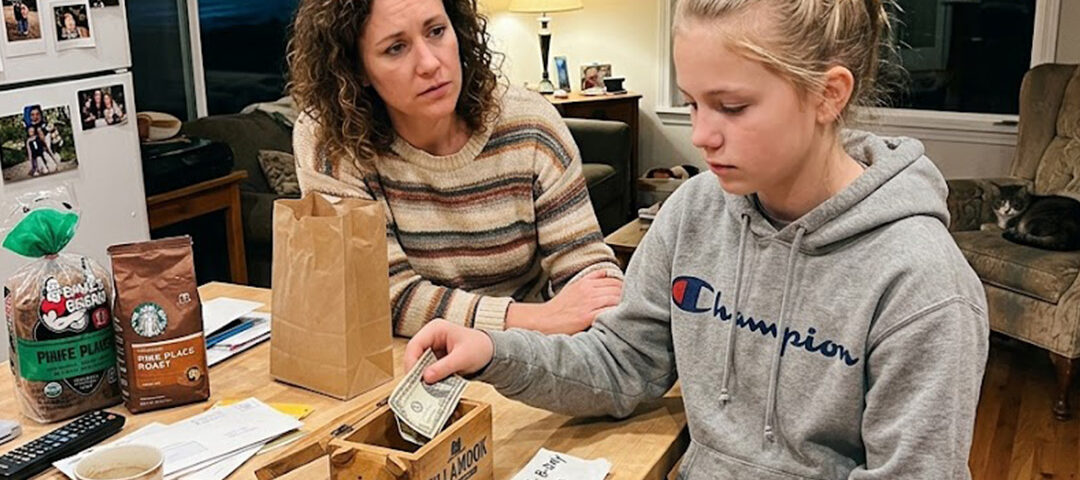
I came in through the side door with my purse sliding off my shoulder and found Mia sitting at the kitchen table.
Her palms were flat against the wood.
At first, I thought she was doing homework.
Then I noticed there were no books.
No pencils.
No laptop.
Just my daughter, sitting very still beneath the buzzing overhead light, trying to hide her hands.
“Hey,” I said softly. “What happened?”
Mia blinked once.
It was not the blink of a child surprised by a question.
It was the blink of a child measuring danger.
“I just worked,” she said.
I stopped in the doorway.
“Worked where?”
“Mrs. Novak’s house,” Mia said. “For three hours. She paid me $20.”
Mrs. Novak lived two doors down and sometimes paid kids to rake leaves or carry boxes from the garage.
She was not cruel.
She was old, practical, and direct.
But Mia’s hands told me this had not been a casual chore.
When she flexed her fingers, she winced.
Her knuckles were red.
The skin around her nails looked rubbed raw.
There were faint marks near one wrist, the kind that come from gripping buckets, scrubbing edges, and pushing past pain because stopping feels like failure.
I crossed the room slowly because I did not want to scare her.
“Mia,” I said, “why did you need money?”
She looked down at the table grain.
“It’s not for me.”
The refrigerator hummed behind us.
A drop of water ticked somewhere in the sink.
The little sounds felt too loud.
“Then who is it for?” I asked.
“It’s for Sophie.”
Sophie.
My niece.
Heather’s daughter.
My parents’ golden child by extension.
Mia swallowed and explained that everyone was collecting money for Sophie’s birthday present.
When I asked how much, she tried to make herself smaller before answering.
“One hundred dollars.”
I remember staring at her because the number made no sense inside the mouth of a twelve-year-old.
One hundred dollars is not pocket change to a child.
It is birthdays saved.
It is allowance counted twice.
It is a broken piggy bank and a neighbor’s dirty baseboards.
“Who told you that you had to pay?” I asked.
Mia whispered, “Grandma.”
My mother.
The word entered the room like a sentence.
“What exactly did Grandma say?”
Mia’s eyes filled.
She did not sob.
That would have been easier.
She tried to hold the tears in as if crying might make her debt worse.
“She said if I don’t contribute, I’m no longer family.”
For a moment, my mind refused to accept the sentence.
Not misunderstood.
Not misheard.
Refused.
There are things adults say in anger, and there are things that reveal the shape of their soul.
That was the second kind.
I sat beside my daughter and took one of her hands.
She tried to pull it back, embarrassed by the redness, but I held it gently.
“I didn’t ask you,” she rushed. “I thought it had to be my money. If you paid, it wouldn’t count. I broke my piggy bank, but it wasn’t enough.”
“How much did you have?” I asked.
“Ninety now,” she said. “I just need ten more.”
That almost broke me.
Not because of the amount.
Because she had done the math.
Because she had accepted the premise.
Because my daughter believed her place in the family could come down to ten dollars.
“You did nothing wrong,” I said.
She looked terrified by the kindness.
“I shouldn’t have told you.”
I stood up because if I stayed seated, I might cry in a way that would make her feel responsible.
I walked into the living room with my phone.
Part of me still wanted my mother to deny it.
Part of me wanted to hear confusion, shock, outrage at the misunderstanding.
Instead, she answered cheerfully.
“Hi, sweetheart. Everything okay?”
“Mom,” I said, “Mia told me you asked her for $100 toward Sophie’s present.”
There was a pause.
It was not the pause of surprise.
It was the pause of someone deciding how little shame to show.
“Yes,” my mother said. “That’s right.”
“She’s twelve.”
“So?” Mom replied. “Twelve-year-olds can work. They can learn.”
My pulse began to thud in my ears.
“Did you tell her if she didn’t pay, she was no longer family?”
“Yes,” my mother said, without hesitation. “She needs to learn what it means to support family. Financial obligation. Values.”
Values.
I looked toward the kitchen where my daughter sat with wounded hands.
My mother had turned cruelty into a lesson plan.
Something inside me went cold and still.
There are angers that burn.
This one froze.
“Okay,” I said.
My mother’s voice sharpened. “Eleanor—”
I ended the call.
At 6:41 p.m., according to the call log, I stood in the living room and understood my entire childhood differently.
I had not been responsible.
I had been trained.
The dog-walking money, the babysitting cash, the little envelopes taken “just this once,” the college fund that somehow never existed for me but appeared later for Heather and Leo.
It was not bad luck.
It was design.
Then I called Heather.
I still do not know why.
Maybe I wanted one person in that family to be decent before I did what I already knew I was going to do.
“Did you know Mia was asked to pay $100 toward Sophie’s birthday?” I asked.
“Oh, yeah,” Heather said, bright and casual.
My stomach tightened.
“Heather, she’s twelve.”
“It’s for something big,” Heather said. “Horse camp. Sophie’s best friends are going. Tuition is $900.”
“So your 12-year-old wants a $900 horse camp, and my 12-year-old is supposed to help pay?”
Heather sighed like I was making her explain a simple household rule.
“Come on. It’s only $100. Besides, Mia does little jobs now. She has income. She’s responsible, like you were. I thought you’d be proud.”
There it was again.
The family script.
Spoken cleanly.
Passed down to my child as if it were an heirloom.
“No,” I said.
Heather’s voice changed.
“No what?”
“My daughter is not paying for Sophie’s horse camp.”
“You’re so dramatic.”
“We’re not contributing.”
“Supporting family is a good thing, Eleanor.”
That sentence had lived in my bones for decades.
For the first time, it sounded ridiculous.
Service only sounds noble to people who benefit from it.
The moment you stop bowing, they call it betrayal.
I hung up.
Then I opened my banking app.
The recurring payments were lined up neatly, as if politeness could make them less obscene.
Mom and Dad mortgage, $450.
Heather mortgage top-up, $300.
Heather kids, $75.
Leo support, $100.
Family utilities, $60.
Five transfers.
Five little drains.
Five quiet proofs that I had been paying membership dues in a family that had just billed my daughter too.
I did not act impulsively.
That is important.
I took screenshots.
I downloaded the transaction history.
I saved the call log showing my mother’s number at 6:41 p.m.
I opened the account authorization page, read every line, and confirmed that every recurring transfer was controlled by me.
Then I canceled them.
One by one.
Cancel.
Confirm.
Cancel.
Confirm.
There was no speech.
No announcement.
No dramatic text.
Just consequences.
When Thomas came home, he found me at the computer with the bank page open and my face dry.
He stopped in the doorway.
“What are you doing?”
“Taking back control of my life,” I said.
His shoulders dropped.
Not in shock.
In relief.
Like he had been waiting years for me to say it.
Then Mia appeared in the doorway with a crumpled envelope.
“I have $90 now,” she said quickly. “I just need ten more. I can ask Mrs. Novak if she needs anything else cleaned.”
Thomas went very still.
I pulled a $10 bill from my pocket and placed it in Mia’s hand.
Her face opened with confusion.
“You’re not going,” I said. “You’re not paying. We’re not sending them a penny.”
“But Grandma said—”
“Mia, listen to me.”
I knelt in front of her so she would not have to look up.
“You don’t pay for love. If someone says your place in the family costs money, that is not love. That is a transaction.”
Her eyes filled again.
“Everyone’s going to be mad.”
“Let them.”
Then I opened the family group chat.
I typed one clean message.
Mia would not attend Sophie’s birthday because she was asked to pay $100 toward Sophie’s present, and I do not allow that.
We would not be coming.
I pressed send.
For three seconds, nothing happened.
Then my phone started ringing.
First my mother.
Then Heather.
Then Leo.
Then my father.
The phone vibrated against the kitchen counter so hard that Mia flinched each time it lit up.
That was the moment that made Thomas reach for it.
I shook my head.
“No,” I said. “Let them hear themselves panic.”
The group chat began to fill.
Mom wrote, “This should have stayed private.”
Heather wrote, “You embarrassed Sophie over nothing.”
Leo wrote, “Wait, are you seriously cutting everyone off?”
No one asked about Mia’s hands.
No one asked whether she was okay.
No one said, “We should not have done that to a child.”
Nobody moved toward accountability.
Then my father sent me a private message.
It was a screenshot of their mortgage account notice.
Under it, he wrote, “Your mother says you canceled tomorrow’s transfer. Fix this before the bank calls.”
There it was.
The real emergency.
Not Mia.
Not the $100.
Not the sentence my mother had spoken to a child.
The transfer.
I answered my mother’s next call on speaker.
Her voice came through sharp and breathless.
“Eleanor, you have no idea what you just did.”
Mia stood beside me with the envelope still in her hands.
Thomas stood behind her, one palm resting gently on her shoulder.
I looked at the phone.
“I know exactly what I did,” I said.
“You are punishing everyone over a misunderstanding,” my mother snapped.
“No,” I said. “I am ending an arrangement.”
Heather jumped onto the call a minute later, apparently patched in by my father.
Her voice was high and angry.
“Sophie is crying because you made her birthday about Mia.”
I almost laughed.
Not because it was funny.
Because it was perfect.
“Sophie’s birthday became about Mia when you decided my child should help pay for a $900 horse camp,” I said.
Heather said, “It was one hundred dollars.”
I said, “Then you pay it.”
Silence.
A long one.
The kind that tells you exactly where the truth is buried.
My father cleared his throat and tried the softer tone he used when money was involved.
“Eleanor, no one meant harm. Your mother used strong words, that’s all.”
“My daughter scrubbed a neighbor’s house until her hands hurt because Mom told her she would be no longer family.”
My mother said, “She needed motivation.”
Thomas made a sound behind me.
It was small, but I knew him well enough to hear the effort it took not to speak.
I held up one hand without looking back.
This was mine to finish.
“You don’t get another dollar from me,” I said.
My mother gasped like I had slapped her.
Heather started talking over her.
Leo demanded to know whether his support was included.
My father said my timing was cruel.
For years, I had imagined that if I ever stopped paying, there would be grief.
There was not.
There was outrage.
That difference taught me everything.
The next morning, I woke up to 53 missed calls.
Twenty-one from my mother.
Fourteen from Heather.
Nine from my father.
Seven from Leo.
Two from numbers I did not recognize, both cousins recruited for pressure.
There were also 38 text messages and one voicemail from my mother that began with crying and ended with the words, “After everything we did for you.”
I saved all of it.
Not because I planned to use it in court.
Not because I wanted revenge.
Because for the first time in my life, I wanted a record that I was not imagining the pattern.
Thomas made pancakes that morning.
Mia sat at the table wearing long sleeves even though the house was warm.
When I placed the plate in front of her, she looked at me and asked, “Am I still allowed to see Grandma?”
That question hurt more than the calls.
It reminded me that children can be wounded by people they still love.
I sat beside her.
“You are allowed to love people,” I said. “But you are also allowed to be safe from them.”
She looked down at her hands.
“They’re going to say I ruined everything.”
“No,” I said. “Adults ruined it when they made you responsible for their choices.”
The birthday party happened without us.
I know because Heather posted photos.
Sophie stood beside a cake shaped like a horse.
My parents smiled in the background.
No one mentioned the missing cousin.
No one mentioned the missing money.
But three days later, Heather texted me privately.
“You could have just said no without cutting off Mom and Dad.”
I replied, “I did say no. You all called because you noticed the money before you noticed Mia.”
She did not answer.
Leo tried next.
He wrote, “So I’m just supposed to figure things out?”
I wrote, “Yes.”
My father came last.
His message was longer.
He said I was making my mother ill.
He said family was not a spreadsheet.
He said money should never come between blood.
I stared at that line for a long time.
Then I typed back, “Tell Mom.”
After that, the calls slowed.
Not because they understood.
Because the old buttons stopped working.
My mother tried guilt.
Heather tried outrage.
Leo tried helplessness.
My father tried disappointment.
I did not respond to any message that did not begin with an apology to Mia.
None came.
That was its own answer.
A week later, Mrs. Novak knocked on our door.
She held a small paper bag and looked embarrassed.
“I heard there was trouble,” she said.
My stomach tightened because I thought she had come to defend my family.
Instead, she handed the bag to Mia.
Inside was a pair of soft cotton gloves and a jar of hand cream.
“I should have asked why you were so desperate for extra work,” Mrs. Novak said. “I’m sorry, sweetheart.”
Mia cried then.
Real tears.
Not the silent kind she tried to swallow.
Mrs. Novak hugged her carefully, and I had to turn away for a second because one neighbor had shown my daughter more tenderness than her own grandmother had.
That night, Thomas and I sat down with Mia and made a new rule.
No adult in our family was allowed to ask her for money.
No secret jobs.
No emotional invoices.
No “don’t tell your mother.”
If anyone made her feel that love had a price, she was to tell us immediately.
Mia listened seriously.
Then she asked, “What if they say I’m no longer family?”
I took her hands.
They were healing by then.
Still a little red, but no longer raw.
“Then they are telling us who they are,” I said.
It took months for the noise to settle.
My parents did not apologize.
Heather did not admit she was wrong.
Leo found another way to cover his expenses.
The world did not collapse because I stopped financing everyone’s emergencies.
That surprised me at first.
Then it freed me.
We used the money differently.
Some went into Mia’s savings account.
Some went toward therapy.
Some stayed in our checking account, untouched, because peace has a sound and sometimes it sounds like not bracing for the next request.
Mia did not go to horse camp.
Neither did Sophie, eventually.
Heather could not cover the full $900 without help, and my parents could not bridge the gap once my transfers stopped.
For a while, Heather blamed me for that too.
But the truth was simple.
A gift that requires another child’s pain is not a gift.
It is a warning.
The last time my mother tried to bring it up, she said, “You changed after that night.”
I said, “No. I noticed.”
She hated that answer.
I did not.
Because that night at the kitchen table, my daughter taught me what my own childhood had not.
You do not pay for love.
You do not earn your seat with sore hands.
And if someone says your place in the family costs money, that is not love.
That is a transaction.
My parents demanded that my 12-year-old daughter pay $100 towards a present for her cousin, and when she could not, my mother told her she was no longer family.
I did not shout.
I did not beg.
I simply stopped paying for a family that had forgotten how to love without charging admission.
If you came here from Facebook because of this story, return to the Facebook post, tap Like, and comment exactly “Amazing” to support the storyteller. That small action means more than it seems and gives the writer genuine encouragement to keep sharing more stories about family pressure, firm boundaries, and finally protecting what you worked so hard to build.
Disclaimer: This story is a work of fiction created for entertainment purposes. Any resemblance to real persons, events, or places is coincidental.