The funny thing about betrayal is that it rarely arrives like thunder. Most of the time, it comes quietly, wrapped in ordinary things.
A phone turned face down at dinner. A husband who starts showering the minute he gets home. A mother-in-law who smiles too brightly while watching you struggle to stand up from the couch.
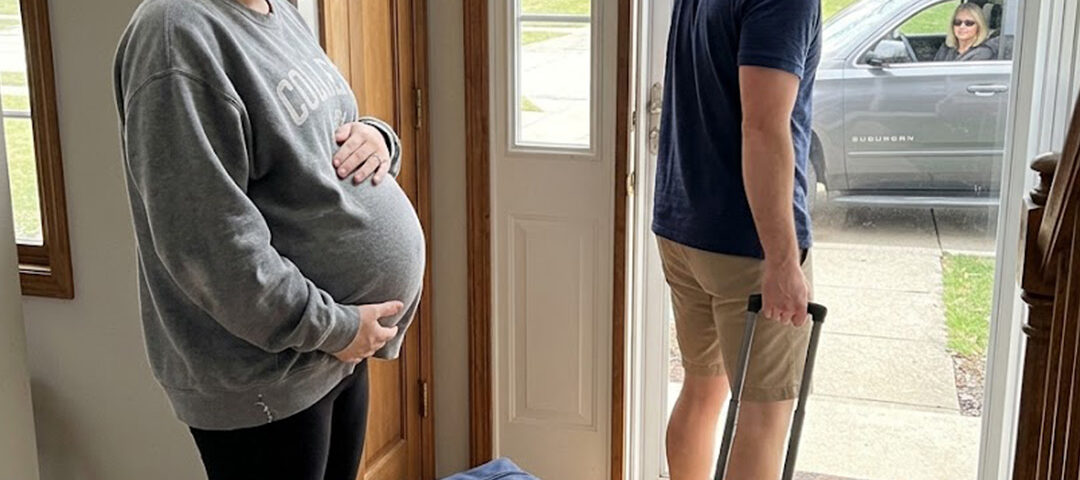
By the time Ethan rolled his suitcase into the hallway on a gray Thursday morning in March, I was 40 weeks pregnant, swollen from my ankles to my fingertips, wearing one of his old college sweatshirts because nothing else fit anymore.
The house smelled like burnt toast because I had forgotten the bread in the toaster while I was folding baby onesies at the kitchen table.
The hospital bag sat by the door, zipped and ready, with tiny socks tucked into the side pocket and a folder of birth documents in the front pouch.
Ethan stepped around it like it was clutter.
He was wearing khaki shorts, a navy polo, and the sunglasses his mother had given him last Christmas. He looked like a man heading to a golf resort, not a man leaving his wife on the day their first child might be born.
“Are you really doing this?” I asked.
I didn’t raise my voice. At that point in my marriage, anger felt too expensive. I had spent so many months trying to get Ethan to care that I had finally learned the exhaustion of begging someone to be decent.
He checked his watch.
“Madison, we talked about this.”
No, we hadn’t.
He had announced it 3 weeks earlier over dinner while I was trying to cut my chicken into pieces small enough to eat without getting heartburn.
His parents had invited him to a long weekend in Scottsdale, he said. His mother needed family time. His father had already booked the rental car. The flights were expensive.
I was 8 and 1/2 months pregnant then, and I remember staring at him across the table, waiting for the punchline.
“You’re not serious,” I’d said.
He didn’t even look embarrassed.
“Your due date is just an estimate.”
That was Ethan in one sentence. Careless, but always dressed up in practicality. If he could make something sound reasonable, he believed he was absolved from the cruelty underneath it.
That morning, his phone buzzed in his hand. He glanced down and smiled before quickly locking the screen.
I saw the smile.
Not the polite one he used for clients. Not the tired one he gave me when I asked him to assemble the crib.
This was soft, private, the kind of smile a man gives when he thinks no one is watching.
His mother’s silver SUV honked outside.
Ethan sighed as if I was making him late for something important.
“Look, if anything happens, just go to the hospital.”
I looked down at my stomach. Our son shifted under my ribs, slow and heavy, as if he had heard his father and was turning away from him, too.
“I might go into labor today.”
“Then call an Uber,” he said, picking up the handle of his suitcase.
I stared at him.
He must have seen something change in my face because, for the first time that morning, he hesitated.
But not enough to stay. Not enough to apologize. Not enough to be a husband.
Then he said the words that would become the hinge of the rest of my life.
“You’re on your own.”
His voice was flat, impatient, almost bored.
He said it the way someone might say, “The milk is expired,” or, “Don’t forget to lock the door.”
As if the mother of his child going into labor alone was not a crisis, but an inconvenience I should have planned around.
Then, because Ethan could never resist adding one final insult dressed as logic, he said, “The tickets are non-refundable.”
Outside, his mother honked again.
I saw her through the front window, sitting behind the wheel with her oversized sunglasses and perfect blonde bob, looking straight ahead, pretending she couldn’t see me standing there barefoot and pregnant in the hallway.
His father was in the passenger seat, scrolling through his phone.
Neither of them got out. Neither of them waved.
There was a time when that would have broken me.
A year earlier, I would have cried. 6 months earlier, I would have pleaded. Even 3 months earlier, I might have asked Ethan what I had done wrong, as if neglect was something I had earned.
But that morning, I only felt still.
Not calm, exactly.
Still, like the air before a tornado.
I looked at the suitcase. I looked at my hospital bag. I looked at the man I had married.
The man who used to bring me coffee in bed and kiss my forehead before work. The man whose name was still printed on the emergency contact form folded inside my bag, though not for much longer.
“I’m serious, Maddie,” he said. “Don’t start a fight.”
I gave him a slight nod.
“Okay.”
The word came out soft, almost gentle, and I could tell it relieved him.
He thought I had surrendered. He thought he had won the little domestic argument, the one where the tired pregnant wife finally stopped complaining and let the husband have his weekend.
That was another thing Ethan never understood.
Silence does not always mean weakness.
Sometimes silence is documentation.
He leaned forward like he might kiss my cheek, then thought better of it. Or maybe he noticed I didn’t move toward him.
Instead, he opened the front door and rolled his suitcase over the threshold.
The wheels bumped once against the step, and the sound was so ordinary, so small, that it somehow hurt more than shouting would have.
His mother finally looked toward the house.
She smiled at me through the windshield.
I smiled back, not because I liked her, because she had no idea what she had just helped set in motion.
After Ethan climbed into the back seat, the SUV pulled away from the curb and disappeared down our quiet suburban street, past the basketball hoop in the neighbor’s driveway, past the mailboxes and trimmed lawns and little American flags left over from President’s Day.
Everything looked normal.
That was the strangest part.
The world did not pause because my marriage had crossed a line it could never uncross.
I stood in the doorway for a few more seconds, one hand resting on my stomach, the other on the frame, and I listened until the engine faded.
Then I closed the door.
I locked it, and I walked slowly to the kitchen table, where my phone was charging beside a half-folded stack of newborn pajamas.
My hands did not shake when I picked it up.
I opened my contacts, scrolled past Ethan’s name, past his mother’s, past his father’s, and tapped the number I had saved under Rebecca Lawson, attorney.
She answered on the second ring.
“Madison.”
I looked at the hospital bag by the door, then at the empty hallway where my husband had just stood.
Chapter 3: Securing safety and rights
“He left,” I said.
There was a pause on the other end.
Not surprise, not confusion, just recognition.
“Today? Today? Are you safe?”
I swallowed.
That question nearly undid me because no one in Ethan’s family had asked it.
My own husband had not asked it. His parents had sat in the driveway and waited while he abandoned me on my due date.
But my attorney, a woman I had met only twice, asked if I was safe.
“Yes,” I said. “For now.”
“Good,” Rebecca said, and her voice became clear and steady. “Then we do exactly what we planned. No drama, no threats, no emotional texts. You protect yourself, you protect the baby, and you let his choices speak for themselves.”
I closed my eyes. The baby shifted again.
For the first time all morning, I took a full breath.
“Okay,” I whispered.
But this time, the word meant something different.
This time, it was not surrender.
It was the beginning.
Rebecca had given me one rule the first day I walked into her office.
“Never confuse revenge with self-p protection.”
At the time, I hadn’t fully understood what she meant.
Now I did.
I set my phone on the kitchen counter and looked around the house Ethan and I had bought 4 years earlier.
It wasn’t extravagant. A two-story colonial in a quiet suburb outside Columbus, Ohio, with white siding, a maple tree in the front yard, and a nursery we’d painted pale sage green only 6 weeks before.
Everyone thought it was our dream home.
Only I knew how lonely it had become.
I carried my hospital bag into the living room and lowered myself carefully onto the couch.
My back achd, my ankles throbbed, and every few minutes, my stomach tightened just enough to remind me that labor could begin at any moment.
I wasn’t panicking.
That surprised even me.
3 months earlier, I would have been terrified at the thought of giving birth without Ethan.
Now, I was terrified of giving birth with him.
Not because I thought he would hurt me, because I knew he wouldn’t be emotionally present even if he stood beside the hospital bed.
A husband who could leave on your due date had already abandoned you long before he packed his suitcase.
My phone buzzed.
Rebecca had sent one message.
Don’t answer any calls from him unless you want to. Everything can wait except your health.
I smiled faintly.
She had become more than my attorney over the past month. She was the first person who had looked at the facts instead of my excuses.
Because I had made plenty of excuses.
Ethan’s under stress. His mother is difficult. The baby will change everything.
Rebecca never argued.
She simply asked questions.
When was the last time he went to a prenatal appointment? When was the last time he asked how you were sleeping? When was the last time he chose you over his mother?
Those questions hurt because I already knew the answers.
6 weeks earlier, I had parked across the street from a little coffee shop downtown.
Ethan thought I was at another prenatal yoga class.
Instead, I was sitting across from Rebecca Lawson, a family attorney in her early 50s, with silver hair pulled into a neat bun and the calmst eyes I’d ever seen.
She listened while I spoke for nearly an hour about the missed doctor’s appointments, about the late nights, about the hotel receipt I’d found in Ethan’s briefcase, about the text message that had appeared on his Apple Watch while he was mowing the lawn.
Can’t wait until your trip. Miss you already.
The message disappeared before I could read the sender’s name.
He denied everything.
Said it belonged to a coworker. Said I was hormonal. Said pregnancy made women paranoid.
Rebecca waited until I finished.
Then she slid a box of tissues toward me.
“I believe you.”
Those 3 words nearly made me cry harder than discovering the affair because no one else had believed me.
Not Ethan.
Certainly not his parents.
His mother actually laughed.
“Oh, Madison,” she’d said over Sunday dinner. “Pregnancy hormones can make women imagine the strangest things.”
Ethan never corrected her.
He just kept eating his pot roast.
Rebecca opened a yellow legal pad.
“Let’s assume you’re right.”
I nodded.
“Let’s also assume you don’t have enough evidence yet to prove adultery in court.”
I nodded again.
“What do you want?”
The question caught me off guard.
I realized I had spent weeks thinking about what Ethan wanted, never what I wanted.
“I want peace.”
Rebecca smiled.
“Good.”
She wrote one word.
Preparation.
“From this moment forward,” she said, “everything you do is preparation, not punishment.”
Over the next month, I quietly followed every piece of advice she gave me.
I opened a checking account in my own name, not to hide money. My paycheck was already deposited there.
The joint account remained untouched except for household expenses.
Rebecca was very clear.
Judges don’t like financial games, so we played none.
I gathered every financial record we owned. Mortgage statements, insurance policies, retirement accounts, tax returns.
I scanned everything into encrypted folders.
Then I made paper copies, not because I expected Ethan to destroy them, because people often become unpredictable when they’re exposed.
I changed every password connected to my personal email, my medical portal, my retirement account, my cloud storage.
Again, not revenge.
Preparation.
The biggest change happened at my obstitrician’s office.
Dr. Patel noticed Ethan hadn’t attended my last five appointments.
“Everything okay?” she asked gently.
I surprised myself by telling the truth.
“My husband may not be available when I deliver.”
She didn’t ask for details.
She simply handed me a clipboard.
“We should update your emergency contacts.”
I stared at Ethan’s name for several long seconds.
Then I crossed it out.
My older sister, Clare.
Phone number. Relationship. Done.
Then came another form.
Who may receive medical information?
Clare. My parents. No one else.
Especially not Ethan’s parents.
The nurse looked at me.
“Are you sure?”
“Yes.”
“Would you like your chart marked private?”
I hesitated.
“What does that mean?”
“It means we won’t confirm whether you’re a patient here to anyone who calls.”
I signed the authorization.
One signature. One simple decision. One layer of protection.
Afterward, I sat in my car and cried for almost 15 minutes.
Not because I felt guilty, because I finally accepted the truth.
I was preparing for childbirth and preparing for divorce at the same time.
Chapter 4: Childbirth without a spouse
My contractions finally began around 9 that evening.
At first, they felt like the tightening I’d experienced for weeks.
Then another came stronger.
7 minutes later, another.
I started the timer on my phone.
6 minutes. 5.
My breathing stayed steady.
I wasn’t alone.
I had made sure of that.
I called Clare.
She answered on the first ring.
“It’s time.”
“I think so.”
“I’m leaving work.”
“You don’t have to speed.”
“I’m already grabbing my purse.”
She arrived 23 minutes later, carrying my favorite oversized hoodie and a paper bag from Panera.
“You forgot to eat lunch again, didn’t you?”
I laughed despite myself.
“You know me too well.”
She hugged me carefully.
“Ready?”
I looked around the living room one last time.
The framed wedding picture still hung above the fireplace. Ethan’s golf clubs leaned against the garage wall. His coffee mug sat beside the sink.
Everything looked exactly as he had left it.
Everything except me.
I picked up my hospital bag.
“Ready?”
Clare reached for it before I could.
“No,” she said softly. “You’ve carried enough.”
As we walked toward the front door, another contraction stopped me in the hallway.
I leaned against the wall, breathed through it, waited.
When it passed, I looked at the family photograph hanging near the staircase.
Ethan’s arm around my shoulders. Both of us smiling.
Taken before I learned how easily smiles can lie.
I turned the frame face down, not out of anger, out of acceptance.
Then Clare helped me into her SUV.
The night air was cold. The neighborhood was quiet.
As she backed out of the driveway, I glanced once at the dark windows of the house.
I didn’t know the next time I’d see it.
But I knew one thing with absolute certainty.
For the first time in a very long time, I wasn’t waiting for my husband to save me.
I was finally saving myself.
Clare drove with both hands on the wheel, the way she always did when she was trying not to cry.
The hospital was only 18 minutes away, but that night the distance felt strange and stretched, as if we were driving out of one life and into another.
The streets were wet from an earlier rain, and the red traffic lights reflected in long, trembling lines across the pavement.
I sat in the passenger seat with one hand pressed low against my stomach and the other gripping the door handle, breathing in the rhythm Dr. Patel had taught me during birthing class.
In for four, out for six.
Clare glanced over whenever another contraction came.
“Talk to me,” she said.
“I’m okay.”
“You don’t have to be okay with me.”
That nearly broke me because everyone else had made my pain feel inconvenient.
But Clare treated it like something worth making room for.
I closed my eyes as the contraction climbed, held, then slowly released.
“I’m scared,” I admitted.
“I know.”
“I thought he’d be there.”
“I know.”
Then she reached over at the next red light and squeezed my wrist.
“But he chose not to be. That’s not on you.”
The hospital entrance glowed ahead, bright and clean against the dark, and Clare pulled up to labor and delivery like she had rehearsed it.
Maybe she had.
She helped me out, grabbed my bag, and walked beside me through the sliding doors, matching her steps to mine.
At the front desk, a nurse with kind eyes looked up.
“Name?”
“Madison Walker.”
Her fingers moved over the keyboard.
Then she nodded.
“We have your chart marked private, Mrs. Walker. Your support person is Clare Benton.”
Clare lifted one hand.
“That’s me.”
The nurse looked back at me.
“Is that still correct?”
“Yes.”
“And the only approved contacts are Clare Benton and Robert and Elaine Miller.”
“My parents,” I said.
“Yes.”
“No one else?”
I felt the weight of that question.
Ethan’s name was not on the list anymore.
Neither were his parents.
Once, that would have felt cruel.
That night, it felt like locking a door before a storm.
“No one else.”
The nurse didn’t judge me.
She simply clicked a box and said, “All right, let’s get you checked in.”
Labor has a way of stripping life down to what is true.
There are no pretty lies in a delivery room.
There is pain and blood pressure cuffs and monitors and nurses who speak gently while doing necessary things.
There is the soft thump of a baby’s heartbeat filling the room, steady and miraculous, reminding you that even when your heart is breaking, another one is still arriving.
Clare stayed beside me through every hour.
She fed me ice chips. She held my hair when I got nauseous. She rubbed the spot at the base of my spine when the contractions became sharp enough to make me grip the bed rails.
She never told me to calm down.
She never told me I was overreacting.
She simply stayed.
Around midnight, my phone buzzed on the table.
Ethan.
I stared at the screen until it went dark.
Clare looked at me.
“Do you want me to answer?”
“No.”
A minute later, a text appeared.
Landed. Hotel is nice. Try not to stress.
I almost laughed.
Try not to stress.
I was 6 cm dilated, sweating through a hospital gown, and my husband was reviewing the hotel.
Another contraction hit before I could decide whether to cry or scream.
By the time it passed, the message didn’t matter anymore.
Ethan had become background noise to the most important thing happening in my life.
Chapter 5: Refusing access
At 3:42 a.m., my son was born.
He came into the world red-faced and furious, with a cry so strong the nurse laughed and said, “Well, he has opinions.”
They placed him on my chest, warm and slippery and impossibly real, and something inside me opened so wide it hurt.
I had imagined that moment with Ethan beside me.
I had imagined him crying, kissing my forehead, whispering that we did it.
Instead, Clare stood there with tears running down her cheeks, one hand over her mouth.
“Oh, Maddie,” she whispered. “He’s perfect.”
I looked down at my son’s tiny fist curled against my skin.
“Yes,” I said, and my voice shook. “He is.”
We named him Noah James Walker.
James was my father’s middle name, not Ethan’s.
I had chosen it weeks earlier, but had never said it out loud because every time I brought up baby names, Ethan said we had plenty of time.
We didn’t.
We never had as much time as he thought.
Later, after Noah was cleaned and swaddled, after the nurses dimmed the lights, and Clare finally convinced me to eat a few bites of toast, the hospital social worker came in with paperwork.
She was gentle, professional, and careful with her words.
“You don’t have to complete everything right this second,” she said. “But we’ll go over what we can.”
I looked at the forms.
Birth certificate information, emergency contacts, release permissions, insurance details.
Each page felt like a doorway, and for the first time in years, I was the one holding the key.
When the form asked for a primary emergency contact, I wrote Clare’s name.
When the hospital asked who could receive updates, I confirmed the list again.
When they asked whether I wanted visitors restricted, I said yes.
“Is there anyone specific we should be aware of?” the social worker asked.
“My husband’s parents,” I said quietly. “And my husband, unless I approve it.”
She nodded as if women said things like that more often than people wanted to believe.
“We’ll note it.”
I did not remove Ethan from fatherhood.
I did not lie.
I did not erase him from the truth.
But I stopped handing him access to me simply because he had once promised to love me.
That was the difference.
By morning, Rebecca had filed the first documents we had prepared.
Not a final divorce, not some impossible overnight victory, but a petition for legal separation and temporary protective boundaries regarding finances, medical communication, and custody discussions.
Everything was measured.
Everything was legal.
Everything was already ready.
She called while Noah slept in the bassinet beside me.
“How are you?” she asked.
I looked at my son, his mouth slightly open, his chest rising and falling beneath the blanket.
“Tired,” I said. “But clear.”
“Good. Then remember this part, Madison. You didn’t do this because he left. You did this because he gave you no safe reason to stay unprotected.”
I closed my eyes.
That was the truth.
Ethan had thought “You’re on your own” was a dismissal.
He thought it meant I would struggle, panic, and wait for him to decide when he felt like being a husband again.
But he had misunderstood me.
I was on my own.
So, I chose who stood beside me.
I chose who held my hand.
I chose who heard my son’s first cry.
And I chose, for the first time in my marriage, not to reward abandonment with access.
By the second evening, I was still in the hospital, sore and exhausted, learning how to feed Noah, while Clare dozed in the chair by the window.
My phone had filled with messages from Ethan, each one more irritated than the last.
Why didn’t you answer last night?
Mom tried calling the hospital. They said they couldn’t confirm anything.
What is going on, Madison?
This is childish.
Then finally:
Call me now.
I looked at Noah sleeping against my chest.
I did not call.
Not yet.
Because for once, Ethan could wait.
Chapter 6: Confronting the reality
By the time Noah was 48 hours old, I had learned two things.
First, newborns had no respect for clocks.
Second, neither did consequences.
Noah slept in bursts of 40 minutes, waking with a determined cry that somehow sounded both desperate and offended.
Every feeding felt like a lesson neither of us had studied for.
And every diaper change came with the strange realization that I was now responsible for another human being every second of every day.
It was exhausting.
It was terrifying.
And somehow, it was still easier than trying to hold together a marriage that had already fallen apart.
Clare was sitting by the window, and my phone buzzed again.
She looked up from the coffee she’d finally managed to heat in the hospital microwave.
“Him?”
I nodded.
I didn’t even have to look at the screen.
The vibration pattern had become familiar over the past day.
Message after message. Call after call, each one a little more demanding than the last.
Clare sighed.
“He’s persistent.”
“No,” I said quietly. “He’s confused.”
There was a difference.
A persistent man keeps trying because something matters.
A confused man keeps trying because he no longer controls the situation.
Ethan had spent years believing access to me was automatic.
Now it required permission.
He didn’t know what to do with that.
My phone lit up again.
Calling Ethan.
I let it ring.
Voicemail.
30 seconds later, another text arrived.
Mom says the hospital won’t tell us anything. Why would you do that?
I stared at the words for a long moment.
Not, “How are you?”
Not, “Is the baby okay?”
Not, “Are you safe?”
His first concern was that someone had finally told his mother no.
That alone answered every question I had once asked myself about our marriage.
Clare watched my face.
“What did he say?”
I handed her the phone.
She read the message, then slowly looked back at me.
“He still doesn’t get it.”
“No. He thinks this is about punishing him.”
I looked down at Noah sleeping against my chest.
“It isn’t.”
Because it wasn’t.
If I wanted revenge, I could have spent months screaming, exposing him on social media, calling every relative we had.
Instead, I had simply stopped giving him unrestricted access to my life.
That felt less like revenge and more like boundaries.
Rebecca arrived just after lunch, carrying a leather portfolio and a bouquet of yellow tulips.
“They’re from my garden,” she said. “Hospital gift shops overcharge.”
I laughed for the first time in days.
She leaned over the bassinet.
“So, this is Noah.”
She smiled.
“He’s handsome.”
“He has my nose and hopefully your judgment.”
Clare snorted into her coffee.
Rebecca pulled a chair closer to the bed.
“I won’t stay long.”
She opened her portfolio.
“The temporary filings were accepted this morning.”
I listened carefully.
Nothing dramatic, nothing impossible, exactly as she’d promised.
The petition for legal separation had been filed.
A request had been made to preserve marital assets until disclosure.
Financial accounts were protected from unusual withdrawals.
Nothing was frozen permanently. Nothing had been taken away.
It simply meant neither of us could make major financial moves without accountability.
“It protects both of you,” Rebecca explained. “And that’s exactly how the court will see it.”
I nodded.
“Good.”
She studied me for a moment.
“Any regrets?”
I looked at Noah. His tiny fingers stretched, then wrapped around one of mine.
“No.”
“Any desire to call him?”
I thought about it honestly.
“No.”
“Then don’t.”
She closed the folder.
“Let him experience uncertainty for once.”
That afternoon, I was discharged.
Clare loaded our bags into her SUV while I carefully buckled Noah into his car seat under the watchful eye of a nurse.
The nurse checked every strap twice.
“Looks good.”
Then she smiled at me.
“Congratulations, Mom.”
Mom.
Not wife.
Not abandoned wife.
Not victim.
Just mom.
The word settled somewhere deep inside me.
Instead of driving back to the house Ethan and I shared, Clare turned toward the small townhouse I’d leased 3 weeks earlier.
Rebecca had insisted.
“Have somewhere safe. Not because Ethan has ever been violent. Because emotional chaos is still chaos.”
The townhouse wasn’t fancy.
Two bedrooms, a tiny kitchen, cream-colored walls, a little fenced patio.
It smelled faintly of fresh paint and new carpet.
It wasn’t home. [clears throat]
Not yet.
But it was peaceful.
Clare carried in the bassinet while I walked slowly behind her with Noah.
My mother and father had already stocked the refrigerator.
Milk, soup, fresh fruit, lasagna.
The kind of quiet love that asked for nothing in return.
I stood in the middle of the living room holding my son.
No yelling. No tension. No wondering when Ethan would come home.
Just silence.
The good kind.
Meanwhile, 800 m away, Ethan’s vacation had ended much earlier than expected.
The photographs his mother kept posting online suddenly didn’t seem as enjoyable after none of my family responded.
He had expected me to cool off.
Instead, everyone had gone quiet.
His mother complained all morning.
“I don’t understand why she’s acting like this.”
His father shrugged.
“Pregnant women get emotional.”
Even then, they still didn’t understand.
It wasn’t emotion.
It was decision.
The flight home landed just after 4:00 in the afternoon.
By 5:30, Ethan’s truck pulled into our driveway.
The house looked exactly the way he’d left it.
He smiled to himself.
“See,” he thought. “She was just upset.”
He unlocked the front door, walked inside, and immediately knew something was different.
The nursery was still there.
The furniture remained. His clothes still hung in the closet.
Nothing had been destroyed. Nothing had been vandalized.
Nothing dramatic.
Yet somehow, the house felt empty.
He opened the refrigerator.
Less food.
He walked upstairs.
The dresser drawers on my side of the bedroom were empty.
Bathroom counter half empty.
Closet nearly bare.
His stomach tightened.
He picked up his phone.
Called me.
Straight to voicemail again.
Voicemail again.
Voicemail.
Then Rebecca’s business card caught his attention.
It was sitting neatly in the center of the kitchen island.
Under it, a large sealed envelope, his name in my handwriting.
Inside were copies of the legal filings, the petition, the financial preservation order, Rebecca’s contact information.
Nothing emotional.
No insults. No accusations.
Just documents.
Real. Official. Measured.
His hands began to shake.
For the first time since leaving 2 days earlier, he realized this wasn’t an argument.
It was a life changing without him.
He dialed my number again.
This time, I answered.
“What the hell is going on?” he shouted before I could speak.
His voice echoed through the quiet townhouse.
I looked down at Noah, sleeping peacefully against my shoulder.
Then I answered softly.
“I’m just doing what you told me.”
Silence.
“What?”
“You said I was on my own.”
Another long silence.
So I adjusted Noah’s blanket.
“I handled everything on my own.”
Before he could say another word, I ended the call.
Not because I hated him, because there was nothing left to explain.
Chapter 7: Mediation and regret
For the first time since the day we married, my peace mattered more than his understanding.
After I hung up, I expected to feel victorious.
Instead, I felt quiet.
Not because Ethan didn’t deserve the consequences of his choices.
He did.
But because revenge had never actually been the point.
I looked down at Noah, sleeping peacefully against my chest, his tiny fingers curled into the fabric of my hospital blanket, completely unaware that his first 2 days in the world had already changed the course of two lives.
He deserved better than parents who spent the next 18 years fighting.
So did I.
The following week settled into a routine that was both exhausting and strangely peaceful.
Every 3 hours, Noah woke hungry.
Every morning, Clare stopped by before work with coffee and groceries.
My parents rotated visits, never overstaying, never making me feel incapable.
My mother folded laundry while humming old country songs.
My father quietly assembled the changing table I’d ordered for the townhouse, pretending he wasn’t stopping every few minutes just to admire his grandson.
Life became wonderfully ordinary.
There were pediatrician appointments, sleepless nights, tiny newborn sneezes that somehow made everyone in the room laugh.
For the first time in months, I wasn’t constantly wondering what Ethan was doing.
I was too busy learning how to be Noah’s mother.
Rebecca checked in once a week.
“He’s contesting the separation?”
“No. The financial disclosures already completed. The temporary parenting plan, that’s where we’ll need to work together.”
I nodded.
That was always going to be the hardest part.
No matter what Ethan had done to me, Noah still deserved a father.
Just not the version of father Ethan had been becoming.
Nearly 6 weeks after Noah was born, we met for mediation.
The conference room wasn’t dramatic.
No courtroom. No television-style speeches.
Just a rectangular table, two attorneys, a mediator, and two people who had once promised to spend forever together.
Ethan looked older.
Not because 6 weeks had changed his face.
Because regret had.
His beard was untrimmed. The dark circles beneath his eyes hadn’t been there before.
He stood when I entered.
“Madison.”
I acknowledged him with a small nod before sitting down.
Rebecca placed a reassuring hand on my arm.
The mediator began by explaining the process.
Parenting schedules, financial responsibilities, communication expectations.
Everything focused on one question.
What serves the child’s best interests?
Not who wins.
That mattered.
Because this meeting wasn’t about revenge anymore.
It was about Noah.
When it came time to discuss visitation, Ethan surprised everyone.
“I know I missed his birth.”
His voice cracked.
“I can’t change that.”
No one spoke.
“I know I chose that trip.”
Another long silence.
“I’ve replayed that morning every single day.”
I believed him.
Not because his apology erased what happened.
Because real regret sounds different from self-pity.
It accepts responsibility without asking to escape it.
He looked directly at me.
“I was wrong.”
Simple.
Direct.
No excuses.
Not, “My mother pressured me.”
Not, “I was stressed.”
Not, “You misunderstood.”
Just, “I was wrong.”
For a moment, the room disappeared.
I saw the man I’d fallen in love with years earlier.
Not because he had returned, but because for the first time in a long time, he was telling the truth.
Rebecca waited for me to respond.
I took a slow breath.
“I don’t hate you, Ethan.”
His shoulders dropped ever so slightly.
“But I don’t trust you.”
He closed his eyes.
“I know.”
“And trust isn’t rebuilt because someone finally says they’re sorry.”
“I know.”
“You missed the day Noah was born.”
His eyes filled with tears.
“I know.”
“You’ll never get that day back.”
“I know.”
There it was.
The consequence.
Not imposed by a judge.
Not created by me.
Created by one sentence spoken on our front porch.
“You’re on your own.”
Those words had cost him something no court could ever return.
His son’s first breath. His first cry. The first time tiny fingers wrapped around an adult hand. The first photograph. The first family moment.
Money couldn’t buy those memories.
Law couldn’t restore them.
Neither could forgiveness.
Some losses simply become part of who we are.
Over the next several months, Ethan did something I hadn’t expected.
He kept showing up.
Not for me.
For Noah.
Every scheduled visit. Every pediatric appointment I invited him to. Every parenting class the mediator recommended.
He even began setting boundaries with his parents.
When his mother insisted she deserved unsupervised time with Noah, Ethan quietly told her no.
“Not until Madison is comfortable.”
Apparently, consequences had taught him something that comfort never did.
Respect.
Our divorce became final just under a year later.
There was no dramatic courtroom battle.
No screaming. No public humiliation.
We divided our assets fairly, sold the house, and each moved forward.
Chapter 8: A new beginning
On the day the judge signed the final order, Ethan met me in the courthouse parking lot after everything was finished.
No attorneys, no mediator.
Just the two of us.
“I’ve wanted to ask you something.”
I adjusted Noah on my hip.
“What?”
“That day?”
He swallowed.
“When I called you.”
I already knew which call he meant.
“What did you mean when you said, ‘I’m just doing what you told me’?”
I smiled sadly.
“I meant exactly that.”
He frowned.
“You told me I was on my own.”
I shifted Noah’s diaper bag onto my shoulder.
“So I stopped waiting for you.”
His eyes searched mine.
“I chose who supported me. I chose who protected me. I chose what kind of future our son would have.”
I paused.
“And for the first time in our marriage, I chose myself.”
He looked down at the pavement for a long time.
Finally, he nodded.
“You did.”
Then, almost in a whisper, he said the words I’d once spent years hoping to hear.
“I’m proud of you.”
A year earlier, those words would have meant everything.
Now, they were simply kind.
And kindness, unlike love, asks for nothing in return.
I wished him well.
He wished us well.
Then we walked toward different cars, different lives.
Neither of us won.
Neither of us truly lost.
But one of us learned too late that love is not maintained by promises.
It is maintained by presence.
Years later, when Noah was old enough to ask why his father didn’t live with [clears throat] us, I never told him his dad abandoned us.
I told him something simpler.
“Your father made a very painful mistake. But people are more than the worst thing they’ve ever done. And the most important thing isn’t whether someone falls, it’s whether they learn to stand back up with honesty.”
As for me, the hardest part wasn’t raising my son without a husband.
It was realizing I’d been raising my marriage alone long before Ethan ever walked out the front door.
The day he told me I was on my own, he unknowingly gave me permission to build a life where I never had to beg someone to stay again.
And that was the only revenge I ever truly needed.
If this story touched your heart, I’d love to hear what you think.
Have you ever seen someone mistake love for something that would always be there, only to realize its value after it was gone?
Share your thoughts in the comments.
Your story may encourage someone else who needs hope today.
And if you enjoy heartfelt stories about resilience, justice, and second chances, please consider subscribing and joining us for the next journey.
Thank you for listening, and take good care of yourself and the people who choose to stand beside you.
If you came here from Facebook because of this story, return to the Facebook post, tap Like, and comment exactly “Amazing” to support the storyteller. That small action means more than it seems and gives the writer genuine encouragement to keep sharing more stories about family pressure, firm boundaries, and finally protecting what you worked so hard to build.
Disclaimer: This story is a work of fiction created for entertainment purposes. Any resemblance to real persons, events, or places is coincidental.