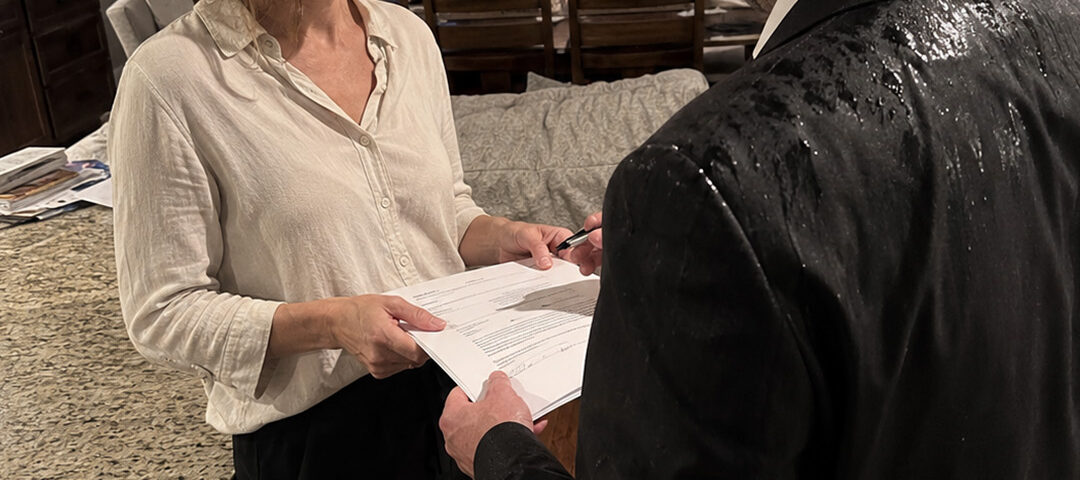
My husband handed me divorce papers 3 hours after we buried my brother.
He stood in my kitchen wearing the same black suit he had worn to the funeral, loosened tie hanging around his neck, rainwater still clinging to the shoulders of his coat, and he looked at me with the cold confidence of a man who believed the world already belonged to him.
Then he said the words that destroyed the last illusion I had left about my marriage.
“I’m going to marry your brother’s wife. Sign the papers, Emily.”
I stared at him for a long moment, then smiled softly and picked up the pen.
30 days later, Ryan Miller was on his knees screaming my name in a downtown Chicago law office because he had finally realized what my brother knew before he died.
Greed makes people blind, and blind people walk willingly into cliffs.
The day we buried Daniel Carter, the sky over Neapville looked like cracked steel. Cold rain drizzled across the cemetery in thin gray lines, coating umbrellas, black coats, and polished shoes with a dull sheen that made everything feel lifeless.
I stood beside my brother’s grave with my hands folded in front of me while the pastor spoke about generosity, leadership, and legacy, but I barely heard a word after they lowered the casket into the ground.
Daniel had been 42 years old, too young to die, too disciplined to die, honestly.
My brother woke up at 5 every morning, ran three miles, even during Illinois winters, and scheduled his annual physicals like clockwork.
Then one drunk driver crossed the median outside Aurora and crushed his SUV headon.
Just like that, the strongest person I had ever known became a photograph beside a coffin covered in white liies.
People from Carter Freight Solutions filled nearly half the cemetery. Drivers, warehouse supervisors, accountants, dispatch managers.
Daniel remembered every employees birthday, every sick child, every mortgage struggle. Men twice his age cried openly beside the grave because my brother had helped them keep their homes during the recession.
Ryan stood beside me during the service with one hand resting lightly against my back, performing grief the way some people perform prayer in public, carefully, visibly, without sincerity.
Looking back now, I realize he never once squeezed my shoulder. Never once asked if I was okay.
His eyes wandered constantly toward Vanessa.
Vanessa Carter, Daniel’s widow, tall, elegant, dark-haired, wearing oversized sunglasses despite the rain.
She held a white handkerchief beneath her nose and cried quietly through most of the service, though something about her sadness felt distant to me, rehearsed almost like someone trying to imitate emotion after seeing it in a movie.
At the time, I hated myself for even thinking that.
Grief makes you suspicious of everybody.
After the funeral reception ended, people slowly returned to their lives. Cars disappeared from the church parking lot one by one while evening settled across the suburbs.
Ryan drove us home in silence, one hand on the steering wheel, the other scrolling through his phone whenever we stopped at red lights.
I watched rain slide across the passenger window and thought about Daniel teaching me how to ride a bicycle when I was 7 years old.
He had run behind me down our old neighborhood street, shouting encouragement while I screamed in terror.
Even after I crashed into a mailbox, he laughed, picked me up, brushed dirt from my knees, and told me something I never forgot.
“Fear passes faster than regret, Emmy.”
He was the only person who still called me Emmy.
When we pulled into our driveway, Ryan got out without waiting for me.
I noticed how quickly he walked toward the house, almost impatiently, like a man rushing toward an appointment.
The moment we entered the kitchen, he loosened his tie and tossed a thick envelope onto the granite countertop.
“You should read those tonight,” he said flatly.
I stared at the envelope.
“What is this?”
“Divorce papers.”
For a second, the room lost sound.
The refrigerator hum disappeared. Rain against the windows vanished. Even my breathing seemed to stop.
I looked up slowly.
“What?”
Ryan exhaled like an exhausted businessman forced to repeat simple instructions to an employee.
“Come on, Emily. We both know this marriage hasn’t worked for years.”
“My brother was buried today.”
“I know that.”
The coldness in his voice frightened me more than the words themselves.
He walked toward the liquor cabinet, poured himself bourbon, then leaned casually against the counter.
“Honestly, this is probably the best time to do it. Clean break, fresh start for everybody.”
I kept staring at him, waiting for the punchline, for guilt, for humanity.
None came.
Then he said the sentence that made my stomach turn.
“I’m going to be with Vanessa.”
I blinked once.
“Daniel’s wife?”
“Widow,” he corrected calmly. “Now she’s a widow.”
I remember gripping the edge of the counter because suddenly I felt physically unsteady.
“How long?” I whispered.
Ryan took a sip of bourbon before answering.
“A while.”
“A while,” I repeated hollowly.
“We didn’t plan for any of this to happen, Emily.”
That lie almost made me laugh.
There are tones people use when they rehearse excuses beforehand, and Ryan had clearly practiced this conversation in his head many times.
“You were always so emotionally dependent,” he continued. “Vanessa understands ambition. She understands what I want out of life.”
I stared at the man I had spent 11 years married to and realized I had never truly known him.
Ryan Miller came from nothing. Student loans, unstable jobs, bounced between apartments throughout his 20s.
Daniel gave him a position at Carter Freight Solutions when we got married, mentored him personally, promoted him twice, trusted him with clients worth millions.
And now, 3 hours after we buried my brother, Ryan was drinking bourbon in my kitchen while talking about replacing me with my dead brother’s wife.
“You’re unbelievable,” I whispered.
“No,” he said quietly. “I’m honest.”
Then he delivered the final blow with astonishing cruelty.
“You were never built for the life I want.”
Not angry. Not shouting.
Just cold calculation.
I expected myself to cry, maybe scream, maybe throw the glass sitting beside the sink directly into his face.
Instead, something inside me became strangely calm because suddenly I remembered a voicemail Daniel left me two nights before he died.
I hadn’t listened to it yet.
My brother rarely called without texting first. The voicemail notification was still sitting unopened in my phone.
Ryan slid the papers closer to me.
“Just sign them. We can avoid dragging this out.”
I looked at the documents.
Illinois no fault divorce. Waiver clauses. Asset separation.
Fast, efficient, prepared in advance, which meant he had planned this before Daniel died.
That realization settled over me slowly, like ice water filling my lungs.
Ryan watched me carefully, probably expecting hysteria.
Instead, I picked up the pen.
His eyebrows lifted slightly.
“Seriously?” he asked.
I smiled faintly.
“Fine.”
Then I signed my name.
For the first time all evening, Ryan looked surprised.
“You’re taking this better than I expected.”
I slid the papers back toward him.
“You seem eager to leave.”
He gave a small shrug.
“No point pretending anymore.”
No guilt. No shame.
He actually looked relieved.
Ryan grabbed the envelope, finished his bourbon, and headed upstairs to pack a suitcase while I remained standing alone in the kitchen, listening to drawers opening and closing above my head.
40 minutes later, he walked downstairs carrying luggage.
At the front door, he paused.
“You’ll be okay eventually,” he said.
It sounded less like comfort and more like dismissal.
Then he left.
I waited until his car disappeared down the street before pulling my phone from my pocket.
My hands trembled as I opened Daniel’s voicemail.
There was a long pause before my brother spoke.
His voice sounded tired.
“Emmy, if you’re hearing this, something probably happened before I got the chance to explain things myself.”
I stopped breathing.
Then Daniel said quietly, “Don’t trust anyone until Richard Lawson reads the will.”
For 3 days after Ryan left, I barely slept.
Not because I missed him.
That part surprised me the most.
I kept waiting for heartbreak to arrive in full force, for the devastation of losing my husband to finally crush me beneath its weight.
But instead, I felt something colder, heavier, more complicated.
It was the feeling people get when they survive a car accident and suddenly replay every ignored warning sign from the last 10 miles of road.
Because once the shock faded, memory became merciless.
Ryan’s late nights at the office. His sudden obsession with designer suits. The expensive watch he claimed came from a sales incentive program.
The way Vanessa laughed too hard at his jokes during company dinners.
All of it rearranged itself into something ugly and obvious.
I spent most of those first days alone in the house, walking from room to room in silence while spring rain battered the windows.
Friends called constantly, offering condolences for Daniel, concern about the divorce, casserles I never touched, but I ignored nearly everyone except my mother.
Even then, I didn’t tell her the truth.
At 70 years old, after losing her son, she didn’t deserve another wound.
Meanwhile, Ryan and Vanessa weren’t hiding anything anymore.
Not even a little.
A picture appeared on Facebook 4 days after the funeral.
Vanessa sat beside Ryan at Gibson’s steakhouse downtown, holding a wine glass while he smiled at the camera with one arm around her waist.
Someone had tagged the location.
Someone else had commented, “Beautiful couple.”
Beautiful.
I stared at that word for a long time.
Daniel had been dead less than a week.
By the following weekend, they were posting photos from Lake Geneva.
Boat rides. Expensive cocktails. Smiling beneath blankets beside outdoor fire pits.
Ryan wore Daniel’s navy cashmere coat in one picture, the coat my brother bought in Milan during a business trip 3 years earlier.
That nearly broke me.
Not because Ryan looked happy.
Because Daniel had trusted him completely.
There is something uniquely horrifying about betrayal after death.
The dead cannot defend themselves, cannot revise mistakes, cannot withdraw love from people who no longer deserve it.
The dead remain loyal forever.
The living do not.
On the seventh morning after the funeral, I drove to Carter Freight Solutions for the first time since Daniel’s death.
The headquarters sat just outside downtown Chicago, a six-story glass building Daniel purchased after expanding the company nationwide.
He started with three delivery trucks and a rented warehouse in Joliet.
20 years later, the company handled freight contracts across six states.
I parked underground and sat inside my car for almost 10 minutes before forcing myself upstairs.
The moment I stepped onto the executive floor, conversation stopped.
Not dramatically.
Just enough for me to feel it.
People looked at me with sympathy first, then discomfort, because corporate offices survive on gossip the same way small towns survive on weather.
Everybody already knew Ryan moved in with Vanessa.
Everybody.
Megan, Daniel’s longtime assistant, hurried toward me, looking furious on my behalf.
“Oh my God,” she whispered, hugging me tightly. “Emily, I’m so sorry.”
I nodded weakly.
“How bad is it around here?”
Megan glanced toward the corner offices before lowering her voice further.
“Ryan’s been acting like he already owns the place.”
That tightened something in my chest.
“What does that mean?”
“He’s been sitting in Daniel’s office every day.”
Of course he had.
Megan hesitated.
“And Vanessa’s been here too.”
I closed my eyes briefly.
The cruelty of some people has no bottom.
Megan guided me toward the conference room and handed me coffee while quietly filling me in.
Ryan had started inserting himself into leadership meetings despite technically holding only a regional sales position.
Vanessa had apparently begun discussing future restructuring ideas with senior staff as though she were preparing to become executive leadership.
They were moving fast.
Too fast.
Almost like people terrified of losing momentum.
That thought stayed with me.
When I finally walked into Daniel’s office, I nearly turned around immediately.
Everything still smelled like him.
Cedarwood cologne. Coffee. Paper. Cold Chicago air drifting through partially opened blinds.
His framed Northwestern diploma hung beside photographs from company charity events, and his desk remained perfectly organized because Daniel believed clutter reflected weakness of thought.
But one thing had changed.
Ryan sat behind my brother’s desk, in my brother’s chair, wearing my brother’s coat.
The sight made my stomach physically twist.
Ryan looked up from a spreadsheet and smiled casually, as if none of this were insane.
“Emily,” he said smoothly. “You should have called first.”
I stared at him in disbelief.
“What are you doing in here?”
“Working.”
“This was Daniel’s office.”
“Somebody has to step up.”
The arrogance in that sentence stunned me.
Ryan leaned back comfortably.
“Honestly, the company needs stability right now. Employees are nervous.”
“You’re a sales executive, not a CEO.”
“Titles change.”
I looked around slowly, noticing several folders stacked beside him.
Financial reports. Investment documents. Acquisition proposals.
Ryan had already started digging through everything.
“Did Daniel authorize this?” I asked quietly.
Ryan smirked faintly.
“Daniel’s gone, Emily.”
The way he said it, cold, practical, almost impatient, made something shift permanently inside me.
I suddenly understood my brother’s voicemail differently.
Don’t trust anyone until Richard Lawson reads the will.
Not if.
Not be careful.
Don’t trust anyone.
Ryan stood and walked around the desk slowly.
“Look, you should probably focus on healing right now. Let the people who understand business handle the company.”
The condescension would have enraged me weeks earlier.
Now it only sharpened my attention.
“Interesting,” I said softly.
“What is?”
“You suddenly acting like this company belongs to you.”
His expression flickered briefly.
Only for a second.
But I saw it.
Fear.
Tiny, hidden, gone immediately afterward.
Ryan folded his arms.
“Vanessa inherited Daniel’s estate.”
There it was.
The assumption underneath everything.
He thought Vanessa controlled Daniel’s fortune.
And through Vanessa, he thought he would control it too.
I nodded slowly, as though considering the idea seriously.
Then I asked the question that changed the atmosphere completely.
“Did Daniel know about you two before he died?”
Ryan’s jaw tightened instantly.
“That’s not relevant.”
“That wasn’t my question.”
Silence stretched between us.
Then Ryan looked away first.
Interesting again.
Before either of us spoke further, someone knocked lightly on the office door.
Richard Lawson stepped inside.
Tall, silver-haired, impeccably dressed.
Daniel’s attorney.
For nearly 15 years, Richard had the calm demeanor of a man who spent his life around wealthy people behaving badly.
His eyes moved from me to Ryan very carefully.
“Mr. Miller,” he said politely. “I’ll need a private word with Emily.”
Ryan looked annoyed but forced a smile.
“Of course.”
As he walked past Richard, I noticed something subtle.
Richard did not shake his hand.
The door closed behind Ryan.
Richard waited several seconds before speaking.
“You listened to the voicemail?”
“Yes.”
He nodded once.
“Good.”
My pulse quickened.
“What’s going on?”
Richard removed a thick envelope from his leather briefcase and placed it gently on Daniel’s desk.
“Your brother made several changes shortly before his death,” he said carefully. “And he instructed me very specifically not to discuss them until 30 days had passed.”
“Why 30 days?”
Richard studied me for a long moment.
“Because,” he said quietly, “your brother believed people reveal their true character when they think they’ve already won.”
The 30 days passed slowly for me and recklessly for Ryan.
That difference mattered.
Pain tends to make careful people quieter, more observant, more patient.
Greed does the opposite.
Greed makes people loud, sloppy, overconfident.
By the fourth week after Daniel’s funeral, Ryan was practically walking through Chicago like a man already crowned king.
And Vanessa encouraged every second of it.
They hosted dinners in Daniel’s house—I still refused to think of it as theirs—and filled the dining room with people who had barely attended my brother’s funeral.
Young investors. Shallow socialites. Real estate brokers. Self-important men who used words like leverage and disruption while drinking $1,200 whiskey beside the fireplace where Daniel once sat reading biographies on winter nights.
Megan kept me informed whether I asked or not.
“They’re redecorating the office,” she told me one afternoon over coffee. “Ryan removed Daniel’s family pictures.”
I stared at her across the cafe table.
“What?”
“He said the company needs a forward-looking identity.”
For a moment, I honestly thought I might throw my coffee directly into the street.
But then another emotion settled in instead.
Calm.
Because Richard Lawson had finally started returning my calls, and every conversation with him deepened the same quiet suspicion growing inside me.
Daniel had known.
Maybe not everything, but enough.
Richard never explicitly said it over the phone.
Attorneys like Richard Lawson survived because they understood precision.
Yet every carefully chosen sentence pointed toward the same truth.
Daniel had spent the last months of his life preparing for something.
Or preparing me.
On the morning of the will reading, Chicago woke beneath low gray clouds and sharp spring wind rolling off Lake Michigan.
I stood inside my bedroom for nearly 20 minutes trying to decide what to wear, which felt ridiculous considering my entire life had collapsed within a single month.
Still, appearances mattered that day.
Not because I wanted revenge.
Because I suddenly understood Daniel had expected strength from me.
So I chose simplicity.
Black slacks. Cream-colored blouse. Minimal jewelry.
No performance. No visible grief.
Just composure.
When I arrived at Lawson and Green downtown, reporters were already gathered outside the building entrance.
Apparently, rumors about Daniel’s estate had spread through local business circles.
Carter Freight Solutions was worth far more than most people realized, and wealthy dead men attracted curiosity the way blood attracted sharks.
Inside the elevator, I caught my reflection in the mirrored wall and barely recognized myself.
30 days earlier, I would have entered that office terrified.
Now I felt strangely steady.
By the time I reached the conference floor, Ryan and Vanessa had already arrived.
Of course they had.
Ryan stood near the windows wearing a charcoal suit Daniel once helped him buy for a corporate fundraiser.
Vanessa sat beside the conference table in a fitted black dress, legs crossed elegantly, diamond earrings catching the overhead lights.
They looked like a couple posing for a luxury magazine advertisement.
Then Ryan noticed me.
The smile on his face carried open triumph.
“Well,” he said casually. “You actually came.”
I ignored the comment and took a seat across the room.
Vanessa studied me over folded hands.
“How are you holding up, Emily?”
The fake concern in her voice was almost impressive.
I looked directly at her.
“Better than expected.”
Ryan chuckled softly.
“That’s good. Healing matters.”
Healing.
The man sleeping with my dead brother’s widow was giving me emotional advice.
I might have laughed if the situation weren’t so grotesque.
Richard Lawson entered precisely at 9:00, carrying several folders.
His expression remained unreadable as always, though I noticed he greeted me first.
“Emily.”
Then a brief nod toward Ryan and Vanessa.
“Mr. Miller. Mrs. Carter.”
Vanessa straightened immediately.
“Will this take long?”
Richard sat at the head of the conference table.
“That depends entirely on how everyone behaves.”
Something in his tone caused Ryan’s smile to fade slightly.
Good.
Richard opened a folder, slowly adjusting his glasses before speaking.
“Daniel Carter amended his estate documents 12 days before his death. These amendments were witnessed, notorized, and legally verified under Illinois law.”
Ryan leaned back comfortably.
“Makes sense. Daniel was always organized.”
Richard ignored him.
“The estate includes Carter Freight Solutions, multiple investment accounts, real estate holdings in Illinois and Wisconsin, retirement assets, and several charitable trusts.”
Vanessa’s posture sharpened almost imperceptibly.
Then Richard delivered the sentence that changed everything.
“Under the revised terms of Daniel Carter’s will, the sole controlling beneficiary of the estate is Emily Carter.”
Silence.
Complete silence.
Ryan blinked once.
Vanessa frowned slightly, as though she had misheard.
I simply stared at Richard.
“The company,” he continued calmly, “including all executive authority and majority ownership shares, transfers immediately to Ms. Emily Carter.”
Ryan laughed suddenly.
A short, disbelieving sound.
“Okay,” he said. “Very funny.”
Richard looked at him flatly.
“Mr. Miller, nothing about estate law is funny.”
Vanessa’s face drained of color first.
“That’s impossible,” she whispered.
Richard slid documents across the table.
“You may review the amended filings yourself.”
Ryan snatched the papers aggressively, scanning pages faster and faster while confusion twisted into panic across his face.
“No,” he muttered. “No, this doesn’t make sense.”
“It makes perfect sense,” Richard replied.
Ryan slammed the documents onto the table.
“Vanessa was his wife.”
“Yes,” Richard said calmly, “and Daniel provided generously for her personal support through a separate trust. However, operational control of all primary assets belongs exclusively to Emily Carter.”
Vanessa turned toward Ryan slowly.
I watched the exact moment fear entered both their faces.
Real fear.
Not embarrassment. Not disappointment.
Fear.
Because suddenly their future looked very different from the fantasy they had built together.
Ryan stood abruptly.
“Daniel would never do this.”
Richard folded his hands.
“Actually, he did.”
Then Richard opened another folder.
“There is also a recorded statement.”
My pulse quickened instantly.
Ryan’s expression darkened.
“Recorded statement?”
Richard pressed a button on a small remote.
The television screen at the far end of the conference room flickered on, and suddenly my brother appeared.
Daniel sat behind his office desk wearing a navy sweater, looking exhausted but focused.
The video timestamp showed it had been recorded 4 days before his death.
For one terrible second, grief punched the air from my lungs.
Because there he was.
Alive. Breathing. Looking directly into the camera.
“If you’re watching this,” Daniel said calmly, “then Richard was right, and things became ugly after I died.”
Ryan slowly sat back down.
Daniel continued.
“I spent years believing loyalty could be earned through generosity. I was wrong.”
The room felt frozen.
Then Daniel looked directly into the camera with devastating clarity.
“Ryan, I know you’ve been stealing from the company.”
Ryan went pale instantly.
“And I know about Vanessa.”
Vanessa covered her mouth.
I closed my eyes briefly.
Daniel knew all of it.
Every disgusting detail.
“I stayed quiet because I needed proof,” Daniel continued, “and because I wanted my sister protected before the truth surfaced.”
Ryan suddenly exploded from his chair.
“This is—”
Richard’s voice turned razor sharp.
“Sit down.”
Ryan ignored him completely.
“He manipulated this!” Ryan shouted, pointing at me. “Emily manipulated him!”
I almost pitied him then.
Almost.
Because desperate people become transparent very quickly.
Richard calmly opened another file.
“There’s one more matter,” he said.
Ryan turned toward him, breathing heavily.
“During your divorce filing,” Richard continued, “you voluntarily signed a full marital asset waiver, relinquishing future claims connected to Emily Carter’s holdings.”
Ryan stared blankly.
Then realization hit him hard.
I watched the exact second he understood what he had done.
He had rushed through the divorce, believing I was worthless, believing Vanessa held the fortune, believing he had already traded up.
But Daniel had left everything to me.
Everything.
The house. The company. The investments. Even the executive accounts Ryan had been using for weeks.
Ryan’s face turned white.
“No,” he whispered.
Richard’s expression never changed.
“Effective immediately, all unauthorized access to Carter Freight Solutions accounts and properties will be terminated.”
Vanessa slowly looked at Ryan like she was seeing him for the first time.
And Ryan looked at me, not with love, not even hatred.
With terror.
Ryan Miller unraveled faster than I expected.
Not publicly at first.
Men like Ryan rarely collapse all at once.
They crack in stages, like ice weakening beneath too much weight.
At the law office, after Richard finished speaking, Ryan kept insisting there had to be another version of the will, another account, another explanation that would restore the future he thought he deserved.
There wasn’t.
Daniel had prepared everything carefully.
Every signature. Every transfer. Every legal protection.
My brother had built freight routes across half the Midwest.
Planning was second nature to him.
He understood risk better than anyone I’d ever known.
And somewhere during the final months of his life, he realized the greatest threat to his company was sitting across the dinner table pretending to be family.
Vanessa left first.
That part still amazes me.
Not because she walked away.
People like Vanessa always walk away once comfort disappears.
But because of how quickly she did it.
One moment, she sat beside Ryan in stunned silence, staring at the estate documents with trembling hands.
The next, she quietly stood, collected her designer handbag, and looked directly at him with something close to disgust.
“You told me the company was practically yours already,” she said coldly.
Ryan looked at her desperately.
“Vanessa, wait.”
“No,” she snapped sharply. “You said Daniel trusted you.”
“I can explain this.”
But she was already backing away from him.
For the first time since Daniel’s funeral, I saw Vanessa without performance, without glamour, without practiced elegance.
Beneath the expensive clothes and polished appearance stood a deeply practical woman realizing she had invested herself in the wrong man.
Then she looked at me.
Not apologetically. Not kindly.
Simply calculating whether speaking to me still held value.
Apparently, it didn’t.
She walked out without another word.
Ryan stared after her like a man watching the last rescue boat leave a sinking ship.
And somehow, even then, he still didn’t fully understand why his life was collapsing.
That was the frightening part.
People consumed by greed rarely believe they are greedy.
They see themselves as ambitious, deserving, smarter than everybody else.
Ryan genuinely believed he had earned Daniel’s success simply because he stood close enough to touch it.
But proximity is not ownership.
Richard ended the meeting shortly afterward.
Security representatives from Carter Freight Solutions arrived quietly to collect Ryan’s building credentials, company laptop, parking access card, and executive account permissions.
The humiliation happened with brutal professionalism.
No shouting. No scene.
Just procedure.
Ryan looked at me repeatedly during the process, searching for softness, searching for the woman who used to protect him whenever life became difficult.
But that woman had disappeared somewhere between the cemetery and the law office.
Outside the building, cold wind whipped through downtown Chicago while reporters shouted questions from behind barricades.
I ignored them and headed toward the parking garage, but footsteps rushed behind me before I reached the elevator.
“Emily!”
Ryan grabbed my arm hard.
I turned slowly.
Up close, he looked terrible already.
Sweat coated his forehead despite the cold weather, and panic had replaced the confidence he wore for the past month like expensive cologne.
“You knew,” he said breathlessly.
“No,” I answered honestly. “I suspected.”
His grip tightened slightly.
“Emily, listen to me.”
I pulled my arm free immediately.
“Don’t touch me again.”
For several seconds, neither of us spoke.
Then Ryan lowered his voice.
“We can fix this.”
I almost laughed.
“Fix this?”
As though betrayal, greed, humiliation, and adultery were accounting errors that could simply be corrected with paperwork.
“You moved into my brother’s house 4 days after his funeral.”
Ryan swallowed hard.
“I made mistakes.”
“You slept with his wife while he was alive.”
His eyes darted away briefly.
“You told me I wasn’t built for the life you wanted.”
“Emily, please.”
“No,” I interrupted quietly. “Now you finally understand who wasn’t built for it.”
That landed.
I saw it because Ryan’s greatest fear was never poverty.
It was insignificance.
The elevator doors opened behind me, and I stepped inside without another word.
The doors closed on his face.
3 days later, Carter Freight Solutions officially terminated Ryan’s employment following an internal financial review.
Daniel had been right.
Money had disappeared from several client accounts over the previous year.
Not enough to trigger immediate alarms, but enough to establish fraud once investigators followed the paper trail carefully.
Ryan hadn’t stolen millions.
Just enough to feel powerful.
Just enough to believe nobody would notice.
The criminal investigation remained private initially, though rumors spread quickly inside Chicago business circles.
Invitations stopped arriving.
Calls went unanswered.
Men who once slapped Ryan on the back at corporate parties suddenly avoided eye contact whenever his name surfaced.
Social status in America is far more fragile than people admit.
One scandal, one lawsuit, one public humiliation, and entire friendships evaporate overnight.
Vanessa vanished from social media almost immediately after the will reading.
According to Megan, she moved out of Daniel’s house within a week.
Apparently, she and Ryan lasted exactly 9 days after discovering the truth about the estate.
9 days.
That was the grand love story that destroyed my marriage.
Meanwhile, I spent nearly every waking hour inside Daniel’s company trying to hold my life together.
The first weeks terrified me.
I understood accounting operations, payroll structures.
Daniel involved me in the business for years, but leading an entire company felt overwhelming.
Executives watched me carefully during meetings.
Some were supportive.
Others clearly doubted whether the grieving younger sister could handle what Daniel built over two decades.
But grief changes people.
Especially women.
People often mistake kindness for weakness until circumstances force kindness to become discipline.
I started arriving before sunrise, reviewing contracts, meeting department heads, walking warehouse floors in Joliet and Rockford, listening more than speaking.
And slowly, something unexpected happened.
Employees began trusting me.
Not because I was brilliant.
Because I cared the way Daniel cared.
Truck drivers stopped me in loading docks to tell stories about how Daniel once paid medical bills for injured employees.
Warehouse managers shared ideas nobody bothered presenting to Ryan because he never listened unless profits were attached.
For the first time in years, I realized I wasn’t invisible.
I had simply spent too much of my life standing beside louder people.
Then, one rainy Thursday evening in late May, Ryan appeared outside my house.
I saw him through the front window before he knocked.
He looked thinner already.
Older.
The expensive suits were gone, replaced by wrinkled clothes and exhaustion.
Rain soaked his hair while he stood beneath the porch light, staring at the door like a man approaching a church after years without faith.
Part of me considered pretending I wasn’t home.
Instead, I opened the door halfway.
“What do you want?”
Ryan’s voice cracked immediately.
“I lost everything.”
I stared at him quietly.
Not because I enjoyed his suffering.
Because I remembered the version of him I once loved.
And there is something deeply unsettling about watching a familiar face become unrecognizable.
“You made choices,” I said calmly.
Tears filled his eyes suddenly.
Real tears this time.
“I was stupid.”
Yes, I thought.
He swallowed hard.
“I thought success would finally make me enough.”
That sentence lingered between us.
Because underneath the greed, underneath the arrogance, Ryan had always carried enormous insecurity.
Daniel’s success fascinated him because Ryan confused wealth with worth.
He believed money could erase shame, erase failure, erase the fear of being ordinary.
It never can.
“I loved you,” he whispered desperately.
I looked at him for a very long time.
Then I answered with complete honesty.
“I think part of you did.”
That hurt him more than anger would have.
Ryan stepped closer, his voice suddenly breaking.
“Please, Emily. Please give me another chance.”
And then, there on the wet front porch, beneath cold Illinois rain, Ryan Miller dropped to his knees, crying, begging, destroyed by the same greed he once mistook for ambition.
But the moment that stayed with me forever wasn’t his apology.
It was what happened next.
His eyes drifted past me into the living room, landing on the framed photograph sitting above the fireplace.
Daniel smiling beside us during Christmas 3 years earlier.
Ryan stared at that picture and finally understood the full weight of what he had betrayed.
Ryan stayed on his knees for several seconds after the silence settled between us, rain dripping from his hair onto the wooden porch beneath him, shoulders trembling beneath a cheap gray jacket that looked nothing like the tailored coats he used to wear to charity gallas and executive dinners.
For the first time in 11 years, he looked honest.
Not impressive. Not charming. Not ambitious.
Just honest.
Broken people usually are.
I stood there holding the door half open while cold wind pushed damp air into the house, and somewhere in the distance thunder rolled softly across the suburbs.
Ryan wiped his face with shaking hands, trying to regain enough dignity to continue speaking, but the words seemed trapped inside him now.
Good.
Some truths should hurt on the way out.
“Emily,” he whispered again, voice raw. “I know I don’t deserve forgiveness.”
“No,” I said quietly. “You don’t.”
He lowered his head immediately.
That answer landed harder than shouting ever could have.
For a moment, I almost pitied him again.
And that frightened me more than anger.
Compassion can be dangerous when directed toward people who mistake mercy for weakness.
I understood that now in ways I never had before.
Ryan looked up slowly.
“I would do anything to fix this.”
I studied him carefully.
“You can’t.”
Another painful silence followed.
Then I opened the door slightly wider and handed him an umbrella leaning near the entryway.
“Go home, Ryan.”
His face crumpled completely at those words because I think he finally understood something devastating in that moment.
He no longer had one.
Not really.
Daniel’s house belonged to the company trust now.
Vanessa had vanished from his life.
Most of his friends disappeared the moment his status collapsed, and the career he spent years building had turned radioactive overnight.
Nobody in Chicago’s logistics industry wanted to hire a man under financial investigation for fraud.
Ryan took the umbrella slowly.
“I never meant for any of this to happen,” he said weakly.
I almost responded immediately, but then I stopped myself because that sentence revealed everything.
People like Ryan never believe they are villains.
They think disaster simply happens, as though betrayal appears magically without decisions leading toward it, one selfish choice at a time.
So instead of arguing, I said the only thing that mattered.
“You kept choosing yourself over everyone who loved you.”
His eyes filled again.
Then he turned and walked back into the rain.
I never saw him again after that night.
Not in person.
Months later, Megan told me Ryan had moved to Indiana and taken a low-level sales job with a small trucking supplier under a different name.
The criminal investigation ended with a settlement agreement rather than prison time because Richard negotiated repayment terms quietly through Ryan’s attorney.
Daniel would have preferred that.
My brother believed consequences should teach people, not simply destroy them.
And strangely enough, I think losing everything finally forced Ryan to become the kind of man hardship could no longer hide from.
As for Vanessa, she sold most of the jewelry Daniel had bought her and relocated to Scottsdale, Arizona.
Occasionally, mutual acquaintances mentioned seeing her with wealthy older men at country clubs or charity events, always searching for another life to step into.
Some people spend their entire existence mistaking comfort for love.
That was punishment enough.
Summer arrived slowly across Illinois that year.
The company survived, then stabilized, then quietly began growing again.
I worked harder than I ever had in my life.
Some mornings, I arrived before the warehouse lights turned on.
Some nights, I stayed so late the cleaning crews started recognizing me by name.
At first, I operated entirely on fear.
Fear of failing Daniel.
Fear of disappointing employees depending on us for paychecks.
Fear that everybody secretly believed Ryan had been right about me all along.
But fear changes shape when confronted long enough.
Eventually, it becomes discipline.
Then confidence.
By August, I was leading executive meetings without notes.
By September, I renegotiated a freight contract that increased regional revenue significantly.
Drivers who once viewed me cautiously started greeting me the same way they used to greet Daniel.
With warmth. With trust. With stories about their families and kids and mortgages.
One afternoon, an older dispatcher named Harold stopped me near the loading docks in Joliet.
“You know what the difference is?” he asked.
“Difference between what?”
“You and Ryan.”
I smiled faintly.
“I’m almost afraid to ask.”
Harold shrugged.
“Ryan wanted the company to make him important. You want the company to take care of people.”
That stayed with me.
Because Daniel had understood something Ryan never did.
Leadership is not ownership.
It’s responsibility.
Late that fall, we launched the Daniel Carter Foundation, a scholarship program for children of company employees pursuing trade school, logistics training, or college degrees.
Richard helped structure the nonprofit legally, while I personally reviewed applications every winter.
The first scholarship recipient was a mechanic’s daughter from Rockford who wanted to become a civil engineer.
When I called to tell her she’d received full tuition support, she cried so hard she could barely speak.
After we hung up, I sat alone in my office, staring at the Chicago skyline outside the windows.
And for the first time since Daniel died, grief no longer felt sharp.
It felt meaningful.
Loss changes shape too.
That December, exactly one year after the voicemail Daniel left me, I drove to the cemetery alone.
Snow covered the ground in soft white layers, and freezing wind swept through rows of headstones beneath a pale gray sky.
I carried fresh white liies because Daniel used to buy them for our mother every Easter when we were children.
I stood beside his grave quietly for a long time.
Then I finally spoke.
“You were right,” I whispered.
The wind moved gently through nearby trees.
“I trusted people too easily.”
For a moment, memories flooded me all at once.
Daniel teaching me to ride a bicycle.
Daniel helping Ryan get his first real promotion.
Daniel sitting beside me in hospital waiting rooms after Dad died.
Always steady.
Always protecting everyone around him, even when they didn’t deserve it.
Especially when they didn’t deserve it.
A tear slid down my cheek despite the cold.
“But you also taught me something else,” I said softly. “You taught me I don’t need someone else to save my life.”
And that was the truth.
Ryan believed revenge meant humiliation, defeat, destruction.
But real revenge is quieter than that.
Real revenge is rebuilding yourself so completely that the people who broke you can no longer recognize the person standing in front of them.
It is waking up one morning and realizing their betrayal forced you to discover your own strength.
It is surviving honestly while they collapse beneath the weight of their own choices.
I placed the flowers carefully against Daniel’s headstone.
Then I smiled.
Not because everything hurt less.
Because everything finally made sense.
As I walked back toward my car, sunlight slowly broke through the heavy winter clouds above the cemetery, spilling pale gold across the snow-covered ground.
And for the first time in a very long time, the future no longer frightened me.
It felt earned.
If this story moved you, take a moment to reflect on the people you trust, the people who truly stand beside you when life becomes difficult, and the quiet strength that sometimes only appears after betrayal.
And if you enjoyed this journey, don’t forget to like, share, and subscribe because somewhere out there, someone else may need the reminder that losing the wrong people can sometimes save your life.
If you came here from Facebook because of this story, return to the Facebook post, tap Like, and comment exactly “Amazing” to support the storyteller. That small action means more than it seems and gives the writer genuine encouragement to keep sharing more stories about family pressure, firm boundaries, and finally protecting what you worked so hard to build.
Disclaimer: This story is a work of fiction created for entertainment purposes. Any resemblance to real persons, events, or places is coincidental.