Come home early. Mom’s making dinner tonight. That was the text my husband Daniel sent me at 4:15 that afternoon. I smiled the moment I read it.
My mother-in-law, Evelyn, rarely invited us over unless it was a birthday or a holiday. She [snorts] wasn’t exactly warm toward me, but during the last few months, she’d seemed softer.
Not affectionate exactly, but less critical. I convinced myself it was progress. Maybe she was finally accepting that I wasn’t going anywhere. I picked up my 3-year-old son, Noah, from his daycare just before 5.
The second he saw me through the classroom window, he ran as fast as his little sneakers could carry him.
Mommy. He crashed into my legs, nearly knocking my purse off my shoulder. I laughed and scooped him into my arms. Hey, buddy. Have a good day. He nodded so hard his brown curls bounced.
We painted dinosaurs and grandma’s making dinner. So, your teacher told you? No, daddy told me this morning. His face glowed with excitement.
I get grandma’s mashed potatoes. You definitely do. He wrapped both arms around my neck. I love family dinner. Those four words would haunt me for years. On the drive home, Noah chatted nonstop from his car seat.
He told me dinosaurs probably liked macaroni, that his best friend Ethan cried because someone stepped on his paper airplane, and that he wanted to show grandma the drawing he’d made for her.
I answered between smiles, stealing little glances at him in the rearview mirror. Children have a way of making ordinary afternoons feel important. The sun was beginning to set as we pulled into our neighborhood.
Everything looked perfectly normal. The trimmed hedges, the bicycles leaning against neighbors garages, the golden light reflecting off our windows. Nothing warned me that my life was about to split into two versions. The woman I had been before opening that front door, and the woman I became afterward. Noah jumped out the moment I unbuckled him.
Race you. He laughed all the way to the porch. I unlocked the front door. The laughter stopped.
Chapter 2: Accusations and eviction
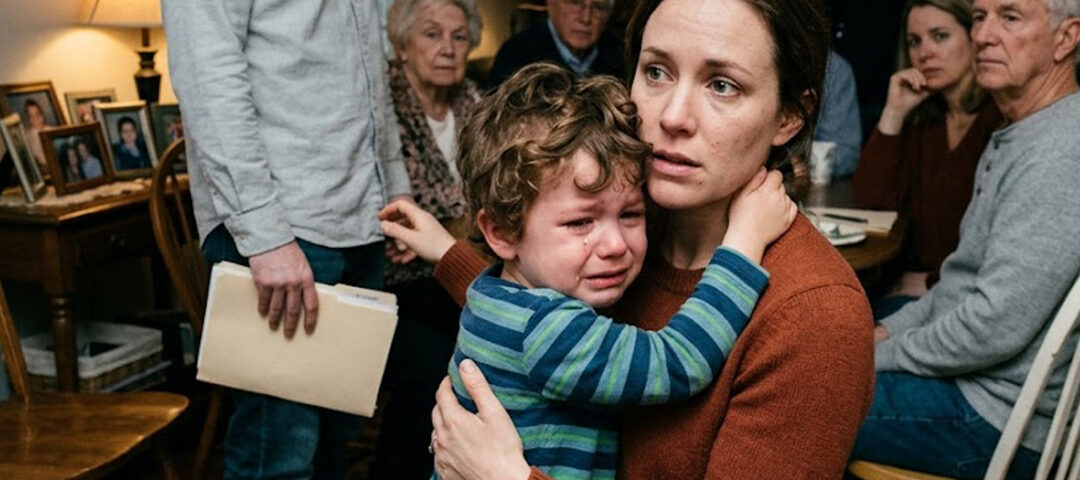
The living room was full. Not just Daniel and Evelyn, his uncle, his aunt, two cousins, his older sister, even neighbors I barely knew. At least a dozen people. Nobody was eating. Nobody was talking. Every chair faced the center of the room as if they had been arranged for a hearing. Every pair of eyes landed on me.
The silence felt rehearsed. Noah instinctively reached for my hand. Mommy. Daniel stood beside the fireplace. His face was pale, not angry. Something worse. Resolved. He held a folder. I looked from him to everyone else.
What is this? Nobody answered. I tried to laugh. Did I miss somebody’s birthday? Still nothing. Then Daniel walked toward me. Every step echoed across the hardwood floor. He stopped less than 6 ft away. Without saying a word, he pulled a sheet of paper from the folder and slammed it onto the coffee table so hard the glass rattled.
I had a DNA test done. My stomach tightened. What? His voice was flat. He’s not my son. For a second, I honestly thought I had misunderstood him. The room blurred around the edges. I stared at the paper. Rows of numbers, laboratory logos, legal language, one sentence highlighted in bold.
Probability of paternity, 0%. I looked back at Daniel. That’s impossible. You still want to lie? I have never lied to you. You expect me to believe this test is wrong? I expect you to believe your wife.
His jaw clenched. I believed you for 3 years. My heart pounded so hard it hurt. Noah is your son. You don’t get to say that anymore. Behind him, Evelyn rose from her chair with the slow confidence of someone who had already decided the verdict. I knew something wasn’t right from the beginning.
I turned toward her. What are you talking about? She folded her arms. He never looked like our family. My mouth fell open. He’s 3 years old. He doesn’t have Daniel’s eyes. Lots of children don’t. He doesn’t have our nose. I stared at her in disbelief. You’re talking about a toddler.
I’m talking about blood. Noah squeezed my fingers so tightly they hurt. Mommy. I knelt beside him. It’s okay. But it wasn’t. Not even close. Daniel wouldn’t look at either of us. I filed for divorce. The words hit me harder than the DNA report.
What? You’ll be served tomorrow. You filed before talking to me. I already had the answers. No, you had a piece of paper. I had proof. I stood up. No, Daniel. Proof would have been asking questions. Proof would have been giving your wife one chance to speak before putting her on trial.
Nobody moved. Nobody defended me. It was like every person in that room had silently agreed that I was guilty before I walked through the door. Evelyn pointed toward the front entrance. Leave. I blinked.
What? You heard me. This is my home. It was. She didn’t even raise her voice. It isn’t anymore. You don’t get to throw me out. She looked at Daniel instead. Tell her. He closed his eyes for a brief second. I think it’s best if you leave tonight. The air disappeared from my lungs.
3 years of marriage, one afternoon, one document, and suddenly I no longer belonged in my own house. Noah started crying. I don’t want to go. I pulled him into my arms. It’s okay, sweetheart.
No. His little body trembled against mine. I want to stay with Daddy. Daniel finally looked at him. For one heartbreaking moment, I thought he would come over, pick up his son, question everything. Instead, he looked away. That hurt more than anything he had said. I grabbed Noah’s backpack from the hallway.
Chapter 3: Seeking refuge
My hands were shaking so badly, I could barely hold the zipper. Nobody offered to help. Nobody apologized. As I reached for the door knob, the front door suddenly opened from the outside. Everyone turned. A man in a charcoal suit stepped inside carrying a leather briefcase.
I recognized him immediately. Martin Hail, Evelyn’s longtime attorney. He paused after seeing me standing there with Noah in my arms. Then he looked around the room. Good. His voice was calm. Since everyone is here, he placed the briefcase on the dining table and unlocked it with practiced hands.
We can proceed. Proceed? I frowned. This isn’t about a divorce. No one answered. Martin removed several neatly organized folders. Not one, several, each marked with colored tabs. His expression was completely professional, almost detached. As requested, he said, looking toward Evelyn.
I’ve prepared every document. Every document. The DNA report suddenly felt much smaller than it had a minute ago. Something inside me shifted. This wasn’t an emotional confrontation that had spiraled out of control. This had been planned carefully, meticulously long before I ever walked through the front door. And somehow, I knew the DNA test wasn’t the real reason they had gathered everyone in that room.
It was only the beginning. I barely remembered leaving the house. The cool evening air hit my face, but it did nothing to stop the ringing in my ears. Noah clung to my shoulder, still crying in exhausted little hiccups while I buckled him into his car seat with hands that wouldn’t stop shaking. Behind me, the front door closed.
Not a single person came outside. Not Daniel, not Evelyn, not one relative who had watched my family fall apart without saying a word. For several minutes, I simply sat behind the steering wheel. I couldn’t bring myself to start the engine. Noah sniffled from the back seat. Mommy, did I do something bad? His tiny voice shattered whatever composure I had left.
I turned around immediately. No, sweetheart. Then why is Daddy mad? My throat tightened. Daddy isn’t mad at you. Then why are we leaving? There are questions no parent is prepared to answer. I forced a smile that felt painfully fake. We’re just going somewhere else tonight. He nodded slowly, trusting me without hesitation. That trust became the only thing holding me together.
The hotel was 20 minutes away. Nothing fancy, just a clean business hotel near the interstate with beige walls, bright lights, and a lobby that smelled faintly of coffee and fresh paint. The receptionist smiled warmly.
Checking in? Yes. For how many nights? I hesitated. I I’m not sure. She didn’t ask another question. For that small kindness, I was grateful. Once we reached our room, Noah immediately climbed onto one of the beds.
Can daddy come tomorrow? I don’t know. Grandma, too. I couldn’t answer. Instead, I helped him into his pajamas, read his favorite dinosaur book twice, and waited until his breathing became slow and steady. Only then did I finally allow myself to cry. Not loudly, just silent tears that soaked the hotel pillow. Everything had happened too fast.
One dinner invitation, one DNA report, one destroyed marriage. None of it made sense. Daniel knew me. He knew the kind of woman I was, or at least I thought he did.
Chapter 4: Uncovering the real motive
At 7 the next morning, my phone buzzed. Daniel. For one foolish second, hope rushed through me. Maybe he’d calm down. Maybe he’d realized something was wrong. Maybe the message contained only one sentence. My attorney will contact yours.
Nothing else. No apology, no questions, no how’s Noah, just business. Minutes later, another notification appeared. Joint checking account access restricted. I open the banking app. Every shared account was frozen. Our joint savings, our household checking, the emergency fund, all inaccessible. I stared at the screen. Then I reached for my credit card, declined.
I tried another declined a third also declined. I called the bank. After verifying my identity, the representative spoke gently. I’m sorry, Mrs. Carter. Those accounts now require authorization from both account holders. So, I can’t buy groceries.
I’m afraid not. I thanked her, hung up, and sat motionless on the edge of the bed. It wasn’t panic anymore. It was calculation. Someone had anticipated every move I might make. Around noon, there was a knock at the hotel door.
A process server. He handed me a thick envelope. I’ve been instructed to deliver these. I signed automatically. Once he left, I locked the door before opening the packet. Petition for dissolution of marriage. Emergency motion.
Temporary financial orders. I expected those. What I didn’t expect was another stack of documents beneath them. Different colored paper, different court, different title. Petition regarding guardianship and conservatorship. I frowned. That had nothing to do with divorce.
I kept reading. Another document. Petition to appoint successor financial manager. Another request for immediate review of existing trust administration. I froze. Trust Noah didn’t have. My thoughts stopped. Yes, he did. The memory came rushing back. 3 years earlier, shortly after Noah was born, my father had died unexpectedly from a heart attack. He had been a careful man, a successful engineer who invested wisely for decades.
His estate had established an educational and family trust for his only grandchild. At the time, everyone agreed on one thing. Because Noah was an infant, I would serve as trustee and financial manager until he turned 18. Daniel had signed every document beside me.
He had never objected. Neither had Evelyn. So why? I turned another page. Then another. My breathing became shallow. The legal argument was clear. If I could be shown to have committed marital fraud through infidelity, if I had intentionally deceived my husband regarding Noah’s paternity, then my integrity as trustee could reasonably be challenged.
And if the court questioned my honesty, someone else could petition to replace me as the person managing Noah’s trust. I looked at the amount listed in the trust summary. Even after taxes and distributions, the remaining assets were worth several million dollars.
I closed my eyes. The room suddenly felt too quiet. This wasn’t about child support. It wasn’t even primarily about divorce.
Chapter 5: Building a legal defense
Someone wanted legal control over Noah’s inheritance. That afternoon, I called the attorney who had handled my father’s estate years earlier. His longtime partner, Richard Lawson, answered instead. He remembered me immediately. After listening without interrupting, he asked one question. Did anyone ever contact you requesting financial records before yesterday?
No. Were you notified that someone intended to challenge your trusteeship? No. He became very quiet. I’d like to see every document. Within an hour, I was sitting across from him in his office. He spread the paperwork across a conference table. He didn’t begin with the divorce filing.
He ignored it completely. Instead, he focused on the trust documents. After 20 minutes, he leaned back in his chair. This was prepared well before yesterday. How can you tell? He pointed to several filing dates. These petitions were drafted weeks ago.
Weeks? They only needed the DNA report before filing. A chill spread through my body. The family dinner. The audience. Martin Hale arriving with his briefcase. Nothing had been spontaneous. Every step had been choreographed.
Richard tapped another page. They intended to file these immediately after removing you from the home. So, they already expected me to lose. They expected you to be emotionally overwhelmed. I swallowed hard and maybe too devastated to notice what they were really taking. The sentence lingered between us. I stared at Noah’s trust summary.
This money wasn’t luxury. It wasn’t revenge. It was his future. College, medical care, a first home someday. Security his grandfather had worked his entire life to build. Richard folded his hands. I don’t think your marriage was today’s primary target. For several seconds, I couldn’t speak. Images from the previous night replayed in my mind.
Daniel refusing to meet my eyes. Evelyn insisting I leave immediately. Martin carrying not one folder but several. Everything suddenly fit together. Not perfectly, but enough. I looked up at Richard. They never wanted my marriage.
He waited. My voice became steadier than I expected. They wanted my son’s inheritance. And for the first time since walking into that living room, I stopped feeling like a victim. I started feeling like someone who had uncovered the first piece of a much larger conspiracy. The moment I walked out of Richard Lawson’s office, I stopped thinking like a devastated wife.
I started thinking like a trustee. For nearly 3 years, I’d managed every report related to Noah’s trust. My father had raised me to document everything, question everything, and never sign a paper I hadn’t read twice. [Snorts] At the time, I’d considered those habits ordinary. Now, they might save my son. Richard had advised me to keep my emotions out of every decision from that point forward.
They’re expecting panic, he had said as he handed me his business card with a direct number written on the back. Don’t give them panic. Give them patience. That night, after Noah fell asleep with his stuffed dinosaur tucked beneath one arm, I spread every document across the small hotel desk, the divorce petition, the DNA report, the guardianship filings, the trust petitions.
I read each page slowly. Then I read them again. This time, I wasn’t looking for accusations. I was looking for patterns. By midnight, three things stood out. First, the DNA sample had supposedly been collected almost 3 weeks earlier.
I frowned. 3 weeks ago, Daniel had been away at a construction conference in Denver for 4 days. Noah had spent every evening with me. No one had asked my permission to collect his DNA. No pediatric appointment, no court order, no consent form, nothing. Second, the laboratory listed on the report wasn’t one I recognized.
The name sounded legitimate, but something about it bothered me. The address wasn’t attached to a hospital or university medical center. It appeared to operate from a commercial office building. Third, every supporting affidavit had been signed on the same day. The witness, the notary, the filing preparation, even Martin Hill’s certification. It was as though everyone had gathered around one table and completed every document in a single afternoon.
That wasn’t impossible, but it certainly wasn’t ordinary. The next morning, Richard introduced me to someone new. Clare, he said, “This is Angela Brooks.” Angela shook my hand firmly. She wasn’t much older than me, dressed in a navy blazer with almost no jewelry. Her calm expression reminded me of emergency room nurses, people who stayed composed because panic wasted time.
“I’m a family law attorney,” she said. “Richard asked me to work with him.” She had already reviewed my case. “The divorce matters,” Angela explained. “But I’m far more interested in the trust.” “So am I,” she nodded because that’s where the planning happened. Over the next hour, she outlined what we needed. An independent DNA test, verification of every filing, financial records, the laboratory’s licensing information, a timeline of every event leading up to that dinner.
Before I left, Angela handed me a yellow legal pad. Write down everything you remember. Everything, even conversations that seemed unimportant. I filled 10 pages before lunch.
Chapter 6: Tracing the conspiracy
By the following afternoon, Richard added another member to our growing team, Victor Ramirez, a financial investigator. He had spent nearly 20 years tracing fraudulent transactions for banks before opening his own consulting practice. He rarely smiled.
Instead, he listened. When I finished explaining the trust, he asked only one question. Who benefits financially if you lose control? I don’t know. Then that’s where we’ll start. He requested copies of every trust statement from the last 5 years, every accounting report, every communication involving Noah’s inheritance. Nothing seemed unusual, at least not at first.
Meanwhile, I reached out to someone I hadn’t spoken to in nearly 6 years, Emily Carter, my college roommate. She now worked as an administrative manager for one of the largest regional medical laboratory networks in the state. When she answered my call, she recognized my voice instantly. Claire, oh my gosh, it’s been forever.
I wish I were calling under better circumstances. After I explained everything, Emily became unusually quiet. Send me the lab’s name. I did. Less than 15 minutes later, my phone rang. Claire, what? I’ve never heard of them. Could they still be legitimate? They could, but every accredited lab in our network appears in the state registry.
This one doesn’t. Not that I can find. A knot tightened in my stomach. Can you check again? I already did. 3 days later, the first real breakthrough arrived. Victor called Richard’s office and asked both of us to come immediately. He had several spreadsheets spread across the conference table.
I found payments. Richard leaned forward. What kind of payments? Victor pointed to highlighted entries. Large wire transfers from Evelyn. No. He slid another page toward us. One payment had been made less than a week before the DNA report.
Another 2 days afterward. The recipients were listed under corporate names that meant nothing to me. Victor tapped the first company. This business shares an address with the laboratory. He tapped the second. And this one belongs to the consulting firm that employed the witness who signed the affidavit.
I stared at him. So someone paid both of them. Yes. Richard folded his arms. Can we identify the sender? Victor nodded once. I traced the originating account. The room fell silent. For several seconds, he simply looked at us. His expression told me he understood exactly how much this answer mattered.
I braced myself. Evelyn, I asked quietly. No, Daniel. No. I searched every possibility in my mind. Martin Hail. A distant relative. Someone connected to the trust. Victor slowly turned his laptop so both of us could see the screen. One name appeared beside the originating account. I read it once, then again. My pulse pounded in my ears.
No, it couldn’t be. Of every person connected to our family, of everyone I had suspected. This was the one name I never would have imagined. Richard looked at me carefully. You know him? I nodded without taking my eyes off the screen. I’ve trusted him for years. The room became impossibly quiet because the money hadn’t come from my mother-in-law.
It hadn’t come from Daniel. It had come from the longtime accountant who had managed nearly every financial record for Daniel’s family since before we were married. And suddenly the conspiracy looked far bigger than a bitter mother-in-law trying to destroy her son’s marriage. Someone had been planning this with financial precision. Someone who understood exactly where Noah’s inheritance was and exactly how to get close to it.
The name on Victor’s screen was Harold Mercer. For more than 25 years, Harold had handled nearly every major financial matter connected to Daniel’s family. He prepared Evelyn’s taxes, managed several rental properties, advised Daniel’s uncle on investments, and sat at the head of the dining table every Thanksgiving as though he were part of the family.
He had even attended our wedding. When Noah was born, Harold sent a silver picture frame engraved with the words for the family’s newest blessing. I stared at his name until the letters seemed to blur. This has to be a mistake.
Victor didn’t react defensively. That’s why I checked it three times. Richard pulled the laptop closer. What account did the money come from? A consulting company called Mercer Strategic Holdings. I shook my head. I’ve never heard of it. That appears to be intentional, Victor said. It has no public facing office, no employees I can identify, and almost no business activity beyond a series of transfers.
Angela, who had joined us by video call, asked, “Transfers to whom?” [Clears throat] Victor opened another spreadsheet. The laboratory, the witness, a records consultant, a private document preparation service. Each payment had been made within 6 weeks of the family dinner.
Richard’s expression hardened. He built the case or financed it. Victor corrected. We still need proof that he directed it. I finally looked away from the screen. Why would Harold care who manages Noah’s trust?
Victor folded his hands. Because whoever controls the trust controls which advisers, managers, vendors, and investment entities get hired. The answer landed slowly. If I were removed as trustee, the court would appoint someone else or approve a replacement proposed by the family, someone Evelyn trusted, someone Harold could influence.
Richard turned to me. Has Harold ever asked to manage Noah’s assets? Not directly. Then I remembered a Christmas dinner 2 years earlier. Harold had casually asked whether I plan to keep the trust with the same investment firm. He said the current fees were unnecessarily high and that he knew several private funds with better returns.
I had thanked him then told him my father’s original adviser was doing fine. At the time, Harold had smiled. Now I remembered how quickly that smile disappeared. He did, I whispered. Everyone looked at me. He suggested moving the money. I said, “No.” Victor leaned forward. Did he mention specific funds?
Not by name. Think carefully. I closed my eyes. He said they were privately managed, mostly real estate, and small business lending. Victor and Richard exchanged a look. That’s useful, Victor said. Over the next several days, he traced business registrations, property records, and payment routes. What emerged was disturbingly simple. Harold controlled a collection of small companies through relatives, former employees, and shell partnerships.
One offered property management services. Another claimed to provide commercial consulting. A third issued private loans. None looked connected at first, but money moved between them in circles. If Harold gained influence over Noah’s trust, he could recommend that millions be invested through those companies, then collect fees, commissions, and inflated payments while presenting everything as legitimate financial management.
He didn’t need to steal the money all at once, Victor explained. He could drain it slowly for years. And Evelyn, I asked, how much did she know? Probably less than she thinks, Angela said.
That possibility made sense. Evelyn was proud, suspicious, and deeply concerned with the family name. Harold knew exactly how to use those weaknesses. He didn’t need to tell her, “Help me steal your grandson’s inheritance.” He only needed to say, “Clare lied to Daniel.
Clare can’t be trusted. The money must be protected by the family.” Once Evelyn believed that, she would do the rest herself. Daniel’s anger had been even easier to manipulate. He had always hated feeling humiliated. Harold had given him a DNA report, a story, and an audience. Instead of questioning the evidence, Daniel had rushed to prove he could not be fooled.
Harold had turned their worst instincts into tools.
Chapter 7: Daniel’s realization
A week later, Daniel called me for the first time. I let the phone ring twice before answering. Clareire. His voice sounded strained. What do you want? There was a long pause. I need to see Noah. You accused him of not being yours in front of 12 people.
I know. You watched him cry. I know. No, Daniel. You remember it. That isn’t the same as understanding it. He breathed unevenly. My attorney says I should request supervised contact. Then let your attorney request it.
Claire, please. I almost hung up. Then he said, “I had another test done. Every muscle in my body went still.” “What?” An independent one. “How did you get Noah’s DNA?” I used his old toothbrush from the house. My anger rose instantly, but something in his voice stopped me. “What did it say?” He didn’t answer.
I heard him inhale, then release the breath like it hurt. 99.99%. The room seemed to narrow around me. He’s yours. Yes, you are his father. Yes. For several seconds, neither of us spoke. Then Daniel began to cry.
Not quietly. Not with dignity. The sound was raw and broken. The kind of crying that comes when a person realizes the disaster was not done to him. It [snorts] was done by him. I threw you both out. I stared through the hotel window.
Yes. I called him another man’s child. Yes. Oh, God. I closed my eyes. No, Daniel, don’t use God to hide from this. I don’t understand how the first test Harold Mercer paid the laboratory.
Silence. What? He also paid the witness. He’s been building a case to remove me from Noah’s trust. Daniel’s breathing changed. No, Harold wouldn’t. That’s exactly what I said. I told him about the shell companies, the payments, and the planned transfer of control. With every sentence, another piece of his certainty collapsed. My mother trusted him, he whispered.
So did you. I have to talk to her. You need to talk to your lawyer. I need to see you. No, Claire, I know where the hotel is. We aren’t there anymore. The night before, Angela had advised us to move to a furnished apartment under a short-term lease. Too many people knew the hotel, and Noah needed routine.
Daniel’s voice sharpened with panic. Where are you? Safe. I’m coming to find you. No, you’re not. But he hung up before I finished. Later, I learned he drove straight to the hotel, ran through the lobby, and demanded our room number. The clerk told him we had checked out that morning. By then, Noah and I were miles away, eating macaroni at a small kitchen table while he told me about a cartoon dinosaur.
Daniel stood alone in that hotel lobby, finally holding the truth in his hands and realizing he no longer knew where his family was. 3 weeks after Daniel called from the hotel lobby, the first hearing was scheduled. It wasn’t a criminal trial.
Chapter 8: The courtroom resolution
It wasn’t even about our divorce. The probate court would decide whether I should remain the trustee of Noah’s inheritance, while the family court would consider temporary custody arrangements until the divorce moved forward. Angela reminded me of that distinction as we waited outside the courtroom.
Today isn’t about revenge. I know it’s about credibility. She adjusted a folder beneath her arm. Stay calm. Answer only what’s asked. Let the evidence do the talking. I nodded, though my stomach felt as though it had been tied into knots. When we entered the courtroom, Daniel was already seated beside his attorney.
He looked different. He had lost weight. The confidence I’d seen the night he threw me out had disappeared, replaced by exhaustion and unmistakable regret. He met my eyes for only a second before looking down. Evelyn sat two rows behind him. Her posture remained rigid, but she no longer carried the certainty that had filled our living room.
Harold Mercer sat at the opposite table with his own attorney. He looked composed, almost bored. If I hadn’t known what Victor had uncovered, I would have believed he was simply another accountant attending a routine hearing. The judge entered and the room rose. Within minutes, Angela began presenting our evidence. She didn’t start with the DNA report.
She started with timing. Every filing challenging my role as trustee had been drafted before Daniel confronted me. The court reviewed the preparation dates, the document metadata, the sequence of filings. The judge frowned as the timeline appeared on the courtroom monitor. So, these petitions existed before the respondent was even informed of the alleged paternity issue.
Yes, your honor. Angela paused. The plan to remove my client as trustee began before anyone claims they sought the truth. Next came the DNA report. Angela introduced the results from the second independently accredited laboratory.
Probability of paternity 99.99%. The judge compared both reports carefully. Daniel’s attorney stood. We acknowledge the second report is accurate. The words echoed through the courtroom. For the first time since this nightmare began, someone on Daniel’s side admitted the truth without qualification.
Noah was his son. Always had been. Harold’s attorney quickly objected. My client had nothing to do with either DNA test. Victor was ready. He took the witness stand and explained months of financial tracing in language even non-experts could follow. Wire transfers, corporate registrations, shared business addresses, layered accounts. One by one, the documents appeared on the courtroom screen.
The payment to the laboratory, the payment to the affidavit witness, the payment to the document preparation company. Each transfer originated from companies Victor had linked back to Harold Mercer. Harold’s attorney attempted to challenge the analysis.
Victor remained calm. I traced every transfer through banking records obtained by subpoena. Could someone else have controlled those companies? They were owned by entities managed by Mr. Mercer. Managed isn’t the same as owned.
No. Victor looked directly at the attorney. But Mr. Mercer signed the authorization for every payment. Silence settled across the courtroom. Angela called another witness, Emily Carter. She testified regarding laboratory accreditation. The facility listed on the original report was not accredited to perform legal paternity testing during the relevant period. So presenting those results in court would have been improper.
Yes. Would the average person know that? No. Angela nodded. No further questions. Then came perhaps the most damaging evidence of all. Email records. Victor had recovered messages through discovery requests. Most were ordinary business correspondents.
One wasn’t. The judge read part of it silently before handing copies to both attorneys. The message was from Harold to the laboratory contact. The family must believe the result immediately. Delay creates unnecessary risk. Another email referred to securing trustee replacement paperwork before emotions cool. The courtroom grew noticeably quieter. Harold finally shifted in his chair.
For the first time all morning, he looked uncomfortable. His attorney requested a recess. The judge denied it. We’ll continue. During cross-examination, Harold insisted he had acted only to protect the family. I believed Mrs.
Carter was dishonest. Angela approached slowly. What evidence did you have? The laboratory report. The report you paid to obtain? Harold hesitated. I paid consulting fees. You paid the laboratory. They performed professional services. You also paid the witness.
I don’t recall. Angela held up a bank record. The transfer occurred the same morning. Harold looked toward his attorney. No answer came. The judge watched carefully. Then Angela asked the question everyone had been waiting for.
Mr. Mercer, if Mrs. Carter had been removed as trustee, who intended to recommend investment management for Noah’s trust. Harold said nothing. Angela displayed another document, an unsigned proposal prepared months earlier. It recommended transferring a significant portion of Noah’s inheritance into several privately managed investment companies. Companies Victor had already linked to Harold. The courtroom seemed to exhale all at once.
The judge closed the folder. I believe I’ve seen enough regarding this issue. Harold lowered his head. Outside the courtroom, investigators from the state attorney general’s financial crimes division were waiting.
Chapter 9: Final legal agreements
They approached Harold before he reached the courthouse steps. His attorney spoke briefly with them, then quietly stepped aside. He turned back toward Harold. I can no longer represent you in this matter. Harold stared at him.
What? Our representation ends immediately. The investigators identified themselves. One asked Harold to accompany them. He didn’t argue. He simply looked around as cameras from local news stations began gathering near the entrance. Within minutes, he disappeared into an unmarked vehicle. Across the plaza, Evelyn remained frozen. Several relatives who had stood behind her during the confrontation at my house quietly walked away.
No one stopped to comfort her. No one defended her decisions. She stood alone. Daniel approached me cautiously. I know I don’t deserve your time. I said nothing. His eyes were red. I kept thinking someone manipulated me.
You were manipulated. He nodded once. But no one forced me to believe a piece of paper instead of believing my wife. I looked at him carefully. He wasn’t asking for forgiveness. He wasn’t making excuses. He was finally accepting responsibility. I chose suspicion, he continued quietly. I chose humiliation over conversation.
He swallowed hard. And Noah paid the price. There was nothing I could say to make that less true. Some punishments don’t come from judges. They come from living with your own decisions. As Daniel stood there watching the investigators drive away with the man who had orchestrated everything, I realized Harold’s scheme had destroyed far more than documents and bank accounts.
It had exposed every weakness our family had refused to confront. Greed had opened the door. Pride had held it open. And blind distrust had walked straight through it. The final hearing took place almost 4 months after Harold Mercer was let out of the courthouse. By then, life no longer felt like it was suspended between one crisis and the next.
It wasn’t peaceful. Not yet. But it was steady. Steady was something I had learned to appreciate. The divorce proceedings had continued alongside the probate matter, and this time there were no dramatic surprises waiting inside sealed envelopes. Harold had been formally charged with multiple financial crimes related to fraud, falsifying business records, and conspiracy.
His criminal case would take months to resolve, but it no longer depended on my testimony alone. The financial records, emails, and payment trails spoke for themselves. The probate court reached its decision first. After reviewing every document and hearing every witness, the judge ruled that there had never been a legitimate basis to remove me as trustee.
The petition challenging my integrity was dismissed in its entirety. Every temporary restriction placed on my authority over Noah’s trust was lifted immediately. When the judge finished reading the order, I didn’t feel victorious. I felt relieved. My father had spent decades building that fund because he wanted his grandson to have opportunities he never had growing up.
For weeks, I had feared that promise might disappear into someone else’s greed. Now it was safe again, exactly as he had intended. Outside the courtroom, Richard smiled for what seemed like the first time in months. I think your father would be proud. I looked down at the signed order in my hands.
I hope so. He trusted you for a reason. Angela joined us a moment later. The family court judge also approved the parenting agreement. I nodded. Daniel and I had finally reached a settlement. There would be no custody battle, no public accusations, no attempts to use Noah as leverage. We would share parenting responsibilities, but Noah’s primary residence would remain with me.
More importantly, every decision would focus on one question. What’s best for Noah? Not for me, not for Daniel, not for anyone’s pride, only for our son. The divorce itself was finalized 2 weeks later. The hearing lasted less than 20 minutes.
Chapter 10: Moving forward and healing
When the judge asked whether either party wished to contest the agreement, Daniel quietly answered, “No, your honor. Neither did I.” Outside the courtroom, our attorneys stepped aside to give us a moment alone. Daniel stood with the final paperwork in one hand. For a long time, neither of us spoke. Finally, he looked at me.
I’ve rehearsed this conversation a hundred times. I know. None of the words feel big enough. They probably aren’t. He gave a sad smile. I deserve that. He took a slow breath. I’ve apologized before, but I don’t think I understood what I was apologizing for.
I waited. I thought I was apologizing because I believed the wrong people. His voice became quieter. But that’s not it. He looked directly into my eyes. I broke the one promise marriage depends on. A tear rolled down his cheek. When everything became uncertain, I trusted strangers before I trusted you. I felt my own eyes sting.
Not because I wanted him back. Because I finally believed he understood. I can’t change what I did. No, I’ll regret it for the rest of my life. I believe you. He swallowed hard. I still love you.
I smiled sadly. I know. I know. I don’t deserve another chance. No. He nodded. I had to say it anyway. I stepped a little closer. For months, I had imagined this moment. In every version, I thought I would feel anger. Instead, I mostly felt peace.
I forgive you. His shoulders trembled. But forgiveness isn’t the same as rebuilding trust. He closed his eyes. I know it took one evening to destroy something we spent years building. I know. I don’t hate you, Daniel.
I know. But I can’t spend the rest of my life wondering whether the next accusation will matter more than my voice. He lowered his head. You shouldn’t have to. For a moment, we simply stood there. Then he signed the last page of the divorce agreement. No arguments, no resentment, no attempt to negotiate.
When he handed the papers back to his attorney, our marriage officially ended. Years passed more quietly than I ever imagined possible. Noah started kindergarten carrying a backpack that looked almost bigger than he was. On his first day of school, he insisted on wearing dinosaur socks because they made him feel brave.
Some things never change. Daniel came to every school play, every soccer game, every parent teacher conference he could attend. He never missed another birthday. He never spoke badly about me. He never tried to rewrite history.
Instead, he focused on becoming the father Noah deserved. Over time, Noah stopped remembering the night we left the house.
Children are remarkable that way. They heal when the adults around them finally choose peace. Daniel and I eventually found a rhythm. We weren’t friends in the way we had once hoped to be, but we became respectful partners in raising our son. Sometimes that is its own kind of success. I saw Evelyn only a handful of times after everything happened.
She sold the large family home a year after Harold’s arrest. Most of the relatives who had once gathered so confidently in her living room drifted away, not because she lost money, because they no longer knew what to believe. The certainty she had carried for so many years had been replaced by quiet regret.
One afternoon, years later, she asked if we could talk. We met at a small park while Noah played nearby. She watched him climbing across the playground before speaking. I thought I was protecting my family.
I listened without interrupting. I never imagined I was helping destroy it. For the first time since I had known her, she looked genuinely small. I can’t ask you to forgive me. No, I only wanted you to know.
Her voice broke. That I finally understand what I took from all of you. There was nothing left to argue about. Consequences had already done what anger never could. As I watched Noah race across the grass with the carefree laughter every child deserves, I realized something that had taken me years to understand. Justice isn’t making someone suffer because they made you suffer.
Justice is protecting what is right before bitterness destroys what’s left. My father protected Noah’s future. The courts protected the truth. And I protected my son. That was enough.
If this story reminded you that trust is precious, that greed can destroy families faster than any lie, and that children should never become weapons in adult conflicts, I’d love to hear your thoughts. Share your perspective in the comments. And if you enjoy thoughtful stories about resilience, justice, and second chances, consider subscribing so you won’t miss the next one.
If you came here from Facebook because of this story, return to the Facebook post, tap Like, and comment exactly “Amazing” to support the storyteller. That small action means more than it seems and gives the writer genuine encouragement to keep sharing more stories about family pressure, firm boundaries, and finally protecting what you worked so hard to build.
Disclaimer: This story is a work of fiction created for entertainment purposes. Any resemblance to real persons, events, or places is coincidental.