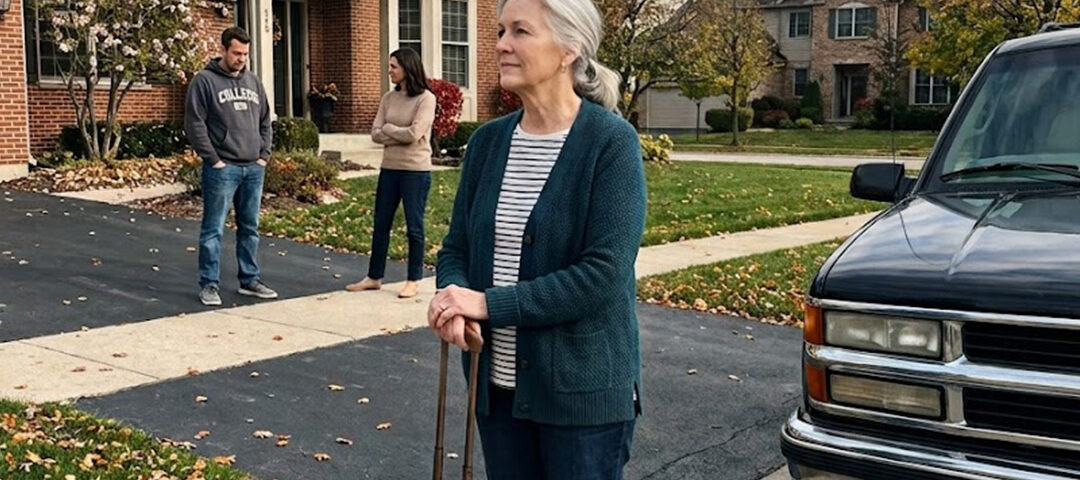
“If you refuse to move into assisted living, then pack your things and leave.”
My son said it from the far side of the kitchen island without raising his voice.
Daniel had always sounded most like his father when he spoke quietly, which made the words hurt more. His hands rested beside a glossy brochure showing silver-haired couples smiling beneath flowering trees. The cover promised independence, comfort, and a community designed for the next chapter.
Vanessa stood beside him with her arms folded over a cream cashmere sweater. She had already placed a blue pen on top of the application.
The room smelled of coffee, furniture polish, and the chicken soup I had started before breakfast because Daniel’s youngest child had a cold.
For one strange moment, I focused on the soup.
The carrots needed another ten minutes.
The broth required salt.
The stove flame was too high.
Small facts were easier to hold than the larger truth sitting across from me.
Daniel believed I no longer belonged in the house my money had helped create.
“Did you hear me, Mom?” he asked.
“Yes.”
“You can’t continue living like this.”
“Like what?”
Vanessa released a careful sigh.
“Margaret, we have tried to be patient.”
I looked at her.
She had called me Mom for the first six months after marrying Daniel. Then I became Margaret. Eventually, when she spoke about me to other people inside the same room, I became she.
“She needs reminders,” Vanessa continued. “She leaves things in the kitchen. She interrupts the children’s routines. She keeps insisting on doing work that no one asked her to do.”
I glanced at the soup, the folded laundry near the pantry, and the permission slip I had signed that morning because neither parent remembered it was due.
“What work?”
Vanessa’s mouth tightened.
“This is exactly what I mean. You turn every conversation into an argument.”
“I asked a question.”
Daniel rubbed his forehead.
“Mom, please don’t make this harder.”
For three years, that sentence had ended nearly every disagreement.
Please don’t make this harder when Vanessa moved my wedding photographs from the living room.
Please don’t make this harder when they gave my bedroom to a visiting business associate and placed me in the converted storage room.
Please don’t make this harder when they expected me to prepare dinner for twelve guests without warning.
Please don’t make this harder when I asked why the money from selling my apartment had never appeared in the investment statements Daniel promised me.
That morning, I finally understood the full meaning.
Making things easier meant disappearing without requiring anyone to admit they had erased me.
Daniel pushed the brochure toward me.
“The residence has a garden, a dining room, transportation, and medical staff nearby.”
“I don’t require medical staff.”
“It’s about planning ahead.”
“I am sixty-eight, not helpless.”
“No one said you were helpless.”
Vanessa looked toward the hallway, lowering her voice as though protecting the children from my existence.
“But the house is becoming crowded. Lily needs a room for schoolwork, and Noah is getting too old to share space when guests stay over.”
I slept in a room barely large enough for a twin bed, a dresser, and three stacked boxes containing the remains of my previous life.
“What space am I taking from them?”
“The storage room could become a study,” Vanessa said.
There it was.
Not concern.
Square footage.
I looked at Daniel.
His face carried discomfort, but not surprise. He and Vanessa had discussed this before inviting me into the kitchen. They had chosen the facility, printed the brochure, and decided which room would replace me.
“You agreed to this?” I asked.
He looked down at the countertop.
“We think it’s best.”
“For whom?”
“Everyone.”
The word settled between us.
I thought of the day Daniel was born, red-faced and furious, with one fist raised beside his cheek. I thought of his first morning of kindergarten when he refused to release my hand at the classroom door. I thought of staying awake beside his bed during fevers, sewing Halloween costumes after midnight, and working extra fittings so he could attend summer camp with his friends.
He was my only child.
For years, that fact had functioned like a key. He could open any door in my heart simply by needing something.
Now he stood in a house supported by my money and told me the family would function better if I left it.
I smiled.
Vanessa’s eyes narrowed.
“Why are you smiling?”
“Because I finally understand.”
Daniel looked uneasy.
“Understand what?”
“That there is nothing left here for me to save.”
I turned off the stove.
The sudden click sounded louder than it should have.
“I’ll pack.”
Daniel’s shoulders lowered with visible relief.
That relief hurt more than the ultimatum.
My name is Margaret Carter, though most people who have known me longer than ten minutes call me Maggie.
For nearly forty years, I made wedding dresses.
Not the mass-produced gowns hanging beneath fluorescent lights in chain stores. I made dresses that began as sketches on tracing paper and ended beneath cathedral ceilings, garden arches, courthouse chandeliers, and oak trees strung with lights.
I understood silk by touch.
I could tell whether satin would wrinkle before cutting it. I knew how much boning a bodice needed, how to hide a zipper beneath lace, and how to repair a grandmother’s veil without erasing the age that made it precious.
My first sewing machine sat on a card table in the corner of a rented apartment on Chicago’s northwest side.
I was twenty-one, newly married to Thomas Carter, and working days at a bridal salon. At night, I altered dresses for women who found my name through church bulletins and handwritten cards left at beauty shops.
Thomas worked in procurement for a regional textile company. He was patient, funny, and never threatened by the fact that I could earn more during wedding season than he did.
When I received my first large commission, I used the money to replace our broken refrigerator.
When I received the second, Thomas bought me a stronger sewing machine.
“You’re building something,” he said.
“So are we.”
We built slowly.
A savings account.
A child.
A small alterations studio.
Eventually, a two-story house in Oak Park with narrow windows and maple floors that creaked near the stairs.
Thomas and I never became wealthy in the way people imagine wealth. We did not own vacation homes or collect expensive watches. We had a paid mortgage, reliable cars, a retirement account, and enough money to help Daniel through college without loans.
We also had friendships that lasted decades.
Harold Bennett was Thomas’s closest friend.
They met in their twenties while unloading fabric rolls at a warehouse near the river. Harold later built a successful hotel and property-management company. Thomas moved into textile distribution and eventually became one of Harold’s early business partners in a company supplying linens and custom furnishings to hotels.
Their lives became financially different, but their friendship never did.
Harold could arrive at our house in a chauffeured sedan and spend the afternoon eating grilled cheese at our kitchen table while Thomas complained about the Cubs.
He never treated us like people he had outgrown.
For years, I thought that quality belonged to all successful men.
Then I watched my son become one.
Daniel was bright, ambitious, and impatient.
As a child, he wanted to skip instructions and reach the finished result. He built model airplanes without reading the manual, then became frustrated when the wings tilted. Thomas would sit beside him, take the pieces apart, and say, “Fast is useful only when you’re moving in the right direction.”
Daniel loved his father.
He also resented how slowly Thomas made decisions.
After business school, Daniel joined Carter-Bennett Hospitality Textiles, the company Thomas had helped build with Harold. By then, Harold had moved his attention toward real estate and hotels, while Thomas managed the textile division with a small executive team.
Daniel arrived with ideas about rapid expansion, online sales, and private-label manufacturing.
Some ideas were excellent.
Others were expensive.
Thomas taught him to distinguish the two.
I continued sewing gowns from a storefront near downtown Oak Park. Brides came from three states. Mothers brought dresses from the 1950s and asked me to create something new without destroying what had come before.
That became my specialty.
Preserving value while allowing change.
I wish I had applied the same principle to my family.
Thomas passed away six years before Daniel told me to leave.
The end came after a brief illness that none of us had expected to move so quickly. One autumn, he was reorganizing tools in the garage. By winter, I was sitting beside a hospital window holding his hand while snow gathered on the parking structure below.
Harold came every day.
Daniel came when work allowed.
Thomas’s final weeks contained more business conversations than I wanted, but he worried about the company and the employees who depended on it.
One evening, he asked Daniel to leave the room.
Then he looked at Harold.
“Make sure Maggie is protected.”
Harold nodded.
“She will be.”
I thought they were discussing life insurance.
After Thomas passed, grief turned paperwork into fog.
Lawyers mailed folders. Banks requested signatures. The company sent documents about succession and deferred compensation. Daniel handled most of it because he said I should not have to worry about business while mourning.
“Dad arranged everything,” he told me. “You’ll receive monthly income, and the rest will remain invested.”
I believed him.
I signed where he placed tabs.
Some pages concerned the house.
Others concerned the company.
Daniel sat beside me at the dining table with a reassuring hand over mine.
“I’ve got you, Mom.”
Those words were enough.
I sold the Oak Park house two years later.
The rooms had become too quiet. Every corner held a version of Thomas I could no longer reach. Daniel and Vanessa had two young children by then, Lily and Noah, and they lived in a large newly built home in Naperville.
Daniel presented the idea over Sunday dinner.
“Sell the house and move in with us.”
I hesitated.
Vanessa reached across the table.
“The children would love having you nearby.”
Daniel described a private suite on the main floor.
“You’ll never be lonely again. You can travel, work when you want, and spend time with the kids.”
He also asked whether I would invest part of the sale proceeds into a new family-business expansion.
Carter-Bennett had become Carter Heritage Interiors after Harold gradually stepped back. Daniel wanted to open a manufacturing facility in Indiana and launch a premium home collection.
“It will protect Dad’s legacy,” he said.
The phrase reached the weakest place in me.
I sold the house for just over eight hundred thousand dollars.
After taxes and closing costs, I transferred four hundred thousand to the company under an agreement Daniel described as a preferred family investment. Another portion paid for renovations to their house, including the downstairs suite intended for me.
The rest remained in my retirement accounts.
On moving day, I placed Thomas’s photograph, my sewing machine, two suitcases, and three boxes inside Daniel’s garage.
The private suite was not ready.
“The contractor is delayed,” Vanessa explained. “Use the guest room for now.”
Two months later, Vanessa’s mother visited for the holidays.
I moved into the small room beside the laundry area.
“It’s only for a week,” Daniel said.
The week became three years.
The downstairs suite became Vanessa’s home office and private exercise room. She said the light was better there and the built-in shelves were perfect for video calls.
My storage-room bedroom had no closet. I kept dresses hanging on a rolling rack beside the dryer. The children’s winter coats occupied the hooks on my door.
I told myself the arrangement was temporary.
Temporary became the most dangerous word in my life.
At first, I enjoyed being useful.
I packed school lunches, prepared dinners, and watched the children when Daniel and Vanessa attended business events. Lily loved sitting beside me while I repaired dresses for longtime clients. She collected scraps of lace and arranged them across notebook pages.
Noah liked measuring ingredients when we baked.
“Level the cup,” I would tell him.
He would drag a butter knife across the flour with intense concentration.
Those moments felt like family.
Then usefulness became expectation.
Vanessa stopped asking whether I could collect the children from school. She sent calendar notices.
Dinner guests appeared with no warning.
Laundry baskets arrived outside my door.
When I purchased groceries, Vanessa handed me a list but never offered reimbursement. When I asked Daniel about the investment statements, he said the accounting department was reorganizing.
“Don’t worry,” he told me. “The money is working.”
I wanted to believe him.
Vanessa disliked my sewing.
She said fabric fibers drifted through the house and made the laundry room look cluttered.
I reduced my work.
Then she complained that clients arriving for fittings disrupted the neighborhood. I began meeting them at a friend’s studio.
Eventually, I stopped taking new commissions.
Forty years of work disappeared from my routine without anyone making a formal decision.
The loss happened quietly.
Just as the loss of my place in the family had.
Vanessa’s contempt rarely came through direct insults. She was too polished for that.
She commented that my sweaters made me look older.
She corrected the way I arranged food on serving platters.
She introduced me at parties as “Daniel’s mother, who helps around the house.”
Once, during a dinner with company executives, a guest complimented the table linens.
“Margaret chose them,” Daniel said.
Vanessa laughed.
“She has strong opinions about fabric. Give her a bolt of cloth and she can stay occupied for hours.”
Everyone smiled.
I smiled too.
That night, I folded napkins in the kitchen while they drank wine in the dining room.
I heard Vanessa say, “Honestly, having her here is like having a very traditional live-in helper.”
Daniel did not correct her.
His silence became the room I lived in.
The final shift began when Vanessa started discussing assisted living.
At first, she mentioned it generally.
A friend’s mother had moved into a beautiful community near Lake Geneva.
An advertisement appeared on the kitchen counter.
A brochure arrived in my mail, though I had never requested information.
Then she began creating evidence that I needed supervision.
If I misplaced reading glasses, she mentioned memory.
If I asked the same question twice because the television was loud, she exchanged a look with Daniel.
If I felt tired after caring for both children during a school holiday, she said I was struggling.
One evening, I found a typed list on the printer.
Margaret—Recent Concerns.
It included forgetting a grocery item, leaving a cup near the sink, and asking Lily whether she had completed homework after Vanessa had already asked.
Beneath the list was a note:
Discuss transition before summer. Convert current room into Lily’s study and storage.
I photographed the page.
I do not know why.
Maybe the accountant inside every seamstress understands that patterns become undeniable only after they are placed side by side.
The morning of the ultimatum, I had already been awake since five.
Noah was coughing. I made soup, washed his bedding, and found his missing library book beneath the couch.
Vanessa entered the kitchen at eight wearing workout clothes and carrying the assisted-living brochure.
Daniel followed.
They had rehearsed the conversation.
When my son told me to leave, I did not cry because the crying had happened in smaller pieces over three years.
At the dinner table.
Inside the laundry room.
Beside the printer.
While folding a child’s sweater after midnight.
The tears had already been paid.
I packed two suitcases.
Clothes.
Thomas’s photograph.
The folder containing our marriage certificate, old business papers, and letters he wrote during work trips.
My sewing shears.
A small wooden box holding jewelry from my mother and grandmother.
When I opened it, the box was nearly empty.
The pearl earrings remained.
My grandmother’s sapphire brooch was gone.
So was the gold bracelet Thomas gave me on our twenty-fifth anniversary.
I searched the drawer beneath the bed.
Nothing.
Vanessa appeared in the doorway.
“Are you almost finished?”
“Where is my jewelry?”
Her face did not change.
“What jewelry?”
“The bracelet and sapphire brooch.”
“You probably stored them somewhere.”
“They were in this box.”
“You have been misplacing things.”
The sentence came too quickly.
I looked at her.
She looked away first.
I placed the empty box inside my suitcase.
Then I sent one message.
Harold, you once said that if I ever needed a door opened, I should call. Is that still true?
His response arrived less than a minute later.
Always. Where are you?
I sent the address, though he knew it.
He called immediately.
“What happened?”
“Daniel asked me to leave.”
A pause followed.
“Are you safe?”
“Yes.”
“Stay where you are. I’m coming.”
I did not tell Daniel or Vanessa who was arriving.
An hour later, a long black sedan stopped in front of the house.
Daniel opened the door before the driver reached the porch.
He expected a taxi.
Harold Bennett stepped out.
At seventy-two, Harold still carried himself with the calm authority of a man used to entering rooms where decisions mattered. His silver hair was neatly combed. He wore a charcoal overcoat and leaned slightly on a polished cane after a recent knee surgery.
The driver opened the rear door.
Harold ignored him and walked toward me.
“Maggie.”
He took both my hands.
For the first time that morning, my composure nearly broke.
“You came.”
“You called.”
He looked at the suitcases.
“Is this everything?”
“Everything I need today.”
Daniel stood in the doorway.
“Mr. Bennett?”
Harold turned.
“Daniel.”
“What are you doing here?”
“Taking your mother somewhere she is welcome.”
Daniel’s face tightened.
“This is a private family matter.”
Harold looked toward the assisted-living brochure visible on the kitchen island.
“So I see.”
Vanessa joined Daniel.
“We offered Margaret a safe, appropriate option. She chose to react emotionally.”
I spoke before Harold could.
“I chose to leave after being told to leave.”
“That is not what Daniel meant,” Vanessa said.
Daniel looked at me.
“Mom, we can discuss this later.”
“No.”
He blinked.
“No?”
“You had three years to discuss how I lived in this house. You chose this morning to end the discussion.”
Harold lifted my larger suitcase himself.
The driver reached for it, but Harold shook his head.
“I’ve got this one.”
That small gesture mattered.
For years, people had handed me things to carry.
Laundry.
Groceries.
Children.
Expectations.
Harold carried my suitcase as though my burden deserved weight in his hands.
Before entering the car, I looked back.
Lily stood near the staircase, crying silently.
Noah held the railing.
I went to them.
“This is not goodbye,” I said.
“Where are you going?” Lily asked.
“To stay with an old friend.”
“Are you coming back?”
I looked at Daniel.
“I will see you soon.”
Vanessa opened her mouth, but Daniel stopped her with one hand.
I kissed both children.
Then I entered the sedan.
As we pulled away, Daniel remained on the porch.
He looked frozen, less because I was leaving than because Harold Bennett had come to collect me.
Daniel understood status.
He understood money.
For the first time, he had seen proof that my life extended beyond the room he had assigned me.
Harold lived in a penthouse overlooking Lake Michigan.
The elevator opened into a quiet foyer with pale stone floors, warm lamps, and windows stretching across the skyline. Snow moved over the lake in thin white sheets.
A housekeeper named Rosa greeted me, then carried one suitcase toward a guest suite.
Harold carried the other.
“You’ll stay as long as you want,” he said.
“I don’t want to become dependent on someone else.”
“You won’t.”
“You don’t know that.”
He set the suitcase down.
“Maggie, offering you a room is not purchasing authority over your life.”
The sentence reached a place in me that had been waiting years to hear it.
The guest suite included a sitting area, private bath, and desk beside the window. It was larger than the apartment where Thomas and I began our marriage.
On the bed lay fresh towels and a folded navy robe.
No boxes.
No children’s coats hanging on the door.
No one’s exercise equipment in the corner.
I placed Thomas’s photograph on the nightstand.
Harold stood near the window.
“I should have checked on you.”
“You called.”
“You said everything was fine.”
“I wanted it to be.”
He nodded.
“That is not the same thing.”
That evening, we ate tomato soup and grilled cheese at the kitchen counter.
Despite the penthouse, Harold still preferred simple food when upset.
“Thomas used to make these too thin,” he said.
“He believed bread should be transparent.”
“He believed butter could repair anything.”
For the first time in months, I laughed without checking whether the sound bothered someone.
Harold watched me.
Then his expression became serious.
“What did Daniel mean when he told me the company had supported you?”
“He said the investment from my apartment sale was growing inside Carter Heritage. I was supposed to receive statements.”
“Have you?”
“No.”
“Any distributions?”
“Monthly deposits. Smaller than expected.”
“How small?”
I told him.
Harold’s face changed.
“Thomas left you more than monthly support.”
I put down my spoon.
“What do you mean?”
He stood and walked into his office.
When he returned, he carried an old leather folder with Thomas’s initials embossed near the bottom.
“I kept copies of the original succession plan because I was still chairman when it was drafted.”
He opened the folder.
A share schedule listed Thomas Carter’s interest in Carter-Bennett Hospitality Textiles before the company changed names.
Forty percent transferred to Margaret Carter through a marital trust.
Voting rights preserved.
Quarterly distributions.
Independent access to financial reports.
I read the lines several times.
“This says I own forty percent.”
“Yes.”
“Daniel told me the shares went into a family holding company.”
“Only if you approved a valid transfer.”
“I signed documents after Thomas passed.”
“Do you have copies?”
“In my suitcase.”
I retrieved the folder I had packed.
Harold spread the papers across the dining table.
Several contained my signature.
Others contained initials that resembled mine but were not quite right. The M curved differently. The final stroke of Carter lacked the small upward hook I had used since high school.
Harold touched one page.
“Did you sign this?”
“No.”
“You’re sure?”
“I have signed thousands of fitting receipts, invoices, contracts, and checks. That is not my signature.”
He called his attorney, Linda Park, even though it was nearly nine.
Linda arrived the next morning with a laptop, reading glasses, and two legal pads.
She reviewed every document carefully.
Then she asked me to describe the meeting where I signed the probate papers.
“Daniel placed tabs on pages. He said they concerned tax elections and company continuity.”
“Was independent counsel present?”
“No.”
“Did anyone explain that one document transferred voting control of your shares?”
“No.”
“Did you receive payment for the transfer?”
“No.”
Linda’s expression remained professional, but her questions became sharper.
“Did you authorize Daniel to redirect distributions into another account?”
“I did not know there were distributions.”
Harold sat across from us, one hand closed around a coffee cup.
Linda requested company records, trust statements, and bank histories. She also arranged for an independent handwriting expert to review the disputed pages.
“Do not confront Daniel yet,” she said. “We need facts before emotion enters the room.”
“I do not want to destroy my son.”
“Requiring an adult to account for money and documents is not destruction.”
“He has children.”
“So do you,” Linda replied. “You have a child too, Maggie. He is simply old enough to be responsible for his decisions.”
The records took two weeks to gather.
During that time, Daniel called daily.
At first, he sounded irritated.
“Mom, you’re creating unnecessary drama.”
Then cautious.
“Harold should not interfere in family business.”
Finally, worried.
“Please do not sign anything without speaking to me.”
I answered only once.
“I will speak when I understand what happened to my shares.”
The line became silent.
“What shares?” he asked.
That question told me everything.
Linda’s review revealed that the forty-percent interest had generated substantial distributions after Thomas’s death.
Nearly two million dollars should have reached the trust for my benefit.
Only a fraction had appeared in my account.
The rest had been routed through a management entity controlled by Daniel.
Some financed company expansion.
Some paid for the Naperville house.
Some covered personal expenses that had nothing to do with the business.
My four-hundred-thousand-dollar investment from the apartment sale had also been recorded incorrectly. Instead of preferred capital with repayment priority, the company books described it as a family contribution without fixed return.
There was no legitimate reason for that language.
The handwriting report found that two transfer authorizations were inconsistent with my known signatures.
Linda placed the findings inside three black binders.
“There is enough to file civil claims for restoration of your shares, repayment of distributions, correction of the investment records, and removal of Daniel’s unilateral voting authority.”
I looked toward the lake.
“What happens to the company?”
“That depends on whether Daniel cooperates.”
“And if he doesn’t?”
“We request a court-supervised accounting.”
Harold remained quiet until Linda left.
Then he said, “There is something else.”
I looked at him.
“I have cared about you for a very long time.”
My body became still.
He continued before I could respond.
“Thomas knew.”
“Harold.”
“I never crossed a line. I would never have dishonored him or you. But he knew that after we met, before either of you married, I had feelings for you.”
“Why tell me now?”
“Because I do not want my help mistaken for a transaction. I expect nothing from you. If you remain in the guest suite for ten years, we are friends. If you move tomorrow, we are friends. If you never want this subject mentioned again, it will not be.”
I looked at the man who had carried my suitcase without trying to claim the life attached to it.
“Thomas knew?”
“He told me once that loving someone sometimes means being grateful she chose a good man, even when that man is not you.”
Tears came then.
Not because Harold had loved me.
Because Thomas had understood and trusted us both.
Harold walked toward the window, giving me privacy inside his own home.
That gesture told me more than any declaration.
The missing jewelry led to the next discovery.
Linda asked me to prepare an inventory of personal property left at Daniel’s house. I listed the sapphire brooch and gold bracelet.
Harold remembered the brooch.
“Your grandmother wore that at Daniel’s christening.”
“Yes.”
Linda sent a formal preservation notice requiring Daniel and Vanessa not to sell or remove my belongings.
Vanessa responded through an attorney that no such items had been in the home.
Three days later, an appraiser contacted Linda.
The sapphire brooch had been sold through a private consignment dealer eleven months earlier.
The seller’s identification belonged to Vanessa.
The gold bracelet had been sold separately.
The proceeds entered an account Vanessa controlled.
That account paid for designer purchases, hotel stays, and rent on a small downtown apartment Daniel did not know existed.
Additional transfers from Carter Heritage had reached the same account through invoices submitted by a marketing consultant named Ryan Mercer.
The invoices described strategy services.
The consultant had performed almost no documented work.
Photographs and messages suggested Vanessa and Ryan had developed a private relationship she concealed from Daniel.
Linda warned me not to reduce the case to personal scandal.
“The financial records matter,” she said. “The relationship explains motive, but our claims rest on unauthorized transactions and property.”
That distinction kept me steady.
The woman who wanted my room for a study had sold my grandmother’s brooch to finance a life she kept hidden from my son.
Daniel had defended her while treating me as the threat to his family.
The confrontation took place in a boardroom at Carter Heritage.
Harold attended as former chairman and a substantial remaining investor. Linda sat beside me. The company’s outside counsel and independent accountant joined us.
Daniel entered first.
He looked exhausted.
Vanessa followed in a pale gray suit, carrying a leather handbag and the expression she used when entering school fundraisers where she expected to be admired.
She stopped when she saw Harold.
Then she noticed the binders.
“What is this?” Daniel asked.
“A formal review,” Linda said.
“I want to speak to my mother privately.”
“No,” I replied.
He looked at me.
“Mom.”
“You asked me to leave privately. We will discuss the consequences with everyone who needs to hear them.”
Linda began with the trust documents.
She explained the forty-percent interest, missing distributions, altered authorizations, and misclassified apartment funds.
Daniel repeatedly shook his head.
“That is not what happened.”
“What happened?” the outside attorney asked.
“Dad wanted the company protected.”
“Your father protected the company through a trust benefiting your mother.”
“We needed voting stability.”
“You could have requested it honestly.”
Daniel looked at me.
“I was going to restore everything once the Indiana facility became profitable.”
“You told me I owned nothing,” I said.
“I never said that.”
“You told me the company supported me. The company was using my money.”
His face changed.
Vanessa leaned forward.
“Daniel made difficult decisions to preserve jobs.”
The accountant opened the second binder.
“Personal expenses were charged through the management entity.”
Vanessa’s voice sharpened.
“That happens in closely held companies.”
“Not without disclosure to a forty-percent owner.”
The third binder contained the jewelry records, consultant invoices, and apartment lease.
Vanessa stopped speaking.
Daniel looked at the lease.
“What is that?”
She reached for it.
Linda moved the page away.
“An apartment funded through an account receiving company payments.”
Daniel turned toward his wife.
“You rented an apartment?”
“It was for work.”
“Why didn’t I know?”
“I needed a quiet place for client meetings.”
“With Ryan Mercer?”
Vanessa’s face tightened.
“This is Margaret trying to turn you against me.”
I placed the consignment records beside the lease.
“Did I force you to sell my jewelry?”
Daniel read the document.
His hands began to shake.
“Vanessa.”
She looked toward the attorneys, searching for an exit.
“The jewelry was sitting in a box. Margaret never wore it.”
“It was not yours,” I said.
“I intended to replace it.”
“With what?”
She said nothing.
The outside accountant opened a spreadsheet showing payments made to Ryan’s company.
Over three years, more than three hundred thousand dollars had left Carter Heritage through invoices with limited supporting work.
Daniel stared at the total.
“You approved these invoices,” the accountant said.
Daniel’s face went pale.
“Vanessa told me Ryan’s firm was handling brand strategy.”
“You never reviewed the reports?”
“I trusted my wife.”
The words entered the room with painful familiarity.
I had trusted my son.
He had trusted Vanessa.
Trust had moved downward through the family until it reached the person most willing to convert it into money.
Vanessa stood.
“I am not staying here while everyone attacks me.”
The company attorney spoke calmly.
“You may leave, but the preservation notice remains in effect. Company devices and records must be returned.”
She looked at Daniel.
“Are you going to let them do this?”
He stared at the apartment lease.
“For how long?”
“What?”
“You and Ryan.”
Her eyes shifted.
“That is not relevant.”
“To me it is.”
She collected her handbag and walked out.
No one stopped her.
After the door closed, Daniel covered his face.
For a moment, I saw the boy who once cried when his model airplane wing would not fit.
I wanted to move toward him.
I remained seated.
He lowered his hands.
“Mom, I’m sorry.”
The apology sounded smaller than the damage.
“For which part?”
He looked at me.
“For all of it.”
“That is not an answer.”
He swallowed.
“For using your shares without explaining. For taking control of the trust. For telling myself I was protecting Dad’s company. For moving you into that room. For staying silent when Vanessa disrespected you.”
His voice broke.
“For telling you to leave.”
I looked at him for a long time.
“Why did you do it?”
“Because every year the company needed more. The expansion was failing. The house cost more than we expected. Vanessa kept saying you would never use the money anyway.”
“And you believed her.”
“I wanted to.”
“Why?”
“Because believing her made my life easier.”
The honesty hurt.
It also gave us the first usable truth.
I placed a proposed settlement in front of him.
It required restoration of my voting rights, repayment of distributions with interest, correction of the four-hundred-thousand-dollar investment, an independent audit, removal of Vanessa and Ryan from company access, and professional oversight of finances.
Daniel would step down as sole chief executive during restructuring.
He would attend individual counseling and establish a reliable parenting plan if his marriage ended.
I would not promise to withdraw every claim immediately.
Compliance would come first.
He read the pages.
“You’re taking the company from me.”
“No. I am taking back what belonged to me.”
“If I sign, the board could remove me.”
“If you refuse, the court may do more than the board.”
He closed his eyes.
“What about the children?”
“They need a father who understands that loving them does not mean controlling what belongs to them.”
He looked at me.
“Will you seek custody?”
“I will seek stability if their home becomes unstable. I would rather you provide it.”
The choice was his.
Not divorce or punishment.
Truth or continued denial.
Daniel signed the temporary agreement that afternoon.
The full restructuring took months.
An independent audit verified the missing distributions and company payments. Several properties and investments were sold to restore funds. The Naperville house was refinanced without using my assets as hidden support.
Vanessa initially denied the financial findings, then negotiated through counsel when the records became impossible to dismiss.
She and Daniel separated.
Their divorce proceeded privately. The children remained primarily with Daniel in the family home, with a structured schedule allowing time with their mother under clear financial boundaries.
Vanessa faced civil repayment obligations related to the jewelry and company funds. The brooch had already been resold overseas and could not be recovered.
A jeweler used old photographs and appraisal records to recreate it.
The replacement was beautiful.
It was not my grandmother’s.
Some losses can be compensated without being reversed.
Daniel entered counseling.
At first, he treated each session as another condition imposed on him.
Then something changed.
He began calling without asking for money, signatures, or forgiveness.
One evening, he said, “I spent my whole life believing Dad’s company was the proof that I mattered.”
“You mattered before the company.”
“I didn’t feel that.”
“Your father loved you.”
“I know. But he respected work, discipline, and responsibility. I wanted to become those things quickly.”
“So you skipped the part where you actually practiced them.”
He laughed sadly.
“Yes.”
Carter Heritage survived.
It became smaller.
The failed Indiana expansion was closed. The home collection was delayed. Outside directors joined the board. Daniel remained with the company in an operations role, reporting to an experienced chief executive.
For the first time, he had authority he had to earn rather than inherit.
I used part of the returned money to purchase a condominium near Lincoln Park.
It had three bedrooms, large windows, and a small terrace overlooking trees. One room became a sewing studio.
My first new client was the daughter of a woman whose wedding dress I had made twenty-seven years earlier.
She brought the original gown in a preservation box.
“I don’t want it to look exactly the same,” she said. “But I want my mother to recognize it.”
I ran my hand across the lace.
“That is my favorite kind of work.”
Preserving value without trapping the future inside the past.
Harold visited often.
He never arrived without calling.
He never opened a cabinet without asking where something belonged.
He never described helping me as a favor I owed him for.
A year after I left Daniel’s house, Harold and I attended a summer concert near the lake.
He held my hand during the walk home.
Neither of us made a speech.
We were too old to confuse grand declarations with trust.
Our companionship grew through ordinary choices.
Coffee.
Museum afternoons.
Arguments about movies.
Quiet evenings when Thomas’s name could be spoken without making either of us uncomfortable.
Love after grief did not replace the love that came before.
It expanded the life around it.
Every Saturday, Lily and Noah visited my condominium.
We baked chocolate cake using the recipe Thomas loved.
Noah still overfilled the measuring cup.
Lily began sewing a skirt from blue cotton printed with tiny stars.
Daniel brought them in the morning and collected them after dinner.
At first, he waited in the hallway.
Then one Saturday, I invited him inside for coffee.
He stood near the kitchen island, uncertain.
The last kitchen island between us had held an assisted-living brochure.
This one held flour, butter, and a bowl of chocolate frosting.
Lily ran toward him wearing the unfinished skirt pinned over her jeans.
“Look what Grandma and I made.”
Daniel smiled.
“It’s beautiful.”
“She did most of it,” I said.
Lily shook her head.
“Grandma fixed all my mistakes.”
“I adjusted them,” I corrected. “Mistakes are often part of learning.”
Daniel looked at me.
We both remembered a family history built around hiding errors until they became disasters.
He sat down.
“I found something,” he said.
He placed an envelope on the counter.
Inside was the note I left when I moved out of my Oak Park house three years earlier.
Daniel had kept it inside an old business folder.
Thank you for making room for me. I hope living together gives us back some of the time grief took away.
My handwriting looked hopeful.
“You did make room for me,” I said. “Then you allowed someone else to decide I no longer deserved it.”
“I know.”
“Why show me this?”
“To remind myself that you entered that house trusting me.”
He folded the note again.
“I don’t expect you to trust me the same way.”
“Good.”
He smiled faintly.
“But I see the work you’re doing.”
“That is enough for now.”
It was.
Forgiveness did not arrive as one emotional event.
It arrived in supervised accounts, returned money, school pickups, therapy appointments, and phone calls made when no one needed rescuing.
It arrived when Daniel stopped defending himself long enough to hear what he had done.
It arrived when I stopped confusing forgiveness with permission to repeat the past.
Two years after the kitchen ultimatum, Daniel brought the children to my home for Christmas Eve.
Harold was there.
So were Linda, Rosa, several old friends from the bridal shop, and three former clients whose daughters had become part of my life.
The dining table extended into the living room.
No one was assigned a lesser chair.
After dinner, Daniel stood near the window holding a cup of coffee.
“I drove past the assisted-living place last week,” he said.
I waited.
“It has a new sign.”
“I’m sure it’s a fine community.”
“That wasn’t the problem, was it?”
“No.”
“The problem was that I tried to make the decision for you because your presence had become inconvenient.”
“Yes.”
He looked toward Lily and Noah decorating cookies with Harold.
“I used to tell myself I was protecting my family.”
“You were protecting the version of your life that required everyone else to cooperate.”
He nodded.
“I’m sorry, Mom.”
This time, I did not ask him to specify.
He had spent two years doing that through action.
“I know.”
He looked at me.
“Do you think Dad would forgive me?”
“Your father loved you.”
“That isn’t what I asked.”
“No.”
He waited.
“I think Thomas would expect you to keep becoming a better man whether forgiveness came quickly or not.”
Daniel looked down at his coffee.
“That sounds like him.”
“It does.”
Later, after everyone left, Harold and I stood on the terrace while snow gathered over the trees.
Inside, the sewing room lamp remained on. Blue fabric lay folded near the machine. Thomas’s photograph rested on a shelf beside one of Harold and me at the lakefront concert.
Two histories.
Neither erased the other.
Harold slipped his hand into mine.
“Cold?”
“A little.”
“We should go inside.”
“In a minute.”
Below us, cars moved slowly along the snow-covered street. Windows glowed in apartment buildings across the park. Somewhere, a family was setting a table. Somewhere else, a woman was packing a suitcase after finally understanding she deserved more than the room people assigned her.
For years, I believed being a good mother meant giving until nothing remained that could inconvenience the people I loved.
I gave Daniel money.
Time.
Labor.
Silence.
Each gift became normal so quickly that he stopped seeing the person who provided it.
The morning he told me to leave, he thought he was removing an unwanted guest.
Instead, he returned me to myself.
I was the woman who built a career one stitch at a time.
The woman Thomas trusted with forty percent of a company.
The woman Harold respected before he ever hoped to love her.
The grandmother whose hands still knew how to guide fabric beneath a needle.
The mother strong enough to hold her son accountable without pretending she had stopped loving him.
They believed I would disappear quietly.
I did leave quietly.
But silence is not always surrender.
Sometimes it is the moment a woman stops explaining her worth to people committed to overlooking it.
Sometimes it is the sound of a suitcase closing, a car door opening, and an old life releasing its claim.
Daniel called the house his.
Vanessa called my room wasted space.
They forgot that home had never been the walls.
Home was dignity.
Choice.
Respect.
The freedom to sit at your own table without earning the right to remain.
They took my trust and used my money.
They tried to reduce my life to a storage room and an application form.
But they could not take the part of me that had spent forty years turning unfinished fabric into something strong enough to carry another woman into her future.
I had done that for thousands of brides.
At sixty-eight, I finally did it for myself.
If you came here from Facebook because of this story, return to the Facebook post, tap Like, and comment exactly “Amazing” to support the storyteller. That small action means more than it seems and gives the writer genuine encouragement to keep sharing more stories about family pressure, firm boundaries, and finally protecting what you worked so hard to build.
Disclaimer: This story is a work of fiction created for entertainment purposes. Any resemblance to real persons, events, or places is coincidental.