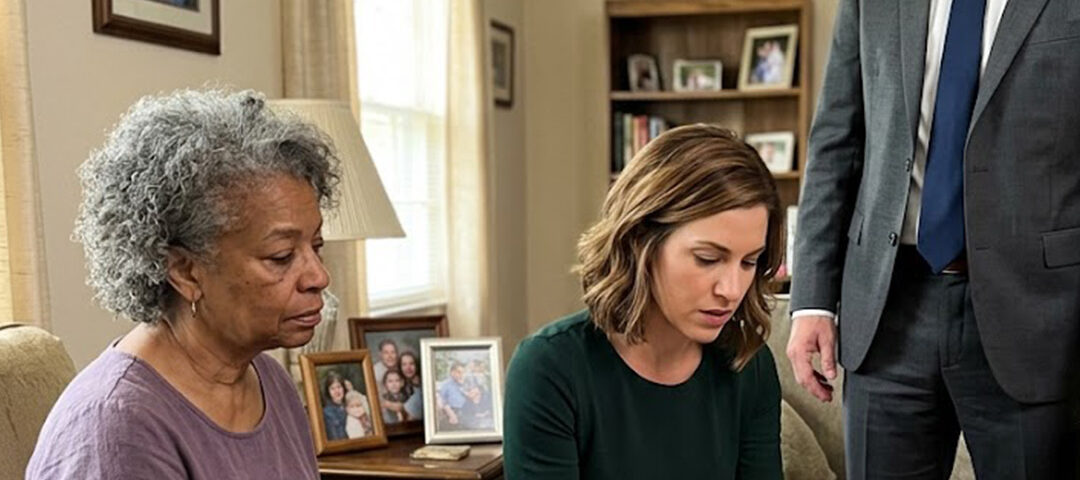
A week after my son Matthew got married, my daughter-in-law Brooke knocked on my door, accompanied by a well-dressed man carrying a leather briefcase.
“Mom, this is Paul, a notary.” She flashed that phony smile I knew too well.
“We’re here to help you with some house paperwork.” My heart pounded.
I need to explain something about the ranch before anyone misunderstands me.
I did not keep it secret because I wanted to trick my son.
I kept it quiet because my husband, Thomas, had asked me to be careful with it.
The ranch had been in his side of the family for decades.
It was not polished wealth, not the kind people show off at parties.
It was fences, wells, tractors, hay fields, cattle records, and an old main house that smelled like cedar after rain.
Thomas loved that land with a quiet devotion.
In the last year of his life, when his hands had grown thin and his voice often tired, he would ask me to sit beside him while he reviewed the ranch papers.
“Suzanne,” he told me one evening, “promise me you will never let anyone make you feel small because you are gentle.”
I laughed then, because I thought he was being sentimental.
“Who is going to do that?”
He looked at me for a long time.
“Sometimes people wait until a woman is alone before they start measuring what they can take from her.”
At the time, the words felt too dark for my life.
Matthew was still close to me then.
He came for Sunday supper, fixed the porch light, teased me about overwatering the basil, and kissed my forehead before leaving.
I could not imagine a day when he would sit across from me and speak in someone else’s voice.
Thomas made sure the ranch passed directly to me, not through a complicated shared arrangement.
He left instructions with our attorney, appraisals in the safe, and a letter I did not open until after his passing.
In that letter, he wrote that the land was my safety, my independence, and my answer to any person who tried to turn love into leverage.
I cried when I read it.
Then I put the letter away because grief was already too heavy and practical matters felt impossible.
For a long time, I lived as if the ranch did not exist.
I stayed in my modest Seattle house, cooked for Matthew, brought casseroles to church potlucks, paid my bills, and kept my routines.
The ranch manager sent reports.
The accounts grew.
I signed what needed signing and told no one.
Not because I was ashamed of it, but because that land belonged to a private part of my marriage, a promise between Thomas and me.
That privacy became my shelter.
When Brooke entered our lives, I saw little signs before I wanted to admit them.
She asked what I owned before she asked what I enjoyed.
She wanted to know if the house was paid off before she knew how Thomas and I had planted the maple tree out front.
She commented on the neighborhood values the way other women comment on curtains.
Matthew would laugh awkwardly and say, “Brooke works with numbers, Mom.
She notices everything.”
Yes, she noticed everything.
Everything except my heart.
I knew exactly what they wanted, but they had no idea what I had quietly prepared over the past few months.
Thank God I had kept quiet about the ranch assets my late husband left me in his will.
Watching Brooke flip through my documents with greedy eyes, I realized silence had been my shield.
But to tell it fully, I have to go back to the day everything began to change. 3 months earlier, when Matthew told me he was going to marry Brooke, I was kneading dough in the kitchen.
The smell of fresh yeast filled the room while my hands pressed into the warm dough.
“Mom, I want you to really understand, Brooke, before the wedding,” Matthew said with that smile that always softened my heart.
“My son, my only treasure has finally found love,” I replied, wiping my hands on the apron.
I’d heard plenty about her. 32 years old, office job, brown hair, always sleek, perfectly manicured nails.
She sounded like the perfect woman for Matthew.
That afternoon, I ran to the supermarket to pick the freshest things.
Large shrimp, perfectly ripe avocados, herbs, heavy cream.
I wanted to cook the dishes Matthew had loved since he was little.
In my head, I imagined the conversations I’d have with Brooke, the advice to keep my son happy, the family recipes the two of us might share.
I stayed up nearly all night cooking.
My feet swelled from standing so long, but I didn’t care.
The clam chowder I made was silky and rich.
The cornbread was fluffy.
The avocado salad was refreshing.
The apple pie was fragrant with cinnamon.
American dishes my family has always loved.
When it was time to meet, I put on my prettiest pink dress, the one I saved for special occasions.
I did my hair carefully and even put on a little lipstick.
I wanted to make a good first impression after all.
This woman might be the mother of my future grandchildren.
The doorbell rang and my heart leapt.
I opened the door with a wide smile.
Brooke, it’s so nice to meet you.
I opened my arms for a hug, but she only brushed my shoulders with her fingertips as if touching me were unpleasant.
“Nice to meet you, ma’am,” she murmured without looking me in the eyes.
Her voice was cold and distant.
She wore an elegant green dress, and her high heels clacked on the floor of my modest home like tiny hammers.
During dinner, I tried to chat about her interests, her job, her plans with Matthew, but every question I asked got clipped one-word answers.
Yes.
No, maybe.
Talking to her felt like talking to an ice wall.
What hurt me most was the way her eyes swept around my house with disdain, the way she wrinklednkled her nose when tasting my food as if it were something inferior.
Matthew tried to smooth it over.
“Mom, the food is delicious as always,” he said, trying to dispel the awkwardness, blanketing the table.
Brooke poked at the beans on her plate with her fork, separating each ingredient as if dodging something unpleasant.
Her glossy red nails contrasted completely with my simple ceramic dishes.
“Do you like cooking, Brooke?” I asked with a hint of hope, pouring more sauce onto her plate.
She looked up, her expression hard to read.
“I don’t have time for that,” she answered flatly.
“I prefer ordering in or going to proper restaurants.
The word proper stabbed my chest like a splinter, so my food wasn’t proper.
My home wasn’t proper either.” Matthew cleared his throat and hurried to change the subject, but I’d already gotten the message.
To Brooke, everything of mine was beneath her.
In the following weeks, each visit grew heavier.
She perched on the edge of the couch as if she’d get dirty, eyes glued to her phone with a bored expression.
She never asked about my day.
She never showed any interest in truly getting to know me.
Mom Suzanne, you’ll be happy to have more time for yourself after we get married, right?
She dropped one day while I was making coffee.
It sounded like an early goodbye, as if she’d already decided to separate Matthew from me.
More time for myself, I repeated, confused.
I like being with you, too.
She glanced at Matthew, the look I didn’t understand then, but understand all too well now.
They were already planning to sideline me.
Wedding prep turned into my personal hard season.
Brooke decided everything without asking me, as if I were invisible.
Have the cleaning lady help with the flowers, I heard her say on the phone one time.
It took me a few seconds to realize she meant me, the one who usually tidied up and cooked whenever my son visited. when I offered to bake the wedding cake myself, a family tradition we’d kept for generations.
Brooke let out a laugh that made my whole body go cold.
Oh no, Mom.
Let the professionals handle that.
I don’t want anything homemade.
That night, I sat in the kitchen and cried, clutching the apron my own mother gave me when I got married.
My cakes had sweetened birthdays, baptisms, graduations.
But to Brooke, the love in every batch was just homemade, a word she pronounced like a disease.
The wedding day arrived like an unavoidable storm.
I got up before dawn to get ready.
Choosing my most elegant purple dress.
I’d bought it just for this occasion.
I stopped by the neighborhood salon.
Carol gave me a hairstyle so pretty I looked 10 years younger.
“You look beautiful, Suzanne,” she said while adjusting my hair.
“Your son will be so proud.” Her words lit a small hope.
Maybe today would be a new beginning with Brooke.
I arrived at the church early, the way I always arrive early everywhere.
I wanted to make sure everything was perfect for my son.
Guests began to arrive and I received their congratulations with a genuine smile.
But when the ceremony began, I realized something that broke my heart.
Brooke had arranged the seating, so I was pushed to the fifth row behind her co-workers, behind neighbors who had only met Matthew a few times, while the groom’s mother sat way in the back like a stranger.
From that row, I had to crane my neck to see my own son walk up the aisle.
The mothers of Brooke’s friends, women who had never stayed up a night with Matthews fever, had better seats than I did.
I swallowed hard and kept my composure, but something inside me cracked.
At the reception, it got worse.
Brooke introduced me to her guests as Matthew’s mom, never using my name or saying mother-in-law respectfully.
She cooks really well, she added with that fake smile, compressing my entire life into a kitchen function.
When it was time for toasts, I waited patiently.
I’d prepared heartfelt words about my dear son, about watching him grow, about my blessings for his new life.
But Brooke conducted things like an orchestra director, calling on her parents, her siblings, her best friends, even co-workers.
“What about the groom’s mother’s toast?” someone asked.
Brooke glanced my way and smiled coldly.
Oh yes, Miss Suzanne can say a few short words.
Short, as if my 69 years of life and 30 years of motherhood were worth only a few lines.
I stood up, legs trembling, feeling every gaze on me.
I want to thank God for this special day.
I had barely reached the second sentence when Brooke started clapping, cutting me off.
Others followed, and my voice was swallowed by the forced applause.
For dinner, they seated me at a back table with Brooke’s distant relatives, people who chatted among themselves as if I didn’t exist.
From there, I watched Matthew laugh with his new family, absorbed in his new life, while I chewed a piece of chicken as bland as cardboard.
When the dancing started, Matthew danced with Brooke, then with her mother, then with her sisters.
I sat still, smoothing my dress, trying to keep my smile from fading.
The song ended, and my son never looked my way.
Not dancing with your mom, Matthew?
Anthony, Rachel’s husband and a close family friend asked as he stopped to say hello.
Matthew laughed awkwardly.
Yeah, in a bit.
But in a bit never came.
Close to 11 p.m.
I decided to say goodbye.
I had to drive home and was tired of pretending everything was fine.
Son, I’m going to head out.
I touched his arm lightly.
He hugged me quickly, eyes already following the music and laughter.
Thanks for everything, Mom.
I love you, but he was looking elsewhere.
Brooke appeared beside him like a possessive shadow.
“Thanks for coming, Mom,” she said.
Her tone sounded more like a permanent farewell than gratitude.
I walked to the parking lot, holding my purse and the gift I’d prepared.
With so much love, behind me, I heard Brooke whisper to her friends, “Good thing she lives far away.
She’s not a bad person, but you know how mothers-in-law are always wanting to have a say in everything.
Their giggles followed me all the way to my car.
I got into my old car, hands shaking, eyes brimming with tears.
For 30 years, I was the center of Matthew’s world.
And in a single night, I became a nuisance to be gotten rid of.
After the wedding, the humiliation followed me home in pieces.
It was not one big scene I could point to and say, “There, that is when I was pushed aside.” It was a dozen smaller moments that collected inside me until I could barely breathe.
The fifth row.
The unfinished toast.
The dance that never happened.
Brooke’s friends laughing in the parking lot.
Matthew’s quick hug with his eyes already somewhere else.
The next morning, I woke with my purple dress hanging over the back of a chair.
I had not had the energy to put it away.
In daylight it looked even sadder, a hopeful thing that had been worn into a room where hope had no assigned seat.
I touched the sleeve and remembered standing in the salon while Carol pinned my hair.
“Your son will be proud,” she had said.
I wondered if Matthew had even noticed.
For the first few days, I made excuses for him.
Weddings are stressful.
Newlyweds are busy.
Brooke was probably nervous.
Maybe the seating chart had been handled by someone else.
Maybe the toast schedule ran long.
Maybe Matthew meant to dance with me but got pulled away.
A mother’s mind can build a thousand soft cushions around a hard truth.
Then came the silence.
No call from the airport.
No photo from the honeymoon.
No “Are you okay, Mom?” after I left early.
I found myself checking the phone every hour, then scolding myself for acting like a teenager waiting for a boy to call.
But it was not romance I was waiting for.
It was my child.
When I finally baked the cookies and drove to Bellevue, I told myself not to expect too much.
I even rehearsed cheerful lines in the car.
“I was in the area.” “I made too many.” “No need to invite me in.” That last one should have warned me.
A mother should not have to rehearse being unwelcome at her son’s door.
Brooke opened it just wide enough to block the hallway behind her.
I could smell coffee and hear Matthew’s voice somewhere inside, low and distant, like a radio in another room.
He was not in an important meeting.
I knew my son’s work voice, and that was not it.
He was home.
For one second, his voice stopped.
I think he heard me.
Brooke accepted the basket with two fingers, the way someone might accept a package left by mistake.
Her robe shimmered under the porch light.
My mint green blouse suddenly felt plain, motherly, foolish.
“Tell Matthew I love him,” I said.
“Of course,” she replied, and closed the door before the sentence had finished breathing.
I sat in my car for several minutes before driving away.
Through the front window, I saw Brooke carry the basket toward the kitchen.
A moment later, the blinds shifted.
I do not know whether Matthew looked out or whether I only needed to believe he did.
That was the day I stopped pretending Brooke was simply difficult.
Difficult people can be kind in small ways.
Brooke was strategic.
The drive home felt endless.
Highway lights blurred through the tears.
I finally let fall.
A love song played on the radio, reminding me of dancing with my husband at our own wedding, the day he promised to always protect me.
But now I faced this new reality alone.
I got home after midnight, feet swollen, heart shattered.
I took off my shoes at the door and walked barefoot to my room, feeling the cold floor against my tired soles.
The next morning, when Brooke and that so-called notary showed up at my door to help me with the house paperwork, I simply smiled.
They didn’t know that this Suzanne, a 69-year-old mother in Seattle, was no longer someone to be led around, and the real story was only just beginning.
The purple dress I had so carefully chosen suddenly felt ridiculous, like a uniform for an old woman pretending she still mattered.
The next days were a strange mix of silence and waiting.
I hoped Matthew would call to tell me about the honeymoon, to check on me, to keep the bond that had held for 30 years, but my phone stayed completely quiet.
A week after the wedding, I decided to call myself.
Hi, son.
How are you two?
Was the honeymoon good?
I tried to sound as cheerful as I could.
His answer was icy.
Great, Mom.
Brooke sends her regards.
I’ll call you later.
We’re busy sorting out the house stuff.
The house.
He didn’t say our house or my house.
Just the house.
As if I had never existed in his family world, I hung up, lonelier than ever, looking at the photos of little Matthew all over the living room.
The bright-eyed boy who would run to hug me every time he came home from school.
Now he was a stranger sending regards through his wife.
Three more days passed with no news.
I decided to bake a batch of chocolate walnut cookies, his childhood favorite, as an excuse to visit.
I dressed neatly, put on my favorite mint green blouse, and drove to the new house in Bellevue with my heart full of hope.
I rang the bell, hoping to see my son smile.
But Brooke opened the door.
She was wearing a wine-colored silk robe that looked expensive, her hair in a perfect bun, as if she’d just left the salon.
“Oh, mom, what a surprise,” she said without a shred of genuine joy.
“I brought cookies for Matthew.” I held up the gift basket tied with a yellow bow, his favorite.
Brooke took the basket without inviting me in, inspecting the cookies like evidence of a case.
How thoughtful.
Matthew is in a very important meeting.
I’ll let him know.
I stood right at the threshold, feeling like a rejected salesperson, waiting for at least a glass of water or a simple, how are you?
But Brooke was already closing the door.
Thanks for the cookies, Mom.
Have a nice day.
The closing door sounded like a verdict.
On the way back, tears blurred the windshield.
I pulled over to cry freely, pounding my wrinklednkled fists on the steering wheel.
How had I let it get to this?
How could I let that woman so easily snatch my son away from me?
That night, eating dinner alone in front of the TV, I suddenly remembered what my late husband told me before he passed.
Suzanne, if anything happens to me, don’t let anyone trample you.
You’re stronger than you think, and you have more than you imagine.
I hadn’t fully understood then, but now those words began to come clear.
The next morning, I did what I’d neglected for months.
I pulled out the safe from the closet, opened it, and organized the seven papers, birth certificates, marriage certificate, house title, insurance policies.
Then I saw an envelope that would change everything.
The deed to a ranch of about 500 acres that my husband had inherited from his uncle and that now belonged entirely to me, a ranch in Eastern Washington.
The legal language was very clear.
I was the sole owner of one of the region’s most profitable ranches.
My heart pounded as I read the details.
Farmland, cattle, a main house with five bedrooms, and three houses for workers, guests.
The most recent appraisal was enough for me to live comfortably for the rest of my life and still leave a substantial inheritance.
But more important than money was power.
The power to decide my own future, to depend on no one, to stop begging for affection or picking up scraps of attention.
For the first time in weeks, I truly smiled.
I put the documents somewhere safe and made a decision.
I would tell no one about these assets.
Not Matthew and certainly not Brooke.
My gut told me this would be my ace up the sleeve, my lifeline when the time came.
And that very week, my instincts proved more accurate than I imagined.
Brooke started calling me constantly, but not to check on me or invite me to dinner.
Her calls had a very specific purpose, to mine for information about my house and finances.
Mom Suzanne, Matthew and I think you might be more comfortable in a smaller place.
She cooed.
This house must be a lot of responsibility for someone your age.
Have you thought about selling and moving to an easier to manage apartment?
Her words gave me chills.
The subtlety of suggesting I get rid of my home was frightening.
No, I’m very comfortable here.
I kept my voice gentle.
This house holds too many beautiful memories.
Sure, but think it over.
If you sell, you could enjoy yourself, maybe travel.
We can also help you manage the money so it earns more.
Brooke continued in that syrupy tone I’d begun to hate. 2 days later, Matthew came by for the first time since the wedding, not just to visit his mother, but with a very clear agenda.
He sat on the sofa where I used to hold him when he had nightmares.
Mom, Brooke and I have been talking about your future.
My future?
I feigned innocence, though I already knew where this was going.
Matthew avoided looking me in the eye, just like when he was little and had done something wrong.
We think this house is too big for you.
Lately, you seem tired, stressed.
Brooke knows a great agent who can appraise it and get a good price.
He fidgeted with his car keys, awkward.
The pain landed like a sharp ache twisting in my chest.
The very child I’d raised with all my love was trying to convince me to sell the house where he grew up, where he took his first steps, where we built every memory.
“Son, do you really think I should sell the house?” I asked directly, needing to hear his voice, not Brooke’s echo.
For a moment, I saw the round, vulnerable little boy, he used to be hesitating, caught between what he knew was wrong and what his wife had put in his head.
“Well, Brooke has a point, Mom.
You should enjoy more, worry less,” he muttered.
But his voice sounded like he was reading a script someone else had wrinkledtten.
That evening, after Matthew left with empty promises to visit more often, I sat in the kitchen with a cup of chamomile tea and made a decision that would change everything.
I called Rachel, the only close friend I could trust completely.
Rachel, I have to tell you something very important, but promise it stays between us.
Rachel’s voice turned serious immediately.
We’d been friends for more than 40 years, practically raising our kids together.
Okay, Suzanne, what’s going on?
You sound worried.
I told her everything from Brooke’s attitude the first time, how they treated me at the wedding, the attempts to convince me to sell the house, and finally the ranch assets I’d kept hidden.
My god, Suzanne. nearly 500 acres and you haven’t told them,” Rachel exclaimed.
“Good thing you kept quiet.” “I saw the calculating look in that girl’s eyes at the wedding.
Her words confirmed my instincts were right,” Rachel, “I feel like something bad is coming.” “The way they look at me like an obstacle to remove.
I’m afraid they’re plotting.
” “Listen, best friend,” Rachel said in her familiar, firm tone.
Tomorrow morning, we’re going to see a lawyer.
You need to protect everything before those opportunists find out what you really have.
And please don’t sign anything without checking with me.
Rachel did not simply take me to an attorney.
She arrived the next morning with a tote bag full of things she said every woman in trouble needed: bottled water, tissues, peppermint candies, a folder, two pens, and a sandwich wrapped in foil because “legal fear burns calories.”
That was Rachel.
Practical in a way that felt like love.
In the car, I tried to minimize what was happening.
I said maybe Matthew was confused.
Maybe Brooke had been raised differently.
Maybe I was sensitive because I missed Thomas.
Rachel let me talk until we reached the bridge, then said, “Suzanne, I love you too much to let you decorate a warning sign with flowers.”
I turned toward the window and cried quietly.
Mr.
Hayes’s office overlooked downtown Seattle, all gray glass and steady rain.
His waiting room had leather chairs, framed certificates, and a receptionist who spoke gently without sounding sugary.
That mattered.
I had become newly sensitive to tones.
People who want to control you often begin by calling you dear.
Mr.
Hayes listened with both hands folded on the desk.
He did not interrupt when my voice shook.
He did not act shocked in a theatrical way.
He asked careful questions: Did Matthew have access to my bank accounts?
Had I signed any power of attorney?
Did Brooke know about the ranch?
Had anyone suggested a medical evaluation?
Had anyone used words like “confused,” “forgetful,” or “unsafe” in recent conversations?
The list made my stomach tighten.
Yes, Brooke had used “unsafe.” Matthew had used “overwhelmed.” Brooke had joked once that I was “starting to forget little things,” even though the thing I supposedly forgot was a dinner invitation she had never actually given me.
Mr.
Hayes wrote it all down.
“This is how these situations often begin,” he said.
“Not with one dramatic demand.
With a story.
The story is that you are fragile, isolated, and unable to decide.
Once that story is repeated enough, they present themselves as the solution.”
Rachel reached for my hand under the desk.
I asked him if I was being paranoid.
It embarrassed me to say the word.
Older women are often taught to fear becoming dramatic, bitter, or suspicious.
We are taught to keep peace until peace becomes a cage.
Mr.
Hayes looked directly at me.
“Caution is not paranoia when it is supported by behavior.”
That sentence steadied me.
He recommended several steps.
Update my estate plan.
Put the ranch and major assets into protective structures.
Limit who could request financial information.
Document conversations.
Avoid signing anything without independent review.
Create a trusted contact protocol with my bank.
Notify the ranch manager that no instructions from Matthew or Brooke were valid unless confirmed by me and my attorney.
Each step felt like setting a fence post around my life.
Before we left, Mr.
Hayes asked me one final question.
“Miss Suzanne, what do you want?”
It should have been easy.
Instead, I sat there unable to answer.
For so many years, what I wanted had been filtered through what Matthew needed, what Thomas needed before he passed, what the house required, what politeness demanded.
Finally, I said, “I want to stay myself.”
Mr.
Hayes nodded.
“Then that is what we protect.”
The next morning, Rachel picked me up early.
She had made an appointment with a reputable attorney, Mr.
Robert Hayes, whose office was in downtown Seattle, a gray-haired man with sharp eyes and decades of handling similar cases.
Miss Suzanne, based on what your friend said and the files I’ve reviewed, your situation is very sensitive, he said after going through the papers.
It’s not uncommon for relatives, well-meaning or not, to pressure older adults to transfer assets.
My recommendation is to build legal safeguards around your entire estate.
Mr.
Hayes spread the documents into a picture of assets on the polished wooden desk.
What you have is substantial.
This ranch alone equals the entire wealth of many families.
He adjusted his glasses.
What concerns me is the behavioral pattern you’ve described.
Emotional isolation.
Making the victim believe she’s incapable.
Then presenting the solution which only benefits them.
His words made me shiver.
This was exactly what I was living through.
Rachel squeezed my hand.
Tell him about the notary.
I recounted how Brooke brought Paul to my door, waving house papers, showing up unannounced like hunters on a trail.
Classic, the lawyer muttered, taking notes.
They often bring along a friendly witness notary. overlook irregularities and pressure for signatures under the pretense of simplifying procedures.
I’ve seen people lose everything in a single signing session.
So, what can I do to protect myself?
I asked, feeling like I was standing in the middle of an invisible difficult legal terrain.
For the first time that day, he smiled.
A lot. will set up an irrevocable trust, document any coercive attempts, and most importantly, prepare scripts for when they show their true intentions.
We left the law office with a clear plan and a set of documents strong enough to wrap my estate in protection.
This time, I was no longer a mother easily led around.
Suzanne of Seattle was ready to stand up for myself.
More important than anything, I walked out of the law office with one certainty.
I wasn’t overreacting or paranoid.
My suspicions had a basis.
Rachel invited me over for a meal.
Her husband, Anthony, hugged me with his familiar bear hug.
Suzanne, that girl has money in her eyes, Anthony said as we ate the pot roast Rachel had cooked.
Even at the wedding, I felt something off,” he continued.
“She kept calculating, probing about who did what business.
Their observations confirmed my worst fears.
In the following days, I kept my normal routine, but on high alert.
Every call, every unexpected visit, every casual remark about age or needing help, I read in a new way.
It was as if I’d suddenly developed X-ray vision to see the true intentions.
On Wednesday afternoon, while I was watering the garden, I saw Matthew’s car pull in.
My heart raced, not with joy anymore, but with anxiety.
When he got out of the car with Brooke, I knew the moment I feared most had arrived.
“Hi, Mom.
” Matthew forced a smile, the smile he had practiced since getting married.
Brooke followed, carrying a thick folder radiating a smuggness that made my skin crawl.
Let us come in.
We want to discuss something important with I invited them to sit in the living room, the very place where Matthew had played with toy cars for hours, where I read him stories every night, where we watched cartoons together.
Now that sacred space had turned into a courtroom, and I was the defendant.
Mom, we’re very worried about you, Matthew began in a strange, patronizing tone.
Brooke and I think you need support managing your finances.
At your age, feeling overwhelmed by many responsibilities is normal.
Brooke opened the folder like a commander unfolding battle maps.
Mom Suzanne, we’ve consulted a few financial specialists for older adults.
Everyone says the best thing is to simplify the assets, concentrating everything in safer, easier to manage options.
Which specialists?
I asked, feigning confusion while my anger rose inside.
Why is it that I haven’t spoken to any specialists at all?
I recorded every word, every gesture, exactly as attorney Robert Hayes had advised.
Matthew jumped in using that patient tone people use with children.
Exactly.
Because you haven’t had proper advice.
Brooke knows highly qualified people who can help you protect your money and secure your future.
Brooke pulled out a stack of papers and spread them on the table like a hand of cards.
Take a look.
This is a very convenient proposal.
An investment fund with guaranteed returns. better than letting money sit in real estate that takes maintenance and causes headaches.
I pretended to scrutinize with the tired eyes of a confused old woman, but in fact, I was memorizing every detail.
The document said, “Sell my house, then transfer the money into a joint account so Matthew and Brooke would have decision-making power over the portfolio to protect me from potential deceptive schemes.
If I sell the house, where would I live?
I asked, my voice trembling exactly the way they expected from a fragile grandma.
Brooke smiled with that well polished fake sweetness.
Oh, Mom, don’t worry.
We found a very nice assisted living, a senior care center with medical care 247.
You’d be much safer and more comfortable there.
A care facility.
The words rang in my head like a final bell.
There was the plan.
Strip me of my house.
Seize the money. move me aside somewhere I wouldn’t be in their way.
All wrapped in glossy paper labeled concern.
A care facility, I repeated, letting my voice waver a little.
But son, I’m fine in my own home.
This is where our memories are.
Brooke and Matthew exchanged that conspiratorial glance I had learned to recognize the silent language of schemers.
Mom, we know it’s hard, but think it through.
Matthew leaned in, offering a benevolent smile.
There you’d have friends, activities, doctors, and we could stop by whenever we want without worrying about your safety.
Whenever we want.
Not every day. not regularly when convenient, like visiting a boarded pet.
The anger rose so high I had to rein in my performance as a frail old lady.
Brooke pulled out more papers.
We’ve run the numbers, sell the house, plus a few smart investments, and you’ll live very comfortably without having to worry about anything.
We’ll handle all the paperwork and make the financial decisions.
The final trap came into focus.
They would hold the reins of my money while I withered in a facility living on crumbs of attention.
A brilliantly cruel plan executed with the precision of financial surgeons.
“What if I don’t want to sell?” I asked softly, as if the thought had just occurred to me.
Brook sighed theatrically, like a patient teacher explaining math to a slow child.
Mom, we understand it’s hard, but at your age, living alone in such a big house isn’t safe.
What if you fall and no one knows?
Or if someone takes advantage of your kindness and deceptive schemes you?
The irony being lectured about dishonest people by the person trying to deceptive scheme.
I need time to think.
I need time to think.
I rubbed my temples as if I had a headache.
It’s a lot to process at once.
Matthew stood and hugged me.
A hug as cold as a gesture without warmth rather than a son’s affection.
“Of course, Mom, but don’t take too long,” he said.
Brooke stacked the documents with the satisfaction of someone who thinks she’s already one.
After they left, I collapsed into a chair, feeling as if I just survived a storm.
My hands shook, not from age, but from fury held in.
I picked up the phone and called attorney Robert Hayes immediately.
Mr.
Hayes, they just came.
Exactly as you predicted.
They want me to sell everything, put me in a facility, and take over the money.
His voice was calm but firm.
Miss Suzanne, this is the critical part.
Do not sign anything at all, no matter how much pressure they apply.
If possible, record all future conversations.
We need to document their true intent.
That night, I couldn’t sleep.
I walked around the house like a ghost, touching each object with a story.
The rocking chair where I nursed Matthew, the table where we did homework together, the piano I played to lull him through nightmares.
All of it would be sold off and scattered to feed the greed of someone who came later, who knew nothing of the days when Matthew was most vulnerable and needed his mother, a person who saw motherly love, only as an obstacle on the road to a money dream.
The next morning, Rachel arrived early with a digital voice recorder her grandchild had lent her.
“It’s really easy to use,” she showed me.
Press this button and it records for 8 hours straight.
Slip it in your purse or apron pocket.
If they come back with proposals, we’ll have their words.
For 3 days, I kept a tense calm, waiting for the hunter’s next move.
On Friday afternoon, the phone rang.
Brooke, her voice sugary with manipulation.
Have you thought about the proposal, Mom?
We found a beautiful place in assisted living, but we need to reserve soon because there’s a wait list.
The fake urgency in her voice confirmed they were eager to close early before I could consult anyone.
Yes, I’ve thought a lot, I answered with my best performance as a hesitant old lady.
Can you come by tomorrow to explain the details again?
At my age, I sometimes forget.
I could practically see her triumphant smile through the phone.
Yes, Mom.
Tomorrow afternoon, we’ll bring all the paperwork.
You’ll see.
This is the best decision for everyone.
Best for everyone.
As if being stripped of my home and freedom were a favor to me.
The week before Brooke brought Paul back to my house, I started keeping a notebook.
Mr.
Hayes suggested it, but Rachel made me promise I would actually use it.
I wrote down dates, times, phrases, and the way each interaction made me feel.
At first it felt silly, like homework assigned to a woman old enough to have raised a man.
Then I realized the notebook gave shape to what had been floating around me like fog.
Tuesday, 9:15 a.m.
Brooke called.
Said house maintenance is “too much at my stage of life.”
Wednesday, 4:40 p.m.
Matthew texted.
“Can Brooke send you some options for senior living?”
Thursday, noon.
Unknown number called twice.
No message.
Friday, 2:05 p.m.
Brooke said a reservation at the care facility might be lost if I waited.
When manipulation stays vague, it can make you question yourself.
Written down, it becomes a pattern.
Rachel also came over and walked through the house with me as if preparing for a storm.
We checked the locks, backed up documents, photographed valuable items, and moved the original ranch papers to Mr.
Hayes’s office safe.
I kept copies in my home safe, because Hayes wanted me to have something to reveal if needed, but the originals were protected.
“I hate that we have to think this way,” I told Rachel as we stood in the hallway.
“I do too,” she said.
“But thinking clearly is not the same as thinking cruelly.”
That became another sentence I held onto.
On Saturday morning, I baked bread.
It may sound strange, but I needed my hands to remember who I was before the afternoon arrived.
Kneading dough had always calmed me.
Push, fold, turn.
Push, fold, turn.
The kitchen filled with the smell of yeast and butter, and for a little while I was simply Suzanne, a woman in her own home, making something warm.
At one o’clock, I placed the recorder in the pocket of my apron.
At one-thirty, Rachel texted: “We are nearby.
Remember, you are not alone.” At two, Mr.
Hayes called and confirmed that he and the investigator would arrive only after enough conversation had been recorded to show intent.
The plan depended on patience.
That was the hardest part.
Letting them speak.
Letting my son lay papers on my coffee table.
Letting Brooke smile as if she had already packed my life into boxes.
Letting Paul explain documents designed to remove my choices while pretending to protect them.
When the doorbell finally rang, I had the pen in my hand and tears on my face.
Some of those tears were real.
Some were useful.
All of them belonged to a woman who had learned that softness and strategy can live in the same body.
I opened the door and saw Rachel, Mr.
Hayes, and the investigator.
For the first time in weeks, the air in my lungs felt like my own.
On Saturday afternoon, they arrived right on time, like opportunists keeping an appointment they expected to control.
This time they brought Paul the notary who had shown up at my door the previous week.
A thin man with a sparse mustache and a leather briefcase.
His eyes roving around my house like an appraisers while he feigned courtesy.
Miss Suzanne very pleased to see if you again.
He smiled without his eyes.
I’m prepared to streamline all procedures.
The faster we resolve this, the fewer complications.
Before we begin, I’d like permission to audio video record this discussion to protect all parties.
Does everyone agree?
I sat down in my favorite armchair, the one where I used to rock baby Matthew, and let them stage their show of fake concern.
Mom, we brought the paperwork ready.
Matthew laid the sheets on the table.
You just need to sign here, here, and here, and we’ll handle the rest.
His finger pointed at dotted lines like crosses in a graveyard.
Brooke sat right next to me.
The kind of hard cell proximity used by aggressive salespeople.
Look, photos of where you’ll live, lovely gardens, a TV room, even yoga classes for seniors.
Brooke showed a few pictures. a place that looked more like a hospital in disguise than a home.
Paul opened his briefcase and ceremoniously pulled out a seal, blue ink, and a set of notary letterhead forms.
Ma’am, these documents are drafted perfectly to protect your interests, a property sale, fund transfer into a family trust, and authorization for relatives to manage your finances if you become incapacitated. incapacitated.
The word landed heavily.
I smiled very slightly, a smile only I understood and looked up.
Then let’s start by reading aloud each clause.
So the audio video record captures everything in full as required.
Shall we?
They had even prepared the next step.
If one day I dared to oppose their decisions, they’d try to have me declared cognitively incompetent.
The plan was so meticulous it gave me chills.
“What if later on I changed my mind?” I asked on purpose, my voice shaking, playing the role of a dirty old woman to perfection.
Paul and Brooke exchanged a look, the kind the recorder couldn’t capture, but I etched it into my memory as proof of their collusion.
“Oh, Mom, these decisions are meant to be final for your own protection,” Brooke said with exaggerated patience.
“If you could change your mind all the time, bad actors could take advantage and trick you into signing things that aren’t good for you.” Bad actors.
How ironic.
The very person stripping me of everything was preaching about people who take advantage.
I had to bite my tongue not to laugh bitterly.
And also, Mom, Matthew held my hand with an artificially gentle touch.
Think how much peace of mind we’ll have knowing you’re safe and cared for.
We won’t have to worry about you anymore.
Won’t have to worry about you anymore.
Translated from the language of manipulators, it means we won’t have to pretend to love you once we control the money.
My tears burst out, not an act anymore.
It was the real pain of a mother deeply hurt by the child she had lovingly raised.
Don’t cry, ma’am.
Paul soothed with professional coldness.
Feeling emotional during major changes is normal.
You’ll feel more at peace afterward.
He pulled out a gold-plated pen and set it in front of me like a final line waiting to be crossed.
I took the pen, my hand shaking, and moved it toward the first sheet.
The air was taut like a violin string.
My two people waiting to benefit held their breath, waiting for the moment of final triumph.
Brooke leaned in like a vampire at a victim’s throat.
Right then, like an angel knocking at the door, the doorbell rang.
“Expecting anyone?” Paul snapped, irritation showing.
“No,” I answered, standing up slowly.
“Probably a neighbor on Mr.
Hayes’s advice.
I had proactively asked the county prosecutor’s office to send an investigator to witness due to signs of elder financial exploitation.” I opened the door.
Rachel stood there with attorney Robert Hayes and an accompanying investigator carrying a camera for recordkeeping.
“Good afternoon, Suzanne,” Rachel smiled, giving me instant strength.
“Hope we’re not too late.” “Come in,” I said, feeling like the cavalry had arrived.
Attorney Hayes entered with the presence only seasoned lawyers have.
The other man followed, lifting the camera.
Matthew turned pale.
Brooke stumbled to gather the stack of documents and Paul stood frozen like a pillar of salt.
“What’s going on, Mom?” Matthew asked tense.
“Hello, everyone,” Mr.
Hayes said politely.
“I represent Miss Suzanne.
As scheduled for today, I’ll be supervising this legal transaction together with the investigator from the prosecutor’s office.
I trust all documents are in proper order and that my client has had sufficient time to review them with independent counsel.
The silence that followed was heavy enough to change the room.
Paul hastily pocketed the gold-plated pen as if it burned.
Brooke glanced at the door, measuring an escape route.
Excuse me.
And you are?
Paul tried to salvage his authority.
Hayes smiled the way a man does after unmasking too many financial exploitation cases to count.
Robert Hayes, attorney for Elder Asset Protection.
And this is Deputy Prosecuting Attorney Daniel Harris from the King County Prosecuting Attorney’s Office in charge of cases targeting vulnerable people.
At Mr.
Hayes’s request, we’re here to witness and record due to indications of elder financial exploitation.
Brooke’s face shifted from confident schemer to chalk white in seconds.
Paul snapped his briefcase shut with clumsy motions as if stuffing and incriminating evidence.
Matthew stood stock still looking from them to me as if for the first time in months he truly saw his mother.
Counsel, I said, my voice steadier than it had been in weeks.
I’m glad you arrived in time.
I was about to sign some papers and wanted to make sure everything is proper.
I set the recorder on the table like a proof no one could ignore.
The investigator switched on the camera per protocol.
Ma’am, could you explain what kind of documents they’re asking you to sign and under what circumstances?
His voice carried legal authority that makes the guilty tremble.
Brooke tried to cut in with a forced laugh.
Oh, it must be a misunderstanding.
We’re just helping my mother-in-law with some convenient paperwork.
Paperwork?
I repeated, smiling to my own surprise.
You call it paperwork to make me sell my house, hand over all my money, and go into a nursing facility so the two of you can control all the assets?
Paul sprang up, aiming to slip away.
Perhaps there’s been a mistake.
I only came to provide notary services.
Mr.
Hayes was already standing neatly in the doorway.
Hold on, colleague.
I’d like to see the documents you brought ready.
This is part of an investigation into real estate financial exploitation.
There is a particular sound paper makes when guilty hands try to gather it quickly.
It is frantic, dry, and unmistakable.
That sound filled my living room as Brooke reached for the documents she had been so proud of ten minutes earlier.
“Leave them on the table,” Mr.
Hayes said, not loudly, but with enough authority to stop everyone.
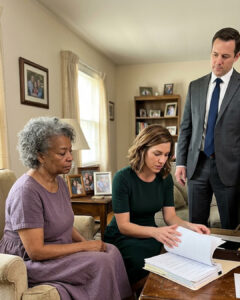
Brooke froze.
Paul adjusted his briefcase.
Matthew looked at me, then at the recorder, then back at me.
I saw realization moving across his face in stages: surprise, embarrassment, anger, and finally something that looked like shame.
“Mom,” he said, “you recorded us?”
“Yes,” I answered.
“In my own home, during a conversation about my own property.”
He flinched.
Brooke jumped in before he could say more.
“This is outrageous.
We came here out of concern.”
Mr.
Hayes picked up the first page with gloved precision, though he wore no gloves.
“Concern usually allows independent review,” he said.
“This document appears to authorize immediate sale preparation for Miss Suzanne’s residence and transfer of proceeds into an account requiring approval from Matthew and Brooke.”
“For management purposes,” Paul said quickly.
“Whose management?” Rachel asked from beside the fireplace.
No one answered.
The investigator asked Brooke when Suzanne had requested these services.
Brooke said we had discussed it many times.
I asked her to name one specific date.
She could not.
Paul said he was only there to notarize signatures, but Mr.
Hayes asked why his name appeared on a referral sheet for the care facility.
Paul’s face tightened.
That was the second layer of the plan: the facility, the financial account, the notary, the “specialists,” all connected by quiet little threads they never expected me to see.
Then I brought out the ranch papers.
It may sound dramatic, but I did not reveal them to impress anyone.
I revealed them because I wanted Brooke to understand the scale of what she had missed.
She had judged my house, my clothes, my cooking, my age, and my silence.
She had mistaken modesty for emptiness.
When Mr.
Hayes read the appraisal summary, Brooke’s face changed so quickly it almost hurt to watch.
Her concern vanished.
In its place came calculation, then panic, then a sweet little smile trying desperately to return.
“Mom Suzanne,” she said, voice thinner now, “this is exactly why you need help.
Assets like that are complicated.”
I looked at Matthew.
“Do you hear her?”
He did not answer.
“Matthew,” I said, “look at me.”
Slowly, he did.
“Your wife just learned I own land worth more than she imagined, and her first instinct was not to ask why I never felt safe telling you.
It was to say I need help controlling it.”
The room went silent again.
That was the moment my son truly heard the conversation.
Not as Brooke’s husband.
Not as a man trying to keep peace.
As the boy I raised, staring at the proof that peace without truth is only surrender.
He sat down heavily on the sofa.
“What have I done?”
Brooke turned on him.
“Matthew, don’t be dramatic.”
But he did not look at her.
He looked at me.
For the first time since the wedding, my son saw me not as a problem to be managed, but as a person he had failed to protect.
Right then, I played my ace.
I went to the bedroom, carried out the safe, opened it in front of everyone, and took out the ranch deed.
I spread the papers on the table, savoring each second of confusion on the schemers faces.
Isn’t this interesting?
I said, “My late husband left me a ranch of about 500 acres.
I simply hadn’t mentioned it yet.
Mr.
Hayes, please read the most recent appraised value.
” Attorney Hayes took the file.
A smile of poetic justice on his lips.
According to the latest appraisal, the market value of this ranch is in the many millions of dollars range, not counting the cattle, agricultural machinery, and auxiliary structures.
Absolute silence.
Brooke’s mouth hung open like a stranded fish.
Matthew stared at the paper like an extraterrestrial object.
Tens of millions, I repeated, savoring each word.
And yet you two were so worried about my poverty and my incompetence.
How kind.
My voice dripped with bittersweet sarcasm.
Paul flailed one last time.
Ma’am, that changes everything.
You need specialists to manage a portfolio of that size.
But Mr.
Brooke was already photographing all the documents they had brought.
Exactly.
I beamed.
Which is why a week ago I engaged Mr.
Hayes to handle all my legal and financial matters.
But thank you for your concern.
At last, Brooke found her voice raspy like a wounded crow.
Mom, we didn’t know.
I mean, we just wanted to help.
Help me.
I stood, reclaiming the dignity I thought I’d lost. help by selling my house without asking, moving me in a facility against my will and taking away my right to decide my own life.
Matthew spoke and for the first time in months, I heard my real son.
Mom, we thought it was what’s best for you.
His eyes were wet.
I didn’t know if it was remorse or frustration at having the game exposed.
What’s best for me, I softened, would have been to ask what I wanted.
What’s best for me would have been to respect my decisions.
What’s best for me would have been to see me as your mother, not an obstacle to your happiness.
Mr.
Hayes placed a protective hand on my shoulder.
Miss Suzanne, I think it’s time for everyone to leave.
We have sufficient documentation to proceed legally if necessary.
Paul practically ran for the door.
Brooke slunk after him, not bothering to keep the considerate daughter-in-law mask.
Matthew lingered a few seconds, looking at me with an expression I couldn’t read.
Mom, can we talk later?
For the first time, the question sounded real and bare.
I nodded slowly, promising nothing.
When they left, I stayed with my true allies, Rachel, Mr.
Hayes, and Mr.
Brooke.
For the first time in months, I felt safe in my own home.
Moving to the ranch was not an escape.
It was a return.
The first morning I woke there, I expected to feel lonely.
Instead, I heard wind moving across the fields and felt Thomas everywhere.
Not as a ghost, not as grief, but as memory woven into the land.
The old porch boards creaked under my slippers.
The kitchen window faced a line of cottonwoods.
Far off, cattle moved like slow shadows in the early light.
The ranch manager, Elena, had worked with Thomas for years.
She met me at the barn with a clipboard and the no-nonsense warmth of a woman who could mend a fence, review payroll, and make cinnamon rolls before sunrise.
“Mr.
Thomas always said you would love it here once you gave yourself permission,” she told me.
I looked out over the fields and realized permission had been the missing word in my life.
I had waited for permission to be included, permission to speak, permission to matter.
The ranch asked for none of that.
It simply stood there, patient and real, waiting for me to claim what was already mine.
Rachel came to stay for a week and never really left.
At first she used the guest room “just until you settle in.” Then she organized the pantry, charmed the ranch hands, started answering letters from women who had heard pieces of my story, and claimed the smaller guest house with the confidence of a queen choosing a summer cottage.
“You need someone here who will tell you when you’re being too noble,” she said.
“And that is you?”
“Obviously.”
We laughed more in those first months than I had laughed in the entire year after Thomas passed.
The refuge began accidentally.
A woman from church called, asking if I could speak with her cousin whose adult children wanted her to sign over a rental property.
Then a neighbor brought her aunt.
Then Mr.
Hayes asked whether I would be willing to meet a retired teacher whose nephew had emptied a joint account “for safekeeping.” Soon the ranch dining table was covered not with wedding plans or manipulative documents, but with folders, tea cups, tissues, and women remembering their own strength.
We did not give reckless advice.
We called attorneys.
We helped them organize papers.
We taught them to ask for independent review, to keep copies, to name trusted contacts, to say, “I will not sign today.” Such a simple sentence.
Such a powerful door.
Matthew watched this transformation quietly.
He continued visiting, sometimes bringing groceries, sometimes helping repair a fence, sometimes just sitting on the porch while I worked through letters.
One afternoon he said, “You turned what happened into something useful.”
“I had to,” I said.
“Otherwise it would only be pain.”
He looked toward the barn.
“Do you think I can become useful after what I did?”
I considered him carefully.
“Yes.
But usefulness begins with honesty.”
The next month, he volunteered at one of our workshops.
He did not speak as an expert.
He stood before a room of older women and said, “I am here as someone who failed his mother and is learning what repair requires.” It was not polished.
His voice shook.
But not one woman in that room looked away.
That was when I began to believe my son might truly come back to himself.
Three months later, I sat on the ranch porch, watching sunset turn my land orange.
It was also when I turned 70, a birthday gift of freedom I gave myself.
Matthew visited once a week alone, trying to mend the bond nearly destroyed by pleasing a woman who saw him only as a ladder to money.
Brooke’s final attempt to benefit from my assets came through the divorce papers.
By then, Matthew had moved into a small apartment and was sleeping on a secondhand sofa because he refused to take furniture from my house.
“I don’t want anything that feels like I profited from you,” he said.
It was clumsy, but sincere.
Brooke, on the other hand, hired an attorney with a reputation for aggressive claims and argued that Matthew had an expected inheritance from me that should be considered part of their marital picture.
When Mr.
Hayes told me, I laughed once, not because it was funny, but because audacity sometimes leaves no other sound.
“An expected inheritance?” I repeated.
“She expected what she tried to arrange.”
Hayes’s mouth twitched.
“That is one way to phrase it.”
Brooke’s attorney requested information about the ranch, my trust, and “financial benefits promised to Matthew.” Hayes responded with a letter so precise it could have been framed.
No promise existed.
No transfer had been made.
Matthew had no ownership interest.
My estate plan was private.
Any attempt to drag my protected assets into their divorce would be challenged immediately.
But Brooke did not stop there.
She sent Matthew long messages, accusing him of letting me manipulate him, insisting that I had “turned everyone against her,” and claiming she had only tried to create stability.
One evening, Matthew came to the ranch with his phone in his hand and asked if he could read one aloud.
“Only if you need me to hear it,” I said.
He read the message slowly.
Brooke wrote that I had always resented her beauty, her education, her influence over Matthew.
She wrote that older mothers often become possessive and that Matthew needed to “finally choose his wife over his mother.” She wrote that if he had been a stronger man, he would have helped her secure our future before I “turned” him against her.
I watched Matthew’s face as he read.
The old version of him would have defended her, explained her stress, or asked me not to take it personally.
This Matthew looked tired, but clear.
“I used to think messages like this were passion,” he said.
“Now I see they were instructions.”
That was a painful kind of growth, but growth all the same.
The divorce hearing was brief.
Brooke arrived in an ivory suit, composed and bright-eyed, as if presentation could replace truth.
Matthew arrived with his attorney and, at his own request, a written statement.
He did not criticize her character.
He did not call her names.
He simply described the pressure around my assets, his role in it, and the moment he understood the difference between helping a spouse and participating in something wrong.
When he read the line, “I failed my mother by confusing obedience with love,” I looked down at my hands.
There are apologies that ask you to forget.
There are apologies that ask you to comfort the person who harmed you.
And then there are apologies that stand up in a public room and accept consequence without demanding reward.
Matthew’s was beginning to look like the third kind.
Brooke received what the law allowed from the marriage and nothing more.
She left the courthouse without looking at me.
I felt no triumph watching her go.
I felt a tired relief, the kind that comes when a long, unpleasant noise finally stops.
Outside, Matthew walked beside me to the parking lot.
“I know a statement doesn’t fix it,” he said.
“No,” I answered.
“But it tells me you understand there is something to fix.”
He nodded.
“Can I come Sunday?”
I looked at him for a moment.
“You can come for lunch.
Rachel is making pot roast.”
His eyes filled at the ordinary invitation.
Sometimes the first real mercy after a hard season is not dramatic.
Sometimes it is a plate at the table, offered with boundaries still intact.
Brooke called many times all went to voicemail.
People say they divorced when she realized I wasn’t the weak poor widow she’d imagined.
Now I help older women facing similar situations.
My home has become a refuge where they can tell their stories and receive free legal guidance.
I’ve learned that silence can be gold, but speaking up at the right time is diamond.
At 69, I finally understood my husband’s last words.
I had more than I thought, and I was stronger than I believed. 6 months after that life-changing afternoon, I sat on the porch with a hot cup of coffee, watching the sun rise over my 500 acres of freedom.
The scent of freshly ground coffee mingled with the orange blossoms I planted last week.
Each morning, a symphony reminding me why I had to stand firm.
The ranch’s main house became something I’d never imagined, a haven for women like me.
The first official workshop at the ranch happened on a windy Saturday in April.
I expected six women.
Twenty-three arrived.
They came in sensible shoes, church dresses, cardigans, work jackets, and the cautious expressions of people who had learned to apologize before taking up space.
Some came with daughters who were genuinely protective.
Some came alone because the very people pressuring them were the ones who controlled their rides.
Elena arranged folding chairs in the converted tack room, Rachel made coffee in giant silver urns, and Mr.
Hayes spread sample documents across a long table.
I stood at the front with my notes shaking in my hand.
“I am not here because I was smarter than everyone,” I began.
“I am here because I nearly signed away my life at my own coffee table.”
No one moved.
So I told them the truth.
Not the polished version.
I told them about the fifth row at the wedding.
The basket of cookies accepted at the door.
The little comments about my age.
The way concern can be sharpened until it becomes control.
I told them how badly I had wanted to believe my son knew better, and how dangerous it can be when love makes us explain away repeated disrespect.
A woman in the second row covered her mouth.
Another began writing quickly.
One elderly man, there with his sister, lowered his head and stared at his shoes.
Then Mr.
Hayes taught them the practical pieces.
Never sign under pressure.
Never sign because someone says the offer expires today.
Ask for copies.
Request independent counsel.
Keep a private list of accounts, property, insurance, and trusted contacts.
Add alerts at the bank.
Do not let shame keep you silent.
If someone frames urgency as love, slow the process down.
“Honest help can wait for review,” he said.
“Dishonest pressure hates daylight.”
That line later became the sentence we printed on the first page of every workshop packet.
After the session, women lined up to speak with me.
One said her grandson had asked her to put his name on her checking account “just for convenience.” Another said her daughter-in-law kept joking that she would be “better off somewhere with supervision.” A third woman, Mrs.
Talbot, brought a stack of unopened mail because her nephew had told her legal letters were “too stressful” and had taken over reading them.
We did not solve everything in one afternoon.
Life rarely grants that kind of neatness.
But we made copies, wrote phone numbers, scheduled appointments, and told each person the same thing: you are allowed to pause.
That word became sacred to me.
Pause before signing.
Pause before transferring.
Pause before believing the person rushing you.
Pause before surrendering your home because someone says your age has made you inconvenient.
When the last visitor left, Rachel and I stood in the tack room surrounded by empty cups and folded chairs.
My feet ached, my voice was hoarse, and my heart felt larger than my body.
“Well,” Rachel said, tying a trash bag closed, “your quiet retirement is going beautifully.”
I laughed until I had to sit down.
For the first time, the pain Brooke brought into my life had been transformed into something that could protect other people.
That did not make what happened good.
Nothing would.
But it meant the story did not end at my humiliation.
It moved through me and became a door others could use.
Every week I receive letters, phone calls, and visits.
They hear my story and recognize their own hard season in it.
And they leave with the one thing I most want to give.
The strength to say no.
Miss Suzanne, they say in trembling voices.
My daughter-in-law is forcing me to sell my house.
Oh, my son says I can’t handle my money anymore.
Yesterday, Margaret, a 73-year-old widow, came to my ranch.
Her children had convinced a court to declare her incapable of managing her assets.
She walked in with a small suitcase and the heavy weight of family deep hurt.
“Miss Suzanne,” she said through tears, “my own children keep me under isolated at home.
They take my pension and won’t let me go out alone.
They say it’s for my own good.
I seated her in the same rocking chair where I once cried from loneliness, poured chamomile tea into a porcelain cup, and told her my whole story.
I saw hope returned to her eyes for the first time in months.
“Can I really take back control of my life?” she asked like a lost child finding the way home.
“Not only can you,” I held her wrinklednkled hands.
“It’s your right, and you are not alone.” The next morning, attorney Robert Hayes reviewed Margaret’s file.
We found multiple procedural irregularities in the incapacity ruling enough to overturn it.
Now, Margaret smiles every day, and her children have been forced to return the funds they had withdrawn to manage for safety.
My story spread like wildfire across the region.
Reporters came to interview me.
Social workers invited me to speak to the community.
I received letters from all over, even Spain and Argentina.
Your courage inspired me to defend my rights,” a woman in Madrid wrote.
Another in Buenos Aires thanked me.
“Thanks to your example, my family no longer treats me as invisible.
But not everything was easy.” Matthew, my son, visited every Sunday by himself, trying to rebuild the bridge his wife had damaged.
The first visits were awkward, embarrassed silences, apologies that sounded memorized.
Gradually, I saw the child he once was flicker behind the eyes of the man who had let someone else betray his mother.
Two weeks ago, as the two of us walked past the barns, he said, “Mom, I don’t know how to apologize to you for what I did.
It’s like I was hypnotized, unable to see the obvious.
His tears were real, and for the first time since the wedding, I recognized my child.” “Son,” I stopped and looked him straight in the eyes.
Forgiveness isn’t asked for, it’s earned, and people prove it with actions, not words.
He nodded, understanding that reconciliation would be a long journey, one that required patience and evidence of remorse.
As for Brooke, she disappeared from our lives as quickly as she had arrived.
Rachel, my best friend who has ears everywhere, said Brooke planned to file for divorce to claim half the assets, but Matthew had legally protected everything on my advice.
She left town without saying goodbye, probably to look for her next target.
The investigation into Paul opened a door none of us expected.
At first, I thought he was simply a questionable notary willing to look away for a fee.
Then Daniel Harris, the investigator from the prosecutor’s office, called Mr.
Hayes and asked whether I would be willing to provide a formal statement.
There were other cases.
Many others.
Paul had appeared in living rooms across three counties.
Always with a folder.
Always with someone claiming to be a helpful relative.
Always with language about safety, simplification, and peace of mind.
Some families may have believed they were doing the right thing.
Others clearly knew exactly what they were doing.
Either way, older adults were losing homes, control, and dignity one signature at a time.
Giving my statement was harder than I expected.
I sat in a conference room with a recorder on the table, just as the recorder had once sat in my living room.
Daniel asked me to describe every step.
Brooke’s first comments.
Matthew’s visit.
Paul’s demeanor.
The papers.
The proposed care facility.
The moment Mr.
Hayes arrived.
When I finished, Daniel closed his notebook.
“Mrs.
Suzanne,” he said, “your preparation may help people you will never meet.”
That sentence stayed with me.
A month later, he called again.
They had identified a pattern involving referrals, document preparation, and pressure tactics.
Paul’s license was suspended first, then revoked.
Other professionals faced review.
Some families quietly reversed transactions before cases went further, frightened by the attention.
Homes were returned.
Accounts were restored.
Not all of them, not perfectly, but enough to prove daylight works.
At the ranch, the letters increased.
We needed a system.
Rachel created intake forms.
Elena converted one of the guest houses into a small office.
Mr.
Hayes brought in two younger attorneys who wanted pro bono experience.
A retired accountant named Mr.
Feld came every Thursday to help women understand statements and beneficiary forms.
Carol, my hairdresser from Seattle, heard what we were doing and mailed a box of scarves with a note: “For women walking into court who deserve to feel beautiful.”
That note made me cry harder than some of the legal letters.
We named the program The Open Gate Project.
Rachel said it sounded hopeful without sounding pitiful.
I agreed.
We were not rescuing helpless people.
We were opening a gate so capable people could walk back into their own lives.
One afternoon, a woman named Denise arrived with her mother, Alma, who was eighty-one and furious.
“I am not fragile,” Alma announced before sitting down.
“Good,” I said.
“Then you will fit right in.”
Her son had convinced her to sign a document she did not understand.
He said it was for bill paying.
It gave him far more authority than she realized.
Alma wanted to reverse it, but she also loved him and feared destroying the relationship.
I knew that ache.
“Accountability does not destroy love,” I told her.
“It tests whether love has respect inside it.”
Alma stared at me, then nodded once.
“Write that down,” she told Denise.
Those moments became the heartbeat of my new life.
Not revenge.
Not bitterness.
Restoration.
At night, when the ranch grew quiet, I sometimes sat on the porch with Thomas’s letter in my lap.
I would read the same line again and again: “Do not let anyone make you feel small because you are gentle.”
I finally understood.
Gentleness was not the problem.
Silence was not always weakness.
Trust was not foolish.
The problem was giving people access to my life after they had shown they did not respect the door.
Now the door had a lock.
It also had a welcome mat for those who came with clean hands.
Paul, the slippery notary, lost his license after deputy prosecuting attorney Daniel Harris submitted evidence of a ring that financially exploited older adults.
The recording of the conversation at my home was the key, helping dismantle the network that had drained money from dozens of elderly people in the area.
Rachel remains my companion now.
She lives in one of the ranch’s guest houses, not as hired help, but as the sister I chose.
Together, we run the refuge we established, organize workshops on the rights of older adults, and plan trips we never had the chance to take when we were young.
Who would have thought that at 70 we’d become activists?
Rachel joked as the two of us sorted through a table piled with applications for legal support.
I smiled, remembering the timid woman I was a year ago, content with crumbs of attention, letting others decide my fate.
Attorney Hayes is no longer just my lawyer.
He has become the legal director of our foundation.
We’ve pushed through changes to several local regulations that better protect older adults and are working with federal lawmakers on broader reforms.
Miss Suzanne, he said at our most recent meeting, “In six months, you’ve done more for elders rights than many organizations have done in decades.
Every night before bed, I walk through the garden reflecting on the road traveled.
Sometimes I find handwrinkledtten letters placed in the mailbox under the big oak left by women who have stayed here.
Thank you for teaching me that it’s never too late to reclaim my dignity, one letter said.
Another read, Thank you for showing me that self-respect has no expiration date.
Tomorrow, a group of ladies from California will come to hear our story and learn how to build similar shelters in their cities.
The movement is spreading like ripples on a pond, touching lives I never thought I could reach.
The first Thanksgiving after everything changed was the true test of our family.
Rachel wanted to make it a large gathering at the ranch because, in her words, “A house this big should smell like gravy at least once a year.” Elena invited two ranch hands who had no nearby relatives.
Mr.
Hayes planned to stop by for dessert.
Margaret, Alma, and three other women from The Open Gate Project asked if they could bring side dishes.
By the time I finished writing the list, Thanksgiving had become less of a family dinner and more of a declaration that none of us had to sit alone at tables where we were not respected.
I invited Matthew last.
Not because I wanted to punish him.
Because inviting him meant opening a door I had only recently learned to guard.
I called on a Sunday evening, standing by the kitchen window while rain tapped the glass.
“We’re having Thanksgiving here,” I said.
“You may come if you understand something first.”
“Anything,” he replied.
“This is my home.
No discussions about inheritance.
No old pressure.
No defending Brooke.
No asking me to move faster than I am ready to move.
If you come, you come as my son, not as someone looking for reassurance that everything is already repaired.”
He was quiet for a moment.
Then he said, “I understand.
What can I bring?”
That answer mattered.
“Apple cider,” I said.
“And yourself on time.”
Thanksgiving morning arrived cold and bright.
Frost silvered the fence posts.
The kitchen steamed with activity.
Rachel commanded the turkey with military focus.
Elena rolled pie crust.
Alma sat at the table snapping green beans and giving unsolicited but excellent advice.
I wore a blue dress Thomas had loved and pinned my hair back with the pearl clip Matthew gave me when he was sixteen, bought with money from mowing lawns.
He arrived ten minutes early with cider, flowers, and no excuses.
For the first hour, he helped quietly.
He carried chairs, set plates, and asked Rachel where things went instead of assuming.
When Margaret struggled with a heavy dish, he took it from her only after asking permission.
It was a small detail, but I saw it.
Men who are trying to change reveal themselves in small permissions.
During dinner, everyone shared something they were thankful for.
I expected simple answers: health, friendship, shelter.
Then Matthew stood.
My fork paused halfway to my plate.
“I am thankful,” he said, voice unsteady, “that my mother loved herself enough to stop me.”
The room went still.
He looked at me, not performing, not pleading, just telling the truth.
“I used to think being a good son meant keeping everyone comfortable.
I was wrong.
I kept the wrong person comfortable and let the right person be humiliated.
I cannot undo that.
But I can spend the rest of my life becoming someone my mother does not have to protect herself from.”
Rachel wiped her eyes with a napkin and pretended she had gotten pepper in them.
I did not rush to speak.
The old me would have softened the room immediately, laughed, waved it away, told him we were fine.
The new me let the truth stand long enough to be honored.
Finally, I said, “That is a good beginning.”
After dinner, Matthew asked if we could walk to the small family cemetery at the edge of the property, where Thomas’s ashes had been placed beneath a stone marker near an old pine.
The air smelled of damp earth and woodsmoke.
We walked slowly, our coats pulled tight.
At the marker, Matthew removed his cap.
“I owe Dad an apology too,” he said.
“You can say it.”
He looked embarrassed, but he did.
He apologized for forgetting what Thomas had taught him about decency.
He apologized for letting greed dress itself as practicality.
He apologized for making me stand alone when Thomas had trusted him to honor me.
The wind moved through the pine branches.
I did not pretend Thomas answered.
But I felt, in that quiet way the heart sometimes knows, that something had been placed back where it belonged.
On the walk back, Matthew said, “Brooke wrote me last week.”
I felt my shoulders tighten.
“She wanted to meet.
Said she had reflected and wanted closure.”
“Did you meet her?”
“No.
I told her any communication could go through the attorneys until the divorce was completely final.
Then I blocked the number.”
I stopped walking and looked at him.
He gave a small, sad smile.
“I know.
I should have learned that earlier.”
“Yes,” I said.
“You should have.”
He nodded.
No defensiveness.
No wounded pride.
Just acceptance.
That was when I reached for his hand.
It was the first time I had done so since the day everything came to light.
His fingers closed around mine carefully, as if he understood the gesture was not a full pardon but a bridge.
A bridge still under repair, but strong enough for one crossing at a time.
Back at the house, laughter spilled from the kitchen.
Rachel was telling a story too loudly.
Alma was correcting someone’s gravy technique.
The windows glowed gold against the darkening fields.
Matthew squeezed my hand once before letting go.
“Thank you for letting me come,” he said.
“Thank you for coming correctly,” I answered.
That night, after the dishes were washed and the guests had settled into rooms or driven home under clear stars, I sat alone on the porch.
The ranch stretched before me, dark and steady.
I thought about the woman I had been at the wedding, sitting in the fifth row, swallowing hurt so no one would call me difficult.
I thought about the woman who almost signed papers because her own child was standing beside the person pressuring her.
I thought about the woman I had become: not hard, not cold, not closed, but awake.
There is a difference.
Being awake meant I could love Matthew and still require accountability.
I could miss the old days and still refuse to return to old patterns.
I could build a refuge without pretending I had never needed one.
I could forgive slowly, with my eyes open.
The porch light hummed above me.
Somewhere in the distance, a gate clicked in the wind.
For the first time in a long time, I did not hear it as a warning.
I heard it as a choice.
At 69, I realized old age isn’t the end of the story.
Sometimes it’s the beginning of the strongest chapter.
I learned that the wisdom accumulated over decades is a tool more powerful than youth.
That lost dignity can always be won back if we dare to stand firm for it.
My name is Suzanne, 69 years old, and this is my Declaration of Independence.
I will never again let anyone make me feel invisible, useless, or disposable.
If my story inspires even one woman to raise her voice against mistreatment and manipulation, then every tear, every deep hurt, every moment of pain will have been worth it.
In the end, I realized my late husband was right.
I was stronger than I thought, and I had more than I believed.
I just needed to remember who I really was.
Perhaps the most powerful thing in Suzanne’s story isn’t the ranch, nor the legal papers, but the moment she stood up straight and named what she deserved.
Dignity, boundaries, and love that knows respect.
Family is where love begins, but it’s also where limits must be set.
Forgiveness can open a door, but trust only returns with action.
And sometimes learning to say no is how we say yes to our own lives to peace, autonomy, and self-respect.
One year later, the ranch did not feel like a secret anymore.
It felt like a promise finally being lived out loud.
The old main house had changed slowly, not in a way that erased Thomas, but in a way that let the place breathe again.
Rachel and I turned the front parlor into a warm meeting room with soft chairs, a long oak table, and shelves full of simple guides that anyone could understand.
No one who came to us needed to feel foolish for not understanding legal language.
That was one of my firm rules.
Complicated words had helped make too many honest people feel small.
On the wall near the window, I hung a framed copy of the sentence Thomas had written in his letter.
The land is your safety, your independence, and your answer to anyone who tries to turn love into leverage.
Visitors often stopped in front of it.
Some read it once.
Some read it three times.
Some cried quietly, then apologized for crying, and Rachel would hand them a tissue and say, “We do not charge extra for honest tears.”
That was Rachel: tender, blunt, and impossible to embarrass.
The Open Gate Project grew faster than we expected.
At first, people came because they had heard a dramatic story about a widow, a ranch, and a family meeting that did not go the way two younger people expected.
But they stayed because the work was practical.
We helped people organize papers.
We helped them write down their wishes.
We helped adult children learn how to offer support without pushing the person they loved out of the center of the decision.
We helped families separate a real need from a rushed assumption.
The most common sentence I heard was, “I do not want to be a burden.”
Every time, I answered the same way.
“Having needs does not make you a burden. Being treated without respect is the burden.”
Sometimes the person across from me would exhale as if they had been holding their breath for years.
One Tuesday in March, a woman named Alma came to the ranch in a navy coat buttoned wrong.
She was seventy-six, sharp-eyed, and proud in a way that had survived a great deal.
Her grandson drove her, but he did not come inside.
I noticed that.
People reveal themselves in doorways.
Alma sat at my kitchen table and placed a folder in front of me.
“My family says this is only a convenience,” she said.
“What is?”
“They want me to add my grandson to my accounts. They say he can pay bills for me. I can pay my own bills. I have paid bills since before that boy knew how to tie his shoes.”
Rachel poured coffee.
“Does anyone else know you came here?”
Alma lifted her chin. “My neighbor. She is nosy in a useful way.”
I liked Alma immediately.
We reviewed the papers. I did not give legal advice, but I knew enough to see that the language gave far more access than Alma seemed to understand.
“This is not just help with bills,” I told her. “This gives broad access.”
Her mouth tightened.
“I asked them. They said I was being dramatic.”
“Dramatic is a word people use when they want your concern to sound like a performance.”
Alma looked at me for a long moment, then laughed once.
“I have been called dramatic since 1962. It has never stopped me.”
Mr. Hayes met with her the next day.
Within a week, Alma had a safer arrangement: limited bill-pay assistance through the bank, monthly statements mailed directly to her, and a trusted neighbor listed as a second contact for notices. Her grandson was not pleased, but he had no reasonable argument once the plan was clear.
Alma returned the following Thursday with three pies.
“I do not bake when I am happy,” she said. “I bake when I have made a point.”
That became a ranch saying.
When someone took back a little authority, Rachel would whisper, “That deserves a point-making pie.”
It is strange what becomes tradition.
Matthew watched all this unfold from the edge at first.
He helped with chairs.
He fixed a leaky faucet.
He carried boxes from the supply room.
He never offered opinions unless asked, which I knew cost him effort.
One afternoon, after a workshop on respectful planning, I found him standing alone in the meeting room.
The chairs were still in a circle.
On each seat, someone had left a card with an unfinished sentence:
The decision I want respected is…
Matthew held one card in his hand.
“A man wrote this,” he said.
“What does it say?”
He read softly. “The decision I want respected is that I am allowed to stay in my home while we explore support, instead of being told I am stubborn.”
I waited.
Matthew set the card down.
“That could have been you.”
“Yes.”
“And I would have called you stubborn.”
“You might have.”
He sat in one of the chairs.
“I used to think the worst part was that Brooke pushed.”
“And now?”
“Now I think the worst part is that I helped her push by staying quiet.”
There it was.
Not the whole truth, maybe, but a clean piece of it.
I sat across from him.
“Silence can participate,” I said.
He nodded.
“I am learning that.”
For a long time, I thought accountability would arrive like a single grand apology and the past would loosen its grip.
It does not work that way.
Accountability arrives in repetitions.
It arrives when a son does not ask to be forgiven at the very moment he apologizes.
It arrives when he lets his mother finish speaking.
It arrives when he accepts a boundary without making sadness the price of it.
It arrives when he changes behavior no one is applauding.
That was what Matthew began to do.
On Mother’s Day, he did not make a public post.
He did not send an oversized flower arrangement that would make him look thoughtful to the delivery driver.
He arrived in the morning with work gloves, a bag of groceries, and a handwritten menu.
“I would like to cook lunch,” he said. “And after that, I will clean the gutters.”
“That is quite a holiday offer.”
“The counselor said love can be concrete.”
“I like your counselor.”
He smiled.
Lunch was better than the birthday dinner had been.
The chicken was not dry this time.
The salad was still over-dressed, but less dramatically.
After we ate, he handed me a small box.
Inside was the framed photograph I had carried to his wedding, the one of him and Thomas on the fishing trip when he was eight.
“I found it in a closet,” he said. “Brooke had put it there after the wedding. I should have noticed. I should have asked where it went.”
He swallowed.
“I am returning it because it was never really mine to hide.”
I touched the frame.
Thomas stood in the picture with one hand on Matthew’s shoulder, both of them squinting into sunlight, both proud of a fish that was honestly not very impressive.
“Thank you,” I said.
“I also made a copy for myself. Is that okay?”
“Yes.”
He looked relieved.
That afternoon, while he cleaned the gutters, I placed the photograph on the mantel.
It looked like it had been waiting to come home.
The following summer, the county asked me to speak at a public forum on aging with dignity.
I nearly said no.
Not because I was afraid of speaking anymore, but because my story had begun to feel like a dress everyone wanted me to wear. The brave widow. The clever mother. The ranch owner who outplanned the planners.
Those versions were not false, but they were too simple.
They did not include the nights I missed my son so badly I almost called and pretended nothing happened.
They did not include the shame I felt when I realized I had taught Matthew, in small ways, that my needs came last.
They did not include how hard it was to become firm without becoming bitter.
Rachel found me on the porch with the invitation in my lap.
“You are thinking too loud,” she said.
“I do not know if I want to tell the story again.”
“Then tell the part people do not expect.”
“Which part is that?”
“The part where you admit boundaries are lonely at first.”
So I went.
The forum was held in a community auditorium with rows of blue chairs and a stage that made everyone look more official than they felt. There were social workers, bank employees, adult children, retired teachers, church volunteers, and older adults sitting with folded arms as if they had come prepared to disagree with everyone.
I liked them best.
When my turn came, I walked to the microphone in my purple dress.
I had reclaimed that dress fully by then.
“Most people ask me how I found the courage to say no,” I began. “That is not the right question. Courage is not a mood you wait for. I was not brave in the way people imagine. I was hurt. I was tired. I was embarrassed. I was still hoping my son would wake up and choose me without being forced to see the truth.”
The room went still.
“The real question is not how to feel brave. The real question is what you do while your hands are shaking.”
I saw several people lean forward.
“You make one call. You keep one note. You ask one trusted person to sit with you. You delay one signature. You request one more day. You say, ‘I need independent advice.’ You do not have to transform your whole life by sunset. You only have to interrupt the rush.”
That line became the one people repeated later.
Interrupt the rush.
After the forum, a man named Harold approached me.
He was eighty-one, dressed in a brown jacket, with a voice as soft as worn cotton.
“My daughter is a good woman,” he said.
“I believe you.”
“She wants me to move in with her. I do not want to. But I am afraid if I refuse, she will think I do not love her.”
“Do you love her?”
“More than anything.”
“Then tell her that first. Then tell her what you want.”
He looked doubtful.
“What if she cries?”
“She may. Tears do not automatically mean you made the wrong choice. Sometimes they mean the other person had a different picture in mind.”
Harold came to the ranch two weeks later with his daughter.
They sat in the meeting room for nearly three hours.
She cried.
He cried.
Rachel cried because she claimed the room was dusty.
In the end, they made a new plan. Harold would stay in his own home for six months, with twice-weekly help, a fall alert device, grocery delivery, and scheduled Sunday dinners at his daughter’s house. At the end of six months, they would review the plan together.
No one got everything.
Everyone got heard.
That, I have learned, is often the best a family can do.
Not perfect agreement.
Respectful adjustment.
The ranch’s second autumn brought a letter from Brooke’s mother.
I did not expect that.
Her name was Diane. I had met her only a few times, mostly at wedding events where she watched Brooke with the anxious admiration of a woman who had learned long ago not to interrupt her daughter’s plans.
The letter was short.
Suzanne,
I owe you an apology for the wedding seating.
I knew it was wrong.
I told myself it was not my place.
I have thought about that often.
I am sorry.
Diane
No explanation.
No request.
No attempt to reopen a relationship.
Just accountability.
I read it twice and felt something in me soften toward a person I had barely considered. I wrote back.
Diane,
Thank you for saying that plainly.
It mattered then, and your honesty matters now.
I wish you well.
Suzanne
Not every apology requires reunion.
Some apologies simply return a piece of truth to the room where it was missing.
That was enough.
Matthew continued to come on Sundays.
Some visits were easy.
Some were not.
Once, he asked if he could bring a woman he had been seeing.
My first reaction was so sharp I had to turn away.
He saw it.
“Forget I asked,” he said quickly.
“No,” I replied. “Do not forget. Let me answer honestly.”
We were standing near the barn, and the afternoon was bright.
“I am not ready,” I said.
He nodded. “Okay.”
No argument.
No wounded speech.
No reminder that he was lonely.
Just okay.
That one word healed more than a dozen apologies.
Three months later, he asked again.
This time, I said yes.
Her name was Nora.
She arrived in jeans, brought banana bread, and asked where she should put her shoes because she did not want to track mud into my kitchen. She did not ask about the ranch value. She did not scan the walls. She asked about Thomas because she had seen his photograph on the mantel and wanted to know what kind of man could smile that proudly over such a small fish.
I liked her before I meant to.
At dinner, Matthew looked nervous enough to drop a plate.
Nora noticed and touched his sleeve.
“You can breathe,” she said.
That small kindness told me more than any resume could have.
After they left, Rachel appeared from the guest cottage pretending she had not been watching through her curtains.
“Well?” she asked.
“She sees people,” I said.
Rachel nodded. “That is rarer than it should be.”
I did not rush. I did not bless. I did not imagine grandchildren or future holidays. I simply allowed a new person to be new.
That was another kind of freedom.
The Open Gate Project eventually became a registered nonprofit, though I still disliked paperwork enough to make Mr. Hayes handle most of the official details. We built a small network of attorneys, counselors, social workers, financial educators, and volunteers who believed in one shared principle: older adults deserve both support and authority.
We created a simple packet called The Kitchen Table Plan.
It asked plain questions:
Where do I want to live if my health changes?
Who do I trust to help with bills?
Who should not have access to my accounts?
What decisions matter most to me?
What kind of help feels respectful?
What warning signs tell me a conversation is becoming pressure?
What phrase can I use when I need time?
The phrase we printed in bold was this:
I do not make major decisions in one sitting.
People loved that sentence.
It was short.
It was calm.
It did not accuse.
It simply placed time back in the hands of the person being rushed.
I began using it myself in all kinds of situations.
When a contractor wanted an answer by evening.
When a relative asked for a favor that felt tangled.
When a charity caller tried to keep me on the phone.
When Matthew, out of habit, once asked if we could “just decide now” about Thanksgiving plans.
I looked at him.
He caught himself.
“Right,” he said. “You do not make major decisions in one sitting.”
“Look at you learning.”
“Slowly.”
“Slowly counts.”
By then, trust had grown enough that we could laugh without pretending the past had vanished.
I think that is what real repair looks like.
Not forgetting.
Not repeating the wound every day.
Letting the truth sit in the room without making it the only furniture.
On the second anniversary of Thomas’s passing, Matthew and I drove to the far edge of the ranch together.
There is a hill there where the land opens wide enough to make a person feel both small and held. Thomas used to stand there at sunset and say, “This is where the day tells the truth.”
Matthew brought a thermos of coffee.
I brought Thomas’s old hat.
We stood in the wind, looking over the fields.
“I used to think inheritance meant what someone leaves you,” Matthew said.
“And now?”
“Now I think it also means what someone teaches you too late, and you spend the rest of your life trying to learn properly.”
I looked at him.
“That is not a bad definition.”
He smiled sadly.
“Dad left you land. You are leaving me a harder lesson.”
“Good. Land requires taxes.”
He laughed, and the sound moved across the hill.
Then he grew serious.
“Mom, I want you to know something. I do not expect anything from the ranch. Not now. Not later. I want to be in your life because I belong there, if you allow it, not because I am waiting for an outcome.”
I believed him.
Not because he said it beautifully.
Because he had been living it in plain, repetitive, unglamorous ways.
That is how trust returns.
Plainly.
Repetitively.
Without applause.
I took Thomas’s hat from my hands and placed it on Matthew’s head.
It sat crooked.
“Your father would tell you to fix the fence before making speeches,” I said.
Matthew adjusted the hat.
“Then I guess I know what I am doing next Sunday.”
We stood there until the sun lowered.
For once, the silence between us did not feel like avoidance.
It felt like room.
Room for grief.
Room for change.
Room for a mother and son learning a new language after both had been fluent in the wrong kind of quiet.
That evening, I wrote a new line in the kitchen notebook.
Love is not proven by how much control someone gets.
Love is proven by how much respect remains when they are told no.
The next morning, a visitor underlined it twice.
She added beneath it:
I came here thinking I needed permission.
I am leaving with a plan.
I stood in the kitchen holding that notebook, the ranch waking around me, coffee warming my hands, and I understood something I wish I had known at sixty, fifty, maybe even forty.
It is never too late to become a safer place for yourself.
Not a harder place.
Not a colder place.
A safer one.
There is a difference.
A hard heart closes every door.
A safe heart installs a lock, keeps the key, and decides who has earned an invitation.
That is how I live now.
My doors are not closed.
They are chosen.
If you came here from Facebook because of this story, return to the Facebook post, tap Like, and comment exactly “Amazing” to support the storyteller. That small action means more than it seems and gives the writer genuine encouragement to keep sharing more stories about family pressure, firm boundaries, and finally protecting what you worked so hard to build.
Disclaimer: This story is a work of fiction created for entertainment purposes. Any resemblance to real persons, events, or places is coincidental.