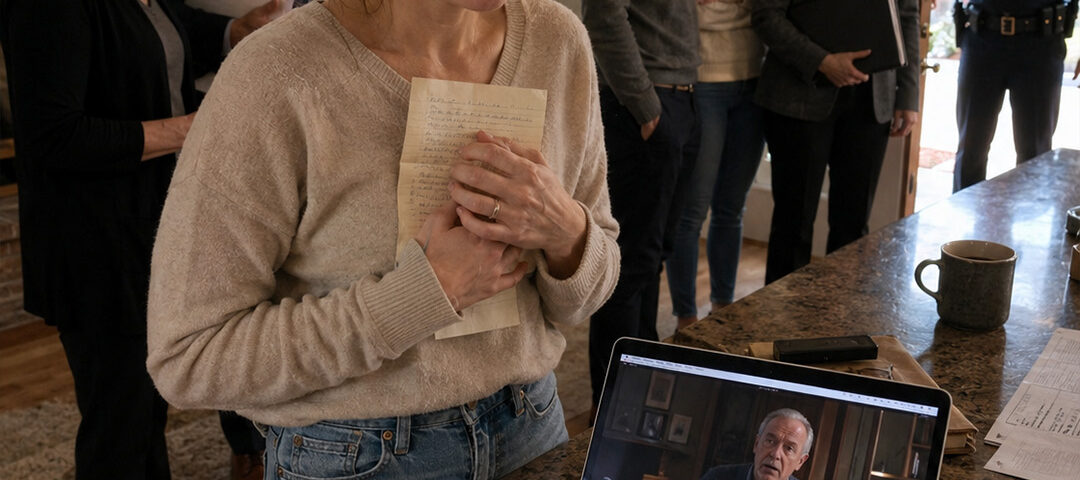
My father’s face filled Benjamin’s laptop screen.
He looked thinner than I remembered, his shoulders swallowed by the dark cardigan he always wore in the study.
The timestamp in the corner showed that the recording had been made eleven days before his final hospital admission.
For several seconds, nothing happened.
My father sat behind his desk with one hand resting beside a stack of documents.
Then Eleanor’s voice came from somewhere behind the camera.
“Take the pills, Thomas.
By tomorrow, you won’t remember what you refused to sign.”
The kitchen seemed to lose all air.
The real-estate agent lowered herself onto a stool.
The buyers stood together near the doorway, their expressions shifting from confusion to alarm.
Even the locksmith, who had been trying to look invisible, stared openly at Eleanor.
She moved first.
With a sudden sweep of her arm, she reached for the laptop.
Benjamin shut it before she touched the keyboard.
“Do not interfere with the evidence,” he said.
“Evidence?” Eleanor’s voice rose.
“That proves nothing.
Thomas was confused.
He recorded conversations constantly.
Harper could have edited it.”
I remained beside the fireplace, holding the envelope my father had left inside the steel compartment.
My hands were steady, but my pulse hammered against my throat.
The buyer’s attorney stepped between Eleanor and the oak island.
“Nobody is removing that drive from this room,” he said.
Eleanor glared at him.
“You represent the buyers, not this family.”
“Correct.
And my clients were nearly persuaded to purchase a property you do not own using documents that may be fraudulent.
That makes this my concern.”
The younger couple exchanged a shaken glance.
The wife pressed one hand against her stomach.
“You told us the title was clear,” she said.
“It is clear,” Eleanor insisted.
“Thomas left everything to me.
Harper and this lawyer are manufacturing a dispute because she cannot accept her father’s wishes.”
Benjamin reopened the blue folder.
“Thomas’s wishes are documented in an irrevocable trust created two years before his death,” he said.
“The property was transferred legally, recorded with the county, and placed beyond the reach of his personal estate.
Harper is the sole beneficiary.
You were granted temporary occupancy only during Thomas’s lifetime.”
“He changed his mind.”
“Then show us the valid document proving it.”
Eleanor’s lips parted, but she did not answer.
Benjamin removed a second device from the hidden compartment.
It was a slim digital recorder wrapped in a plastic evidence sleeve.
“The USB contains copies,” he said.
“This is the original recorder.
Thomas also arranged for encrypted duplicates to be delivered to my office every Sunday night.
Editing the files would have required altering three independent sets with matching metadata.”
The certainty in his voice frightened her more than anger would have.
Eleanor backed away from the island.
“Thomas was sick,” she said.
“He was paranoid.
He imagined things.”
“Then why did you know where the recording was hidden?” I asked.
She stopped.
Everyone had seen the way she looked toward the fireplace before I opened it.
“I did not know,” she replied.
“You tried to stop me from reaching it.”
“Because I knew your father kept private things there.
A wife has a right to protect her husband’s dignity.”
The buyer’s wife spoke again.
“You told us the fireplace was worthless and
should be demolished first.”
Eleanor turned on her with startling coldness.
“You are buying a house, not conducting an interrogation.”
“We are not buying anything from you,” the husband said.
“Not anymore.”
That landed harder than anything I had said.
Until then, Eleanor had still been clinging to the idea that the sale could be saved.
She had brought the agent, the buyers, and the locksmith to create a public surrender.
She expected me to cry, hand over my keys, and disappear while strangers watched.
Instead, the audience she selected was turning against her.
Her gaze returned to me.
“You planned this.”
“My father planned it,” I said.
“I only followed his instructions.”
I opened the sealed envelope.
The first page was a letter in my father’s handwriting.
Beneath it lay a pharmacy report, several appointment summaries, and photocopies of prescription receipts.
Eleanor’s signature appeared on each collection form.
One medication had been picked up three times during the same month.
The prescribing doctor had canceled it after the first week.
My mouth went dry.
I remembered that month.
My father had become disoriented.
He slept through entire afternoons and struggled to finish sentences.
Eleanor told me the decline was natural and accused me of upsetting him whenever I asked questions.
Benjamin read over my shoulder.
“These records match the dates in Thomas’s journal,” he said quietly.
Eleanor’s face hardened.
“I collected what the pharmacy gave me.
That does not mean he took it.”
“The video may clarify that,” Benjamin replied.
He opened the laptop again and selected another file.
This recording had been captured at night.
The camera angle showed only part of the study, but my father was visible in his chair.
Eleanor stood beside him holding a glass of water and a small white tablet.
“The doctor said no more of those,” my father told her.
“The doctor is not here,” she answered.
“You collected another bottle.”
“Because you need to sleep.”
“I need to remain awake long enough to read what you keep putting in front of me.”
Eleanor placed a document on the desk.
“Sign the transfer and you can rest.”
“The house is not yours to take.”
“Everything becomes mine when you are gone.”
The recording ended.
No one spoke.
The real-estate agent finally pushed her folder away as though it had become contaminated.
“Eleanor,” she whispered, “you told me Thomas signed the property over before he died.”
“He intended to.”
“That is not what you said.”
“I said what was necessary to complete a legal sale.”
The buyer’s attorney looked sharply at Benjamin.
“The deed she provided includes Thomas Caldwell’s signature.”
“I know,” Benjamin said.
He removed a copy from the folder and placed it beside the trust documents.
The signature at the bottom resembled my father’s, but the strokes were too smooth.
By the final months of his life, his hand trembled badly.
Even signing a birthday card had taken effort.
This signature looked as if it had been copied from an older document.
“The deed is dated three days after Thomas entered the hospital,” Benjamin continued.
“Medical records show he was unconscious that entire day.”
The agent covered her mouth.
Eleanor pointed at Benjamin.
“You have always hated me.
Thomas told me that.
You filled his head with suspicion and turnedHarper against me.”
“I rarely spoke to Thomas about you,” Benjamin said.
“He did not require my opinion.
He brought me recordings, financial records, and medication logs.
He was building a record because he feared no one would believe him once his health deteriorated further.”
“He was delusional.”
“That will be assessed by the appropriate authorities.”
Outside, tires moved slowly across the gravel.
A dark sedan stopped beside the garden gate.
Eleanor looked through the window.
Her confidence vanished so quickly that it seemed to drain from her face.
“You called the police.”
Benjamin shook his head.
“No.
Thomas contacted an elder-abuse investigator six months before he died.”
The front door opened.
A woman in a navy coat entered with a uniformed officer behind her.
She introduced herself as Investigator Lena Ortiz and displayed her badge before setting a sealed file on the oak island.
“Mrs.
Caldwell,” she said, “we need to discuss what happened during the weeks preceding your husband’s hospitalization.”
Eleanor recovered enough to lift her chin.
“I will not answer questions without an attorney.”
“That is your right,” Ortiz replied.
“For now, I am securing materials connected to an existing investigation.”
She looked at Benjamin.
“Is that the original recorder?”
“Yes.
The storage compartment remained sealed until today.”
I handed Ortiz the pharmacy records and my father’s letter.
She photographed each item where it lay before placing it into separate evidence sleeves.
The officer moved toward the front entrance, quietly preventing anyone from leaving with documents.
Eleanor noticed.
“Am I under arrest?”
“Not at this moment,” Ortiz said.
“But you are not permitted to remove or destroy anything from the property.”
“This is my home.”
“The trust documents indicate otherwise.”
Those words finally cracked her composure.
She turned toward me with naked fury.
“You ungrateful little coward.
You let me care for him alone, and now you stand there pretending you saved him.
Where were you when he woke screaming at two in the morning? Where were you when he could not remember what day it was?”
The accusation struck an old wound because part of it was true.
I had not been there every night.
Eleanor had made sure of that.
She changed the alarm code without telling me.
She canceled visits because he was supposedly sleeping.
She told neighbors I upset him.
When I called, she often said he was too tired to speak.
For months after his death, I tortured myself with the possibility that I should have fought harder.
My father’s letter shook slightly in my hand.
I unfolded it.
Harper,
If you are reading this, Eleanor has attempted to take the house.
That means I was right about what she would do, though I wish more than anything that I had been wrong.
Do not blame yourself for the distance between us.
She controlled my telephone, canceled your visits, and told me you had stopped trying.
I knew that was false because Benjamin showed me your messages and the letters returned unopened.
I had to behave as though I believed her.
Once she thought I was helpless, she became careless.
The words blurred for a moment.
I pressed my lips together and continued.
The house is yours because it has always been your home, but protecting the building is not the most
important thing.
Protect the truth.
Eleanor will try to make you feel cruel for exposing her.
Remember that silence protects the person causing harm, not the person surviving it.
I am sorry I could not tell you sooner.
I love you.
Dad.
When I finished, the kitchen was quiet.
I did not look at Eleanor immediately.
I folded the letter along its original crease and held it against my chest until I could breathe normally again.
Investigator Ortiz spoke first.
“Mrs.
Caldwell, did you prevent Harper from visiting her father?”
“I protected a sick man from stress.”
“Did you tell Thomas that Harper had stopped contacting him?”
“He asked why she was never there.
I answered honestly.”
Benjamin opened another folder.
“These are copies of forty-three text messages Harper sent during Thomas’s final four months.
Most were marked delivered but never answered.
These are seven letters returned from the house after Thomas died.
None had been opened.”
Eleanor glanced at the stack.
“Anyone could have created those.”
“The postal markings are original,” Ortiz said.
Eleanor’s breathing grew faster.
The investigator asked the real-estate agent to explain how the house had been listed.
The woman described Eleanor’s insistence on a private sale, the rushed closing, and the unusually low price.
She admitted Eleanor had demanded that no title company contact Benjamin Vance or Harper Caldwell.
The buyers’ attorney then disclosed that Eleanor had requested a large nonrefundable deposit be wired to an account in another state.
“She said she needed immediate funds for relocation,” he explained.
Ortiz wrote down the account information.
Eleanor interrupted.
“This has nothing to do with Thomas’s health.”
“It may establish motive and a continuing pattern of deception,” Ortiz replied.
“You cannot prove I harmed him.”
The sentence entered the room like a dropped glass.
No one had accused her directly in those words.
Ortiz studied her.
“I said we were investigating the circumstances surrounding his hospitalization.”
Eleanor realized her mistake.
“You are twisting everything I say.”
“Then let the recordings speak for themselves.”
Benjamin selected the final file listed on the USB drive.
The timestamp showed 1:14 a.m.
on the night my father was taken to the hospital.
The study was dark except for the lamp beside his chair.
My father’s breathing sounded strained.
Eleanor stood near the fireplace with a document in one hand.
“I will not sign it,” he said.
“You already signed it.”
“That is not my signature.”
“Who will believe you? Harper is gone.
Your friends think you are confused.
Your doctor knows you forget things.”
“The trust owns the house.”
For the first time in any of the recordings, Eleanor looked frightened.
“What trust?”
My father’s voice weakened, but the satisfaction in it was unmistakable.
“The one you cannot touch.”
She stepped closer.
“Where are the papers?”
“Safe.”
“Where?”
“With someone who knows exactly what you have done.”
The video jolted as though the recorder had been bumped.
Eleanor moved out of frame.
A drawer slammed.
My father called her name once.
Then the recording captured the sound of a glass striking the floor.
The file ended.
Investigator Ortiz closed the laptop.
“The hospital toxicology report detected a medication that had been discontinued weeks earlier,” she said.
“At the time, there was not enough evidence to establish how he received it.
These recordings and pharmacy records materially change that situation.”
Eleanor turned toward the door.
The officer stepped into her path.
“Mrs.
Caldwell,” Ortiz said, “you are being detained pending further questioning regarding suspected financial exploitation, document fraud, and medication tampering.”
“You said I was not under arrest.”
“The evidence has changed since I entered the room.”
Eleanor looked at me as the officer approached.
“Harper, stop this.”
It was the first time she had said my name without contempt.
“Tell them your father was confused,” she pleaded.
“Tell them I cared for him.
You know how difficult he became.”
I thought about the returned letters.
The canceled visits.
The nights I spent believing my father no longer wanted to hear my voice.
Then I thought about him sitting alone in the study, pretending to be weaker than he was while quietly sending evidence beyond Eleanor’s reach.
“You did care for him,” I said.
“That is why he trusted you near his medicine.”
Her eyes filled, but the tears did not soften her face.
“I gave up five years of my life.”
“And you tried to collect payment from a house that was never yours.”
The officer escorted her outside.
She continued protesting until the car door closed.
No one in the kitchen moved for several moments.
The buyers were the first to apologize.
They explained that Eleanor had presented herself as a grieving widow forced to sell because her stepdaughter refused to leave.
They had believed they were helping her escape an ugly family dispute.
“You do not owe me an apology,” I said.
“You stopped as soon as you learned the truth.”
Their attorney confirmed that the transfer would be canceled and their deposit recovered through the escrow account.
Because Benjamin had contacted him before the funds were released, they had not lost their savings.
The real-estate agent was less fortunate.
She faced an investigation by her brokerage and licensing board for ignoring title inconsistencies and allowing Eleanor to rush the transaction.
She handed Benjamin every email, message, and document connected to the listing before leaving the house in silence.
The locksmith packed his untouched tools into his case.
“For what it is worth,” he said to me at the door, “I am glad I did not change those locks.”
By evening, the house was quiet again.
Benjamin remained at the kitchen island while Investigator Ortiz cataloged the final documents.
She warned me that the case would not be resolved quickly.
The recordings were powerful, but specialists would need to authenticate them.
Medical experts would review my father’s records.
The forged deed, the pharmacy pickups, and the attempted sale would be investigated separately.
“Truth is slower than fear,” she told me.
“But it leaves a stronger record.”
Over the following months, her prediction proved accurate.
Forensic analysis confirmed that the recordings were unedited.
The pharmacy’s security footage showed Eleanor collecting the discontinued medication.
A handwriting expert concluded that my father’s signature on the false deed had been traced from an older insurance form.
Bank records revealed that Eleanor had already prepared to move the buyers’ deposit through several accounts.
Most damaging of all was an email she had sent to a private consultant two weeks before my father’s hospitalization, asking how quickly property could be transferred if a spouse
was declared mentally incompetent.
Eleanor’s attorney attempted to portray her as an overwhelmed caregiver who made desperate mistakes.
That argument collapsed when investigators found messages in which she mocked my father’s confusion and discussed selling the land after his death.
She eventually accepted a plea agreement covering fraud, attempted financial exploitation, forgery, and unlawful administration of medication.
The medical evidence could not prove that the discontinued drug alone caused my father’s final collapse, so prosecutors did not claim that it had.
They did prove she had given it to him against medical instructions while pressuring him to surrender assets.
The distinction mattered to me.
I did not need the law to exaggerate what happened.
The truth was terrible enough.
Eleanor received a prison sentence, was ordered to repay the legal and investigative costs connected to the fraudulent sale, and lost any claim against my father’s remaining personal estate.
The out-of-state account was frozen before she could move the buyers’ deposit.
The trust held.
The house remained mine.
For a long time, I could not enter the study without hearing her voice from the recordings.
I considered sealing the room and never using it again.
Instead, I opened the curtains, cleaned the shelves, and placed my father’s letter in a simple wooden frame beside his desk.
I kept the fireplace exactly as he left it.
Not because of the steel compartment or the evidence it once held, but because of what it represented.
Eleanor saw old brick she could demolish.
My father saw a place strong enough to guard the truth until I was ready to find it.
The following spring, the climbing roses opened earlier than usual.
I invited Benjamin and Investigator Ortiz to the house for coffee.
We sat in the garden near the cedar fence while sunlight moved across the stained-glass window.
No one mentioned Eleanor until Benjamin raised his cup toward the house.
“Thomas built more than a trap,” he said.
“He built you a way back to him.”
After they left, I walked through the quiet hallway and stopped beside the pantry door.
The pencil marks measuring my childhood height were still visible beneath the varnish.
For years, Eleanor had tried to convince me that I had no place in my father’s final life.
But the house told a different story.
So did the letters.
So did the recordings.
My father had not forgotten me.
He had not surrendered.
Even while frightened and physically weak, he had protected the home, preserved the evidence, and left me the one thing Eleanor could never forge.
The truth.
I placed my hand against the old fireplace brick and stood there until the last of the evening light crossed the floor.
Then I turned off the study lamp, locked the front door with my own key, and stayed home.