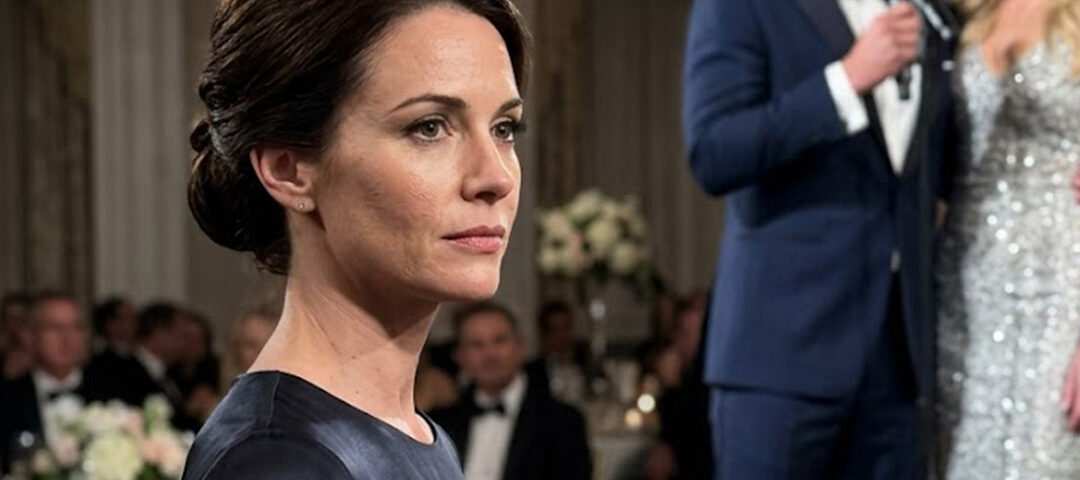
The applause did not begin immediately.
For three long seconds, the Grand Ballroom of the Plaza Hotel held nothing but the soft electrical hum of the microphones and the faint clatter of a server stopping too quickly beside the head table. Then someone near the stage brought two palms together. Another guest followed. Within moments, hundreds of people were applauding because no one in that room wanted to be the first person who admitted they understood what they had just witnessed.
I stood beyond the edge of the spotlight with a champagne flute balanced between my fingers. The glass trembled once, barely enough to disturb the surface, and I tightened my grip until it stopped.
Aleric looked magnificent beneath the chandeliers. His midnight tuxedo had been tailored that week, his dark hair had been brushed back from his forehead, and the company pin at his lapel caught the light whenever he turned. Lucy Henderson stood beneath his arm in a silver dress that skimmed her body without appearing inappropriate for a corporate event. Her smile was modest enough for the cameras and triumphant enough for me.
Behind them, a forty-foot screen displayed the Apex Global logo above the words BUILDING TOMORROW TOGETHER.
Aleric lifted his glass higher.
“Lucy believed in this company before anyone else did,” he said. “She worked beside me through every impossible quarter, every product failure, and every night when we weren’t sure we would survive.”
My father’s company had financed two of those impossible quarters.
I had negotiated the first emergency facility myself.
No one looked at me while Aleric continued.
“Tonight, I want to stop pretending that loyalty can be reduced to a title. Lucy is the woman who has truly shared my life. She is my partner, my family, and the person I have always considered my real wife.”
The applause grew louder.
On the linen-covered table beside me sat a place card that read BEATRICE PRESCOT — STRATEGIC PARTNER.
One letter was missing from my family name.
The same letter I had corrected in two separate proofs.
I placed the champagne flute beside it and stepped toward the stage.
My heels made clean, measured sounds against the marble border surrounding the dance floor. The applause thinned as people noticed me moving. A few guests lowered their hands. A senior vice president from one of our banks looked down at his napkin as though it contained instructions for surviving the evening.
Aleric’s smile tightened.
“Beatrice,” he said through the microphone, “this isn’t the time.”
I stopped beneath the stage lights.
“You chose the time.”
Lucy’s hand closed around his sleeve.
Aleric glanced at the camera positioned near the center aisle. The banquet was being streamed to investors, employees, and partners who had not been invited to the room. He had arranged the stage, the audience, and the broadcast because he believed public certainty would prevent private resistance.
He still thought I would protect him.
My phone vibrated inside my clutch.
I knew who it was without looking.
Aleric leaned toward the microphone again. “Our marriage was always part of a larger understanding between our families. I’m sorry if Beatrice interpreted it differently, but I won’t apologize for finally choosing an honest life.”
A murmur moved across the ballroom.
I looked down at the misspelled place card, then back at the man I had slept beside for three years.
“Did you approve that card?”
His eyes narrowed.
“What does that have to do with anything?”
“Did you approve it?”
Lucy answered before he could.
“The event team made hundreds of cards. A minor spelling error shouldn’t become a distraction.”
Her voice was soft, reasonable, and prepared.
That was when I understood the mistake was not a mistake at all.
My phone vibrated again.
This time, I opened the clutch.
Nine weeks earlier, I had been sitting across from Aleric at our kitchen island while a gray Manhattan morning pressed against the windows. He was answering emails on his tablet and drinking coffee that had already gone cold. I was reviewing the financing agenda for an Apex board meeting scheduled later that afternoon.
Our apartment occupied the thirty-seventh floor of a limestone tower overlooking Central Park. Aleric had chosen it because the building’s history impressed investors. I had chosen the kitchen stools because they were comfortable enough for the breakfasts we rarely finished together.
He had been home for nineteen minutes.
“Will you be at dinner tonight?” I asked.
He kept typing. “Which dinner?”
“My father’s birthday.”
A pause.
Then he resumed typing.
“I told Lucy to send regrets.”
“You told Lucy?”
“She handles my calendar.”
“It’s a family dinner, Aleric.”
“I have the product launch review.”
“The review was moved to tomorrow.”
His fingers stopped.
“How do you know that?”
“I’m on the board.”
He looked up at last. “Not every operational adjustment requires your attention.”
There had been a time when he would have smiled after saying something that sharp. He would have reached across the island, touched my wrist, and made the sentence feel like teasing.
That morning, he simply looked annoyed that I possessed information he had not chosen to give me.
I turned my wedding ring once around my finger.
“Dad invited your mother too.”
“Then the two of them can discuss how disappointing their children are.”
“That isn’t fair.”
“No, Beatrice. What isn’t fair is pretending I can build a company while attending every Prescott family ceremony designed to remind me who paid for it.”
He stood, carried his cup to the sink, and left it there.
At the elevator, he adjusted his tie using the mirrored wall.
“I’ll try to stop by.”
“You said the same thing at Christmas.”
“I said I’ll try.”
The doors opened.
I watched him leave without mentioning that I had seen Lucy’s name on the revised restaurant reservation.
Aleric and I had met six years earlier at a venture philanthropy conference in Boston. I had been speaking on a panel about using private investment to improve regional supply chains after natural disasters. He had been an unknown founder with a failing prototype, a rented suit, and the kind of confidence that made strangers listen before deciding whether he had earned it.
He challenged one of my answers during the question period.
“You’re describing responsible capital,” he said, “but not patient capital. Responsibility becomes meaningless if investors demand proof before innovation has time to work.”
The moderator tried to move on.
I asked him to continue.
He told the room about a logistics platform that could predict hospital shortages before existing systems registered them. His prototype was crude, his projections were optimistic, and his understanding of institutional purchasing was painfully incomplete.
His idea was still better than half the polished presentations I had heard that year.
After the panel, I found him near the coffee station, arguing with a machine that refused to accept his credit card.
“You were wrong about one thing,” I said.
He turned, recognized me, and grinned.
“Only one?”
“Patient capital still needs accountability.”
“Accountability is what investors call control when they want to sound benevolent.”
“And disruption is what founders call recklessness when they want to sound visionary.”
He laughed.
I bought him coffee.
We spoke for two hours.
At the time, I worked as a director in the strategic investments division of the Prescott Group, the privately held company my grandfather had expanded from a regional transportation business into a national network spanning logistics, medical technology, real estate, and data infrastructure. Business magazines estimated my father’s wealth every year. He never corrected them.
Aleric pretended not to know who I was until our third meeting.
Later, he admitted he had searched my name before I reached the coffee station.
“I wanted you to like the idea before you knew I needed the money,” he said.
I should have heard the warning inside the charm.
Instead, I heard ambition.
My father did not trust Aleric at first. Ferdinand Prescott distrusted anyone who arrived with a perfect answer before asking enough questions. He agreed to review the company only because I placed my own reputation behind it.
Apex Global received its first Prescott investment eighteen months later.
Aleric proposed to me the same week.
People would later say the marriage had always been strategic. They would point to the timing, our families, the investment agreements, and the photographs of my father standing beside Aleric at the New York Stock Exchange when Apex completed its public listing.
They were not present when Aleric proposed in the empty warehouse that had housed his first servers.
There had been no photographer.
No press release.
No contract waiting on a table.
He had scattered battery-powered candles across the concrete floor because the building’s electricity had been disconnected. He told me he had spent his life trying to create something large enough that no one could take it from him.
Then he said loving me was the first thing that had made him willing to share control.
I believed him.
For the first year of our marriage, we fought over ordinary things. He left cabinet doors open. I scheduled weekends too tightly. He hated the way I folded towels. I hated the way he purchased expensive appliances and never learned to use them.
Those arguments reassured me.
They felt like evidence that our private life belonged to us.
The first fracture was so small I nearly admired its efficiency.
Lucy joined Apex as an executive assistant eight months after our wedding. She was twenty-eight, polished, and almost unnaturally calm. She remembered every name, every dietary preference, and every promise Aleric made in passing. Within six months, she had reorganized his office, reduced scheduling conflicts, and become the person executives called when they needed him to change his mind.
I thanked her more than once.
She sent me reminders about family dinners.
She arranged flowers when Aleric forgot our anniversary.
She even called a tailor the morning he tore his jacket before a benefit gala.
The first time she crossed a line, she apologized so gracefully that I felt embarrassed for noticing.
Aleric and I were hosting eight investors for dinner at our apartment. I had planned the menu with the chef and left work early to prepare. When I reached home, Lucy was already in my kitchen, standing barefoot on the marble floor while she selected wine from the temperature-controlled cabinet.
“Aleric said you were stuck downtown,” she explained.
“I wasn’t.”
Her smile flickered.
“I must have misunderstood.”
Aleric entered from the hallway fastening his cuff links.
“Lucy saved us,” he said. “The Bordeaux shipment was wrong.”
“I ordered Burgundy.”
“Exactly. Half the guests prefer Bordeaux.”
I looked at the bottles arranged on the counter.
“How would Lucy know what our guests prefer?”
Aleric kissed my cheek without answering.
During dinner, Lucy sat at the end of the table after one investor canceled. She knew which story Aleric planned to tell about Apex’s first hospital contract. When he forgot the name of the procurement director, she supplied it without looking up.
Everyone laughed when she corrected him.
I did too.
After the guests left, I found one of my mother’s crystal glasses beside Lucy’s place setting.
A faint crescent of her lipstick marked the rim.
“Aren’t you going to thank her?” Aleric asked.
“For drinking our wine?”
“For rescuing the dinner.”
“I didn’t know it required rescuing.”
He sighed. “Not everything is territorial, Beatrice.”
I put the glass in the sink.
“I didn’t say it was.”
“You didn’t have to.”
That became his answer whenever I questioned the space Lucy occupied.
I was territorial.
I was insecure.
I misunderstood modern working relationships.
I failed to appreciate the demands placed on him.
Each explanation contained enough truth to make me inspect myself instead of him.
My father’s birthday dinner ended without Aleric.
His mother, Miriam Garrison, sat beside me at the long walnut table in my parents’ home in Greenwich. She apologized twice for her son’s absence and then stopped mentioning him. My mother, Claire, touched my wrist whenever the conversation approached my marriage.
My father did not ask where Aleric was.
That restraint felt worse than criticism.
After dessert, he invited me into his study.
The room had changed little since my childhood. The leather chairs had softened with age, the shelves remained overfilled, and the brass clock on the mantel lost four minutes every month. My father refused to replace it because it had belonged to his father.
He poured himself mineral water and offered me the same.
“You are working too many hours,” he said.
“So are you.”
“I’m old enough to have learned nothing from the consequences.”
“I’m thirty-four.”
“Exactly.”
I sat across from him.
He studied me for a moment. My father never filled silence to make other people comfortable.
“Apex requested another bridge facility,” he said.
I had reviewed the preliminary materials that morning. The company needed temporary liquidity to complete a manufacturing partnership and cover delayed customer payments.
“The fundamentals support it.”
“The fundamentals are not the only question.”
“What’s the other question?”
“Whether Aleric tells you the same story he tells his board.”
I felt my spine stiffen.
“If you have a concern, say it.”
“I have a pattern.”
He opened a folder and pushed a single page toward me. It was not evidence of theft, fraud, or any dramatic betrayal. It was a list of meeting dates.
On three occasions, Aleric had told me he was negotiating with banks while telling the banks he was meeting customers. Each time, his calendar placed him at private dinners organized by Lucy.
“The dinners were probably related to the funding,” I said.
“Probably.”
“You had someone check his schedule?”
“My credit committee checks the schedule of every chief executive asking us for seventy-five million dollars.”
“He’s your son-in-law.”
“He is a borrower first.”
The words hurt because I knew my father had once tried to treat him as family.
“I won’t participate in spying on my husband.”
“Good,” he said. “Then don’t spy. Ask him.”
“I have.”
“And?”
I looked toward the window.
My father leaned back.
“Your mother used to believe keeping peace meant absorbing every impact before it reached anyone else. She became very good at it. Too good.”
“This isn’t about Mom.”
“It is about what you learned from watching her.”
My mother had spent years retreating from public life after a business magazine published an ugly profile describing her as fragile, ornamental, and dependent. The article had been wrong, but the attention surrounding it had intensified a period of depression she was already struggling to manage.
I had been sixteen.
I remembered reporters shouting questions outside our gate and my mother whispering that dignified people did not create spectacles.
After that, I learned to lower my voice whenever I was wounded.
I learned to leave rooms before tears arrived.
I learned that composure could keep a private pain from becoming public property.
My father watched recognition move across my face.
“Silence is useful,” he said. “But only when you are choosing it.”
I pushed the meeting list back toward him.
“I’ll handle my marriage.”
“I know.”
“And the credit facility?”
“Recommend what you believe is right.”
That was how my father protected me. He offered information, then refused to make the decision I would later need to live with.
Aleric arrived home after midnight.
I was reading in the living room with the lamps turned low. He entered quietly, removed his jacket, and paused when he saw me.
“You waited up.”
“I wanted to ask you about the bank dinners.”
His expression changed so quickly I almost missed it.
“What bank dinners?”
“The three meetings Lucy arranged at the Hawthorne Club.”
He loosened his tie.
“Your father is monitoring me now?”
“The credit committee reviewed your schedule.”
“Of course they did.”
“Why did you tell me you were meeting lenders when the lenders weren’t there?”
“Because I was meeting potential capital partners.”
“Who?”
“People who value discretion.”
“I’m your wife and an Apex board member.”
“You’re also Ferdinand Prescott’s daughter.”
The sentence settled between us.
“Which one makes me unworthy of the truth?”
He rubbed both hands over his face.
“Beatrice, I’m tired.”
“So am I.”
“I can’t spend every night defending normal business decisions because your father treats my company like an extension of his estate.”
“This isn’t about Dad.”
“It is always about him.”
He walked to the drinks cabinet, poured two fingers of bourbon, and drank before sitting down.
“Do you know what people say when I enter a room?” he asked. “They don’t say I built Apex. They say I married the Prescott daughter.”
“I was beside you before the first investment.”
“That doesn’t change the story.”
“Then tell a better one. Don’t punish me for what strangers assume.”
His mouth tightened.
“I’m not punishing you.”
“No. You’re excluding me and calling it independence.”
For a moment, he looked like the man I remembered from Boston—angry, brilliant, frightened of needing anyone.
Then his face closed.
“The dinners were exploratory. Nothing came from them. That’s the entire truth.”
“Was Lucy at all three?”
“Yes.”
“Why?”
“Because she works for me.”
“She works closer to you than your chief financial officer.”
“She gets things done.”
“So do I.”
“That is exactly the problem.”
I stared at him.
He set his glass down too hard.
“You don’t help without becoming responsible for the outcome. Every investment becomes a Prescott decision. Every introduction becomes a Prescott relationship. Every room becomes a room where people wonder whether I belong there without you.”
“What would you like me to do?”
“I would like you to stop watching me like a project.”
I stood.
“I would like you to stop treating our marriage like a debt.”
He slept in the guest room.
The next morning, Lucy emailed me a draft invitation for the annual Apex banquet.
The event celebrated the company’s tenth anniversary and the planned launch of a new logistics platform. The invitation described Aleric as “the visionary founder who transformed a kitchen-table idea into a global enterprise.”
It listed Lucy as “Chief of Staff and Founding Partner in Spirit.”
My name appeared beneath the sponsoring organizations.
BEATRICE PRESCOT, PRESCOTT GROUP STRATEGIC INVESTMENTS.
The missing letter was easy to see.
I replied within four minutes.
Please correct the spelling of Prescott and list my role as an Apex Global board director. Thank you.
Lucy responded eleven minutes later.
Of course. Apologies for the production oversight.
A corrected version arrived that afternoon.
Three days later, I learned the version sent to the printer still contained the original wording.
I was meeting Naomi Chen, Apex’s chief financial officer, in a conference room when she mentioned the banquet materials had gone to production.
“Lucy finalized them yesterday,” she said.
“Yesterday?”
Naomi looked up from her laptop.
“Yes. Is that a problem?”
“She sent me a corrected proof three days ago.”
Naomi’s expression became careful.
“I don’t know which proof she used.”
The answer was ordinary.
Her caution was not.
“How is the bridge request progressing?” she asked.
“We’re still reviewing it.”
“We need clarity soon.”
“The board packet showed six weeks of cash.”
“That assumes the Everett contract pays on time.”
“Is there a reason it won’t?”
Naomi closed her laptop.
“The customer asked for another extension.”
“That wasn’t in the packet.”
“Aleric said the delay was temporary.”
“When did he say that?”
“This morning.”
“And you believed him?”
She held my gaze.
“I believed he did not want the board discussing alternatives before the banquet.”
The cold in my chest had nothing to do with Lucy.
“Why?”
“Because he plans to make an announcement.”
“What kind of announcement?”
Naomi looked toward the glass wall. Employees moved along the corridor beyond it, carrying coffee and talking about ordinary work.
“I wasn’t told,” she said. “But he asked whether the company could survive if the Prescott facility were delayed.”
“What did you tell him?”
“That survival and control were different questions.”
I left the building without visiting Aleric’s office.
That evening, I called him from the back seat of my car.
“Are you making an announcement at the banquet?”
He was silent for half a second.
“We’re launching Atlas.”
“Naomi said there was another announcement.”
“You questioned my CFO about me?”
“I asked one question.”
“You put people in impossible positions when you do that.”
“What position have you put her in?”
He exhaled.
“I’ll be home in an hour.”
He arrived three hours later.
By then, I had changed out of my work clothes and placed dinner in the refrigerator. He found me standing near the windows, watching headlights move along Fifth Avenue.
“You’re turning this into something it isn’t,” he said.
“I haven’t said what I think it is.”
“You don’t need to.”
“Then help me.”
He removed his coat but kept it in his hand.
“Lucy is receiving a new title at the banquet.”
“Which title?”
“President of strategic development.”
“That requires board approval.”
“It’s an operational designation.”
“Not according to our governance agreement.”
“Your governance agreement.”
“The agreement you signed.”
His jaw tightened.
“This is why I didn’t tell you.”
“Because I would know it violated the agreement?”
“Because you would turn a recognition decision into another test of my authority.”
I crossed my arms.
“Is she qualified?”
“Yes.”
“Is your relationship with her professional?”
He looked directly at me.
“That question insults both of us.”
“It requires one word.”
“I refuse to dignify it.”
The answer entered the room without being spoken.
I felt it move through every memory I had defended: the canceled dinners, the midnight calls, the apartment wine, the private bank meetings, the anniversary flowers Lucy had ordered on his behalf.
I did not cry.
Aleric mistook that for relief.
He set his coat over a chair.
“I need you to understand how much pressure I’ve been under.”
“From what?”
“From the company. From your father. From being married to a family that can change the terms of my life with a committee meeting.”
“No committee changed the terms of our marriage.”
“Didn’t it?”
“What does that mean?”
He walked toward the kitchen, then turned back.
“It means we should stop pretending love erased the practical reasons our families supported us.”
“My family supported your company because I believed in it.”
“Exactly.”
“You say that like it was a crime.”
“I say it because I have never known whether you loved me or invested in me.”
The cruelty of the sentence was not its volume. He said it wearily, as though I had forced him to reveal an unfortunate truth.
“I gave you six years of my life.”
“And sometimes it felt like due diligence.”
I looked at him for a long time.
“Are you in love with Lucy?”
He dropped his gaze toward the city.
“That isn’t the useful question.”
“It’s the only one I asked.”
“She understands the life I’m trying to build.”
“And I don’t?”
“You understand it too well. You understand every weakness, every dependency, every compromise.”
“That’s what marriage is.”
“No,” he said. “That’s what oversight is.”
I walked to the bedroom and closed the door.
He did not follow.
For the next two weeks, our marriage became a professionally managed silence.
Aleric left before I woke and returned after I went to bed. His assistant communicated changes to our joint calendar. A driver delivered clothing from our apartment to a suite Apex maintained at the Whitmore Hotel for visiting executives.
When I asked whether Aleric was staying there, Lucy replied that the suite was being used for “launch preparation.”
I stopped asking her questions.
Instead, I watched behavior.
Aleric canceled a Sunday lunch with his mother but appeared in a photograph from an Apex staff retreat in the Hudson Valley. Lucy stood beside him in the photograph. His hand rested at the center of her back.
The company’s public relations director sent me a banquet schedule that included a fifteen-minute segment called FOUNDER’S PERSONAL ACKNOWLEDGMENT. When I requested details, the director forwarded my message to Lucy.
Lucy replied that Aleric wanted the segment to remain a surprise.
The event planner called to confirm whether I preferred to be seated with the Prescott delegation or at the Apex executive table.
“I’m the founder’s wife,” I said.
A silence followed.
“Of course,” she answered. “I was working from the seating file provided to us.”
“What does the file say?”
“That you’re attending as the Prescott Group representative.”
“Who approved it?”
“Ms. Henderson.”
I asked her to send the file.
At the head table, the chair beside Aleric belonged to Lucy.
Mine was twelve seats away, between a bank executive and the chairman of a packaging company.
Beside my assigned seat, the printed label again read BEATRICE PRESCOT — STRATEGIC PARTNER.
I stared at the digital proof until the letters blurred.
Then I called Lucy.
She answered on the third ring.
“Beatrice, I’m walking into a production meeting.”
“This will take thirty seconds.”
“All right.”
“Why am I seated away from my husband?”
“The table is arranged around the program.”
“I’m part of the program.”
“Not the stage portion.”
“Who made that decision?”
“Aleric.”
Her answer came without hesitation.
“And why is my name wrong again?”
A softer pause.
“The printer must have used the earlier file.”
“I corrected the earlier file.”
“I know.”
The two words changed everything.
Lucy recovered quickly.
“I mean, I remember your email. I’ll ask whether they can reprint it.”
“Don’t.”
“Excuse me?”
“Leave it exactly as it is.”
“I’m sure we can fix it.”
“I said leave it.”
For the first time since I had known her, Lucy did not have a polished response.
I ended the call.
That afternoon, I drove to Greenwich.
My father was in the greenhouse behind the main house, trimming dead leaves from an orchid my mother had nearly given up on. He wore an old navy sweater and gardening gloves that made him look less like a billionaire chairman than the patient man who had taught me to ride a bicycle.
He saw my face and removed the gloves.
“What happened?”
“Aleric is going to declare his relationship with Lucy at the banquet.”
My father’s expression did not move.
“How certain are you?”
“He changed the seating. He created a personal announcement segment. He moved into the Whitmore suite. He’s preparing the room to make resistance look unreasonable.”
“Have you asked him directly?”
“Yes.”
“And?”
“He told me love was not the useful question.”
My father looked toward the orchid.
“What do you want to do?”
“I don’t know.”
“That is not true.”
“I want him to stop.”
“Also not true.”
I felt anger rise.
“Could you please be my father for one minute instead of cross-examining me?”
He set the shears on the workbench.
“I am being your father. If I tell you what to do, you will spend the next ten years wondering whether you chose it.”
I turned away.
Through the greenhouse glass, I could see my mother walking slowly across the terrace with a book tucked beneath her arm. She had been doing better that year. She attended small dinners, advised the family foundation, and laughed more often than she had when I was a teenager.
“I don’t want this to become a spectacle,” I said.
“It already is one. You simply have not seen the audience.”
“I could stay home.”
“You could.”
“He wants me there.”
“Yes.”
“Why?”
“Because your presence makes his version look consensual.”
The truth landed with a physical force.
“He thinks I’ll sit there.”
“He thinks you will protect the company.”
“I do care about the company. Thousands of employees had nothing to do with this.”
“Then protect them. That is different from protecting him.”
I faced my father again.
“The bridge facility is scheduled for credit committee review the morning after the banquet.”
“Yes.”
“Can it be moved?”
“It can.”
“I want the committee available that night.”
He studied me.
“To punish him?”
“To make sure he can’t use my silence as implied support.”
“That is a better answer.”
“I don’t want you to decide for me.”
“I won’t.”
“I may need you on the phone.”
“I will answer.”
Before I left, my mother found me near the front hall.
She wore a cream cardigan and held the same book against her chest.
“Your father told me enough,” she said.
“I asked him not to.”
“He did not give me details.”
“That has never stopped you from understanding them.”
She smiled sadly.
“No.”
I looked toward the staircase.
“I’m scared I’ll freeze.”
“You may.”
“Then what?”
“Take one breath.”
“That’s your advice?”
“Take one breath that belongs only to you. Not to the room, not to your husband, not to your father. Decide what you can live with after it.”
She touched my cheek.
“Dignity is not the same as disappearing, Beatrice.”
On the morning of the banquet, Aleric came home for the first time in four days.
I found him in our bedroom selecting cuff links. A garment bag lay open across the bed, and the room smelled faintly of the cedar cologne he wore to major events.
He glanced at me through the mirror.
“You’re attending.”
“It’s on my calendar.”
“I wasn’t sure.”
“Lucy knew.”
He looked back at the cuff links.
“I don’t want tonight to become hostile.”
“That depends on what you’re planning.”
“I’m planning to be honest.”
“With whom?”
“With everyone.”
“Except me.”
He closed the jewelry case.
“I tried to speak to you.”
“You refused to answer a direct question.”
“Because you make every answer a verdict.”
“I asked whether you loved her.”
His shoulders lowered.
“Yes.”
The word was quiet.
It still divided my life into before and after.
I sat on the edge of the bed.
“How long?”
“I don’t know.”
“That means you do.”
“Months.”
“Were you with her while you were still coming home to me?”
His face tightened.
“I’m not discussing private details.”
“You’re announcing her publicly tonight.”
“I’m announcing that our lives have changed.”
“Our lives changed when you lied. Tonight is only when you plan to make the lie useful.”
He turned.
“I’m not asking permission.”
“No. You’re asking for my presence.”
“You’re an Apex director and the representative of our largest investor.”
“And your wife.”
He looked at me with something that might once have been grief.
“We both know the marriage stopped being real.”
“When?”
“I can’t give you a date.”
“Try.”
He looked away.
I understood then that he needed the past to be vague. If there was no date, there was no moment when he had made a choice. There was only an inevitable drift toward Lucy, a natural correction to a marriage he now wanted to describe as artificial.
“You intend to say our marriage was strategic,” I said.
“It was strategic.”
“It was also real.”
“For you.”
I stood.
His face changed.
He heard the sentence after he said it.
“Beatrice.”
“Don’t soften it now.”
“I’m not trying to hurt you.”
“You’re trying to preserve your preferred version of yourself.”
“That isn’t fair.”
“Fairness stopped being relevant when you arranged my seat.”
He frowned.
“What seat?”
“The one twelve places away from you.”
“I didn’t handle the seating.”
“Lucy did.”
“Then it was a production decision.”
“She told me you approved it.”
His lips parted, then closed.
I moved toward the door.
He called my name.
I stopped without turning.
“You should know the Prescott credit committee is meeting tonight.”
“What?”
“The bridge facility review.”
“That meeting is tomorrow.”
“It was.”
He crossed the room.
“You moved it?”
“I requested that it be moved.”
“Because of us?”
“Because you intend to make a public statement that may affect governance, leadership credibility, and the relationship with your largest capital partner.”
“You’re threatening the company.”
“No. I’m refusing to guarantee what you haven’t disclosed.”
His expression hardened.
“This is exactly why our marriage failed.”
I opened the door.
“No, Aleric. This is what you hoped would keep me quiet.”
The ballroom glittered that night with controlled excess.
Thousands of white flowers framed the stage. Tall arrangements rose from the tables, carefully elevated so guests could see one another beneath them. A string quartet performed near the entrance while waiters moved through the crowd carrying trays of champagne.
The Apex logo appeared on napkins, menus, ice sculptures, and the gold backdrop where guests posed for photographs.
I arrived with my father’s chief financial officer and two members of the Prescott investment committee. My father remained in Greenwich with my mother, though I knew he was watching the stream from his study.
Aleric greeted donors and customers near the stage.
Lucy stood three feet from him.
She wore silver.
When she saw me, her expression remained composed, but one hand moved toward her waist as if checking that the fabric lay smoothly.
“Beatrice,” she said. “I’m glad you came.”

“I’m sure.”
She glanced at the Prescott executives behind me.
“We adjusted your table placement.”
“I asked you not to.”
“We found a better solution.”
My seat had been moved closer to the stage but not beside Aleric. It placed me alone at a small sponsor table visible to the cameras.
The place card remained wrong.
I sat without correcting it.
During dinner, Aleric did not approach me.
He delivered his prepared remarks between courses, thanking employees, customers, and investors. He praised my father’s early support without mentioning me. Each omission was small enough to defend and precise enough to feel deliberate.
Lucy introduced the Atlas product demonstration. She spoke with confidence, moved naturally beneath the stage lights, and referred to “our company” four times.
The guests responded warmly.
She was good at what she did.
That made the betrayal more painful, not less.
Shortly before ten, the lights dimmed.
Aleric returned to the stage and asked Lucy to remain beside him.
My father’s chief financial officer stopped touching his dessert spoon.
Naomi Chen, seated at the executive table, looked toward me once.
The founder’s personal acknowledgment began.
Aleric spoke about loyalty, sacrifice, and the loneliness of leadership. He described Lucy’s years of service and the private understanding they had developed under pressure.
Then he placed his arm around her.
“Lucy is the woman who has truly shared my life,” he said. “She is my partner, my family, and the person I have always considered my real wife.”
The first applause came from an Apex sales executive.
Others followed.
I watched Aleric absorb the sound.
His shoulders relaxed.
The room had accepted the statement because the room had not yet been asked to pay for it.
I stepped into the light.
When I asked whether he approved the misspelled card, Lucy called it a production error.
Aleric looked irritated.
“Beatrice, don’t reduce this to stationery.”
“I’m not.”
“Then say what you came to say.”
“I came to hear what you chose to say.”
He shifted toward me.
“I have been honest.”
“You called your legal marriage an arrangement.”
“It was an arrangement.”
“You renewed our promises privately last spring.”
His eyes moved toward the cameras.
“That was a personal effort to preserve stability.”
A few guests lowered their glasses.
I remembered that weekend in Maine—the small inn, the rain against the windows, the words he had written himself and read with his hands shaking. He had told me he wanted to choose me again without investors, families, or expectations in the room.
Now he turned that memory into administration.
Aleric’s voice became firmer.
“You knew we had grown apart.”
“I knew you stopped coming home.”
“This is not the place.”
“You built the place.”
Lucy moved closer to him.
“Aleric has tried to handle this respectfully.”
I looked at her.
“By placing you in my chair?”
Her cheeks colored.
“The seating reflected the program.”
“The card reflected the program too.”
Aleric exhaled into the microphone.
“Beatrice, don’t turn a business arrangement into a scene.”
There it was.
The sentence he had brought me there to hear.
He expected anger.
He expected tears.
He expected me to confirm his story by losing control inside it.
Instead, I picked up the place card.
I held it between two fingers and looked at the missing letter.
“I corrected this twice.”
No one spoke.
“Lucy knew.”
Aleric glanced at her.
She swallowed.
“It was an administrative oversight,” she said.
“No. It was a rehearsal.”
I set the card down.
Then I removed my wedding ring and placed it beside the printed name he had reduced me to.
The sound against the china plate was tiny.
The ballroom heard it anyway.
My phone vibrated inside my clutch.
I took it out.
Aleric stepped toward the edge of the stage.
“Put the phone away.”
“You used a microphone.”
“Do not involve your father in our marriage.”
“You involved his company when you asked for another bridge facility.”
His expression shifted.
Only slightly.
But the cameras saw it.
Lucy’s hand left his sleeve.
I accepted the call and turned on the speaker.
“Dad.”
My father’s voice entered the ballroom calmly.
“Are you safe?”
The question almost broke me.
I took my mother’s one breath.
“Yes.”
“Do you want me to remain on the line?”
“Yes.”
Aleric tried to interrupt.
“Ferdinand, this is a personal misunderstanding.”
My father did not answer him.
“Beatrice, did you authorize tonight’s statement?”
“No.”
“Did the Apex board receive advance disclosure of a personal relationship between the chief executive and a senior officer?”
Naomi Chen stood slowly.
“No, Mr. Prescott,” she said from her table.
Aleric stared at her.
My father continued.
“Did you recommend that the credit committee rely on the assurances provided in the current bridge application?”
I looked at Aleric.
For weeks, I had tried to decide whether protecting the company required me to hide what its founder had done.
Then I saw the answer clearly.
Protecting an institution did not mean protecting one man from the consequences of his governance.
“No,” I said.
Aleric’s hand slipped from Lucy’s waist.
A collective breath moved through the room.
He descended from the stage.
“Beatrice, think carefully.”
“I have.”
“You know what delaying that facility will do.”
“I know what misrepresenting leadership risk could do.”
“This is retaliation.”
“No. Retaliation would be using power to create a false consequence. I’m allowing the real information to reach the people responsible for the decision.”
His voice dropped, though the microphone still carried it.
“You’ll destroy thousands of jobs to punish me.”
“I will not let you hide those employees behind your choices.”
My father spoke again.
“The credit committee will meet in twenty minutes. Existing payroll support will remain available under the current agreement. Uncommitted expansion financing will be suspended pending independent review.”
Aleric turned toward the speakers as though he could see my father through them.
“You can’t make that decision unilaterally.”
“I have not,” my father said. “That is why there is a committee.”
Lucy stepped down from the stage.
Her confidence had begun to fracture.
“Aleric told me the marriage was already over,” she said.
I looked at her.
“Did he also tell you the facility was guaranteed?”
She said nothing.
Aleric moved between us.
“Leave her out of this.”
“You put her beside you under a spotlight.”
“Because I love her.”
“Then stand beside the choice without billing the cost to everyone else.”
The words left me without anger.
That frightened him more than anger would have.
The ballroom remained still. A waiter near the wall lowered a tray to an empty table. One of the bankers whispered to another, and both began checking their phones.
The market had not moved.
No company had collapsed.
Nothing dramatic had happened beyond a woman refusing to lie for her husband.
Yet Aleric looked as though the floor had changed beneath him.
I picked up the misspelled card and turned it face down.
“Tonight, I am resigning from the Apex board effective after the emergency review. I will also instruct my attorney to begin our separation.”
Aleric’s face lost color.
“You planned this.”
“I prepared for the possibility that you meant what you said.”
“You can’t announce a separation in front of everyone.”
“You announced the end of the marriage before I reached the microphone.”
I turned toward the guests.
“I’m sorry that a company celebration became a private spectacle. Apex Global is larger than any marriage, any founder, or any investor. The employees deserve leadership that tells them the truth before asking them to carry the risk.”
I looked at Naomi.
“Please attend the credit meeting.”
She nodded.
Then I looked at my father’s executives.
“Let’s go.”
Aleric caught my wrist before I could step away.
His grip was not violent, but it was the first physical claim he had made on me in weeks.
“Beatrice,” he whispered. “If you walk out now, there is no fixing this.”
I looked down at his hand.
He released me.
“There was no fixing it when you entered the room,” I said. “Only hiding it.”
I left the stage without taking the place he had assigned me.
The hotel corridor beyond the ballroom was cool and quiet. The doors closed behind us, muffling the rise of voices inside. My father remained on the phone while I walked toward a private conference suite reserved for the committee.
“Do you want me there?” he asked.
“Yes.”
“I can be in Manhattan within an hour.”
“No. Stay with Mom.”
A pause.
“She is standing beside me.”
My mother’s voice came through.
“Take another breath.”
That was when my composure broke.
Not dramatically.
No sob escaped.
My knees simply weakened, and I pressed one hand against the corridor wall until the floor became steady again.
My father’s chief financial officer looked away to give me privacy. Naomi arrived a minute later carrying her laptop. Her expression held embarrassment, anger, and relief in equal measure.
“I’m sorry,” she said.
“For what?”
“I should have told you more.”
“You told me enough.”
“I knew about the relationship.”
The corridor seemed to narrow.
“How long?”
“I suspected for four months. I confirmed it six weeks ago.”
“Why didn’t you tell me?”
“Aleric said you knew. He said you had agreed to manage the timing privately because of the financing.”
I closed my eyes.
The lie had been designed with care. He had used my silence as proof with every person who might have warned me.
Naomi continued.
“He also said the Prescott facility was secure regardless of personal developments.”
“It wasn’t.”
“I know that now.”
“Did you sign the bridge projections?”
“I signed the operating numbers. I added a disclosure request about the Everett delay. Aleric removed it from the presentation version.”
That was the first fact that no longer belonged to my marriage.
I straightened.
“Show us.”
The emergency credit meeting began at 10:38 p.m.
My father appeared by secure video from his study. Six committee members joined remotely. Naomi presented the company’s cash position, delayed receivables, vendor obligations, and the assumptions behind the expansion schedule.
Aleric requested access three times.
The committee declined until Naomi finished.
When he was admitted, Lucy was no longer beside him. His tuxedo jacket hung open, and the polished certainty he had carried onstage had disappeared.
“This meeting is improper,” he began.
My father lifted one hand.
“You requested the facility.”
“I requested a good-faith review, not an ambush conducted by my wife.”
I spoke before my father could.
“The committee was moved before the banquet because you planned an undisclosed leadership announcement while representing the financing as secure.”
“My relationship is not a credit event.”
“Your undisclosed relationship with a direct report, your removal of a material receivables note, and your representation that I supported the application are governance events.”
He looked at Naomi.
“You discussed internal documents without authorization.”
“I am the chief financial officer,” she said. “The committee asked for complete numbers.”
Aleric laughed once, without humor.
“So this is a takeover.”
“No,” my father said. “A takeover would require us to want your position.”
The committee approved three measures.
The uncommitted expansion facility would be paused.
A limited payroll line would remain available for thirty days, but funds could be used only for wages, essential vendors, and customer delivery.
An independent restructuring adviser would review Apex’s liquidity and governance.
Aleric would retain his title during the review, but any payment above a defined threshold would require a second signature.
The decision did not bankrupt Apex.
It removed the assumption that my family would continue financing Aleric without questions.
That assumption had been carrying more weight than anyone outside the committee knew.
By midnight, two banks had requested updated information. By morning, the Everett customer had formally delayed payment another sixty days. By noon, the financial press had separated the marital spectacle from the business issue and begun asking why Apex had needed emergency liquidity so soon after announcing record growth.
Aleric called me seventeen times.
I did not answer.
I spent the night at my parents’ home.
My father was waiting near the front entrance when the car arrived. He had changed from his suit into a cardigan, but he still held his phone.
He opened his arms.
I crossed the distance between us and pressed my face against his shoulder.
For several minutes, neither of us spoke.
My mother joined us and placed one hand between my shoulder blades.
“I thought I was ready,” I said.
“You were,” she answered.
“I still loved him when I walked out.”
“That does not mean you should have stayed.”
Inside, the kitchen lights were on. My mother made tea herself, ignoring the housekeeper who offered to help. My father sat across from me at the breakfast table while I told them the parts of the evening they had not seen.
When I described the card, my mother’s expression tightened.
“Such a small cruelty,” she said.
“That was why it worked.”
My father folded his hands.
“What do you want from Apex?”
“Nothing that belongs to Aleric.”
“That was not my question.”
I looked at him.
“The employees need time. If the review finds a viable core business, we should preserve it.”
“Even if that preserves some of his ownership?”
“If it is the best outcome for the company.”
My father’s eyes softened.
“You are allowed to be angry.”
“I am.”
“You do not have to prove your dignity by becoming merciful before you are ready.”
“I’m not being merciful. I’m trying not to let him define what I become.”
My mother placed the teapot on the table.
“That is a better reason.”
The days that followed were ugly in ordinary ways.
Photographers waited outside the Manhattan apartment. Commentators debated whether I had used my father’s money to retaliate against a cheating husband. Strangers decided our marriage had been fake because the alternative required admitting that sincere love could coexist with catastrophic misjudgment.
Aleric released a statement describing the banquet announcement as “an emotionally honest acknowledgment of a long-standing private separation.”
I released one sentence through my attorney.
I had not agreed to or known of any separation before my husband’s public statement.
Lucy took a leave of absence from Apex.
Her attorney insisted the relationship had begun after Aleric told her our marriage was over. I did not know whether that was true. It did not erase her participation, but it changed the shape of my anger.
Aleric’s mother visited me in Greenwich.
Miriam arrived without calling and stood in the front hall holding a handbag against her chest. She looked smaller than she had at my father’s birthday dinner.
“I raised him to believe needing people was dangerous,” she said after we sat in the library. “His father left us with debts and excuses. Aleric decided he would never be dependent again.”
“He built a company with other people’s money.”
“I know.”
“He married me.”
“I know that too.”
“Then why did he act as though love was a form of captivity?”
“Because gratitude feels like captivity to someone who is ashamed of receiving.”
Her answer was not an excuse.
That made it useful.
She asked whether I would speak to him once.
“I will during the divorce process.”
“He is not sleeping.”
“Neither am I.”
“He believes your father wants to ruin him.”
“My father offered a payroll line and an independent review.”
“He does not experience conditions as help.”
“That is no longer mine to solve.”
Miriam’s eyes filled.
“No,” she said. “It isn’t.”
The independent review found that Apex had a strong product, valuable customer contracts, and a dangerous concentration of authority around its founder.
It also found that Aleric had accelerated the Atlas launch despite unresolved software problems because he needed the banquet to produce new customer commitments. He had not stolen money. He had not committed some secret criminal scheme. His failure was more recognizable and, in some ways, more tragic.
He had confused confidence with truth.
He had delayed bad news, pressured subordinates to support optimistic assumptions, and built financial plans around the belief that I would never allow my family to let his company fail.
The company could survive, but not without new controls, asset sales, and a substantial reduction in Aleric’s voting power.
My father offered terms.
Apex would receive enough financing to complete existing customer projects and preserve most jobs. In exchange, Aleric would step aside as chief executive for eighteen months, the board would appoint an independent chair, and the founders’ family holding company would surrender majority control.
Aleric rejected the proposal.
He called it a disguised seizure.
The board gave him forty-eight hours to reconsider.
On the second evening, he asked to meet me.
We chose a private conference room at my attorney’s office. The space contained a rectangular table, six gray chairs, and a window overlooking the East River. Nothing in the room encouraged nostalgia.
Aleric arrived early.
He had lost weight. His hair needed cutting, and the shadows beneath his eyes made him look older than thirty-eight.
For several seconds, we simply looked at each other.
“I’m sorry,” he said.
I sat across from him.
“For which part?”
“All of it.”
“That isn’t specific enough.”
He lowered his gaze.
“I’m sorry I lied about Lucy. I’m sorry I made the announcement without telling you. I’m sorry I described our marriage as something I knew it wasn’t.”
“Why did you?”
“Because I needed the room to believe I had already chosen.”
“You had chosen.”
“Not completely.”
The answer disgusted me.
He saw it.
“I loved her,” he continued. “I thought I did. I also knew leaving you privately would force me to face everything at once—the marriage, the board, the funding, my mother, your father. The banquet made it irreversible.”
“You used an audience to prevent yourself from retreating.”
“Yes.”
“And you used me to make it credible.”
His eyes closed briefly.
“Yes.”
“What did you think I would do?”
“Leave.”
“Quietly.”
“Yes.”
“And the bridge facility?”
“I thought you would separate the business from the marriage.”
“I did.”
“No, you suspended it.”
“Because you concealed information from the board and removed Naomi’s disclosure.”
“That had nothing to do with Lucy.”
“It had everything to do with believing rules changed when you needed them to.”
His hands tightened on the table.
“If I accept your father’s terms, I lose the company.”
“You lose control. The company may survive.”
“I built Apex.”
“Then why are you willing to let it collapse rather than let someone else lead it?”
He did not answer.
The silence lasted long enough to become the answer.
“I hated that you were always the calm one,” he said at last. “Do you know that?”
“No.”
“You could walk into any room and belong there. You never had to prove why you deserved the seat.”
“You arranged mine away from you.”
“Because beside you, I felt borrowed.”
The honesty hurt more than his excuses.
“I loved you before anyone knew Apex’s name.”
“I know.”
“I argued with my father for the first investment.”
“I know.”
“I defended you after every missed holiday, every delayed plan, every sentence that made me smaller.”
“I know.”
“Then what else could I have done?”
He looked at me with tears standing in his eyes.
“Needed me less.”
I sat back.
There was nothing left to misunderstand.
“You did not want a wife,” I said. “You wanted a witness who would applaud without affecting the story.”
“That’s not fair.”
“It is the fairest thing I have said.”
He wiped one hand across his face.
“Lucy left.”
I felt no victory.
“Why?”
“She said the relationship could not survive becoming responsible for what happened.”
“That may be the first honest thing either of you admitted.”
He looked toward the window.
“Are you going to save Apex?”
“That depends on whether its owners allow it to be saved.”
“You mean whether I surrender.”
“I mean whether you choose the company over your title.”
He laughed softly.
“You sound like your father.”
“I used to take that as an insult when you said it.”
He signed the preliminary separation agreement that afternoon.
He did not accept the restructuring terms.
A week later, Apex missed a covenant tied to its delayed customer payments. The board removed Aleric as chief executive under the company’s emergency provisions. He challenged the decision, frightened two potential lenders, and attempted to rally shareholders around a plan that required more time than the company possessed.
The stock declined.
Vendors shortened payment terms.
Customers requested assurances.
The pressure did not arrive because my father made a single devastating call. It arrived because certainty had been the product Apex sold most effectively, and the banquet revealed how much of that certainty depended on one man’s untested version of events.
Three weeks after the gala, Apex Global filed for Chapter 11 protection.
The filing allowed the company to continue operating while it restructured its debts. It did not mean the lights turned off or thousands of people lost their jobs overnight.
It did mean the Garrison family holding company could no longer pretend it controlled the outcome.
My father’s investment division proposed purchasing Apex’s hospital logistics unit through a court-supervised process, preserving its contracts and offering continued employment to most of the engineers, customer teams, and operations staff.
I removed myself from the final price decision.
I did not remove myself from the employee transition plan.
For six weeks, I met with managers who had spent years believing the company’s identity and Aleric’s identity were the same. Some were angry with me. Others apologized for attending the banquet and applauding.
I told them I did not need apologies.
I needed honest estimates, realistic timelines, and a list of people whose visas, health insurance, or family obligations made employment gaps especially dangerous.
Naomi led the transition.
She accepted the role of interim chief executive after the restructuring board approved her.
On her first day, she called me from the Apex lobby.
“The logo is still here,” she said.
“It should be.”
“I expected your father to change everything.”
“My father bought assets, not history.”
She was quiet.
“Thank you.”
“Build something worth keeping.”
Aleric’s parents lost most of their equity when the restructuring converted debt into ownership. Business magazines described the outcome as the destruction of the Garrison empire.
The phrase made my father angry.
“There was no empire,” he said over breakfast. “There was a company with a good product and an overleveraged founder.”
“The headline is easier.”
“Easy stories are usually expensive.”
Aleric moved out of our apartment while I was in California meeting an Atlas customer. He took his clothes, personal books, and the battered laptop he had used during Apex’s first year.
He left the framed photograph from our wedding in a hallway closet.
I found it behind an umbrella.
For a long time, I sat on the floor holding the frame.
I did not destroy it.
I did not display it.
I wrapped it in paper and placed it in a storage box with letters, photographs, and other evidence that something could have been real even if it did not last.
Our divorce took five months.
Aleric did not seek my Prescott shares after his attorney explained they were protected family assets. I did not pursue ownership of the remaining Garrison interests in Apex. We divided the apartment, accounts, art, and furniture without drama.
The final meeting occurred in the same conference room overlooking the river.
After we signed, he remained seated.
“What will you tell people about me?” he asked.
“The truth when it’s necessary.”
“And when it isn’t?”
“Nothing.”
He nodded.
“I’ve started therapy.”
“I hope it helps.”
“I keep thinking about the card.”
I looked at him.
“The misspelling?”
He nodded.
“I didn’t approve it.”
“Lucy said you did.”
“I approved the seating. I didn’t notice the name.”
“That was the point.”
“I know.”
He stared at his hands.
“I thought the cruel thing was the announcement. Now I think the cruelest part was how many small things I trained myself not to notice.”
I felt grief move through me, old and familiar.
“That is how people make cruelty feel accidental.”
“I’m sorry.”
“I know.”
“Do you forgive me?”
“No.”
His face tightened.
“Maybe someday?”
“I don’t know.”
It was not the answer he wanted.
It was the first answer I gave him without managing what it would do to him.
Outside the building, autumn wind moved along the river. My father’s driver waited at the curb, but I told him I wanted to walk.
I crossed three blocks before calling my mother.
“It’s finished,” I said.
“How do you feel?”
“Quiet.”
“That may be enough for today.”
Months later, I returned to the Plaza Hotel for a foundation dinner supporting community health clinics.
The ballroom looked smaller without Apex branding covering every surface. The chandeliers were unchanged. The marble still reflected the lights, and the service doors opened with the same soft swing.
An event coordinator met me near the entrance.
“We have you at the family foundation table,” she said. “Beside your parents.”
She handed me the seating proof.
My name was spelled correctly.
I smiled despite myself.
At dinner, my father complained that the soup needed salt. My mother reminded him his doctor disagreed. Naomi joined us between courses and reported that the former Apex hospital unit had signed two new regional systems without missing payroll.
Aleric was no longer involved.
Lucy had accepted a communications role at a smaller company in Chicago. I had heard she kept her private life private.
I wished neither of them harm.
That surprised people who wanted the story to end with vengeance.
They misunderstood what I had wanted from the beginning.
I had not wanted Aleric ruined.
I had wanted him to stop using my loyalty as a resource he could spend without permission.
Near the end of the evening, I stepped into the quiet corridor outside the ballroom. My father followed and stood beside me.
“You did well,” he said.
“At dinner?”
“In the year.”
“I had help.”
“Everyone does.”
I looked at him.
“You know, Aleric thought needing help made everything he built less his.”
“Many people confuse independence with never owing gratitude.”
“You never liked him.”
“I liked him more than I trusted him.”
“Why didn’t you tell me?”
“You would have defended him harder.”
He was right.
My mother appeared at the ballroom doors and waved us back inside.
Before returning, my father touched my shoulder.
“I did not destroy his company.”
“I know.”
“He did not destroy it alone either. Markets, lenders, boards, customers—people prefer one villain because systems are harder to understand.”
“I know that too.”
“What the company became after him matters more than what failed under him.”
Inside the ballroom, guests were standing for the foundation chair’s closing remarks.
I returned to my seat between my parents.
The applause began.
This time, I knew exactly why I was joining it.
That night, at the Greenwich house, I opened the cedar jewelry box my mother had given me on my twenty-first birthday. I placed my wedding ring inside beside a pair of pearl earrings and closed the lid without ceremony.
Then I went downstairs.
My parents were in the kitchen arguing gently over whether leftover cake belonged in the refrigerator. My father claimed chilled frosting was an insult. My mother claimed food safety outranked aesthetics.
I cut three slices.
We sat beneath the warm pendant lights and ate cake after midnight.
There were no cameras.
No investors.
No one asking me to prove whether I belonged.
For the first time in years, silence did not feel like something I was using to keep the peace.
It felt like peace itself.
How long should loyalty be mistaken for consent before silence becomes a betrayal of yourself?
If you came here from Facebook because of this story, return to the Facebook post, tap Like, and comment exactly “Amazing” to support the storyteller. That small action means more than it seems and gives the writer genuine encouragement to keep sharing more stories about family pressure, firm boundaries, and finally protecting what you worked so hard to build.
Disclaimer: This story is a work of fiction created for entertainment purposes. Any resemblance to real persons, events, or places is coincidental.