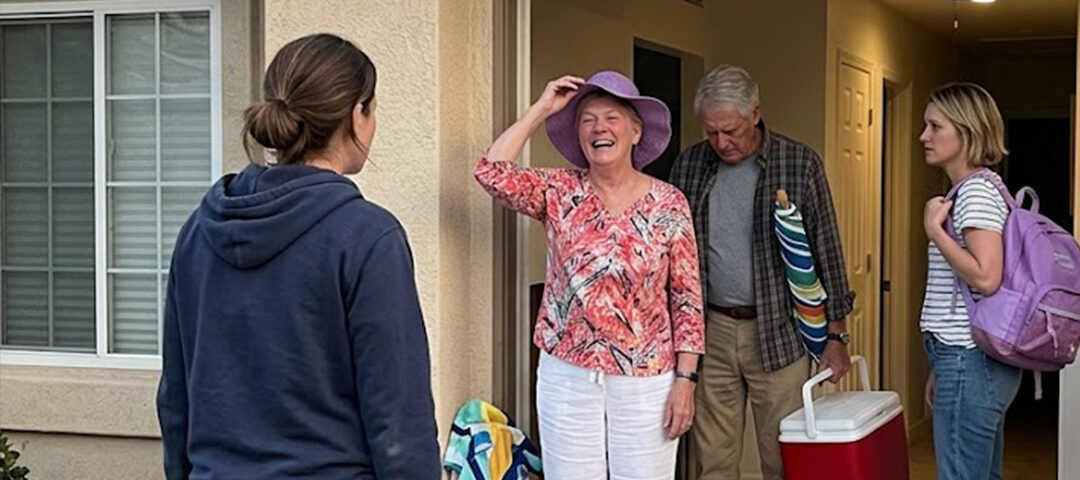
My mother came home from Malibu laughing, wearing my six-year-old daughter’s purple sunhat.
Mia wasn’t with her.
Before the night was over, I would find my little girl hidden behind a shuttered snack stand, too frightened to run into my arms—and I would learn that “forgotten” was the kindest lie my family had told me.
Part 1 — The Child They Left Behind
Sand still clung to my mother’s sandals as she crossed the entryway. My father followed with a red cooler in one hand and a striped beach umbrella tucked beneath his arm. My sister Chloe came in last, carrying Mia’s purple backpack over one shoulder.
For half a second, my mind refused to understand what my eyes were seeing.
Three adults.
A cooler.
Four towels.
Mia’s backpack.
No Mia.
“Where is she?” I asked.
No one answered.
I had been waiting near the kitchen island, cutting strawberries for the dinner Mia had requested before leaving that morning. Grilled cheese, tomato soup, and strawberries arranged in a circle because she insisted fruit tasted better when it looked like a flower.
The knife was still in my hand.
I set it down slowly.
“Where is Mia?”
My mother sighed as though I had asked why she had forgotten to buy milk.
“Harper, don’t start.”
I moved toward the front door.
“Where is my daughter?”
My father dropped the cooler in the entryway. The plastic bottom struck the tile with a hollow crack. Chloe looked toward the staircase, refusing to meet my eyes.
My mother gave a careless little laugh and lifted both hands.
“Oh, calm down. I must have left her near the towels.”
For a moment, there was no sound in the house except the refrigerator humming behind me.
“Left her?”
“She was playing.”
“She is six.”
“There were lifeguards everywhere.”
“It’s almost dark.”
“You always do this,” Mom snapped. “You take one ordinary mistake and turn it into a catastrophe.”
An ordinary mistake.
As if Mia were a water bottle.
A beach bag.
A folding chair.
As if she had not stood in my bedroom that morning wearing her purple swimsuit and a floppy sunhat, asking whether dolphins knew their own names.
As if she had not kissed my cheek before leaving.
As if she were not my entire world.
I grabbed my keys from the console table so tightly the metal cut into my palm.
Mom rolled her eyes.
“You always make everything dramatic.”
Chloe muttered, “She’s probably with a lifeguard or something.”
I turned toward her.
“You brought her backpack home.”
Chloe looked down at the strap over her shoulder, as though she had only just noticed it.
“She left it in the car.”
“Why didn’t you go back for her?”
“I thought Mom had her.”
“I thought Chloe had her,” my mother said immediately.
My father stared at the floor.
He had not said a single word.
That frightened me almost as much as the empty doorway.
Dad was the person in our family who filled every silence. He explained late bills, missed appointments, and angry neighbors until every bad decision sounded like unfortunate weather.
Now he stood with both hands empty, his face drained of color.
“Dad,” I said. “What happened?”
His eyes lifted toward mine, then shifted to Mom.
That tiny movement answered more than words could have.
My mother stepped between us.
“Go get her, then. I’m sure she’s exactly where we left her.”
Where we left her.
Not where she wandered.
Not where she got lost.
Where they left her.
I ran outside.
My car door was already open when Chloe called after me.
“Harper, wait.”
I turned.
She had followed me onto the porch but stopped beneath the light. Mia’s backpack remained on her shoulder.
For one strange second, Chloe looked afraid.
Not worried about Mia.
Afraid of me.
“What?” I demanded.
Her lips parted.
Mom appeared behind her.
“Chloe.”
One word.
That was all it took.
My sister’s mouth closed.
“Just be careful driving,” she said.
I stared at both of them.
Then I got into my car.
The drive back to Malibu felt endless.
Every red light became an act of cruelty. Every slow car felt deliberately placed in front of me. I called the beach’s public-safety number twice, then the emergency line when no one answered. I gave Mia’s description while driving with the phone on speaker.
Six years old.
Brown hair cut just below her shoulders.
Purple swimsuit.
White cover-up with yellow flowers.
Barefoot unless she had found her sandals.
A small crescent-shaped birthmark behind her right ear.
The dispatcher told me units were being sent.
“Do you know when she was last seen?” she asked.
“No.”
“Was she with relatives?”
“Yes.”
“Can they provide an exact location?”
“They won’t tell me.”
There was a pause.
“What do you mean, they won’t tell you?”
“I don’t know yet.”
The sun had dropped behind a wall of dark clouds by the time I reached the coast. Wind drove mist across the road. The ocean looked black beneath the bruised sky.
The parking lot was almost empty.
A maintenance truck stood near the restrooms. Two surfers were fastening boards to the roof of an SUV. Farther down, a lifeguard vehicle moved slowly along the sand with its lights flashing.
I left my shoes in the car and ran.
The sand was cold beneath my feet. Wind tore at my clothes and carried my voice away each time I shouted.
“Mia!”
Nothing.
I ran toward the lifeguard tower.
“Mia!”
The beach seemed impossibly large.
Earlier that morning, it had been crowded with umbrellas, children, music, and families dragging coolers toward the water. Now the tide had erased most of the footprints. Abandoned seaweed lay in dark ropes along the shoreline. The closed concession buildings cast long shadows across the service path.
I found the striped towels first.
They were piled beside a trash barrel, damp and half covered in sand.
Mia’s yellow sandals sat beside them.
Placed together.
Not kicked off near the water.
Placed.
My hands began to shake.
I called her name again.
A faint sound came from behind the shuttered snack stand.
Not a voice.
A quick scrape.
Then silence.
I rounded the corner.
Mia was curled in the narrow space between the back wall and two large trash bins. Sand coated her legs and tangled in her hair. Her white cover-up was torn near one sleeve. Her knees were drawn tightly against her chest.
For one terrible second, she did not recognize me.
“Mia.”
Her eyes found my face.
She did not run toward me.
She flinched.
That movement broke something inside me more completely than any scream could have.
I stopped several feet away and lowered myself carefully, keeping my hands visible.
“Baby, it’s Mama.”
Her mouth trembled.
“Mama?”
“I’m here.”
She stared at me, searching my face as though she needed proof.
Then she crawled out of the narrow space and rushed toward me.
I caught her against my chest.
Her entire body shook beneath my hands.
“I’m sorry,” she whispered.
“No. No, sweetheart. You didn’t do anything wrong.”
“Grandma said you’d be mad.”
“I’m not mad at you.”
“She said I ruined the day.”
“You didn’t ruin anything.”
I pulled off my jacket and wrapped it around her.
That was when I saw the marks around her wrists.
Dark bands circled both arms just above her hands. They were too even to look like a fall or rough play. Mia noticed where I was looking and pulled her wrists against her chest.
My stomach turned.
“What happened to your hands?”
She shook her head.
“You can tell me.”
“Grandma said not to.”
The world narrowed to her face.
“What did Grandma tell you not to say?”
Mia looked over my shoulder toward the service road behind the beach.
“A man took me over there.”
My breath caught.
“What man?”
She pointed toward the dark road leading behind the concession buildings.
“Aunt Chloe saw.”
My skin went cold.
“Chloe saw him take you?”
Mia nodded.
“Grandpa said I was ruining everything because I cried.”
I pressed my forehead briefly against hers, forcing myself to breathe.
“What man, baby?”
Her eyes locked on mine.
“The man from the picture in Grandma’s drawer.”
I already knew before she finished.
“The one you said could never come near us.”
Victor Hale.
My mother’s younger brother.
The man whose name had not been spoken in our family for more than fifteen years.
When I was fourteen, I found a photograph of him in the back of my mother’s dresser. He stood beside an old silver van, wearing a leather bracelet and smiling directly at the camera. When I asked who he was, Mom ripped the picture from my hand and told me never to mention him again.
Years later, I heard fragments of the story from an aunt who had been drinking at Thanksgiving.
Victor had worked with a youth sports charity.
Money disappeared.
Records vanished.
Several parents filed complaints.
Then the investigation quietly collapsed, and Victor supposedly left California.
My mother insisted he had been falsely accused.
My grandmother called him dangerous.
When Mia was born, I made my mother promise that Victor would never be allowed near her if he ever returned.
She had looked insulted.
“He’s gone, Harper.”
“He stays gone.”
Now Mia was shaking inside my jacket and pointing toward a dark service road.
My phone was already in my hand when headlights appeared at the edge of the parking lot.
My parents’ SUV rolled in slowly.
Not fast like people searching for a missing child.
Slowly.
Carefully.
As though they had followed me to see how much I knew.
My mother stepped out first.
This time, she was not laughing.
Part 2 — The Performance
“Give me the child, Harper,” she said.
I pulled Mia behind me and dialed the emergency dispatcher again.
My mother stopped several yards away. Dad exited the driver’s side but remained near the SUV. Chloe stepped out last, still holding Mia’s backpack.
“Stay where you are,” I told them.
Mom glanced at my phone.
“Oh, for God’s sake.”
“Mia says Victor took her.”
Chloe’s face changed.
It lasted less than a second, but I saw it.
My mother did too.
“Don’t answer,” she warned.
I moved Mia farther behind me.
“Did you see him take her, Chloe?”
“No.”
“You weren’t there?”
“I didn’t say that.”
“Then what are you saying?”
“I’m saying Mia is upset and confused.”
“She knows who Victor is.”
“She has seen pictures.”
“One picture. In Mom’s drawer.”
My mother folded her arms.
“Children absorb things. You’ve filled her head with your paranoia for years.”
Mia’s fingers tightened around the back of my shirt.
I could feel her trembling.
“Why are there marks around her wrists?”
Dad looked toward Mia for the first time.
His face crumpled.
Mom spoke before he could.
“She fell near some rope.”
“There was no rope,” Mia whispered.
My mother heard her.
Her expression hardened.
“Sweetheart, you’re frightened. You don’t remember clearly.”
Mia hid her face against my back.
I stepped between them.
“Do not speak to her.”
“Harper, I am her grandmother.”
“You brought her home without her.”
“It was an accident.”
“You followed me here.”
“Because we knew you would overreact.”
“You knew where I would find her.”
Silence.
The wind lifted sand between us.
My father looked toward the service road.
That was the second time his eyes gave them away.
Sirens grew louder along the highway.
My mother’s posture shifted instantly.
Her shoulders lowered. Her face softened. Tears appeared with astonishing speed.
By the time the sheriff’s vehicles entered the parking lot, she was crying against my father’s shoulder.
Two deputies approached. One went directly to Mia and me while the other stayed near my family.
My mother spoke first.
“My daughter is exhausted,” she said through carefully measured sobs. “She has always been anxious, but since becoming a mother, it has gotten worse.”
I stared at her.
“She panics over everything,” Mom continued. “My granddaughter wandered off, and Harper is turning it into some kidnapping story.”
Mia hid her face in my shirt.
I showed the deputy her wrists.
The older officer, Deputy Mercer, stopped writing.
His face hardened with the quiet seriousness of someone who recognized when a child’s fear did not match the adults’ explanation.
He did not touch Mia.
He moved several feet away, lowered himself to her eye level without coming too close, and softened his voice.
“No one is in trouble for telling the truth. Can you tell me who held your arms?”
Mia looked at me.
“You can tell him,” I said.
She whispered, “Uncle Victor.”
For half a second, my mother stopped crying.
Mercer noticed.
So did the second deputy.
Chloe stared at the ground.
Dad muttered, “She’s six. She doesn’t know what she saw.”
Mia lifted her face.
“He had the bracelet.”
“What bracelet?” Mercer asked.
“The brown one with the silver circle.”
My throat tightened.
Victor had been wearing that bracelet in the old photograph.
Mia continued in fragments.
A silver van.
A smell like smoke and old coffee.
A storage building beside the beach road.
A folding chair.
Victor telling her to stop crying because her mother would come soon.
Grandma saying grown-up mistakes cost money.
Grandpa standing outside the van.
Aunt Chloe arguing with someone on the phone.
Each detail pulled another thread from my family’s story.
Deputy Mercer called for another unit.
My father stepped forward.
“This is a family matter.”
Mercer rose slowly.
“No, sir.”
Dad’s face tightened.
“We can handle this ourselves.”
“No,” I said, my voice shaking with rage. “This is not something you handle. This is something you answer for.”
My mother moved toward Mia.
“I want to comfort my granddaughter.”
Mercer stepped between them.
“Please remain where you are.”
Mom looked offended.
“You’re keeping a grandmother from a frightened child?”
“I’m keeping everyone separated until we understand what happened.”
That was the first moment my mother realized the room—though there was no room, only wind and sand and flashing lights—no longer belonged to her.
Her tears stopped.
At the hospital, a pediatric nurse named Camille documented Mia’s injuries while a child advocate sat beside her with apple juice, crackers, and a soft blue blanket.
I wanted to collapse.
I wanted to scream until someone explained how the people who had raised me could bring my daughter to a beach, hand her to the one man I had forbidden from approaching her, and then return home laughing.
Instead, I remained steady.
Mia kept watching my face to decide whether the world was still safe.
So I made it safe.
I answered questions.
I held her hand when she allowed it.
I told her she was brave without making bravery sound like a job she had to perform for me.
When she cried, I did not tell her to stop.
When she went silent, I did not force her to speak.
Shortly after midnight, Detective Elena Alvarez arrived.
She was in her forties, with tired eyes and a voice that never rushed. She listened to Deputy Mercer, spoke privately with the medical team, then sat across from me in a small consultation room.
“Why was Victor Hale forbidden from seeing your daughter?”
I told her everything I knew.
The charity.
The missing money.
The photograph.
My grandmother’s warning.
The investigation that disappeared.
Detective Alvarez did not look surprised.
“That case was not primarily about stolen funds,” she said.
My mouth went dry.
“What was it about?”
“The organization kept confidential intake records for minors. Some of those files vanished. Several families reported unauthorized contact with their children. Victor Hale was questioned, but key evidence was lost after someone inside the organization altered the storage logs.”
The room seemed to tilt.
“My mother said he had been cleared.”
“He was never cleared. The investigation became impossible to prosecute.”
“Why wasn’t I told?”
“I can’t answer that yet.”
I could.
My family had not merely hidden Victor’s location.
They had rewritten his history.
Alvarez leaned forward.
“Did your grandmother leave you property?”
The question seemed unrelated until it didn’t.
“Yes.”
“What kind?”
“A house.”
“Where?”
“Near the foothills. She left it to me when she died.”
“Have your relatives asked you to sell it?”
My pulse quickened.
“For months.”
“How often?”
“My mother brings it up every week. Chloe says the market is too good to wait.”
“Who benefits if you sell?”
“The original family agreement gives my mother and Chloe a portion of the proceeds, but they can’t force a sale. The house is in my name.”
Alvarez wrote something down.
“Victor has debts.”
“What kind of debts?”
“Enough that a valuable property might look like an exit.”
My hands went cold.
I remembered a dinner two months earlier.
Mom had placed a real-estate estimate beside my plate and told me sentimentality was selfish.
Chloe had laughed.
“Mothers will agree to almost anything when their children are scared.”
At the time, I thought she was making one of her cruel little jokes about my cautious parenting.
Now I understood.
She had not been joking.
She had been rehearsing.
Part 3 — The House They Wanted
The next morning, officers found Victor’s silver van behind a rented storage unit less than two miles from the beach.
Inside were items matching Mia’s description, along with a prepaid phone and printed copies of documents connected to my grandmother’s house.
One paper was a proposed sale authorization.
My name appeared at the bottom.
The signature was not mine.
Another was a temporary power-of-attorney form that would have allowed my mother to negotiate a sale if I were deemed emotionally unable to manage my affairs.
Victor’s prepaid phone contained messages from Chloe.
One read:
She is young enough to believe what we tell her afterward.
Another said:
Mom says one night will be enough. Harper will sign anything once she thinks she might lose Mia.
I read the messages in Detective Alvarez’s office while Mia slept in a family waiting room with Camille nearby.
The words blurred.
One night.
They had measured my daughter’s fear in hours.
Chloe was arrested outside my parents’ house before lunch.
My father tried to block the officers until they warned him twice to step aside. My mother stood in the doorway, pale but silent, watching her oldest daughter being placed in the back of a car.
She still did not ask about Mia.
She asked whether the neighbors were watching.
My mother called me that afternoon from a number I did not recognize.
“You have no idea what you’ve done.”
I stood beside the hospital window. Mia was sleeping beneath the blue blanket, one hand resting near her face.
“I know exactly what I stopped.”
“You sent officers to our home.”
“You handed my daughter to Victor.”
“That is not what happened.”
“Then tell me what happened.”
Silence.
I waited.
My mother lowered her voice.
“Victor needed help.”
“So you gave him my child?”
“He was never going to hurt her.”
“She was found shaking behind a closed building.”
“He panicked because you arrived early.”
The words came out before she could stop them.
I gripped the phone.
“Arrived early for what?”
Mom inhaled sharply.
“Harper—”
“You knew where she was.”
“You’re twisting my words.”
“You knew where she was.”
“We needed you to listen.”
“You could have called me.”
“You never listen when it comes to that house.”
I closed my eyes.
There it was.
The house.
My grandmother’s last gift.
The property my mother had treated as family money from the moment the deed entered my name.
“You took Mia to force me to sell.”
“We were going to bring her back.”
My knees nearly gave way.
I reached for the windowsill, steadying myself before Mia could wake and see me fall apart.
“You left her with Victor.”
“He is my brother.”
“He is the man you promised would never come near her.”
“You don’t understand what family loyalty means.”
“No,” I said. “I finally do.”
I ended the call.
The recording icon still glowed at the top of my screen.
Detective Alvarez had asked me to record any contact.
My mother had just given them the missing piece.
The truth came out slowly, each part worse than the last.
Victor had never left California.
My parents had been hiding him for years, moving him between short-term rentals and sending money through Chloe’s accounts. My mother paid his phone bills. Dad registered vehicles through a former coworker. Chloe routed money from a side business into accounts Victor used.
He owed people money from failed schemes and gambling debts. The amount had grown large enough that hiding him was no longer sustainable.
My grandmother’s house was worth more than any of them had expected.
Victor wanted it sold.
Chloe wanted her percentage.
My parents wanted Victor’s debts paid before his past resurfaced and destroyed the family’s reputation.
The plan was astonishing in its cruelty and simplicity.
They would take Mia for one night.
Victor would later pretend to “find” her.
My family would return her frightened but physically safe, presenting Victor as the person who had helped.
While I was exhausted, terrified, and grateful, my mother would put the sale authorization in front of me.
Sign, and Mia comes home.
Refuse, and the story becomes more complicated.
“They planned to return her scared,” Detective Alvarez explained carefully. “Then pressure you while you were desperate.”
I felt sick because it made sense.
For months, Mom had called me selfish for refusing to sell.
Chloe had asked whether I had updated Mia’s emergency-contact forms.
Dad had casually mentioned how difficult it would be for a single mother to manage the house if something happened.
They had been studying the shape of my fear.
I had mistaken it for family conversation.
Mia spoke to investigators twice, always with a child advocate present and never in front of my relatives.
She told the same story both times.
No confusion.
No exaggeration.
Just a six-year-old explaining how the people she trusted had handed her to a man she feared.
She said Victor drove her to the storage building and showed her a picture of the house.
“He said it belonged to him,” she told Alvarez.
“What did you say?”
“I said it belonged to Mama.”
“What happened then?”
“He got mad.”
“Did he say anything else?”
“He said Mama stole it and Grandma was fixing it.”
Mia described crying for me.
Victor told her she could see me after I signed a paper.
When she became louder, my father came inside.
For one second, hope had filled her.
“Grandpa came,” she said.
I took her hand.
“What did Grandpa do?”
Her eyes dropped.
“He told me to stop making it harder.”
That sentence stayed inside me like glass.
Victor left the unit after receiving a warning from Chloe that patrol vehicles had been seen near the beach. In the confusion, Mia slipped out through a side door and followed the service road back toward the water.
She hid behind the snack stand because she saw my parents’ SUV pass once before I arrived.
She believed they were searching for her.
Not to rescue her.
To return her to Victor.
He was caught three days later at a motel outside Bakersfield.
He had shaved his beard and dyed his hair, but he still wore the leather bracelet Mia described.
Chloe’s messages, the storage-unit footage, the recorded phone call, and Mia’s medical report were enough to keep him in custody.
My parents were charged with conspiracy, child endangerment, attempted extortion, and obstruction.
My father cried when officers escorted him from the house.
My mother did not.
She looked directly at the cameras gathering near the sidewalk and lifted her chin as though public dignity mattered more than what she had done.
Part 4 — The People Who Looked Away
At the first hearing, Mom sat between two attorneys in a gray suit I recognized from Easter services.
She had chosen pearls.
Of course she had.
My father sat several feet away. He looked smaller than I remembered, his shoulders rounded, his eyes fixed on the table.
Chloe entered through a side door with her attorney. She did not look at me.
Victor appeared by video.
The sight of him made Mia’s fingers tighten around mine in the waiting room outside the courtroom. She was not required to enter. I had promised her she would never have to see any of them unless she chose to.
A victim advocate stayed with her while I attended the hearing.
My mother looked across the room and mouthed two words.
You ruined us.
I thought of Mia shaking behind the snack stand.
I thought of the dark bands around her wrists.
I thought of the dinner waiting on my kitchen counter while my family drove home without her.
Then I mouthed back:
No. You did.
The judge granted a long-term protective order covering Mia, me, our home, her school, and every location connected to her therapy or medical care.
My mother’s attorney argued that preventing contact caused unnecessary emotional harm to the family.
The judge looked down at him.
“The emotional harm under consideration is the harm done to the child.”
Mom’s expression did not change.
My father’s did.
He covered his face.
After the hearing, he asked through his attorney to speak with me.
I refused at first.
Then Detective Alvarez said he might be ready to cooperate.
We met in a monitored interview room with attorneys present.
Dad sat across from me, twisting his wedding ring.
“I never wanted this,” he said.
“You drove them.”
“Your mother said Victor only needed to scare you.”
“You drove Mia to the storage unit.”
“I stayed outside.”
“She saw you.”
His face collapsed.
“I went in once.”
“She thought you were there to save her.”
He looked away.
“I was afraid of your mother.”
The excuse was so small compared to what he had done that I almost could not process it.
“You were afraid of Mom, so you abandoned a six-year-old with Victor?”
“I thought he would bring her back.”
“She begged you.”
His eyes filled with tears.
“I know.”
“No. You know now because there are consequences.”
“Harper, please.”
“She said you told her she was making everything harder.”
Dad pressed both hands over his face.
“I’m sorry.”
“For which part?”
He lowered his hands.
I had never seen him look so old.
“For looking away.”
That was the closest he came to the truth.
My family’s greatest talent had never been lying.
It was looking away until the lie became easier to live with than the truth.
Dad agreed to provide records showing the money transfers and locations where Victor had stayed. His cooperation reduced the charges against him, though it did not erase them.
Chloe tried to blame our mother.
Then Victor.
Then Dad.
Investigators played her messages in court.
Her own words ended every version of innocence she attempted to create.
My mother blamed everyone except herself.
She claimed Victor manipulated her.
She claimed Chloe misunderstood.
She claimed I had weaponized Mia against the family.
But the recorded call remained.
We needed you to listen.
You never listen when it comes to that house.
They were going to bring her back.
No performance could erase those sentences.
The forged property documents revealed one more betrayal.
My mother had already contacted a private buyer.
She had promised the house at a price well below its value, provided the transaction closed within ten days. Part of the payment would have gone directly to an account connected to Victor’s debts.
The buyer withdrew and cooperated with investigators.
My grandmother’s house remained mine.
I placed it into a protected trust for Mia.
No one in my family could borrow against it, claim a percentage, or force a sale.
When the paperwork was complete, I stood inside the old house alone.
My grandmother’s furniture remained beneath white dust covers. Afternoon light spilled through the windows. A framed photograph of Mia as a toddler sat on the mantel beside one of me at the same age.
Grandma had known.
Maybe not the exact plan.
But she had known what her children became around money.
That was why she left the house directly to me.
Not because she loved my mother less.
Because she trusted me not to turn shelter into leverage.
I changed the locks.
Not because I expected my family to return.
Because I needed to hear the new lock click and understand that this door now closed for us, not against us.
Part 5 — The Long Way Back
Healing did not arrive like a happy ending.
It arrived slowly, through therapy appointments, legal updates, school meetings, and nights when Mia woke before dawn crying because she dreamed she was back inside the silver van.
For the first month, I slept on a mattress beside her bed.
She held my sleeve while she slept.
If I moved, her eyes opened.
“I’m here,” I whispered every time.
Sometimes she asked the same question.
“Why did Grandma do it?”
There was no answer gentle enough to be satisfying and no truth simple enough for a six-year-old.
So I told her what mattered.
“Grandma made a terrible choice. It was not because of anything you did.”
“Did she love me?”
I swallowed.
“People can say they love someone and still make choices that are not loving.”
“Do you love her?”
The question hurt.
“I don’t know what I feel yet.”
“Can you love someone and not see them?”
“Yes.”
That answer became important for both of us.
Mia started therapy with a woman named Dr. Bennett, whose office contained puppets, colored pencils, and a miniature sandbox.
At first, Mia refused to enter without me.
Then she allowed me to sit near the door.
Then in the hallway.
One afternoon, she asked me to wait in the car.
I cried after the door closed.
Not because she was leaving me.
Because she trusted I would still be there when she came back.
The first night she slept without holding my sleeve, I remained awake beside her bed anyway.
Her hand rested open on the blanket.
Free.
At breakfast, laughter returned in pieces.
A joke about a pancake shaped like California.
A strawberry that looked like a heart.
Extra syrup because “therapy days need more sugar.”
She began wearing purple again.
For weeks after the beach, she refused anything the color of her swimsuit.
Then one morning, she chose a purple headband for school.
I did not make it significant.
I simply helped her fasten it.
Victor eventually accepted a plea agreement that guaranteed a long sentence and prohibited any future contact with Mia.
Chloe received a shorter sentence after providing evidence against him, but her cooperation did not restore what she had broken.
My father received supervised release after serving time and completing the terms of his agreement. He wrote letters I did not open.
My mother went to trial.
She sat through every day with perfect posture.
The jury heard the recording.
They saw the messages.
They watched footage of her SUV following the route between the beach and the storage unit.
They heard Mia’s recorded forensic interview, conducted gently enough that the courtroom became completely silent.
My mother was convicted.
Before sentencing, she was allowed to speak.
She stood and talked about family loyalty.
About sacrifice.
About how one desperate decision had erased decades of motherhood.
She never said Mia’s name.
The judge noticed.
“So much of your statement concerns what you lost,” the judge said. “Very little concerns what the child endured.”
For the first time, my mother had no answer.
Months later, Mia and I moved into my grandmother’s house.
Not permanently at first.
We stayed on weekends, repainting rooms and opening windows that had been closed too long.
Mia chose a bedroom overlooking the backyard.
She wanted pale blue walls, glow-in-the-dark stars, and a shelf large enough for every seashell she planned to collect someday.
“Someday?” I asked.
“When the beach isn’t scary anymore.”
I nodded.
“Someday.”
We did not rush it.
The first time we returned to Malibu, we remained inside the car.
I parked where she could see the ocean.
We ate fries and listened to music.
She did not get out.
The second time, we walked only as far as the boardwalk.
The third time, she touched the sand with one shoe and immediately stepped back.
Each time, I followed her pace.
No one told her to calm down.
No one called her dramatic.
No one treated fear like an inconvenience.
Nearly a year after the night behind the snack stand, we returned with two friends, a picnic basket, and a purple kite.
The sky was bright and clear. Families moved along the shoreline. Lifeguards watched from the tower. The snack stand was open, its windows painted a new shade of blue.
Mia stood beside me at the edge of the sand.
Her hand was tight around mine.
“We can leave,” I told her.
“I know.”
“We don’t have to prove anything.”
“I know.”
The kite snapped in the wind behind us.
One of our friends held the spool, waiting.
Mia looked toward the service road.
Then toward the waves.
Her fingers loosened around mine.
“Can we go closer?”
“Yes.”
We walked together until the water reached the toes of our shoes.
A wave rolled in and dissolved around us.
Mia laughed.
The sound was small at first, surprised by itself.
Then another wave came.
She laughed louder.
She took the kite spool from our friend and began running along the wet sand. Purple fabric lifted above her, caught the wind, and climbed.
I watched her.
I did not look at my phone.
I did not scan the parking lot for my family’s SUV.
I watched my daughter run toward the sunlight, her hair flying behind her.
Halfway down the beach, she turned.
For one old, terrible second, my body remembered the empty entryway and the abandoned sandals.
Then Mia waved.
“Come on, Mama!”
I ran after her.
The kite rose higher over the ocean.
There would be more therapy.
More questions.
More nights when the past returned without permission.
Healing had not erased what happened.
It had taught us that memory did not have to control every door we opened.
Mia reached for my hand when I caught up.
Then, a few steps later, she let go again.
Not because she was lost.
Because she knew exactly where I was.
The waves moved around her feet. Sunlight flashed across the water. The purple kite pulled against the clear sky as though determined to carry every terrible secret away from us.
I had once believed protecting Mia meant never taking my eyes off her.
Now I understood it also meant building a world where she could run freely and still trust that I would be there when she turned around.
She ran toward the water.
And this time, no one was looking away.
If you came here from Facebook because of this story, return to the Facebook post, tap Like, and comment exactly “Amazing” to support the storyteller. That small action means more than it seems and gives the writer genuine encouragement to keep sharing more stories about family pressure, firm boundaries, and finally protecting what you worked so hard to build.
Disclaimer: This story is a work of fiction created for entertainment purposes. Any resemblance to real persons, events, or places is coincidental.