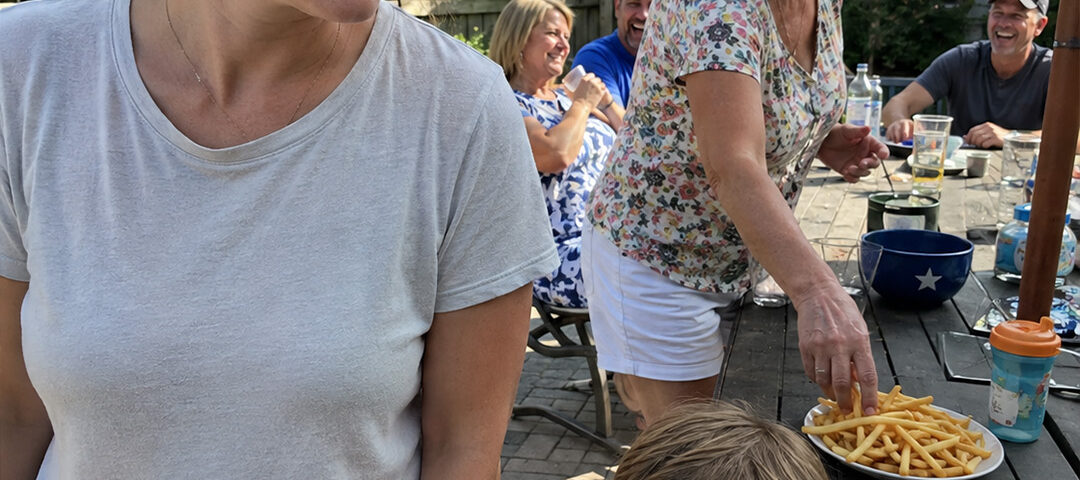
My name is Lucy Spearman and I’m 32 years old. At my mother’s backyard barbecue, my four-year-old son reached for a fry and my mother pulled the whole plate away.
“Those are only for my real grandchild,” she said loud enough for everyone to hear.
And they laughed—comfortable laughter, the kind that means a thing has been said many times before.
I didn’t shout. I wiped Dy’s hands, told him we were going somewhere better, and walked him three blocks to a diner.
By midnight, my mother was calling me over and over because she had just remembered something she needed from me.
What she didn’t know was that I had finally remembered something, too.
And the answer was sitting in a box I hadn’t opened in 5 years.
To understand why a plate of fries ended something in me for good, you have to understand how it always was.
I grew up second—not second place in a race, because a race has a finish line and a winner. I mean second the way a couch is second.
Present. Useful. Expected to hold weight. Never once admired.
My sister Chelsea came along 2 years after me. And from the day she arrived, our whole house turned toward her like she was the only window in the room.
Chelsea cried and someone came running. I cried and someone told me to keep it down.
Chelsea got asked how she was feeling. I got asked what I could fix.
By the time I was 10, I already knew my job. I was the strong one, the capable one, the daughter who didn’t need anything, which is a strange thing to decide about a child.
Nobody decides a 10-year-old doesn’t need anything. They just find it convenient to believe.
My mother’s name is Carol. She is the kind of woman who can make a compliment feel like a door closing.
My father, Wayne, is quieter.
For most of my life, I told myself his silence was a different thing than my mother’s cruelty. That he just didn’t see it.
It took me a long time to understand that a man who watches and says nothing has made a choice, too.
If you ever want to know exactly where you stand in a family, look at the refrigerator.
On my mother’s refrigerator, there were nine photographs. I counted them once, standing in her kitchen while she talked at me about something Chelsea had done.
Nine photos of my nephew Carter, Chelsea’s son.
Carter at the beach.
Carter in a tiny baseball cap.
Carter blowing out candles.
Nine of held up by little plastic magnets shaped like fruit.
There were none of my son.
I found one photo of Dany later, tucked behind the electric bill in a drawer, like a thing that had been received and then quietly filed away where it wouldn’t have to be looked at.
I was the one they called when something needed doing.
I cut my mother’s hair for free in her own kitchen, kneeling on a towel because she didn’t like the way the salon chairs sat.
I covered a heating bill one winter that my parents told the relatives they’d just forgotten to pay.
Chelsea was treasured.
I was relied on.
Those are not the same thing.
And it took me half my life to feel the difference in my body instead of just knowing it in my head.
Chapter 2: Seeking a life of her own
The one place the arithmetic reversed was my salon.
I opened Wild Flower Salon in 2022 in a little storefront with a bell on the door and a heating system that groaned in January.
It wasn’t much, but at that salon, everyone knew Dy’s name.
My regulars saved the good lollipops for him.
He had a corner with a stool and a jar of crayons, and his drawings climbed up the edges of my mirrors, one taped a little higher every few months, like a chart of a boy growing into himself.
At the salon, my son belonged to a whole small world of people who were glad he existed.
At my mother’s house, nobody even used his name.
The invitation to the barbecue came by text. The way everything came from my mother.
“Family cookout Saturday. Family only.”
I remember reading those two words twice.
Family only.
As if the two of us were something else. As if my son, who was blood, who had my father’s chin and my grandmother’s stubborn cowick, was a guest at best and a problem at worst.
Dany was drawing at the kitchen table when I read it.
He looked up at me with syrup on his cheek and asked why he wasn’t ever on Grandma’s refrigerator like his cousin was.
He wasn’t upset. He was four.
He was just trying to understand the shape of the world.
I didn’t have an answer that was true and kind at the same time.
So, I wiped the syrup off his face and told him some refrigerators just run out of room.
He accepted that because children accept almost anything from the people who love them.
If you’ve ever been the child who was only loved when you were useful, stay with me for this one.
This story is for you.
And I promise you, it does not end where you think it does.
To tell you the rest, I have to go back 5 years to the one time I let myself want a life of my own.
His name was Jesse.
He came to the salon on a Tuesday in the spring of 2020, sent by the landlord to look at the light over my main chair, the one that had been flickering for a month and making my clients look like they were being interviewed on a true crime show.
He was an electrician.
He had rough hands and a slow, easy way of talking, and he wore a work shirt with his name stitched on the pocket like he was proud of it.
He climbed my rickety step ladder, did something up in the fixture, and the light came on clean and steady, and stayed that way.
Then he looked around at the mirrors, at Danny’s future corner that back then was just an empty stool, at me, and he said, “Now you can see who you really are in here.”
He said it about the light, but I felt it somewhere else.
Jesse was not the kind of man my parents pictured for their daughter.
He rented.
Chapter 3: The manipulation of the truth
He drove a truck with 180,000 m on it.
His father had done the same work, and his father before that.
And Jesse talked about that lineage like it was something to stand on, not something to climb out of.
My mother had spent my whole life pointing me up a ladder toward people with soft hands and good last names.
Jesse was proudly, cheerfully at the bottom of that ladder.
And he was the first person who ever made me feel like the bottom of the ladder might be a fine place to build a home.
We were together most of a year.
It was the happiest I had ever been, which is why I kept it quiet from my family as long as I could.
Some good things you protect by not letting the wrong people breathe on them.
Then I found out I was pregnant.
I took the test in the little bathroom at the back of the salon. After close, with the chairs already up on the tables.
Two lines.
I sat down on the cold tile floor, and I laughed and I cried at the same time.
And my first feeling, before fear, before anything, was that I wanted this.
I wanted him.
I wanted the messy, unglamorous life that came with him.
My second feeling was that my mother was going to try to take it from me.
I was right.
I told my parents at their kitchen table, the same table where I’d cut my mother’s hair a hundred times.
I barely got the words out before my mother stood up and started moving around the kitchen the way she did when she was rearranging reality to suit herself.
Wayne stayed in his chair with his coffee going cold in front of him and said nothing at all.
My mother told me I was throwing my life away.
She told me Jesse would ruin me, that men like him always did, that I would be poor and tired and alone and it would be my own fault.
And then she took a folded pamphlet out of the kitchen drawer, a pamphlet for a clinic two towns over, and she slid it across the table toward me like it was a bill I owed.
“You’ll thank me for this,” she said.
I didn’t take the pamphlet.
I stood up and I told her I was keeping my baby.
And I watched something move across my mother’s face that I have spent 5 years trying to name.
It wasn’t anger.
Anger I knew.
This was cooler than anger.
It was the look of a woman who had just been told no by someone she had counted on never saying no.
It was the look of someone recalculating.
I moved out that week.
I found a little apartment and I got ready to build a life with Jesse and our baby.
And for a few weeks, I let myself believe I had won.
I was in the hospital in labor with my son when Jesse disappeared.
That is how it was told to me.
And that is how I understood it for five years.
While I was on the worst and most important day of my life, the calls stopped.
The messages stopped.
He was just gone the way my mother had promised he would be.
Chapter 4: Proving self-reliance
She was the one who brought me the news, standing beside my hospital bed with a paper cup of the terrible coffee while I held a newborn who had his father’s chin.
“He’s gone, Lucy,” she said.
“I handled it.”
I was so tired.
I had been awake for two days.
I had just met my son.
I heard the words, “I handled it,” and some small alarm went off somewhere far back in my mind.
And I was too exhausted to walk back and see what it was.
So, I let it go.
I told myself Jesse had run.
That when it got real, he’d bolted.
Exactly like my mother said men like him always did.
It hurt more than I let anyone see.
And underneath the hurt was something worse, which was the feeling that my mother had been right about me all along, that I had reached for a life of my own and it had crumbled in my hands.
And now I would spend the rest of my days proving I could carry the weight alone.
So I did.
I named him Dany, and I took him home to that little apartment, and I built us a life the only way I knew how, which was to work.
I grew the salon slowly, one loyal client at a time.
I learned to do a full day on 4 hours of sleep.
I learned which bills could wait a week and which couldn’t.
Danny grew up in that shop, first sleeping in a car seat behind the reception desk, then toddling between the chairs, then finally settling into his corner with his crayons.
[Snorts.]
Every few months, I made a new pencil mark on the doorframe by the mirrors to show how tall he’d gotten.
Those marks were my proof.
Proof that whatever my mother believed, we were doing just fine.
My family stayed at a careful distance the whole time.
They didn’t help, and I learned to stop expecting them to, which is its own kind of quiet grief.
But they also never fully let go because I was still useful.
And useful people are worth keeping on a long leash.
Then, in March of this year, my father had a stroke.
It wasn’t the kind that takes everything at once.
It was the kind that takes pieces.
His speech went slow and thick.
His right hand stopped listening to him.
He needed care.
Real care.
The daily kind.
The kind that doesn’t photograph well and doesn’t earn anyone praise.
Chelsea couldn’t handle hospitals.
That was the phrase everyone used gently, like it was a diagnosis instead of a decision.
Chelsea couldn’t handle it.
So who did?
Chapter 5: The breaking point
At 5 in the morning, in the hospital parking lot, in the cold.
It was my car every time.
I was the one who learned the rhythm of the rehab center, the smell of it, the code to the side door.
I paid the co-ay on his rehab stay.
$2,300 off a credit card without telling anyone because telling people would have made it a favor.
And I was so used to my help being invisible that I made it invisible myself.
Every month after that, I put around $1,800 toward his care, month after month, for eight months.
I kept a running spreadsheet on my phone that I never showed a soul.
Every Sunday, I filled his weekly pill box, seven little compartments, morning and night, so my father wouldn’t take the wrong thing and hurt himself.
It became the shape of my week.
Whatever else happened, Sunday meant the pill box.
And every Sunday, somewhere across town, someone in my family was telling a relative how wonderfully Chelsea was coping with Dad’s illness.
Chelsea posted a photo online, a hospital hallway, a caption about being there for the people you love.
She got 200 comments telling her she was an angel.
I was the one there.
She was the one being there for Dad out loud, where it counted for something.
When the barbecue invitation came, I almost didn’t go, but my mother made a point of it and I understood why.
There would be relatives at that barbecue—aunts, cousins, the family, friends.
My mother needed the picture to look right.
She needed the whole clan present and smiling so no one would ask too many questions about who was actually holding my father together.
I was part of the picture she needed.
Dany was an afterthought she’d tolerate.
I told myself it was one afternoon.
I dressed my son in a good shirt.
I made a pasta salad in my nicest bowl, and I drove us over to my mother’s house with no idea that I was walking into the last hour I would ever spend pretending.
It was a bright, hot Saturday at the end of August.
The backyard was full of people and the smell of charcoal.
There were two coolers on the patio.
One had a piece of blue tape on it that said family in my mother’s handwriting.
That was where the good drinks were.
I set my pasta salad on the far end of the food table next to the trash bags because that was the only clear space, and nobody moved it anywhere better.
Carter was the center of the yard.
My nephew, 5 years old, was passed from lap to lap and praised for every ordinary thing a 5-year-old does.
My mother had his artwork clipped to a little easel by the drinks like it was a gallery opening.
Dany stayed close to my leg.
He was shy in that yard, the way he never was at the salon, because some part of him had already learned that this was not a place where his name got called.
He watched Carter get scooped up and spun around, and he didn’t ask to be included.
He just watched.
After a while, hungry, he tugged on my sleeve and whispered that he wanted some fries.
There was a plate of them on the table, hot and salted, near where my mother was holding court.
I nodded, and Dany walked over on his own, brave about it, and reached up with his small hand.
My mother pulled the plate away.
She lifted it out of his reach, looked around at the adults nearby, and said in a clear, carrying voice, “Those are only for my real grandchild.”
And they laughed.
That’s the part I need you to sit with because it’s the part I still hear at night.
It wasn’t shocked laughter.
It wasn’t cruel, sharp laughter.
It was easy.
It was comfortable.
It was the laughter of people who had heard my mother say things like this before about me, about Dany, for years and had gotten so used to it that it landed as a joke instead of a wound.
Dy’s hand was still up in the air.
He didn’t understand what had happened yet.
He looked up at me across the yard, and his face was asking me a question.
He was asking me if it was true.
If he wasn’t real.
If that was a thing a boy could not be.
Something in my chest went very, very still.
I have thought a lot about that stillness.
It wasn’t rage, though I had every right to rage.
It was more like a door in me swinging shut softly, all the way, and locking.
Five years of telling myself these were just their ways.
That if I stayed patient and useful, they might someday warm to us.
All of it closed in that one quiet second.
I was done.
I just didn’t announce it.
I never do.
Chapter 6: A shift in perspective
I walked over to my son.
I took the paper napkin from the table and wiped his hands slowly because I wanted him to feel me being calm.
I crouched down to his level and I told him we were going to go get our own fries somewhere better.
Just the two of us.
Then I stood up, took his hand, and walked out of my mother’s yard.
I didn’t slam the gate.
I didn’t say a word to anyone.
Behind me, I could still hear the party going uninterrupted, like the ground hadn’t just shifted under all of us.
There was a diner three blocks away, a little place called Marleene’s with a chrome counter and a bell on the door.
Dany cheered up on the walk, swinging our joined hands.
Inside, a waitress with kind eyes and a name tag that said, “Marlelene,” took one look at my boy and treated him like he was the most important customer she’d ever had.
She brought him his own basket of fries, and when he’d nearly finished, she came back and set down a second basket without being asked.
“These ones are all yours, too, sweetheart. Refills are on me.”
Dany grinned up at her like the sun had come out.
He got more warmth from a stranger in an apron in 10 minutes than he’d gotten from his own blood in 5 years.
I sat across from him and watched him be a happy kid.
And I felt something loosen in my shoulders that I hadn’t known was clenched.
Then my phone buzzed on the sticky diner table.
A missed call.
My mother.
By the time we got home and I’d given Dany a bath and put him to bed, my mother had called 11 times.
I sat in the dark of my bedroom and listened to the voicemails pile up.
And you could hear the whole story of who my mother is just in the order of them.
The first ones were fury.
How dare I?
How dare I embarrass her in front of everyone?
Did I know how it looked?
Storming off like that, making a scene over nothing, over a plate of food.
She had raised me better than to be so dramatic.
Then, somewhere around the seventh or eighth message, the tone changed.
The fury drained out, and something else came in.
Need.
My father had taken a turn that evening.
His medication schedule was off.
She didn’t know which pills, didn’t know the rehab number by heart, didn’t know any of it because she had never once had to know it.
I did.
I always had.
She didn’t hear the difference between her own messages.
The rage and the need sat right next to each other in her voice like they belonged together.
But I heard it.
I heard a woman who would insult my child in front of a laughing crowd at 2:00 in the afternoon and call me, desperate for help, at midnight and expect me to answer as if the first thing had never happened.
I looked at my phone for a long time.
Then I typed one word and sent it and put the phone face down on the nightstand.
“Remember.”
That was all.
One word.
Remember what you said about my son.
Remember the laughing.
Remember it the next time you need someone real to show up at midnight.
She texted back within a minute.
There was no apology in it.
There was no acknowledgement.
There was only an instruction and an assumption and an entitlement so complete it almost took my breath away.
She needed me at the house first thing in the morning to deal with Dad.
She said it like a manager reminding an employee of a shift.
I sat there in the dark, and I understood something that I should have understood years earlier.
In this family, I was not a daughter.
I was a resource—loved when useful, called when needed, laughed at when convenient.
And I decided two things at once that night, and they didn’t cancel each other out.
The first was that I would not go back to being invisible, not for one more day.
The second was that I would not be cruel about it.
My father was a sick old man, and however small the part of him that had ever tried to protect me, I was not going to punish his failing body for my mother’s sins.
I would make sure he was cared for.
I just wouldn’t be the invisible hands doing it anymore.
I looked at the pill box sitting on my kitchen counter, the one I would normally deliver in the morning.
Seven little doors, all filled.
And I felt, for the first time in years, that I might finally set some of this weight down.
Then a new text came in.
And it wasn’t from my mother.
It was from my aunt Colleen, my father’s younger sister, a soft, quiet woman who had never asked me for anything in her life.
“Come by tomorrow,” it said. “There’s a box of your dad’s things you should see. Please, just you.”
Chapter 7: Uncovering the betrayal
I read it twice.
Aunt Colleen never texted like that.
She never asked for private meetings.
And the word please sitting there on its own had a weight to it I couldn’t quite place.
I went to Colleen’s the next afternoon.
My father was in a rehab facility by then, and my mother, in the way she managed everything, had asked Colleen to store a few boxes of his things while the house got sorted out.
So, Colleen’s spare room was stacked with cardboard boxes, and the whole space smelled of mothballs and old paper.
Colleen met me at the door, and she looked like she hadn’t slept.
She led me back to that spare room, and in the middle of all those boxes, set apart on the bed like it had been quarantined, was a single shoe box.
“I found it going through your dad’s things,” she said.
Her hands were trembling.
“I wasn’t going to my grave holding this, Lucy. I couldn’t.”
I sat down on the edge of the bed and I took the lid off the shoe box.
Inside was a stack of envelopes held together with a dry, cracked rubber band.
They were letters.
Every one of them was addressed to me in a man’s blocky, careful handwriting at my parents’ address.
And across the front of every single envelope, in my mother’s slanting cursive, were the words, “Return to sender.”
But they hadn’t been sent back.
That was the thing my mind couldn’t hold at first.
They were marked return to sender.
And then they’d been kept hidden in a box.
For years.
I knew that handwriting on the inside of those envelopes before I even opened one.
It was Jesse’s.
My fingers went cold.
I slid the rubber band off and it snapped and fell apart in my hand.
The first envelope on the stack wasn’t a letter at all.
It was a card, a children’s birthday card with a cartoon dog on the front and, in Jesse’s handwriting above the dog, it said, “For my son Danny.”
I couldn’t breathe.
Colleen was crying now, quietly standing in the doorway.
She told me there was more.
She reached into the box and lifted out a slip of paper, a check stub, and she put it in my hand.
It was a canceled check.
$600 made out from Jesse to my mother, dated the spring my son was born, endorsed, deposited into my mother’s account.
Money he had sent for his baby that my mother had cashed and kept and never breathed a word about.
“There’s one more thing you need to know,” Colleen said, and her voice broke on it.
“I was in the kitchen once back then when he called the house looking for you. Your mother answered. I heard her tell him you’d lost the baby. I heard her say it, Lucy.”
“She told him there was no baby at all, and I was too scared of her to say anything. God forgive me. I was too scared.”
The room tilted.
He thought there was no baby.
For 5 years, I had believed that Jesse abandoned us, that he ran when it got real.
And the whole time, the truth was sitting in a shoe box in my father’s things.
Jesse hadn’t run from his son.
He had been told his son didn’t exist.
He had written letter after letter to a woman he was told wanted nothing to do with him, and everyone had been intercepted, marked, returned, and buried.
He had sent money for a baby he’d been told was never born.
I opened one of the letters, my hands shaking so hard the paper rattled.
It was short.
He wasn’t a writer, and you could feel him struggling to say the thing.
He wrote that he didn’t understand what had happened.
He wrote that if I didn’t want him, he would go, but he needed to hear it from me.
And near the end, he wrote a line I have never been able to forget.
“Just tell me you’re okay and I’ll be whatever you need.”
I was 5 years too late reading it.
I sat on my aunt’s guest bed on the floor of that mothball-smelling room, surrounded by the wreckage of a lie I’d been living inside my whole adult life, and I cried in a way I hadn’t cried since the delivery room.
Danny’s most recent drawing was folded in my bag, the one where he’d drawn our little family.
Just him and me and the salon.
Because that was the whole world he knew.
His father had wanted him.
His father had fought to reach him.
And someone I called my mother had stood between a man and his child on purpose for 5 years and slept fine.
When I could finally move, I looked at the top-left corner of the envelope in my hand.
A return address.
Jesse’s.
Out of state, a couple hundred miles south in Kentucky.
He might not even live there anymore.
It had been 5 years.
But it was a thread, and I had spent 5 years believing there was nothing left to pull.
I could call.
I waited until that night, after the salon was closed and Dany was asleep at a friend’s house.
Chapter 8: Reconnecting with the past
I sat alone in the empty salon with the chairs up on the tables and one light on over my station, the same station where Jesse had once fixed a flickering bulb and told me I could finally see who I really was.
And I dialed the number off the corner of a 5-year-old envelope, and I listened to it ring.
And I did not know what I would say if a stranger answered.
Or a wife.
Or nobody at all.
A man’s voice picked up.
Careful.
“Hello.”
I said his name.
I said mine.
There was a silence so long I thought the call had dropped.
And then he said, in barely more than a whisper, “Lucy.”
And then, before I could answer, in a voice that cracked right down the middle, “Is this… Are you okay? Are you real?”
I told him I was real.
I told him I was okay.
And then I told him the thing I’d figured out how to say, and in the end, I just said it plainly.
“Jesse, we have a son. His name is Danny. He’s four years old. He’s alive. And he’s mine. And he’s yours.”
The sound he made is not a sound I can describe.
It wasn’t quite crying.
It was more like something inside a person coming apart and being put back together at the same time.
When he could speak again, all he could say was, “He’s four. He’s… he’s four.”
We talked for 3 hours.
He told me his side.
And every word of it fit the shoe box like a key fits a lock.
He [snorts] told me he had called the house over and over that spring, and my mother had told him I’d lost the baby, and then told him I was grieving and never wanted to see him again and to stop calling.
He told me he’d written letters until they stopped mattering, until the silence had convinced him it was real.
He’d sent money the one time he had any because it was the only fatherly thing left he could do for a child he’d been told was gone.
“I stayed away because I thought that was what you wanted,” he said. “I thought I was respecting you.”
“Every single day, I wondered if I’d done the right thing. Every day, Lucy.”
He wasn’t the same reckless kid from 5 years ago.
He’d gotten steady work, an electrical job with a crew he’d been with for years.
He’d gotten his life quiet and sober and small.
He said he still had a photo of me from back then.
He laughed, wet and broken, and said he remembered I used to love the fries at that diner near the salon, the crinkle-cut ones, and how I’d steal his.
Near the end of the call, he went very quiet.
And then he asked me so carefully, like he was afraid the answer would take a limb.
“Would you ever let me meet him?”
I told him yes, but not yet.
First, I had to understand the whole shape of what had been done to us so I could make sure it never got a second chance.
Because here is the thing I had to sit with alone in that dark salon, and it was almost worse than the lie itself.
My mother had not done this to protect me.
I had spent years imagining that, in her own twisted way, she’d thought she was saving me from a hard life.
But that wasn’t it.
If it had been about my well-being, she’d have wanted me happy eventually, in any form.
She didn’t.
What she couldn’t stand was the idea of me building a life she didn’t control with a man she considered beneath us.
She would rather have a humiliated single daughter she could summon at midnight than a happy one she might lose to a decent man in a work shirt.
It wasn’t love gone wrong.
It was control wearing love’s coat.
There was one more piece.
And Colleen was the one who’d handed it to me weeks before without knowing what it meant.
She’d once let slip that my mother, long ago, before my father, had been in almost exactly the position I’d been in.
Young. Pregnant. In love with the wrong sort of boy.
And my mother had done the thing she demanded I do.
She had folded.
She had chosen the respectable path and let the other life go, and she had never, not once, in 40 years, forgiven herself for it.
That was the poison under all of it.
She couldn’t bear to watch me keep the very thing she had given up.
My son wasn’t a stranger’s child to her.
He was the ghost of a choice she’d spent her whole life pretending she didn’t regret.
Understanding that didn’t make me want revenge.
It made me tired.
And it made me absolutely certain of one thing.
I was not going to keep her secret, not to destroy her.
I had no interest in exposing the private wound she’d been hiding for 40 years.
And I never did.
But the lie about Jesse, the theft of my son’s father, the years of treating Dany like something to be ashamed of, that was going to come into the light in front of the people my mother spent all her energy performing for.
And I wasn’t going to do it alone.
Colleen, trembling and guilty and finally brave, told me she would stand beside me when I did.
Chapter 9: The confrontation
“I should have spoken up 5 years ago,” she said. “Let me speak now.”
I didn’t have to wait long for the room.
Two weeks later, my father came home from rehab and my mother decided to throw a Sunday dinner.
I understood exactly what it was for because I’d learned to read her my whole life.
It was two things at once.
It was a chance to smooth over the barbecue in front of the relatives, to make the family look whole and warm again before anyone thought too hard about that afternoon.
And it was a chance to pull me back into place, to remind me gently in front of witnesses that I was still the daughter who handled things.
She called me herself, sweeter than she’d been in months.
“Let’s put all that ugliness behind us,” she said.
“Come to dinner. It’s for your father. And bring Dany.”
A pause.
“Have him behave this time.”
Have him behave, as if a four-year-old reaching for a fry had been the problem in that yard.
I said we’d come.
Then I got to work, and I did it the way I do everything: quietly and completely.
Before I set foot in that house, I arranged real care for my father.
I hired a home health aid, a good one, and I paid the first month myself, so that when I stepped back, he wouldn’t fall.
I was not going to abandon a sick man to make a point.
I was going to make sure he was held and then let go of the rope.
And I packed the shoe box into my tote bag.
The letters, the card, the check, all of it held together with a fresh rubber band.
The dinner was on a Sunday evening.
The good tablecloth out.
The whole clan there: Colleen, my cousin Ryan, the Fosters, Naen and her husband, who’d been friends of my parents for 30 years and had been at the barbecue and had laughed, though I didn’t hold it against them yet, because they didn’t know what I knew.
I pulled into the driveway a few minutes early, and through the lit front window, I could see them all in there moving around the table, laughing, warm, a family in a photograph.
My son’s small hand was in mine on the console between us.
Before I tell you what happened at that table, let me ask you something because I think some of you already know this exact feeling.
Have you ever had to stay perfectly calm while an entire room of people waited for you to break?
If you have, tell me in the comments.
I have a feeling there are more of us than anyone wants to admit.
Then I took a breath, and I took my son’s hand, and I walked in.
The seating told me everything, the way the refrigerator always had.
Carter sat at the head of the table in the place of honor at my mother’s right hand, in a booster seat she had bought special.
Dy’s plate had been set at the very far end, near the corner, alone.
No one on either side of him.
My four-year-old climbed up into that chair by himself at the edge of his own family and started coloring on the paper placemat like he was used to being at the edge, because he was.
We hadn’t gotten through the first course before my mother started.
She set down her fork and folded her hands and said warmly, for the whole table to hear, that she thought it would be good for everyone if I apologized for the way I’d behaved at the barbecue.
For storming off.
For making a scene.
For being so dramatic over nothing and upsetting the whole day.
The table got a little quiet.
A few eyes came to me, waiting.
I didn’t apologize.
I said evenly that I hadn’t come to talk about the barbecue.
My [clears throat] mother didn’t like that, but she was skilled, and she pivoted.
She started talking about my father, about how hard this illness had been on the family, on her, and how much everyone had pulled together.
And then Naen Foster, meaning nothing by it, meaning to be kind, said what a blessing it was that Chelsea had been such a rock through all of it, always there for her dad.
Chelsea gave a modest little smile and accepted it.
Chapter 10: Speaking the truth
My father’s illness.
The 8 months.
The 5 a.m. parking lots.
The pill boxes.
The $2,300.
The 1,800 a month.
All of it turned into a compliment for my sister right there at the table.
And my sister took it.
I felt the spreadsheet on my phone burning a hole in my pocket.
But I didn’t reach for it.
Not for that.
That wasn’t the receipt that mattered tonight.
I just said quietly into the warm hum of the table, “Actually, I’ve been paying for Dad’s care and driving him to every appointment for 8 months.”
The table went still in a different way.
I didn’t say it cruy.
I didn’t raise my voice.
I just laid the plain fact down in the middle of the good tablecloth, and I watched the room rearrange itself around it.
Naen’s smile faltered.
My cousin Ryan looked at Chelsea.
Chelsea’s modest little smile curdled at the edges.
My father, at his end of the table, went very quiet and stared at his plate.
My mother recovered fast.
She waved a hand and said something about how, of course, the whole family contributed in their own ways, and it wasn’t a competition.
And this was exactly the kind of drama she’d hoped to avoid tonight.
And then, because she couldn’t help herself, because she had spent 5 years believing she’d buried the past so deep it could never surface, she reached for the oldest weapon she had.
Dany had said something small from his end of the table, some four-year-old comment, and it turned the conversation for a moment to him and to the fact that his father had never been in the picture.
Someone asked gently, “Whatever happened to the boy’s dad?”
And my mother, secure at the head of her table in front of all her people, said it.
“Oh, that boy was trash,” she said with a little laugh, like it was settled history.
“We did you a favor getting rid of him.”
The word we.
The words getting rid of him.
They landed on that tablecloth and just sat there in front of everyone.
My father flinched.
It was small, but I saw it.
His head came up and he looked at my mother with something I hadn’t seen on his face in years.
I set down my fork.
“Getting rid of him,” I said. “How exactly, Mom?”
The room got very quiet.
My mother’s smile stayed on her face, but something behind it went uncertain because she had said we did you a favor as a figure of speech.
The way she’d said things for years.
And my question had put a floor under the figure of speech and asked it to hold weight.
“How did you get rid of him?” I said again.
Calm.
Not loud.
“Say it. In front of everyone.”
She started to bluster.
She said I was being dramatic again.
That this was ancient history, that no one wanted to hear it.
So, I reached into my tote bag and I took out the shoe box and I set it on the good tablecloth in the middle of the table.
I took off the lid.
I lifted out the stack of letters held with the fresh rubber band, and I turned the top one so the table could see the front.
Return to sender, in my mother’s unmistakable handwriting.
I set it down.
Then the birthday card.
Cartoon dog.
For my son Danny, in a man’s handwriting.
I set that down beside the letters.
Then the canceled check.
$600 made out to my mother, endorsed and deposited.
I set that down, too.
I didn’t make a speech.
I didn’t recite 5 years of history.
I just laid the pieces down one at a time and let the room read them.
“Danny’s father wrote to me,” I said. “For a long time, every letter came here to this house. My mother marked them returned to center and then kept them in a box so I would never see them.”
I picked up the top letter and I unfolded it and I read one line aloud.
Just one.
“Just tell me you’re okay and I’ll be whatever you need.”
I looked up at my mother.
“He wrote that,” I said. “And you sent it back. And then you told him I’d lost the baby.”
“You told a man his son didn’t exist.”
The silence at that table was total.
Naen Foster had a hand over her mouth.
Ryan was staring at my mother like he’d never seen her before.
Chelsea had gone white.
And then Colleen spoke from her seat in a voice that shook but didn’t stop.
“It’s true,” she said. “I was here. I heard her tell him on the phone that Lucy lost the baby. I’ve carried it for 5 years, and I’m done carrying it. It’s true.”
My mother opened her mouth.
Nothing came out.
For the first time in my life, I watched Carol Spearman have no next move.
And then my father spoke.
Slow.
Thick.
The words hard for him now.
Each one dragged up out of a body that had betrayed him.
He looked at my mother and he said, “Carol, what did you do?”
Four words from a man who had watched silent for a lifetime.
It wasn’t enough to make him innocent.
But it was the first true thing I’d ever heard him say.
I stood up.
I didn’t scream.
I didn’t cry.
I didn’t stay to watch my mother try to build a new lie out of the ashes of the old one because I didn’t need to.
The verdict was already in every face at that table.
“Dad’s care is arranged,” I said quietly to the room. “There’s an aid starting Monday. I’ve paid the first month. He’ll be looked after, but I’m done being the invisible one in this family, and I’m done keeping your secret.”
I walked to the far end of the table and I held out my hand to my son.
Dany slid down from his lonely chair and took it.
He was still clutching a dinner roll in his other hand, one he’d taken from the basket, half expecting someone to tell him it wasn’t for him.
Nobody did.
I leaned down and I said softly, just to him, “Come on, baby. There’s somebody who’s been wanting to meet you for a very long time.”
And we walked out.
The front door clicked shut behind us.
Chapter 11: Setting new boundaries
Not a slam.
Just a small, final sound.
Outside, the evening had gone cool.
I stood on the front step for a second with my son’s hand in mine, and I breathed out all the way, and it felt like I was exhaling 5 years I’d been holding in my chest.
I’d love to tell you the fallout was clean and quick.
But real life is slower and stranger than that.
The home health aid I’d hired showed up Monday morning right on schedule, and my father was cared for, exactly as I’d promised he would be.
The family had to actually reckon with that.
They had to look at the arrangement I’d already built and realize that the invisible thing holding my father together had been me all along.
And now it was a paid stranger because I’d made it so.
The family group chat, which normally never stopped, went completely silent for days.
Nobody knew what to say.
The relatives didn’t all fall in line behind me, and I didn’t expect them to.
Some of them went quiet and pulled back from my mother without ever quite saying why.
Naen Foster called me a week later and cried on the phone and said she was ashamed she’d ever laughed at that barbecue, that she hadn’t understood.
Ryan started checking in on me, awkward and sincere.
And some others decided it was all too messy and kept their distance from everyone, me included.
My mother, of course, had her own version of events, and some people chose to believe it because it was easier.
Not everyone wants the truth.
Some just want the quiet.
Chelsea called me a few days after the dinner.
Her voice was different than I’d ever heard it.
Small and shaken.
She’d spent her whole life being the treasured one, and she’d never had to look straight at what that treasure had cost me.
She didn’t fully apologize.
She wasn’t ready.
But she was rattled.
And underneath the rattle was the first real question she’d ever asked me, which was whether it had truly been like that our whole lives.
I told her the truth, which was yes.
And then the grief came, the part nobody warns you about.
I want to be honest with you because I think some of you need to hear that this part is normal.
I didn’t feel triumphant.
I sat alone in my salon after close, in the dark, with Dy’s drawings climbing up the edges of my mirrors, and I cried.
Not because I’d lost my mother.
I cried because I finally saw all the way down that I had never really had one.
You can grieve a thing you never got to have.
That grief is real and it’s heavy and it doesn’t care that you were right to walk away.
Being right and being at peace are not the same thing.
A boundary can be the correct choice and still ache while it heals.
There was one more thing from that side of my family, and it undid me a little.
A few weeks after the dinner, a folded piece of paper came in the mail.
No envelope.
Just a page in my father’s shaking poststroke handwriting.
It took him effort I could only imagine.
There were only a few words on it, and one of them, for the first time in 5 years, was my son’s name.
“Danny is a good boy,” it said.
“I’m sorry, Lucy.”
It didn’t erase anything.
A lifetime of silence isn’t undone by a sentence.
But I understood the difference, sitting there holding that page, between the kinds of sorry a person can be.
There’s the sorry that’s really fear of getting caught.
There’s the sorry that’s just guilt looking for relief.
And then, very rarely, there’s the sorry that’s simply true, from someone who has finally seen the thing clearly and has nothing left to gain by saying it.
My father was dying by inches, and he had nothing to gain.
I let his few words be what they were.
I didn’t call him, but I didn’t throw the page away either.
When Chelsea reached out again, wanting to talk more, I set a boundary, and I want you to hear exactly how I did it because I know some of you are standing right where I was.
I met her on my own front step.
I handed her a printed copy of my father’s care schedule, the AIDS number, the medication list, everything organized because I will always be a person who organizes things.
And because helping my sick father was never the thing I was walking away from here, I told her, “I’ll keep helping Dad. I’ll always help Dad, but I’m not coming back to be used.”
“Those are two different things.”
She took the folder.
And then I did the thing I should have done years earlier.
I blocked the number that had only ever called me when this family needed something carried.
Not out of hatred.
Out of peace.
Some doors you don’t slam.
You just stop standing in the doorway waiting to be let all the way in.
And then, finally, there was Dy’s father.
Chapter 12: Choosing a new family
We took it slow because a four-year-old’s heart is not a place you rush into.
Jesse and I talked for weeks first.
He drove up from Kentucky.
And on a cool afternoon in late fall, I took my son to a park and I told him there was a man there who had loved him since before he was born and had been trying to find him for a very long time.
Jesse was already there when we arrived, sitting on a bench, and I watched a grown man’s hands shake as we walked up.
He didn’t rush at Dany.
He got down low, all the way to my son’s level, the way you do when you understand that you are the giant and the child is the one who gets to decide.
And then he held out a paper basket of fries, crinkle-cut ones.
He’d remembered.
He’d driven 3 hours and stopped to get the exact kind.
And he held them out to my son and he said, in a voice that was barely holding together, “These are all for you, buddy. Every single one.”
Danny looked at the fries.
Then he looked up at me.
Then he looked at this careful, kneeling man, and something in a four-year-old decided it was safe.
He took a fry and he grinned.
And he asked Jesse, with no idea what he was doing to us, if he would push him on the swings.
I stood back and I watched my son’s father push my son on a swing higher and higher.
Both of them laughing 5 years late and somehow right on time.
And I thought about a plate of fries pulled out of that same boy’s hands by a woman who called herself family, and a basket of fries handed to him by a stranger in a diner.
And now a basket of fries from the father who’d been stolen from him.
And I understood that the whole story of my son’s worth had been told in who was willing to feed him.
That was the fall.
This is now.
Sundays look different in my life these days.
There’s a dinner at my little place, at my own table.
Colleen comes, my brave, guilty, forgiven aunt who finally spoke.
Jesse comes, still building it slowly, still respectful, earning his way into his son’s life one careful afternoon at a time, the way it should be earned.
The salon is doing fine.
Not rich.
Fine.
Full of people who know Dy’s name.
And on my refrigerator now, there is not one bare inch of metal showing.
It’s covered corner to corner in my son’s drawings.
Crayon sons and stick-figure families, and one right in the center of a boy and his mom and a man pushing a swing.
The other night, I looked around my full, loud table and I realized something that made my throat go tight.
Not one person at it was there out of obligation.
Not one of them was keeping score or waiting to be repaid or tolerating my son as a problem to be managed.
Every single person at that table had chosen to be there.
That’s the thing I finally understand.
And it’s the thing I want to leave with you.
My mother spent my whole life talking about real family, real grandchild, blood, who counted and who didn’t.
And all that time, she was the one taking a real family apart.
Brick by brick.
Letter by hidden letter.
The people who talk the loudest about blood are so often the ones with the least love to show for it.
Belonging was never about blood.
It’s about who shows up, who stays, who gets down on their knees in a park with a basket of fries because a small boy is worth driving 3 hours for.
I stopped waiting to be chosen by people who only ever wanted to use me.
And I built a family out of the ones who choose us on purpose every single day.
If you’ve ever had to choose yourself over the people who are supposed to love you, tell me about it below.
Tell me about the door you finally stopped standing in.
Somebody scrolling past right now needs to know they’re not the only one who walked out of that yard and finally, finally breathed.
I still have the shoe box.
I don’t keep the letters in it anymore.
Those lives somewhere safe now for the day Dany is old enough to know that his father never stopped writing to him.
The box itself sits empty on a high shelf in my closet.
And most days, I don’t think about it at all.
Last night, Dany fell asleep on the couch before I could carry him to bed, worn out from a good day, and Jesse’s jacket was hanging by the door, so I laid it over him.
My son warm under his father’s coat in a house where no one has ever once told him he isn’t real.
I stood in the doorway and watched him sleep for a while.
If you came here from Facebook because of this story, return to the Facebook post, tap Like, and comment exactly “Amazing” to support the storyteller. That small action means more than it seems and gives the writer genuine encouragement to keep sharing more stories about family pressure, firm boundaries, and finally protecting what you worked so hard to build.
Disclaimer: This story is a work of fiction created for entertainment purposes. Any resemblance to real persons, events, or places is coincidental.