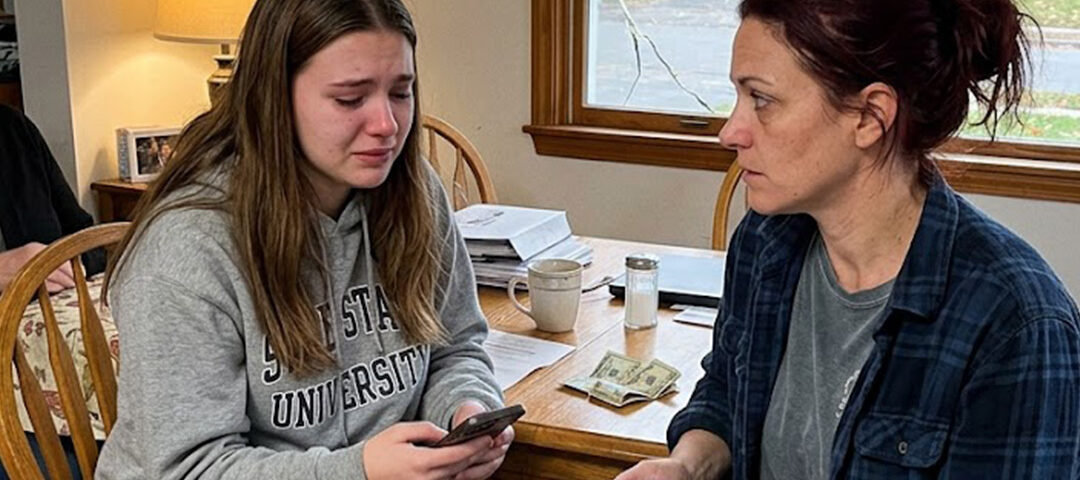
My daughter saved $5,400 for her first semester of college. My mother took the money to remodel my brother’s house: “She can earn it back.” I smiled and canceled the $27,000 resort stay I had already paid for the whole family. By morning, Mom was calling me from the resort lobby…
My daughter saved $5,400 for her first semester of college. My mother took the money to remodel my brother’s house.
“She can earn it back.”
I smiled and cancelled the $27,000 resort stay I had already paid for the whole family. By morning, Mom was calling me from the resort lobby.
The resort confirmation email was still open on my phone when my daughter walked into the kitchen and said the six words that rearranged everything.
“Mom, my savings account is empty.”
I was standing at the counter with a cup of coffee in one hand and the phone in the other, scrolling through the itinerary for a trip I had spent four months planning and $27,000 booking. Four rooms, seven nights, all-inclusive oceanfront.
I had reserved it for the entire family because that is what I did. I was the one who paid. I was always the one who paid.
My name is Brooke Novak. I am 35 years old, the senior HR director for a manufacturing company with 300 employees. Compensation, benefits, employee relations, internal investigations—15 years of reading financial documents, tracing payroll discrepancies, and sitting across from people who are lying while asking them questions I already know the answers to.
That skill set does not turn off when you leave the office. It follows you home. It followed me into the kitchen that morning.
The other thing that followed me home was the bill. Not one bill. The permanent, inherited, never-discussed bill of being the person in my family who makes enough money to keep everyone else afloat.
My mother, Martha, was 62 and retired on a teacher’s pension that covered her mortgage and groceries, but not much else.
Her car insurance? I paid it—$180 a month for five years.
Her grocery delivery service, after she said driving to the store was getting harder? I set it up. I paid the $400 monthly.
My brother Jordan’s electric and gas bill? My payment method had been on his utility account for three years. $220 a month.
The family vacations, mine. The holiday dinners, mine. The birthday gifts for the kids, mine.
I did not keep a running total because keeping a total would have meant admitting that the relationship was transactional, and I had spent 35 years telling myself it was love.
It was not love. It was a budget line I had never been brave enough to cancel.
My brother Jordan was 38, a construction foreman, married to Lindsay, with two kids, and the center of my mother’s universe. He was the son who stayed close while I moved 12 miles away into a career Martha called “your office thing.”
He was the son who received first at every holiday and was forgiven fastest after every failure. His failures included a bankruptcy at 29, a car repossession at 31, and a pattern of borrowing money from Martha that Martha then covered by borrowing money from me.
The cycle had been running since I was 26. I was the engine. Jordan was the passenger. Martha was the driver. And she never once checked the fuel gauge.
Audrey was 18. She had just graduated from high school three weeks earlier. She had been accepted to State University for the fall semester, and she had spent the last four years saving every dollar she could earn.
She babysat on weekends starting at 14. She worked the front desk at a veterary clinic the summer she turned 16. She picked up holiday retail shifts at a clothing store downtown.
Every paycheck went into a savings account my mother had helped her open when she was 14. My mother was listed as a joint signer on the account because Audrey was a minor at the time, and I was at work the day they went to the bank.
The account had held $5,400 as of two weeks ago. Audrey had checked it herself.
She told me the number at dinner with the kind of pride that does not need to announce itself. She said it quietly, the way you say something you have been building toward for a long time and do not want to jinx.
On her nightstand, next to her phone charger and a dog-eared copy of a college orientation guide she had read three times, sat a small glass jar. Inside the jar was a single dollar bill folded twice.
The jar had a label written in purple marker in the handwriting of a 10-year-old.
“College money.”
Audrey made that jar when she was in fourth grade.
She put her first dollar in it from a lemonade stand she ran on our front sidewalk for two Saturdays in July. $11 total. She kept one.
She spent the rest on poster board for a school project because she said the project was more important than the money.
She was 10 years old, and she was already making choices about what to invest in and what to let go. That is who my daughter was.
That is who my mother stole from.
The jar was not where the $5,400 had been stored. The savings account held the real money. But the jar was where the idea began.
It sat on her nightstand for eight years, through two apartment moves and one cracked lid I glued back together with epoxy on a Sunday afternoon while Audrey watched and said, “Careful, Mom. That jar is older than me.”
And it held the first dollar and the promise that came with it.
The promise was simple: Save long enough, work hard enough, and the world opens a door.
Nobody told Audrey that the person holding the door might also be the person emptying the room behind it.
“What do you mean, empty?”
The coffee was still warm in my hand, but my stomach had already gone cold.
Audrey turned her phone toward me. The banking app was open. The balance read $0.
She had tried to pay her tuition deposit that morning, the $800 required to hold her spot for the fall semester, and the transaction was declined.
She called the bank. The representative told her the account had been closed to a zero balance following a withdrawal on March 14th. The full amount, $5,400, one transaction.
“I didn’t withdraw anything,” Audrey said.
Her voice was flat. Not angry yet. Confused in the way people get confused when something they trusted turns out to have a door they did not know about.
The coffee went on the counter. My laptop came off the shelf.
The banking portal loaded in eight seconds. The transaction history appeared the way transaction histories always appear when something is wrong.
Normal. Normal. Normal. Wrong.
March 14th. Withdrawal. $5,400. Authorized signer: Martha Novak.
My mother.
Audrey sat beside me and gave the bank permission to speak with me on speakerphone. The representative confirmed what the app already showed.
The withdrawal was authorized by a listed joint signer. Technically, the bank treated it as a valid transaction.
The banker explained the ugly truth.
Because Martha was still listed as joint signer from when Audrey was 14, the bank had no obligation to block the withdrawal. That did not make the money Martha’s. It only meant recovering it would go through civil court, not a bank reversal.
My HR training kicked in before my heart did.
When you investigate an expense report or a benefits claim at work, you do not look at the one line that triggered the flag. You look at the pattern.
You look at every transaction in the window, and you ask what does not belong. You do not assume the problem started where you found it. You assume it started earlier, and you just were not looking.
There were seven other withdrawals I had never noticed.
$300 on January 8th. $450 on September 22nd of last year. $200 on June 4th. $150 on March 3rd. $250 on November 15th. Two more of $175 and $275 scattered across the previous spring.
Small amounts, always below the threshold that would trigger a bank alert, always on dates that fell between Audrey’s own deposits, so the balance never looked empty when she checked casually.
My mother had been skimming from this account since Audrey was 16 years old.
The total, when I added every column, was $7,200.
$7,200 taken from a teenager’s savings account by her own grandmother over 24 months.
Audrey had earned every dollar of it at minimum wage, summer hours, and holiday shifts where she came home smelling like dog shampoo from the veterinary clinic.
And her grandmother had been thinning the account like someone pruning a plant, taking just enough to keep it alive while removing what mattered.
The final withdrawal, the $5,400 that emptied the account completely, had been made on March 14th, one day before I confirmed the $27,000 resort booking.
My mother knew about the resort. She had seen the confirmation email I forwarded to the family group chat. She knew I was committing to the full cost.
She timed the last withdrawal so I would be financially locked in before Audrey discovered the loss.
That was not carelessness. That was architecture.
I closed the laptop. I looked at Audrey.
She was standing in the kitchen doorway with her phone in her hand and her college orientation guide tucked under her arm. She looked exactly like what she was: an 18-year-old girl who had worked for four years and had nothing to show for it because the person she trusted emptied the register.
“Mom, did someone hack the account?”
“No, sweetheart. I am going to find out what happened. Give me 24 hours.”
If you are watching this and you already know who took the money because you have lived inside a family where one person carries the weight and another person takes the pieces, subscribe to Karma Unfolded, because what my mother said when I confronted her made me cancel a $27,000 vacation with a smile on my face.
I did not call my mother that night.
I sat with the numbers the way I sit with a benefits discrepancy at work: quietly, thoroughly, letting the data speak before my voice did.
Tuesday morning, I drove past my brother Jordan’s house on the way to work. Jordan was 38, the construction foreman, the golden child.
My mother had told me on the phone Monday evening that the $5,400 was for Jordan’s kitchen remodel. His contractor needed a deposit. The kitchen was falling apart. Audrey could wait one semester.
“She can earn it back,” Martha had said.
Those were her exact words. Not an apology. Not a question. A dismissal wrapped in the language of someone who had never once earned $5,400 on her own.
Jordan’s house sat on a corner lot in a subdivision built in the ‘9s. The siding was beige. The lawn was cut, but not edged. The kitchen window faced the sideyard.
I slowed the car and looked.
No scaffolding. No dumpster in the driveway. No contractor truck. No stacked lumber. No tarps over windows. No dust on the sills.
The kitchen, visible through the side window, had the same oak cabinets from 1994, the same laminate countertop, and the same hairline crack in the tile above the sink that had been there since Jordan bought the place six years ago.
The county permit search is public record. Anyone can check it.
I did not need construction experience or a special database. The address returned nothing—no permits filed, pending, or applied for.
There was no remodel.
The $5,400 had not gone to a kitchen.
And my mother either knew exactly where it went and lied to my face, or did not know and chose not to ask, which was its own form of complicity.
That afternoon, sitting in my office after processing a termination review for an employee who had falsified his time card for three months, I pulled one more thread.
In HR, we call it following the money past the explanation.
When someone tells you where the money went and the destination does not exist, you look for the destination that does.
Karen’s cousin worked at the county courthouse and told me where to search civil filings.
The personal loan itself was private, but the credit union had filed a notice of default after two missed payments. That filing was public record.
It named Jordan Novak as borrower, Martha Novak as co-signer, listed the original principal at $14,000, and stated the cure amount needed to bring the account current before the April quarterly review: $5,400.
That number stopped me.
Not $5,000. Not $6,000. Not an approximation.
$5,400.
The exact amount Martha withdrew from Audrey’s account on March 14th.
My mother had not stolen for a vague emergency. She had stolen a mathematically precise amount to cover a specific debt on a specific timeline, and she had done the calculation before she walked into the bank.
Jordan had taken a $14,000 personal loan behind his wife’s back. Martha had co-signed it behind my back.
And when the payments slipped, Martha reached into an 18-year-old savings account to bail out a 38-year-old man who could not tell his own wife where the money was going.
She did this while telling me it was a kitchen remodel in a kitchen that had not changed in six years.
She did this while saying, “She can earn it back,” about a girl who had already earned it dollar by dollar, summer by summer, weekend by weekend, at $9 an hour.
That evening, I called Karen Webb.
Karen had been my closest friend since our sophomore year of college, when we shared a dorm wall so thin we could hear each other’s alarm clocks.
She was a marketing director now. She had no children, two cats, and the kind of honesty that most people call blunt, but I call necessary.
She was the person I called when things broke because she never tried to glue them back together before I was ready.
Six months earlier, when Audrey’s acceptance letter arrived from State University, Karen drove 40 minutes to our house on a Wednesday night with a cake she had baked herself.
Blue frosting. “Statebound” written across the top in slightly crooked letters because Karen was a marketing director and not a pastry chef, and she did not care about straight lines when the message was right.
She stood in our kitchen while Audrey opened the envelope and screamed and jumped off the floor.
And Karen caught her midair like she had been waiting for exactly that moment since the day Audrey started studying for the SATs at our kitchen table.
Brooke watched from the doorway.
Karen looked over Audrey’s shoulder and mouthed two words.
“You did this.”
That was the moment. Not the acceptance letter. The moment when someone who was not family saw what the letter meant and celebrated it harder than anyone in my family ever had.
I told Karen everything on the phone. The withdrawals, the $7,200 total, the fake remodel, the permit search, the personal loan, the co-signer document.
She listened without interrupting, which is how Karen listens when she is already angry.
“What are you going to do?” she said.
“Cancel the resort. All $27,000. Every dollar.”
“Good.”
I almost canled the trip silently. Just made the call, taken the refund, and let the family show up to an empty front desk without warning.
Then I looked at the resort brochure on the kitchen counter.
Audrey had circled the snorkeling excursion with a gel pen. She had circled the sunset kayak tour. She had circled the spa package and written, “Mom and me,” next to it with a smiley face.
Her handwriting. Her excitement. Her circles around activities she would never experience because her grandmother decided Jordan’s hidden loan was worth more than Audrey’s visible future.
The brochure had been on the counter for three months. Audrey checked it every few days, adding new circles and adjusting her plans.
She had mapped out which excursion to do on which day. She had looked up the restaurant menu online and picked what she wanted to order the first night.
She was 18, and she was doing what 18-year-olds do when someone gives them something to look forward to.
She was planning.
I would not cancel this silently.
Every person in that family would know exactly why the vacation disappeared and exactly who was responsible.
Thursday evening, 6:15 p.m., I called the resort.
The reservation was in my name only. My credit card. My email.
The cancellation policy was clear in the booking terms: Full refund if canceled 72 or more hours before the scheduled check-in date.
Check-in was Sunday at 2 p.m. My call landed at 72 hours and 15 minutes.
The representative processed the cancellation in four minutes.
Four rooms. Seven nights. Allincclusive ocean view package. Cancelled.
The confirmation email arrived at 6:18 p.m.
$27,000 returning to my account within 10 business days.
Martha did not know. Jordan did not know.
Nobody knew because I was the person who booked it, the person whose credit card was on file, and the person whose name was on the reservation.
The same way I was the person on every other bill they never thought about.
I spent the rest of Thursday evening on the phone and online, methodically removing myself from every financial obligation I had been carrying for my family.
Martha’s car insurance canled effective Monday. Five years of premiums at $180 per month. Total I had paid: $10,800.
The cancellation took seven minutes and one confirmation code.
Jordan’s utility bill payment method removed from the online portal. Three years at $220 per month.
The autopay simply stopped. Jordan would receive a past-due notice within two weeks.
Martha’s grocery delivery service account cancelled. The $400 monthly charge that had been going to my credit card since Martha retired would no longer process.
Martha would need to drive to the store herself or find someone else to feed her.
Total monthly support I was withdrawing from my family’s life in one evening: $800, plus a $27,000 vacation, plus $7,200 in stolen money that I fully intended to recover.
Friday morning, Audrey and I went to a different bank and opened a new savings account.
Audrey only. No co-signers. No joint access. No grandmother’s name on any line.
The banker who helped us notice that Audrey’s starting deposit was $1. She did not ask why.
Audrey placed the bill on the counter without explanation.
It was the same dollar from the lemonade stand, the one that had lived in the glass jar for eight years.
She was starting over from the beginning.
And the beginning was where she had always been strongest.
I almost called my mother after the resort cancellation. Her number was on my screen, and my thumb hovered over the call button. I could feel the words stacking up behind my teeth, ready to fall.
Then I looked through Audrey’s open bedroom door.
The glass jar on the nightstand. The purple label. The empty space inside where the dollar used to sit.
The jar was lighter now, but it was still standing.
I put the phone down.
Wednesday, I asked Karen for a favor.
“Sunday dinner at Martha’s house.”
Karen said yes without asking what the plan was, which is how you know a friend trusts you enough to stand next to you in a room that is about to change.
Saturday morning, 9:14 a.m., my phone rang.
“Brooke, I am standing at the front desk of the Ocean View Palms Resort, and they are telling me there is no reservation under Novak.”
Martha’s voice was high and tight, the way a wire sounds before it snaps.
“There is no reservation under any name they can find. I have my suitcase. Jordan and Lindsay are in the parking lot unloading the car. The children are asking about the pool.”
What is happening behind her voice? The lobby. Soft music. Other families checking in. Rolling luggage on tile.
The sound of a place that was supposed to be a gift from a daughter who had given enough.
“There is no reservation, Mom.”
“What do you mean there is no reservation? You booked four rooms. You sent the confirmation. We drove three hours. Jordan took time off work. Lindsay packed for the children. Brooke, what did you do?”
“I canled it Thursday evening.”
Silence. Four full seconds.
In the background, a front desk clerk asked someone else how their drive was.
“You canled the whole thing? A $27,000 vacation without telling anyone?”
“You withdrew $5,400 from Audrey’s college account without telling her. And before that, you took another $1,800 in withdrawals you thought nobody would notice. Tomorrow at dinner, we are going to talk about all of it. Drive home safely.”
“Mom. Brooke. Brooke, wait. Jordan and Lindsay are standing in the parking lot with their suitcases. The children are crying. They can see the pool from the parking lot. Do you understand what you are doing to this family?”
“Do you understand what you did to Audrey?”
Martha did not answer.
In the background, the front desk clerk was helping another family check in.
Laughter. The beep of a key card being programmed. The ordinary sounds of people whose vacations were still happening.
“Drive home,” I said again. “Sunday dinner is at five.”
I hung up. The phone went face down on the counter.
The resort brochure with Audrey’s gel pen circle sat in the kitchen drawer. I folded it one more time and put it underneath the bank statements, where the evidence was thicker than the brochure would ever be.
Then I poured a second cup of coffee and sat at the table where my daughter used to do her homework.
And the house was quiet in the way it gets quiet when you have just ended something that should have ended years ago and the relief has not yet caught up with the grief.
If you are still watching and you think cancelling a $27,000 vacation is the hardest thing I did that weekend, stay with Karma Unfolded, because Sunday dinner is where the room stopped breathing.
Sunday, 5:00 p.m. Martha’s dining room.
The table was set for seven.
Martha was in the kitchen. She had not mentioned the resort since the phone call.
Jordan and Lindsay were already seated. Jordan was leaning back in his chair with his arms crossed, the posture of a man who had been told Brooke was making drama and had shown up to defend his territory.
Lindsay was quiet, the way she always was at family dinners, folding and refolding her napkin.
Karen sat next to me. She had her phone in her lap, not recording, just ready. The way a witness is ready.
Martha set the dishes on the table without making eye contact with me.
She had decided, I could tell from the rigid way she held the serving spoon, that the strategy was to act normal and wait for me to back down the way I always backed down.
She had watched me back down for 35 years.
At every holiday when Jordan got the bigger share. At every birthday when Martha forgot to call Audrey but remembered Jordan’s kids. At every family dinner where my contributions were expected and my presence was optional.
She had no reason to expect anything different tonight.
The dining room smelled like roast chicken and bread rolls.
Martha’s good china was out, which meant she was performing normaly with her best dishes.
Jordan was chewing. Lindsay was cutting her food into small pieces the way she did when she was nervous.
Karen sat beside me with her hands flat on the table. Still, the way a person sits when they have agreed to be a wall.
After everyone was served, after Jordan had food on his fork and Martha had settled into her chair, I spoke.
“Mom, when did you last check Audrey’s savings account?”
Martha’s fork stopped halfway to her mouth.
“What?”
“Audrey’s savings account. The one you co-signed when she was 14. When did you last look at the balance?”
“I do not check her account, Brooke. That is her private business.”
“That is interesting, because the bank’s records show eight transactions on that account authorized by your name over the last two years. If you were not checking the balance, you were certainly checking the withdrawal limits.”
Martha set her fork down slowly. Jordan stopped chewing.
“The most recent withdrawal was March 14th,” I said. “$5,400. The entire remaining balance, authorized by Martha Novak.”
“We already talked about this on the phone,” Martha said.
Her voice was careful now. Measured.
“Jordan needed it for the kitchen. I told you she can earn it back.”
“You did tell me that, and I believed you for about 12 hours. Then I drove past Jordan’s house on Tuesday morning.”
Jordan’s eyes moved to me.
“Same cabinets. Same countertop. Same cracked tile above the sink. No scaffolding. No dumpster. No contractor truck. No stacked materials. I checked the county permit database from the car. No building permits filed for your address in the last 12 months, Jordan. No plumbing. No electrical. Nothing pending.”
“I haven’t started yet,” Jordan said. “The contractor is coming next month.”
“What is his name?”
“A guy Darren recommended. I do not remember his last name.”
“What company?”
“I do not have to give you his company name. Brooke, this is not a job interview.”
“You are right. It is not. But the county requires a filed permit before any structural or plumbing work begins in a residential kitchen, and nothing has been filed. If you have a contractor coming next month, he has not pulled permits, which means either he does not exist or he is unlicensed. And if he is unlicensed, the county can stop the work and find you.”
Jordan looked at Martha.
Martha was looking at the tablecloth.
“But the permits are not the reason I brought this up tonight,” I said.
I opened my bag and took out the first bank statement.
I placed it on the table between the bread rolls and the salt shaker.
“March 14th, $5,400.”
A second statement.
“January 8th, $300.”
A third.
“September 22nd of last year, $450.”
A fourth.
“June 4th, $200.”
Each page landed on the tablecloth like a document being admitted into evidence.
Seven statements in total. Seven withdrawals, all authorized by the same name. Seven withdrawals over two years.
Total: $7,200.
“Every one of them authorized by you, Mom. Every one of them taken from a savings account that belonged to a teenager who earned every dollar working summers and weekends and holidays.”
Martha’s face tightened. Her hands were flat on the table.
“You have no right to go through her bank records,” Martha said.
“She is my daughter. She is 18. She asked me to. And you were co-signer on a minor’s account, which means every withdrawal you made is documented, timestamped, and legally traceable.”
The room was quiet.
Lindsay had stopped folding her napkin.
Jordan was staring at the bank statements like they were written in a language he was trying not to understand.
“And the $5,400 did not go to a kitchen remodel,” I said. “I checked. There is no remodel. There is no contractor. What there is, Mom, is a co-signer document on a personal loan that Jordan took out 11 months ago. A loan he never told Lindsay about. You co-signed it, and the $5,400 went to pay it down before the next review.”
Lindsay turned to Jordan.
Her napkin was on the floor. She had not noticed it fall.
“What loan?”
Jordan’s jaw locked. The muscle under his ear pulsed.
“It is not what she is making it sound like.”
“What loan, Jordan?”
Lindsay’s voice was different now. Not quiet. Not folded. It had edges.
“A personal loan. Eleven months ago. $14,000. Mom co-signed.”
“$14,000.”
Lindsay repeated the number like she was testing whether it was real.
“You took out a $14,000 loan, and you did not tell me. We share a mortgage. We share a checking account. We have two children in this house, and you walked into a credit union and took out $14,000 with your mother’s signature instead of mine.”
“It was for the truck repairs and some other things that came up. I was going to tell you when it was paid off.”
“When it was paid off with what money, Jordan? Because the money that paid it down came from Audrey’s college account. Your mother stole from your 18-year-old niece so you could hide a debt from your wife. Is that what just happened at this table?”
“That is not how I would describe it,” Jordan said.
“Then how would you describe it? Because I have been sitting here for 20 minutes watching your sister lay out bank statements and permits and loan documents, and you have not denied a single one. You have not said, ‘That is wrong,’ or, ‘That is not mine.’ You have said, ‘I have not started yet,’ and, ‘It is not what she is making it sound like.’ Those are not denials, Jordan. Those are stalls.”
Jordan looked at Martha.
Martha’s eyes were on the table.
The bank statements were spread across the tablecloth between the bread rolls and the serving dishes. Seven pages of evidence that nobody at that table could explain away.
Karen sat still. She had not spoken once. She did not need to.
The documents were speaking. The silence between Martha’s responses was speaking.
The look on Lindsay’s face, which had gone from confusion to disgust in the span of 90 seconds, was speaking louder than anything Karen could have said.
Martha stood up from the table. She placed one hand on the back of her chair and the other flat against her chest.
“My heart is racing. I think I am having palpitations. Brooke, this stress is going to put me in the hospital. I need to sit in the other room.”
Martha’s health performances were not new.
At family dinners, when the conversation approached anything uncomfortable, her body produced a symptom.
A headache when I mentioned money. A stomach pain when Audrey’s grades came up in comparison to Jordan’s kids. A racing heart when anyone asked a question Martha did not want to answer.
It was the emergency exit she pulled when the building was not on fire.
“If you are having a medical event, I will call 911 right now,” I said. “If you are performing, sit down and listen because I am not finished.”
Martha looked at me for three seconds.
Then she sat down.
Her hand stayed on her chest for another 10 seconds, then quietly moved to her lap, where nobody could see whether it was still shaking.
“You took $7,200 from your granddaughter’s college savings account over two years,” I said. “You told me the last $5,400 was for a kitchen remodel that does not exist. The money went to a personal loan Jordan took without telling his wife, a loan Yuko signed without telling me. You timed the final withdrawal one day before I confirmed a $27,000 resort booking because you knew I would already be committed before Audrey discovered the loss.”
I turned to Jordan.
“And you let your mother steal from an 18-year-old girl who worked four years at minimum wage to cover a debt you were too ashamed to tell your own wife about.”
I looked back at Martha.
“My attorney has the bank records, the county’s no-permit result, and the default notice with your co-signature. The demand letter for $7,200 goes out tomorrow. The amount is under the county’s small claims limit, which is why we are keeping this simple. If it is not repaid within 30 days, I file.”
Martha’s eyes were wet. Her mouth was a thin line.
She said the words she had been saving since Saturday morning.
“That girl has been spoiled since the day you put a jar on her shelf and told her the world owed her a degree. Jordan has a family to hold together. His house is falling apart. Your daughter can wait one semester and get a job like everyone else instead of floating through life on your credit card. She is not special just because you decided she was, Brooke. And neither is that jar.”
Six targets.
Audrey’s work ethic. My parenting. The emotional object. Jordan’s needs elevated above a child’s education. My spending framed as the problem. And the jar dismissed as a prop in a fantasy I built for my daughter.
I did not raise my voice.
“Audrey is not special because I decided she was. Audrey is special because she worked two summers, three weekends a month, and every holiday break to put $5,400 into a savings account that you drained in one withdrawal while telling me she could earn it back. She already earned it. You are the one who took it.”
Martha opened her mouth.
Nothing came out.
Her right hand went to the edge of the table and gripped it. Her shoulders rounded forward. Her breathing changed to the kind of breathing that has nowhere to go.
“The resort is cancelled. The bills are ending. The demand letter goes out tomorrow.”
I reached into my bag.
The glass jar. Audrey’s jar. The label facing up.
“College money,” in purple marker.
The handwriting of a 10-year-old girl who believed that if she saved long enough and worked hard enough, the people around her would protect what she built.
“That jar is still on her nightstand. It still says ‘college money’ in purple marker. It is the only thing you did not take.”
Martha’s right hand came off the table and went to the edge of her chair.
Her shoulders dropped forward like the string holding them had been cut. Her mouth opened, and nothing came out.
Her breathing was shallow, the kind of breathing that sounds like something being pressed flat.
For the first time since I had started talking, she looked like someone who understood that the conversation was not going to end with me apologizing.
I set the jar on the table between the bank statements and the salt shaker.
Then I stood.
Karen stood with me.
We walked out of Martha’s dining room together.
Behind us, Lindsay was still standing. Jordan had not moved from his chair.
Martha was looking at the jar the way you look at something that used to belong to you and no longer does.
The dining room was quiet except for the clock on the wall and the sound of Jordan’s daughter in the next room asking her brother if she could have his juice box.
I almost let the whole thing end there.
Just the cancellation, the demand letter, and the walkout. A clean break with no looking back.
But then I thought about the lemonade stand.
Two Saturdays in July. Audrey was 10.
She sat on a folding chair in the sun for four hours each day with a handwritten sign and a picture of lemonade made from a recipe she found online.
She earned $11 total.
She put one of them in a jar and labeled it with a purple marker and set it on her nightstand and said, “That’s the start.”
She was 10 years old.
She was not doing it because I told her to. She was doing it because she wanted something bigger than what she had, and she believed that working for it would get her there.
Her grandmother spent the next eight years proving that belief wrong.
Audrey deserved more than a walkout.
She deserved the full accounting.
“I am cancing your car insurance Monday,” I said from the front door, loud enough for the dining room to hear. “Five years of premiums, $10,800 total. The grocery deliveries are cancelled. Jordan’s utility autopay is removed. The resort refund is mine. My attorney sends the demand letter for $7,200 tomorrow. Do not call me about any of it. Do not ask Audrey to forgive you before she is ready. And do not come to my house until you are ready to repay what you took from an 18-year-old girl who earned it at $9 an hour.”
The front door closed behind me.
Karen and I walked to my car.
She did not say anything for a full minute.
Then she said, “You should have done that years ago.”
And I said, “I know.”
Monday morning, the consequences began arriving at Martha’s door the way bills arrive, one at a time, each one heavier than the last.
The car insurance app on Martha’s phone showed a red banner: “Policy not active.”
She called the provider. The representative confirmed the policyholder, Brooke Novak, had cancelled coverage effective that day.
Martha’s Honda sat in the driveway. She could not legally drive it.
She called three insurance companies that afternoon. The cheapest quote she could find on her pension income was $240 per month, $60 more than what I had been paying because my bundled rate was lower.
She signed up on Thursday. It was the first insurance premium she had paid herself in five years.
Jordan’s electric company sent a past-due notice by the following Monday.
The autopay had been removed. His bill was $220, due in 14 days.
Lindsay was staying at her sister’s house with the children while she decided what to do about a husband who had taken a $14,000 loan behind her back.
Before she came home, she made Jordan sign a written repayment agreement for his share of the $5,400, witnessed by her sister.
Jordan signed it at the kitchen table without argument.
It was the first financial document he had put his name on without hiding it in 11 months.
The grocery delivery service sent Martha a cancellation confirmation email on Tuesday.
Martha drove to the grocery store herself for the first time in two years. She spent $127 and carried the bags inside alone.
The demand letter arrived by certified mail on Wednesday.
$7,200.
Itemized every withdrawal date, every amount, 30-day repayment window. After that, small claims county jurisdiction.
Martha read the letter at her kitchen table.
She read it twice.
Then she folded it and set it beside her plate, next to the phone that had not rung since Sunday.
Two weeks after the dinner, Martha’s phone rang on a Tuesday evening.
Donna, her closest friend from 30 years of teaching.
Donna’s voice was not warm.
“Martha, is it true you took Audrey’s college savings? Somebody at church told me, and I told them they were wrong. Then Karen’s mother showed me the whole story.”
“It was a family matter, Donna. It is being handled.”
“Handled how? My daughter works in the registars’s office at State. She told me Audrey’s enrollment was on hold for two weeks because of a missing deposit. That girl almost lost her spot because you cleaned out her account. Is that true?”
Martha did not answer.
“I have five grandchildren, Martha. If I took $1 from any of their college accounts, I would not be able to look at myself in the mirror for the rest of my life. I think you need to fix this. Fix it before Easter. Fix it before Audrey’s first semester starts, and fix it before you call me again, because I do not want to hear your voice until you have made this right.”
The line went quiet.
Martha held the phone against her ear for three seconds after Donna hung up, listening to the dial tone where her oldest friendship used to be.
The Thursday lunches were over.
The phone did not ring again that week.
Three weeks after the dinner, Jordan’s six-year-old daughter was eating cereal at the kitchen table on a Saturday morning.
Lindsay was back in the house, but the air between her and Jordan had not thawed.
The little girl set her spoon down and looked at Lindsay with the kind of directness that only children and people with nothing left to lose can manage.
“Mommy, why doesn’t Aunt Brooke come to dinner anymore? And where did Audrey go?”
Lindsay stopped loading the dishwasher.
She looked at Jordan, who was sitting across the table, scrolling his phone.
Jordan set the phone down.
He looked at his cereal.
He did not look at his daughter.
He did not have an answer a six-year-old could understand because the truth was that Aunt Brooke stopped coming because Grandma stole Audrey’s college money and Daddy hid alone, and nobody at that table said sorry until the silence was louder than anything they could have said.
The demand letter was not answered within the 30-day window.
My attorney filed in small claims the following Tuesday.
The hearing date was set for June, two months before Audrey’s move-in day.
Martha would be served. Jordan would be named as the beneficiary of the funds.
September move-in day at State University.
Audrey carried three boxes up two flights of stairs while I carried two. And Karen carried a lamp and a bag of hangers she had bought at Target that morning because she said every dorm room needs at least 12 hangers, and Audrey would thank her by October.
The room was small. Cinder block walls painted off-white. A window that faced a parking lot and a strip of grass where two students were throwing a Frisbee. A desk, a chair, and a twin bed that squeaked when Audrey sat on it to test the mattress.
She opened the last box.
Inside, wrapped in a dish towel, was the glass jar.
She lifted it out the way you lift something that weighs more than its size suggests.
She set it on the corner of her desk, label facing out.
“College money.”
Purple marker faded at the edges from eight years of sunlight through a bedroom window, but every letter still legible.
The dollar was gone.
It was in the new savings account at the new bank, the first deposit in a ledger that belonged to no one but Audrey.
The jar was empty now, but it was not finished.
It was the container for the beginning of something.
And the beginning was still happening.
Next to the jar, she placed a framed photo.
The three of us: Brooke, Audrey, and Karen.
Cake night. “State bound” in blue frosting behind us. Karen’s arm around Audrey’s shoulder.
My face half visible in the doorway because I was watching instead of posing, which is what I had always done.
Watch. Provide. Keep the lights on. Stand at the edge of the frame and make sure everyone else was in focus.
Martha’s kitchen, the last I heard from Karen’s mother, had one fewer chair pulled up to the table.
The resort brochure sat in a drawer nobody had opened.
The certified demand letter was pinned under a magnet on the refrigerator, which was the same refrigerator where Audrey’s school photos used to hang before Martha took them down.
The car was insured again at a higher rate, paid by Martha for the first time in five years.
Jordan’s utility bill was current because Lindsay made him set up his own autopay as a condition of her coming home.
The personal loan was still outstanding.
Audrey’s dorm room was small and bright and hers.
The jar sat on the desk between a macroeconomics textbook and a coffee mug Karen had given her that said, “Earned it.”
The label caught the afternoon light from the window.
The empty glass held nothing but air and the memory of a 10-year-old girl who believed that saving was how you built a life.
I stood in the doorway of the dorm room with my arms crossed, leaning against the frame, and watched my daughter unpack her future into a room nobody could take from her.
The jar caught the light. The label was legible. And the girl who wrote it was here.
If this story reminded you that the people who say she can earn it back are usually the ones who never earned it themselves, and that the hardest boundary to set is the one you should have drawn years ago.
If you came here from Facebook because of this story, return to the Facebook post, tap Like, and comment exactly “Amazing” to support the storyteller. That small action means more than it seems and gives the writer genuine encouragement to keep sharing more stories about family pressure, firm boundaries, and finally protecting what you worked so hard to build.
Disclaimer: This story is a work of fiction created for entertainment purposes. Any resemblance to real persons, events, or places is coincidental.