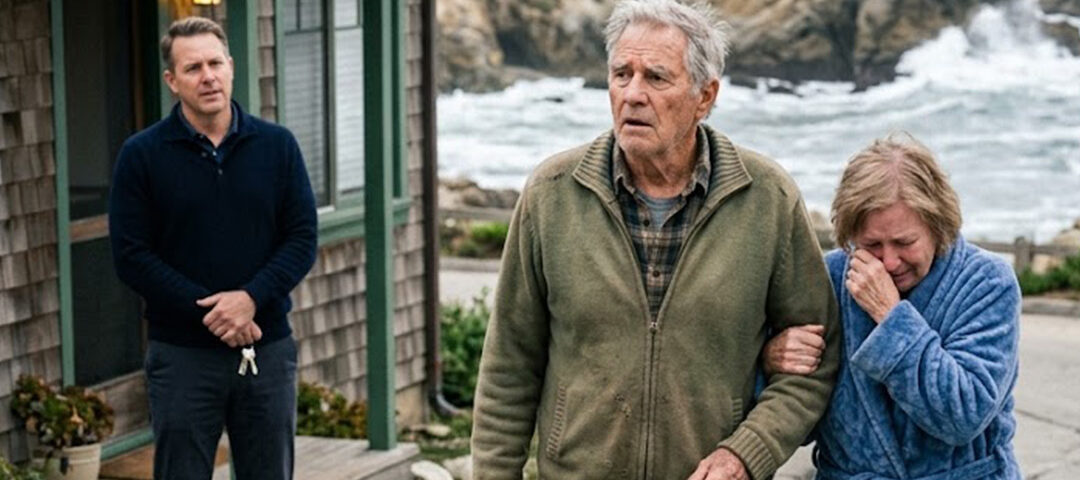
The morning my brother-in-law threw my seventy-year-old father out of his own seaside home, he had no idea the keys jingling in his hand were about to become evidence.
“Get out,” Daniel Mercer said.
My father, Robert Hayes, stood frozen in the doorway of the oceanfront cottage I had bought for my parents’ fortieth anniversary. One hand still rested on the brass doorknob. The other clutched a small brown grocery bag containing coffee, eggs, and the cinnamon rolls my mother liked on Sunday mornings.
Behind him, gray waves crashed against the rocky Monterey shoreline. Wind moved through the cypress trees, bending their dark branches toward the water. It should have been a quiet morning in the one place my parents had finally learned how to rest.
Instead, my mother was standing outside in her slippers, crying so hard she could barely breathe.
“This isn’t your house,” Daniel repeated, louder this time, as if my father had failed to understand the insult. “You can’t just walk in whenever you want.”
My father looked down at the key in his own hand.
It no longer fit.
Daniel had changed the locks.
My sister Claire stood several feet behind her husband in the entry hall, pale and rigid, wearing the cream sweater my mother had given her the previous Christmas. She would not look at our parents.
“Claire?” my father said.
My sister’s mouth moved, but no sound came out.
Daniel lifted a new key ring and let it swing from one finger.
“We’re trying to protect the property,” he said. “Someone has to make adult decisions.”
My mother reached for my father’s arm.
“Robert, please. Let’s just call Ethan.”
That was the moment Daniel smiled.
Not broadly. Not enough for anyone passing on the road to notice.
It was a small, satisfied curl of the mouth from a man convinced that every other person in the scene was weaker than he was.
“Call whoever you want,” he said.
So my mother did.
I was in San Jose when the phone rang.
I had just stepped out of a Saturday meeting at my construction firm and was walking toward the parking garage when I saw her name. Mom rarely called during work hours. She believed every business meeting I attended was somehow more important than anything happening in her life.
I answered immediately.
“Hey, Mom.”
For several seconds, all I heard was wind.
Then she whispered, “Ethan, you need to come right now.”
The fear in her voice stopped me beside the elevator.
“What happened?”
“He changed the locks.”
“Who?”
“Daniel.”
I thought I had misunderstood.
“What locks?”
“The cottage.”
Behind her, I heard my father speaking. His voice was controlled, but I had known him too long not to hear the humiliation beneath it.
Then Daniel’s voice came through the phone.
“They need to stop acting like children.”
My grip tightened around the phone.
“Put him on.”
“No,” Mom said quickly. “Please just come.”
“Are you inside?”
Another pause.
“We’re on the porch.”
The elevator doors opened.
I stepped inside alone.
“Stay there,” I said. “Do not leave. Do not sign anything. Do not give him any documents.”
“Ethan—”
“I’m coming.”
The forty-five-minute drive took thirty-seven.
I do not remember most of it.
I remember the speedometer.
The ocean appearing between the hills.
My mother’s shaking voice replaying in my head.
And I remembered the night, seven months earlier, when I had handed my parents a navy envelope during their anniversary dinner.
We had celebrated at a small restaurant near Carmel, the kind with white tablecloths but no pretension. My father ordered salmon because he always ordered the least expensive entrée on the menu, even when I told him the price did not matter. My mother wore a blue dress she had owned for fifteen years and still described as “too nice to waste.”
After dessert, I placed the envelope between them.
Dad frowned.
“What is this?”
“Open it.”
He slid one finger beneath the seal.
Inside were photographs of the cottage, the trust documents, and two brass keys tied with a white ribbon.
My mother stared at the first photograph.
The little house stood on Cypress Point Road with weathered cedar siding, wide windows, and a stone path leading toward the bluff. Beyond it stretched the Pacific.
“Ethan,” she whispered.
My father read the first page twice.
Then a third time.
“We can’t accept this.”
“You already did.”
“No, son.”
His eyes were wet.
“This is too much.”
It was not enough.
Nothing I could give them would ever equal what they had sacrificed.
Dad had worked the night shift at a manufacturing plant for twenty-eight years. He left home before sunset and returned after sunrise smelling like machine oil and cold air. When the plant closed, he took maintenance jobs, delivery work, and whatever else kept the mortgage current.
Mom stretched every dollar until it was almost transparent.
She patched our clothes.
Cut coupons.
Skipped meals and called it dieting.
When Claire needed braces, Mom sold the necklace her own mother had left her. When I earned admission to an engineering program in another state, Dad refinanced the house without telling me so I could attend without loans.
They never took vacations.
Never bought new cars.
Never had a room where the sound of traffic did not reach them.
The cottage was supposed to be the end of sacrifice.
“It’s yours,” I told them. “Not borrowed. Not shared. Yours for the rest of your lives.”
Mom covered her face and cried.
Dad stood and wrapped both arms around me.
It was the first time since I was a child that I felt him shaking.
I had placed the property inside the Hayes Family Residential Trust. I remained the grantor and trustee because I wanted to handle taxes, insurance, and major maintenance without burdening them. My parents were named irrevocable lifetime occupants.
No sale.
No rental.
No refinancing.
No one could force them out while either was alive.
I had built every protection I could think of into the documents.
What I had not anticipated was my own sister treating their home like an untapped bank account.
When I pulled into the gravel driveway that morning, two suitcases sat on the porch.
My father’s brown leather case leaned against a planter.
Mom’s small floral suitcase stood beside it, half-zipped, one sleeve trapped in the opening.
The sight hit me harder than Daniel’s words could have.
Those suitcases meant he had not simply changed the locks during an argument.
He had packed their belongings.
My father stood near the porch rail, facing the ocean. My mother sat in a wicker chair with both hands clasped around a tissue.
Daniel stood in the doorway with his arms crossed.
The keys dangled from his hand.
Claire remained behind him.
I got out of the car and closed the door carefully.
“What’s going on?”
Daniel smiled as though we were meeting for a scheduled business discussion.
“Good. You’re here. We need to clear this up.”
My father turned toward me.
I had never seen him look so old.
“He says he has a right to the property,” Dad said.
“A right?” I looked at Daniel. “On what basis?”
Daniel stepped onto the porch and pulled a gray folder from beneath his arm.
“Claire and I have been managing things.”
“Managing what?”
“The property.”
“No one asked you to manage it.”
“Your parents are getting older,” he said. “The upkeep, taxes, insurance, liability—it’s too much.”
“I pay the taxes, insurance, and maintenance.”
Daniel’s eyes flickered.
Only once.
Then his confidence returned.
“That arrangement isn’t sustainable.”
“It’s been perfectly sustainable.”
“We decided short-term rental income would make better use of the house.”
I looked at Claire.
“We?”
My sister crossed her arms.
“Ethan, calm down. You’re overreacting.”
I stared at her.
“Mom is crying. Dad was locked out of the house I bought them, and their luggage is sitting on the porch. Which part would you like me to react to calmly?”
Claire finally met my eyes.
“Daniel is trying to be responsible.”
Daniel held up the keys.
“I’m protecting the asset.”
That word made everything inside me go cold.
Asset.
Not home.
Not anniversary gift.
Not the place where our father drank coffee while watching whales move along the horizon.
Not the kitchen where our mother had finally begun baking because she enjoyed it rather than because four children needed food.
An asset.
Something to monetize.
Something Daniel believed he could control.
My mother looked at me.
“He told your father that if we tried to go inside again, he would call the police.”
The wind moved between us.
Even Daniel seemed to recognize that the sentence had changed the situation.
I held out my hand.
“Give me the keys.”
He laughed.
That was his mistake.
The laugh lasted only a moment, but it told me everything.
Daniel believed this was family drama. He thought there would be shouting, tears, a few ugly phone calls, and eventually someone would ask everyone to forgive each other for the holidays.
He did not understand that I had purchased the property outright.
He did not understand that I had reviewed every trust clause with two attorneys.
He did not understand that changing locks on legal lifetime occupants was not an argument.
It was evidence.
“Give me the keys,” I repeated.
“No.”
He closed his fist around them.
“And remember, Claire is your sister. We’re family.”
My father flinched.
My mother looked at Claire with the quiet heartbreak only a parent can carry.
Claire lifted her chin.
“Daniel is right. You dropped a huge responsibility on Mom and Dad without asking whether they could handle it.”
I nearly laughed.
“A responsibility?”
“The house needs to generate something,” she said. “They barely use most of the rooms.”
“They live here.”
“They could stay with us while renters use it.”
My mother stared at her.
“Stay with you?”
Claire looked away.
Their house had three bedrooms, but one was Daniel’s office and another had been converted into a home gym neither of them used.
Mom seemed to understand the plan all at once.
“You never meant for us to go back inside,” she whispered.
“That’s not true,” Claire said quickly.
Daniel answered over her.
“It would depend on the rental schedule.”
My father turned his face toward the ocean again.
I saw his jaw tighten.
He had worked his entire life to provide homes for other people.
Now his own daughter and son-in-law were discussing when he might be permitted to enter his.
“This is a misunderstanding,” Claire said.
“No,” I replied. “A misunderstanding is arriving on the wrong day. This required a locksmith, contracts, photographs, packed luggage, and a plan.”
Daniel waved the gray folder.
“We have paperwork.”
I held out my hand.
He hesitated, then shoved it toward me.
Inside was a draft short-term rental agreement.
A proposed management contract naming Mercer Coastal Holdings as property operator.
A property-release form.
And an “authorized representative” declaration bearing my mother’s name.
The signature was wrong.
My mother’s handwriting leaned slightly to the right. This signature was too straight, too careful.
I looked at her.
“Did you sign this?”
Mom stood and came closer.
She studied the page.
“No.”
Claire’s face changed.
I turned to Daniel.
“Who signed it?”
He shrugged.
“It was electronically authorized.”
“By whom?”
“Your parents agreed verbally.”
“We did not,” Dad said.
His voice was quiet.
But for the first time that morning, it carried steel.
Daniel glanced toward him.
“You said the maintenance worried you.”
“I said the salt air damaged the window frames.”
“Same issue.”
“No,” Dad replied. “It is not.”
I turned the document over.
The property-management company listed at the bottom had been created six weeks earlier.
The registered address matched Claire and Daniel’s house.
“You formed a company to rent my parents’ home.”
Daniel’s expression hardened.
“Our company. Claire is part of this family too.”
“Family relationship does not create ownership.”
“We were trying to help.”
Claire’s voice had weakened.
I looked at her.
“Did you approve this?”
She hesitated.
That was answer enough.
“We thought Mom and Dad would eventually see the benefit.”
“You thought they would accept it after you removed them.”
“It was temporary,” Daniel insisted. “Just while renters stayed. Do you know how much this place could make during summer?”
He pulled out his phone and showed me a listing estimate.
Nine hundred dollars per night during peak season.
My mother made a broken sound.
“You put our bedroom online?”
Daniel lowered the phone slightly.
“The listing isn’t active yet.”
“Did strangers see photographs of our things?” she asked.
No one answered.
She looked at Claire.
“My wedding photograph?”
“Mom—”
“My clothes? Your father’s medicine? Grandma’s quilt?”
“It’s only a house,” Daniel said.
My father turned.
The humiliation disappeared from his face.
Something harder replaced it.
“No,” Dad said. “It is our home.”
For the first time, Daniel did not immediately answer him.
I took out my phone and called Rebecca Sloan, the attorney who had structured the trust.
She answered on the second ring.
“Ethan?”
“I’m at Cypress Point. You’re on speaker.”
Her tone sharpened.
“What happened?”
I placed the phone on the porch table.
“Who owns the property?”
“The home is held by the Hayes Family Residential Trust. You are the grantor and acting trustee.”
“Who has the legal right to occupy it?”
“Robert and Linda Hayes are the irrevocable lifetime occupants.”
“Can Claire Mercer or Daniel Mercer change the locks, remove my parents, or rent the property?”
“No.”
The answer came immediately.
Daniel stepped closer to the phone.
“They were not removed. We were managing the home with family authorization.”
Rebecca continued as if he had not spoken.
“No person other than the trustee may approve occupancy changes, leases, rentals, access restrictions, or management agreements. Locking out legal occupants may create significant civil liability and, depending on the conduct, potential criminal exposure.”
“Criminal?” Claire whispered.
“Yes,” Rebecca replied. “Family status does not override property law.”
Daniel’s face lost color.
Only for a second.
Then he reached for anger.
“This is ridiculous. We’re family.”
“Family members can still commit unlawful acts,” Rebecca said calmly.
He pointed toward me.
“He gave them the property. That means it belongs to all of us eventually.”
“No,” Rebecca answered. “It means precisely what the trust documents state. There is no future interest assigned to you.”
Daniel stared at the phone as though it had personally insulted him.
I looked at Claire.
“Did he tell you the house would eventually be yours?”
She lowered her eyes.
There it was.
The deeper plan.
Daniel had convinced my sister that our parents’ gift was an inheritance waiting to be harvested.
The cottage had not been theirs for seven months before Claire and Daniel began planning its future without them.
A white SUV pulled into the driveway before anyone could speak.
A woman stepped out carrying a camera bag and tripod.
She smiled professionally.
“Good morning. I’m here for the Cypress Point listing photos.”
My mother covered her mouth.
I turned toward Daniel.
“You actually scheduled this?”
He said nothing.
The photographer looked between us.
“I was told the property would be vacant by ten.”
My father stared at the suitcases.
Vacant.
That was why Daniel had packed them.
Not merely to frighten my parents.
He needed the house empty for photographs.
I walked down the porch steps.
“This listing is unauthorized. Do not enter or photograph the property.”
The woman immediately lowered her camera bag.
“I had no idea.”
“Who hired you?”
She checked her phone.
“Mercer Coastal Holdings.”
“Please email me the booking confirmation and all communications.”
Daniel moved toward her.
“You don’t need to do that.”
She stepped away.
“I’m not getting involved in a disputed property.”
“You were contracted.”
“Not by the owner.”
She returned to her vehicle.
Daniel watched her leave with his hands curled at his sides.
Then the sound of tires on gravel came from the road again.
A patrol car entered the driveway.
My mother looked at me.
“Did you call them?”
“No.”
Daniel had.
He had threatened my parents with law enforcement and apparently decided to make good on it before I arrived.
The patrol officer stepped out and adjusted the radio on his shoulder.
A second officer followed from the passenger side.
Daniel walked toward them first.
“Thank God. These people are trying to break into a property I manage.”
One officer looked toward my parents.
My mother was in slippers.
Dad still held the grocery bag.
Their luggage remained beside the porch.
Then the officer looked at Daniel.
“Who owns the residence?”
“It’s a family property.”
“That wasn’t my question.”
Daniel held out the gray folder.
“I’m the authorized manager.”
The officer opened it.
Read the first page.
Then another.
He glanced toward me.
“Do you have ownership documents?”
“My attorney is emailing certified copies now.”
Rebecca spoke through the phone on the porch table.
“I can also verify the trust directly with your department.”
The officer picked up the phone, identified himself, and listened while Rebecca explained the structure.
His expression became increasingly serious.
When he ended the call, he turned toward Daniel.
“This paper does not grant you authority to remove the occupants.”
“They agreed.”
“No, we did not,” my father said.
The officer looked at him.
“Sir, do you reside here full-time?”
“Yes.”
“How long?”
“Seven months.”
“Do you receive mail here?”
“Yes.”
“Utilities?”
“In our names.”
“Personal belongings inside?”
“Everything we own.”
The officer turned back to Daniel.
“Did you change the locks?”
Daniel hesitated.
“Yes, but—”
“Did you remove their belongings?”
“We packed essential items.”
My mother released a disbelieving laugh through her tears.
“You packed two suitcases.”
The officer’s jaw tightened.
“Return the keys.”
Daniel held them more firmly.
“We need to resolve the management issue first.”
“There is no management issue to resolve here. Return the keys.”
Claire touched Daniel’s arm.
“Just give them back.”
He looked at her.
Something passed between them.
Anger.
Blame.
Fear.
Daniel dropped the key ring into the officer’s open hand.
The officer gave it to my father.
Dad stared at the new keys.
“They still don’t match our old lock.”
“We’ll have the locksmith restore it,” I said.
The second officer walked around the house, documenting the altered lock, luggage, and exterior cameras.
The first officer faced Daniel again.
“You are not to interfere with the occupants’ access. If there is any further attempt to remove them, change locks, shut off utilities, or enter without permission, this situation may escalate.”
Daniel’s confidence had disappeared.
“We’re their daughter and son-in-law.”
The officer looked toward Claire.
“That doesn’t give you a right to their home.”
My father finally set the grocery bag on the porch table.
He looked at Claire.
“I spent years wondering whether I had done enough for you.”
Claire began crying.
“Dad.”
“When you needed tuition, we found it. When your first apartment fell through, we let you come home. When Daniel lost his job, your mother bought groceries and never told Ethan because she didn’t want him judging you.”
“I know.”
“No,” Dad said. “You remembered what we gave you. You forgot why.”
Claire covered her face.
Daniel turned away.
The officers remained until a locksmith I hired arrived and replaced the deadbolt again. This time, only my parents and I received keys.
Mom stepped inside as though entering a house she had never seen.
She moved slowly through the hallway.
Nothing appeared missing at first.
Then she noticed the photographs.
Several family pictures had been removed from the living-room shelves and stacked facedown inside a box.
Her wedding photograph was among them.
A framed picture of Dad holding Claire as a newborn lay beneath it.
Mom lifted that one.
Her fingers shook.
Claire stood in the doorway behind us.
“I was going to put them back.”
“When?” Mom asked. “Between renters?”
Claire began to answer.
Mom turned away.
In the kitchen, cabinet doors stood open. Pantry items had been consolidated onto one shelf so the photographer could make the room appear less occupied. Bathroom drawers had been emptied into plastic bins.
Daniel had not been preparing for a temporary weekend rental.
He had been erasing signs that my parents lived there.
My father entered the bedroom.
A printed inventory sheet rested on the dresser.
Master bedroom: remove personal clothing, medication, photographs, religious items.
He read it silently.
Then he folded the paper once.
“You planned all of it,” he said.
Daniel remained outside with the officers, but Claire heard him.
She leaned against the doorframe.
“I thought the income could help everyone.”
Dad looked at her.
“Who is everyone?”
She could not answer.
The truth unraveled over the next several days.
Daniel had already accepted three reservation deposits through an unofficial booking site.
The first guests were scheduled to arrive the following Friday.
He had promised Claire they could clear nearly twelve thousand dollars in the first month, then use the income to finance a larger home for themselves.
He had also discussed taking a loan against anticipated rental revenue.
The forged authorization sheet was meant to convince a property-management company that my mother approved.
Claire claimed she had not known the signature was false.
I believed she had not signed it.
I did not believe she had avoided asking questions.
Within a week, Rebecca issued a cease-and-desist order.
Claire and Daniel were barred from the property.
The rental listings were canceled.
The deposits were refunded from an account Daniel controlled.
I strengthened the trust protections, updated every access code, installed new security cameras, and hired a local caretaker who reported directly to me.
My mother hated involving lawyers.
“Claire is still our daughter,” she said.
“She was your daughter while your suitcase sat on the porch.”
Mom looked toward the ocean.
“I don’t want to lose her.”
“You don’t have to stop loving her. But love does not require giving her another key.”
My father said nothing.
He had become quieter since the lockout.
For weeks, every sound near the front door made him look up.
One afternoon, I found him testing the deadbolt three times.
“You’re safe,” I said.
“I know.”
He checked it again.
“Knowing and feeling are different.”
The sentence stayed with me.
The house had been restored in one morning.
Their sense of safety took longer.
Claire called repeatedly.
First she was angry.
“You humiliated us in front of the police.”
Then emotional.
“Daniel pressured me.”
Then defensive again.
“You always think you’re smarter because you have money.”
Finally, apologetic.
“I didn’t understand how far he would take it.”
I answered only once.
“This was not one mistake, Claire. You watched him pack our parents’ luggage. You stood behind him while he told Dad to get out.”
“I froze.”
“You remained frozen through the locksmith, the listing paperwork, and the photographer appointment.”
She cried.
“I’m sorry.”
“I hope you become sorry enough to change.”
“What does that mean?”
“It means an apology is not a key.”
I ended the call.
Eventually, she stopped trying.
Three months later, the house felt peaceful again.
I visited my parents for dinner on a Sunday evening. Mom made roast chicken and too many potatoes. Dad opened a bottle of wine he had been saving since their anniversary.
The ocean glowed beneath a golden sunset.
From the dining-room window, the waves looked almost gentle.
After dinner, Dad and I stood on the bluff while Mom carried dishes into the kitchen.
He placed one hand on my shoulder.
“I thought we lost this place that day.”
“You didn’t.”
“Because you made sure of it.”
“I should have warned you that Claire and Daniel might see the house as money.”
“How could you have known?”
I looked toward the cottage.
“I knew Daniel.”
Dad almost smiled.
Then his expression became serious again.
“Did I fail her?”
“Claire?”
He nodded.
“She knew better.”
“That doesn’t mean she was strong enough to act better.”
“Isn’t that failure?”
“Sometimes.”
He looked out at the horizon.
“Can people come back from it?”
“I think they can. But they have to walk back themselves.”
Claire eventually did.
She returned nine months after the lockout.
Alone.
Her marriage had ended.
Daniel’s unauthorized rental scheme was not the only reason, but it revealed a pattern she could no longer ignore. He had also opened credit accounts in her name, hidden debts, and used her family relationships as business opportunities.
She arrived without warning but stopped outside the gate and called instead of entering.
That mattered.
Mom looked at me when the phone rang.
I said nothing.
The decision belonged to my parents.
Dad walked to the gate.
Claire stood on the other side holding no suitcase, folder, or excuse.
Only a small framed photograph.
It was the picture of Dad holding her as a newborn—the photograph Daniel had boxed before the listing photos.
“I found this in our garage,” she said.
Dad looked at it but did not reach for it.
Claire began crying.
“I stood behind him.”
“Yes.”
“I told myself I was keeping the peace.”
Dad’s voice remained quiet.
“You were protecting your comfort.”
She nodded.
“I know.”
“You let him call our home an asset.”
“I know.”
“You watched him put your mother outside.”
Claire’s shoulders shook.
“I know.”
Dad looked toward the house.
Then back at her.
“What do you want?”
“I want to apologize without asking you to fix what I did.”
That answer opened the gate.
Not completely.
But enough.
Mom met her on the porch.
She did not embrace Claire immediately.
She took the photograph and held it against her chest.
Claire apologized to both of them.
Not perfectly.
Not once.
Many times.
She attended counseling.
Found her own apartment.
Stopped asking relatives to carry messages.
Six months later, Mom invited her to Sunday dinner.
Claire knocked before entering.
Dad opened the door.
That was how trust returned.
Not through grand gestures.
Through permission.
Through patience.
Through a daughter waiting on the correct side of a locked door until the people inside felt safe enough to open it.
Daniel never came back.
He sent one letter threatening to sue over the income he claimed he had lost.
Rebecca answered it with eleven pages of documented facts.
We never heard from him again.
The cottage remained what it had always been meant to be.
Not an asset.
Not a business.
Not an inheritance waiting for impatient hands.
A home.
A place where my mother left cinnamon rolls cooling beside an open window.
Where Dad kept binoculars near the deck so he could watch for whales.
Where Claire eventually learned to knock.
And where two people who had spent their lives giving everything away finally understood that they were allowed to keep something for themselves.
If you came here from Facebook because of this story, return to the Facebook post, tap Like, and comment exactly “Amazing” to support the storyteller. That small action means more than it seems and gives the writer genuine encouragement to keep sharing more stories about family pressure, firm boundaries, and finally protecting what you worked so hard to build.
Disclaimer: This story is a work of fiction created for entertainment purposes. Any resemblance to real persons, events, or places is coincidental.