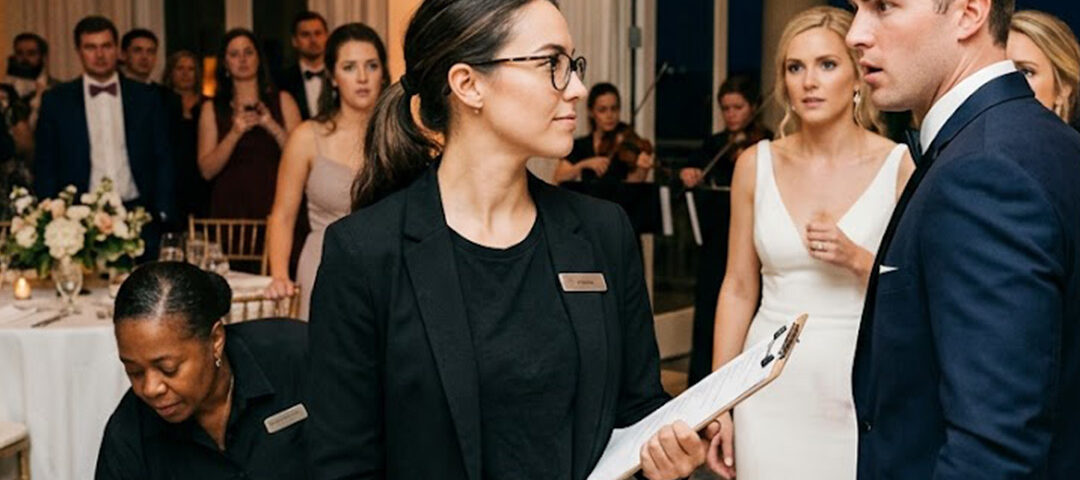
The crystal hit the marble floor at 8:17 on Saturday night, and the entire ballroom seemed to inhale at once.
One moment, Wana Lewis was moving carefully between tables with a silver tray balanced against her shoulder. The next, the bride’s wide skirt swept into her path, six champagne glasses slid toward the edge, and a bright cascade of crystal scattered beneath the hanging orchids.
Wana stopped immediately.
“I’m so sorry,” she said, lowering the tray before another glass could fall. “Are you all right, ma’am?”
Channing Thorne looked down at the broken glass, then at the small splash of champagne near the hem of her gown.
Her face changed.
“Are you serious?”
The string quartet faltered but kept playing. Conversations thinned around the ballroom. A server near the dessert station looked toward me, waiting.
I remained beside the service entrance in a plain black jacket, dark-framed glasses, and the discreet name tag I had worn all evening.
Gwen.
Nothing else.
To Channing, I was one more hotel employee standing too close to her expensive celebration.
She did not know the ballroom belonged to me.
She did not know the entire coastal resort belonged to me.
And until that moment, her groom had not recognized me either.
Wana crouched carefully, reaching for the dustpan Mateo had brought from the side station.
Channing stepped back as if the older woman had created the problem deliberately.
“Don’t touch my dress.”
“I won’t,” Wana said. “We’ll clear this immediately.”
“Clear it?” Channing’s voice rose just enough to carry beyond the nearest tables. “You nearly ruined my gown.”
“You turned into her path,” one of the bridesmaids murmured.
Channing ignored her.
Preston Vance left the bar and came across the room with the same measured stride I remembered from five years earlier. His tuxedo fit perfectly. His silver cuff links caught the amber light. He wore confidence the way some men wore cologne—too heavily, and with the belief that everyone else should be grateful for the exposure.
“What happened?” he asked.
“This woman walked straight into me.”
Wana looked toward him.
“I was following the marked service lane, sir. I stopped as quickly as I could.”
Preston did not look at the tape beneath the carpet edge that identified the lane. He did not look at the witnesses. He barely looked at Wana.
He turned toward Mateo.
“Get your manager.”
“I’m the banquet captain,” Mateo said calmly. “We’re already addressing the glass.”
“I didn’t ask whether you were addressing the glass. I asked for someone who can remove her from this event.”
The silence widened.
Wana’s hand froze above the dustpan.
Mateo straightened.
Across the ballroom, Delilah Ruiz stood beside the lighting console, one hand resting near her headset. Our legal counsel, Kendall Brooks, waited near the rear doors with a slim black folder under his arm.
Everyone knew the protocol.
No one moved until I did.
Preston looked down at Wana again.
“She’s done here.”
That sentence took me back five years.
Not because he had ever said those exact words to me.
Because the meaning was familiar.
Disposable.
Replaceable.
Finished the moment he decided you no longer served him.
I stepped out from the service entrance.
“No,” I said. “She isn’t.”
Preston turned.
His gaze moved over my black uniform, my clipboard, and the glasses I did not normally wear. Irritation appeared before recognition.
“I’m sorry?” he said.
“Wana followed the service route. Your wife entered it without looking. Our staff responded correctly.”
Channing stared at me.
“Who are you?”
“The person responsible for this property.”
Preston gave a short laugh.
“Then take responsibility and do what your client is asking.”
I removed my glasses.
His smile disappeared.
The music continued for two more measures before the first violinist noticed the room and lowered her bow.
Preston looked directly into my face.
“Gwen?”
I handed the clipboard to Delilah, who had crossed the ballroom to stand beside me.
“Good evening, Preston.”
Five years earlier, he had left me with a failing company, a locked office, and more debt than I could understand in a single sitting.
Now he stood in the ballroom of the hotel I had built after losing nearly everything.
Around us, two hundred wedding guests watched him realize that the employee he had dismissed with a wave of his hand was the owner whose contract he had signed without reading.
Kendall approached and opened the black folder.
I kept my voice low.
“Your event agreement is terminated effective immediately.”
Channing’s face went still.
“You can’t cancel my wedding.”
“The ceremony is complete,” I said. “The reception contract can be terminated for staff mistreatment, material misrepresentation, and unauthorized commercial billing. All three conditions have been documented.”
Preston looked from Kendall to me.
“You planned this.”
“No,” I said. “You signed it.”
Long before the crystal struck the floor, long before Preston arrived at the Whispering Palms in a tuxedo, a reservation request appeared on a Tuesday morning while I was drinking coffee in my office above the lobby.
Managing a luxury hotel is less glamorous than people imagine.
The polished stone, white orchids, and ocean views conceal a daily procession of emergencies involving people who believe money has liberated them from inconvenience.
A guest once demanded that we stop the tide because seaweed had appeared near her morning photographs.
Another insisted our chef recreate a soup he had eaten in Paris fifteen years earlier, despite remembering neither its name nor its ingredients.
A technology executive requested that we remove the birds from the east garden because their singing interrupted his conference call.
My staff handled these moments with patience, humor, and boundaries.
The hotel’s reputation depended on all three.
The Whispering Palms sat on a quiet stretch of coast south of Savannah, where wind-shaped oaks leaned toward the Atlantic and the marsh grass turned gold in late afternoon. The main building had once been a declining 1930s resort with cracked stucco, warped floors, and a ballroom closed because of water damage.
I bought it at auction with two investors, a restoration loan, and a level of confidence I did not actually possess.
Seven years later, the property had forty-eight rooms, six private cottages, a restored ballroom, a garden terrace, and a reservation list that often extended months ahead.
Guests saw the linen curtains moving in the ocean breeze.
I still noticed the beams we reinforced by hand because the original contractor missed the deadline.
They saw Italian marble beneath the lobby chandelier.
I remembered choosing between the marble deposit and payroll during our second year.
They saw an elegant hotel.
I saw every night I stayed awake wondering whether elegance could survive another invoice.
My glass-walled office overlooked the grand lobby. It allowed me to watch arrivals without hovering and to notice when a desk agent needed support.
That Tuesday morning, I was reviewing staffing projections when Delilah entered holding a corporate event file thick enough to be concerning.
She closed the door behind her.
“That expression usually means someone wants elephants,” I said.
“No elephants.”
“Indoor fireworks?”
“No.”
“A celebrity dog with dietary restrictions?”
“Not yet.”
She placed the folder on my desk.
“Full resort buyout. Holiday weekend. Three nights.”
I looked at the company name printed across the cover.
Vanguard Logistics Group.
“They want every guest room?”
“And the cottages. Ballroom, garden terrace, rehearsal dinner, brunch, private beach setup, transportation coordination, executive security package, and late checkout for forty rooms.”
“That is not a wedding. That is a temporary occupation.”
“They’re calling it a corporate leadership retreat with a private celebration attached.”
I opened the financial sheet.
The total made me sit back.
“They accepted the premium minimum?”
“They negotiated the corporate package.”
“Who approved the discount?”
“Sales received documentation showing that Vanguard would be the contracting party and primary payer.”
I turned another page.
Something about Delilah’s posture made me slow down.
“What aren’t you saying?”
“They want to bring in an outside cake.”
“That is disappointing, not frightening.”
“They insisted on it. The rider lists the bride’s pastry company and several delivery contacts.”
I scanned the names.
Channing Thorne.
Nothing stirred.
Then I reached the final event page.
Groom: Preston Vance.
My hand stopped.
For a second, the office disappeared beneath an older room.
A catering kitchen after midnight.
Invoices spread over stainless steel.
A locked company account.
Preston’s empty desk.
The scent of burnt sugar from a batch of caramel no one had remembered to remove from the stove.
Delilah had worked with me long enough to recognize silence as information.
“You know him.”
“I was engaged to him.”
Her expression shifted.
“That Preston?”
I nodded.
She knew the general story. Most of my senior staff did. Not the intimate details, but enough to understand that my first company had ended badly and that its collapse had nearly taken me with it.
“Do you want me to reject the booking?”
I looked at the corporate rider again.
Vanguard Logistics.
Preston had once believed every important room would open for him if he arrived with the right suit and enough borrowed authority.
Now he was requesting the most expensive weekend package at a hotel owned by a woman he had left in a studio apartment with a failing credit score and three collection notices taped inside a kitchen cabinet.
“Does he know I own the resort?” I asked.
“I doubt it. Public materials list Harrison Hospitality Group. Your name appears only in some trade publications and state filings.”
After the catering company collapsed, I had reclaimed my maiden name.
Gwen Harrison.
Preston had known me as Gwen Vance-to-be, the future wife who signed joint business forms and trusted him with operating accounts.
He had never known the woman who came afterward.
Delilah sat across from me.
“We can decline without explanation. The application is not final.”
I looked through the paperwork carefully.
The contracting entity was Vanguard. The celebration was listed as an executive hospitality event. Yet most of the requested rooms were assigned to personal guests with no connection to the company.
The corporate rate reduced certain fees. More importantly, it allowed the organization to avoid weekend restrictions applied to private buyouts.
“They’re misrepresenting the event structure,” I said.
“That was my concern.”
“Did sales request clarification?”
“Twice. Vanguard’s office confirmed the wedding was an approved company function honoring a senior executive.”
“Who signed the confirmation?”
Delilah turned to the treasury page.
Lena Morse.
The name landed almost as sharply as Preston’s.
Lena had been the marketing assistant who left our catering company three weeks before he did.
For years, I had avoided calling her the other woman because reducing the collapse of my life to romance had never explained the financial records.
She had helped copy the client database.
She had redirected vendor emails.
She had signed the lease on the office Preston opened after abandoning ours.
Whatever happened privately between them mattered less than what they had done professionally.
Now Lena was Vanguard’s assistant treasurer.
And she had signed the deposit authorization for Preston’s wedding.
Delilah watched me absorb it.
“This is not a clean booking.”
“No.”
“Then we reject it.”
I leaned back and looked through the glass wall toward the lobby.
Wana was arranging fresh gardenias near the reception desk. Mateo stood beside a newly hired server, demonstrating how to carry a tray without stiffening the wrist. At the entrance, two bell attendants greeted an elderly couple by name.
The Whispering Palms was not a stage built for my revenge.
It was a workplace.
A business.
A promise to people who had trusted me with their careers.
Any choice I made had to protect that.
“We do not accept it as written,” I said.
Delilah waited.
“Send an amended agreement. Full private-event pricing. No corporate discount unless Vanguard provides a board-approved statement identifying the business purpose. Include our staff conduct policy, outside-vendor liability clause, and identity-disclosure requirement.”
“And if they sign?”
“Then we host the event professionally.”
Her eyebrows rose.
“You would really let him hold his wedding here?”
“If the contract is accurate and they follow the rules.”
“And if they don’t?”
“Then we enforce the agreement.”
Delilah studied me.
“You are calmer than I would be.”
“I have spent five years paying for the education.”
She gathered the file.
At the door, she paused.
“Do you want your name removed from their planning materials?”
“Yes. Assign me as executive operations lead under G. Harrison. Do not tell the couple I own the property.”
“You want to observe.”
“I want to make sure my history does not influence the staff’s decisions. If there is a problem, I need facts.”
Delilah nodded.
“And if he recognizes you?”
“He will survive the surprise.”
After she left, I closed the blinds.
Then I allowed myself ten minutes to remember.
Preston and I met when we were twenty-six.
I was managing private events for a hotel in Charleston. He handled vendor partnerships for a regional restaurant group. We spent six months seeing each other at tastings, charity dinners, and venue tours before he asked me to have coffee.
He had the ability to make ambition sound romantic.
He talked about building something together instead of working forever inside other people’s plans. I had recipes, operational experience, and a reputation among wedding planners. He had sales instincts, financial confidence, and a talent for entering rooms as if he had already been invited.
We founded Vance & Harrison Catering with a rented kitchen and four secondhand vans.
For the first three years, we grew quickly.
We catered garden weddings, corporate retreats, museum openings, and holiday galas. I developed menus, trained staff, and controlled production. Preston managed sales, contracts, and expansion.
He told clients we were perfect partners because I saw every detail and he saw the future.
I believed him.
By the fourth year, we employed thirty-two people.
We also carried more debt than I realized.
Preston pushed for expansion into three additional cities. He signed leases before the first location became consistently profitable. He offered aggressive discounts to secure large contracts and used deposits from future events to cover current expenses.
Whenever I asked for full financial access, he showed me carefully prepared summaries.
“We’re growing,” he said. “Growth looks messy before it looks impressive.”
I was in the kitchen at four in the morning before most events. He was in meetings I did not attend. I mistook divided responsibilities for trust.
The unraveling began with a florist.
She called asking why an invoice remained unpaid after Preston told me it had been cleared.
Then a landlord sent a notice to our office.
Then two long-term clients contacted me because a new catering company had approached them using menu language and package descriptions almost identical to ours.
The company belonged to Preston.
Its marketing director was Lena.
When I confronted him, he did not deny it.
We stood inside our office on a Sunday evening. The walls still held photographs of events we had built together. My engagement ring felt suddenly heavy.
“The business was already failing,” he said.
“You created another company while this one carried the debt.”
“I created an exit.”
“For yourself.”
“For the viable clients.”
“You copied our records.”
“They were company records.”
“Our company.”
“You don’t understand the financial side, Gwen.”
The sentence hurt more than the betrayal because it revealed how he had explained me to himself.
Useful in the kitchen.
Emotional in business.
Too limited to understand the decisions made above my head.
“You moved deposits,” I said.
“I moved revenue where it had a chance to survive.”
“You left the obligations here.”
“They were attached to this entity.”
“This entity belongs to both of us.”
“That was the agreement.”
He spoke as though the paperwork had betrayed me rather than the man standing in front of it.
I removed the ring and placed it on his desk.
“Did you ever plan to tell me?”
“When the transition was complete.”
“Transition.”
“Don’t make this more personal than it needs to be.”
We had lived together for three years.
Our wedding invitations were being printed.
He had introduced Lena to me as a bright young employee who needed mentorship.
Yet he wanted the ending to remain professional.
I left with two boxes, my recipe notebooks, and a coffee maker purchased before the company existed.
Three days later, I learned the business accounts were nearly empty.
The debts were not.
Because I had personally guaranteed several leases and supplier contracts, I spent two years negotiating repayment. I sold my car, moved into a studio apartment with a persistent leak near the bathroom window, and accepted every consulting shift I could find.
Some friends disappeared because financial collapse made them uncomfortable.
Others believed Preston’s version—that I had resisted necessary restructuring and become difficult after our relationship ended.
My mother sent grocery cards.
My brother helped me move.
But the person who rebuilt my life was me.
That fact mattered.
I worked mornings in a hotel purchasing department and evenings coordinating private dinners. I learned financial accounting from a retired controller who met me at a diner every Thursday before sunrise.
I studied property operations.
I studied debt structure.
I studied contracts until no one could ever again explain my own business to me using simplified language.
During that period, I met Kendall Brooks.
He was an attorney representing one of our former vendors. He expected resistance and found a woman carrying color-coded repayment proposals.
“You’re more organized than the company that hired me,” he said.
“They can afford disorganization.”
“You cannot.”
“No.”
He helped me negotiate a settlement that did not erase the debt but made survival possible.
Years later, when I developed the plan for Whispering Palms, he reviewed every document.
“You understand this could fail,” he told me.
“Yes.”
“You could lose the rest of your savings.”
“Yes.”
“You still want to proceed.”
“I know the difference between a risk I choose and one hidden from me.”
He smiled.
“That is the correct answer.”
The hotel did not rise from ashes.
That phrase makes rebuilding sound clean.
It rose from permits, delays, leaking roofs, payroll spreadsheets, investor meetings, and the daily decision not to be embarrassed by starting again.
I never built it to prove Preston wrong.
At first, I built it because I needed work.
Then I built it because people began depending on me.
Wana joined during the restoration stage. She had been cleaning rental cottages along the coast and needed stable hours after becoming responsible for her grandson during the week.
Mateo started as a banquet server and became captain within eighteen months.
Delilah left a large convention hotel because she wanted to plan events without treating employees as invisible machinery.
We created standards together.
Guests could be demanding.
They could not be degrading.
Money could purchase privacy, customization, and beautiful service.
It could not purchase another person’s dignity.
The wedding contract returned four days after I first saw Preston’s name.
They signed every amendment.
No corporate discount.
Full disclosure of the private celebration.
Outside-vendor deposit.
Staff conduct policy.
Immediate termination clause for targeted harassment, unsafe conduct, deliberate property misuse, or material financial misrepresentation.
The deposit was one hundred fifty thousand dollars.
Nonrefundable after the final planning deadline and applicable to staffing, vendor commitments, lost booking opportunity, damages, and contract enforcement costs.
Kendall reviewed the signatures.
“They did not read this carefully,” he said.
“They initialed each section.”
“That is not the same thing.”
“It is legally the important thing.”
He turned to the Vanguard authorization.
“Lena signed the company payment approval.”
“Can the company legally pay for an executive’s wedding?”
“Possibly, if properly authorized and reported as compensation or a business event. But their supporting letter claims this is client hospitality.”
“There are no clients on the guest list.”
“I noticed.”
“Can we cancel now?”
“Yes.”
“Should we?”
Kendall leaned back.
“As your attorney, I prefer problems that leave before checking in.”
“As my friend?”
“I suspect you want the records to become clearer.”
“I do not want to accuse them based on suspicion. If Vanguard’s finance office confirms the payment, we host the event.”
“And if they do not?”
“We enforce the contract before the event begins.”
He tapped the file.
“Do not confuse restraint with surrender, Gwen.”
“I learned that years ago.”
Two weeks later, Preston and Channing arrived for their venue walkthrough.
I wore the standard black floor-staff uniform, tied my newly darkened hair into a low knot, and put on reading glasses with clear lenses. The disguise was not elaborate.
It did not need to be.
People like Preston rarely looked carefully at anyone they considered support staff.
He entered the ballroom while speaking into his phone.
“No, move the call. I’m at the venue and apparently no one else can make basic decisions.”
He ended the conversation without saying goodbye.
Channing followed with Delilah and two bridesmaids. She was tall, striking, and dressed in cream trousers that looked tailored for someone who did not sit in public.
The ballroom’s restored arched windows framed the ocean beyond the lawn. Original plasterwork curved above the stage. Italian velvet draperies softened the acoustics near the west wall.
Channing looked around.
“It seemed larger online.”
Delilah smiled professionally.
“The ballroom seats two hundred twenty with a dance floor. Your current count is one hundred ninety-six.”
“I don’t want it to feel crowded.”
“We can reduce the table count if the guest list changes.”
“The guest list isn’t changing.”
“Then the current layout provides the recommended spacing.”
Channing pointed toward the draperies.
“Those need to go.”
I stood beside Delilah with the clipboard.
“The draperies are part of the room’s acoustic design,” I said. “Removing them would affect the sound quality during dinner.”
Channing turned.
“And you are?”
“Gwen, operations.”
“I wasn’t asking about sound quality. I said I don’t like them.”
Delilah stepped in.
“We can change the lighting so the fabric appears lighter in photographs.”
“I don’t want tricks.”
Preston glanced toward me.
For one suspended second, his eyes met mine.
Nothing.
No recognition.
He looked away.
“Just give her what she wants,” he said.
“The musicians’ contract requires an acoustically balanced room,” I explained. “We can substitute a lighter sound curtain, but complete removal would create an echo.”
Channing stared at me.
“Why is the setup person debating me?”
“I’m giving you the available options.”
“I don’t need options. I need compliance.”
Preston checked his phone again.
“Gwen, was it?”
“Yes.”
“Make a note. Remove the curtains.”
“I’ll document the request and the acoustic waiver.”
He looked mildly surprised that I had not apologized.
We continued.
At the sample table, Channing disliked the number of utensils.
“It looks cluttered.”
Mateo explained the sequence for the five-course dinner.
She picked up a salad fork, held it between two fingers, and released it onto the carpet.
“Now it looks cleaner.”
Mateo bent to retrieve it.
“The service requires separate utensils for the fish and salad courses.”
“Then wash them between courses.”
“That would delay service for nearly two hundred guests.”
Channing looked toward Preston.
“Why does everyone here have an opinion?”
He gave her an indulgent smile.
“Because expensive places believe inconvenience is sophistication.”
I wrote the exact words on my clipboard.
Channing noticed.
“What are you writing?”
“Requested modifications.”
“Let me see.”
I turned the page toward her.
She scanned it.
“You wrote that I dropped the fork.”
“You did.”
“I was demonstrating the arrangement.”
“I’ll change the wording to demonstration if you prefer.”
She handed the clipboard back.
“Do that.”
I did not.
After they left, Mateo stood beside the ballroom doors.
“Are we really hosting them?”
“If they comply with the agreement.”
“They won’t.”
“Then we document what happens.”
He looked at me carefully.
“You know the groom.”
“Yes.”
“The old company?”
“Yes.”
Mateo had heard enough over the years to understand.
“Do you need someone else leading operations?”
“No. But I need you to tell me if I stop seeing the event clearly.”
He nodded.
“That goes both ways.”
“Agreed.”
In Kendall’s office that afternoon, the financial picture became less ambiguous.
Vanguard’s public filings listed Preston as a regional development director, not an owner. The company had no disclosed event at Whispering Palms. The payment came from a discretionary hospitality account supervised by Lena.
Kendall had contacted Vanguard’s finance department using the verification authority included in our contract.
“They asked us not to discuss the matter with Preston until they complete an internal review,” he said.
“Do they consider the payment authorized?”
“They confirmed the account is real. They did not confirm that a private wedding is an approved expense.”
“Can we accept additional payments?”
“Not from the company account without written authorization.”
We required the remaining balance from personal funds.
Preston protested through Delilah, then paid it from a private account two days before the deadline.
The deposit remained tied to Vanguard.
Kendall closed the file.
“If the company later disputes the charge, our contract and verification records protect the hotel.”
“And Preston?”
“That depends on his employer, not us.”
I looked through the office window toward the service corridor.
Wana pushed a linen cart past the door.
“How is her grandson?” Kendall asked.
“Better. The new treatment plan is helping.”
Wana’s grandson had a chronic condition that required frequent appointments. The hotel’s employee support fund covered transportation and several expenses not included in her insurance.
I had not created the fund alone. Staff members contributed voluntarily, and the hotel matched every dollar.
Preston used to call employee assistance inefficient generosity.
At our catering company, he cut meal allowances before reducing executive travel. He delayed vendor payments while upgrading his car.
He believed every line on a spreadsheet represented money waiting to be reclaimed by someone with enough authority.
I believed a company was the behavior it permitted when no client was watching.
The wedding weekend arrived beneath thick coastal humidity.
Guests began checking in Friday afternoon. Champagne waited in the cottages. White orchids filled the lobby. The welcome dinner took place on the garden terrace under strings of soft lights.
Preston saw me twice and showed no sign of recognition.
Channing noticed me constantly.
The temperature of her bridal suite was one degree too warm.
The welcome cards were placed on the wrong side of the fruit baskets.
A golf cart arrived three minutes late because one of the groomsmen had taken it without permission.
Each complaint came through her planner, through Delilah, or directly at whichever employee happened to be nearest.
We corrected genuine problems.
We documented the rest.
At breakfast on Saturday, Channing told a young server that his smile looked insincere.
At noon, Preston demanded access to a locked wine storage room because he wanted to show his friends the reserve inventory.
At three, one of the groomsmen attempted to move an antique table onto the lawn for photographs. Mateo stopped him before damage occurred.
Each incident alone was manageable.
Together, they revealed a pattern.
I met with the department heads in the service conference room at four thirty.
“The event continues,” I said. “No one argues with guests. No one accepts personal degradation. If a request violates safety or policy, call a supervisor.”
Wana adjusted the cuff of her uniform.
“Mrs. Thorne asked whether I was new because I folded a towel differently from the picture she sent.”
“What did you say?”
“That I would refold it.”
“Did she make any personal comment?”
“No.”
“Document the request. Nothing more.”
Mateo watched me.
“You are still giving them room.”
“I am giving them the event they purchased.”
“And when that room is gone?”
“We act.”
The ballroom looked extraordinary that evening.
White orchids descended from suspended frames without obstructing the chandeliers. Amber light warmed the walls. The original floor reflected candles from nearly two hundred place settings.
The outside cake arrived in a refrigerated truck shortly before dinner.
I recognized the pastry company.
Vance Atelier Events.
Preston had built the brand from the remains of our stolen client list. The company now operated as a boutique luxury planner, though he no longer managed it directly.
A sugar design on the cake resembled one I had created for a museum gala years earlier.
Not identical.
Close enough to awaken an old ache.
Delilah stood beside me near the service kitchen.
“Do you want it removed?”
“No. The vendor paperwork is valid.”
“It’s your design.”
“It was my design.”
“That distinction seems unfair.”
“Fairness is not improved by damaging someone’s wedding cake.”
She smiled faintly.
“That may be the least satisfying mature answer I’ve ever heard.”
“I agree.”
Dinner began at seven.
The first two courses passed smoothly.
Preston moved through the room with a glass in hand, accepting congratulations as if he had personally arranged the ocean.
Channing focused more on photographers than guests. She repeatedly turned toward the cameras before reacting to speeches.
During the main course, Vanguard’s chief financial officer called Kendall.
The company had completed its preliminary review.
The deposit authorization had not been approved by the required executive committee.
The wedding had been inaccurately categorized as a client-development program.
Vanguard requested copies of the contract and payment records.
Kendall met me near the west corridor.
“We now have written confirmation,” he said.
“Do they want the event stopped?”
“They have frozen additional corporate payments. The remaining balance was personal, so that does not affect tonight.”
“Then the wedding continues unless another contract condition is breached.”
“You do not need another breach.”
“We have financial misrepresentation.”
“Yes.”
“But no immediate operational risk. I will address the contract privately after dinner.”
Kendall studied me.
“You are determined not to make this personal.”
“It became personal five years ago. Tonight is business.”
At 8:17, the crystal fell.
The accident itself was minor.
No one was injured.
The floor team responded exactly as trained.
What changed the evening was not the glass.
It was the way Channing and Preston behaved when they believed Wana lacked power.
Channing demanded her removal.
Preston reinforced it.
Then he threatened to damage the hotel’s professional reputation if the staff did not obey him immediately.
Our agreement identified precisely that conduct.
I stepped forward.
When Preston recognized me, the confidence left his face so quickly that for a moment I saw the man from our old office—the one who had expected my confusion to protect him.
“Gwen,” he said again.
Channing looked between us.
“You know her?”
Preston did not answer.
Kendall opened the contract folder.
I turned toward Wana.
“Are you all right?”
“Yes.”
“Please let Mateo handle the floor. Take ten minutes in the service lounge.”
Channing stared at me.
“You are not dismissing her?”
“No.”
“I’m the bride.”
“You are a client whose contract requires respectful treatment of staff.”
“I said she ruined my dress.”
The champagne mark was smaller than my hand.
Delilah had already signaled for the wardrobe attendant.
“We can clean the hem,” I said. “The accident does not justify your conduct.”
Preston recovered enough to step closer.
“This is because of our history.”
“No. Our history is why I made sure every decision was documented by people other than me.”
“You hid who you were.”
“My ownership is public record. You booked through a management company and did not ask.”
Channing turned toward him.
“What history?”
He kept his eyes on me.
“She was my former business partner.”
“Fiancée,” I said. “And business partner.”
A low current of whispers moved through the nearest tables.
I had no desire to perform the story for guests.
I looked at Kendall.
He removed the termination notice.
“Under sections twelve, fourteen, and nineteen of the event agreement,” he said, “the venue is ending service based on documented staff misconduct and material misrepresentation of the contracting party’s business purpose.”
Preston’s jaw tightened.
“We paid for this ballroom.”
“You paid for an event subject to terms,” I said.
“The evening is nearly over.”
“Then leaving should be simple.”
Channing looked toward the cake, the flowers, and the tables filled with guests.
“You expect everyone to walk out?”
“We will provide thirty minutes for an orderly departure. Guest rooms remain available tonight for individuals who comply with hotel policy. Ballroom service ends now.”
“You cannot embarrass us like this.”
“I am not discussing your financial records publicly. I am enforcing the conduct policy after you publicly demanded an employee lose her job over an accident you helped create.”
Preston lowered his voice.
“Talk to me privately.”
“We can speak in the office after the ballroom is cleared.”
“I am not leaving my own reception.”
“It is no longer an active reception.”
His face hardened.
“You always needed the last word.”
I looked at him.
“No, Preston. I needed access to the accounts.”
That silenced him.
Channing turned sharply.
“What does that mean?”
He looked away.
Our event supervisors entered through the side doors. They did not form a dramatic line. They simply began the procedure we used whenever a private event ended early.
The bar closed.
Music stopped.
Servers removed service items.
Transportation staff brought vehicles to the covered drive.
Delilah approached the bandleader and photographer.
Kendall handed Preston the termination notice and a copy of the signed agreement.
No one raised a voice.
That calm made the shift more complete.
Guests began collecting purses and jackets. Some avoided looking at the couple. Others looked too openly.
A man I recognized from Vanguard’s executive team approached Kendall and asked to speak with him in the lobby.
Lena Morse stood near the cake table, pale and motionless.
She had attended as a guest.
For the first time in five years, she and I looked directly at each other.
“You knew,” she said.
“I recognized your signature.”
She glanced toward Preston.
“He said the company approved it.”
“That is between you and Vanguard.”
“I didn’t know you owned this place.”
“No.”
Her eyes moved around the ballroom.
“You built all this?”
“Yes.”
There was no satisfaction in saying it to her.
Only truth.
She looked down.
“I’m sorry.”
“For which part?”
The question was not cruel. I genuinely did not know.
She seemed unable to answer.
I nodded once and walked away.
In my office, Preston refused the chair across from my desk.
He stood near the window overlooking the now-quiet lobby. Channing remained downstairs with her mother and planner. Kendall sat beside the conference table, recording the official meeting notes.
Preston looked at the ocean beyond the glass.
“You waited five years for this.”
“No.”
“You accepted the booking because you wanted to watch me fail.”
“I accepted a corrected contract at full price. I would have hosted the entire event if you had followed it.”
“You put yourself on the floor.”
“I manage major buyouts.”
“You disguised yourself.”
“I wore staff clothing.”
“You changed your hair.”
“I changed it three years ago.”
He turned.
The anger in his face had always been cold. That had once made it difficult to recognize.
“You enjoyed that moment.”
“When you recognized me?”
“When you stopped the reception.”
“No.”
He laughed without humor.
“Still pretending to be morally superior.”
“I am not morally superior. I am contractually responsible for everyone working in this building.”
“One broken glass.”
“This was never about the glass.”
He knew it.
Kendall placed a payment summary on the table.
“The deposit will be applied according to the agreement,” he said. “Committed vendor costs, staffing, cleanup, damages, lost booking revenue, and legal expenses will be calculated. Any amount not properly retained will be returned to the lawful payer.”
Preston looked at him.
“The deposit is nonrefundable.”
“It is nonrefundable within the limits of the contract and applicable law,” Kendall said. “The hotel will document every allocation.”
That was the difference between the company Preston had run and the one I ran now.
Records.
Limits.
No money moving simply because someone with authority wanted it moved.
Preston picked up the payment summary.
“Vanguard will handle this.”
“Vanguard has already requested a financial review,” Kendall said.
Preston’s face changed again.
“You contacted them?”
“The contract authorized payment verification.”
“You had no right.”
“You represented the event as approved corporate hospitality,” I said. “We verified that representation.”
He set the paper down.
“Lena handled the authorization.”
“She signed it. You submitted it.”
“She told me the account could be used.”
“That is a conversation for your employer.”
For the first time, uncertainty replaced anger.
He sat.
Five years earlier, I had been the one staring at documents while he explained that the consequences belonged to the entity, the contract, the numbers.
Now the paperwork was in front of him.
Accurate.
Signed.
Available.
He looked smaller than I remembered, though nothing physical had changed.
“Channing doesn’t know about you,” he said.
“That seems unlikely now.”
“She didn’t know how the old company ended.”
“That was your choice.”
“She believes I sold my interest.”
“You moved the viable assets and left the liabilities.”
Kendall remained silent.
Preston looked toward him, then back at me.
“You want me to admit I was wrong.”
“No.”
“What do you want?”
“Nothing from you.”
The answer unsettled him more than accusation would have.
He leaned back.
“You built this because of what happened.”
“I began learning because of what happened. I built this because I became good at it.”
“You always were good at events.”
“I was good at operations. You made sure I did not understand the rest.”
“I handled finance because you hated it.”
“I trusted you because we were partners.”
“We were under pressure.”
“You opened another company.”
“The original company was failing.”
“You made sure it failed on my side of the door.”
He looked down.
The old anger rose in me, but it no longer controlled the room.
I did not need to convince him.
The records had outlived his explanation.
Kendall closed the folder.
“The meeting is complete. Mr. Vance, your guest room remains available until ten tomorrow morning. Communication regarding the contract will go through counsel.”
Preston stood.
At the door, he looked back.
“Was any part of tonight real?”
“The flowers were real. The food was real. The people who served you were real.”
“That is not what I meant.”
“I know.”
He left.
By midnight, the ballroom was empty.
The cake remained mostly untouched. At Channing’s request, her planner arranged for it to be transported to another location. We packed the flowers for guests and local care facilities. The band received full payment. Hourly employees were paid through the scheduled end of the event, plus additional time for the early breakdown.
Wana sat in the employee dining room with tea in front of her.
I joined her.
“You did not need to stop an entire reception because of me,” she said.
“I stopped it because of them.”
“I’ve had guests speak sharply before.”
“So have I.”
“They were angry.”
“Anger does not cancel responsibility.”
Wana looked at her hands.
“I thought for a second you might let them send me home.”
The admission hurt.
Not because she doubted me.
Because experience had taught her that clients often won those moments.
“I’m sorry you had to wonder.”
She looked up.
“You came quickly.”
“I was nearby.”
“You were waiting.”
“I was observing.”
A small smile appeared.
“That sounds nicer.”
“It is more accurate.”
Mateo entered carrying two plates of leftover wedding dinner.
“The kitchen insists we eat before they pack everything.”
He set one plate in front of Wana and one in front of me.
She looked at the elaborate arrangement.
“This is too pretty to trust.”
“It’s sea bass,” Mateo said. “Not a moral decision.”
Wana laughed.
The sound loosened something in the room.
Three weeks later, Vanguard completed its internal review.
Preston had used company resources to support several personal events beyond the wedding. Lena had approved payments without the required authorization. Both were removed from financial decision-making while the company restructured their roles.
Preston resigned before the final review meeting.
Lena remained long enough to cooperate with repayment arrangements, then left the company quietly.
There was no dramatic public collapse.
No headline.
No grand statement.
Professional consequences rarely arrive with music.
They arrive through suspended access, canceled meetings, revised titles, and emails that no longer include your name.
Channing sent the hotel a letter claiming emotional distress and reputational damage. Kendall responded with the signed agreement, incident reports, witness statements, financial verification request, and time-stamped security footage from the ballroom.
Her attorney did not pursue the matter.
The deposit accounting took a month.
A significant portion covered the exclusive weekend reservation, contracted vendors, payroll, cleanup, and the revenue lost because no replacement event could be booked. A smaller amount covered legal and administrative costs. The documented remainder was returned to Vanguard after the company requested it.
I did not simply take one hundred fifty thousand dollars and divide it among the staff.
That would have made me too much like Preston.
Instead, the hotel paid every employee the full scheduled event gratuity from our operating account, even though the reception ended early. We also approved a holiday bonus pool based on the hotel’s strongest quarter since opening.
The money came from earned revenue.
The decision came from gratitude.
At the staff meeting, I did not mention Preston by name.
I thanked the team for remaining professional under pressure.
I reminded them that our conduct policy protected everyone, from department heads to new dishwashers.
Then Wana raised her hand.
“Can we add something?”
“Of course.”
“If a guest tells one of us we don’t matter, we should know who to call before it becomes a ballroom problem.”
Mateo nodded.
We created a direct reporting system allowing any employee to alert a supervisor discreetly from a service phone. We expanded training for de-escalation and documented guest boundaries more clearly.
The wedding became useful in ways revenge never could have been.
It made the hotel safer.
Months passed.
The story faded from staff conversation. New guests arrived. New problems replaced old ones. A spring storm damaged the garden terrace. A celebrity chef complained about our knives, then tried to recruit two line cooks. A guest proposed beneath the palms and dropped the ring into a planter.
Life continued.
One afternoon, Delilah entered my office with another event file.
I looked at its thickness.
“Elephants?”
“Worse.”
“Influencers?”
“Three families combining a reunion, graduation, and vow renewal.”
I opened the folder.
“Do they want an outside cake?”
“Two cakes.”
“We survived one.”
She sat across from me.
“Do you ever think about that night?”
“Sometimes.”
“Did it feel how you expected?”
“I did not expect it.”
“You accepted his booking.”
“I expected a difficult event. I did not expect Wana to be the moment.”
Delilah looked toward the lobby.
“You could have canceled when Vanguard failed to confirm the payment.”
“Yes.”
“Why didn’t you?”
I considered the question.
Part of me had wanted Preston to see the hotel.
I could admit that now.
I wanted him to walk through rooms built by the woman he believed he had finished.
I wanted him to experience competence he could not claim, redirect, or explain away.
But wanting recognition was not the same as planning destruction.
“If I had canceled early,” I said, “he would have told himself I was still reacting to him. Hosting the event under clear rules made the outcome his responsibility.”
“That sounds very reasonable.”
“It took years to say it reasonably.”
She smiled.
After she left, I opened the office blinds.
Late sunlight covered the lobby floor. Wana stood near the reception desk showing a new housekeeper how to arrange flowers so guests saw the ocean beyond them. Mateo crossed toward the terrace carrying a seating chart. At the front doors, a family arrived with two tired children and more luggage than four people could possibly need.
The hotel moved around me.
Not an empire.
I disliked that word.
Empires required subjects.
I had built a company made of people.
That difference was the point.
I kept one object from the wedding.
Not the termination notice.
Not a copy of Preston’s payment records.
Not even the incident report.
I kept the clear-lens glasses I wore during the walkthrough and reception.
They sat inside the top drawer of my desk.
For months, I thought they represented the moment he failed to recognize me.
Eventually, I understood they represented something else.
He had looked directly at me and seen only the role he assigned.
A setup employee.
A person without authority.
Someone expected to obey.
Five years earlier, he had done the same thing when I was his partner. He saw the part of me that developed menus, trained staff, and solved crises. He did not see the woman capable of understanding financing, contracts, property, or power.
The blindness was never mine.
I no longer needed him to see me clearly.
The hotel existed whether he understood it or not.
One evening near the end of summer, I found Wana on the terrace after her shift. The ocean was pale beneath a wide pink sky. She had changed out of her uniform and was waiting for her grandson to finish a tutoring session in town.
“Sit,” she said, pointing toward the chair beside her.
“This is technically guest furniture.”
“Then manage me.”
I sat.
For several minutes, we watched the marsh grass move.
“My grandson asked why I still work when the hotel is doing well,” she said.
“What did you tell him?”
“That the hotel doing well is the reason I still work.”
“I hope you also told him you like us.”
“I left that implied.”
She smiled.
Then her expression softened.
“Were you afraid when you stepped into the ballroom?”
“Yes.”
“You didn’t look afraid.”
“I have discovered that posture is cheaper than confidence and often works until confidence arrives.”
She laughed.
“What were you afraid of?”
“That I was making the decision for the wrong reason.”
“And were you?”
“No.”
“How do you know?”
“Because if another guest had treated you the same way under the same contract, I would have ended the event.”
She nodded.
“That’s the answer.”
The wind lifted a corner of the napkin on the table between us.
I caught it before it blew away.
Wana looked toward the ocean.
“People think consequences are revenge when they are used to being excused.”
I turned toward her.
“Where were you when I needed legal language?”
“Cleaning up after people with legal language.”
That evening, after she left, I remained on the terrace until the lights along the path came on.
I thought about the woman I had been in the studio apartment.
She counted coins at a laundromat because the building’s dryer required exact change. She kept vendor notices in a kitchen drawer so visitors would not see them. She avoided restaurants where she might encounter former clients.
She believed shame was the price of having trusted the wrong person.
I wanted to reach backward and tell her the truth.
Trust had not made her foolish.
His choices had made him unworthy of it.
Losing a company did not mean she lacked business ability.
It meant she had been denied accurate information inside a partnership that depended on it.
Starting again did not erase what happened.
It proved what happened had not defined the limits of her life.
I could not speak to that earlier version of myself.
So I did the next best thing.
I built the kind of workplace she had once needed.
Transparent accounts.
Shared decisions.
Written policies applied equally.
A support fund no employee had to beg to access.
A rule that no client, regardless of wealth, could purchase the humiliation of someone earning a paycheck.
Preston believed power meant controlling the room.
He was wrong.
Power was making the room safe for people who had less authority than you.
A year after the wedding, an envelope arrived without a return address.
Inside was a handwritten note from Lena.
Gwen,
I have rewritten this more times than I can count. I know an apology cannot repair what I helped do. I told myself Preston was saving the viable part of the company. I knew you had not agreed. I knew the records belonged to both of you. I chose the version that benefited me.
I am repaying Vanguard under the agreement from the review. I have also sent copies of old client-transfer records to the administrator handling the final closure of Vance & Harrison. Kendall will receive them.
You built something better than what we took.
I am sorry.
Lena
I read the note twice.
Then I called Kendall.
He had received the records.
They confirmed details we had suspected years earlier but no longer needed for any active claim. The old business was closed. Settlements were final. Legal deadlines had passed.
“Do you want me to respond?” he asked.
“No.”
“Do you want to keep the documents?”
“Yes.”
“For what purpose?”
“I don’t know.”
He understood.
Evidence sometimes mattered even when no remedy remained.
It told the truth to the person who had once been told she misunderstood.
I placed Lena’s letter inside the same drawer as the glasses.
Not as a trophy.
As an ending.
Preston never contacted me again.
I heard through the hospitality world that he moved to Dallas and joined a smaller development firm. Channing continued running her lifestyle company. Their marriage lasted at least through the following year, though I stopped noticing after that.
I did not need their lives to fall apart.
That would have kept me tied to the outcome.
The consequence I cared about had already happened.
Inside my ballroom, in front of people he wanted to impress, Preston had treated an employee as disposable and expected the room to support him.
Instead, the room followed the standards I had built.
His money did not overrule the contract.
His confidence did not change the record.
His opinion did not decide who mattered.
That was enough.
On the fifth anniversary of the Whispering Palms, we held a staff dinner on the garden terrace.
No clients.
No press.
No elaborate speeches.
The kitchen prepared a family-style meal. Delilah created a slideshow of construction photographs, including one of me standing in the unfinished lobby wearing a hard hat and boots covered in plaster dust.
Mateo found a photograph of Wana sitting on an overturned bucket during our first week of room setup.
She objected until her grandson asked for a copy.
Near dessert, Kendall raised his glass.
“To Gwen,” he said.
I shook my head.
“To the people who arrived before the roof stopped leaking.”
Everyone laughed.
Kendall continued.
“To the owner who learned enough contract law to become exhausting.”
“That is more accurate.”
“And to a hotel that knows service is not submission.”
The laughter quieted.
Glasses lifted around the table.
I looked at the faces of people who had carried linens, answered phones, repaired pipes, balanced budgets, calmed guests, plated dinners, and stayed through uncertain years.
Success did not look like Preston’s face changing in the ballroom.
It looked like this.
People eating at the same table.
Employees who knew the numbers.
Managers who could question me.
A business strong enough to survive a difficult client without sacrificing the people serving him.
After dinner, I returned to my office.
The lobby below was quiet. Moonlight touched the ocean beyond the windows. The glass walls reflected my desk, the shelves, and the woman standing alone in the center of the room.
For years, I imagined closure as a door slamming.
It was not.
Closure was a door that could remain open without pulling me back through it.
I opened the top drawer and took out the clear-lens glasses.
Then I carried them downstairs.
At the employee entrance, we kept a small display case containing objects from the hotel’s restoration: an original brass room key, a piece of blue tile from the old pool, the first handwritten reservation card, and a photograph of the ballroom before repairs.
I placed the glasses inside.
The next morning, Delilah found them.
“What do these represent?” she asked.
I wrote a small card.
Look carefully. Authority does not always wear the outfit you expect.
She read it.
“That is extremely restrained.”
“I’m growing.”
“Should we add something about reading contracts?”
“Kendall would enjoy that too much.”
She placed the card in the case.
Guests passed the display without knowing the full story.
Staff members understood enough.
I went upstairs, opened the blinds, and watched the hotel begin another day.
A couple argued softly about checkout time. A child pressed both hands against the lobby glass to see the palms. Wana adjusted the flowers. Mateo reviewed the lunch setup. Delilah answered a call while pointing a new coordinator toward the ballroom.
Nothing in the building required Preston’s regret.
Nothing in me required it either.
He had once taken the clients, the company, and the future I thought we shared.
He could not take what I learned while rebuilding.
He could not take the standards I wrote.
He could not take the trust my staff placed in me.
And he could not take the hotel standing above the coast, filled with people whose dignity was not available for purchase.
I had not built the Whispering Palms from the ruins of his choices.
I had built it from mine.
That was the difference.
That was the answer.
And at last, it was enough.
If you came here from Facebook because of this story, return to the Facebook post, tap Like, and comment exactly “Amazing” to support the storyteller. That small action means more than it seems and gives the writer genuine encouragement to keep sharing more stories about family pressure, firm boundaries, and finally protecting what you worked so hard to build.
Disclaimer: This story is a work of fiction created for entertainment purposes. Any resemblance to real persons, events, or places is coincidental.