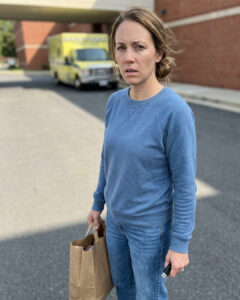
The lobby of St. Alden Medical Center smelled like antiseptic and lemon polish, sharp enough to make my eyes water.
I clutched the crinkled paper bag in one hand, the charcoal-gray tie slung over my wrist. Wesley had forgotten both at home that morning, rushing out at 5 a.m. for an emergency triple bypass, his usual kiss to my forehead quick, distracted, already halfway to the OR in his head.
Eleven years of marriage, and I was used to it.
I walked up to the main reception desk, my sneakers soft on the polished marble. The receptionist, a girl in her mid-twenties with dark hair pulled so tight it pulled at her temples, looked up with a tired, polite smile. Her name tag read DANA CROSSWELL.
“Hi,” I said, returning the smile. “I’m Elara Carver. I’m here to drop off lunch and a tie for my husband, Dr. Wesley Carver. He’s chief of surgery.”
Dana’s smile froze.
Her fingers, hovering over her keyboard, stopped mid-air. She glanced at her screen, then back at me, her eyes darting to the paper bag, the tie, my face, like she was trying to solve a puzzle she didn’t want to finish.
“Is something wrong?” I said, laughing a little, nervous. “I know he’s busy, I can just leave it here—”
“I’m sorry, ma’am,” she said, her voice careful, too careful, like she was tiptoeing through broken glass. “But Dr. Carver’s wife checked in about ten minutes ago. She used his personal security badge. Said he asked her to collect documents from his office.”
The paper bag crinkled in my grip so hard I heard the sandwich inside squish.
The hum of the lobby, the beep of monitors, the soft murmur of voices—all of it faded, like someone had turned the volume down on the world.
“Could you repeat that?” I said. My voice sounded thin, far away.
Dana leaned forward, her voice dropping to a whisper, her eyes darting to the security camera above the desk.
“She signed in as Mrs. Carver,” she said. “Mid-thirties, blonde, red lipstick. Carried a leather tote. Said she was there to pick up his research files for a conference next week. The guard let her right up. She had his badge, so no one questioned it.”
I stared at her.
I am Mrs. Carver.
The words sat on my tongue, heavy, sharp, but I couldn’t make them come out. For eleven years, I’d been the wife in the background. The one who smiled at donor dinners, who remembered the names of every board member’s spouse, who stayed home with our eight-year-old daughter Mia when Wesley worked late, who didn’t ask questions when he came home at 2 a.m. smelling of hospital soap and expensive cologne and the whiskey he swore he only drank with trustees.
I’d traded my own nursing degree, my own career, to build his. To make his name mean something at this hospital. To be the perfect wife for the perfect doctor everyone adored.
And now some blonde woman was walking the halls of his hospital, wearing his badge, calling herself his wife.
“What name did she give?” I said, my voice steady now, cold, the way I used to sound when I worked triage in the ER, before Mia was born.
Dana hesitated. She bit her lip, glancing at the camera again.
“I’m not supposed to share visitor details,” she said. “Dr. Carver is… very well respected here. If I tell you the wrong thing, I could lose my job.”
Before I could answer, a hand touched my elbow.
I jumped, turning fast.
A man in a faded gray hoodie stood behind me, his head down, a baseball cap pulled low over his face. He looked like he’d been sleeping in his clothes, his beard unshaven, his eyes red-rimmed. I didn’t recognize him.
“Come with me,” he said, his voice so low only I could hear. “Now. Before his security detail sees you talking to Dana.”
I stared at him. “Who are you?”
“Someone who lost his job because of your husband,” he said. “Someone who has proof of every lie he’s ever told. If you want to know who that blonde really is, and what Wesley’s been doing with your name, your money, and this hospital’s funds… come with me. Now.”
He glanced at the elevator, his jaw tight.
“She’ll be coming down any minute. You don’t want her to see you here. Not yet.”
I looked back at Dana. She gave a tiny, almost imperceptible nod, like she was telling me to trust him.
I followed him.
We walked out of the main lobby, through a side door into the empty ambulance bay, the hot summer air hitting my face hard. He stopped behind a parked ambulance, far enough from the security cameras that no one could see us.
He reached into his hoodie pocket and pulled out a small, black USB drive, matte, no label. He pressed it into my palm, closing my fingers around it.
“Everything is on here,” he said. “Photos, bank records, surgery logs, emails. Four years’ worth. His name is Marcus Hale. I ran the IT department here for six years. I caught him skimming money from the hospital’s research fund. Fired me the next day, told everyone I’d embezzled. Ruined my career.”
He paused, his voice breaking a little.
“Two patients died last year because he cut corners on their post-op care to cover up the missing money. No one would listen to me. But they’ll listen to you. You’re his wife.”
“Who is the woman?” I said, my hand tight around the drive.
“Her name is Lila Voss,” he said. “She’s his physician’s assistant. They’ve been together four years. They have a three-year-old son. His name is Leo. Wesley bought them a house in the suburbs, pays for everything with the money he’s been stealing. Told everyone at the hospital she’s his widowed sister-in-law. Told her you two have been separated for three years, that you’re dying of late-stage breast cancer, that you’ve agreed to a quiet divorce so he can marry her before you’re gone.”
The world tilted.
I leaned against the ambulance, my legs suddenly too weak to hold me up. The paper bag with Wesley’s lunch slipped from my hand, falling to the asphalt, the roast beef sandwich and tie spilling out onto the oil-stained ground.
Marcus grabbed my arm, steadying me.
“Don’t open this at home,” he said, tapping the USB in my hand. “He has keyloggers on your laptop, your phone, everything. Go to someone you trust. Someone he doesn’t have access to. And whatever you do… don’t let him know you have this. Not yet. He’s dangerous, Elara. He’s spent eleven years building a perfect life on top of a mountain of lies. He won’t let anyone knock it down. Not even you.”
He let go of my arm, pulling his hood up.
“I’ll be in touch,” he said. “Don’t try to find me. I’ll find you.”
He walked away, disappearing around the corner of the building before I could say another word.
I stood there alone in the ambulance bay, the black drive burning a hole in my palm, the lunch I’d made my husband lying in the dirt at my feet.
The elevator doors in the main lobby dinged.
I peeked around the ambulance.
A blonde woman in a navy pencil skirt, red lipstick, carrying a leather tote, walked out of the elevator, Wesley’s ID badge clipped to her blazer. She laughed at something the security guard said, her hand resting lightly on her stomach, like she was used to people looking at her like she belonged.
Like she was Mrs. Carver.
She walked out the front doors, climbing into a black SUV I’d never seen before, and drove away.
I closed my fingers tight around the USB.
Eleven years.
Eleven years of smiles, of sacrifices, of loving a man who’d built an entire second life right under my nose. Who’d lied to everyone, stolen from everyone, and was planning to let me die of a cancer I didn’t even have so he could marry his mistress and keep all the money.
I wiped the tears from my face with the back of my hand, angry at myself for crying at all.
I didn’t go back inside.
I turned and walked to my car, the drive safe in my pocket, my mind already racing.
I drove straight to my sister Jules’ apartment, my hands shaking so bad I missed two turns.
Jules was a criminal defense attorney, sharp as a razor, the only person in the world who’d never liked Wesley. She’d told me on our wedding day, pulling me aside before I walked down the aisle, “There’s something cold behind his eyes, Elara. Don’t ever let him make you small.”
I’d laughed it off then.
I wasn’t laughing now.
She opened her door before I even knocked, her face falling when she saw me.
“Jesus,” she said, pulling me inside. “What happened? You look like you’ve seen a ghost.”
I told her everything. The receptionist. The blonde woman. Marcus. The USB.
By the time I finished, she was pacing her living room, her jaw tight, her hands clenched at her sides.
“Son of a bitch,” she said, for what felt like the hundredth time. “I always knew he was a narcissistic prick, but this? This is next level.”
She locked her front door, closed all the blinds, and pulled her old work laptop out of her closet—the one she kept off her home Wi-Fi, the one she used only for sensitive client work.
“Let’s see what’s on that drive,” she said.
I handed it over. My fingers were still cold.
She plugged it in. The screen lit up, folders upon folders, labeled with dates going back four years.
She opened the first one: PHOTOS.
My breath caught.
Hundreds of them. Wesley and Lila, kissing on a beach in Hawaii. Wesley holding a tiny newborn baby with his eyes, his chin, his exact crooked smile. Lila, pregnant, standing in front of a white picket fence, Wesley’s hand on her belly. The three of them at a Disney park, Mia’s favorite place, the place Wesley had told me for three years he was “too busy” to take us.
One photo was dated last Christmas.
Wesley was in front of a Christmas tree, Leo on his shoulders, Lila leaning against his chest, all three of them in matching red pajamas. The same day he’d told me he had to stay late at the hospital for emergency surgeries, that he’d be home by 10. He’d come home at 1 a.m., smelling like pine and sugar cookies, and I’d made him hot chocolate and tucked him into bed, thinking he was exhausted from saving lives.
I’d been making him hot chocolate while he opened presents with his other family.
Jules swore under her breath, clicking to the next folder: FINANCES.
It was worse.
Bank statements from a secret account in the Cayman Islands, $2.4 million deposited over four years, all traced back to St. Alden’s pediatric cancer research fund. Forged loan documents, my signature copied perfectly on three separate personal loans totaling $750,000, all taken out in my name, the money wired to Wesley’s secret account. A mortgage on the suburban house he’d bought for Lila, $850,000, also in my name.
And then the last document in the folder.
A $5 million life insurance policy on me.
Taken out six months earlier. Wesley was the sole beneficiary. The cause of death listed on the attached rider: accidental prescription overdose. The policy was set to pay out in full if I died before my 40th birthday.
I was 38.
My birthday was in three weeks.
“Oh my god,” Jules whispered. “He’s not just cheating on you, Elara. He’s planning to kill you.”
The room spun.
I thought of the little blue pill Wesley had started giving me every night before bed, three weeks earlier, “for my headaches.” He’d said it was a new migraine medication prescribed by a colleague. I’d stopped taking it after a week, because it made me so tired I could barely get Mia to school in the morning. I’d told him I lost the prescription. He’d been so angry, he’d slammed his fist on the kitchen counter so hard a glass shattered.
I’d thought he was just stressed about work.
He’d been angry I’d ruined his timeline.
Jules clicked the next folder: SURGERY LOGS.
Redacted patient files, two of them marked DECEASED. Internal hospital emails, Marcus’s name on dozens of them, flagging that Wesley had skipped mandatory post-op checks on both patients, that he’d falsified their vitals in their charts to cover up that he’d left the hospital early to be with Lila the nights they’d coded.
The emails ended with Wesley sending a memo to HR: Marcus Hale terminated for cause, embezzlement of hospital property.
The last folder was labeled PERSONAL.
Emails between Wesley and Lila, going back four years.
I read one, dated the day Mia was admitted to the ER with a severe asthma attack, the night Wesley had told me he was stuck in an emergency surgery and couldn’t make it.
From Wesley to Lila:
Baby, I’m so sorry I have to leave the party early. Elara’s kid is in the ER again, she’s blowing up my phone. I’ll be back as soon as I calm her down. She’s so dramatic about everything. I can’t wait until we don’t have to hide anymore. Soon, my love. Soon.
Elara’s kid.
He didn’t even call her his daughter.
Mia, who thought her dad was the greatest man alive, who drew him pictures of superheroes and left them on his pillow, who cried every time he missed her soccer games because “he’s busy saving people.”
She was just Elara’s kid to him. A burden. An inconvenience.
I stood up, fast, and ran to Jules’ bathroom, throwing up everything I’d eaten that day. My throat burned, my eyes stung, but I didn’t cry. The tears were gone, replaced by something cold, hard, unbreakable in my chest.
Rage.
Jules followed me, holding my hair back, rubbing my back.
“We’re gonna take him down,” she said, her voice fierce. “Every last lie. Every stolen dollar. He’s gonna lose his job, his license, his money, that little house in the suburbs, and he’s never gonna see Mia again. I promise you. And if he so much as looks at you wrong, I’ll make sure he rots in prison for the rest of his life.”
I wiped my mouth, standing up, looking at myself in the mirror. My eyes were red, my face pale, but there was no fear left in them.
“First,” I said, my voice steady, “we get Mia out of the house. I’m not letting her stay under the same roof as him for one more night.”
Jules nodded. “I’ll pick her up from school. Tell her we’re having a girls’ week at Aunt Jules’ house, pizza and movies every night. She’ll love it.”
“Good,” I said. “Then we go home. I act like nothing is wrong. I let him think I still believe every lie. And we collect every last bit of evidence we need to make sure he never hurts anyone ever again.”
I walked back into the living room, looking at the laptop screen, at the photo of Wesley and his other family in their matching Christmas pajamas
I got home at 6 p.m., right on time, like I did every night.
I’d stopped at the grocery store on the way, bought the ingredients for Wesley’s favorite lemon garlic salmon, the one I made every Friday. I put on the soft blue sweater he liked, the one that brought out my eyes, and fixed my hair the way he preferred, pulled back in a low bun, no loose strands.
If he suspected I knew anything, the plan died. Mia would be in danger. I would be in danger.
So I would act.
I’d spent eleven years acting the perfect wife. I could do it for a few more weeks.
The front door opened at 7, right on schedule.
Wesley walked in, his white coat slung over his arm, his hair perfectly combed, that warm, charming smile on his face—the one that made donors write five-figure checks, that made juries believe whatever he said, that had made me fall in love with him the second I met him in nursing school.
“Hi, baby,” he said, leaning down to kiss my cheek, just like he did every night. “Smells amazing. I’m starving. Long day at the hospital, three back-to-back surgeries. I’m exhausted.”
He hung his coat up, walking into the kitchen, pouring himself a glass of scotch—the expensive kind he kept in the back of the pantry, the one he claimed he only drank on special occasions.
I turned from the stove, smiling, my heart hammering so hard I was sure he could hear it.
“Where’s Mia?” he said, frowning a little when he didn’t see her backpack by the door.
“Jules took her for the weekend,” I said, flipping the salmon. “Remember? She got those concert tickets Mia has been begging for. They’re gonna stay at her place, get manicures tomorrow. Girls’ weekend.”
It was a lie, but a safe one. Jules really did have the tickets—she’d bought them a month earlier, for Mia’s birthday. Wesley had forgotten, of course. He forgot everything that didn’t revolve around him.
His face relaxed. He smiled, taking a sip of scotch, leaning against the counter.
“Nice,” he said. “We can have a quiet night alone. It’s been forever.”
He walked over, wrapping his arms around my waist from behind, resting his chin on my shoulder. His body was warm, familiar, the smell of his cologne wrapping around me, and for a split second, I almost forgot. Almost believed this was real. That the man holding me was the man I’d married, not a stranger who’d stolen my life, my money, and was planning to kill me for insurance money.
I stiffened for half a second, then forced myself to relax, leaning back against him like I always did.
“Did you have a good day at the hospital?” I said, casual, like I asked every night. “I stopped by at lunch to drop off your sandwich and your tie, but you were in surgery, so I left it with Dana at the front desk.”
His arms around me went rigid.
Just for a second. So fast I would have missed it if I hadn’t been waiting for it.
Then he relaxed again, laughing a little, like it was a silly mistake.
“Dana?” he said. “Oh, right, the new receptionist. She’s still learning. My PA, Lila, stopped by my office right after you left. She must have picked it up for me. She’s been a godsend lately, picking up my slack when I’m swamped.”
Lila.
He said her name so easily, like she was just a coworker, nothing more. Like he didn’t have a three-year-old son with her. Like he hadn’t told her I was dying of cancer.
“Lila Voss, right?” I said, turning in his arms, smiling, handing him a plate of salmon. “I think I met her once at the hospital gala last year. Blonde, pretty. Seems nice.”
He took the plate, his eyes never leaving mine, looking for any sign of doubt. Any crack in my act.
“She’s great,” he said. “Hard worker. Single mom, kid’s about Mia’s age. I try to help her out when I can. She doesn’t have anyone else, you know how it is.”
I nodded, sitting down across from him at the table, cutting my salmon into tiny bites I didn’t eat.
“That’s kind of you,” I said. “Always the hero, huh?”
He laughed, that warm, charming laugh, and dug into his food, talking about his surgeries, the board meeting next week, the new wing of the hospital they were naming after him. He talked for twenty minutes straight, never asking me how my day was, never asking about Mia, never noticing I hadn’t taken a single bite of food.
Just like always.
After dinner, he poured himself another scotch, sitting down at his desk in the home office, closing the door like he did every night. I knew he was logging into his secret email, talking to Lila, checking his hidden bank accounts. He thought the keyloggers he’d installed on all our devices meant I could never see anything.
He didn’t know about the USB.
I waited until I heard him snoring in our bedroom at 11, then slipped out of bed, grabbing my phone and the small hidden camera Jules had given me, the size of a pinhead. I taped it to the frame of the family photo on his desk, the one of me, him, and Mia at the beach three years earlier, the photo he kept front and center to sell the perfect family lie.
It would record everything he did in that office, every email, every call, every word he said to Lila when he thought no one was listening.
I climbed back into bed next to him, lying stiffly on my side, as far away from him as I could get without falling off the mattress. He rolled over, throwing an arm over my waist, his breath hot on my neck, and I had to bite my tongue so hard I tasted blood to keep from flinching.
I lay awake all night, staring at the ceiling, my hand resting on the USB tucked into the back of my phone case.
The next morning, he left at 5 a.m. again, kissing my forehead, telling me he had an early surgery.
I waited until his car pulled out of the driveway, then called Marcus.
He answered on the second ring.
“You’re alive,” he said, relieved. “Good. I was worried he’d suspect something when you showed up at the hospital.”
“He didn’t,” I said. “He lied about Lila. Said she’s just a PA who picked up the lunch. Marcus, I need more. The USB is damning, but Jules says we need proof he was planning to act on the insurance policy. Proof he bought the drugs, proof he wrote the fake prescription. Otherwise, his lawyers will say it’s all just a fantasy, that he never meant to go through with it.”
Marcus was quiet for a second.
“I can get it,” he said. “But it’s risky. I still have a friend in the hospital pharmacy. She saw him fill a prescription for fentanyl and Xanax two weeks ago, under a fake patient name. The doses are exactly what you’d use to stage an accidental overdose. She kept the prescription slip. She’s scared of him, but she’ll talk if we can guarantee her immunity.”
“Jules can make that happen,” I said. “When can we meet her?”
“Tonight,” he said. “Midnight. The old boathouse at the lake on the edge of town. No phones, no cars with GPS. Come alone. Tell no one. Not even Jules. Wesley has people everywhere. We can’t trust anyone but us.”
He hung up.
I stood in the quiet kitchen, the sun coming up through the window, lighting up the photo of Mia on the fridge, her grinning, missing her two front teeth.
Midnight. The boathouse.
It was dangerous. It could be a trap. Wesley could have paid Marcus to lead me there, to make me disappear before my birthday.
But I had no choice.
If I didn’t get that prescription slip, Wesley would walk away with everything. My money, my daughter, my life. He’d marry Lila, raise Leo, spend my insurance money, and everyone would still think he was the perfect, grieving widower.
Not if I had anything to say about it.
That night, I told Wesley I was going to a late book club with some friends from the neighborhood. He didn’t even look up from his laptop, just waved a hand, told me to have fun.
I drove to the lake, my headlights off the last mile, parking half a mile down the road and walking the rest of the way through the dark woods, my heart pounding, a small can of pepper spray in my jacket pocket.
The boathouse was dark, falling apart, the windows boarded up. I pushed the door open, my hand shaking on the pepper spray.
A single lightbulb hung from the ceiling, swinging in the wind.
Marcus was there.
And so was the blonde woman from the hospital.
Lila Voss.
She was holding a piece of paper in her hand, her face streaked with tears, her red lipstick smudged. When she saw me, she flinched, like she expected me to hit her.
“Elara,” Marcus said, holding his hands up, calm. “It’s okay. She’s not here to fight. She’s here to help.”
Lila looked at me, her eyes red, her voice breaking.
“I didn’t know,” she said. “I swear to god, I didn’t know you were alive. I didn’t know he was still living with you. He told me you had six months left, that you were in hospice. I had no idea. I would never have touched him if I knew.”
She held out the paper in her hand.
It was the prescription slip. Fentanyl and Xanax. Doses enough to kill three people. Wesley’s handwriting, clear as day.
“He gave this to me three days ago,” she said, sobbing now. “Told me it was pain meds for Leo’s ear infection. I looked it up. It’s not. It’s enough to kill you. He was gonna bring it to your house next week, say it was your new migraine meds. He was gonna watch you take it, wait until you were dead, then call 911 and say you’d been taking too many pills for your headaches. I’m so sorry. I’m so, so sorry.”
I stared at her.
At the woman who’d been my husband’s mistress for four years. Who’d had his baby. Who’d worn my name, my husband’s badge, lived in a house bought with my money.
And I realized, looking at her, that she wasn’t the enemy.
She was just another victim.
Another woman Wesley had lied to, manipulated, used, to build his perfect little empire.
The three of us sat on the rotting wooden floor of the boathouse for the next two hours, every secret we’d each been carrying spilling out into the dark.
Lila told us everything.
She’d started working at St. Alden five years earlier, a 26-year-old single mom, fresh out of PA school, desperate for a job to support her sick newborn daughter—who’d died of SIDS at six months old, a year before she met Wesley. She’d been broken, grieving, easy prey for a man like Wesley, who’d shown up with flowers, kind words, promises of a better life.
He’d told her he was unhappily married, that I was cold, distant, that we’d slept in separate bedrooms for years. Six months into their affair, he’d told her I’d been diagnosed with terminal breast cancer, that I’d refused treatment, that I had at most two years left. He’d said we’d agreed to keep it quiet to protect Mia, that he couldn’t leave me while I was dying, but that as soon as I was gone, he’d marry her, adopt Leo, give her and the baby the life they deserved.
She’d believed every word.
For four years, she’d believed him.
She’d quit her second job, moved into the house he’d bought her, let her whole world revolve around him and his lies. She’d worn his badge to the hospital because he’d told her it was easier, that no one would question her if they thought she was his wife, that it was the only way he could get her access to his research files without the board asking questions.
She’d had no idea about the embezzlement. No idea about the life insurance policy. No idea the drugs he’d given her for Leo were meant to kill me.
“I found the insurance papers in his briefcase last week,” she said, wiping her tears with the back of her hand. “The $5 million policy. I thought it was for you, that he was just making sure Mia was taken care of after you were gone. Then I saw the overdose rider. And then the prescription. I put it all together. I tried to leave him, take Leo and run. He told me if I left, he’d tell child protective services I was a drug addict, that I’d been stealing meds from the hospital, that I’d never see Leo again. He said he’d ruin me. He said no one would ever believe me over him. He’s Wesley Carver. Everyone loves him.”
She looked at me, her eyes raw.
“I’m not asking you to forgive me,” she said. “I know I hurt you. I know I was part of it, even if I didn’t know. But I will do whatever it takes to make this right. I’ll testify. I’ll give you every text, every email, every photo. Whatever you need. He doesn’t get to kill you. He doesn’t get to keep doing this to people.”
Marcus nodded.
“I’ve got the pharmacy tech, Sarah, ready to testify too,” he said. “She’s the one who filled the prescription. She kept a copy. She’s scared, but Lila talked to her yesterday. She’ll cooperate if we can keep her safe.”
Jules was going to lose her mind when I told her we had two more witnesses, both with direct evidence tying Wesley to attempted murder.
But there was still one problem.
“St. Alden’s board will never go against him,” I said. “He’s their golden boy. He brings in half the hospital’s donations. If we go to them first, they’ll cover it up. They’ll fire Lila, fire Sarah, discredit Marcus, say we’re all just disgruntled employees trying to ruin a good man’s name. We need to go over their heads. To the state medical board. To the DA. To the news. Hit him from every side at once, so he can’t talk his way out of it.”
Marcus pulled a folded piece of paper from his pocket, sliding it across the floor to me.
“Then we hit them where it hurts,” he said. “The two patients who died. Mrs. Hale, 72, and Mr. Torres, 56. Both had routine surgeries. Both coded and died 12 hours later, when Wesley was supposed to be on call. Both families were paid off by the hospital’s legal team, told it was just a tragic, unavoidable complication. But I have the OR logs. Wesley left the hospital four hours before they coded. He was at Lila’s house, celebrating Leo’s second birthday. He falsified their charts to say he’d checked on them an hour before they died. The time stamps on the hospital security cameras prove he was gone.”
He paused.
“The families have no idea. They think their loved ones died because of bad luck. If we tell them the truth? They’ll file wrongful death suits so big the hospital board will throw Wesley under the bus so fast his head will spin. They won’t protect him if it costs them millions.”
I looked at the names on the paper. Mrs. Eleanor Hale. Mr. Javier Torres.
I’d met Mrs. Hale once, in the hospital cafeteria a year earlier. She’d been knitting a scarf for her granddaughter, waiting for her surgery date. She’d given me a piece of peppermint candy, told me Wesley was the best doctor she’d ever met, that he’d held her hand and told her everything would be okay.
He’d left her to die alone so he could go to a birthday party.
I folded the paper, putting it in my pocket next to the prescription slip.
“Tomorrow,” I said. “First thing, Jules contacts the DA, the medical board, and the families. We give them everything. The USB, the camera footage from his office, the prescription, Lila’s testimony, Sarah’s testimony, the OR logs. We don’t hold anything back. We drop it all at once, so Wesley has no time to spin it.”
Lila nodded, her jaw set.
“I’ll call Sarah tonight,” she said. “We’ll both give sworn statements to the DA tomorrow. Whatever you need.”
We left the boathouse an hour later, going our separate ways, agreeing to meet at Jules’ office the next morning at 9 a.m., all of us together, to give the DA everything.
I drove home, the sky starting to lighten on the horizon, a weight lifting off my chest I hadn’t even known I was carrying. For the first time since Dana had spoken those words in the hospital lobby, I didn’t feel alone. I had Jules, Marcus, Lila, Sarah. All of us, hurt by the same man, all of us ready to make him pay.
Wesley was already gone when I got home, a note on the kitchen counter: Early surgery. Be home late. Don’t wait up.
I crumpled the note up, throwing it in the trash.
I called Jules, telling her everything that had happened at the boathouse. She was quiet for a long time when I finished, then let out a long, low whistle.
“Holy shit,” she said. “This is it. This is the nail in his coffin. Attempted murder, embezzlement, manslaughter, fraud, forgery. He’s gonna spend the rest of his life in prison. I’ll call the DA’s office first thing. I know the lead prosecutor there, she hates corrupt doctors more than anything. She’ll move fast. We’ll have a warrant for his arrest by the end of the week.”
She paused.
“Are you okay?” she said, softer. “I know this is a lot. Finding out the man you married is a monster, then teaming up with his mistress to take him down… it’s a lot.”
“I’m better than okay,” I said, looking at Mia’s photo on the fridge. “I’m finally fighting back. For me. For Mia. For Mrs. Hale and Mr. Torres. For everyone he’s ever hurt.”
I hung up, pouring myself a cup of coffee, sitting down at the kitchen table.
I should have been scared. Wesley was powerful, connected, dangerous. He’d ruined Marcus’s career, threatened Lila, lied to everyone for over a decade. He wouldn’t go down without a fight.
But I wasn’t scared anymore.
I was angry. Angry enough to burn the whole perfect world he’d built to the ground, and build something better on top of the ashes.
My phone buzzed on the table.
A text from an unknown number.
I opened it.
It was a photo.
Me, standing outside the boathouse an hour earlier, talking to Marcus and Lila.
The text below it:
I know what you’re doing, Elara. If you go to the DA tomorrow, Mia dies. Don’t test me.
My blood turned to ice.
He knew.
Somehow, Wesley had known. He’d followed me. He’d seen us.
And now he was threatening my daughter.
I stood up, fast, knocking my coffee cup over, the hot liquid spilling all over the table, running down onto the floor.
I grabbed my keys, running out to my car, peeling out of the driveway, heading straight for Jules’ apartment. Mia was there. She was safe. She had to be safe.
I called Jules, my hands shaking so bad I almost dropped the phone.
“He knows,” I screamed when she answered. “Wesley knows. He followed me to the boathouse. He sent me a photo. He threatened Mia. Get her out of there. Now. Take her somewhere he can’t find her. Please.”
Jules didn’t ask questions.
“On it,” she said, calm, sharp, the lawyer she was. “I’m taking her to my friend’s cabin upstate, the one with no cell service, no address in my name. You meet us there. Now. Don’t go home. Don’t call anyone. Just drive. We’ll be fine. I’ve got her, Elara. I swear to god, I’ve got her.”
She hung up.
I pressed my foot harder on the gas, the car flying down the highway, tears blurring my vision.
The game had changed.
Wesley had just made the biggest mistake of his life.
I drove for three hours straight, my hands white on the wheel, not stopping until I pulled up to the small log cabin deep in the woods, smoke curling from the chimney.
Jules was on the porch, a shotgun across her lap, when I got out of the car. Mia ran out the door a second later, her pigtails flying, throwing herself into my arms.
“Mommy!” she said, grinning. “Aunt Jules said we’re having a secret adventure! We made s’mores last night! She let me shoot the BB gun!”
I held her so tight I thought I might crush her, breathing in the smell of her shampoo, her chocolate-stained cheeks, warm and alive and safe in my arms.
“I’m here, baby,” I whispered into her hair. “I’m here. You’re safe. I’m never letting anything happen to you.”
Jules led us inside, locking the door behind her, sliding the deadbolt home. She’d turned the cabin into a fortress: motion sensor lights outside, extra locks on every window, the shotgun loaded by the door.
“The DA is on her way up,” she said, pouring me a cup of coffee. “I called her an hour ago. She’s bringing two plainclothes officers with her. We’re gonna give her everything today, right here, so Wesley can’t intercept us. She’s already got a warrant for his medical records, his bank accounts, his hospital emails. By the end of the day, his assets will be frozen, his badge will be revoked, and there’ll be a warrant out for his arrest for attempted murder.”
She looked at me, her face serious.
“The photo he sent you?” she said. “It’s admissible. It’s a direct threat against a minor. We can add child endangerment and witness tampering to the list of charges. He just dug his own grave deeper.”
The DA, a tall, no-nonsense woman named Rita Mendez, showed up an hour later, two detectives behind her, all of them carrying boxes of evidence folders. We sat around the kitchen table for the next four hours, laying everything out: the USB, the hidden camera footage from Wesley’s office, the prescription slip, Lila’s sworn statement, Sarah’s testimony, the OR logs for the two dead patients, the threatening text Wesley had sent me.
Rita read through every document, her face getting darker and darker with every page.
“This is one of the worst cases of public corruption and medical fraud I’ve ever seen,” she said, when we finished. “Dr. Carver has built an entire career on lies, and he’s hurt a lot of people to keep it going. We’re not gonna let him get away with it. I’m filing all charges today: two counts of manslaughter, one count of attempted first-degree murder, seven counts of fraud, three counts of forgery, embezzlement, witness tampering, and child endangerment. Bail will be denied. He’s gonna be in a cell by tonight.”
She stood up, clapping Jules on the shoulder.
“Thank you for bringing this to us,” she said. “And thank you for being brave enough to come forward, all of you. Too many men like him get away with this because people are too scared to talk. You’re doing the right thing.”
She and the detectives left an hour later, heading back to the city to file the warrants.
Mia was outside in the yard, picking wildflowers, completely unaware of how close we’d come to losing everything. I stood in the doorway, watching her, my heart finally starting to slow down.
“Hey,” Marcus said, walking up behind me. He’d driven up an hour after the DA, bringing Lila and Sarah with him, all of them ready to give their statements to the detectives. “She’s gonna be okay. We’re all gonna be okay. Wesley’s done. He just doesn’t know it yet.”
I nodded, not taking my eyes off Mia.
“Thank you,” I said. “For all of this. For not giving up when he fired you. For coming to me in that ambulance bay. None of this would have happened without you.”
He smiled, a little shy, rubbing the back of his neck.
“Jake was my best friend growing up,” he said, quiet. “Your brother. We joined the Army together right out of high school. He made me promise if anything ever happened to him, I’d look out for you and your mom. He died in Afghanistan 12 years ago, remember? I came back here, got the IT job at St. Alden, kept an eye on you from a distance. When I found out what Wesley was doing… I couldn’t let him hurt you. I owed Jake that.”
I stared at him.
Jake.
My big brother, who’d taught me to ride a bike, who’d beaten up the kid who bullied me in middle school, who’d walked me down the aisle at my wedding because our dad had died when I was 16. I’d thought about him every day since he died. I’d had no idea Marcus was his best friend. No idea he’d been watching over me all these years.
Tears burned my eyes.
“Jake would have loved you,” I said, smiling through them.
He laughed, a little wet. “Yeah, well, he would have also kicked my ass for waiting so long to say hi.”
We stood there together, watching Mia chase a butterfly through the wildflowers, the sun coming through the trees, golden and warm.
For the first time in a long time, the future didn’t look scary.
It looked like hope.
Back in the city, Wesley was finishing his last surgery of the day, unaware that his whole world was about to collapse.
He walked out of the OR at 5 p.m., pulling his mask down, ready to go to Lila’s house for dinner, like he did every Friday. He was already thinking about the weekend, about how he’d sneak into the house the next night while Mia was at Jules’, slip the fentanyl into Elara’s nightly tea, make it look like an accident. The insurance money would be in his account in three weeks. He’d marry Lila, adopt Leo, take over as hospital CEO in the fall. Everything was going exactly to plan.
He walked into the hospital lobby, his head held high, smiling at the nurses, the donors, the patients’ families, all of them looking at him like he was a god.
He didn’t see the two plainclothes detectives waiting for him by the front doors until they were right in front of him, their badges out.
“Dr. Wesley Carver?” one of them said.
Wesley smiled, his charming, perfect smile.
“Yes, that’s me,” he said. “Can I help you officers? Is there a problem?”
“Dr. Carver,” the other detective said, pulling a pair of handcuffs from his belt. “You’re under arrest for the attempted murder of Elara Carver, two counts of manslaughter, embezzlement, fraud, forgery, witness tampering, and child endangerment. You have the right to remain silent. Anything you say can and will be used against you in a court of law.”
The lobby went dead silent.
Everyone stopped and stared. The nurses, the doctors, the families, the security guards. All of them watching as the perfect, golden chief of surgery was handcuffed, his face white with shock, his perfect smile finally gone.
“You’re making a mistake,” he said, his voice shaking, as they led him out the front doors to the waiting police car. “I’m Wesley Carver! I run this hospital! Call the board! Call my lawyer! This is a setup! My wife is dying of cancer, she’s confused, she’s making all of this up—”
The detective pushed him into the back of the squad car, slamming the door shut behind him.
The siren wailed as they pulled away from the hospital, past the spot where I’d stood just a few days earlier, holding my husband’s forgotten lunch, my whole life falling apart around me.
Up in the chief of surgery’s office, the board was already meeting, voting unanimously to fire Wesley, to suspend his medical license, to freeze all his accounts, to issue a public apology to the families of the two patients who’d died.
The news broke at 6 p.m.
Every local news station, every newspaper, every social media feed led with the same headline: ST. ALDEN CHIEF OF SURGERY ARRESTED FOR ATTEMPTED MURDER, FRAUD, MANSLAUGHTER.
The helicopter footage showed Wesley being led out of the hospital in handcuffs, his head down, his perfect reputation in tatters. The reporters listed every charge, every detail of the embezzlement, the two dead patients, the life insurance policy, the mistress, the secret family.
The comments flooded in:
I can’t believe it! He seemed so nice!
My mom had surgery with him last year! Is she okay?
What a monster. Poor wife and daughter.
I hope he rots in prison.
I sat on the couch at the cabin, Mia asleep on my lap, watching it all unfold, feeling nothing. No joy. No triumph. Just a quiet, empty relief that it was finally over. That he couldn’t hurt us anymore.
His lawyer called Jules at 8 p.m., screaming that the whole thing was a witch hunt, that we’d fabricated all the evidence, that Wesley would be out on bail by morning.
Jules just laughed.
“Good luck with that,” she said. “The judge is a friend of mine. She hates men who hurt their families. Bail is denied. He’s in jail until trial. Enjoy.”
She hung up, pouring us all glasses of wine, Lila, Sarah, Marcus, Rita, all of us sitting around the cabin’s living room, the weight of the last week finally lifting off our shoulders.
Lila was quiet most of the night, holding a photo of Leo, her three-year-old son, who was staying with her parents across the state. She’d called them as soon as Wesley was arrested, told them everything, told them not to let anyone take him.
“What happens now?” she said, finally, swirling the wine in her glass. “To me? To Leo? I was his accomplice. Even if I didn’t know. People are gonna hate me. I’m gonna lose my job. My license. Everything.”
Rita leaned forward, her voice gentle but firm.
“You’re not an accomplice,” she said. “You’re a victim. You were manipulated, lied to, threatened. You came forward, you cooperated, you gave us the key evidence that put him away. The state is not pressing any charges against you. I’ve already talked to the medical board. If you complete 100 hours of community service and attend mandatory ethics training, you keep your license. You can work anywhere you want. St. Alden already said they’ll give you your job back, with a raise, if you want it. They’re desperate to make this right.”
Lila stared at her, tears streaming down her face.
“Really?” she whispered.
“Really,” Rita said. “You did good, Lila. You helped take down a very bad man. You saved Elara’s life. That counts for something.”
Sarah nodded, squeezing Lila’s hand. “I’ll go back with you. We can stick together. No more secrets.”
I looked at Lila, at the girl who’d been my husband’s mistress for four years, who’d lived in a house bought with my money, who’d called herself Mrs. Carver. I didn’t hate her. I couldn’t. She’d been just as trapped as I was. Just as fooled by the same perfect lies.
“Leo is welcome at my house anytime,” I said, quiet. “He’s Mia’s half-brother. They deserve to know each other. If you want that.”
Lila looked at me, shocked, then smiled through her tears, nodding.
“I’d like that,” she said. “A lot.”
The next few weeks were a blur of lawyers, statements, court dates, interviews. The families of Mrs. Hale and Mr. Torres filed their wrongful death suits, St. Alden settling for $20 million each, publicly apologizing, firing half the board for covering up Wesley’s crimes for years. The hospital’s new administration asked me to come back, to finish my nursing degree on their full scholarship, to come work in the pediatric ER when I graduated.
I said yes.
Wesley’s trial started six months later.
It was the biggest trial the city had seen in decades. Reporters packed the courtroom every day, cameras outside the doors, the whole city watching to see if the golden doctor would get what he deserved.
The prosecution called 32 witnesses: Marcus, Lila, Sarah, the two families, the pharmacists, the IT team, the detectives, Rita, Jules. Every one of them told the truth, laid out every lie, every crime, every hurt Wesley had caused.
The defense tried to paint me as a bitter, scorned wife, angry that my husband was leaving me for a younger woman, who’d fabricated all the evidence to ruin his career. They tried to say Marcus was a disgruntled ex-employee with a grudge, that Lila was a jilted mistress who’d made up the overdose story to get revenge, that the two patients had died of unavoidable complications.
It didn’t work.
The evidence was too overwhelming. The prescription slip in Wesley’s handwriting. The hidden camera footage of him talking to Lila about the “plan” to make my death look like an accident. The bank records, the forged signatures, the security footage proving he’d left the hospital the night the two patients died. The threatening text he’d sent me about Mia.
The jury deliberated for four hours.
They came back guilty on every single count.
All 14 charges.
The judge sentenced him to 42 years in maximum security prison, no possibility of parole.
“Dr. Carver,” she said, looking down at him from the bench, her voice cold. “You took an oath to do no harm. Instead, you stole from the sick, lied to everyone who trusted you, let two innocent people die, and tried to murder the mother of your child so you could collect insurance money to fund your double life. You are not a doctor. You are a monster. You will spend the rest of your natural life in a cell, where you can never hurt anyone ever again.”
Wesley didn’t say a word as the bailiffs led him away. He didn’t look at me. Didn’t look at Lila. He just stared straight ahead, his face blank, his perfect world finally gone.
As we walked out of the courtroom, the reporters swarmed us, shouting questions, holding microphones in our faces.
“Elara! How does it feel to win?”
“Lila! Do you have any regrets?”
“Marcus! Will you sue the hospital for wrongful termination?”
I didn’t answer any of them.
I just kept walking, holding Mia’s hand tight in one of mine, Marcus’s hand in the other, Jules on my other side, Lila and Sarah right behind us.
We walked out of the courthouse together, into the bright summer sun, all of us survivors, all of us free.
The year after the trial was the hardest, and the best, year of my life.
Healing wasn’t linear.
Some days were perfect. I’d go to my nursing classes, get straight A’s, pick Mia up from school, go home and make cookies, and feel like the old me was back, the girl I’d been before Wesley, before the lies, before the fear.
Some days were hard.
I’d wake up screaming from nightmares where Wesley was standing over my bed with a syringe, or where Mia was gone and I couldn’t find her. I’d flinch when a man at the grocery store had the same cologne as him. I’d have to leave class in the middle of a lecture if the professor talked about forging medical records, my hands shaking so bad I couldn’t hold my pen.
Mia had hard days too.
She’d started therapy a week after Wesley was arrested, a wonderful woman named Dr. Hale who specialized in kids whose parents were in prison. She’d been angry at first, confused, asking why her dad had lied, why he’d tried to hurt me, why he didn’t love her anymore. She’d ripped up all the drawings she’d made of him, thrown all the toys he’d given her in the trash.
But slowly, with time, with therapy, with all of us loving her through it, she started to heal.
She met Leo three months after the trial.
We met Lila and Leo at the zoo, neutral ground, lots of space, no pressure. Leo was three, with Wesley’s eyes and Lila’s curly blonde hair, shy at first, hiding behind his mom’s leg. Mia was nine now, tall for her age, confident, kind, the best big sister anyone could ask for. She walked right up to him, held out a stuffed lion she’d brought just for him, and said, “Hi, I’m Mia. I’m your big sister. Wanna go see the tigers?”
Leo’s face lit up. He grabbed her hand, and they ran off together, Lila and I walking behind them, laughing as they argued over which animal was cooler.
They were inseparable after that.
Every other weekend, Leo came to stay with us. Mia taught him how to ride a bike, how to draw dinosaurs, how to make the perfect s’more. He called her “Sissy” and followed her everywhere she went. Lila and I became friends, slowly, carefully, two women bound by the worst experience of our lives, building something good out of the wreckage.
Marcus and I started dating six months after the trial.
It was slow, careful, neither of us wanting to rush. He’d been there through everything, my rock, my protector, the man my brother had trusted with my life. He was kind, funny, honest, the kind of man who remembered Mia’s soccer schedule, who fixed the leaky faucet in my kitchen without being asked, who held me on the hard nights and never made me feel broken for being scared.
He never tried to replace Wesley. He never tried to be Mia’s dad. He just was. Aaron, the guy who made the best pancakes in the world, who killed all the spiders, who loved me and Mia exactly as we were.
Mia adored him.
She called him “Marcus” at first, then “Marky” when she was teasing him, then one night at dinner, out of nowhere, she looked up at him and said, “Can I call you Dad? Not instead of my other dad. Just… my bonus dad. The good one.”
Marcus cried.
I cried.
Even Jules, who was sitting at the table with us, pretended she had something in her eye.
“Only if you want to, kiddo,” Marcus said, his voice breaking. “I’d like that more than anything.”
I went back to St. Alden a year after the trial, the day I graduated from nursing school at the top of my class. The new chief of surgery, a wonderful woman named Dr. Bennett, met me at the front doors, holding my new ID badge.
“Welcome home, Elara,” she said, smiling. “The pediatric ER has been waiting for you.”
I walked through the lobby, the same lobby where Dana had told me another woman was using my husband’s badge, where my whole life had fallen apart. It felt different now. Lighter. Brighter.
Dana was still at the front desk, now the head of reception. She waved when she saw me, grinning.
“Told you that son of a bitch was going down,” she said, quiet, as I walked past.
I laughed, waving back.
I worked in the pediatric ER for the next year, and it was everything I’d ever dreamed of. I held scared kids while they got stitches, talked nervous parents through bad diagnoses, brought sick babies back from the brink, and every single day, I knew I was exactly where I was meant to be.
Marcus got his job back at St. Alden too, promoted to head of IT, given a huge settlement for the wrongful termination. He used half the money to set up a scholarship fund for kids whose parents were in prison, the other half to buy us a small, yellow house with a big backyard and a white picket fence, the kind of house I’d always dreamed of as a kid.
We moved in on Mia’s 10th birthday.
She ran through the house, screaming with joy, picking the biggest bedroom for herself, the one with the window seat overlooking the backyard, immediately claiming it as her own. Leo got the room next to hers, painted blue with dinosaurs on the walls, for the weekends he stayed with us. Marcus had a workshop in the garage, I had a small sunroom I turned into a reading nook, and the kitchen was big enough for all of us to cook together, even when Jules, Lila, Sarah, and half the ER staff showed up for Sunday dinner.
Life wasn’t perfect.
I still had bad days. Mia still had bad days. We still went to therapy, still talked about the hard things, still held each other when the memories got too loud.
But it was ours.
I was working a late shift in the ER on a cold Tuesday in November, three days before Thanksgiving, when the paramedics rolled in a John Doe, unresponsive, overdose, found in an alley behind a bar downtown.
I was the first nurse to the bay.
I pulled back the sheet to start an IV, and my blood ran cold.
It was Wesley.
He looked nothing like the man I’d married. His hair was gray, his face gaunt, covered in cuts and bruises, his once-perfect body thin, wasted. He’d been released from prison on compassionate release two months earlier, after being diagnosed with late-stage pancreatic cancer, given six months to live. I’d gotten the letter in the mail, ignored it, thrown it in the trash. I hadn’t thought about him since.
Until now.
“Elara?” one of the doctors said, looking at me, concerned. “Do you know him? You’re white as a sheet.”
I took a deep breath, steadying my hands.
“He’s my ex-husband,” I said, my voice calm, professional, the nurse I’d trained to be. “Wesley Carver. Former chief of surgery here. Allergies: penicillin, sulfa drugs. Medical history: hypertension, high cholesterol, stage four pancreatic cancer, diagnosed two months ago. No next of kin listed in the system that I know of.”
I stepped back, letting the team take over. I couldn’t treat him. It was a conflict of interest. But I stayed at the nurses’ station, watching through the window, as they intubated him, started fluids, pushed Narcan, did everything they could to bring him back.
He woke up an hour later, the tube out, weak, his eyes searching the room until they landed on me.
He tried to speak, his voice a hoarse rasp.
I walked into the room, closing the door behind me, keeping my distance, my hand resting on the call button just in case.
“Elara,” he whispered, tears leaking from his eyes. “You look good. Happy. You always did look best when you were happy. I was an idiot. I know that. I wasted everything. The best thing that ever happened to me, and I threw it away for lies and money and… nothing. It was all nothing.”
He coughed, wincing in pain.
“I’m dying,” he said. “We both know it. I don’t have long. I’m not here to ask for forgiveness. I don’t deserve it. I just… I need to know Mia is okay. That she’s happy. That she’s not… that she doesn’t hate me too much.”
I looked at him. At the man who’d once been my whole world, who’d tried to kill me, who’d destroyed so many lives, now broken, dying, alone in a hospital bed.
I didn’t hate him.
Hate was too strong a word. Too much effort. I felt nothing for him. Just a quiet, empty pity for the man who’d had everything and thrown it all away because he was too greedy, too selfish, to appreciate what he had.
“Mia is perfect,” I said, my voice steady. “She’s on the honor roll. She’s captain of her soccer team. She wants to be a vet when she grows up. She has a little brother, Leo, who adores her. She’s loved, and safe, and happy. She’s everything good you ever did in this world, and none of the bad. She doesn’t hate you. She just… doesn’t think about you much anymore. You’re a memory to her. A small one. Not a bad one, not a good one. Just gone.”
Wesley cried, silent tears running down his face, into the white sheets.
“Good,” he whispered. “That’s good. She deserves that. Peace.”
He paused, reaching a shaking hand under his pillow, pulling out a thick envelope, holding it out to me.
“This is for her,” he said. “Everything I have left. The little money they didn’t take in the settlement. Letters. For her 16th birthday, her graduation, her wedding. All the things I won’t be there for. Tell her… tell her I’m sorry. That I loved her, even when I was too stupid to show it. That she was the only real thing I ever had.”
I took the envelope, putting it in my pocket. I’d give it to Mia when she was old enough to understand. When she was ready. If she was ever ready.
“Goodbye, Wesley,” I said, turning to leave.
“Elara,” he said, stopping me. “Who is he? The man you’re with. The one in all the photos on your social media. Marcus. Is he good to you? To her?”
I looked back at him, a small, soft smile on my face.
“He’s the best man I’ve ever known,” I said. “He loves me like you never could. Unconditionally. No lies. No secrets. Just love. Mia adores him. He’s her dad, in every way that matters. We’re getting married next spring.”
Wesley nodded, a small, sad smile on his face.
“Good,” he said. “You deserve that. All of it. I’m glad you found it. Even if it wasn’t with me.”
I walked out of the room, closing the door behind me, and didn’t look back.
He died three hours later, alone, just like he deserved.
I didn’t go to the funeral.
I didn’t tell Mia until a week later, over dinner, Marcus holding my hand under the table. She was quiet for a long time, pushing her pasta around her plate, then looked up at me, her eyes serious.
“Is it okay that I’m not sad?” she said.
I reached across the table, squeezing her hand.
“Of course it is, baby,” I said. “Grief isn’t something you have to force. If you’re not sad, that’s okay. Whatever you feel is okay.”
She nodded, going back to her pasta.
“Can we get a puppy for Christmas?” she said, like we’d been talking about something trivial.
Marcus laughed. “We’ll see, kiddo. We’ll see.”
That night, I sat on the porch swing with Marcus, the envelope Wesley had given me in my lap, the cold November air making my nose run.
“Are you okay?” he said, wrapping his arm around me, pulling me close.
I leaned my head on his shoulder, watching the snow start to fall, soft and white, covering the yard.
“I’m perfect,” I said. “He’s gone. Really gone. No more trials, no more threats, no more ghosts. Just us. Our family. Our life.”
He kissed the top of my head.
“Forever,” he said.
I closed my eyes, listening to the sound of Mia laughing inside the house, chasing Leo through the living room, Lila and Jules yelling at them not to break the Christmas tree.
Our wedding was perfect.
We got married in the backyard of our yellow house, under the big old oak tree in the corner, the one Mia said was magic. It was a small wedding, just our people: Jules, Lila and Leo, Sarah and her wife, Dr. Bennett and half the ER staff, Marcus’s family, my mom, who’d flown in from Florida. No fancy donors, no fake smiles, no lies. Just us.
I wore a simple white lace dress, my hair loose down my back, a pair of white sneakers under the skirt so I could dance all night. Mia was my maid of honor, wearing a yellow dress the color of our house, her hair in two braids with daisies woven through them. Leo was the ring bearer, carrying the rings on a pillow covered in dinosaur stickers, tripping halfway down the aisle and making everyone laugh.
Jake’s dog tags were pinned to my bouquet, so he could walk down the aisle with me.
Marcus wore a navy suit, his Army dress shoes, his eyes wet when he saw me walking toward him on Jules’ arm.
The officiant was Dr. Hale, Mia’s therapist, who’d become a close friend over the last two years. She talked about love that was built, not found, about healing together, about choosing each other every single day, even when it was hard.
When she said “You may kiss the bride,” Mia and Leo squeezed between us, insisting on a group kiss, just like we’d talked about. Everyone cheered, throwing wildflower petals in the air, the sun shining through the oak tree’s leaves, golden and warm.
The reception was in the backyard, long tables covered in yellow tablecloths, plates of my mom’s lasagna, Marcus’s famous ribs, three different kinds of cake. We danced to old country songs, Mia forcing Marcus to dance with her to every Taylor Swift song she knew, Leo falling asleep on Lila’s lap halfway through the night, his face smushed with cake.
At one point, I looked around the yard, at all the people I loved, all the people who’d stood by me through the worst of it, and I had to stop and breathe, because my heart was so full it felt like it might burst.
Jules found me leaning against the oak tree, sipping champagne, watching everyone.
“Look at you,” she said, grinning, clinking her glass against mine. “Mrs. Hale. Who would have thought, huh? That day you showed up at my apartment, shaking, holding that stupid black USB, I thought we’d be lucky if we got him to sign divorce papers. Now look. You’re a nurse, you’re married to a good man, you have the best kid in the world, you’re happy. You did that, Elara. You fought for it. All of it.”
I hugged her tight, the sister who’d never left my side, who’d held a shotgun on her porch to protect my daughter, who’d fought every legal battle for me like it was her own.
“Couldn’t have done it without you,” I said.
Marcus came over, wrapping his arms around my waist from behind, resting his chin on my shoulder.
“Dance with me, wife,” he said, quiet, in my ear.
I smiled, letting him lead me to the makeshift dance floor, the first dance song we’d picked—my mom’s favorite, the one Jake used to sing to me when I was little—playing soft over the speakers.
We swayed under the oak tree, the fairy lights strung above us twinkling, Mia dancing between our legs, grabbing our hands and spinning in circles.
“I love you,” Marcus said, looking down at me, his green eyes bright. “More than anything. You and Mia. You’re my whole world.”
“I love you too,” I said, standing on my tiptoes to kiss him. “Forever.”
The party went on until 2 a.m., everyone helping us clean up, carrying plates and tables into the garage, laughing and telling stories. When everyone was gone, the three of us—me, Marcus, Mia—sat on the porch swing, wrapped in blankets, watching the fireflies blink in the backyard, the cake crumbs still on our clothes, our feet sore from dancing.
“Best day ever,” Mia said, yawning, her head on Marcus’s shoulder.
“Best day ever,” Marcus agreed, kissing the top of her head.
I leaned my head on his other shoulder, looking up at the stars through the oak leaves, thinking about the day I’d walked into St. Alden with a paper bag and a tie, my whole life about to shatter. I’d thought that day was the end of everything.
It was just the beginning.
The beginning of finding my voice, my strength, my real family. The beginning of a life I’d never dared to dream of, full of love, and safety, and joy.
Wesley was gone. His lies, his money, his perfect fake life, all turned to ash.
But from those ashes, we’d built something real. Something strong. Something that would last forever.
Five years later.
I stood in the middle of our backyard, wiping dirt from my hands, looking at the garden we’d built.
Mia was 15 now, tall, with my eyes and Marcus’s stubborn chin, the captain of her high school varsity soccer team, already talking about going to college to become a large animal vet. She was kneeling in the dirt next to me, planting sunflower seeds along the fence, her best friend next to her, both of them laughing and covered in mud.
Leo was 8, in third grade, obsessed with space and dinosaurs, riding his skateboard up and down the driveway, yelling that he was gonna be the first kid on Mars. Lila lived three blocks away now, married to a wonderful elementary school teacher who’d adopted Leo, their new baby girl sleeping in a stroller under the oak tree.
Marcus was on the ladder, hanging new string lights for our annual summer barbecue, Jules yelling at him from the ground to be careful, holding a pitcher of lemonade. Sarah and her wife were at the grill, flipping burgers, the smell of charcoal and meat drifting through the yard. Half the ER staff was there, their kids running through the sprinkler, screaming with joy.
I was 43 now, the head nurse of the pediatric ER at St. Alden, running the new family support program we’d started for kids whose parents were incarcerated. Marcus was the hospital’s chief operating officer, using his IT background to fix all the broken systems Wesley had left behind, making sure no doctor could ever again get away with what he’d done.
We’d just celebrated our fifth wedding anniversary the week before, taking the kids to the beach for a week, building sandcastles, eating too much seafood, falling asleep to the sound of the waves.
Life was loud, and messy, and chaotic, and perfect.
“Mom!” Mia yelled, waving me over. “Look! I found a ladybug! It’s red with black spots! Can we keep it?”
I laughed, walking over, kneeling down next to her.
“We can watch it for a little while,” I said. “But then we have to let it go, okay? It has a family to get back to.”
She nodded, serious, letting the ladybug crawl onto her finger, watching it with wide eyes.
I looked up at Marcus on the ladder. He caught me looking, winked, and blew me a kiss. I caught it, pressing it to my heart, just like I always did.
Five years.
Five years since the trial, since Wesley died, since we’d started building this life. There were still hard days, of course. Mia still had days where she missed the idea of her dad, where she’d sit in her room and read the letters he’d left her, the ones I’d given her on her 13th birthday, when she’d said she was ready. Leo still asked questions sometimes, about his biological dad, about why he’d done the things he’d done. We answered them honestly, age-appropriately, never hiding the truth, never sugarcoating it, always reminding them that the bad things that had happened didn’t define them. That they were loved, and safe, and enough, exactly as they were.
Justice had been served.
Wesley was gone, his name removed from the hospital wing, his legacy erased, replaced by the good work we were all doing now, every single day, to make up for the harm he’d caused. The two families he’d hurt had started foundations in their loved ones’ names, funding free care for low-income patients at St. Alden, turning their grief into something beautiful.
I was safe. I was loved. I was confident, strong, the woman I’d always been meant to be, before a man had tried to make me small.
Mia let the ladybug go, watching it fly up into the oak tree, then stood up, wiping her hands on her jeans, grinning at me.
“Race you to the sprinkler!” she yelled, taking off.
I laughed, chasing her, Marcus yelling from the ladder to be careful, Jules cheering us on, the whole yard full of laughter and sunshine and the people I loved most in the world.
I didn’t win the race. Mia was faster than me now, long legs flying, her braids flying behind her. But I didn’t care.
I slowed down, stopping by the oak tree, leaning against its thick trunk, watching everyone I loved running, laughing, eating, dancing in the summer sun.
I thought about the black USB, the boathouse, the courtroom, the cold cabin in the woods. All the hard, scary things that had led me here. To this yard. This family. This perfect, beautiful life.
I wouldn’t change a single thing.
Not the pain. Not the fear. Not the betrayal.
Because all of it had led me here. To Marcus. To Mia. To Leo. To all of it.
Marcus climbed down the ladder, walking over to me, wrapping his arms around my waist, pulling me back against his chest, kissing the side of my neck.
“What are you thinking about, Mrs. Hale?” he said, quiet, in my ear.
I smiled, lacing my fingers through his, watching Mia tackle Leo into the grass, both of them screaming with laughter.
“I’m thinking,” I said, “that this is the happiest I’ve ever been. That we did good. That all of it was worth it, to get here.”
He held me tighter.
“Me too,” he said. “Me too.”
We stood there together, under the oak tree, watching our family and friends celebrate the life we’d built from nothing, the garden we’d grown from the ashes of a man’s lies.
The sun was setting, painting the sky pink and orange and purple, the string lights starting to glow, the smell of burgers and cake and summer filling the air.
Somewhere, a ladybug landed on a sunflower leaf.
Somewhere, two kids were laughing so hard they could barely breathe.
Somewhere, a woman who’d once been told she was nothing, who’d been lied to, stolen from, almost killed, was standing in the garden she’d grown, surrounded by love, knowing she was exactly where she was meant to be.
If you came here from Facebook because of this story, return to the Facebook post, tap Like, and comment exactly “Amazing” to support the storyteller. That small action means more than it seems and gives the writer genuine encouragement to keep sharing more stories about family pressure, firm boundaries, and finally protecting what you worked so hard to build.
Disclaimer: This story is a work of fiction created for entertainment purposes. Any resemblance to real persons, events, or places is coincidental.