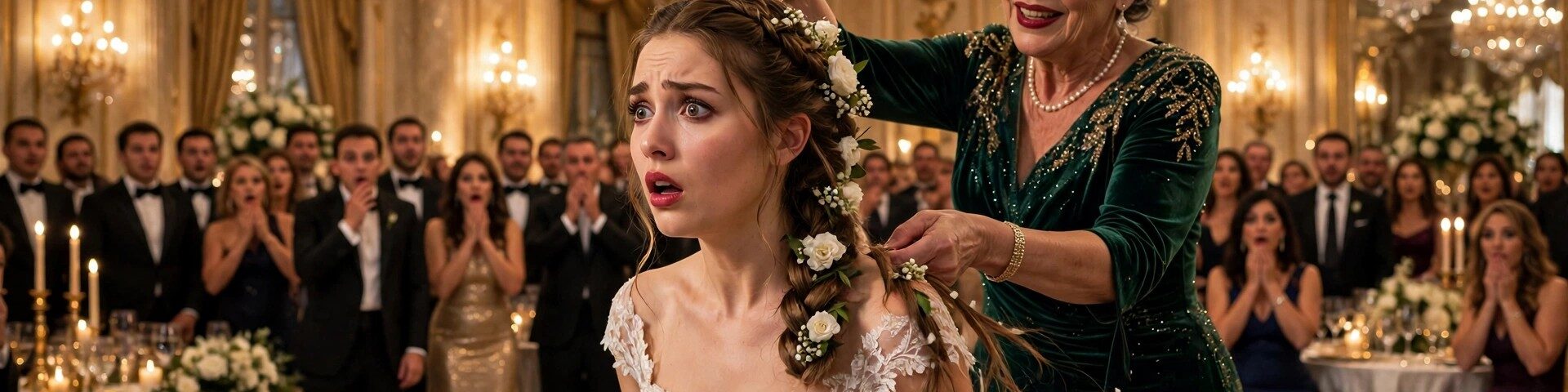
I never heard the scissors. That is the detail that still wakes me at three in the morning — not the gasps, not the laughter that followed, not even the sight of my own wedding braid dangling from her fist like a trophy. It is the silence before it. One moment I was dancing with my husband, flowers woven through my hair, believing the hardest part of loving Nick had already been survived. The next, something tugged hard at the back of my head, there was a strange dry crunching sound, and the ballroom went quiet in the particular way rooms go quiet when something unforgivable has just happened in front of everyone.
I turned around, and Martha was standing there holding my hair in one hand and a pair of sewing scissors in the other.
My hair had taken years to grow. For the wedding I had it braided into a thick rope down my back, white blossoms threaded through it, the way I had pictured since I was a girl. Now Martha held that braid the way a hunter holds something it has killed, and where it had been attached to my head there was only a ragged edge, cut brutally short against my neck. The ballroom tilted. Someone’s champagne glass hit the floor. I heard myself scream — a sound I did not recognize as mine — “What did you do?!”
Martha smiled. Actually smiled. “Honey,” she said, loud enough for the back tables, “it’s a family tradition. In our family, the bride’s hair gets cut at the wedding.”
Three hundred guests stared. Nobody moved. Nobody had ever heard of such a tradition, because no such tradition existed. Martha had invented it on the spot the way she invented everything else about herself — out of spite, and out of the certainty that no one would dare contradict her.
I stood there crying, shaking so hard my bouquet fell apart in my hands. And Martha just stood there laughing, dabbing at her own dry eyes, telling anyone who would listen, “It’s only hair. It’ll grow back.”
The Cut
To understand what happened on that dance floor, you have to understand Martha. Nick and I had been together since high school — first loves, the kind people write off as puppy love right up until it outlasts everyone’s predictions. We knew we would marry someday the way you know the sun will come up. We just had to survive his mother first.
Martha hated me from the beginning, and she never bothered to hide it. I was “poor.” I was “a terrible homemaker.” I was “not good enough for her son.” The real problem, which she said out loud at more than one family dinner, was that she had already chosen Nick’s wife: Chloe Harrington, the daughter of her wealthy best friend Beatrice. In Martha’s mind, the Harringtons were the life she deserved, and I was the obstacle standing between her son and the country-club dynasty she had spent twenty years trying to marry into.
She whispered in Nick’s ear constantly that he couldn’t be with me, that I wasn’t worthy of him, that a man of his prospects needed a woman of “standing.” Nick tried to reason with her. He tried to keep the peace. He did not want a war with his own mother, so he absorbed her cruelty the way he absorbed everything — quietly, hoping it would pass. It never passed. It just got sharper.
On our wedding day, the ceremony itself was beautiful. Then came the reception at the restaurant, the crowd, the loud music, the dance floor. Nick and I were dancing when Martha came up right behind me — so close I felt her breath before I felt her hand in my hair. I didn’t hear her approach. I will never forgive the music for covering it.
Afterward, people told me the whole room froze when she lifted the scissors. The DJ killed the music mid-beat. A waiter dropped a tray. My maid of honor started forward and stopped, the way people do when they cannot believe what they are seeing is real.
Nick was in shock. His face went white, then gray. For a few seconds he just stood there, staring at his mother, at the braid, at me — and I could see the exact moment something inside him snapped. Not loudly. There was no shouting, no scene. He simply took my shaking hand, pressed it once, and walked away. He disappeared through the side doors of the ballroom and did not come back for ten minutes.
Those were the longest ten minutes of my life. Martha used every one of them, working the room, laughing too loudly, telling the story her way before anyone else could tell it theirs. “A little wedding prank!” she announced. “Our family’s little tradition!” People smiled uncertainly. A few laughed because they didn’t know what else to do.
Then the side doors opened, and Nick walked back in. He wasn’t alone. He went straight to the DJ booth, took the microphone, and asked every guest to sit down, because he had an important announcement to make.
“Dear guests,” he said, his voice steady in a way that made my skin prickle, “I forgot to mention that I invited a special guest to our wedding.”
He turned toward the doors. And the woman who walked through them made Martha drop her champagne glass.
The Special Guest
She was elderly, leaning heavily on an ornate silver cane, dressed in a tailored midnight-blue suit with her silver hair swept into an elegant chignon. The lines in her face were deep, but she crossed that ballroom with the unhurried confidence of someone who had never once in her life needed anyone’s permission to be anywhere. The whispers started before she reached the dance floor.
“Mother?” Martha whispered. All the color left her face. All the laughter, all the performance, all the triumph — gone in a single word, stripped away like paint.
“Hello, Martha,” the old woman said. Her voice was raspy with age, but it carried to every corner of the silent room.
It was Eleanor. Martha’s mother. Nick’s grandmother. The woman Nick had been told died in a car accident fifteen years ago.
Nick kept his arm locked around my waist, shielding me, as his grandmother walked toward us — each step of that cane landing like a drumbeat. Months earlier, while organizing old family documents for the wedding, Nick had stumbled onto inconsistencies: no death certificate that held up, a forwarding address that didn’t make sense, a name that kept appearing in his late grandfather’s papers. He had hired someone to find the truth, tracked Eleanor down, learned why she had been banished from the family — and quietly, carefully, invited her to the wedding, hoping to rebuild a bridge. He never meant to use her arrival as a weapon. He told me later, holding me that night, that he had planned a gentle reunion over coffee. Then his mother put scissors to my head, and the plan changed.