My dad forgot to hang up the phone. I heard every word.
“It’s time to get him out of that house.”
My chest went cold. My ears rang.
They weren’t talking about some random tenant. They were talking about me.
That house was worth $910,000.
And it was the last piece of my mother I had left.
I didn’t say a word. I waited. I planned.
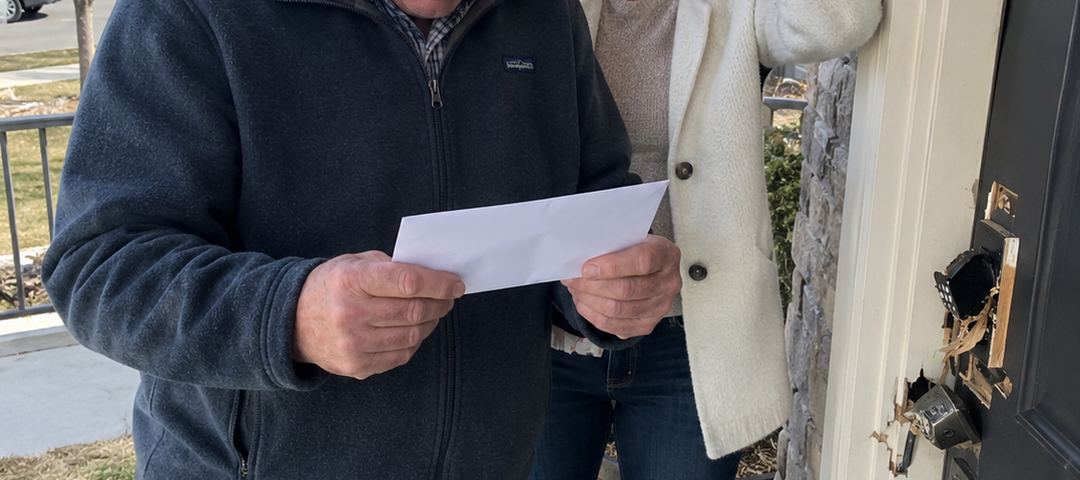
And when he came home from his business trip, smiling like nothing had changed, he slipped the key into the lock.
It didn’t fit.
On the doorstep sat a single envelope. He opened it, and the smile fell off his face.
Then he started screaming.
My name is Ethan, and this is how I took back my home.
Monday night in early spring carried that cool, forgiving breeze that only Denver, Colorado seems to know.
From the cracked-open window in my living room, I could hear faint laughter from somewhere down the street, carried on the wind from Washington Park.
The scent of cut grass and blooming jasmine mingled with the lingering warmth of the oven as I slid out the last slice of leftover pizza.
The Congress Park House felt too quiet, too still.
I sat alone on the couch, feet on the hardwood floors I’d installed with my own hands years ago, and let my eyes drift toward the bay window where Mom used to read with a cup of tea.
The granite counters in the kitchen caught the lamplight, the same ones Mom had insisted on.
“It looks like sunshine caught in stone,” she’d said.
My phone lit up.
“Dad.”
I answered, and Franklin’s voice came through with that easy charm I’d grown up trusting.
He said he was in Dallas with Kelly, his new wife, and that things were going well.
We exchanged a few lines, then he signed off with, “Talk soon, son.”
The call ended, or so I thought.
The line stayed open.
I heard shuffling, a muffled laugh that wasn’t Kelly’s, and then his voice, sharper, stripped of any warmth.
“Time to get Ethan out of that house. He’s unemployed. He’s a burden.”
Kelly’s voice followed, casual as if discussing weather.
“That place could sell for $910,000 easy. Enough to put down on Chatfield Reservoir.”
Then a third voice.
I recognized Derek Vaughn, Dad’s business partner.
“Mark’s hot right now. Don’t give him time to figure it out.”
Something in my chest cracked.
My heart punched against my ribs.
I stared at the framed photo of Diane Cole on the mantle, her gentle smile like a lifeline and a knife all at once.
My mind split in two.
Part of me wanted to hit end call and scream into the phone.
The other half urged silence.
Listen. Learn.
I leaned back, eyes still locked on Mom’s photo.
I remembered 2016.
Both of us in work boots, eating instant noodles on overturned buckets while we built this place.
Her voice warm but firm.
“It’s in your name. Don’t let anyone take it.”
The papers were clear.
The house was mine.
Mom’s will had made sure of that.
I’d paid Dad’s $55,000 debt when his business went under in 2024, fixed his car for another $3,500, and opened my door to him and Kelly for a few months after their wedding.
Months had stretched into years.
My hand tightened around my phone.
I didn’t call back.
I didn’t confront him.
Instead, I opened my notes app and typed, “If they want the house, they’ll have to read my letter first.”
The game had changed.
I was no longer the quiet, beautiful son.
I was in control now, and I would play this in silence.
Mom’s photo seemed to watch me, the bay window framing her memory like a warning.
The open line on my phone whispered the truth I hadn’t wanted to hear, and I knew exactly what I had to do.
Morning sunlight spilled over Washington Park, gilding the edges of the grass as I walked the familiar path.
A busker strummed a weathered guitar under the oaks.
And for a moment, I was 13 again, holding Mom’s hand as she led me to the weekly outdoor concerts.
Those afternoons had been simple: music, picnic blankets, and the feeling that family meant safety.
But safety had a way of eroding.
My thoughts drifted to 2016.
Mom and I lived lean, eating instant noodles for weeks while saving for the materials to build the house.
I installed the hardwood floors myself, my knees aching for days.
She picked the granite counter’s pale gold streaks through gray like trapped sunlight.
Then 2024 hit.
Dad’s business collapsed, and I pulled $55,000 from my savings to clear his debts.
When his BMW’s transmission failed, I paid $3500 to fix it.
When he and Kelly married, I offered them my guest room just until they found a place.
They never left.
By the time I returned home from the park, my mind was still.
I pulled down the cedar box from the top shelf of my closet, the one Mom had labeled in her careful handwriting, “house and will.”
Inside were the deeds, the inheritance papers, the building contracts.
Every one of them had my name, not his.
I needed more than documents.
I needed clarity.
I dialed Tom Jenkins, one of Dad’s oldest friends.
“Did Dad say anything to you about selling my house?” I asked.
Tom hesitated.
“He mentioned Chatfield Reservoir once or twice, but I thought he was joking.”
I could hear the uncertainty in his tone, but there was something else.
The way people talk when they know more than they’re saying.
Later, rumaging through Mom’s old folders, I found a small digital recorder tucked in an envelope.
I pressed play.