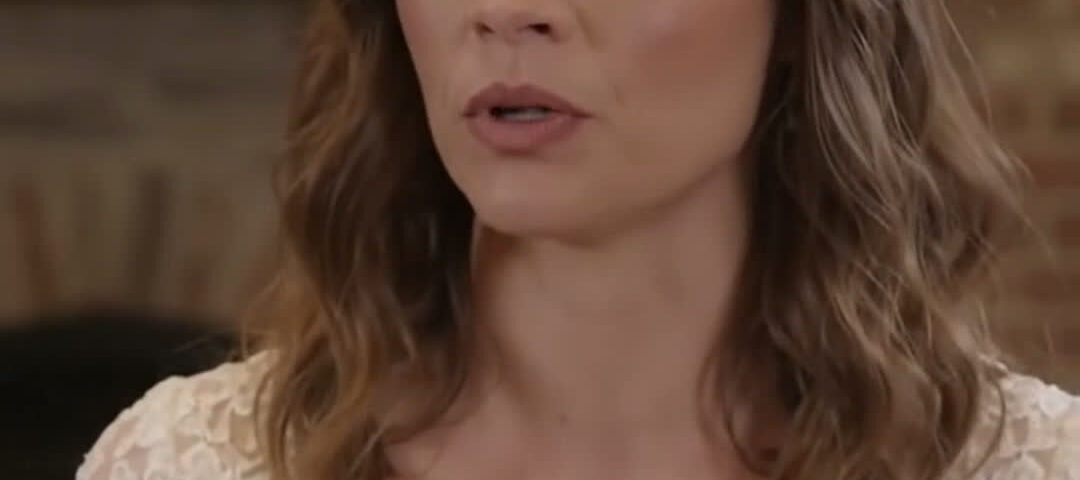
The room went still.
She looked different from the woman I remembered at the wedding. The polished confidence was gone. She held herself stiffly, as if every person in the room might turn toward her at once. Her hair was pulled back simply. She wore no jewelry. She looked, for the first time since I had known her, like a person with nothing left to perform.
Richard stared at her.
“What are you doing here?”
Tiffany looked at him, and in her eyes I saw something I had never seen there before: not calculation, but the raw panic of a person watching their last shelter collapse.
“You promised me the property.”
No one moved.
Daniel took one step forward.
“What did you say?”
Tiffany lifted a hand toward her mouth, realizing too late what she had revealed. But the sentence was already in the room, and there was no taking it back.
Richard’s face changed.
“You don’t know what you’re talking about.”
But the sentence had already landed, and everyone had heard it.
Tiffany looked from him to Daniel, and something in her seemed to break, or perhaps to finally stop pretending.
“You told me Margaret would eventually transfer everything.”
Whispers moved around the room like wind through the trees.
I remained where I was.
The wedding.
The demands.
The pressure.
The questions about Robert’s assets.
The way Tiffany had pushed me toward paperwork connected to the land, sitting beside me at my kitchen table, pointing at clauses with manicured fingers.
For months, I had interpreted each piece separately because doing so was easier than accepting what they formed together.
It had never been only about champagne.
Or flowers.
Or the guest list.
Or one perfect wedding day.
Richard had given Tiffany a reason to believe that marrying Daniel would eventually give her access to property she did not control. He had fed her the story of hidden wealth, had helped her read the documents, had promised her that patience and pressure would eventually deliver what she wanted.
Tiffany had pushed Daniel.
Daniel had pushed me.
And I had nearly mistaken pressure for love.
Richard pointed toward her, his composure finally cracking.
“She’s lying.”
Tiffany shook her head. Tears were running down her face now, and she made no move to wipe them away.
“You said she would give it to Daniel. You said once we were married, it would be ours.”
Daniel’s expression hardened, but he did not interrupt.
For the first time, he let the truth become uncomfortable without rushing to make anyone feel better. He did not soften it. He did not explain it away. He stood in the middle of his family’s reckoning and let it happen.
Hayes set a folder on the table.
“Robert Bennett anticipated this possibility.”
Richard turned toward him.
“What?”
Hayes opened the folder.
“Your brother knew you better than you thought.”
Inside was a recording Robert had made. Hayes lifted a small device and pressed play, and the room held its breath.
Robert’s voice filled the room.
Older than I remembered from the early years of our marriage, but unmistakably his. The measured cadence. The quiet authority. The voice that had read bedtime stories to Daniel and had told me, on our thirtieth anniversary, that I was the best decision he had ever made.
Calm.
Certain.
“If anyone attempts to take advantage of Margaret’s kindness, they will discover something important.”
My eyes filled before I could stop them.
“My wife is gentle,” Robert continued after a pause. “But gentle does not mean powerless.”
I lowered my head for a moment.
Even after death, he had found a way to stand beside me at the moment I needed to hear him. Six years gone, and still protecting me. Still believing in me more than I had believed in myself.
The recording continued.
“The person who protects Margaret’s heart will receive my trust.”
Another pause. I could hear the faint sound of Robert shifting in his chair, the small human details that made it impossible to doubt this was him.
“The person who breaks it will lose access forever.”
No one spoke.
Richard lowered his head.
He understood what the words meant.
Whatever influence he had hoped to gain through Daniel or Tiffany, Robert had anticipated the possibility and built his instructions around character rather than pressure. The trust would go to the one who protected, not the one who maneuvered.
The confrontation did not end with shouting.
It ended with the one thing Richard had tried hardest to avoid: everyone in the family seeing the same pattern at the same time. There is no defense against a room full of people who have all finally understood the same truth.
In the months that followed, the property remained protected.
Richard stopped appearing at family gatherings. His chair at the estate meeting sat empty. No one spoke of him much, but his absence changed the temperature of every room, as if a draft had finally been sealed.
Tiffany moved away.
I did not ask where.
Daniel continued rebuilding his life slowly.
There was no dramatic morning when everything became easy. He still carried regret. I still had moments when I remembered him standing in that ballroom and saying Tiffany had been stressed, the words landing like stones in still water.
But he no longer tried to hurry me past those memories.
He understood that rebuilding trust meant allowing me to decide how much time I needed, and he gave me that time without resentment, which was itself a kind of proof.
The biggest change, though, happened inside me.
For most of my life, I had measured my value by how useful I could be to the people I loved.
If someone needed money, I found a way.
If someone needed help, I rearranged my schedule.
If someone was angry, I looked for the fastest path back to peace.
I had called that love.
Some of it was love.
Some of it was fear—fear that if I stopped giving, people might stop needing me, and if they stopped needing me, perhaps they would stop loving me. It was the quiet terror underneath a lifetime of yes, the belief that my worth was something I had to earn daily through service and sacrifice.
Robert had understood that fear long before I did.
A year after the worst of it was over, Daniel and I stood beneath Robert’s favorite tree.
The afternoon was quiet. The property looked ordinary in the best possible way—grass moving in the breeze, shadows stretching beneath the branches, no lawyers, no folders, no raised voices. Just land, and trees, and the two of us.
Daniel looked up into the tree.
“Dad would be proud of you.”
I shook my head.
“No.”
He looked surprised.
“He would be proud of you.”
“Why?”
“Because you finally chose what was right over what was easy.”
Daniel absorbed that quietly.
Then he hugged me.
There was no request attached to it.
No apology hidden inside it.
No question about money.
No attempt to prove that he had changed.
He simply held me because he loved me.
That was what I had wanted all along.
Not the expensive wedding.
Not the perfect family photograph.
Not the property.
Not the money.
I had wanted love that did not come with a price.
The woman who stood in that ballroom with a handprint fading from her cheek believed, for a few terrible minutes, that setting a boundary might cost her family.
Instead, I learned the difference between losing family and losing access to people who only knew how to love me while I was useful to them.
I did not lose everything that night.
I lost the people who had confused my kindness with permission.
And in the end, that was the greatest gift the disaster could have given me.
If you came here from Facebook because of this story, return to the Facebook post, tap Like, and comment exactly “Amazing” to support the storyteller. That small action means more than it seems and gives the writer genuine encouragement to keep sharing more stories about family pressure, firm boundaries, and protecting what you worked so hard to build.
Any resemblance to real persons, events, or places is coincidental. This story is a work of fiction created for entertainment purposes.