But we were not children anymore. And this was not a cookie.
I put the phone face down and told myself she was being dramatic. Eden’s threats usually became cold silence at Thanksgiving, a vague social media quote, or a call from Mom asking why I could not “just keep the peace with your sister.”
Still, I slept badly. Wednesday passed without a word from Eden, and that worried me more than texting would have. Quiet Eden was plotting Eden.
By Thursday morning I had nearly convinced myself I was overreacting. I opened the cabin windows, made coffee, watered the basil on the porch, and drove in for my closing shift. Around noon, while labeling bins of drawer pulls, I called Colleen from two cabins down.
Colleen Baker was a retired schoolteacher in her seventies, sharp as a tack, who had basically adopted me after Pop died. She knew everything happening on that end of the lake before the rest of us had poured a second cup of coffee.
“Colleen, can you do me a favor? If you see any trucks or people at my place today, will you call me?”
A pause. “That sounds specific.”
“It’s Eden.”
“Oh,” she said, and that one word carried three decades of understanding. “I’ll keep watch.”
At 3:47 that afternoon, my phone rang while I was ringing up a man buying deck screws and a tape measure. Colleen’s name lit the screen. I answered with the phone tucked between my shoulder and ear, and I could hear wind rushing over the receiver. She was outside.
“Victoria, honey, there’s a whole crew in your driveway.”
My hand froze over the register. “What kind of crew?”
“Event crew. Big van says Lakeside Lux Events. Tables, a white tent, a flower arch. Looks like a wedding, except nobody’s wearing uncomfortable shoes yet.”
My heart gave one hard thud. “Tell them to stop. Tell them they don’t have permission to be there.”
I heard Colleen call out, muffled but clear: “Excuse me, folks, the owner says you need to stop unloading.” A pause, background voices, a woman’s professional confusion. Colleen came back: “The lady in charge says she has a contract. Says Eden Sutton booked the venue and paid a deposit.”
I closed my eyes. Venue. My grandfather’s cabin had become a venue.
“Tell her I’m on my way.”
My manager Rob waved me off before I finished explaining. “Go. I’ll call Maddie to cover.”
The drive back felt endless. Every slow truck in the county appeared in front of me. I kept seeing Pop’s cabin in my mind — the porch he built with cedar boards from a salvage yard, the birch trees he planted, the dock where he taught me to tie a cleat hitch — and then strangers dragging rental tables across the grass, Eden laughing with champagne as if she had won.
When I turned onto the gravel drive, I said “No” out loud.
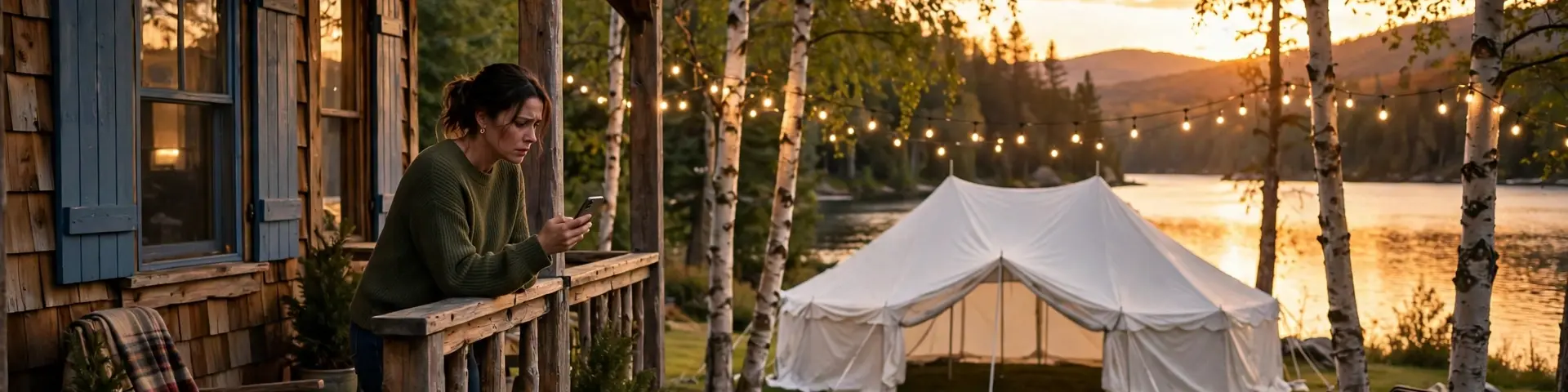
The cabin looked like a wedding magazine had been dropped on it from a great height. A white tent stood half-raised near the lake. String lights looped between Pop’s birch trees. Round tables leaned in the grass. Two men carried a floral arch toward the dock while another unloaded linen boxes. A woman in a black blazer stood by the driveway with a clipboard, directing traffic like she had done it a thousand times. Colleen was on my porch with her arms folded, wearing a look that said I didn’t touch anybody, but I thought about it.
I walked straight to the woman with the clipboard. “Hi. I’m Victoria Sutton. This is my property.”
She turned with a polite smile that faltered. “Oh. You must be Eden’s sister.”
“I am. And I never approved this.”
Her eyebrows drew together. “I’m Maren, the event coordinator. We were told you were aware.”
“I was not.”
“She said it was a family lake house.”
“It was. Now it’s mine.”
Maren’s expression shifted from confusion to caution — the look of a professional realizing the ground beneath a contract might not be solid. “She also said you were out of town.”