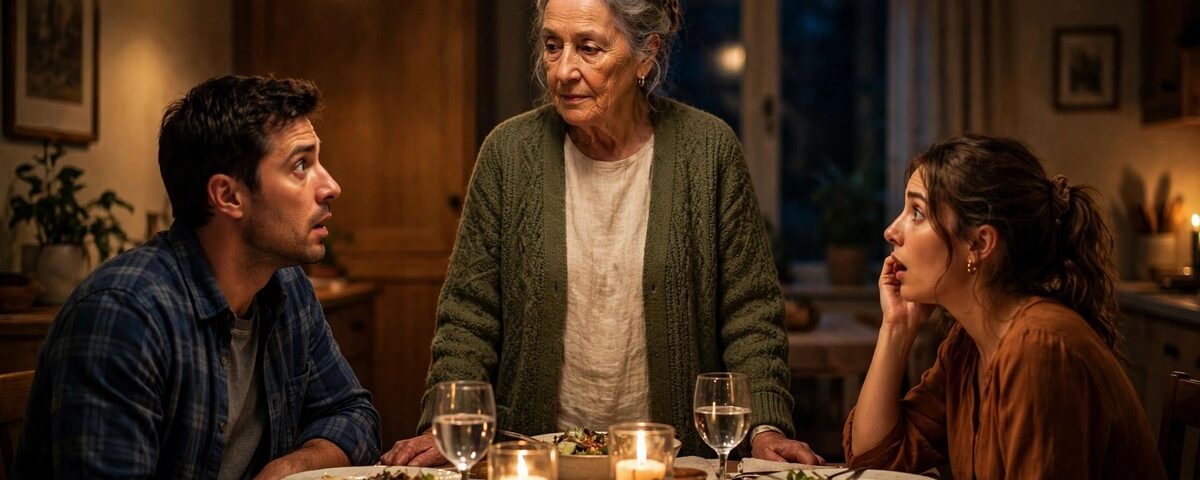
Halfway through, he wiped his hands on a dish towel and looked at me. “Mom.” I kept chopping. “Yes?” “I owe you an apology.” My knife stopped. He stared at the countertop, rubbing the edge of the dish towel between his fingers. “I’ve been trying to figure out what to say without making it sound like I’m apologizing because I want something.”
I set the knife down and turned toward him. “That’s a good place to start.” He nodded. “I lied to Camila.” “Yes.” “I lied to you too.” I waited. He took a breath, then continued. “I kept telling you every request was temporary when I knew I was depending on you.” His voice was quiet, and there was no attempt to make the admission sound less serious than it was. “And every time you helped, instead of feeling grateful, I felt embarrassed. So I changed the story in my head.”
“What story?” “That I deserved it.” I leaned against the counter, letting him continue without rushing to fill the silence. He looked down at his hands. “I told myself the house would be mine someday anyway. I told myself Dad would have wanted me to have the car. I told myself you had enough money, so it didn’t matter.”
He swallowed. “Then I started acting like everything you gave me was something I earned.”
There it was. The truth I had been waiting for. Not because I needed to win. Not because I wanted him to confess every wrong he had done so that I could hold the list over his head. Because without the truth, there was nowhere for us to go. We could have spent years arguing about whether I had been too generous or whether he had been under too much pressure, and neither of us would have changed.
He took another breath. “I also shouldn’t have spoken to you the way I did.” “The dinner?” “The dinner. Before that too.” He looked toward the dining room, where the old table still stood. “I think I was trying to impress Camila by making you seem old-fashioned.” That hurt more than I expected. I had suspected something like it, but hearing him say it aloud made the memory sharper. He had used my age, my cooking, and the things I owned as props in a performance meant to make himself look better.
He saw the change in my expression. “I know.” I looked out the window. Rain moved down the glass in silver lines, gathering at the bottom before disappearing from sight. “When you said I would never be as good as your wife, do you know what hurt?” He shook his head. “It wasn’t being compared to Camila.” I folded my arms, searching for words that would explain the wound without turning it into another accusation. “It was realizing you had become comfortable diminishing me in a house where you had been loved your whole life.”
His eyes dropped. “I’m sorry.” I believed him. Believing an apology did not mean erasing what happened. It did not mean the years of financial support suddenly became harmless or that I would never remember the way he had spoken to me. It meant I believed he was beginning to understand what he had done.
That was another lesson I had learned. “I accept your apology.” He looked up. “But?” I smiled faintly. “You know me too well.” He almost smiled back. “But things are not going back to how they were.” “I know.” “No monthly help.” “I know.” “No rescuing.” “I know.” “No pretending your rent is someone else’s emergency.” He laughed quietly, looking down at the dish towel in his hands. “I pay it on the third.” “Why the third?” “Payday.” “Fair enough.”
For a moment, we stood there smiling at each other, and the tension that had followed us through so many conversations seemed to ease. Then he reached into his jacket pocket. “I have something else.” He placed an envelope on the counter. I opened it. Inside was a check for two hundred dollars. I stared at it for a moment, looking at the amount and then at his face. “What is this?” “The beginning.”
“Hugo—” “I know I can’t repay everything right now.” “You don’t have to—” “I want to.”
I looked at the check again. Two hundred dollars was tiny compared with what I had spent. It would not cover even a small fraction of the money I had given him over the years, much less the cost of the house, the vehicle expenses, and the countless other things I had quietly absorbed.
But the number was not the point. The direction was. For the first time in years, money was moving toward responsibility instead of away from it.
I folded the check and returned it to the envelope. “I’ll take it.” He looked relieved. “Really?” “Yes.” “I thought you’d refuse.” “So did I.” We both laughed.
Later, while the chicken roasted, he told me about work. Not the inflated version. The real one. He coordinated deliveries for three warehouse routes. The software was annoying. His manager drank terrible coffee. One driver complained about everything. He had made two mistakes his first week and had to admit them. He had also been praised for solving a scheduling problem on Friday.
He described the work in a straightforward way, without trying to make it sound more important than it was. When something had gone badly, he said so. When something had gone well, he seemed pleased but not eager to impress me.
There were no luxury trips in his story. No impressive bonuses. No performance. And for the first time in years, I enjoyed listening to him talk about his life.
At seven, Isabel arrived. She stopped in the doorway when she saw Hugo carrying plates. “What alternate universe is this?” He rolled his eyes. “I invited her,” I said. “Of course you did.” Isabel set a pie on the counter and looked at the roasting chicken. “Did he cook?” “I supervised.” “So no emergency services?” “Isabel.” “I’m joking.” Hugo surprised us both. “I earned that one.”
Isabel stared at him for a moment, then laughed. It was the kind of laughter that comes when something unexpected breaks through an old pattern, and I found myself laughing with her. We sat down at the same dining table where everything had begun six months earlier. The scratch from the old Thanksgiving was still near Hugo’s glass. Daniel’s chair was empty. I no longer tried to make the emptiness disappear. I did not need to pretend he was still there, and I did not need to avoid looking at the place where he used to sit.
Some absences deserve to be acknowledged. We ate. The chicken was slightly overdone. The potatoes were excellent. The green beans had just enough seasoning, and the rosemary filled the room with a familiar, comforting smell. Nobody compared anyone to anyone else. Nobody used the meal to demonstrate superiority. We simply ate together.
After dinner, Hugo stood before I could gather the plates. “I’ve got these.” I looked at him. “What?” “The dishes.” Isabel raised her eyebrows. I said, “Don’t scare him away.”
He carried the plates into the kitchen. A moment later, we heard the faucet running and the soft clatter of dishes as he began rinsing them. Isabel leaned toward me. “Who is that man?” “My son, apparently.” She smiled. Then her face softened. “You okay?”
I looked toward the kitchen. Hugo was rinsing plates before putting them into the dishwasher, doing it inefficiently but sincerely. He had stacked the bowls in the wrong order, and I could already see that he would need to rearrange them before everything fit.
But he was doing it himself. “Yes,” I said. And I meant it.
After they left, I sat alone at the breakfast counter with a cup of chamomile tea. The renovated kitchen glowed beneath warm pendant lights, and the windows reflected the soft light from inside the house.
On the counter lay Hugo’s two-hundred-dollar check. Next to it sat the manila folder containing the old bank statements. I had kept them not because I enjoyed looking at them, but because they reminded me how easy it was to mistake giving for love.
Mothers are often praised for how much they sacrifice. How little they need. How quickly they forgive. How often they put themselves last. We are taught to see those things as evidence of devotion, and sometimes they are. There is beauty in generosity. There is comfort in knowing that someone will help you when you have nowhere else to turn.
There is also danger when generosity becomes the price of belonging. For years, I believed protecting Hugo from discomfort was part of loving him. I thought that if I could prevent him from feeling embarrassed, frightened, or financially strained, I was making his life better.
It was not that simple. Sometimes the discomfort I removed was the very thing that might have encouraged him to change. Sometimes my help gave him a way to avoid a conversation he needed to have or a decision he needed to make. Sometimes, by trying to spare him the consequences of his choices, I had helped him believe those consequences did not apply to him.
Sometimes love is a warm meal. Sometimes it is an open door. Sometimes it is an envelope of money when someone truly needs help. And sometimes love is looking at your adult child and saying, calmly, no more.
Not because you want them to fall. Because you finally understand they cannot learn to stand while leaning on something they pretend is not there.
I used to think the hardest part of losing Daniel was learning to live alone. I was wrong. The hardest part was learning that being needed and being loved were not the same thing.
Once I understood that, the silence in my house changed. It stopped sounding like abandonment. It became peace.
Hugo and I still have work to do. We are not one of those families who erase years of damage with one dinner and an apology. We still have moments when a conversation becomes awkward or one of us remembers something the other would rather forget.
But the relationship is changing. He pays his own rent now. He drives a used sedan he bought within his budget. He sends me two hundred dollars when he can. Some months, it is one hundred. I never ask. He never makes excuses. The money matters less than the way he handles it. He no longer treats a bill as a problem that will eventually become mine. When he tells me he has paid his expenses, I do not have to wonder whether he is leaving out an important detail. When he says he cannot afford something, he does not immediately follow the admission with a request for me to cover the difference.
He is learning to live within his means, and I am learning to let him.
Camila and I exchanged one message shortly after she moved out. She apologized for the way she had treated me. I accepted. She and Hugo eventually chose separate paths, and I stayed out of the details.
There was a time when I would have believed it was my responsibility to fix that too. I would have called one of them, listened to the complaints, tried to interpret what the other had meant, and offered suggestions that neither had requested.
I would have confused being involved with being helpful. It never was my responsibility to fix their marriage.
Isabel comes over most Sundays. Sometimes Hugo joins us. Sometimes he doesn’t. Nobody is required to perform closeness anymore. We do not have to prove that we are a happy family by gathering around the same table every week or pretending that the past has been forgotten.
That may be the greatest change of all.
Last Sunday, we cooked breakfast in my new kitchen. Sunlight came through the larger windows and spilled across the oak floor. Isabel brought fruit. Hugo brought coffee. I made eggs. At one point, he opened a cabinet and asked where I kept the serving plates. “Second shelf.” He found them without asking me to get up.
Such a small thing. Yet I noticed. I notice different things now. Not expensive gifts. Not promises. Not apologies repeated until they lose meaning. I notice whether someone knocks. Whether they tell the truth when the truth makes them look ordinary. Whether they clean their own plate. Whether they carry their own bills. Whether they understand that love is not unlimited access.
I notice whether people respect the things I have built, even when those things seem ordinary to them. I notice whether they can accept help without pretending it was never help at all. And I notice how I feel after spending time with them.
For years, I measured love by how much someone needed me. Now I pay attention to whether I can be myself around them without feeling that I must solve something, provide something, or apologize for having limits. It is a quieter way of living. It is also a much happier one.
If you came here from Facebook because of this story, return to the Facebook post, tap Like, and comment exactly “Amazing” to support the storyteller. That small action means more than it seems and gives the writer genuine encouragement to keep sharing more stories about family pressure, firm boundaries, and finally protecting what you worked so hard to build.
Disclaimer: This story is a work of fiction created for entertainment purposes. Any resemblance to real persons, events, or places is coincidental.