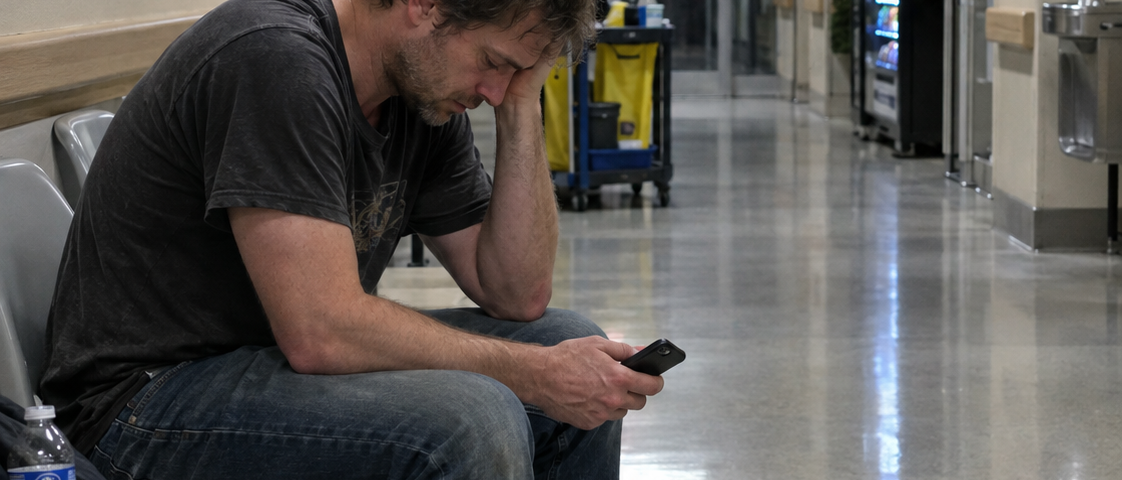
I stared at the floor. The linoleum had a crack shaped like a river.
“I am not going anywhere. Noah is in the ICU. He could die.”
Her reply was ice.
“Doctors can handle it. Family comes first. If you do not come, I will reconsider all financial support.”
I pressed my eyes shut.
“You are using this hospital to control me.”
She exhaled through the phone like I was the unreasonable one, like I was a child throwing a tantrum instead of a father sitting outside his son’s ICU room.
“If you will not honor your family, then you are no longer part of it.”
And she hung up.
For the first time in my life, I did not beg. I did not call back. I did not spend the next three hours rehearsing what I should have said.
My hand shook as I opened my phone, found her name, and pressed block.
My body felt hollow, and yet something inside me steadied for the first time in years, like the moment before a diver breaks through the surface of the water.
Almost immediately, an email popped up from the bank.
A notice: Change in Management Authority. Noah Carter College Fund.
My breath froze. I did not yet know what it meant, but dread spread through me like cold ink.
I walked back down the hallway, back toward the soft glow of Noah’s room, and stood at the glass, watching his chest rise and fall with the help of a machine.
I whispered to myself.
“This time I choose him.”
And for once, there was no hesitation, no guilt, no war inside me. Just a quiet, solid certainty that whatever happened next, I was finally standing on the right side.
That night, the third night, I refused to close my eyes.
Noah’s room was dim except for the monitors casting shifting greens and blues across the walls. I sat beside his bed, feeling every muscle in my back protest, but not caring enough to move. Logan came in to check his pupils and murmured, “There is slight improvement.”
Slight, but enough to hook itself into me like a lifeline.
I leaned forward, resting my hand on Noah’s. His skin was warm. That was the thing I kept coming back to — he was warm, he was here, the machines were helping but he was doing the real work.
Sometime after midnight, Noah’s fingers twitched beneath mine.
Not a reflex, not a spasm. A deliberate squeeze, faint but undeniable, the way he used to squeeze my hand when he was little and something scared him at the movies.
My breath caught.
Logan hurried back when I called his name, and after examining Noah, he nodded.
“He is responding to you.”
I felt tears gather before I could stop them. For the first time since the accident, hope did not feel like a betrayal. It felt like oxygen.
But then another memory surfaced, one I had brushed aside when he first mentioned it.
Two weeks ago, Noah had come home quiet, tugging at the sleeves of his hoodie. When I asked what was wrong, he whispered, “Dad, a woman keeps watching me at school.”
I dismissed it, thinking it was a teacher, a volunteer, maybe another parent waiting for pickup. I told him grown-ups stand around schools all the time, that it was probably nothing.
Now, sitting in that room with the beeping machines and my son’s hand weakly curled around mine, the words slithered back into my mind and settled there.
I felt the skin on my arms tighten.
At dawn, my phone buzzed with another call from a Greenwich area code. I answered, but all I heard was background noise — traffic, maybe, or wind — then the line went dead.
The calls kept coming throughout the morning, each one ending the same way. Silence, then nothing.
It no longer felt random. It felt like pressure. Eyes on the back of my neck, a presence I could not name yet, but could feel circling closer.
Around midmorning, the doctor came in and said they were lowering Noah’s sedation.
“We need to see what his brain can do on its own,” he explained.
I nodded, heart thumping, watching Noah’s eyelids tremble like they were trying to remember how to lift.
His breathing steadied, each inhale a little stronger than before.
Then his lashes fluttered, and for a moment, his eyes cracked open. Unfocused, glassy, but open.
His lips moved.
I leaned close, so close I could feel the faint warmth of his breath.
His voice came out like a scrape.
“Dad, I am scared.”
I swallowed, my voice thick.
“Of what, buddy?”
He blinked slowly, struggling.
“The woman.”
My heartbeat faltered.
“What woman?”
No answer. His eyes drifted shut again, the effort too much for him.
But something had been set in motion. Something I could not stop now.
Later, during a routine check, the doctor asked Noah a series of simple questions. Noah barely managed words, but one phrase came out soft and broken.
“I saw the silver truck.”
A shiver sliced through me.
My mother’s GMC Sierra was silver. Very silver. She had bought it two years ago and mentioned the color three times in one phone call, as if the color were an achievement.
I shook the thought away, too wild, too cruel. But the seed had been planted, and it hurt.
By the time Noah whispered about the silver truck, something inside me shifted from fear to a sharp, focused kind of resolve.
I could not sit in that chair another second.
I asked Logan to stay with him, promising I would be gone no more than half an hour. Though every step I took away from the ICU felt like stepping off a cliff, I drove straight to the Boulder Police Station.
Palms sweating on the wheel, replaying Noah’s voice in my head. The woman. The silver truck. The silent calls.
I walked in and asked to file an incident report tied to a hit-and-run near the trail.