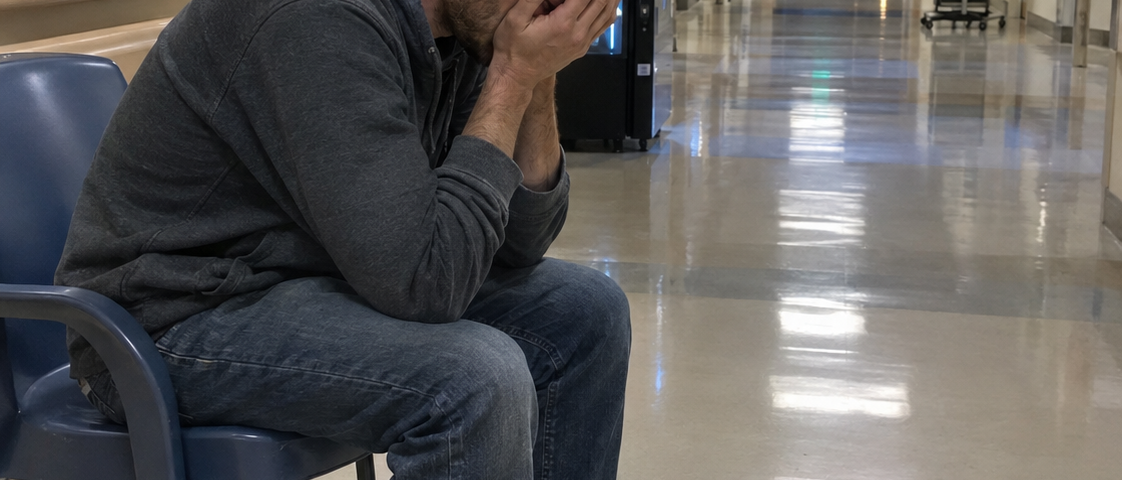
The world outside blurring.
Images of Noah flashed through my mind.
His grin over breakfast.
That untied shoelace.
His tiny voice explaining gravity.
I whispered, “Please, please, please.”
Each time I turned onto a new street, a siren wailed somewhere nearby, and I followed the sound as if it was the only thread leading me forward.
The ER was chaos.
Stretchers, nurses shouting orders, the sharp bite of antiseptic in the air.
I stumbled to the counter, barely able to speak.
“My son, Noah Carter. 8-year-old. Bike accident.”
The receptionist nodded quickly, her expression shifting into something both practiced and kind.
A coordinator led me into a small room off the side where the walls felt too close.
A doctor came in, and his face said everything before his words did.
Severe head trauma.
Internal bleeding.
Broken ribs.
Broken leg.
He repeated “critical” like it was a diagnosis on its own.
“The next 52 hours are crucial,” he said.
When they finally let me see him, I did not recognize my own child.
His small body was swallowed by bandages, tubes, and machines that breathed for him.
His face, my bright, curious boy, was swollen, bruised, too still.
I felt the world tilt.
A nurse named Logan stood beside me, explaining each machine and monitor in a calm, grounded voice.
He told me I could talk to Noah even if he could not respond.
“His brain still needs to know you are here,” he said.
That sentence became the anchor I clung to.
Later, when I stepped out into the hallway to breathe, I overheard Logan and another nurse whispering near the supply cart.
“A woman called asking about the boy once. Said she would not give her name. Just said she was family. Very insistent, refused to leave a callback number.”
Something prickled at the base of my neck.
I thought of my mother, of the missed Greenwich call on Noah’s phone, but I forced myself to push it aside.
She was too busy hosting events and planning Hannah’s birthday to be circling around my son’s hospital room in secret.
At least that was what I told myself.
I stayed by Noah’s bedside as the sky outside darkened.
My father, Richard, called and said he would get to Boulder as soon as he could.
Friends offered to check in on the apartment.
Nurses encouraged me to rest, but I could not leave.
“If he wakes up and I am not here,” I told Logan, “he will think I abandoned him.”
Logan did not argue.
He just brought me a blanket and dimmed the lights.
I sat in that stiff plastic chair, my hand resting on Noah’s arm, listening to the steady beeping that now dictated the rhythm of my world.
Every rise and fall of his chest felt borrowed.
Every breath felt fragile.
And as the first long night settled in around us, one promise wrapped itself around my heart like a binding.
From this moment on, I would live according to the sound of my son’s heartbeat, whatever it took.
By the second morning in the ICU, exhaustion had settled so deeply into my bones, it felt physical, like a second spine made of lead.
I caught sight of myself in the bathroom mirror.
Bloodshot eyes, stubble darkening my jaw, shirt creased from too many hours spent curled in a plastic chair.
I splashed cold water on my face, but nothing washed away the heaviness under my skin.
When I opened the door, Logan was waiting in the hallway with a paper cup of coffee.
It tasted burnt and thin, but it was the first warm thing I had held since yesterday.
The doctor stopped me before I stepped back into Noah’s room.
He said the swelling was holding steady, which was not bad news, but not good news either.
“We are waiting,” he said.
Waiting.
My least favorite verb in the English language.
Back in the dim ICU, I sat beside Noah’s bed, listening to the steady click and beep of machines.
Every sound felt like a reminder of how fragile he was.
I lowered my head and whispered, asking questions with no answers.
If he did not wake up, who would I become?
If he woke up but could not walk or speak or remember me?
What kind of father would that make me?
I stared at his small, bruised hands and wondered how a life could pivot so violently in a single hour.
As the minutes dragged on, my mind drifted back to Greenwich, to the house where every wall gleamed and every conversation felt like a performance.
I could see the long dining table polished to a mirror shine, the crystal glasses lined up with military precision.
I was a teenager again, sitting stiffly while Hannah recited her award-winning essay, and my mother clapped like she was watching a Broadway show.
When it was my turn, I mentioned a photograph I had taken, something I was proud of, but my mother did not even let me finish.
“Evan, focus on something practical,” she said. “Photography will not take you anywhere.”
Her voice still echoes in my head, sharp as the silverware she aligned at those dinners.
Then came the sentence that shaped the entire trajectory of my life.
“You are not allowed to fail. I did not raise a mediocre son.”
I spent years trying to outrun that line.
Hannah was everything I was not.
She fit every mold, hit every benchmark, followed every script our mother handed her.
Perfect grades, perfect job, perfect family.
She never meant to be my rival.
She just existed in a house where presence alone was enough to overshadow me.
I did not resent her.
Not really.
I resented the way our mother weaponized her achievements to point out my inadequacies.
Eventually, I stopped going home unless I had to.
Boulder became more than distance.
It became survival.
A different memory surfaced: the day my mother announced she had opened a college fund for Noah.
I had just gone through the divorce.