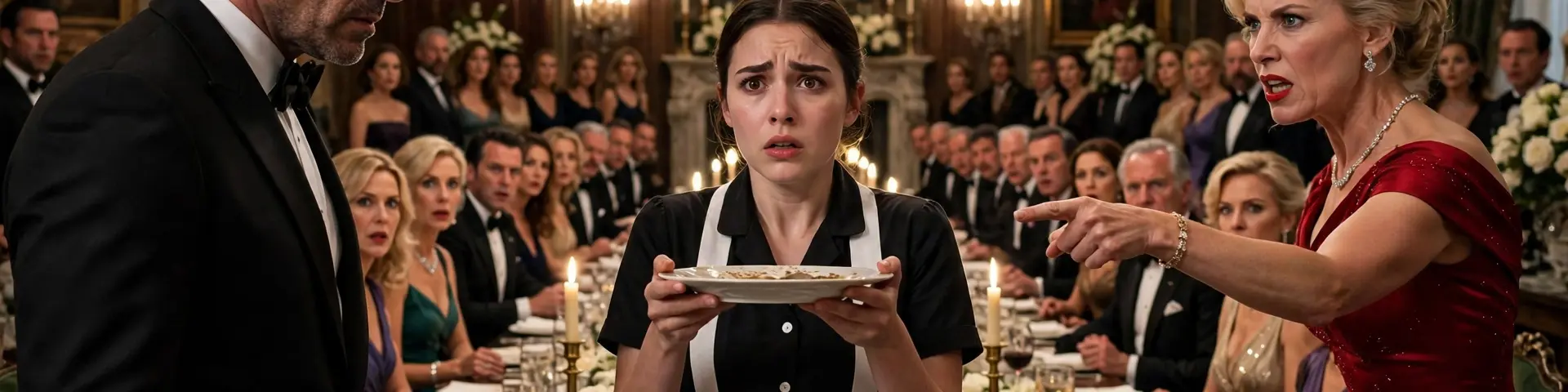
Someone pulled out a chair. I don’t remember who. I sat because my legs had decided they were done holding me up.
The dinner ended early. Guests left in a strange, hurried politeness, the way people leave a theater when the fire alarm goes off but nobody wants to be the first to run. Vanessa left through the front doors with the two men from the doorway walking on either side of her. She didn’t look back at the mansion. She didn’t look at Luca. She looked at me, once, and I will remember that look for the rest of my life.
I kept my job. More than that — two weeks later, I was moved from housekeeping to the private service staff, with a raise that covered my father’s therapy and then some. Luca never explained what was in the silver box. He never had to. Some questions answer themselves.
People ask me if I was brave that night. I tell them the truth: I was terrified. I needed that job more than air. But there is a difference between being afraid and being willing to watch something wrong happen while you hold the tray.
I was just a maid. But that night, for three seconds in a quiet dining room, I was the only person in the room who was paying attention.
And that made all the difference.
The Morning After
I barely slept that night. I lay in my small apartment listening to the radiators click and replayed every second of the dinner in my head, the way you replay a car accident — not because you want to, but because your brain insists on checking whether it really happened.
At six the next morning, my phone rang. It was the house manager. My stomach dropped straight through the floor. This was it, I thought. Last night’s mercy had an expiration date, and it had expired overnight.
“Emma,” she said, “Mr. Moretti would like to see you in his study at eight. Don’t be late.”
I stood in that study at eight o’clock sharp, hands folded, trying to look like someone who belonged there. Luca Moretti sat behind a desk the size of a boat and looked at me for a long time without speaking. I had learned the night before that his silences were worse than other people’s shouting.
“Do you know what you did last night?” he finally asked.
“I interfered with dinner, sir. I’m sorry—”
“You did your job,” he cut in. “Everyone else in that room was paid to be there. You were the only one who was actually watching.” He slid an envelope across the desk. “Your new assignment starts Monday. Private service. Better hours, better pay. Don’t argue.”
I didn’t argue. I took the envelope home and cried at my kitchen table — not from fear this time, but from relief so big it didn’t fit inside my chest.
My father still asks me about that night sometimes. His speech is slow now, and he has to work for every word, but he always manages the same question: “The… dinner… tell me… again.” And I tell him again, about the chandeliers and the ticket and the leaves, and he squeezes my hand with the hand that still works, and that is enough.
Vanessa Bellini’s name disappeared from the society pages within a month. I never saw her again. I never wanted to. Some people you only need to meet once to understand completely.
Here is what I learned, standing invisible at the edges of rich people’s rooms for all those years: power is not about money. Power is about who gets believed. That night, thirty-two guests watched a maid take a plate away from the most feared man in Chicago — and the room believed the maid.