“Claire loved the marsh at five o’clock. It’s time he saw it.”
Half an hour later, the four of them stood at the end of the long wooden dock stretching into the salt marsh. The tide was coming in. The sky was deep orange streaked with gold and purple.
Roman held seven-month-old Nicholas against his chest. The baby’s dark eyes were wide, watching egrets fly low over the water.
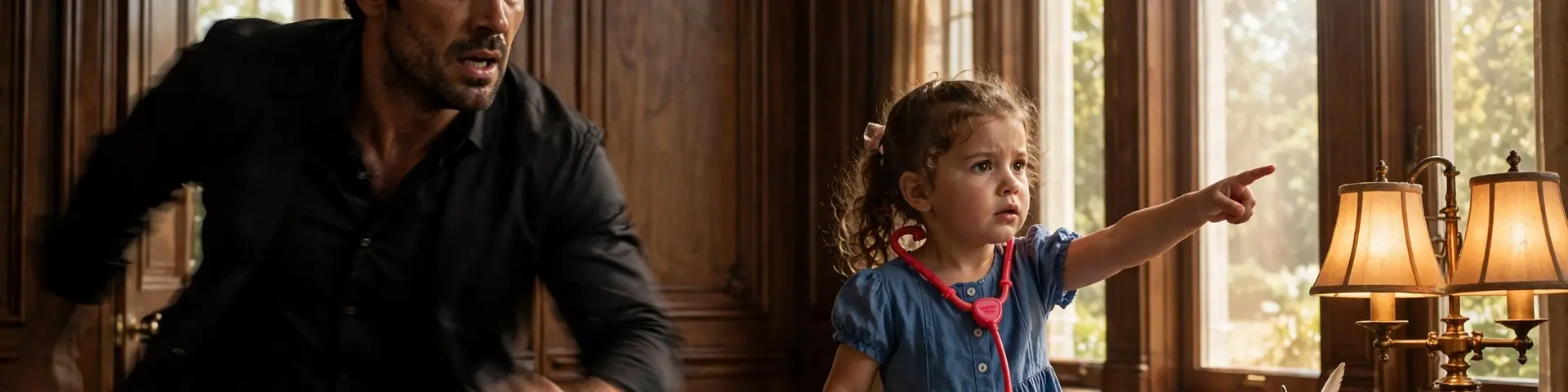
Beside Roman stood Rachel, holding Sophie’s hand. Sophie stood on the bottom rail, pressing her red plastic stethoscope against a wooden post.
“What are you doing, Doctor?” Roman asked, a quiet, easy smile on his face — no longer rare.
“I’m checking the wood,” Sophie announced. “It has a quiet heart.”
“Wood doesn’t have a heart, Sophie,” Rachel laughed.
“It does too,” Sophie insisted, pointing her disc at Roman’s chest. “And he has one too. I heard it in the hallway.”
Roman looked down at his son. Nicholas turned, looked up at his father’s face, and let out a bright gurgle, his small fist grabbing Roman’s chin.
Roman leaned down, pressing his cheek against his son’s warm forehead, feeling the small, rapid heartbeat against his own.
He looked at Rachel. She was watching him with such clear, quiet understanding that for the first time in six months, Roman didn’t feel the cold weight of the limestone walls. He felt the broad, open sky above the marsh.
“He’s warm,” Roman whispered.
“He’s safe,” Rachel corrected gently, stepping closer. “You both are.”
By late October, the lowcountry had lost its humidity to crisp autumn days.
The Bellini estate looked different from the road. The iron gates and cameras remained, but the gravel driveway was no longer empty. On Saturday mornings, two red supply vans from the Charleston Children’s Health Initiative parked near the old carriage house — which Roman had renovated into a pediatric clinic for low-income families across North Charleston.
The initiative was funded entirely by a new charitable trust created by Roman Bellini, with Rachel Miller serving as executive director.
In the second-floor nursery, eight-month-old Nicholas sat on a woven rug playing with wooden blocks, strong and chubby, dark hair curling at his neck like his father’s. Beside him sat Sophie, wearing a real blue pediatric stethoscope — a gift from Dr. Sterling for her fifth birthday.
Downstairs, Roman sat behind his walnut desk. No more guardianship papers or subpoenas — just construction plans for a new health clinic in West Ashley, and a framed photograph that hadn’t been there three months ago: Nicholas laughing on the wooden dock, Sophie behind him in her giant striped hat, Rachel beside Roman with her arm resting lightly against his sleeve, the sun setting over the marsh.
Marco walked in carrying a single white envelope. “Evelyn’s lawyers sent the final release. She’s withdrawing her claim to the trust administration permanently. Charles agreed not to press charges over the July twentieth incident.”
Roman didn’t open the envelope. “And Victor Moretti?”
“Resigned from the terminal board Tuesday. The new coalition chairman wants to extend our freight contracts ten years on our terms.”
Roman stood and walked to the window. Outside, Rachel was helping nurses unload pediatric equipment from a red van, laughing with the driver.
“She’s good at it,” Marco observed.
“She’s better at it than anyone I’ve ever hired,” Roman said softly.
“Evelyn’s lawyer asked Charles if you were going to marry her,” Marco added offhandedly.
“What did Charles say?”
“Charles told him Roman Bellini doesn’t answer questions from people who charge by the hour.”
Roman let out a short, quiet laugh — a sound becoming more common in the mansion.
“Tell Charles he’s getting a raise,” Roman said.
He walked out of the study, down the marble staircase, toward the rear terrace where the autumn sun warmed the stone tiles.
The sun was setting behind the marsh at five o’clock on the last Sunday of October.
On the terrace, a long wooden table was set with blue ceramic plates, fresh bread, roasted chicken, and apples. Martha bustled between kitchen and terrace, her face bright with the happy energy that had returned to the household.
Roman sat at the head of the table, sleeves rolled up, holding Nicholas on his lap. The baby chewed happily on soft bread, watching birds over the marsh grass.
Beside Roman sat Rachel, pouring tea. And at the far end, on a high cushion, sat Sophie — blue stethoscope around her neck like a real physician, notebook open, purple crayon in hand.
“Doctor Sophie,” Roman called across the table, his voice warm with easy affection. “Are you going to give us the evening report?”
Sophie looked up with professional gravity. “Yes. Nicholas has zero fevers today. He ate three applesauce cups and he did not cry when the cat took his shoe.”
“Very good report,” Roman said solemnly. “And how is the house?”
“The house is clean,” Sophie said, looking around at the limestone walls and sunny terrace. “The wood has no cold spots today.”
“And the father?” Rachel asked softly, glancing at Roman.
Sophie leaned forward, pressing her stethoscope toward Roman. She closed her eyes for three seconds, her small face pulled into that look of intense concentration that had saved their lives.
She opened her eyes and smiled — a big, wide smile showing two missing front teeth.
“The father is all fixed,” Doctor Sophie declared.
Roman looked at the little girl, then at his son sleeping against his chest, then at Rachel, whose hand came across the linen tablecloth to rest over his knuckles.
The long shadow of Claire’s death still rested quietly in the corners of his memory. But it was no longer a wall. No longer a cage of stone and iron.
Roman turned his hand over, wrapping his broad fingers around Rachel’s, holding tight against the cool autumn wind.
Outside the estate, the gate stood open.
And inside, by the salt marsh under the golden sky, the Bellini home was finally alive.