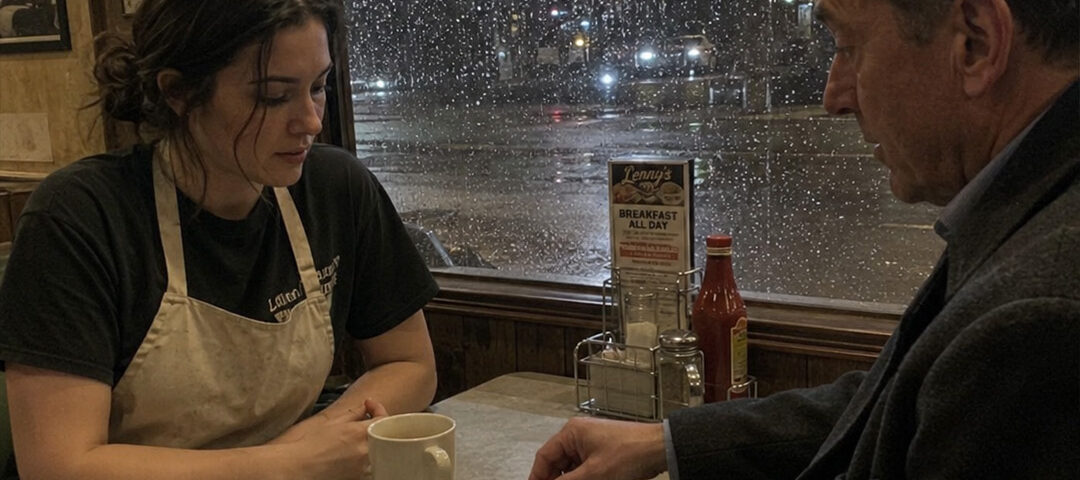
The Note Under The Coffee Cup
“You’re not safe here — pretend I’m your dad,” the well-dressed stranger whispered to the waitress. She froze for half a second, then forced a smile and played along. But when he quietly slid one small note across the table, everything about that night changed.
Catherine Alvarez read the note without moving her head.
Smile. Do not sign anything. Your full name is the key.
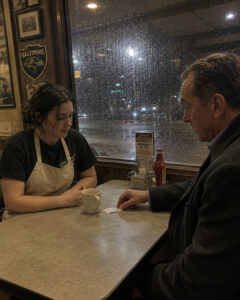
For a moment, the words meant nothing. They sat there on the torn edge of a receipt, written in black ink with a hand too steady for the madness of the moment. The stranger’s coffee sat untouched between them. A slice of lemon meringue pie, the last piece in the display case, leaned sadly on a white diner plate under the bright hanging light. Outside the front window of Melvin’s Diner, rain painted the Baltimore street silver and smeared the headlights of passing cars into long, restless lines.
Catherine’s apron was damp at the edges from wiping down tables. Her hair was twisted into a low bun that had started neat at four in the afternoon and had slowly surrendered through the dinner rush. She was twenty-three, tired down to the bones, and used to strange customers. Men who called her sweetheart. Couples who fought over the check. Truckers who left quarters under the sugar packets. College kids who stayed too long and tipped too little.
But she was not used to strangers who knew fear before she did.
The man across from her looked like he belonged in a private airport lounge, not a corner booth under a neon sign that buzzed whenever it rained. He wore a charcoal overcoat, a white dress shirt with the collar open, and a silver watch that caught the diner light whenever he moved. His hair was dark with gray at the temples. His face was calm, but not relaxed. There was a difference. Calm could be chosen. Relaxed had to be earned.
Two men in gray suits stood by the counter.
They had walked in three minutes earlier and asked for coffee they did not drink. One had scanned the room once and then stopped on Catherine. The other kept his right hand near the inside pocket of his jacket, not dramatic, not obvious, just close enough to make Catherine’s stomach tighten for reasons she could not explain.
The cook, Jimmy, was in the back humming along to an old radio station that played soft rock between weather updates. Mrs. Donnelly at table five was counting out cash from a coin purse. The lawyer who came every Thursday was reading the sports page and circling something with a red pen. Everything was ordinary, which made the wrongness sharper.
“Dad,” Catherine said, making the word land like a complaint instead of a question, “I already told you Mom doesn’t want a party.”
The stranger’s mouth moved, barely enough to count as a smile.
“Well,” he said, loud enough for the men at the counter to hear, “your mother has been avoiding celebrations since before you were born. Twenty-five years deserves a cake, whether she admits it or not.”
Catherine swallowed. The sentence was smooth. Too smooth. Like he had been waiting years to say it.
She forced herself to lean one hip against the booth and cross her arms the way she had seen irritated daughters do in movies. “You’re impossible.”
“That’s what she says.”
One of the men at the counter shifted. His polished shoe made a soft sound against the tile. Catherine could feel his attention moving over her face, over the stranger’s hand resting near the coffee cup, over the receipt between them.
The stranger picked up his spoon and tapped it once against the saucer. Not loud. Not enough to draw the diner’s attention. But the sound steadied Catherine somehow, like a cue in a play she had not rehearsed.
“My name is Russell Chase,” he said under his breath. “You do not know me. Your mother does.”
“My mother?” Catherine whispered.
His eyes flicked toward the counter. “Smile.”
Catherine showed her teeth.
“Good,” Russell said softly. “In about thirty seconds, you’re going to walk toward the back hallway like I asked for more napkins. You are not going to take your purse. You are not going to look at the front door. You are going to go into the staff restroom, lock it, and wait by the storage exit. I will meet you there.”
“No.”
The word came out before she could stop it. Too sharp. Too real.
Russell reached for the receipt and turned it over as if checking the price. “Those men did not come here for coffee.”
Her eyes darted to the counter. One of the gray suits now had his phone angled low, thumb moving across the screen.
Catherine thought of all the times her mother had changed apartments in the middle of a lease. Philadelphia to Baltimore. East side to west side. Fourth-floor walk-up to basement unit. One school to another. New grocery store, new bus route, new neighbors, new excuses. Her mother always had reasons. Rent went up. The area was changing. A landlord got strange. A man in a black sedan parked too long across the street.
Catherine had built resentment out of those reasons. Stacked it brick by brick until it became a wall between her and Linda Alvarez.
Now that wall had a small note under a coffee cup.
“Why should I trust you?” she whispered.
Russell’s expression changed. Not enough for anyone else to see. Just a flicker around the eyes, a deep old pain passing through and disappearing before it could be used against him.
“Because your father asked me to keep you alive long before you knew how to say his name.”
Catherine stopped breathing.
Her father was not a subject in the Alvarez apartment. He was a closed cabinet, a locked drawer, a room with no handle. Linda had told her only one story: Thomas Alvarez left before Catherine was born because some men were better at disappearing than staying. For years Catherine had repeated that sentence to herself until it hardened. She imagined him selfish, charming, forgetful. The kind of man who could laugh in a bar while a woman carried his child alone.
Russell’s voice cut through the memory.
“Walk now.”
Catherine moved because the men at the counter moved first.
She grabbed a stack of napkins from the service station, rolled her eyes toward Russell like an annoyed daughter doing an errand, and headed down the narrow back hallway. The staff restroom smelled faintly of bleach and lavender hand soap. Her hands shook so badly she missed the lock the first time. When the latch finally caught, she stood with her back against the door and pressed the receipt note to her chest.
Smile. Do not sign anything. Your full name is the key.
A minute later, there was one soft knock.
“Catherine,” Russell said from the other side. “It’s me.”
She opened the door. Russell stood in the hallway alone. Behind him, Jimmy’s radio kept humming from the kitchen as if nothing had happened. He gestured toward the storage exit.
“Go.”
The alley behind Melvin’s was wet, narrow, and cluttered with stacked crates from the morning produce delivery. A black Lincoln waited under the weak glow of a security light. Not flashy. Not new. Clean enough to belong to someone careful. Russell opened the rear door for her, and for one horrible second Catherine wondered if she had made the worst choice of her life.
Then the front door of the diner opened behind them.
The two gray suits stepped out under the awning, scanning the alley.
Russell did not touch Catherine. He did not pull or shove. He simply placed himself between her and the men, lifted one hand as if greeting old acquaintances, and said, “Evening, gentlemen.”
His calm was more frightening than panic would have been.
Catherine got into the car.
The door closed with a soft, expensive sound, and the world outside became muted behind tinted glass. Russell climbed into the driver’s seat ten seconds later, started the engine, and pulled away from the curb like a man leaving a restaurant after an ordinary meal. No screeching tires. No wild turns. Just steady movement through side streets Catherine had walked past a hundred times without ever noticing how many ways there were to disappear.
She sat upright, both hands gripping the receipt note.
“Who were they?” she asked.
“Representatives of a family called Rourke.”
“That tells me nothing.”
“It tells you enough for the next five minutes.”
“No, it doesn’t.” Her voice rose, then cracked. “You just made me leave work through the back like I was stealing from the register. You said something about my father. You said my mom knows you. You do not get to act like I’m supposed to sit here quietly.”
Russell glanced at her in the rearview mirror. “Your mother always said you had Thomas’s temper.”
Catherine hated the way her heart jumped at his name.
“You knew him?”
“Yes.”
“Was he really my father?”
Russell’s jaw tightened. “More than anyone ever let you believe.”
The car turned into a parking garage near the harbor and climbed three levels. The city noise faded floor by floor. Finally Russell parked in a far corner beneath a fluorescent light that flickered every few seconds. He turned off the engine. The silence that followed felt staged and heavy.
He opened the glove compartment and removed an old photograph.
Catherine did not take it right away.
Russell held it out between two fingers. “You should see him before you hear about him.”
The photo showed a man in his late twenties standing beside Russell, both of them younger, sharper, brighter. The man on the left had Catherine’s eyes. There was no poetic almost about it. The same dark almond shape. The same slight downward tilt at the outer corner. The same dimple in the left cheek, the one Catherine had always hated because it appeared whenever she was trying not to smile.
Thomas Alvarez looked alive in that photo. Not like an absence. Not like a story told to close a subject.
Catherine’s throat tightened. “My mother said he left.”
“Your mother said what I told her to say.”
The words struck harder because Russell did not soften them.
Catherine looked up. “You told her to make me hate him?”
“I told her to keep you from asking questions before you were old enough to survive the answers.”
“That is a very convenient way to describe lying.”
“Yes,” he said. “It is.”
The honesty took some of her anger and gave it nowhere clean to land.
Russell leaned back, rubbing one hand over his face. For the first time, he looked tired. Not tonight tired. Lifetime tired.
“Thomas worked for Rourke Maritime before it became Rourke Group. Logistics, payroll systems, internal routing. He was young, brilliant, and poor enough to think powerful people were offering him a ladder instead of a cage. By the time he understood what they were asking him to help hide, he was already useful to them.”
“What did they hide?”
“Money. Properties. Names. Charities that weren’t charities. Payroll deductions that never reached workers. Scholarship funds used to buy silence. Families pushed out of homes they had already paid for. Nothing that looked dramatic from far away. That was the genius of it. Paper can hurt people quietly.”
Catherine looked at the photograph again. Thomas’s smile now seemed less easy.
“He found records,” Russell continued. “Enough to expose decades of fraud. Enough to take Rourke apart in court. He copied everything and hid it before anyone realized what he had done.”
“What happened to him?”
The question came out small.
Russell looked toward the concrete wall as if the answer had been written there twenty-three years earlier and he still hated reading it.
“He died before he could bring it forward.”
Catherine closed her eyes. Even after a lifetime of believing Thomas had chosen to leave, the word died opened a door in her chest she had not known was there.
“How?”
“A late meeting at a warehouse near the harbor. Officially, an accident. Unofficially, nobody who cared about Thomas believed that story for one minute.”
Catherine’s fingers tightened around the photograph.
Russell kept his voice level. “Your mother was seven months pregnant. Thomas made me promise that if anything happened to him, I would keep both of you away from Rourke until the evidence could be found or until they stopped looking.”
“And did they stop?”
“No.”
The fluorescent light flickered above them.
Catherine laughed once, without humor. “So my whole life? The moves? The fake names on mailboxes? My mom checking the peephole before opening the door? That was you?”
“That was survival.”
“That was prison with a nicer word.”
Russell accepted the blow without flinching. “Maybe.”
“I turned down college because she cried for three days when I got accepted out of state.” Catherine’s voice shook with old rage. “I stayed in Baltimore because she said she couldn’t manage without me. I have spent my entire life shrinking to fit inside her fear.”
“Your mother did not fear shadows, Catherine.”
“No. She feared the truth. And now you want to hand it to me in a parking garage like a tip receipt?”
Russell said nothing.
Catherine stared at the note again. “What does my full name have to do with this?”
Russell’s eyes lifted to hers in the mirror. “That is the part I never understood.”
By the time Russell drove her home, rain had thinned to mist. Catherine’s apartment building sat on a narrow street lined with wet brick row houses and small porches crowded with plants. A neighbor’s porch flag hung limp from its pole. Someone had left a grocery flyer wedged in the front door. The place looked exactly the way it had that morning, which made it feel like a liar.
Catherine climbed the stairs ahead of Russell, her keys trembling in her hand. Apartment 4C smelled like garlic, lemon cleaner, and the chamomile tea Linda drank every night before bed. The television was on low in the living room. Linda Alvarez stood at the kitchen island folding dish towels, her dark hair streaked with silver and pulled back in a clip.
She looked up when Catherine entered.
Then she saw Russell behind her.
The towel slipped from her hands.
“No,” Linda whispered.
One word. Twenty-three years inside it.
Catherine shut the door. “So you do know him.”
Linda’s eyes filled instantly. “Cathy—”
“Don’t Cathy me. Not tonight.” Catherine held up the photograph. “Is this my father?”
Linda pressed one hand to her mouth.
“Answer me.”
“Yes.”
The room seemed to tilt. The old apartment, the chipped mug by the sink, the grocery list held to the fridge by a crab-shaped magnet, the mail stacked beside the toaster — all of it suddenly belonged to a life built on edited sentences.
Catherine placed the photograph on the kitchen island.
“You told me he left.”
Linda gripped the counter. “I told you what I had to tell you.”
“No.” Catherine’s voice rose, but she kept it from breaking. “You told me what made me stop asking.”
Linda looked at Russell, desperate and accusing. “You said she was safe.”
“They found her at the diner,” Russell said quietly. “Two Rourke men. They had documents ready.”
Linda sat down hard on the nearest chair.
Catherine noticed the reaction. Not confusion. Recognition.
“What documents?” she asked.
Russell removed a folded sheet from inside his coat and placed it beside the photograph. “One of them dropped this when he turned in the alley.”
It was a legal acknowledgment addressed to Catherine Soledad Alvarez. The name was printed in full across the top. Soledad. The middle name her mother had treated like a curse. Catherine had been told never to use it on forms unless absolutely necessary. In school, Linda had argued with administrators. At the DMV, she had corrected a clerk three times, insisting the initial S was enough.
Catherine looked at her mother. “Why is my middle name on this?”
Linda’s face crumpled.
“Because your father chose it,” she said.
The apartment went quiet except for the low murmur of the television. Linda stood slowly, moved to the refrigerator, and pulled it away from the wall with a strained scrape. Catherine watched, stunned, as her mother reached behind it and peeled loose a manila envelope taped flat against the back panel.
Dust clung to the envelope. The edges were soft with age.
Linda set it on the kitchen island with both hands.
“I promised myself I would give you this when you were thirty,” she said. “Then when you were thirty, I thought maybe thirty-five. Then I told myself if you got married, or if I got sick, or if the Rourkes stopped asking questions.” She swallowed. “There was always another reason to wait.”
Catherine stared at the envelope. “Open it.”
Linda did.
The first thing that slid out was a hospital bracelet, yellowed with age, wrapped around a tiny knitted cap. Next came photographs. Thomas standing beside Linda at the harbor, one arm around her shoulders. Thomas at a diner booth, laughing at something outside the frame. Thomas kneeling in front of a half-painted nursery wall, holding a small brush and wearing a grin so wide it looked almost foolish.
Catherine touched that photo with two fingers.
“He painted a nursery?”
Linda covered her mouth. Tears slipped through her fingers.
“He painted it yellow because we didn’t know yet,” she said. “He said yellow was brave.”
Catherine bent over the island, breathing carefully.
There was a letter at the bottom of the envelope. The paper had been folded and unfolded so many times the creases were soft as cloth. Linda did not touch it. Russell did not move. Catherine picked it up herself.
My little Catherine Soledad,
If your mother is giving you this, then the world has not been kind enough to let you remain untouched by my choices. I am sorry for that. I wanted you to inherit my love, not my trouble. I wanted your first memories to be pancakes, library cards, and your mother singing off-key in the kitchen. If I failed to give you that, forgive me.
Your name matters. Catherine because your mother said it sounded strong. Soledad because I needed one word that meant comfort after a life of noise. Alvarez because whatever they say about me, you are mine, and I loved you before I ever saw your face.
If Russell is still with you, trust him. If your mother seems afraid, remember she carried two lives when she ran: yours and the life she wished we could have had.
The truth is hidden where your mother first told me about you.
Third plank from the left.
Every letter counts.
— Dad
The last word blurred.
Dad.
Catherine pressed the paper flat against the island as if it might disappear. She had spent her whole life training herself not to want that word. Now it sat in front of her in ink that had outlived him.
“Where?” she asked.
Linda closed her eyes. “Harbor Park. The bench near the lighthouse view.”
Russell exhaled slowly. “Thomas said ‘somewhere she’d never think to look.’ I thought he meant you.”
Linda gave him a shattered smile. “He always thought he was more clever than he was.”
For one second, the three of them almost looked like a family assembled by grief instead of blood. Then the building intercom buzzed.
Linda flinched so hard the chair legs scraped the floor.
Catherine moved toward the speaker, but Russell lifted a hand.
“Don’t answer.”
The buzzer sounded again.
Then Catherine’s phone lit up on the kitchen island. Unknown number. A message appeared.
Miss Alvarez, we need only five minutes. Signing tonight protects everyone.
Attached was a photograph of Melvin’s Diner, taken from across the street.
The room changed.
It was not chaos. It was worse than chaos. It was three people becoming completely still because the same thought had entered all of them at once.
Russell picked up the legal acknowledgment and scanned the bottom. “They want your signature because your full name activates standing.”
“Standing for what?” Catherine asked.
“For whatever Thomas hid.”
Linda whispered, “They found out about Soledad.”
Catherine looked from her mother to Russell, then down at her father’s letter. For years, fear had been something passed to her without explanation. A household rule. A warning tone. A reason to cancel plans. But now fear had shape. It had stationery, legal language, gray suits, and a family name printed at the top of documents.
She folded the letter carefully and placed it back inside the envelope.
“No more moving,” she said.
Linda stared at her. “Catherine, you don’t understand—”
“I understand enough.” Catherine’s voice was calm in a way that surprised even her. “I spent my whole life obeying a story I was never allowed to read. Now I have the first page.”
Russell watched her for a long moment. “Your father sounded exactly like that the week before he died.”
“Then maybe he left me something besides his eyes.”
The buzzer sounded a third time.
Catherine walked to the intercom and pressed the button.
A man’s voice came through, polished and pleasant. “Miss Alvarez, my name is Daniel Cross. I represent Rourke Group. We do not want to disturb your evening.”
Catherine looked at Russell. He shook his head once, warning her not to speak. She spoke anyway.
“You already did.”
A pause.
“Then allow us to make it brief. There are legacy matters involving your late father. A simple acknowledgment will prevent unnecessary discomfort for your family.”
Linda whispered, “Hang up.”
Catherine’s gaze stayed on the manila envelope. “My father’s name was Thomas Alvarez.”
Another pause, smaller this time, but there.
“Yes,” Cross said. “That is correct.”
“It took me twenty-three years to hear the truth about him. I’m not signing anything after a five-minute hallway pitch.”
The politeness drained slightly from his voice. “This is not a pitch.”
“No,” Catherine said. “It’s pressure dressed as paperwork.”
Russell almost smiled.
Catherine released the button.
For a full minute, nobody spoke. Footsteps moved in the hallway outside, then faded down the stairs. A car door closed on the street below.
Linda sank into the chair again. “You should not have done that.”
“Maybe not,” Catherine said. “But it felt good.”
The search began before dawn.
Russell insisted they wait until morning because darkness made old fear louder. Catherine did not sleep. She sat at the kitchen table with her father’s letter, the photograph of the yellow nursery, and the receipt note lined up in front of her like evidence in a trial. Linda made coffee neither of them drank. Around five, the first buses started sighing at the corner. By six, the city was gray-blue and damp, waking into itself.
Harbor Park was almost empty when they arrived.
A man in a hooded sweatshirt jogged past with earbuds in. A woman in a red coat walked an old terrier that stopped to sniff every bench leg. The lighthouse across the water blinked slowly, softened by mist. Catherine had passed this park dozens of times without knowing it held the center of her life.
Linda led them to a weathered bench facing the harbor.
“This one,” she said.
Her voice had changed. Softer. Younger. As if the woman who had once stood there with Thomas was still trapped beneath the woman who had spent twenty-three years looking over her shoulder.
“He brought coffee in paper cups,” Linda said. “I was so nervous I spilled mine on his shoes. I told him I was pregnant, and he just sat down right here like his knees stopped working. I thought he was upset.” A small broken laugh escaped her. “Then he cried. Not loudly. Just put his head in his hands and cried. When he looked up, he said you were his chance to do one clean thing.”
Catherine sat on the bench.
The wood was cold through her jeans.
Russell knelt and counted planks from the left. One. Two. Three. The third plank was slightly warped, its screws rusted but intact. He took out a small multitool and began working carefully, not rushing, not forcing. Catherine watched his hands, steady despite the weight of two decades.
The plank came loose with a soft groan.
Under it was a narrow metal box wrapped in layers of old plastic and sealed with tape that had yellowed at the edges. Russell lifted it with both hands and set it on the bench between them.
The lock had four small wheels, each with letters instead of numbers.
Catherine looked at her mother.
Linda nodded, tears already forming.
Catherine turned the wheels slowly.
CATHERINESOLEDADALVAREZ.
Every letter counted.
The lock clicked.
Inside the box were documents packed so tightly they had barely shifted over time. Copies of ledgers. Partnership agreements. Internal memos. Deeds. Payroll records. A small bundle of photographs. A flash drive sealed in a plastic sleeve. At the very top was a note in Thomas’s handwriting.
For my daughter. For the court. For every family they taught to feel powerless.
Catherine did not cry then.
The moment was too big for tears.
She touched the note, then lifted the first folder. The top page showed Thomas Alvarez listed as a founding systems partner in an early Rourke subsidiary. Not an employee. Not a disposable name in a payroll file. A partner. Beside his signature was Victor Rourke’s.
Russell leaned over her shoulder. His face hardened.
“They erased him,” he said. “Not just from the scandal. From the company.”
Linda took the paper with trembling hands. “Thomas said he was owed shares. He said he would use them as leverage. I thought he was just trying to reassure me.”
Catherine lifted another document. A resignation letter supposedly signed by Thomas two days after the night he died.
She looked up slowly.
“My father signed papers after he was gone?”
Russell’s eyes darkened. “Apparently Victor thought the dead made quiet employees.”
Catherine turned the page. More signatures. More transfers. More documents removing Thomas from ownership, redirecting his stake, and burying his claims under layers of corporate language. At the bottom of the box was a brass key taped to a bank receipt and a card from a downtown law office that no longer existed.
Before anyone could speak, footsteps approached on the path.
An older man in a camel coat walked toward them, flanked by Daniel Cross and the second gray-suited man from the diner. The older man had silver hair, a trim beard, and the polished sadness of someone who had practiced sympathy in mirrors. Catherine knew who he was before Russell said his name.
Victor Rourke.
He stopped a respectful distance away, hands visible, expression mild. “Miss Alvarez.”
Russell stood immediately.
Victor gave him a weary smile. “Russell Chase. Still faithful to ghosts.”
Catherine rose with the metal box in her hands.
Victor looked at it, and for the first time, the calm slipped. Not much. Just enough.
“I see Thomas remained sentimental,” he said.
Catherine heard her mother’s breath catch beside her.
Victor’s eyes moved to Linda. “Mrs. Alvarez. You look well.”
Linda’s voice was barely above a whisper. “You don’t get to speak to me like an old friend.”
“No,” Victor said. “I suppose I do not.”
The jogger had disappeared. The woman with the terrier had turned down another path. The park felt staged again, as the diner had. Ordinary things holding extraordinary pressure.
Victor looked back at Catherine. “Whatever Russell has told you, I imagine it was emotional.”
“He told me my father didn’t abandon me.”
“That part is true.”
The admission was so smooth it made Catherine angrier.
Victor continued. “Thomas was gifted. He was also reckless. He collected information he did not fully understand and convinced himself he could use it to fix matters far larger than himself.”
“Matters,” Catherine repeated. “That’s a careful word.”
“I have found careful words prevent unnecessary harm.”
Russell stepped forward. “You are not here for language.”
“No,” Victor said, eyes still on the box. “I am here to offer a way forward. Catherine, you are young. You work long hours in a diner. Your mother has lived under strain for too many years. I can end that by lunch.”
Daniel Cross opened a leather folder and removed a cashier’s check.
The amount printed on it made Linda grip the bench.
Victor watched their faces. “This is not an admission. It is closure. You give us the box. You sign an acknowledgment confirming your father transferred all interests voluntarily. In return, your mother never worries about rent again. You can go to college anywhere you like. Russell can retire from his crusade. Everyone gets peace.”
The old Catherine might have looked at the check and seen freedom. Tuition. A better apartment. A new car for her mother. Dental work Linda kept postponing. A life without double shifts and diner grease in her hair.
This Catherine looked at the check and saw a price tag tied to her father’s name.
“My father left this for court,” she said.
Victor sighed softly. “Courts are slow. Public attention is cruel. Families do not heal under fluorescent lights and legal filings.”
“No,” Catherine said. “They heal when people stop buying their silence.”
Daniel Cross stiffened. Victor’s eyes cooled.
“You have Thomas’s stubbornness,” he said.
“And Linda’s memory,” Catherine replied. “And Russell’s note.”
Victor glanced at Russell. “What note?”
Catherine smiled then. Not wide. Not warm. Just enough to show she finally understood the game.
“The first one,” she said. “The one he slid across the diner table telling me not to sign anything. He wrote another number on the back.”
Russell’s eyebrow lifted.
Catherine turned the receipt over. Beneath the warning, written small in the corner, was the name Amanda Chen and a phone number. Catherine had called it from the staff restroom before she opened the storage exit. She had not known who Amanda was then. She only knew Russell had told her to trust the note.
“Amanda is a civil attorney,” Catherine said. “She specializes in corporate fraud and estate recovery. She has photos of this box, the documents we opened, your cashier’s check, and a live recording of this conversation.”
Daniel Cross went pale.
Victor turned very still.
Catherine held his gaze. “Smile, Mr. Rourke. You’re on record.”
That was the first power shift.
The second came three days later in a courthouse hallway downtown.
Amanda Chen was not what Catherine expected. She was compact, sharply dressed, and spoke with the crisp efficiency of someone who could fit a tornado inside a legal brief. She filed an emergency petition to preserve evidence, halt any transfer connected to Thomas Alvarez’s disputed partnership interest, and compel Rourke Group to produce original records from the years surrounding his disappearance from company documents.
Victor’s legal team arrived with six people, three rolling cases, and the confidence of a corporation that had outlived every ordinary person who challenged it.
Catherine arrived with her mother, Russell, one metal box, and a navy folder Amanda had labeled simply: ALVAREZ ORIGINALS.
The hallway outside the courtroom smelled like coffee, wool coats, and old paper. Catherine wore the only blazer she owned, bought on clearance two years earlier for a job interview she never attended because Linda had begged her not to change her schedule. Her shoes pinched. Her stomach twisted. But when Victor Rourke stepped off the elevator and saw her standing there, she did not look away.
He stopped beside her.
“This can still be resolved privately,” he said.
Catherine looked at the polished floor between them. “My father died privately. My mother suffered privately. I think we’re done with private.”
Victor’s mouth tightened.
Inside the courtroom, his attorneys argued that Thomas had left voluntarily, signed away his interests, and created confusion his daughter was now exploiting through emotion. They spoke of stale claims, lost records, sentimental documents, and unreliable memories. Catherine listened as men in expensive suits turned her father into a clerical inconvenience.
Then Amanda stood.
She did not raise her voice. She did not perform. She placed one original partnership document under the evidence camera and let the courtroom monitor fill with Thomas Alvarez’s signature beside Victor Rourke’s.
“Your Honor,” Amanda said, “we are not here because of a family rumor. We are here because Rourke Group has relied for more than two decades on documents allegedly signed by a man after the date their own internal correspondence confirms he was no longer available to sign anything.”
The room shifted.
A small sound moved through the benches behind Catherine. Paper stopped rustling. One of Victor’s lawyers leaned toward another and whispered too quickly.
Amanda placed the resignation letter beside the original signature. “The signatures do not match. The dates do not match. The payment records do not match. And this morning, after receiving our preservation notice, Rourke Group attempted to classify the files as routine archives scheduled for off-site disposal.”
The judge looked over his glasses. “They attempted to move records after notice?”
Amanda handed up another sheet. “We have the email.”
Daniel Cross lowered his head.
Catherine looked at Victor. For the first time, he did not look back.
That was the third shift.
The fourth came when Linda took the stand.
Catherine had feared this most. Her mother had spent twenty-three years surviving by shrinking the truth until it fit inside a suitcase. Now she had to unfold it in front of strangers.
Linda’s hands shook as she swore to tell the truth. But her voice held.
She described the constant moves. The envelopes left at old addresses. The landlord who suddenly refused to renew after asking too many questions about Catherine’s school forms. The man from Rourke Group who approached her outside a grocery store when Catherine was nine and said, “Some names are safer when forgotten.” She described Russell arriving with cash for deposits, false explanations, and the same tired apology every time.
Then Amanda handed her the letter from Thomas.
Linda read the first line aloud and broke.
My little Catherine Soledad.
The courtroom waited.
Catherine wanted to stand, to go to her mother, to undo every hard word she had said in the apartment. But Linda wiped her face, took a breath, and continued. When she finished, nobody spoke for several seconds.
Even the judge looked down at his papers longer than necessary.
Victor’s lead attorney rose for cross-examination. He was polite in the way polished people are polite when they mean to cut. “Mrs. Alvarez, isn’t it true you accepted financial support from Mr. Chase for years?”
“Yes.”
“And isn’t it true you moved repeatedly without any court order requiring you to do so?”
“Yes.”
“So much of this story depends on fear you cannot document.”
Linda looked at him.
Then she looked at Catherine.
“No,” she said. “It depends on a daughter I kept alive and a husband whose name your clients buried because a dead man was easier to manage than an honest one.”
A quiet breath moved through the courtroom.
Catherine’s eyes filled.
Russell, seated behind her, placed one hand on the back of her chair. Not touching her shoulder. Just there.
By the end of the hearing, the judge ordered Rourke Group to preserve and produce all relevant records, froze the disputed shares connected to Thomas Alvarez’s original partnership, and appointed an independent forensic accountant to review the documents. It was not the ending. Amanda warned Catherine that legal truth moved slower than emotional truth.
But as they walked out, reporters from local business papers were already waiting.
Victor Rourke kept his chin high, but his eyes had changed. The certainty was gone.
In its place was calculation.
Three months passed in a blur of filings, depositions, coffee cups, and old paper. Catherine still worked at Melvin’s, but fewer shifts. Jimmy joked that she had become “fancy court people” because she now carried a leather folder instead of a server pad. Mrs. Donnelly started leaving newspaper clippings beside her tips. Customers who recognized her from the business section tried to ask questions, and Catherine learned to say, “I’m letting the process speak,” in a tone that ended conversations.
At home, she and Linda learned how to speak again.
Not perfectly. Not softly at first. Some nights ended with doors closing. Some mornings began with apologies neither of them fully knew how to give. Catherine still had anger. Linda still had fear. But the manila envelope stayed on the kitchen island for weeks, not hidden, not taped behind anything. Sometimes Catherine would find Linda standing over Thomas’s photograph, touching the edge of the yellow nursery picture.
“I should have told you he loved you,” Linda said one night.
Catherine stood in the doorway. “Yes.”
Linda nodded, accepting the wound without defending it. “I thought if you missed him, they could use it. I thought if you hated him, you would never go looking.”
“I did hate him.”
“I know.”
“That hurt me.”
“I know.”
The silence after that was not empty. It was work.
Russell came by often but never stayed long. He fixed a loose lock on the apartment door, replaced a broken kitchen chair, and left before gratitude could become too tender. Catherine began to understand him as a man built almost entirely out of promises. He had not married. Had no children. Owned little that could not fit in his car. Thomas had asked him to keep watch, and Russell had mistaken that for a life.
One evening, Catherine found him sitting on the front steps with two coffees from a corner shop.
“You don’t have to keep doing this,” she said.
He handed her one. “I know.”
“Do you?”
A faint smile tugged at his mouth. “I’m learning.”
She sat beside him. Traffic moved along the wet street. A siren sounded far away, ordinary city noise, nothing to do with them.
“My father was your best friend,” she said.
“Yes.”
“And I was his daughter.”
“Yes.”
“What am I to you?”
Russell looked down at his coffee cup.
For once, the answer did not come easily.
“At first?” he said. “A promise. Then a responsibility. Then a kid I watched grow up from across streets and school parking lots and diner windows.” His voice roughened. “Somewhere along the way, you became family. I just never had permission to say so.”
Catherine looked at him for a long moment.
“You can say it now,” she said.
Russell nodded, but he did not speak.
He did not have to.
The final power reversal came at Rourke Group headquarters, in a glass conference room overlooking the harbor.
The forensic accountant had completed her report. The findings were worse than anyone outside Rourke had expected and exactly as bad as Thomas’s box suggested. His ownership had been removed through documents the court now deemed deeply questionable. Payments had been routed through shell vendors. Families who had joined Rourke housing programs had been charged fees never disclosed in their contracts. Scholarship accounts had been drained and renamed until the original donors could no longer trace them.
Amanda negotiated with a precision that frightened everyone except Catherine.
Rourke Group could fight for years, but every month would bring more public filings, more discovery, more reputational damage, and more families coming forward. Investors were restless. Board members were angry. Victor’s allies began stepping away one by one, issuing statements about transparency and review.
Then Amanda called.
“They want mediation,” she said.
Catherine stood behind the counter at Melvin’s, coffee pot in hand. “Do they want mediation or surrender?”
Amanda laughed softly. “They think it’s mediation. Wear something that makes you feel taller.”
The conference room smelled like glass cleaner and expensive anxiety. Victor sat at the head of the table when Catherine entered, as if the chair itself could protect him. Daniel Cross sat to his left, pale and thinner than before. Two board members avoided eye contact. A woman from investor relations kept rearranging her pen.
Catherine wore a navy dress, low heels, and her father’s brass key on a chain beneath her collar.
Amanda set the ALVAREZ ORIGINALS folder on the table.
Victor opened with dignity. “For the sake of all involved, Rourke Group is prepared to create a compensation fund and issue a statement acknowledging certain historic irregularities.”
“Irregularities,” Catherine said. “There’s that careful word again.”
Victor’s gaze sharpened. “Miss Alvarez, if you are looking for theatrical satisfaction, you will be disappointed. Business resolutions require restraint.”
Catherine nodded. “Good. Then I’ll be restrained.”
She opened her folder and placed Thomas’s partnership agreement on the table.
“My father’s shares are to be restored to his estate. Their present value will be calculated independently. The housing and scholarship funds will be repaid with interest. Every family affected will receive notice, not a buried web statement. The company will issue a public correction clearing Thomas Alvarez’s name. And you will step down from the board.”
The investor relations woman stopped moving her pen.
Victor’s face remained composed, but one hand curled slightly against the table.
“That is not a proposal,” he said.
“No,” Catherine replied. “It’s the quiet version.”
Amanda slid another folder forward. “The louder version includes filing the deposition excerpts currently under seal, including Mr. Cross’s testimony regarding record movement after the court’s preservation order.”
Daniel Cross closed his eyes.
One of the board members whispered, “Victor.”
The name sounded less like loyalty than warning.
Victor looked around the table and finally saw what Catherine had seen: the room no longer belonged to him. The people beside him were not protecting him. They were calculating distance.
Catherine leaned forward.
“You told me in the park that courts are slow,” she said. “You were right. But you forgot something. Slow doesn’t mean weak.”
Victor stared at her.
For a second, she saw the man who had frightened her mother for decades. Then she saw what he was beneath the tailored suit and practiced sorrow: an old man who had built a fortress out of paper and believed nobody poor, young, or grieving would know how to read it.
He signed before sunset.
Rourke Group’s public correction ran the next morning. Thomas Alvarez had not abandoned his responsibilities. He had not voluntarily surrendered his ownership. He had raised concerns regarding company conduct that were never properly addressed. The language was still corporate, still careful, still scrubbed of anything that looked like a confession. But his name was there, attached to courage instead of disgrace.
For Linda, that was enough to make her sit at the kitchen table and cry until Catherine wrapped both arms around her.
For Russell, it was enough to make him stand on the fire escape for twenty minutes, staring at nothing, while his coffee went cold.
For Catherine, it was not enough.
So she used part of the settlement to create the Thomas Alvarez Fund, not as a grand foundation with gala dinners and glossy brochures, but as a practical fund with lawyers, accountants, and tenant advocates. It helped families read contracts before signing them. It paid filing fees. It hired translators. It covered motel rooms for people who needed two safe nights to think clearly before agreeing to something that would shape the next ten years of their lives.
Paper could hurt people quietly.
Catherine decided paper could protect them loudly.
One year after Russell slid the note across the diner table, Catherine stood at Harbor Park beside the bench where everything had been hidden. The city had repaired the plank but left it slightly different from the others, a narrow line in the wood marking where the past had opened. A small bronze plaque sat on the back of the bench.
Thomas Alvarez
Beloved husband and father.
He chose truth when silence was easier.
Linda stood on one side of Catherine. Russell stood on the other, hands in the pockets of his overcoat, pretending not to be moved. Jimmy from Melvin’s had closed the diner for two hours and brought a tray of coffee in paper cups. Mrs. Donnelly came with flowers wrapped in grocery-store plastic. Amanda arrived late, carrying two phones and looking like she had already won an argument that morning.
Catherine placed the old receipt note beneath the flowers.
Smile. Do not sign anything. Your full name is the key.
The ink had faded slightly. The message had not.
Linda touched the plaque. “He would have loved this.”
Catherine looked at the water. “He would have hated all the attention.”
Russell gave a quiet laugh. “He would have pretended to hate it.”
For a while, they stood without speaking. The harbor moved under the morning light. A gull landed near the railing and strutted like it owned the city. Somewhere behind them, traffic carried people to work, to school, to appointments, to ordinary lives they did not know how lucky they were to trust.
Catherine had been accepted into the University of Maryland’s legal studies program for the spring semester. She still worked weekends at Melvin’s because leaving all at once felt wrong, and because Jimmy threatened to ruin every omelet in Baltimore if she abandoned him completely. Linda had started painting again, small watercolors of row houses, lemons, coffee cups, the view from the bench. Russell had rented an apartment two blocks away and claimed it was for convenience, not sentiment.
Nobody believed him.
After the small memorial, Catherine walked alone to the end of the path. Russell joined her a minute later.
“You okay?” he asked.
She looked at him. “You know, the first thing you ever said to me was to pretend you were my dad.”
His face tightened. “I’m sorry.”
“Don’t be.” She watched the water catch the sun in broken pieces. “It worked.”
Russell looked away, blinking once.
Catherine smiled softly. “You don’t have to pretend anymore.”
He cleared his throat. “Your father would have been proud of you.”
“For finding the box?”
“For putting down the check.”
She laughed under her breath. “That check was tempting.”
“I know.”
“I thought about college. Rent. Mom’s teeth. A car that doesn’t make that clicking sound.”
“And?”
“And then I thought about him painting a yellow nursery.”
Russell nodded slowly.
Catherine reached into her coat pocket and pulled out the brass key. It no longer opened anything. The bank office was gone. The box had been emptied. The evidence was in court archives and secured files and the hands of people who could use it. But the key had weight. Proof did not stop mattering just because the door had opened.
She closed her fingers around it.
“For twenty-three years,” she said, “my life was shaped by a secret I didn’t choose.”
Russell said nothing.
“Now I get to choose what it becomes.”
Behind them, Linda called Catherine’s name. Jimmy was handing out coffee. Amanda was arguing with the city parks coordinator about plaque maintenance. Mrs. Donnelly had cornered Daniel Cross, who had come quietly and unexpectedly, and appeared to be lecturing him about conscience with a paper cup in one hand.
Catherine looked at Russell. “Breakfast?”
He smiled. “Anywhere but Melvin’s?”
She shook her head. “No. Melvin’s. I want to walk in the front door this time.”
They did.
The bell over the diner door rang the same way it always had. The same neon sign buzzed. The same pie case hummed in the corner. But Catherine did not feel like the same woman crossing the black-and-white tile. A year earlier, she had left through the back hallway with a receipt note in her palm and fear in her throat. Now she walked in beside her mother and the man who had kept an impossible promise, carrying her father’s name without flinching.
Jimmy lifted a coffee pot from behind the counter. “Booth six?”
Catherine looked toward the corner booth where Russell had first sat. The table was clean. The sugar packets were straight. The overhead light glowed warm instead of harsh.
“Yes,” she said. “Booth six.”
They sat together.
Linda ordered pancakes. Russell ordered coffee. Catherine ordered lemon meringue pie for breakfast because some days deserved to begin badly and beautifully at the same time.
When the waitress brought the check, Catherine reached for it out of habit.
Russell covered it with his hand.
“My turn,” he said.
Catherine raised an eyebrow. “Dad move?”
He smiled down at the bill, then at her.
“Family move.”
Catherine let him pay.
Outside, Baltimore moved on. Inside, the diner filled slowly with morning noise — forks against plates, coffee pouring, a child laughing in the next booth, the soft rustle of newspapers opening. Ordinary sounds. Sounds no one had to fear.
Catherine unfolded a fresh napkin and took the brass key from her pocket. She placed it beside her plate, not hidden, not buried, not taped behind anything.
Linda looked at it, then at Catherine.
“You’re keeping it?”
Catherine nodded.
“It reminds me that a locked thing is not always lost,” she said. “Sometimes it is waiting for the right person to stop being afraid of the door.”
Russell lifted his coffee cup. Linda lifted hers. Catherine lifted her water glass because she had already had too much coffee and because her mother was watching.
“To Thomas,” Russell said.
“To the truth,” Linda whispered.
Catherine looked at the booth, the note in her memory, the two people beside her, and the life ahead of her no longer shrinking to fit inside somebody else’s fear.
“To full names,” she said.
And for the first time, Catherine Soledad Alvarez said every part of herself out loud and heard no danger in it at all.