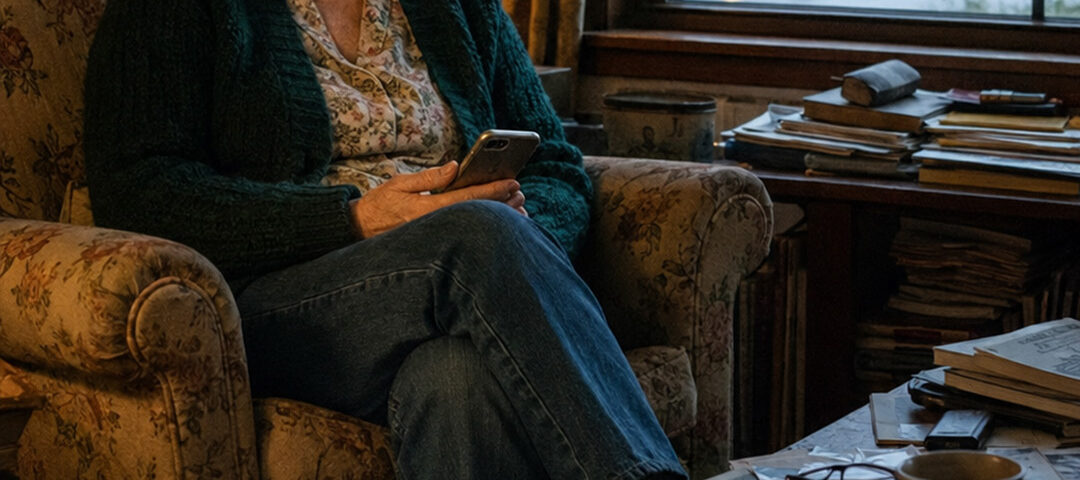
THE NIGHT I STOPPED BEING THEIR BANK
At two o’clock in the morning, my phone lit up the dark bedroom with my son’s name.
Julian.
For one soft, half-dreaming second, I thought it was Arthur.
That happens sometimes when you have been a widow for twenty years. Sleep opens a little door, and the past walks through wearing its old face. In my dream, Arthur had been standing at our kitchen counter, making Sunday coffee the way he always did, with too much sugar in mine and none in his. He was humming under his breath, some old jazz tune he never knew all the words to. I could smell toast. I could hear the spoon tapping the rim of the mug.
Then the phone buzzed again.
The dream vanished.
The bedroom was cold. My cream-colored walls looked pale and flat in the phone’s light. The electric candle beside Arthur’s framed photograph glowed on the nightstand. Outside the window, the street was wet from rain I had slept through.
I reached for the phone because mothers reach.
Even at seventy-two.
Even when they already know.
“Mom,” Julian said, before I could speak. His voice came through tight and breathless. “Mom, I need you to listen to me. I’m in serious trouble.”
I sat up, my back protesting. The mattress made its familiar small creak beneath me.
“What happened?”
“Your card was declined at the hotel.”
I closed my eyes.
Not he was sick.
Not Caroline was hurt.
Not Mia needed help.
Your card was declined.
“We’re at the front desk,” he continued, talking fast now. “The resort manager won’t let us check out until the balance is handled. It’s embarrassing, Mom. Caroline is crying. People are staring. This is a five-star resort in Las Vegas. You have to send nine thousand dollars right now.”
Nine thousand dollars.
At two in the morning.
As if he were asking me to pass the salt.
I turned on the small lamp. Its yellow light filled the room and settled over the objects that made up my quiet life: the dresser I inherited from my mother, the old quilt folded at the foot of the bed, the slippers Mia bought me two Christmases ago, the little stack of library books I had been too tired to read.
Julian kept talking.
“The hotel says if we don’t settle it, they’ll file a formal complaint. I told them it was a mistake, that my mother always handles these things. I told them you gave me that authorized card for emergencies.”
“This is an emergency?”
“Yes!” His voice rose. “Mom, come on. Don’t do this. I can’t have Caroline standing here like this. We paid for the shows, the dinners, the suite upgrade. I thought the card had enough available. You’ve always helped before.”
That was true.
I had always helped.
That was the whole problem.
“Mom? Are you listening?”
I looked at Arthur’s photograph.
He was smiling in that picture, one shoulder turned slightly toward the camera, his eyes warm behind wire-rimmed glasses. The picture had been taken three months before the heart attack that took him from me at fifty-six. He had been healthy then, or so we thought. Still working. Still teasing me for saving grocery coupons in a rubber-banded stack. Still telling me I needed to buy better shoes.
“Eleanor,” he would say, “you can’t walk through life acting like your feet don’t matter.”
My feet were in old slippers now. My left heel had been bothering me for months because I refused to spend one hundred fifty dollars on walking shoes.
But Julian was asking for nine thousand dollars for a Las Vegas resort bill.
“Call your wife,” I said.
There was a pause.
“What?”
“Call Caroline.”
“She’s standing right here. She’s upset.”
“Then solve it together.”
“Mom, what are you saying?”
“I’m saying I’m going back to sleep.”
I ended the call.
Then I turned the phone off.
For a moment, I sat very still, waiting for guilt to arrive like it always did. Usually, guilt came fast. It came with Julian’s voice. It came with Caroline’s sighs. It came with memories of him as a little boy, crying into my skirt after Arthur’s funeral, promising me we would always take care of each other.
But that night, guilt did not come.
Only silence.
Clean silence.
I placed the phone face down on the nightstand, lay back against the pillow, and listened to the rainwater dripping from the gutter outside.
My heart was steady.
My hands did not shake.
For the first time in years, I slept through another person’s crisis.
Morning came bright and clear.
Sunlight poured through the window and landed across the foot of my bed. I woke slowly, stretching my fingers, my knees, my shoulders. There is a particular sound a body makes after seventy years of carrying other people’s weight. Not pain exactly. More like an old house settling.
I put on my brown slippers and walked into the kitchen.
The apartment was small but mine. Two bedrooms, one bathroom, narrow kitchen, old linoleum floor, radiator that hissed like an irritated cat in winter. The refrigerator had been making a low grinding sound for nearly a year. The television in the living room had a green line across one corner of the screen. There was a water stain near the ceiling in my bedroom that I had been meaning to repair.
Meaning to.
But every time I saved enough money to fix something, Julian needed something more urgent.
A car repair.
A tuition gap.
A vacation deposit he swore would be “the last big thing for a while.”
A new laptop.
Furniture.
House maintenance.
Dinner expenses.
Mia’s school needs.
Caroline’s birthday trip.
Always something.
I filled the kettle and set it on the stove. While the water heated, I looked out the kitchen window. Mrs. Higgins from the apartment across the courtyard was walking her little white poodle. An orange tabby cat balanced along the fence as if the whole world had been built for its convenience.
The kettle began to whistle.
I made coffee with two spoonfuls of sugar.
Then toast with butter and strawberry jam.
I sat at the small round table Arthur and I bought at a flea market thirty years earlier. The wood was scratched. A faded ring mark from one of Julian’s childhood juice cups still sat near the edge. I ran my fingers over it and thought about how many years I had spent confusing usefulness with love.
After breakfast, I turned on my phone.
Thirty-seven missed calls.
Twenty-two messages.
Julian.
Caroline.
Julian again.
Then an unknown Las Vegas number.
I did not open the messages.
I already knew the recipe.
Please.
How could you?
What kind of mother?
We need you.
You are embarrassing us.
You always helped before.
That last one was the hook they used most often. Not with cruelty, not exactly. With assumption. They had grown comfortable inside my yes.
I left the phone on the table and walked to my bedroom closet.
On the top shelf sat a shoe box.
There were no shoes inside.
Only paper.
I took it down and sat on the bed with it in my lap. The cardboard had softened over the years, the corners worn from being opened in private and closed before anyone came over. I lifted the lid.
The first paper was a photocopy of the check I wrote for Julian and Caroline’s wedding.
Fifteen thousand dollars.
They had wanted the botanical garden venue, the five-course dinner, the live band, the open bar, the fireworks. Caroline said her family expected a certain standard. Julian said he did not want to disappoint her.
I paid.
I wore the same beige suit I had bought for my cousin’s wedding because I told myself the day was about them, not me.
The second paper was the down payment on their house.
Thirty thousand dollars.
Julian had come to my apartment then with Caroline beside him, both of them glowing with the excitement of people who had already decided I would say yes.
“It’s an investment in our future, Mom,” he said. “Caroline is pregnant with Mia. We need space.”
I paid.
Then the car.
Eight thousand dollars.
Furniture.
Four thousand.
Europe anniversary trip.
Six thousand.
Laptop.
Two thousand five hundred.
Roof repairs.
Three thousand.
Holiday dinner.
Four thousand.
Private school fees. Uniforms. Books. Deposits. Summer programs. Emergency transfers that never felt like emergencies once I saw the photos Caroline posted afterward: dinners, dresses, weekend resorts, theater tickets.
I placed the papers across the bed one by one until my comforter looked like a map of my own disappearance.
I added them again even though I already knew the total.
More than one hundred twenty thousand dollars.
Not counting the monthly transfer.
Two thousand five hundred dollars every month.
Julian once told me it helped “stabilize things.” I started it when Mia was small, just until they got ahead. Then the months became years. Years became habit. Habit became expectation.
I lived in a tired apartment with a failing heater while they remodeled a kitchen I helped them buy.
I wore clearance shoes while Caroline posted photos from spas.
I skipped dental work once because Julian needed money for “school expenses” that later turned into a ski trip.
One hundred twenty thousand dollars.
And I could not remember the last time Julian called simply to ask, “Mom, how are you?”
The unknown Las Vegas number called again.
This time, I answered.
“Good morning. Am I speaking with Mrs. Eleanor Brooks?”
“Yes.”
“Mrs. Brooks, this is Officer Miller with Las Vegas Metro. I’m calling regarding Julian Brooks and his wife, Caroline. There is an unresolved hotel balance and related fees. Your son listed you as his emergency contact.”
“I understand.”
“The total required to settle the matter today is eleven thousand two hundred dollars. Mr. Brooks says you are able to resolve the situation.”
“I am able,” I said.
A pause.
“Ma’am?”
“I am able. I am choosing not to.”
The officer cleared his throat. In the background, I heard voices, a radio, someone laughing far away.
“Mrs. Brooks, if this is not handled, they may have to remain here while the hotel proceeds with its complaint.”
“My son is forty years old. His wife is an adult. They booked the hotel. They ordered the meals. They upgraded the suite. Those choices belong to them.”
“I understand, but—”
“No,” I said gently. “You don’t. And that is not your fault. But I have solved their problems for fifteen years. I am finished solving this one.”
I ended the call.
Then I sat at my kitchen table, looking at the papers still spread across my bed in the other room, and felt something open inside me.
Not joy.
Not revenge.
Room.
For the first time in decades, there was room inside me where duty used to live.
The phone erupted again.
Julian: The police said you refused. Are you serious?
Caroline: Eleanor, this is unbelievable. My mother would never do this.
Julian: They’re treating us like we did something wrong.
Caroline: What kind of mother abandons family?
Julian: You paid for everything before. Why stop now?
Why stop now?
Because I had finally understood that I was not stopping love.
I was stopping the transaction that had replaced it.
I turned the phone off again.
Then I called the bank.
The woman who answered was named Sandra. She sounded young and cheerful, as if life had not yet asked her to choose between groceries and other people’s emergencies.
“Good morning, Mrs. Brooks. How can I help you today?”
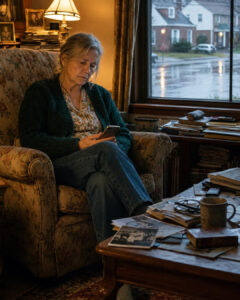
“I need to cancel an authorized user card.”
“Of course. Name on the card?”
“Julian Brooks.”
There was typing.
“I see the card. Are you certain you want it cancelled?”
“Yes.”
“It may take up to two hours to deactivate fully.”
“That is fine.”
“Anything else?”
“Yes. I also need to cancel an automatic transfer.”
More typing.
“I see a monthly transfer of two thousand five hundred dollars to an account ending in 3421.”
“That’s the one.”
“Do you want to pause it or cancel it permanently?”
“Cancel it.”
There was a brief silence.
“Mrs. Brooks, this transfer has been active for many years. I just need verbal confirmation.”
“You have it.”
“Very well. The transfer is cancelled.”
After I hung up, I stood in the middle of my living room with the phone in my hand.
The apartment looked the same.
Olive-green armchair with worn arms.
Old television.
Crocheted throw over the couch.
A stack of magazines on the coffee table.
Arthur’s books on the shelf.
Everything ordinary.
But I was not ordinary anymore.
Not inside.
I was a woman who had just taken back the keys to her own life.
At noon, Caroline’s mother called.
Catherine Whitmore had always spoken to me as if kindness were a social obligation she resented. She lived in Connecticut in a house with bay windows, polished floors, and an herb garden maintained by people she never needed to know by name.
“Eleanor,” she said, icy from the first syllable, “Caroline called me from Las Vegas in tears.”
“Good afternoon, Catherine.”
“Do not good afternoon me. Your son and my daughter are humiliated. I am told you refused to send help.”
“That is correct.”
“What is wrong with you?”
I almost laughed.
The old Eleanor would have apologized immediately. She would have explained. Softened. Backed away. The old Eleanor would have found the fastest path to peace, even if peace meant paying for someone else’s poor judgment.
But the old Eleanor was very tired.
“I am not the one who spent money I did not have,” I said.
“They are family.”
“They are adults.”
“Julian is your son.”
“Julian is forty.”
There was a crackle of silence.
Catherine lowered her voice. “You are being cruel.”
“No. I am being late. I should have done this years ago.”
“You have always helped them. You cannot suddenly change the rules because you are having a mood.”
“It is not a mood. It is a boundary.”
“That word,” Catherine snapped. “People use it now to excuse selfishness.”
“Perhaps. But I am using it to end my own.”
She made a dismissive sound.
“Send the money, Eleanor. I will reimburse part of it if that makes you feel better.”
“Send it yourself.”
Another pause.
“What?”
“You said they are family. You said Caroline is suffering. You said mothers should help. Send the money.”
Catherine went silent.
For the first time in fifteen years, I had passed the bill to someone else.
Finally, she said, “Fine. I will. But when they come home, we will all need to discuss your behavior.”
“No, Catherine. You may discuss it among yourselves. I will not be available for scolding.”
I ended the call and went into the kitchen.
My hands trembled then.
Not from fear.
From rage.
Years of rage, actually. Quiet rage. Civilized rage. The kind you fold into checks and call generosity because the alternative might cost you the last little connection you have left.
I chopped onions because chopping gave my hands something to do. Then tomatoes, garlic, peppers. I cooked chicken and rice. Old jazz played softly from the radio. Arthur loved jazz. On Sundays, he used to pull me into the kitchen and make me dance while Julian laughed from his high chair.
The memory hurt.
Then it warmed.
Then it steadied me.
When Mia called, I answered.
Mia was nineteen, pre-med, bright and tenderhearted in a way that reminded me of Arthur. She did not call as often as I wished, but when she did, she asked real questions.
“Grandma,” she said quietly. “Mom told me what happened.”
“I imagine she did.”
“Are you okay?”
That question nearly undid me.
Not, Are they okay?
Not, Why didn’t you pay?
Are you okay?
“I am,” I said. “For the first time in a long time, I think I am.”
There was a long silence.
“Can I ask why now?”
I turned off the stove and sat at the kitchen table.
“Because I realized I was disappearing.”
Mia said nothing.
I told her about the shoe box. The receipts. The wedding check. The down payment. The monthly transfer. The one hundred twenty thousand dollars. The shoes I did not buy. The dentist appointment I canceled. The water stain I ignored. The birthdays alone. The calls that came only when they needed something.
When I finished, Mia was crying.
“Grandma,” she whispered, “I didn’t know.”
“I know.”
“I’ve asked you for money too.”
“Yes.”
“I’m sorry.”
“You are young, Mia. And you still call me to ask about my day. That matters more than you know.”
“It’s not enough.”
“No,” I said gently. “But it is something we can build on.”
She sniffed.
“What are you going to do now?”
I looked toward my bedroom closet, where the old suitcase Arthur and I used for small trips still sat behind winter coats.
“I am going to live.”
That afternoon, I opened my laptop and searched for senior travel groups.
Charleston.
Savannah.
Santa Fe.
The Santa Fe tour caught my eye and would not let go.
Ten days in New Mexico. Adobe architecture. Canyon walks. Traditional cooking class. Art markets. Taos Pueblo. Bandelier National Monument. Single room. Meals included.
Three thousand two hundred dollars.
More than I had spent on myself in five years.
My finger hovered over the button.
That old voice rose in me.
What if Julian needs something?
What if this is selfish?
What if something happens?
Then another voice came, older and warmer.
Arthur.
Life is short, Ellie. Don’t wait until there’s nothing left of you.
I clicked confirm.
Purchase complete.
My name appeared on the booking.
Only my name.
I cried then.
Not because I was sad.
Because a seventy-two-year-old woman had just remembered she was allowed to want something.
The next morning, Julian and Caroline came straight from the airport.
They knocked hard enough to rattle the chain.
I opened the door slowly.
Julian stood there red-eyed and furious. Caroline was behind him with sunglasses pushed into her hair, expensive luggage beside her, and the offended posture of a woman who believed inconvenience was a personal insult.
“How could you?” Julian demanded.
“Good morning.”
“Good morning? Mom, we spent the worst night of our lives because you refused to help.”
“No,” I said. “You spent it because you booked a trip you could not pay for.”
Caroline laughed sharply.
“This is unbelievable.”
“Come in,” I said. “We need to talk.”
They entered like people arriving to collect a debt.
I brought out the shoe box.
When I placed it on the coffee table, Julian frowned.
“What is that?”
“The reason I said no.”
One by one, I laid out the papers.
Wedding.
Down payment.
Car.
Furniture.
Europe.
Laptop.
School fees.
Holiday transfers.
Monthly deposits.
I placed them in rows until the coffee table could barely hold them.
“One hundred twenty thousand dollars,” I said. “At least. I stopped counting after that.”
Julian picked up the wedding check copy.
His face changed.
Caroline stayed standing, arms crossed.
“You chose to help,” she said.
“Yes. I did. And now I choose to stop.”
Julian looked up.
“Mom, I didn’t know it was that much.”
“You never asked.”
He winced.
“I thought you were okay.”
“You never asked that either.”
The room went still.
I looked at my son, really looked at him: the expensive watch, the travel clothes, the tired face of a man who had been protected so long he mistook protection for normal weather.
“Do you know how many times you invited me to dinner in the last fifteen years?”
He did not answer.
“Three.”
He looked down.
“Do you know how many times you called just to ask how I was?”
“Mom.”
“I can count them on one hand.”
Caroline stepped forward.
“We have busy lives.”
“So do I,” I said. “Or I will now.”
Her eyes narrowed.
“What does that mean?”
“It means the authorized card is cancelled. The monthly transfer is cancelled. My account is closed to both of you. I booked a trip to Santa Fe. I bought myself new shoes. I am fixing the water stain in my bedroom. I am replacing my refrigerator before it gives out. I am using my money for my life.”
Caroline stared at me as if I had spoken a foreign language.
“You can’t just cut us off.”
“I can.”
“We depend on that money.”
“That is the problem.”
Julian sat heavily on the sofa.
“What are we supposed to do?”
“Live on what you earn.”
Caroline’s face hardened.
“You are his mother.”
“Yes. I raised him. I fed him. I educated him. I loved him. I buried his father and kept going. I did my job. What I have done since then has been extra. Too much extra.”
Julian covered his face with both hands.
For the first time, I saw shame move through him.
Not panic.
Not anger.
Shame.
Caroline grabbed her purse.
“You’ll regret this, Eleanor. You are going to end up alone.”
I looked at her.
“I have been alone for years, Caroline. The only difference is that now I may finally be at peace.”
She left, slamming the door.
Julian stayed.
For several minutes, he said nothing.
Then, in a voice I had not heard since he was twelve years old, he whispered, “I’m sorry, Mom.”
I did not rush to comfort him.
That was new too.
“I believe you are sorry right now,” I said. “But sorry under pressure is easy. Change is harder.”
He nodded, tears in his eyes.
“I don’t know how we got here.”
“One yes at a time,” I said.
He let out a broken laugh.
Then he stood and hugged me.
It was clumsy. Uncomfortable. Too late and not enough.
But it was a beginning.
Three weeks later, Julian drove me to the airport.
He carried my suitcase without being asked. At security, he hugged me and said, “Take pictures of everything, Mom. Eat what you want. Buy what you like. Please enjoy your life.”
I did.
Santa Fe was like stepping into a painting I had not known I needed.
Dry heat. Blue sky. Adobe walls glowing pink at sunset. Markets full of turquoise and woven blankets. Food with green chile that made my eyes water and my heart laugh. I met other travelers who had their own versions of my story: widows, caregivers, retired teachers, women who had spent decades being useful and had come searching for themselves.
At Bandelier, I climbed a wooden ladder to a cliff dwelling and stood above the canyon, wind pushing gently against my face.
For the first time in years, I felt small in a good way.
Not reduced.
Released.
I bought a hand-carved wooden owl painted turquoise, pink, and yellow. The artist told me the owl represented seeing clearly in the dark.
I held it carefully all the way back to the hotel.
“That’s me,” I told no one.
On the last night, our tour group shared what the trip had meant.
A woman named Stella said she found courage.
Victor said he found joy after grief.
Margaret said she found a self she had misplaced while caring for everyone else.
When it was my turn, I stood with my hands trembling just a little.
“I found Eleanor,” I said. “I found the woman I had forgotten existed. And I am not going to lose her again.”
Everyone clapped.
Some cried.
So did I.
When I landed home, Julian and Mia were waiting with a small sign that said Welcome Home, Grandma.
Mia ran to me first.
“You look radiant,” she said.
Julian looked at my face for a long moment.
“You look younger.”
“I feel older and younger at the same time,” I said.
He laughed.
A real laugh.
In the car, I showed them photos. The canyon. The markets. The cooking class. The wooden owl. My new friends. Myself standing in front of an adobe church, smiling like a woman who had stopped apologizing for being alive.
That Saturday, Julian invited me to dinner.
A real dinner, he said.
No asking for money.
No emergency waiting in the hallway.
Just dinner.
When I arrived, he opened the door wearing an apron. The house smelled of rosemary chicken and roasted vegetables. Mia was setting the table. Caroline sat stiffly in the living room, still uncomfortable, still not ready to be kind, but she stood and said hello.
That was not forgiveness.
But it was a start.
Dinner was awkward at first.
Then softer.
Julian told me they sold the expensive SUV and bought a used sedan. They canceled memberships they never used. He had started a budget. Caroline was looking for part-time work after years at home. Mia talked about school. I talked about Santa Fe.
No one asked me for money.
After dinner, Julian walked me to my car.
“Mom,” he said, “I know one dinner doesn’t fix everything.”
“No. It doesn’t.”
“I’m going to keep trying.”
“I hope you do.”
He nodded.
“I want to be your son again. Not your dependent.”
I touched his cheek, the way I did when he was little.
“That would be a beautiful thing to become.”
That night, back in my apartment, I placed the wooden owl on my nightstand beside Arthur’s photograph.
The past and the present.
The love I lost and the woman I found.
Before bed, I opened my journal and wrote one line.
Today, I did not have to pay to be loved.
Then I closed the notebook, turned off the lamp, and lay in the dark with my heart calm and full.
My name is Eleanor Brooks.
I am seventy-two years old.
For fifteen years, I believed being needed meant being loved.
Then one night, at two in the morning, my son called from a hotel demanding money I no longer owed him.
I said no.
And that one word gave me back the rest of my life.