THE SILVER PENDANT FROM THE DESERT
The jukebox stopped in the middle of a song.
Not faded.
Not skipped.
Stopped.
One second, an old country ballad was dragging itself through the dusty speakers of the Copperhead Saloon, all steel guitar and heartbreak. The next second, the room went silent so completely that even the ice machine behind the bar sounded too loud.
Every man in leather turned his head.
Every glass paused halfway to a mouth.
Every conversation died at once.
At the center of that silence stood Hank Riley, known to almost everyone on Route 66 as Bull. Six-foot-four, broad as a doorway, sunburned by years of desert riding, with a scar under his jaw and hands so large they looked like they had been built for engines, not people. He had been halfway to the back hallway when something silver flashed in the darkest booth near the wall.
Now he stood frozen.
His eyes were fixed on the ten-year-old boy sitting in that booth.
More exactly, they were fixed on the pendant hanging from the boy’s neck.
The boy’s name was Leo Pendleton.
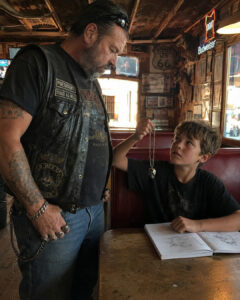
He was small for his age, all elbows and watchful eyes, with brown hair that refused to stay combed and a sketchbook open on the table in front of him. He had spent the afternoon drawing muscle cars and desert birds while his aunt Maggie worked the bar. He was used to staying quiet. After his father passed three months earlier, quiet had become the safest place he knew.
But there was no hiding now.
Bull took one slow step toward the booth.
Then another.
The floorboards complained under his boots.
Maggie, behind the bar, felt her stomach drop.
She had owned the Copperhead long enough to know when trouble was only passing through and when it had chosen a chair. The Copperhead was not much to look at: cinder-block walls, no windows on three sides, a scratched mahogany bar, faded beer signs, a pool table that leaned slightly left, and a ceiling fan that clicked with every rotation. It sat outside Needles, California, just off a battered stretch of Route 66, where the Mojave heat bent the horizon and made even honest roads look like mirages.
People came there when they did not want questions.
Truckers. Mechanics. lonely locals. Men who rode motorcycles in packs and knew how to make a room obey without saying much.
That Thursday in July 2004, the Iron Saints motorcycle chapter had rolled into the parking lot at 3:15 in the afternoon.
Maggie heard them before she saw them. A low rumble first, then a growing thunder that vibrated through the bottles on the shelves. The regulars at the bar had placed their money down and slipped out the back before the engines even shut off. They knew the sound.
Two dozen motorcycles pulled in under a cloud of dust.
At the front rode Bull Riley.
He was not the club president, but everyone knew his word carried a weight most presidents would envy. Years earlier, his older brother John Riley, known as Iron John, had founded the San Bernardino chapter and built it into something men followed because they believed it meant loyalty. When John disappeared in the winter of 1989, Bull became the man who held the old chapter together, not by speeches, but by memory.
Nobody talked about Iron John unless Bull brought him up first.
And nobody had seen the pendant since the night John vanished.
Until now.
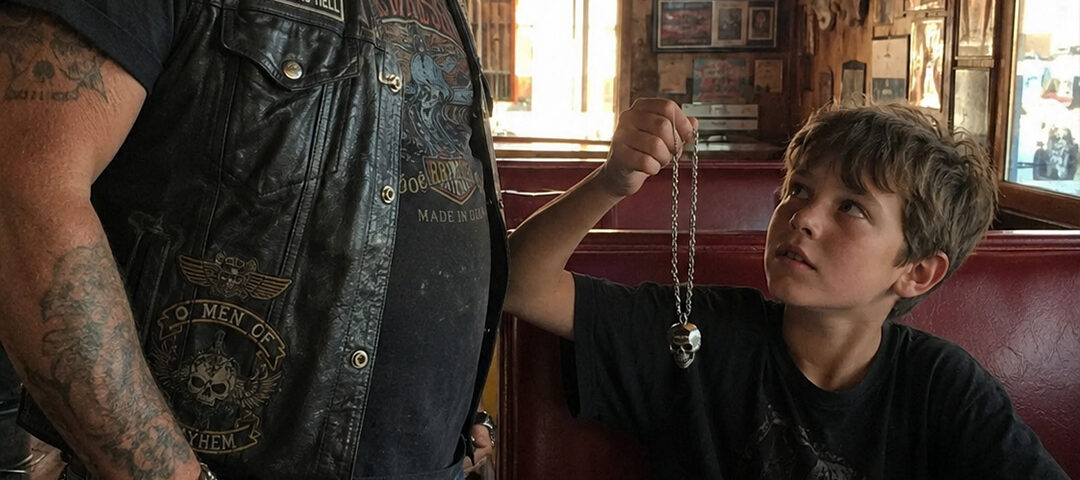
Bull stopped beside Leo’s booth.
His shadow covered the table.
Leo shrank into the red vinyl seat, his fingers still wrapped around the pendant.
The necklace was heavy for a child. A thick steel chain. A custom silver piece shaped like a winged skull gripping a broken motorcycle piston. One eye socket held a chipped red stone, dark as dried wine under the neon. The left wing had a jagged crack in the silver, a flaw from the original casting that had never been repaired.
Bull stared at it like a man staring through fifteen years of dust.
Then he pointed at the pendant.
His finger shook.
“Where did you get that?”
His voice was low.
That made it worse.
Maggie moved fast. She came around the end of the bar, wiping her hands on a towel she had forgotten she was holding.
“Bull,” she said. “Back off. He’s a child.”
Bull did not look at her.
He lifted one hand, not touching her, only placing it between her and the booth like an iron gate.
“I’m not here to scare him, Maggie,” he said, though Leo’s face showed clearly that he already had. “But I need to see that silver.”
Maggie stood still.
She knew Bull. Not well, but enough. He could be hard. He could be dangerous in the way desert men become dangerous after life teaches them that softness gets used against you. But she had also seen him pay funeral costs for a waitress’s husband, fix a truck for a stranded family, and leave more money than he owed when a bartender was short on rent.
Bull was not the kind of man who hurt children.
Still, he was a man standing in a room full of riders who had just gone silent at his command, and her nephew was ten years old.
Leo looked at his aunt.
Maggie nodded slowly.
“It’s okay, honey,” she said, though she was not sure it was.
Leo lifted the chain over his head. His hands trembled so badly the pendant tapped against the table twice before he let go.
Bull picked it up.
The silver looked small in his palm.
He turned it over once.
Then again.
His thumb found the crack in the wing. His eyes moved to the chipped red stone. A sound left his chest, not quite a breath and not quite a word.
Behind him, Dutch Miller, one of the senior riders, whispered, “No.”
Another man, Snake Henderson, took his sunglasses off slowly.
The whole room understood at the same time.
It was Iron John’s pendant.
The one he wore every day.
The one he said would not leave his neck while he still drew breath.
For fifteen years, the pendant had been a ghost. A missing symbol. A question nobody could answer.
Now it sat on a table in front of a child.
Bull lowered himself into the chair across from Leo. Even sitting, he seemed too large for the booth.
“What’s your name, kid?”
“Leo.”
“Leo what?”
Leo swallowed.
“Leo Pendleton.”
The name hit the saloon like a door slamming in a hallway.
Dutch stepped forward.
“Pendleton?”
Bull did not look away from the boy.
“Your father,” he said slowly. “What was his name?”
Leo’s eyes filled with tears.
“Arthur.”
Maggie heard herself gasp.
Arthur Pendleton had been her sister’s husband. He had been quiet, polite, nervous, a man who kept receipts in envelopes and wrote lists for everything. Maggie had never known much about his life before her sister. He said he once handled books for a garage network in California. He never explained more than that.
To the Iron Saints, Arthur Pendleton was not just a bookkeeper.
He was the missing accountant.
In 1989, on the same night Iron John Riley disappeared, Arthur had vanished too. The club’s reserve fund, more than half a million dollars in cash from legitimate shops, bars, and property holdings, vanished with him. The story that hardened over the years was simple: Iron John was lost in a desert dispute, and Arthur Pendleton used the chaos to run with the money.
The story had started a feud.
It had fractured families.
It had made men old before their time.
Bull had believed it for fifteen years because believing anything else meant admitting there were no answers.
Now the accountant’s son sat in front of him wearing Iron John’s pendant.
Bull’s voice changed.
“Your dad gave you this?”
Leo nodded quickly.
“He said I had to keep it safe.”
“Did he say where he got it?”
Leo wiped his nose with the back of his hand. “He said it was a reminder.”
“A reminder of what?”
Leo looked down at the sketchbook.
“He didn’t like to talk about it. Not out loud.”
“What did he say when he gave it to you?”
“That if anyone ever came looking for the silver skull, I should give them the notebook.”
Bull’s eyes moved to the spiral notebook.
It looked like an ordinary child’s notebook, torn at the corners, covered in pencil drawings, car wheels, cartoon monsters, desert birds, and strange little maps Leo made when he was bored. But the back half bulged oddly, thick with pages taped into the binding.
Leo pushed it across the table.
“My dad gave it to me at the hospital,” he whispered. “He said the back pages weren’t for me unless someone asked about the necklace.”
Bull opened it.
The first pages were Leo’s.
Cars.
Riders.
A little drawing of the Copperhead sign.
Then the handwriting changed.
The neat child’s pencil marks gave way to an adult hand pressed so hard into the paper that several lines were almost carved through. Dates. Broken sentences. Notes written in the middle of the night. Bible verses crossed out and rewritten. A man trying to empty guilt from his head and finding it came back heavier every time.
Bull read silently at first.
Then his face changed.
Maggie watched the color drain from beneath his sunburn.
He turned a page.
A map filled the next two sheets.
Not a professional map. Something hand-drawn by a man who remembered too much. The rusted Iron Mountain pumping plant ruins. A dry wash. A cluster of Joshua trees. A rocky outcropping shaped like an anvil. At the base of the outcropping was an X.
Below it were coordinates.
And beneath those, one line written in block letters.
I buried the iron. I buried the gold. I kept the silver.
Bull closed the notebook.
For a long second, nobody moved.
Then Snake said, “If that’s real—”
Bull lifted one finger.
Snake stopped.
Dutch said quietly, “We need to ride.”
Bull stood.
He placed the pendant back on the table, then stopped himself. His hand hovered above it.
Leo looked terrified he would take it.
Bull saw that.
Slowly, carefully, he placed the pendant in Leo’s palm and closed the boy’s fingers around it.
“You keep that for now,” he said.
Leo blinked.
“I thought you were going to take it.”
Bull’s jaw tightened.
“It was my brother’s. But your father gave it to you. Until I know the truth, it stays with you.”
That was the first moment Maggie breathed.
Bull turned to the room.
“Dutch. Snake. Get the bikes ready.”
Several men moved at once.
Bull looked back at Maggie.
“You and the boy stay here.”
Maggie’s shoulders stiffened.
“Bull—”
“I’m leaving two men outside, not to hold you. To make sure nobody else comes asking questions before I get back.”
Maggie studied his face.
Under the scar, the size, the hard life, she saw something she had not expected.
Not threat.
Grief.
“Where are you going?” she asked.
Bull held up the notebook.
“To find out what the desert has been keeping from us.”
Within minutes, the Iron Saints thundered out of the parking lot and onto Route 66, leaving dust behind them and silence inside the Copperhead.
Leo sat with the pendant clutched in both hands.
Maggie slid into the booth beside him and pulled him close.
For the first time since Arthur’s funeral, Leo cried without trying to hide it.
The desert was still hot when they left, but by the time the riders reached Iron Mountain, the sun had started dropping behind the jagged ridges. Heat bled out of the sand. Shadows lengthened. The sky shifted from white to copper to bruised purple, and the motorcycles became dark shapes moving through the old road like a memory returning unwillingly.
Bull led the pack without speaking.
The map in Arthur’s notebook was tucked inside his vest. Every few miles, he felt it there against his chest, as if the paper itself had a pulse.
He had spent fifteen years hating Arthur Pendleton.
Not loudly. Bull had never been much for speeches. But the hate sat inside him like a stone. He hated Arthur for running. Hated him for leaving the club broken. Hated him for turning Iron John’s last night into a question nobody could answer. Most of all, he hated him because it was easier than admitting he had failed to find his brother.
Now the son of that hated man had walked into his life with the one object Bull had never stopped seeing in dreams.
By the time they reached the old pumping plant ruins, the moon was up.
The place looked exactly like men remembered forgotten places looking: rusted pipes, collapsed fencing, concrete bones half-buried in sand, Joshua trees twisted under the stars. The anvil-shaped rock stood beyond the dry wash, black against the moonlit ridge.
Bull shut off his engine.
One by one, the others did the same.
The silence after the engines died felt sacred.
Nobody joked.
Nobody smoked at first.
Bull walked to the rock and stood there with the notebook in one hand.
He did not ask for help.
He took a folding shovel from his saddlebag and began to dig.
The ground was hard. Packed. Desert dirt that had spent fifteen years becoming part of itself. The shovel struck, scraped, lifted. Again. Again. Again. Sweat darkened Bull’s shirt. His breathing grew heavy. Still, he did not stop.
After an hour, Dutch stepped forward.
Bull shook his head.
“Not yet.”
After ninety minutes, Snake said quietly, “Bull.”
“No.”
So they let him dig.
Some things a man has to do with his own hands.
At nearly three feet down, the shovel hit something that was not stone.
A hollow sound.
Bull froze.
Then he dropped the shovel and fell to his knees, scraping dirt away with both hands. Dutch and Snake joined him then, not asking permission this time. Together, they cleared the earth until a rusted military-style lockbox emerged from the ground.
Snake let out a breath.
“The gold.”
Bull looked at the box only briefly.
Then he turned back to the hole.
“Keep digging.”
Two feet to the left, the dirt changed.
Softer.
Older.
Beneath it, they found canvas, decayed but still wrapped around something that had once been protected with care. Bull brushed sand away slowly. A strip of weathered black leather appeared. Then a tarnished belt buckle. Then a faded patch, white and red under the dirt.
Nobody spoke.
Bull sat back on his heels.
For the first time in fifteen years, he had found his brother’s final resting place.
The men behind him removed their hats and sunglasses. Even Snake lowered his head.
There are moments when grief is too old to come out as crying. Sometimes it comes out as silence. Sometimes it sits in a circle of men under desert stars while the wind moves through dry grass and nobody knows where to put their hands.
Bull stayed on his knees for a long time.
Finally, he stood, took the crowbar from Dutch, and opened the lockbox.
Inside, sealed in plastic, lay the missing money.
The full reserve.
Untouched.
Every bundle carefully wrapped.
Arthur Pendleton had not spent a dollar.
On top of the cash was a thick envelope wrapped in layers of plastic. Bull opened it slowly. The paper inside had yellowed but stayed dry. The handwriting matched the notebook.
The letter began with his name.
Bull,
If you are reading this, then my boy found the courage I never did. I need you to know I did not betray John. I was afraid. I was weak. But I did not betray him.
Bull’s hands shook.
Dutch moved closer.
Bull read aloud, his voice rough.
That night, John and I rode back from the bank in Barstow with the reserve. He had information that the chapter was being watched, and he wanted the money hidden until things cooled down. We were supposed to meet you the next morning.
We never made it.
A rival crew was waiting near the old road. John knew we could not outrun them together. He told me to take the lockbox and ride into the wash. He said he would slow them down. I begged him not to. He laughed at me, Bull. He laughed and said, “Arthur, you keep numbers. Tonight, you keep my people alive.”
Bull stopped reading.
His mouth tightened.
The desert wind moved the edge of the paper.
He continued.
When I came back, the road was empty. John was still there, but he was badly hurt. I tried to get him to a doctor. He refused. He said if the authorities found him with the reserve nearby, the club would lose everything and the truth would never matter. He ordered me to bury the box. He gave me the pendant and told me to bring it to you when it was safe.
He made me promise to hide him deep enough that his enemies could never use him as a trophy.
I did what he asked.
Then I ran.
That is the truth. I can write it a thousand times and it will not make me braver. I should have come back. I should have given you the pendant. I should have stood before the chapter and taken whatever came.
But I was scared.
I changed my name. I built a small life. I married. I had Leo. I kept the money sealed. I kept the map. I kept the pendant. And every night, your brother stood in my dreams asking why I was still breathing when I had left him in the desert.
Do not punish my boy for my fear.
He knows nothing except that I loved him and that the silver mattered.
John was loyal to the end.
I was loyal too late.
Forgive me if you can.
Arthur Pendleton.
When Bull lowered the letter, no one said anything.
Dutch wiped one hand across his mouth.
Snake stared into the hole as if the ground itself had accused him.
For fifteen years, the chapter had built its anger around the wrong story.
They had called Arthur a thief.
A coward.
A traitor.
They had spoken his name with contempt.
But the lockbox sat open beneath the motorcycle headlights, filled with money he had preserved. The letter trembled in Bull’s hand. The final resting place of Iron John lay beside it, protected exactly as Arthur said.
Bull looked down at the earth.
His brother had not disappeared as a victim of betrayal.
He had chosen the hardest thing a leader can choose.
He had ordered the weakest man in the group to carry the heaviest burden.
And Arthur, terrified as he was, had carried it for fifteen years.
By dawn, they had done what needed to be done.
They marked the site properly. Took photographs. Made calls to people who knew how to handle the past with respect and discretion. No shouting. No celebration. No old revenge awakened by new facts.
The truth was heavy enough.
Bull placed the letter and the notebook in his saddlebag.
Then he wrapped the lockbox again and strapped it to Dutch’s bike.
Before they rode back, Bull stood alone near the anvil rock.
For years, he had imagined what he would say if he ever found the place where his brother’s story ended.
Now that he was there, words seemed too small.
So he placed one hand over his chest and bowed his head.
Then the engines started.
Back at the Copperhead, Maggie had not slept.
Leo had dozed briefly with his head against her arm, but every time a truck passed outside, he woke and reached for the pendant. Maggie kept one eye on the door and one on the two riders Bull had left outside. They had not bothered her. One even brought Leo a sandwich from the gas station across the road.
Still, the night had felt endless.
At sunrise, the motorcycles returned.
The sound came low at first, then filled the road, the parking lot, the walls, the glass bottles behind the bar. Leo sat upright immediately.
Maggie stood.
The door opened.
Bull entered alone.
He was covered in desert dust. His hair was flattened with sweat. His face looked older than it had the day before, but somehow lighter, as if something had been removed from his shoulders even though it left a hollow place behind.
He walked to the booth.
Maggie stepped in front of Leo by instinct.
Bull stopped.
“I told you,” he said quietly. “No one touches the boy.”
Maggie did not move.
Bull reached into his pocket and pulled out the silver pendant.
Leo’s hand went to his chest, where the chain had been.
Bull held it out.
Leo stared at him.
“Take it,” Bull said.
The boy reached slowly.
The pendant dropped into his small palm with a heavy sound.
Bull lowered himself into the booth across from him.
“Your father was not a thief.”
Leo blinked.
“And he was not a traitor,” Bull continued. “He was a frightened man who kept a promise that was too heavy for him. He protected something that belonged to my brother. He protected it until the end of his life.”
Leo’s eyes filled.
“My dad was good?”
Bull looked at the boy for a long time.
“He made mistakes. Big ones. Fear made him run when he should have come home. But good men can make bad choices when they are scared. And bad choices do not erase every good thing they did.”
Leo gripped the pendant.
“He told me he was sorry.”
“I believe him.”
Maggie covered her mouth.
Bull placed the notebook on the table.
“This belongs to you, but I need to keep copies. The chapter needs to know the truth.”
“What about the money?” Maggie asked.
Bull looked at her.
“It goes where John meant it to go. Not into old hands. Not into foolishness. We’re setting up a trust.”
“A trust?”
“For the boy,” Bull said. “Arthur kept that money untouched because he believed it belonged to the future of the chapter. Leo is part of that future now, whether he rides or not. Education, housing, whatever the kid needs. Clean and legal. No games.”
Maggie stared at him.
“You don’t have to do that.”
Bull’s face hardened slightly.
“Yes, I do.”
Leo looked confused.
“Why?”
Bull leaned forward, his massive elbows on the table.
“Because your father spent fifteen years being blamed for something he did not do. Because my brother trusted him. Because I believed the wrong story and let that wrong story live too long. When a man learns the truth late, he pays what he can.”
Leo wiped his cheeks.
“Can I still wear it?”
Bull’s eyes moved to the pendant.
The old instinct was there. Maggie could see it. The urge to reclaim the symbol. The last visible piece of his brother.
But Bull pushed it away.
“You wear it,” he said. “Proudly. If anyone asks where you got it, you tell them Arthur Pendleton gave it to you. And you tell them the Iron Saints said nobody gets to question that.”
Leo nodded, trying to be brave.
Bull stood.
Then, after a long hesitation, he placed one hand gently on top of the boy’s head.
It lasted only a second.
But everyone in the bar felt it.
The jukebox clicked back on by itself, or maybe Dutch had plugged it in again outside. A soft old tune filled the saloon, low and scratched.
The room exhaled.
In the months that followed, stories spread across Route 66.
Some were wrong, as stories often are.
Some said a boy found a treasure map.
Some said the Iron Saints recovered a lost fortune.
Some said Bull Riley walked into the Copperhead a hard man and walked out carrying ghosts.
The truth was quieter.
Bull arranged for Iron John to be remembered properly. Not with spectacle, not with newspaper attention, but with a private ride at sunrise and a marker placed where the desert wind could pass over it. Men who had not spoken to one another in years stood shoulder to shoulder that morning. Some apologized. Some did not know how. The old feud, built on a misunderstanding, did not vanish overnight, but it lost its reason for breathing.
Arthur Pendleton’s name was cleared among the only people who had kept it dirty.
A small plaque appeared behind the bar at the Copperhead months later.
Arthur Pendleton
Keeper of a hard promise
Maggie read it three times when Bull brought it in.
“You sure?” she asked.
Bull nodded.
“Long overdue.”
The money from the lockbox did not go back into some dusty club reserve. Bull and the remaining senior members placed it into a trust administered by a local attorney who looked nervous the first time he met them and slightly less nervous the third. The trust funded Leo’s schooling, Maggie’s guardianship expenses, and later a small vocational scholarship for kids from desert towns who wanted to learn engines, welding, accounting, or any other trade that could get them into a life with choices.
Bull insisted on adding accounting.
“Arthur would like that,” he said.
Leo kept drawing.
At first, his pictures were all skulls, motorcycles, and desert rocks. Later, they became maps. Then buildings. Then machines. By the time he was sixteen, he could take apart an old carburetor faster than most grown men. By nineteen, he was studying mechanical engineering in Arizona, wearing the silver pendant under every shirt.
He never joined the Iron Saints.
Bull never asked him to.
Some legacies are better honored by living freely than by repeating the exact shape of the past.
Years later, when Leo came back to the Copperhead after his first semester of college, Bull was sitting at the bar with a cup of coffee instead of beer. His beard had more gray in it. His shoulders were still broad, but time had begun to carve him down around the edges.
Leo slid into the seat beside him.
“Hey, Bull.”
Bull looked at him, then at the pendant chain visible at his collar.
“You still wearing it?”
“Every day.”
Bull nodded.
“Good.”
Leo placed a folded paper on the bar.
“What’s that?”
“My first scholarship essay.”
Bull frowned.
“I’m not reading schoolwork.”
“You should read this one.”
Bull unfolded it.
The title read:
The Weight of a Promise.
Leo watched him read.
It told the story carefully. Not the club details. Not the old names that did not belong in public. But the heart of it: a frightened accountant, a lost leader, a son carrying a pendant, a man who chose truth over anger, and a community learning that the story it had repeated for years was not the same as justice.
At the end, Leo had written:
My father gave me a pendant. Bull Riley gave me my father back.
Bull stared at the page for a long time.
Then he folded it carefully and slipped it into his vest pocket.
“Kid,” he said gruffly, “your grammar is terrible.”
Leo smiled.
“My professor liked it.”
“Professor needs better standards.”
But his voice broke on the last word.
Maggie, polishing glasses behind the bar, pretended not to notice.
The Copperhead never became famous. It remained a roadside saloon with a leaning pool table, a temperamental jukebox, and a crowd that changed depending on weather, work, and regret. But something in the room was different after that summer.
People watched their words more.
Old grudges were questioned before being passed along.
And every now and then, when the desert heat turned the horizon watery and strange, someone would ask about the silver pendant hanging behind the framed copy of Leo’s essay near the bar.
Maggie would look up and say, “That’s not decoration. That’s a reminder.”
If they asked what it reminded people of, she would tell them the safe version.
That truth can sit buried for years and still come back breathing.
That fear can make a person run, but it does not have to be the last thing remembered about him.
That loyalty is not always loud.
Sometimes it is a man keeping a box sealed for fifteen years, even while the world calls him a thief.
Sometimes it is a boy carrying a necklace he does not understand.
Sometimes it is a brother strong enough to admit he believed the wrong story.
And sometimes, in the middle of a dusty bar off Route 66, the whole room stops because a child pulls a piece of silver from under his shirt and the past finally decides it has waited long enough.
Leo grew into a man who understood that weight.
He wore the pendant not because it made him part of something dangerous, but because it reminded him that every family has stories someone got wrong.
His father was not perfect.
Iron John was not invincible.
Bull was not only the hard man people feared.
Maggie was not just a bartender.
And Leo was not just a scared boy in a corner booth.
They were all pieces of a truth that had taken fifteen years to find its way home.
The night the jukebox stopped, everyone thought danger had entered the room.
Maybe it had.
But so had justice.
Not the loud kind. Not the kind that needs headlines or applause.
The kind that returns a name to a son.
The kind that lets a brother finally mourn properly.
The kind that turns a silver pendant from evidence of an old wound into proof that even buried stories can rise again.
By the time the song resumed, the Copperhead was no longer the same bar.
And Leo Pendleton was no longer only Arthur’s son.
He was the boy who carried the truth back into the light.