The night my brother-in-law got married, I wore the wrong color.
Not wrong by accident, wrong by design.
Mine, I chose ivory.
Structured, tailored, expensive in the way that only looks simple.
My mother-in-law had spent 3 weeks calling every woman on the guest list to coordinate colors.
Dusty rose for the bridesmaids, sage green for the cousins, champagne for the older aunts.
When she called me, I said, “I’ll find something appropriate.”
She paused just long enough to let me know she’d heard the distance in my voice.
Then she said, “Perfect, darling.”
In that tone, she reserved for things she’d already decided she wouldn’t forgive.
I knew what I was doing.
So did she.
My husband didn’t notice until we were already in the car, pulling out of our driveway.
He glanced at me from the driver’s seat and said, “Is that what you’re wearing?”
I turned to look out the window.
“Yes,” I said.
He didn’t push it.
He knew better by then.
My name is not important yet.
What matters first is this.
I had been married for 4 years to a man who loved me the way people love a painting, admiringly from a distance and mostly when other people were watching.
My husband, I’ll call him my husband because that’s what he was legally on paper, in the eyes of everyone at that wedding, worked as a project director at a midsize architecture firm downtown.
He earned good money, not extraordinary, but comfortable enough to feel like a provider.
That was important to him in ways I didn’t fully understand until it was too late.
I was a corporate attorney, partner track, the kind of job that sounds impressive at dinner parties and feels like a second mortgage on your soul every morning.
I billed more hours in a week than most people worked.
My firm handled mergers, acquisitions, high-stakes contracts for companies whose names you’d recognize.
I was good at it.
I was very, very good at it.
When my husband and I met, he had just been promoted.
He was confident, funny in a quiet way.
He opened doors, literally physically opened doors, and I thought that meant something about the kind of man he was.
We dated for 2 years, got engaged, got married, moved into a house I made the down payment on, and we both pretended was ours equally.
His mother, I will call her my mother-in-law, though the word mother does a kindness to the relationship that was never earned, had opinions about me from the beginning.
Not loud ones.
She was too elegant for loud.
She expressed her disapproval through omissions, forgetting to copy me on family emails, mentioning my husband’s college girlfriend at holidays with a wistful smile.
Once, at a Christmas dinner, she looked at my hands, which were bare because I’d taken my rings off to wash dishes, and said to no one in particular, “Some women just don’t feel complete without jewelry, do they?”
And then she laughed, and everyone else laughed, and my husband refilled his wine glass.
But the wedding, my brother-in-law’s wedding, was where she decided to stop being subtle.
My brother-in-law was marrying a woman I actually liked.
She was warm, direct, had a laugh that filled entire rooms.
I’d helped them negotiate their venue contract as a personal favor, saved them close to $8,000 in penalty clauses.
She thanked me 3 separate times.
She sent flowers to my office.
She was the only person in that family who ever made me feel like I was a person in that family.
The venue was a restored historic estate about 40 minutes outside the city, the kind of place with ivy on stone walls and a grand staircase and staff who spoke in murmurs.
My husband and I arrived 20 minutes before the ceremony.
I’d been in depositions until 6:00 the previous evening and up at 5 that morning, finishing a contract amendment.
I was tired in the specific way that lives behind your eyes.
We checked in at the welcome table.
There were two young women in matching blazers, handing out programs and directing guests.
One of them looked at the list, looked at me, looked at the list again, and then smiled and said, “The ceremony is right through those doors.”
She did not tell us our seats.
Inside, the chairs were arranged in curved rows facing a floral arch at the far end of the room.
An usher, one of my brother-in-law’s college friends, walked us partway down the aisle and then gestured vaguely to the left side.
“Families on this side,” he said.
We sat down.
The ceremony was beautiful.
I cried a little, which surprised me.
My new sister-in-law walked in on her father’s arm, and she was radiant in the specific way that happens when someone is exactly where they want to be.
My brother-in-law’s face did something I had never seen my husband’s face do.
I filed that observation away somewhere quiet, and kept smiling.
The reception was where it started.
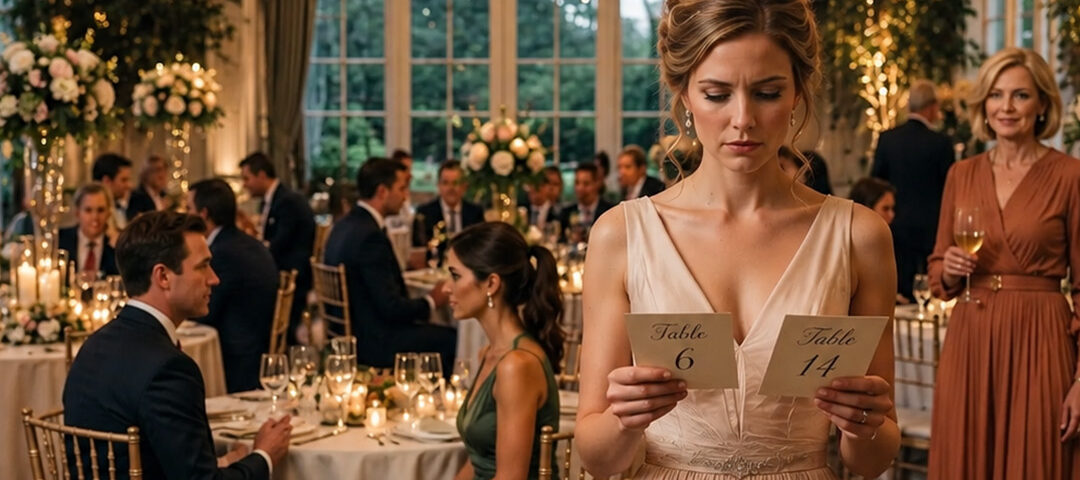
The room had been arranged with round tables, each seating eight, each with a small card with a table number on a silver stand.
We found our escort cards at the entrance.
My husband’s card said table 3.
Mine said table 11.
I stood there with a card in each hand for a moment.
My husband looked at his, looked at mine, then he said, “There’s probably a mistake.”
I said, “Probably.”
We went to find my mother-in-law.
She was standing near the bar with a glass of white wine and 3 of her sisters, laughing at something.
When she saw us approaching, her expression did that thing it always did, a brief recalibration like a camera autofocusing on a subject it hadn’t expected.
Then the smile settled in, wide and warm and entirely performed.
“You two, doesn’t everything look just stunning?”
My husband showed her both cards.
He explained the situation with the tone of a man who believes there has been a clerical error and also does not want to embarrass anyone.
He was very careful.
He used the word mix-up twice.
My mother-in-law tilted her head and made a sympathetic sound.
“Oh, sweetheart. No, that’s not a mix-up.”
She touched his arm.
“We just ran out of space at the family tables. You know how these things go. Everybody brought a guest. Tables filled up fast.”
She looked at me then, just briefly.
“Table 11 is lovely. It’s right near the windows.”
My husband started to say something.
She was already turning back to her sisters.
I put his escort card in my purse.
I put my own in my purse, too.
I said, “I’ll be right back,” to no one in particular.
And I walked to the restroom, locked the door of a stall, and stood there for approximately 90 seconds doing nothing.
Then I took my phone out and texted my paralegal, a woman named Dana, who has worked with me for 6 years and whose judgment I trust more than most people I’ve met.
And I said, “Can you pull the venue contract from the Henderson Marsh file and send it to my personal email?”
She replied in 4 minutes.
“Done. You okay?”
I replied, “Getting there.”
I washed my hands.
I looked at myself in the mirror.
I was wearing ivory.
I had known what I was doing.
I walked back out to the reception.
Table 3 was the immediate family table.
My husband’s parents, his grandparents on his mother’s side, his aunt and uncle who flew in from Phoenix, his cousin who was also a groomsman, and a woman I will call my husband’s colleague because that was the word my mother-in-law used for her when I had asked once, 6 months earlier, why she kept appearing in the background of his firm’s Instagram posts.
“She’s just his colleague,” my mother-in-law had said. “They work closely together. It’s sweet, really, how dedicated she is.”
The colleague was seated in what would have been my chair.
She was in a sage green dress, the color coordinated, the color that had been assigned.
And she was laughing at something my father-in-law said, and her hand was resting on the back of the chair that had my husband’s name card next to it.
Not touching it, but very close.
The way you rest your hand near something you already think of as yours.
I watched this for about 10 seconds from across the room.
Then I went and found my brother-in-law.
He was near the bar with his new wife and 2 of his friends.
When he saw my face, he excused himself immediately.

He always had good instincts and walked over to me.
I told him quietly what had happened.
Not emotionally.
I was a lawyer. I knew how to present facts.
His face moved through 4 distinct expressions in about 8 seconds.
He said, “I’m going to fix this right now.”
I put my hand on his arm and I said, “Please don’t. Not tonight. This is your wedding. Don’t let her do this to your wedding, too.”
He looked at me.
He said, “I’m sorry.”
I said, “I know. Dance with your wife.”
I went to table 11, which was in fact near the windows, and I sat down.
And I introduced myself to the other 7 people there, who were mostly colleagues of my sister-in-law’s from her former job, warm and easy to talk to.
And I had a glass of wine, and ate the salmon, and laughed at the right moments, and stayed for exactly 1 hour and 40 minutes after dinner was served.
Then I found my husband.
He had been at table 3 the entire time.
I had watched him twice from across the room, and each time he had been laughing.
He had not come to check on me once.
I tapped him on the shoulder.
He turned.
I said very quietly, directly into his ear, “I’m going to head home. You stay. Enjoy the rest of the night.”
He started to protest.
I said, “Please stay.”
And I meant it in a way that had nothing to do with being generous.
I found my new sister-in-law and hugged her and told her she was luminous and that the flowers were perfect.
She held my hands and looked at me and said, “You didn’t deserve tonight.”
I told her that was true of a lot of nights.
She started to cry.
I told her not to ruin her makeup.
I drove home alone.
The highway was empty.
I played nothing on the radio.
When I got home, I sat down at the kitchen table with my laptop and the venue contract Dana had sent me.
I read through it carefully, the way I read every contract I’ve worked on for the past 9 years.
Then I opened a separate document and started to write.
My husband came home at midnight.
I was still at the kitchen table.
He saw the laptop and the notepad covered in my handwriting and he said, “What are you doing?”
I said, “Working.”
He sat down across from me.
He said, “About tonight.”
I said, “I know.”
He said, “She shouldn’t have.”
I said, “No, she shouldn’t have.”
He said, “I should have said something.”
I looked at him then.
Really looked at him.
I said, “Yes. You should have. A long time ago.”
He slept in the guest room that night.
I’m not sure if he chose it or if he understood somehow that it had been decided for him.
I did not sleep.
What I did instead was think about a pattern I had noticed over 4 years of marriage.
Not the big things, those were obvious in retrospect.
The way landmarks always look more obvious on the map after you’ve already passed them.
I thought about the small things.
The way my husband referred to my salary as your income and his as what I bring in, as though they were categorically different.
The way he never once attended a work event of mine, but expected me at every firm happy hour, every holiday party, every dinner with clients I had nothing to say to.
The way his mother called our house phone, we still had a house phone at her insistence.
And when I answered, she would say, “Oh, is my son home?”
Not hello.
Not my name.
Just is my son there.
I thought about the colleague.
I thought about how long I had let myself use the word colleague.
In the morning, I called my own mother.
She is a woman who has never in her life wasted a syllable on a feeling she wasn’t certain of.
And when I finished explaining, she was quiet for a moment and then she said, “What do you need?”
Not what happened.
Not are you sure?
Not maybe he didn’t know.
“What do you need?”
I said, “I need a family law recommendation.”
She gave me one.
I called that attorney.
Her name was Patricia.
That same morning, we spoke for an hour.
I took notes.
Patricia said, “You’re going to be fine.”
She said it the way doctors say it when they mean something specific.
Not that everything will be easy, but that you specifically, with what you have, will be okay.
That week, I did 3 things.
First, I had a conversation with my husband, not a fight.
I was too tired for a fight.
And fights were, in my professional assessment, a form of negotiation where both parties perform emotion to gain leverage.
And I wasn’t interested in performing anything anymore.
I sat across from him at the same kitchen table and I said, “I think we both know what’s happening.”
He was quiet for a long time.
Then he said something that I think he believed was an explanation.
Something about how hard the last 2 years had been, how distant I’d been, how the colleague understood his world in a way that I never seemed to want to.
I listened to all of it.
When he finished, I said, “Thank you for being honest.”
Then I stood up and said, “I’d like you to stay at your parents’ this week.”
He started to say something.
I said, “Please. I’m asking you to do this one thing without an argument.”
He left that evening.
Second, I called the managing partner at my firm.
I told him I was navigating a personal situation and would need slightly adjusted hours for the next 3 weeks.
He said, “Anything you need.”
I had just brought in the largest client in the firm’s history.
He would have said anything I needed.
Third, and this is the part that took the most out of me, not because it was complicated, but because it required me to feel it fully in order to do it correctly.
I called my sister-in-law.
I told her what I’d confirmed, what I was doing, and I thanked her for what she’d said at the wedding.
She was silent for a moment, and then she said, “I want you to know that my husband had no idea about the seating. He found out when you did.”
I said, “I know.”
She said, “His mother is going to lose her mind.”
I said, “I know that, too.”
She laughed.
Just a little.
She said, “Good.”
The divorce proceedings took 7 months.
My mother-in-law attended one mediation session uninvited and had to be asked to leave by the mediator.
My husband retained an attorney who was decent but not exceptional.
We had no children.
The house was in both our names.
I bought out his half, and he moved into an apartment downtown, closer to the office, closer, I assumed, to his colleague.
Patricia was excellent.
There was one moment about 4 months in when my husband called me directly, not through our attorneys, which he was not supposed to do, and said that he wished things had been different, that he’d handled things differently, that he knew he’d let it go on too long.
I believed him in the limited way I’ve learned to believe people when they say things they mean, but not enough to have acted on sooner.
I said, “I believe you.”
He said, “I’m sorry.”
I said, “I know.”
There was a long silence.
Then I said, “I hope she’s worth it.”
Not meanly.
I genuinely, in some exhausted part of myself, hoped that he was happy, that it had been worth burning what we had.
Otherwise, it was just waste.
He didn’t answer.
I hung up.
My mother-in-law sent me a letter during the proceedings.
Handwritten.
3 pages.
I read it once.
The general substance was that I had never truly made an effort to be part of the family, that my career had always come before my marriage, that she had seen this coming for years and had only ever wanted what was best for her son.
On the last page, in slightly different ink, as though she’d paused and come back to it, she wrote, “I want you to know that the seating at the wedding was my decision and mine alone. Marcus had nothing to do with it.”
Marcus was my brother-in-law.
“I thought it would make things clearer. I see now it only made things harder.”
I folded the letter and put it in a manila folder and labeled the folder and put it in a filing cabinet.
That is what I do with things I don’t know what to do with yet.
Patricia told me near the end of everything that I was one of the most composed clients she’d ever had.
I said I spent 9 years learning how to stay composed in rooms where people were trying to take things from me.
She laughed.
I wasn’t entirely joking.
The divorce was finalized on a Tuesday in November.
I was in my office for most of it, on a call about a merger that was closing in 6 days.
Patricia texted me at 2:47 p.m.
“It’s done.”
I finished the call.
I told my assistant I was stepping out.
I went to the coffee shop on the corner and ordered something I don’t even remember and sat at a small table by the window and watched people walk by on the street for about 15 minutes.
Then I went back to the office.
I still live in the house.
I bought new furniture for the living room, not because there was anything wrong with the old furniture, but because I wanted things in my house that I had chosen entirely for myself.
I learned that I prefer silence in the mornings.
I learned that I’d been waking up tense every day for years without noticing.
I started sleeping better within 2 weeks of living alone, which told me something I was still processing about what the previous 4 years had actually cost me.
My sister-in-law and I have dinner every few weeks.
She is the best thing I kept from that marriage.
She still sends flowers sometimes for no reason, the way she sent them to my office after I helped with the venue contract.
Last week, she sent a small cactus with a card that said, “Thriving without much water.”
I put it on my kitchen windowsill where I can see it every morning.
I have not spoken to my mother-in-law since I received her letter.
I have not spoken to my ex-husband since the day the divorce was finalized.
I think that’s the right distance for both of us.
There is one last thing I want to say.
Not because it’s dramatic, but because it’s true.
On the morning of the wedding, before we left, I stood in front of the mirror in our bedroom in the ivory dress and I looked at myself for a long time.
I knew what I was wearing.
I knew what it meant to show up in that color in that family on that day.
I knew it would be noticed and interpreted and logged.
And I wore it anyway.
I told myself it was defiance.
I told myself I was refusing to be coordinated, managed, arranged, and that was true.
But it was also something else.
It was the first honest thing I had done in a very long time.
I showed up as exactly what I was.
Not dusty rose, not champagne, not whatever color I was supposed to be to fit into a story someone else was telling.
I don’t think I knew then how close I was to the end.
But some part of me must have, because I wore the wrong color to a wedding.
And I felt, underneath the exhaustion and the dread, something that it took me a long time to identify correctly.