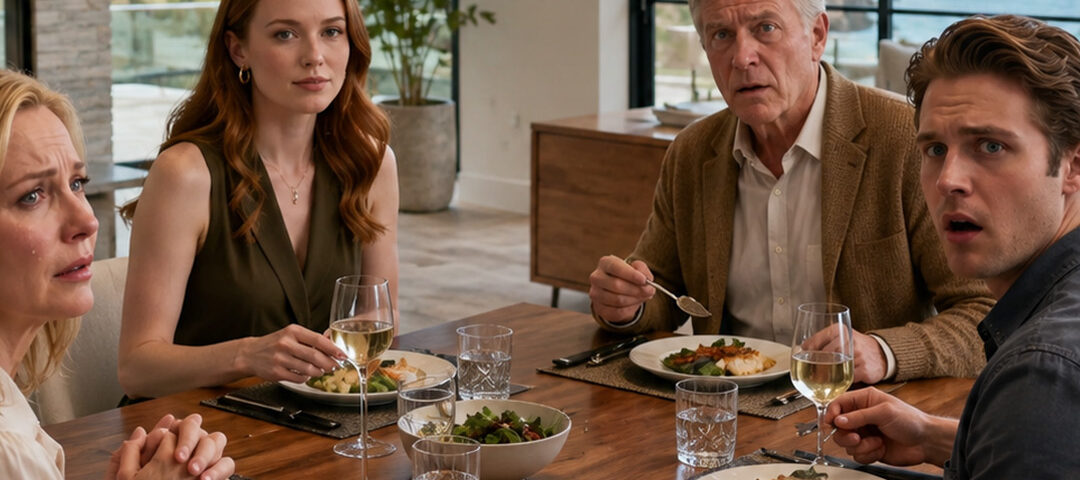
“Get out and stay out,” my dad yelled.
They threw me out for dropping out of surgical residency. They didn’t know I was worth $32 million.
Next day, I moved to my Laguna Beach fortress. Three weeks later…
The house in Philadelphia always smelled of antiseptic and old wood. A stone manor built on the Main Line, designed to look imposing, cold, and ancient, just like the men who lived in it.
My father, Dr. David Sterling, chief of surgery, believed in hierarchy above all else. In this house, affection wasn’t given. It was prescribed, dosed out in milligrams based on performance.
Dinner at 6 sharp.
My brother, Tyler, the golden boy, sat to my father’s right. I sat to his left.
My mother, Patricia, sat at the foot of the table, a silent observer in a room full of egos. The walls were lined with oil portraits of ancestors holding scalpels, staring down at us with judgmental eyes.
“Tyler, tell us about the aneurysm repair,” my father would demand, cutting his steak with surgical precision.
“Clean clipping, Dad,” Tyler would beam. “Dr. Evans let me close.”
“Excellent,” my father would nod. Then he’d turn to me. “Chloe, how was your rotation?”
I learned early on that there was only one correct answer.
“Thirty-six hours, three appendectomies, perfect sutures.”
I never mentioned the other life, the one that started when the hospital lights dimmed and I snuck into the server room.
While Tyler memorized anatomy, I was teaching a machine to see it. I saw patterns where they saw procedure. I saw data where they saw dogma.
My partner, Ethan, a coding prodigy I’d met in undergrad, called it Panacea, an AI capable of predicting surgical complications faster than any human brain.
My father called technology a servant’s tool.
To him, real doctors cut. Real doctors had blood on their hands. Anything else was administrative fluff.
So I lived a double life. By day, the perfect resident stitching skin. By night, the architect of a digital revolution.
The weight of it was crushing. I’d watch my mother sometimes, sitting in the drawing room, staring at the grand piano she never played. It gathered dust in the corner, a monument to a life unlived.
She had been a concert pianist once, before she married the dynasty. Now she just arranged flowers and managed the social calendar.
One night, I found her tracing the keys without making a sound.
“Do you miss it?” I asked.
She flinched, pulling her hand away like she’d been burned.
“Don’t be silly, Chloe. Your father needs a wife, not a musician.”
That was the moment I realized the truth.
My mother wasn’t just weak. She was a warning. She had traded her voice for security, her passion for prestige. And deep down, I think she hated me for trying to escape the cage she had locked herself into.
She wasn’t protecting me when she told me to just listen to your father. She was trying to ensure I didn’t make her sacrifice look foolish. If I broke free, it would prove that she could have, too.
And that was a truth she couldn’t survive.
So I kept coding. I kept stitching, waiting for the moment the algorithm would finally solve the equation of my life.
And then the email came.
It was the 36th hour of my shift when the phone buzzed against my hip. I was scrubbing out of a seven-hour craniotomy. My hands raw, my eyes burning from the harsh fluorescent glare.
I pulled the phone from my pocket.
One email.
Subject: Acquisition complete.
Wire amount: $32 million.
I didn’t scream. I didn’t jump. I just stared at the screen, letting the blue light wash over the blood specks on my surgical clogs.
The number was so large it looked abstract, like a vitals monitor flatlining. But it wasn’t a death.
It was a birth.
My partner Ethan had done it. We had done it.
I drove straight to the manor. The rain was falling in sheets, turning the Pennsylvania slate into a slick black mirror.
I didn’t change out of my scrubs. I wanted them to see me in the uniform they worshiped one last time.
Dinner was already in progress. The silence in the dining room was heavy, broken only by the rhythmic scrape of silver against china.
David sat at the head, a king in his castle. Tyler was midstory about a resident he’d humiliated during rounds. Patricia was pushing peas around her plate, her eyes glazed over.
“I’m resigning,” I said.
I didn’t sit down.
David didn’t look up from his plate.
“Sit down, Chloe. You’re delirious. We’ll discuss your rotation schedule after you’ve slept.”
“I’m not tired,” I said, my voice steady, cutting through the room like a fresh scalpel blade. “I submitted my letter of resignation to the board 20 minutes ago. I am done with surgery. I am done with this hospital. I am done with this life.”
The silence that followed was violent.
David slowly placed his knife and fork on the table. He looked at me, and for the first time, I saw the terrifying void behind his eyes.
He wasn’t looking at a daughter.
He was looking at a possession that had suddenly malfunctioned.
“You are a Sterling,” he said, his voice dangerously low. “We cut. That is what we do. It is who we are. If you walk away from that residency, you are walking away from this family.”
“I’m leaving to lead a technology division,” I said. “I built something, Dad. Something that will save more lives than your scalpel ever could.”
He stood up, his face flushing a deep, mottled red.
“Technology? You want to be a technician? Support staff?”
He slammed his hand on the table, rattling the crystal.
“You are spitting on three generations of legacy. You are humiliating me.”
That was it. The core of the wound.
It wasn’t about my happiness or my potential. It was a narcissistic injury.
To a man like David, children aren’t people. They are mirrors. I was designed to reflect his grandeur back at him.
By choosing a path he didn’t understand, I had shattered the mirror. I had proven that his approval wasn’t the oxygen I needed to survive.
And that terrified him.
“If you leave this house tonight,” he hissed, pointing a trembling finger at the door, “you leave with nothing. No trust fund, no connections, no name.”
“I don’t need your name,” I said. “I have my own.”
“Give me the keys,” he demanded. “I paid for the car. I paid for the clothes on your back. If you want to be independent, start walking.”
I reached into my pocket. I pulled out the key fob to the Audi. I placed it gently on the linen tablecloth, right next to his untouched wine glass.
“You’re right,” I said. “You paid for everything except my mind.”
I turned and walked out.
I heard my mother gasp, a small, suffocated sound. But she didn’t move. She didn’t speak.
I stepped onto the porch. The rain was torrential now. I had a laptop bag, a phone with a $32 million bank balance, and nowhere to go.
My father slammed the heavy oak door behind me, the sound echoing like a gunshot.
He thought he had just executed a punishment.
He didn’t realize he had just performed an amputation.
He had cut me off to save the body of the family, but he was the one who was rotting.
I was finally free.
I didn’t cry. I didn’t shake.
I walked to the edge of the estate, where the manicured lawn met the treeline, and I sat on a wet stone wall.
I opened my laptop. The screen was the only source of light in the darkness.
My bank account: zero.
David had frozen the trust fund I hadn’t touched since I was 18. He had canceled my credit cards. I was homeless, penniless, and alone.
Or so he thought.
I logged into my secure cloud server. The acquisition funds were sitting in an escrow account, waiting for my final authorization.
$32 million.
It wasn’t just money. It was leverage. It was power. It was a weapon.
I typed in the authorization code.
Transfer complete.
Then I looked at housing. Not hotels. Not rentals. I looked at listings in California.
I had always dreamed of living by the ocean, far away from the greystone and gray skies of Philadelphia.
I found it.
A fortress in Laguna Beach.
$24.5 million.
Brutalist concrete, floor-to-ceiling glass, perched on a cliff edge in Emerald Bay.
It looked like a bunker designed by a poet.
Indestructible, beautiful, cold.
I called the realtor. It was 3:00 in the morning in California, but for $24 million, people pick up the phone.
“I want to buy it,” I said. “Cash today.”
“Miss Sterling,” the realtor stammered, “you haven’t even seen it.”
“I’ve seen enough,” I said. “Send the papers.”
I closed the laptop. The rain had stopped.
The silence of the night was heavy, but it wasn’t oppressive anymore. It was empty, and I could fill it with whatever I wanted.
I didn’t go to a hotel. I went to the only place that felt safe, the server room at our startup office.
It was a small, windowless space humming with the sound of cooling fans. The air was crisp and filtered.
I curled up on a beanbag chair in the corner, wrapped in my damp coat. I fell asleep listening to the hum of the servers.
It was the sound of my future, the sound of my freedom.
The next morning, I flew to California.
I didn’t tell anyone. I didn’t say goodbye. I just disappeared.
The house was even more imposing in person. A monolith of concrete and glass, staring out at the Pacific.
I stood in the empty living room, the ocean roaring below, and I felt nothing.
No joy. No triumph. Just a cold, hard sense of safety.
I was safe.
No one could hurt me here. No one could tell me who I was.
I hired a security team. I installed cameras. I bought a white Range Rover, the kind of car my mother would have called vulgar.
I drove it fast along the coast highway, the wind whipping my hair. And for the first time in my life, I didn’t care what anyone thought.
I was building a fortress, not just of concrete and steel, but of silence and distance.
I was ghosting my old life.
I was becoming someone new, someone unbreakable.
For three weeks, the silence was a bomb.
I healed in the quiet of my concrete sanctuary. I woke up when I wanted. I ate what I wanted. I didn’t have to report my location, my sutures, or my worth to anyone.
I was a ghost in my own life, and it was paradise.
Then the contagion hit.
TechCrunch ran the profile on Tuesday morning. The headline was catchy, designed for clicks: The surgeon who traded the scalpel for code inside the $32 million exit.
It detailed everything. The acquisition price, the technology, and in a small paragraph near the bottom, it mentioned my relocation to a private estate in Emerald Bay, Laguna Beach.
The news traveled from Silicon Valley to the Philadelphia Main Line faster than a virus in a pressurized cabin.
My phone, usually dormant, began to seize on the kitchen counter. Notifications stacked up like incoming trauma cases.
Cousins I hadn’t spoken to in a decade. Medical school peers who had snubbed me.
And then the inner circle.
Tyler texted first. No greeting. No congratulations.
Just a screenshot of the article and three words.
Is this real?
It wasn’t brotherly concern. It was an audit.
Tyler was calculating the net worth difference between a neurosurgery resident and a tech founder, and the math was making him sick.
I didn’t reply.
Then my mother called. I let it go to voicemail. I listened to it standing by the infinity pool, the ocean crashing below.
“Chloe,” her voice cracked, thick with performance anxiety. “Your father is falling apart. He saw the article. He’s… he’s in a state. We didn’t know. You have to understand. We were just worried about you. We’re coming to see you. We need to repair this family before it’s too late. We land on Saturday.”
They weren’t asking.
They were announcing.
It was the old dynamic. They dictated the schedule, and I was expected to scrub in.
But they had miscalculated the venue.
They weren’t coming to the manor in Philadelphia, where they held the keys.
They were coming to my fortress.
I could have blocked them. I could have told security to turn them away at the gate.
But I realized that wouldn’t be enough.
If I blocked them, I would always be the runaway child in their narrative, the daughter who couldn’t handle the pressure.
I needed them to see.
I needed them to walk through the concrete halls.
I needed David to look at the empire I built with servant’s tools.
I texted back two words.
Saturday noon.
Then I prepared the house.
I didn’t buy flowers. I didn’t soften the edges. I wanted the house to look exactly like what it was: cold, expensive, and impenetrable.
I wasn’t preparing a home for a family reunion.
I was preparing a boardroom for a hostile takeover.
I called Ethan.
“They’re coming,” I said.
“Do you want me there?” he asked.
“No,” I said. “I need to do this alone. But keep the server logs open. I might need to show them the back end.”
“You’re going to show them the code?”
“No,” I said, looking at the sun reflecting off the water like a blade. “I’m going to show them the future.”
They arrived at noon. Exactly.
A white rental sedan crawled up the winding driveway, looking like a toy car against the massive scale of the concrete walls.
I watched from the upper terrace.
They stepped out into the California sun, blinking like moles dragged into the light.
They were dressed for a Philadelphia country club. Heavy tweeds, stiff loafers, pearls.
In the stark salt-air brightness of Laguna, they looked gray. They looked out of place.
They looked like the past.
I walked down to meet them.
I didn’t offer a hug. I didn’t offer a hand. I just unlocked the 10-foot pivot door and stood aside.
“Welcome,” I said.
They walked in.
The silence of the house swallowed them.
David stopped in the foyer, his eyes scanning the 30-foot ceilings, the floating staircase, the wall of glass framing the Pacific Ocean.
He was looking for a crack. He was looking for dust. He was looking for something to criticize so he could reestablish his dominance.
But I ran this house like an operating theater. It was sterile. It was perfect.
“It’s substantial,” he muttered, unable to meet my eyes.
“It’s secure,” I corrected.
I led them on the tour.
It wasn’t a tour of a home. It was a tour of a fortress.
I showed them the infinity pool that dropped off into the horizon. I showed them the guest house that was larger than our entire downstairs in Philly.
Tyler walked behind me, running the math in his head. I could practically hear the gears turning, calculating the property tax, the down payment, the net worth required to sustain this.
He looked sick.
Patricia didn’t speak. She just touched the surfaces, the cold marble, the warm walnut, with trembling fingers.
She wasn’t looking at the luxury.
She was looking at the freedom.
She was realizing that the cage she had spent 30 years polishing was just a cage, and I was standing on the outside, holding the key.
We sat for lunch on the cantilevered deck. The ocean roared below us, a constant, violent reminder of where we were.
The private chef served a charred octopus salad. David poked at it suspiciously.
He couldn’t take the silence. He couldn’t take the shift in gravity.
He needed to be the chief of surgery again. He needed to be the smartest man in the room.
“It’s a nice view, Chloe,” he said, putting down his fork. “But let’s be realistic. Real estate is a volatile asset. Real work, real legacy happens in the hospital.”
I took a sip of sparkling water.
“Is that so?”
“In fact,” he said, leaning back, finding his rhythm, “we are revolutionizing the department. We just licensed a new system, a surgical intelligence platform.”
My heart didn’t speed up.
It slowed down.
It was the predator’s calm.
David beamed. He was back in his pulpit.
“It’s incredible, actually. It uses predictive algorithms to map complications before we even make the incision. It’s analyzing thousands of data points in real time. It’s going to save the department’s accreditation.”
“We were slipping, I admit it. But this… this is the future. It catches mistakes the human eye misses.”
“It sounds expensive,” I said, baiting the hook.
“Quality costs,” he scoffed. “We paid a premium. But the developers? Geniuses. Absolute geniuses. They understand the anatomy better than half my attending surgeons. I told the board, ‘Give them whatever they want. We need this tech.’”
I looked at Tyler. He was nodding in agreement.
I looked at my mother. She was staring at the ocean.
I looked at David. He was glowing with pride for a machine that he thought validated his brilliance.
He had no idea he was praising the very mind he had tried to lobotomize.
He was worshiping the servant’s tool.
“It’s funny,” David said, taking a sip of wine. “I always told you that technology was a support role. But this software, it’s almost like it thinks like a surgeon. A master surgeon.”
I placed my glass on the table. The sound of the crystal hitting the stone was sharp.
“I’m glad you like it, Dad,” I said. “The interface was the hardest part to design.”
David stopped chewing. The fork hovered halfway to his mouth.
“What did you say?”
“Panacea,” I said, leaning forward slightly. “That’s my company, Dad. My code, my patent. I signed the licensing agreement with your hospital board yesterday morning. You’re not just implementing a new system. You’re implementing me.”
The silence that fell over the table was heavy, suffocating, and absolute.
I watched the realization hit him in waves.
First confusion.
He wasn’t the master of his domain anymore.
He was a user. A customer.
He was paying a premium to the very daughter he had discarded because she was useless.
Tyler made a choking sound, setting his water glass down hard. He looked from me to David, his eyes wide.
He realized the hierarchy had just inverted.
The golden boy was now working for the exile.
David’s face went gray.
“You… you own Panacea?”
“I built it,” I said, “with the servant’s tools you despised.”
For a moment, I thought he might yell. I thought he might storm out.
But he didn’t.
He did something worse.
He smiled.
It was a tight, desperate grimace, an attempt to rewrite history in real time.
“Well,” he said, his voice trembling slightly. “This is extraordinary. I always knew you had a brilliant medical mind, Chloe, even if you applied it differently. This… this validates everything. We should discuss the integration. As a consultant, perhaps I could—”
I held up a hand.
“I’m just saying,” he pressed, desperation creeping in, “that this is a family triumph. We can—”
“There is no we,” I said.
My voice was calm, devoid of the anger I thought I would feel.
“You don’t get to pivot, Dad. You don’t get to claim this. You fired me from this family. You told me I was nothing without your name. Well, now your hospital is paying seven figures a year to use mine.”
I stood up.
The ocean breeze fluttered the tablecloth.
“I have a meeting with my CTO in 20 minutes,” I said, checking my watch. “You need to leave.”
“Chloe,” my mother whispered, finally finding her voice. “Please.”
“The gate code expires in 10 minutes,” I said. “Don’t make me call security.”
They stood up.
They looked small against the backdrop of the Pacific.
They looked like guests who had overstayed their welcome.
They walked back through the house in silence, but this time they didn’t look at the architecture with judgment. They looked at it with fear.
I watched from the foyer as the heavy front door clicked shut.
I watched the white rental car wind its way down the driveway and disappear onto the coast highway.
I didn’t feel sad. I didn’t feel lonely.
I felt the clean, sharp relief of a successful amputation.
The necrotic tissue was gone. The wound was closed.
I was whole.
Night fell over Laguna. The house lit up, a beacon on the cliff.
I sat in my office, the glass walls reflecting the stars. I opened my laptop.
On the screen, a live dashboard showed the Panacea system running in hospitals across the country, including Philadelphia General.
Status: active.
Anomalies detected: zero.
Lives protected: 142.
I watched the data stream. It was a heartbeat.
It was my heartbeat.
I had traded the scalpel for the code, and in doing so, I had saved the most important patient of all: myself.
I closed the laptop. I walked out to the edge of the infinity pool and listened to the ocean roar.
You are the surgeon of your own destiny.