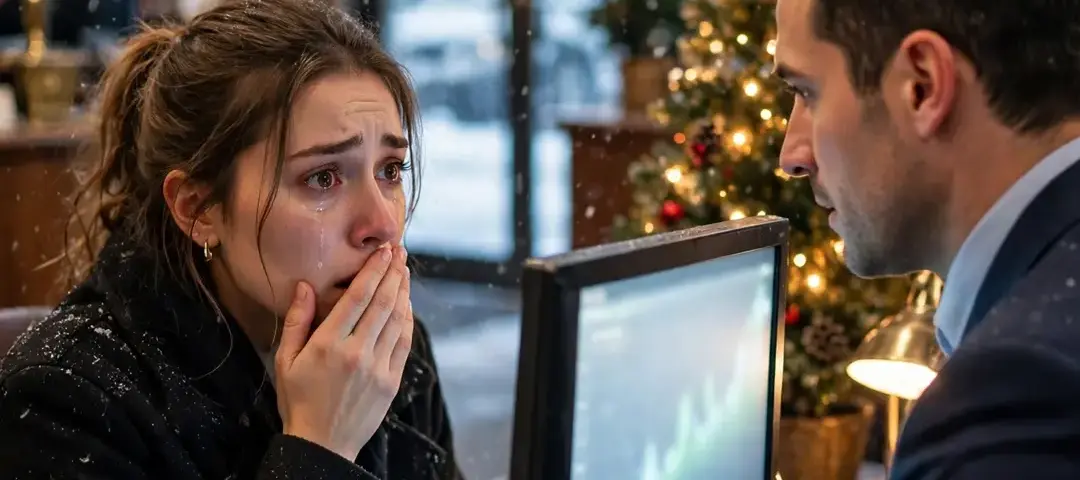
My parents made me leave on Christmas with nothing but the clothes I was wearing. Mom would not even let me take one bag, and Dad said, “Let’s see how far you get on your own.” I walked to the bank with the old card my grandfather had left me, hoping it could cover one night somewhere safe. The manager checked the card, then went completely still. “Ma’am,” he said quietly, “please sit down. You need to see this.” When the account opened on the screen, my grandfather’s name was there, my name was beside it, and one note said my parents were never allowed to touch a cent.
THE CARD OWEN LEFT BEHIND
The handwritten bill was already waiting on the kitchen table when my mother called me downstairs on Christmas Eve.
It sat beside the ceramic snowman saltshaker, the one with the chipped red hat, under the warm yellow light above the breakfast nook. Outside, the neighborhood was quiet and frozen, every lawn silvered with frost, every porch in the cul-de-sac glowing with soft white lights. Inside, my parents’ house smelled like cinnamon, pine, and the ham my mother always baked too early and reheated until it was dry around the edges. The tree blinked in the living room behind me. Somewhere on the television, muted carolers were smiling in a town square that looked nothing like real life.
For half a second, coming downstairs, I had let myself believe the night might still be a holiday. There were gifts under the tree with my handwriting on the tags, three of them, wrapped at midnight after my second job.
My father sat at the kitchen table with his arms crossed.
My mother stood near the sink, wiping the same clean counter with a dish towel she didn’t need. My younger sister, Vanessa, leaned against the refrigerator with one ankle crossed over the other, wearing a red sweater, glossy lipstick, and the small satisfied smile she had been carrying around for weeks, like she knew the punchline to a joke I hadn’t heard yet.
I stopped in the doorway.
“What’s going on?”
My father did not say hello. He did not ask how my shift had gone. He did not mention the plate of cookies I had brought home from the bakery where I worked mornings. He only looked at the chair across from him.
“Sit down, Rachel.”
That was the first sign.
My father, Frank Doyle, only used my full name when he wanted the room to feel like court. When I was little, it meant someone had tracked mud through the hallway or left the back gate open. At thirty-two, it meant something colder: a decision had already been made, and I was being invited to watch it happen.
I sat.
The chair was the same one I had used since childhood, though now it wobbled slightly because one of the screws had been loose for years. I had tightened it twice since moving back in. Nobody noticed. Nobody noticed the leaking pipe under the sink until I fixed it. Nobody noticed the back fence looked fresh because I repainted it after work one Saturday. Nobody noticed that I bought my own groceries and kept them on the bottom shelf of the refrigerator in a canvas bag so no one could say I was eating food that wasn’t mine.
But they had noticed something.
My father slid the paper across the table with two fingers.
At the top, in his blocky handwriting, were the words Household Expenses.
Beneath that was a list.
Groceries.
Utilities.
Water.
Internet.
Heating.
Laundry.
Shared supplies.
Extra household wear.
Beside each item was a dollar amount, rounded in a way that made the numbers look official without being honest. At the bottom was a total written with a hard line beneath it.
$4,218.63.
I stared at the number.
For a moment, I thought I had misunderstood. Not because money was not real to me. Money had been painfully real for the last year. A breakup that had left me starting over, two part-time jobs, no apartment, no safety net I could reach without shame. I had moved back into my parents’ house seven months earlier with two suitcases, a storage bin of books, and the intention to stay as briefly and quietly as possible.
I paid for my own food.
I did my own laundry.
I drove my mother to doctor appointments when her car was in the shop.
I cleaned the guest bathroom every week because I was the only one using it.
I did not invite friends over. I did not leave dishes in the sink. I did not raise my voice. I did not ask for anything I could buy myself.
I had thought, foolishly perhaps, that I was being careful enough to be tolerated.
“What is this?” I asked.
My father leaned back.
“What it looks like.”
“It looks like you’ve been adding up my existence.”
Vanessa gave a tiny laugh into her glass of water.
My mother stopped wiping the counter.
My father’s eyes hardened.
“Don’t get dramatic. You’ve been here seven months. Your mother and I have carried the extra cost. We’ve been patient. We’ve been generous.”
“I buy my own groceries.”
“You use the refrigerator.”
I looked at him, waiting for some sign that he heard himself.
He did not.
“I fixed the sink,” I said. “I repainted the fence. I drove Mom to six appointments. I covered gas when Vanessa borrowed my car for that bridal shower in March.”
“That’s not the point,” Vanessa said.
I turned to her. “Then what is?”
She lifted one shoulder. “The point is you always think doing a few little things cancels out the fact that everyone else has to make room for you.”
Make room.
Two words that told me exactly how I was seen in that house.
Not as a daughter recovering from a bad chapter. Not as a woman working hard to rebuild. Not as family. As a box in the hallway. A dent in the budget. A disruption in the story my parents preferred to tell about themselves.
My father tapped the paper.
“You have always had a problem standing on your own two feet.”
The sentence landed gently, which made it worse.
I looked at my mother.
She kept her eyes down.
“Mom?”
Her hand tightened around the dish towel.
“Your father is trying to help you face reality.”
Reality.
I almost laughed. The house was warm. The tree was glowing. Wrapped gifts sat beneath it, including three I had bought with tip money and wrapped at midnight after my second job. My coat still smelled faintly of bakery sugar and cold air. I was wearing the same black pants I wore to the diner on weekend nights because I had come straight from work.
And they were telling me I did not understand reality.
“I’m saving,” I said. “I told you that. I’m trying to move out by February.”
“Trying,” my father said, “is not the same as doing.”
Vanessa set her water glass down with a soft click.
“Maybe if you hadn’t always waited for people to rescue you, you’d be further along.”
I looked at her then, really looked. My younger sister was twenty-nine, married to a man with a steady job, living in a townhouse my parents had helped furnish, still coming by twice a week to use my mother’s laundry room because she said the machines in her complex were “gross.” Nobody wrote her a bill for detergent. Nobody reminded her how much hot water cost. Nobody told her she was a burden while she folded her sweaters on my mother’s dining room table.
I had been comparing quietly for years.
That night, comparison became clarity.
“What are you asking me to do?” I said.
My father stood.
Not quickly. Not angrily. With the terrible calm of a man enjoying his authority.
He walked to the front closet, opened the door, and pulled out a black duffel bag.
My bag.
The one I kept on the top shelf of the closet in my room.
He carried it to the kitchen and placed it on the floor beside the table.
I stared at it.
Inside, through the half-open zipper, I could see a few shirts, a pair of jeans, a phone charger, and my toothbrush in a plastic sandwich bag.
That was all.
Everything else I owned was upstairs.
My winter coat was on the chair behind me. My work shoes were by the back door. My laptop, my documents, my photographs, my grandmother’s little jewelry box, the savings notebook where I tracked every dollar I earned and spent — all upstairs in the guest room I had been trying very hard to treat as temporary.
My father’s voice was flat.
“Tonight, you need to leave.”
For a second, I could not understand the words.
“It’s Christmas Eve.”
“Yes.”
“It’s twenty-two degrees outside.”
“You have a car.”
“I don’t have anywhere to go.”
My mother finally looked up.
Her eyes were not wet. I wish they had been. Tears would have suggested conflict. Her face showed only exhaustion, like I was a problem she was relieved someone else had decided to remove.
“You can call a friend,” she said.
I stood slowly.
“I’m going upstairs to get my things.”
My father moved before I did. He stepped into the archway that led to the staircase and blocked it with his body.
“You can collect the rest after the holiday.”
The room went still.
Even Vanessa stopped smiling for a moment.
I looked at my father, at the man who taught me to check the oil in my first car, who used to hold the back of my bicycle seat when I was learning to ride, who sat in the auditorium when I graduated high school and clapped because he was supposed to. He stood between me and the only belongings I had left in that house like I was a tenant who had overstayed.
“You packed my toothbrush,” I said.
It was a strange thing to say.
But in that moment, the toothbrush hurt more than the total on the paper. The intimacy of it. Someone going into the bathroom, opening my travel case, deciding which small pieces of my life I was allowed to carry into the cold.
My father’s jaw flexed.
“This is not a debate.”
I looked at my mother one last time.
Something in me, the child part maybe, still expected her to stop him. To say enough. To tell him that Christmas Eve was not a night to put your daughter out with a duffel bag and a bill. To remember that seven months was not forever, that I had been trying, that families were supposed to be more than ledgers.
Instead, she said the sentence I would hear in my head for years.
“You can’t do anything on your own, Rachel. You never could. You’re desperate.”
She said it quietly.
Not with anger.
With certainty.
Like she had been holding it for years and was relieved to finally put it down.
Vanessa looked at the floor, but not before I saw satisfaction return to her face.
I picked up the duffel bag.
It was lighter than it should have been.
At the front door, my mother followed me halfway down the hall, then stopped. My father stayed near the staircase. Vanessa remained in the kitchen, one hip against the counter, watching like this was a scene in someone else’s movie.
I opened the door.
The cold hit my face so sharply my eyes watered.
For a second, the Christmas lights across the street blurred. The Hendersons’ wreath swung slightly in the wind. A small plastic reindeer glowed on the lawn next door, cheerful and ridiculous.
I stepped onto the porch.
Behind me, the door closed.
Then the lock turned.
That sound did something to me.
It did not break me. Breaking would have been easier. Breaking would have meant collapsing, crying, knocking until someone remembered I was their daughter. Instead, the sound of that lock moved through me like a line being drawn.
I walked to my car, put the duffel bag in the passenger seat, and sat behind the wheel with both hands resting on my knees.
For almost an hour, I did not drive.
My breath fogged the windshield. The heater worked slowly because the car was old and dramatic about cold mornings. My checking account had twenty-two dollars and change. My phone battery was at eighteen percent. Simone, my closest friend, had texted three times.
Are you okay?
Do you need me?
Rachel, answer me.
I stared at the messages and could not make myself type the truth. Asking someone to take you in on Christmas Eve felt like arriving with a burden wrapped in apology. I had spent seven months trying not to be too much for anyone, and now I was sitting outside the house where I grew up, locked out with a toothbrush.
You’re desperate.
My mother’s voice kept circling.
At first, it hurt.
Then, somewhere around the forty-minute mark, hurt became something steadier.
Anger, but not the loud kind.
Quiet anger.
Useful anger.
The kind that does not waste itself on the people who caused it because it has already begun looking for the next door.
That was when I remembered the card.
My grandfather, Owen Doyle, had been gone three years. He was my father’s father, though they had never been close in the way people expect fathers and sons to be close. Owen was quieter, gentler, and far more observant than anyone in our family gave him credit for. He wore flannel shirts, kept peppermints in the console of his truck, and could fix almost anything with patience and a small flashlight held between his teeth.
He called me Rach.
Not Rachel, unless he was pretending to be formal.
He was the only adult in my childhood who never once made me feel like I was taking up space. When my parents’ house got loud, his porch got quiet, and there was always a second chair.
After he died, his attorney sent me a small envelope. Inside was a bank card in my name and a folded note written in Owen’s shaky handwriting.
For when you really need it, Rach.
Don’t use it early.
You’ll know.
I had kept the card in my wallet behind my license ever since.
Untouched.
I assumed it was symbolic. Maybe a few hundred dollars. Maybe a little emergency money he wanted me to have without family commentary. I never checked because it felt sacred and because I kept telling myself I did not need it yet.
Sitting in my freezing car on Christmas Eve, with twenty-two dollars and a duffel bag my father had packed for me, I decided yet had arrived.
The bank would not open until morning.
So I drove to a twenty-four-hour diner off the highway, the kind of place with red vinyl booths, chrome edges on the tables, and waitresses who know when not to ask too many questions. A plastic Christmas garland hung over the pie case. The television in the corner showed a silent holiday parade. Someone had taped a handwritten sign near the register: Christmas Hours, Open Till Noon.
I ordered the cheapest coffee on the menu and a side of toast because I needed somewhere to sit that would not ask me what my plan was.
The waitress, a woman named Carla according to her name tag, poured my coffee and glanced at the duffel bag beside me.
“You traveling?”
“Something like that.”
She nodded as if that answer contained enough truth.
She came back twice more that night without being asked. On the hardest night of my life, that small, unmeasured kindness nearly undid me more than the bill had.
I sat in the corner booth until sunrise. I did not sleep. I watched truckers come in for coffee, a nurse in scrubs eat pancakes alone, an older couple split a piece of pie at six in the morning. I watched my phone battery drop to nine percent and used the outlet beneath the booth to bring it back to life. Simone kept texting. Eventually, I replied.
I’m safe. I’ll call you soon.
At eight-thirty, I drove to the bank and waited in the parking lot until the doors opened.
By then, I looked exactly like someone who had spent Christmas Eve in a diner booth. My hair was pulled into a messy knot. My eyes were raw. My clothes were wrinkled. I had brushed my teeth in the diner bathroom with the toothbrush my father had so thoughtfully packed.
The bank lobby was warm, beige, and too bright. A Christmas playlist drifted softly from ceiling speakers. There was a small tree near the reception desk with gold ornaments and paper snowflakes. Behind the teller line, someone had placed candy canes in a coffee mug.
A man in a navy suit greeted me near the entrance.
“Good morning. I’m Arthur. How can we help you today?”
I took the card from my wallet.
“My grandfather left me this. I’ve never used it. I’m not sure what’s attached to it.”
Arthur took the card, glanced at the name, and asked for my ID. His manners were polished but kind, the kind of professional calm that makes you feel less foolish for not knowing what you are doing. He led me to a desk, typed for a moment, then frowned slightly.
Not in irritation.
In surprise.
He typed again.
A full two minutes passed.
His face changed.
He looked at me, then back at the screen, then stood slowly and closed the half-door beside his desk.
“Ms. Doyle,” he said quietly, “please sit down.”
“I am sitting.”
He pulled the chair closer as if worried I might not be for long.
“You need to see this.”
He turned the monitor toward me.
The first thing I noticed was not the number. It was the ugly beige pattern of the carpet beneath my shoes. My mind fixed on it because the rest was too large to take in. The carpet had little brown diamonds on it, faded near the rolling chair. Above me, the Christmas music changed to a cheerful version of “Joy to the World.”
Then I looked at the screen.
Account balance: $473,000.
I read it once.
Then again.
Then I looked at Arthur.
“There’s a mistake.”
He shook his head slowly.
“No, ma’am.”
“That can’t be mine.”
“It is yours.”
“My grandfather gave me a card. I thought maybe there was a little money for emergencies.”
Arthur’s expression softened.
“This account was opened in your name when you were fifteen. Your grandfather made the initial deposit. There were several additional deposits over the years, and the funds have grown. You are the sole owner and beneficiary. No one else has access.”
Seventeen years. The whole time, that number had been sitting there quietly, growing in the dark, behind a card I treated like a keepsake.
My hands were shaking now.
I put them in my lap so he would not see.
“Are you sure no one else can touch it?”
“Absolutely. The restriction is printed right on the account. It names your parents specifically, and bars them from any information or access. Your grandfather was very precise.”
Precise. That was Owen — precise the way a man is when he has already decided exactly where the danger would come from.
Arthur glanced back at the screen.
“There is one notation I need to explain.”
My stomach tightened.
“What notation?”
He read carefully.
“About two years after your grandfather passed, someone came into a branch asking whether this account still existed and whether he could obtain information about it. He was denied because he was not the account holder.”
The room seemed to tilt without moving.
“Who?”
Arthur looked at me with the careful face of a man who knew the answer would matter.
“The inquiry record lists Frank Doyle.”
My father.
I sat back.
For several seconds, I could not speak.
My father had known.
Maybe not the amount. Maybe not the details. But he had known enough to ask. He had gone to the bank after Owen died and tried to find out what his father had left me. He had been turned away. Then seven months ago, when I showed up at his door after my life fell apart, he let me in. I had thought it was reluctant kindness. Now another possibility opened in front of me, colder than the air outside.
He had been waiting.
Watching.
Maybe wondering when I would mention the card. Maybe hoping I would feel indebted enough to hand something over. Maybe growing angrier each month that I did not bring up the money he suspected existed.
And when I did not, when I kept working, saving, buying my own groceries, and staying quiet, he decided to push me out before I discovered it on my own.
On Christmas Eve.
With a bill.
And a bag.
Arthur’s voice brought me back.
“Ms. Doyle, would you like me to bring in a financial adviser?”
“Yes,” I said, though I barely recognized my own voice.
I spent two hours in that bank.
Arthur introduced me to a woman named Denise Caldwell, who spoke calmly and did not treat me like a child. She explained the account structure, options for transfer, tax considerations, protections, and how to separate the funds from anything my family might try to access. I opened a new personal account in my name only. I updated every contact method. I removed my parents’ address. I created security questions no one in that house could guess. I set up alerts. I scheduled an appointment with an independent financial adviser after Christmas.
Denise never once asked why I was doing all of this on Christmas morning in yesterday’s clothes. She just kept sliding the next form across the desk and let me sign my name back into my own life.
By noon, I was no longer the woman who had slept in a diner booth with twenty-two dollars.
I was still tired.
Still hurt.
Still homeless for the moment.
But the floor under me had changed.
Not because money fixes betrayal. It does not. Money cannot unlock the door your father closed or unsay what your mother said. It cannot make your sister’s smile disappear from memory. It cannot give you back the illusion that your family is safe.
But money can buy time.
It can buy a bed behind a locked door.
It can buy the space to heal without asking permission.
It can turn a person from trapped to choosing.
I walked out of the bank into thin winter sunlight and called Simone.
She answered on the first ring.
“Rachel?”
“I need help,” I said.
Her voice cracked. “Where are you?”
“At the bank.”
“Are you okay?”
I looked at the card in my hand. Owen’s card. The one I had carried for three years like a message from another world.
“I think I’m going to be.”
I told her everything in the parking lot. The kitchen table. The list. The bag. The lock. The diner. The account. My father’s inquiry.
She cried before I did.
“Come here,” she said.
“I don’t want to ruin your Christmas.”
“Rachel, if you say that again, I’m driving over there and putting you in my car myself.”
That was the difference between people who loved you and people who measured you.
Simone’s apartment was small, bright, and cluttered with plants she kept insisting were “mostly alive.” She gave me her bed and slept on the couch despite my protests. Her mother dropped off leftovers that evening and hugged me without asking questions. For the first time in twenty-four hours, nobody asked what I cost.
I slept eleven hours and woke to a note on her counter — Coffee’s in the pot. Stay as long as you need. — and cried over it, because the note had no total at the bottom.
Within a week, I signed a lease on a small apartment across town.
It was not fancy. One bedroom, pale walls, decent light, a kitchen with scratched cabinets, and a window that looked out over a parking lot and a maple tree. But when I stood in the empty living room with the keys in my palm, I felt something I had not felt in years.
The floor was mine.
Nobody could order me down to the kitchen.
Nobody could pack my toothbrush.
Nobody could lock me out.
I paid six months upfront and cried in the leasing office bathroom afterward, not because I was sad, but because relief can be just as overwhelming as grief when you have been holding your breath too long.
I bought a bed. A couch. Dishes. A coffee maker. A small kitchen table from a furniture outlet where the salesman tried to talk me into a more expensive set and then backed off when I said, “This one.”
I did not call my parents.
I did not drive by their house.
I did not ask Vanessa to send my things.
Instead, I made a list.
My laptop. My documents. My jewelry box. The quilt from my grandmother. The savings notebook. My winter boots. My books. The framed photo of Owen holding me on his lap when I was six, both of us wearing paper crowns from Christmas crackers.
I hired movers.
Not friends. Not family. Professionals.
Then I called my father.
He answered on the third ring.
“Rachel.”
No hello.
“I’m coming Saturday at ten to collect the rest of my belongings,” I said. “I’ll have movers with me.”
There was a pause.
“You should have called earlier.”
“I’m calling now.”
“You can’t just show up with strangers.”
“I can, actually.”
My voice sounded calm in a way that made me stand a little straighter in my new kitchen.
“I lived there seven months. My belongings are there. I’ll be there at ten. If that doesn’t work, you can put everything on the porch before then.”
“Don’t take that tone with me.”
I looked at the keys on my counter.
“I’m not taking a tone. I’m giving you information.”
Another silence.
Then my mother’s voice in the background.
“Is that Rachel?”
My father covered the phone poorly. “She says she’s bringing movers.”
I heard Vanessa laugh.
That laugh decided something for me.
“Also,” I said, “please have the expense list ready.”
“The what?”
“The bill you gave me Christmas Eve.”
“You know what that was.”
“I do. I’d like a copy.”
“Why?”
“Because I want my records complete.”
My father said nothing.
Records made him nervous now.
Good.
On Saturday morning, I arrived in a rented moving van with two men from a company Simone recommended. They were polite, efficient, and uninterested in family tension, which was exactly what I had paid for.
My father opened the door.
He looked older than he had on Christmas Eve, though only a week had passed. My mother stood behind him, arms folded around herself. Vanessa was in the living room, pretending to scroll her phone but watching every move I made.
No one hugged me.
That was fine.
I walked in with the movers behind me and a clipboard in my hand.
“Bedroom upstairs,” I told them.
My father blocked the hallway for half a second, then stepped aside.
It was a small moment, but I felt it.
Christmas Eve, he had stood between me and my things.
This time, he moved.
My room looked wrong. Not ransacked, not touched enough to accuse anyone of cruelty, but subtly disturbed. Drawers not fully closed. The jewelry box shifted. My notebook missing from the desk. The closet door open.
I opened the dresser.
Most of my clothes were there.
My winter boots sat by the window instead of in the closet.
The framed photo of Owen was face down on the nightstand.
I picked it up and held it for a moment.
In the picture, Owen was smiling, one arm around me, his eyes crinkled at the corners. Behind us was the old Christmas tree from my childhood, the one my grandmother decorated with wooden ornaments. I ran my thumb over the frame.
“Thank you,” I whispered.
Vanessa appeared in the doorway.
“You’re being dramatic.”
I turned.
She looked elegant, rested, and faintly irritated, as if my boundaries were an inconvenience to her morning.
“You always do this,” she said. “You make everything into some huge thing.”
I looked at her carefully.
“You watched them put me out on Christmas Eve.”
Her chin lifted.
“You’re an adult.”
“So are you.”
Her eyes narrowed.
“What’s that supposed to mean?”
“It means adults don’t lean on counters smirking while someone else gets thrown out into the cold.”
For once, Vanessa had no immediate reply.
Downstairs, my mother called my name.
When I entered the kitchen, she stood beside the table where the bill had been. My father sat in the same chair, arms crossed, but the posture looked less powerful now. The paper lay between them.
“You asked for this,” he said.
“I did.”
He pushed it across the table.
I took it, folded it once, and placed it in my folder.
Then I pulled out a cashier’s check.
The exact amount.
$4,218.63.
My mother stared at it.
My father’s eyes flicked to the bank logo.
Vanessa stepped closer.
“What is that?”
“Payment,” I said.
My father’s face changed.
“Where did you get that?”
I slid the check across the table.
“You presented a bill. I’m paying it.”
“That’s not what this was about.”
“I know.”
The room went quiet.
My mother looked at me then, really looked, perhaps for the first time since Christmas Eve. Her mouth softened, but I no longer trusted softness that arrived after consequences.
“Rachel,” she said, “we were trying to make you stand on your own.”
“No,” I said. “You were trying to make me feel small enough to accept whatever story you told about me.”
My father’s hand moved toward the check but stopped.
I opened my folder and placed another paper on the table.
It was a printed copy of Owen’s handwritten note.
For when you really need it, Rach.
Don’t use it early.
You’ll know.
My father went very still.
There it was.
The moment the room shifted.
Not loud. Not cinematic in the way people imagine. No one stood. No one cried out. The refrigerator hummed. The furnace clicked on. A car passed outside, tires crunching over salted pavement.
But my father’s face told me everything.
He knew the note.
Or he knew enough.
“You went to the bank,” I said quietly.
His eyes lifted.
My mother looked at him. “Frank?”
I kept my voice even.
“The bank has a record of your inquiry after Grandpa died. You asked about the account. They turned you away.”
Vanessa’s face changed first.
She looked at my father, startled, then at me.
“What account?”
My father said nothing.
My mother gripped the back of a chair.
“Frank, what is she talking about?”
He looked smaller by the second.
I did not give them the amount. I did not owe them the number. The number was not the point. The point was that Owen had seen me accurately when the people in that kitchen had not. He had spent years building a door for me to walk through when theirs closed.
“I don’t know what you thought would happen,” I said. “Maybe you thought I knew and was hiding it. Maybe you thought if I felt guilty enough, I’d hand something over. Maybe you were angry because Grandpa protected me in a way you couldn’t control. I don’t really need the explanation.”
“Rachel,” my father said, but the authority was gone from his voice.
“No,” I said. “You gave me your explanation on Christmas Eve.”
My mother’s eyes filled now.
Too late.
“I didn’t know,” she whispered.
I looked at her.
“You knew enough to let him block the stairs.”
That ended whatever defense she might have tried to build.
The movers carried the last boxes downstairs. One of them asked if there was anything else. I checked my list. Laptop. Documents. Jewelry box. Quilt. Boots. Books. Photo. Savings notebook, found under a stack of old magazines in the closet.
Everything that mattered.
I picked up my folder.
“The check covers the amount you wrote,” I said. “Consider it paid in full.”
My father stared at it like it was something dangerous.
“Rachel, let’s talk.”
“We already did.”
“When?”
“When the lock turned.”
I walked to the front door.
This time, I opened it from the inside.
For one second, I paused on the porch. The Christmas wreath was still there, browning at the edges. The air was cold, but not unbearable. My car was parked at the curb behind the moving van. My whole life, or the start of it, was boxed and loaded.
Vanessa stood behind the screen door.
“You think money makes you better than us?”
I turned back.
“No,” I said. “But it showed me who thought I was nothing without it.”
She looked away first.
I drove to my apartment and unpacked until midnight.
The bed frame squeaked. The couch was too stiff. The coffee maker made a strange clicking sound before it brewed. The living room was full of boxes labeled in black marker, and the kitchen smelled like cardboard and takeout.
It was perfect.
Over the next few months, I built my life with the care of someone laying foundation after a storm.
I did not quit working immediately. That surprised Simone. It surprised Denise at the bank too. But I kept both jobs for a while, not because I needed every shift, but because I needed to remember that I could choose. I cut back slowly. I met with the financial adviser. I set up investments. I made a plan for school, because I had always wanted to finish the degree I paused years earlier when life got expensive and my family’s needs kept finding their way ahead of mine.
I bought a reliable car.
I paid off the small debt my breakup had left behind.
I gave Simone a check for the rent she refused to ask for during the nights I stayed with her. She cried and called me impossible. I told her people who open doors get to be thanked properly.
I never told my parents the amount.
They tried, of course.
My father called twice. My mother left a message saying she wanted to understand. Vanessa sent one text that began with I think we all said things we didn’t mean, which was such a dishonest sentence I deleted it before reading the rest.
Later, my father sent a letter.
Handwritten.
No apology at first. Just explanations. He said he had been worried about me. He said Owen had always been secretive. He said the bank inquiry was “a misunderstanding.” He said Christmas Eve had gotten out of hand.
I read it at my kitchen table, the new one, the small one by the window.
Then I took out a pen and wrote one sentence on a blank card.
The account was never the reason I left. The way you treated me was.
I mailed it without a return address.
Spring came slowly that year.
The maple tree outside my window opened tiny green leaves. I started walking in the mornings before work, past townhouses and coffee shops and a church sign that changed every week. My apartment became less empty. Books found shelves. Dishes found cabinets. Owen’s photo found a place on the wall above my desk, next to his note, framed in plain wood.
For when you really need it.
I used to think need meant financial need. Rent. Food. A place to sleep.
I understand now that Owen meant something larger.
Need can be the moment you finally see your life clearly. The moment love stops making excuses for people who do not protect you. The moment a locked door becomes proof, not punishment. The moment you stop trying to convince people you deserve room and simply go build a home where your name is already on the key.
That Christmas Eve, my parents thought they were sending me into the cold with almost nothing.
They did not know my grandfather had been walking beside me for seventeen years in the form of a card I had never used.
They did not know the bank would remember.
They did not know the bill they wrote to shame me would be the last thing they ever got to charge me for.
On the first Christmas in my own apartment, Simone came over with too many cookies and a lopsided wreath. We made coffee, burned the first batch of cinnamon rolls, and laughed until we had to open the window.
Later, after she left, I stood alone in the quiet living room. The tree I bought was small, only four feet tall, but the lights made the whole room warm. Outside, snow touched the parking lot in soft, harmless flakes.
My phone stayed silent.
No one called me desperate.
No one told me I could not do anything on my own.
I took Owen’s card from my wallet and placed it in a small box on my desk, next to the receipt for the cashier’s check and the folded expense list my father had written.
Paid in full.
That was what I wrote across the top.
Not because I owed them.
Because I didn’t anymore.
If you came here from Facebook because of this story, return to the Facebook post, tap Like, and comment exactly “Amazing” to support the storyteller. That small action means more than it seems and gives the writer genuine encouragement to keep sharing more stories about family pressure, firm boundaries, and the quiet people who protect us long after they are gone.
Any resemblance to real persons, events, or places is coincidental. This story is a work of fiction created for entertainment purposes.