Know where documents are.
Know who is named.
Know which accounts transfer directly.
Understand that a will is not the entire estate plan.
And perhaps most importantly:
Do not wait for grief to become your first financial education.
One Sunday, months after Daniel’s death, Michael and Clare came for dinner.
Clare brought pie.
Michael brought nothing.
I looked at his empty hands.
“What?”
he asked.
“I’m just glad you didn’t bring a folder.”
Clare nearly choked on her water.
Michael laughed.
This time no one was being diminished.
After dinner, I carried my laptop into the living room.
“There’s something your father wanted you to hear.”
Their faces changed.
I played the rest of Daniel’s recording.
He apologized to me again.
Then he spoke to them.
“If Michael and Clare are watching this, I hope the three of you have already had conversations I should have started while I was alive.”
Clare took my hand.
Daniel continued.
“I taught you to respect work.”
Another.
“I taught you about investing.”
Another.
“I taught you not to sign things you didn’t understand.”
He smiled sadly.
“But I may have taught you too much about building wealth and not enough about what wealth is supposed to protect.”
Michael lowered his head.
Then Daniel said:
“If money ever makes you look at your mother and see an obstacle, then I taught you the wrong lesson.”
Clare began crying.
So did I.
Then he looked straight into the camera.
“Evie, I should have trusted you with the whole plan sooner.”
Another.
“I’m sorry.”
No defense.
No reason.
Just apology.
For months, I had been angry because I could not answer him.
That evening, I whispered:
“I know.”
The recording ended.
Nobody spoke.
Then Michael looked at me.
“Can I ask one thing?”
“You usually do.”
He smiled.
“How much did Dad actually leave you?”
Clare elbowed him.
“What?”
He laughed.
“I know we’re all wondering.”
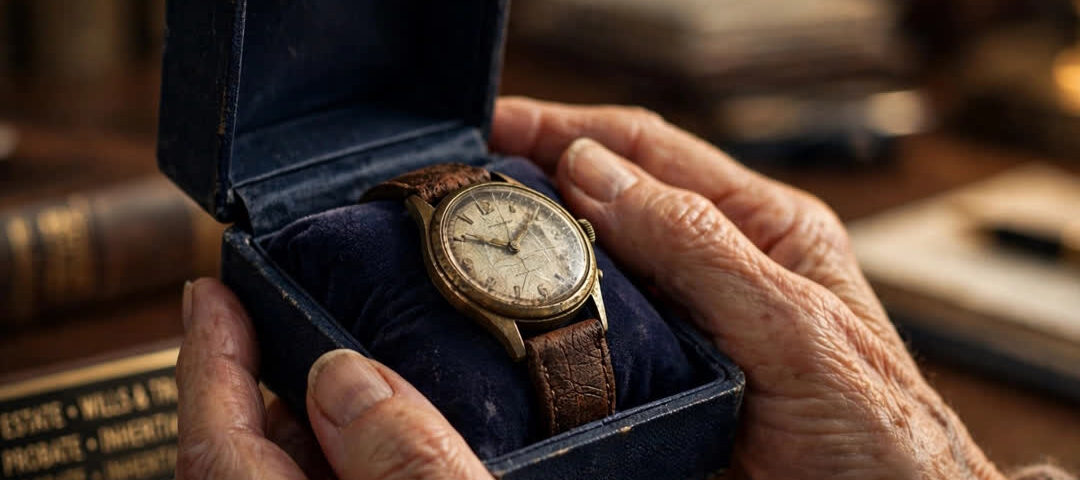
I looked at the watch on my wrist.
I had started wearing it.
The leather band was new.
The scratched crystal remained.
Daniel.
Forty-one years.
One watch.
A trust.
A house.
Commercial properties.
More money than I had ever expected to manage.
“Enough.”
Michael smiled.
This time, no greed sat inside it.
“Fair.”
Clare looked at the watch.
“Funny.”
“What?”
“We thought that was the least valuable thing Dad left.”
I touched the worn face.
“So did I.”
That became the part I understood best.
Under his will, Daniel truly had left millions to our children.
Under that same will, he truly had left me an old watch.
Nothing about the will reading was fake.
We had simply mistaken one document for the entire truth.
The watch led me to the rest.
But the rest was not merely money.
It was evidence.
Of Daniel’s fear.
Of my habit of rescuing.
Of Michael’s certainty.
Of Clare’s financial anxiety.
Of forty-one years in which I had made myself so reliable that everyone, including my husband, began planning around what I would eventually agree to carry.
Money did not create those weaknesses.
It exposed them.
Once exposed, we had a choice.
Punish.
Or repair.
I chose repair with boundaries.
The house stayed mine until I decided otherwise.
Several years later, I sold it.
Not because Michael suggested it.
Not because Clare worried.
Because I was ready.
The rosebush still did not bloom properly.
The stairs had become annoying.
I wanted something smaller near the river.
I bought a two-bedroom condo with a balcony.
Before listing the old house, I called both children.
“I’m selling.”
Michael said:
“Do you want help?”
Clare asked:
“Have you found somewhere you like?”
Neither asked what would happen to the money.
That was how I knew something real had changed.
I moved.
The trust funded part of my new life according to its terms.
I traveled.
Not extravagantly.
Comfortably.
Daniel and I had once planned a long train trip through the Rockies.
I took it alone.
Carried his watch.
At one point, somewhere west of Denver, sunlight flashed off the scratched crystal.
I laughed.
“Very subtle, Daniel.”
A woman across the aisle looked at me strangely.
I did not care.
I eventually told Michael and Clare more about the trust.
Not every account.
Not every valuation.
They no longer needed the full balance to behave correctly.
That, too, was a kind of freedom.
The trust remained primarily for me.
Later, what remained would benefit the family according to Daniel’s plan and the amendments I made with proper legal advice.
Some to the children.
Some to the grandchildren.
Some to a scholarship Daniel and I created for students whose families could not easily fund college.
No punishment clauses.
No emotional traps.
No inheritance used to control behavior from beyond the grave.
Daniel had taught me enough about the limits of that approach.
The old Hamilton sits on my wrist most days.
People occasionally comment on it.
“It looks vintage.”
“It is.”
“Worth much?”
I smile.
“More than you’d think.”
Not financially.
A watch is still a watch.
The value is in what happened because I looked underneath it.
Four words.
DON’T TELL THE KIDS.
For a while, I hated those words.
Now I understand them more gently.
Daniel was afraid.
Afraid our children would see inheritance before grief.
Afraid I would give away security to spare them consequences.
Afraid his death would turn the family into a financial negotiation before I had enough strength to know where I stood.
He handled that fear imperfectly.
So did I.
So did our children.
Real love does not make people flawless.
It gives them enough reason to come back and try again when the flaws become visible.
Michael calls now without an agenda.
Clare brings her children to visit.
Sometimes they ask about their grandfather.
I tell stories that have nothing to do with money.
Daniel burning pancakes.
Daniel falling asleep during movies he insisted he was watching.
Daniel buying the wrong anniversary flowers because he confused peonies with hydrangeas.
I want them to remember the man, not the estate.
Last Christmas, Michael gave me a new watch box.
The old one had begun to split at the hinge.
Inside the new box, beneath the velvet lining, was a tiny folded note.
I laughed before opening it.
Four words.
WE ASK BEFORE PLANNING.
I looked at him.
He grinned.
“Too much?”
I started crying.
Clare cried because I cried.
Then Michael did too, though he claimed something had gotten in his eye.
The note is still inside the box.
Beside Daniel’s original.
Two generations.
Eight words.
A family changing in writing.
After forty-one years of marriage, I thought my husband had measured our entire life and left me the least valuable object in the room.
What I eventually understood was more complicated.
He left our children money they genuinely inherited.
He left me security he had built separately.
He left all of us consequences.
And inside an old watch box, he left me the question none of us had been asking while he was alive.
What is wealth supposed to protect?
For me, the answer became simple.
My home until I chose to leave it.
My independence.
My dignity.
My children’s chance to become adults without me constantly paying for the softest possible landing.
And, eventually, the family itself.
The millions told us what we might own someday.
The watch forced us to see how we had begun treating each other before that day arrived.
In the end, that was the inheritance that mattered most.
“If this story touched your heart or stayed with you after the final page, please consider supporting us by following our Facebook page, leaving a like, and sharing your thoughts in the comments below. Every reaction, every kind word, and every new follower helps us continue bringing meaningful stories like this to you. From the bottom of my heart, thank you for reading, for being here, and for becoming part of our storytelling community. Your support truly means more than words can express.”
If you came here from Facebook because of this story, return to the Facebook post, tap Like, and comment exactly “Amazing” to support the storyteller. That small action means more than it seems and gives the writer genuine encouragement to keep sharing more stories about family pressure, firm boundaries, and finally protecting what you worked so hard to build.
Disclaimer: This story is a work of fiction created for entertainment purposes. Any resemblance to real persons, events, or places is coincidental.