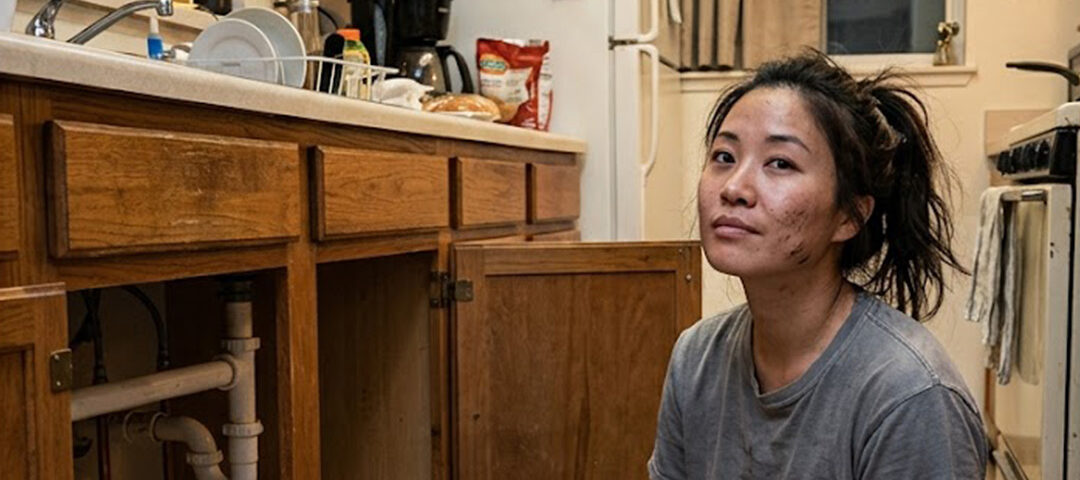
The night Derek told me to be mature about his ex coming to our housewarming, I was on the kitchen floor with one shoulder wedged against the cabinet and my left arm buried up to the elbow in pipes that someone had clearly installed with anger instead of skill.
Our apartment in Seattle was the kind of place people described as charming because there wasn’t enough room to call it spacious. The kitchen had exactly one square of linoleum large enough for a person to stand without touching a cabinet, a refrigerator, or the stove. The living room windows looked directly into a brick wall three feet away, and the bathroom fan sounded like a helicopter trying to escape through a vent the size of a shoebox.
But the rent was almost reasonable for the neighborhood. The light in the morning was good. And when Derek first convinced me to move in, he had kissed my forehead in the doorway and said, “This is where our real life starts.”
At the time, I believed him.
The under-sink pipe had been dripping for two days. Not a dramatic leak. Not the kind that floods a room and announces itself with urgency. Just the kind that taps steadily into the bottom of a bucket with patient annoyance until you begin to feel judged by your own plumbing.
Derek had stepped over the tools twice that evening and said things like, “You sure you don’t want to call maintenance?” in a tone suggesting he found my job charming in theory but inconvenient in practice.
I fixed elevators for a living.
I spent most days in steel shafts, machine rooms, rooftops, concrete service corridors, and half-lit basements coaxing giant systems back to life. I knew hydraulic fluid by smell. I could hear when a door operator was misaligned before the diagnostic screen confirmed it. I had once pulled a panicked executive out of a stalled elevator while he was still on a conference call pretending everything was fine.
A sink trap and a stubborn compression fitting did not intimidate me.
What it did require was focus.
I was just on the edge of getting the angle right when the front door slammed so hard the picture frames on the wall rattled.
I flinched, banged my elbow against the pipe, and cursed.
Derek’s footsteps came sharp and fast through the apartment.
I slid backward on my heels and knees, wrench still in hand, and looked up to find him standing in the kitchen doorway with his arms crossed over his chest. He was still wearing his work jacket, hair neat, jaw set, expression already half irritated and half righteous, like a manager preparing to explain why the impossible deadline had become my responsibility.
“We need to talk about Saturday,” he said.
I pushed a loose strand of hair out of my face and sat back against the cabinet.
“Okay,” I said. “What about Saturday?”
He inhaled through his nose, almost theatrically, and straightened his shoulders.
Even before he spoke, I could tell he had practiced this.
There was a polished quality to his tension. A rehearsed confidence. Derek liked difficult conversations best when he had time to write both scripts in his head.
“I invited someone,” he said. “She’s important to me. And I need you to be calm and mature about it. If you can’t handle that, we’re going to have a problem.”
I blinked at him.
The wrench felt heavier in my hand.
Behind him, the kitchen light cast a hard line down the hallway, and I had the strange sensation that I had missed something enormous, as if the scene had started without me and I had wandered in late.
“Who?” I asked.
He did not look away.
“Nicole.”
The name landed with almost physical weight.
Not because I had never heard it before.
The opposite.
I had heard it too many times.
Nicole from college. Nicole who loved red wine and indie films. Nicole who used to make everyone breakfast on Sunday mornings. Nicole who was brilliant, impulsive, impossible to pin down. Nicole who had broken his heart. Nicole who still liked his photos online. Nicole who texted him on his birthday every year because, in Derek’s words, some people were capable of being adults after a breakup.
I set the wrench carefully on the counter.
The small sound it made against the cheap laminate felt like a gavel.
“You invited your ex,” I said slowly, “to our housewarming.”
He tilted his head as if correcting me on a technicality.
“We’re still friends.”
“That’s not what I said.”
“Good friends,” he added. “And if that bothers you, maybe you’re not as confident as I thought.”
There it was.
The actual point.
Not information.
Not a conversation.
A test disguised as a moral lesson.
He was not telling me what was happening. He was telling me which version of myself I would be allowed to be in response.
I stared at him.
There are moments in a relationship when the floor under everything gives way so quietly you do not hear the crack until later. In the moment, all you know is that your body understands before your mind catches up.
Something in my chest went very still.
Derek shifted his weight.
“I need you to stay calm and mature,” he said again, slower this time. “Can you do that? Or are we going to have an issue?”
I should explain that Derek was not a cartoon villain.
If he had been, leaving would have been easier.
He was handsome in a polished, city-bred way that made older women call him handsome and younger women call him dangerous when they meant attractive. He worked in tech marketing, a job he described as translating value propositions across engagement channels, which sounded to me like making PowerPoints expensive.
He knew how to host.
He knew which wine to bring, which restaurant to book, which story would make a table laugh.
He remembered birthdays, sent thank-you texts, brought flowers after funerals, and could make a room believe he had chosen every person in it on purpose.
People loved him.
That was part of the problem.
Derek was never cruel in ways that made good stories later. He was cruel in ways that dissolved confidence and then asked why you seemed tired.
Over the past two years, I had become very good at absorbing impact without naming it.
When he made jokes at my expense in front of his friends, I learned to smile half a beat earlier so no one would see the sting.
When he dismissed my suggestions and later repeated them as his own, I learned not to interrupt the flow.
When he said I was overthinking, I started distrusting the thoughts themselves.
He did not yell often. He did not throw things. He did not call me names.
He simply kept placing my feelings in front of me like poorly written drafts and asking whether I was sure I wanted to submit them.
He was ready for me to fail now.
I could see it in the set of his mouth.
Ready for jealousy. Indignation. Tears. Ready to do what he always did when I protested something that hurt me: widen his eyes in disappointed surprise and ask why everything had to be so dramatic.
Instead, I smiled.
It was a calm, level smile that felt so unlike me in that moment that it almost belonged to someone else.
Maybe it did.
Maybe it belonged to the version of me I had been before Derek and was only now remembering.
“I’ll be very calm,” I said. “And very mature. I promise.”
He blinked.
“Really?”
“Really.”
“You’re okay with this?”
I folded the rag beside the sink and set it down.
“Absolutely. If she’s important to you, she’s welcome.”
He searched my face for sarcasm and found none.
I made sure of it.
His own certainty threw him off balance. He had come home prepared to wrestle me into reasonableness. He did not know what to do with immediate surrender.
“Great,” he said finally, relief loosening his shoulders. “I’m glad you’re not going to make this weird.”
While he walked away, already reaching for his phone, I picked mine up from the counter and opened my messages.
My thumb hovered over a name.
Ava.
We had met in community college at nineteen when she lent me a pen during a math final and later confessed she only did it because I looked like I might actually stab someone with my pencil if it snapped. Ava was a landscape architect with a laugh like a car engine turning over, all abrupt ignition and momentum. She had the rare gift of asking uncomfortable questions with no interest in making them softer.
She also had, at present, a spare room in the little bungalow she rented in Greenwood, a room she used for storage, occasional guests, and once for fostering an injured rabbit that hated everyone equally.
I typed:
Hey. That spare room still open?
The dots appeared almost instantly.
Always. What’s going on?
I stared at the question.
In the living room, Derek was talking too loudly into his phone, saying something about how he had “handled it” and how “some people surprise you when you give them the chance.”
I could feel each word moving through the apartment like perfume I had not chosen.
I typed back:
I’ll tell you Saturday. I just need a place to stay for a while.
No hesitation.
No questions.
Just:
Door’s open. Come anytime.
I put the phone down and tightened the compression nut under the sink until the dripping stopped.
My name is Maya Chen.
I was twenty-nine that summer, and if you asked people who only knew me from work, they would have described me as competent, sarcastic, unflappable, and very hard to impress. I fixed elevators in office towers, apartment complexes, hospitals, schools, hotels, and occasionally in buildings so old the machinery looked like it had been designed by a man who distrusted the future.
I liked my job because the problems were real.
Something failed, you found the failure, you corrected it.
Weight moved or it did not.
Doors aligned or they did not.
There were manuals, diagnostics, schematics, codes. Even when things got messy, there was a physical truth under the mess.
Human relationships, by contrast, had no service log you could print out and pin to a corkboard.
I met Derek at a barbecue hosted by a mutual friend in West Seattle. I remember the smell of lighter fluid and rosemary chicken and the fact that I arrived late because I had been called out for an elevator entrapment at an assisted living facility. I still had grease under my nails and my hair was pulled back with a zip tie because I had forgotten an actual elastic.
Derek was leaning against the deck railing in a pale blue shirt rolled neatly at the forearms, holding a beer and laughing with three people at once. When he noticed me, he shifted his attention so completely it felt like stepping into a spotlight.
“You look like you’ve had a more interesting day than the rest of us,” he said.
I glanced down at my work boots.
“Only if your interests include hydraulic fluid and one very angry Pomeranian.”
He laughed exactly the right amount. Not too hard. Not too little.
Later, he found me by the cooler and asked if it was true that elevators almost never actually fell.
Later still, he brought me a plate before the food ran out because he had noticed I had not eaten.
He had that talent then, for making attentiveness feel like intimacy.
For the first year, things with him were easy in all the ways that make you ignore the hard parts.
He texted good morning and good night.
He wanted to hear about my work.
He kissed me in parking lots and grocery store aisles.
He told me my hands were beautiful because they looked capable.
I had never dated anyone who noticed details the way he did, and I mistook that for depth.
When I worked late, he brought Thai takeout to my shop and sat on overturned buckets telling me about office politics while I wiped down tools. He came to my softball games and heckled the umpire with so much charm that people found it funny. When my grandfather died, Derek handled phone calls and laundry and remembered to buy more tea when relatives started arriving.
That was the version of him I defended for too long.
The version I held up like a photograph every time another, smaller, meaner version flickered underneath.
The move-in happened six months before the housewarming.
His idea, mostly.
My lease on the studio I was renting in Wallingford was ending, and his apartment in Capitol Hill was larger, better located, already furnished, and according to him, silly to keep paying separately when we were practically living together anyway.
It made sense on paper.
It also meant most of my furniture went into storage because there was “no room.”
Most of my kitchen gear got boxed because he already had nicer versions.
My name never made it onto the lease because “it’s just a hassle with management, and we know this is long-term.”
I noticed all those things and told myself they were logistical, not symbolic.
That was one of my specialties then.
Misclassifying emotional evidence as administrative detail.
The day after he invited Nicole, he behaved as though we had crossed a hurdle together. He texted me while I was working on a modernization project in South Lake Union, each message bubbling up on my screen while I balanced on a ladder inside a control room.
Need your opinion: rosemary crackers or pita chips?
Can we borrow Jenna’s extra folding chairs?
I found the perfect playlist. You’ll love it.
No mention of Nicole.
In Derek’s world, once he had delivered his position and secured my compliance, the matter was concluded. Any lingering feeling on my part would simply be emotional lag.
At lunch, I sat in the front seat of my van with my boots on the dashboard and made a list in the notes app on my phone.
I titled it MINE.
My grandfather’s watch.
Laptop.
Passport.
Family photos.
Tools.
Work clothes.
The blue ceramic mug Ava made in pottery class that somehow survived three apartments.
The paperback copy of The Left Hand of Darkness with notes in the margins from when I was twenty-two and dramatic.
The jade bracelet my mother gave me on my twenty-fifth birthday.
The old flannel from my dad’s closet that I slept in during winter.
I stared at the list.
It was short.
I had moved into Derek’s apartment the way a guest slowly overstays on purpose, adapting to his dishes, his couch, his lamps, his framed prints, his favorite knives, his way of arranging books by color instead of author.
If I left, the apartment would barely change shape.
It would just lose the woman constantly adjusting herself inside it.
After lunch, I stopped by the bank and opened a new savings account. My paycheck already went into my own checking, but I moved money anyway because doing something practical steadied me. Then I went to a drugstore and bought travel-sized shampoo, toothpaste, deodorant, a hairbrush, cheap socks, and a notebook.
I packed a gym bag in the van with a week’s worth of clothes and toiletries and shoved it behind the driver’s seat under an old moving blanket.
Every action felt both surreal and ordinary.
You would be amazed how many life-changing decisions are made under fluorescent lights while comparing toothbrushes.
When I got home, Derek had turned the apartment into a staging area for charm.
Shopping bags covered the dining table. There were fairy lights, small candles, new coasters, a cheese board so large it looked ceremonial, and enough charcuterie to feed a minor monarchy.
“There she is,” he said, grinning. “Can you help me hang these?”
He held up a coil of string lights, the kind with warm Edison-style bulbs that make cramped spaces look intentional.
I set down my bag.
“Sure.”
For an hour, we hung lights and rearranged furniture. He talked the whole time, not because he was nervous, though maybe a little, but because he liked the sound of anticipation when it came from his own mouth.
He talked about his coworkers finally seeing the place.
He talked about making a good impression on the neighbors.
He talked about how this was a fresh start for us after months of stress.
He talked about growth, community, hosting.
He stood in the doorway at one point, hands on his hips, admiring the living room with the self-satisfaction of a man who had chosen two throw pillows and considered the environment transformed.
“Doesn’t it feel different already?” he asked.
“Oh, definitely,” I said. “A turning point.”
He smiled, hearing only what he wanted to hear.
That evening, we ate pizza on the couch with paper towels for napkins because the good plates were already set aside for Saturday. Derek scrolled through the guest list on his phone and read names aloud like a king confirming his court.
“Marcus is bringing Aaron.”
“Mm-hm.”
“Jenna and Sam can’t stay too late, but they’re coming.”
“Good.”
“Nicole just confirmed.”
I took another bite.
“Did she?”
“She’s bringing a really nice bottle of wine.”
He looked at me over the edge of the screen, searching for friction.
“How thoughtful,” I said.
He lowered the phone.
“You’re really calm about this.”
I dabbed my mouth with the paper towel.
“You asked me to be mature. I’m doing exactly that.”
He watched me a second longer, then shrugged, satisfied enough to let the matter go.
It is hard to fight with someone who will not pick up the sword you hand them.
I barely slept that night.
Derek snored on his back, one arm flung over the pillow, and I lay awake studying the ceiling as the apartment settled around us. Pipes clicked. A siren passed somewhere below. The string lights in the living room cast a faint amber wash under the bedroom door.
My mind moved backward through our relationship, collecting moments I had discarded at the time because each one by itself seemed too small to justify alarm.
The restaurant where I suggested a Thai place I loved, and he laughed, kissed my forehead, and said, “Let’s go somewhere you’ll actually enjoy,” before taking us to his favorite tapas bar.
The game night where he told his friends, “Maya can rebuild an elevator motor but somehow still gets lost in parking garages,” and everyone laughed, including me, because the alternative was making the joke stop and that always cost more.
The weekend I got food poisoning and spent twelve hours on the bathroom floor while he sighed in the doorway because we had reservations he was excited about.
The morning I told him I wanted to visit my parents in Olympia for my mother’s birthday, and he said, “Do you have to go this weekend? I was hoping for couple time.”
The countless sentences that began with “If you were more…” and ended with some trait he found convenient.
More social.
More easygoing.
More affectionate in public.
More strategic with your career.
More polished with my coworkers.
More understanding.
If you were more.
If you were more.
If you were more.
By three in the morning, I was no longer thinking about Nicole.
Nicole was a symptom.
Derek could have invited an ex, a colleague, a stranger off the sidewalk. The point was never who he invited. The point was that he wanted to prove he could force me into emotional compliance and then admire himself for my restraint.
He wanted evidence of my devotion under pressure.
He wanted me to absorb disrespect and call it trust.
At seven, my alarm went off for work.
Derek rolled over, kissed my shoulder, and mumbled, “Morning, babe,” as if nothing in the world had shifted.
At the job site, Marcus took one look at my face and handed me coffee before saying a word.
Marcus was a service mechanic with forearms like bridge cables and a tendency to narrate problems in sports commentary tones. He was also, beneath a thick layer of sarcasm, one of the gentlest men I knew.
“You look like you spent the night staring at your ceiling and contemplating murder,” he said.
“Only metaphorical.”
“Good. That paperwork’s easier.”
We were assigned to a high-rise downtown where one of the traction cars had started leveling unevenly. The kind of troubleshooting I usually loved. That day, every bolt I touched felt too vivid, every test run too loud.
Marcus eventually leaned against the machine-room door and said, “Okay. Who do I need to dislike on purpose?”
I told him the short version while we waited for a diagnostic cycle.
“He invited his ex,” Marcus said flatly.
“To the housewarming.”
“And told you to be cool about it.”
“To be mature about it.”
Marcus took a slow sip of coffee.
“That’s a man who enjoys losing.”
I barked a laugh, which felt good enough that I almost cried.
By Friday night, the apartment was fully staged.
The fridge was crowded with drinks. The counters gleamed. Derek had ironed a shirt. I had packed most of what mattered into my van in two discreet trips: a duffel of clothes, a box of keepsakes, my laptop bag, a small tool case, the framed photo of my grandfather holding me on his shoulders at age four.
Derek noticed none of it.
He was too busy curating ambiance.
Saturday came bright and mild, one of those Seattle days that feels almost suspicious in its generosity. The sky was clear. The air smelled faintly of salt, cut grass, bus exhaust, and the damp pavement that never really leaves the city.
I woke early and lay still for a few minutes, listening to Derek hum in the shower.
My body felt calm in the way steel feels calm before stress testing.
Not relaxed.
Certain.
I made coffee.
Derek came into the kitchen toweling his hair, kissed my cheek, and said, “Big day.”
“Big day,” I echoed.
He beamed.
“I’m glad we’re doing this.”
There are so many moments in life when you want to stop someone and ask them to identify which this they mean.
By noon, he had me assembling cheese boards with military precision. He believed in abundance as a hosting strategy, which meant there were three kinds of olives, two kinds of hummus, rosemary almonds, marinated artichokes, a mountain of prosciutto, sliced baguettes, and tiny bowls of honey no one was ever going to use.
I chopped herbs and arranged crackers while he bounced between playlists and speaker placement and whether the overhead lighting felt too harsh.
At one point, he came up behind me, wrapped his arms around my waist, and rested his chin on my shoulder.
“Thanks for being so great about all this,” he said.
I kept slicing strawberries.
“About what?”
“Everything. The party. Nicole. Just…”
He kissed the side of my neck.
“Being my partner.”
The knife paused in my hand.
Something about the tenderness of it nearly undid me.
Not because it was real, but because it was exactly the sort of moment I used to store as proof that everything was okay. A little affection after a violation. A gentle word after dismissal. Enough warmth to make me doubt my own weather report.
Instead, I finished slicing the strawberries and said, “Of course.”
Guests started arriving a little after four.
The apartment filled fast, the way small places do, sound climbing up the walls until every laugh seemed larger than itself. Derek’s coworkers came first, all expensive casualwear and stories about deadlines. Then friends from his gym, one neighbor from downstairs, my softball friend Jenna with her husband Sam, Marcus with Aaron, two women I knew from a maintenance training course, and a scattering of mutual acquaintances who belonged more to Derek’s orbit than mine.
Music floated through the rooms. Someone opened wine. Someone else turned the living room into an accidental bottleneck around the snack table.
I moved through it with a smile and a tray and the strange clarity of someone already absent.
I refilled ice, handed out napkins, explained to Derek’s coworker Nolan that no, elevators were not all computerized death traps, and yes, people really did try to force the doors open with umbrellas.
More than one person leaned in with the particular conspiratorial energy people adopt when they want gossip to count as concern.
“So,” one woman from Derek’s office whispered, glancing toward the door, “his ex is really coming?”
I gave the same small smile each time.
“Looks that way.”
“And you’re okay with that?”
“I’m keeping it friendly.”
That answer satisfied no one, but it gave them nothing to use.
Jenna cornered me in the kitchen when she arrived, her expression already suspicious. We had been friends since tenth grade, when she punched a boy in the shoulder for telling me girls weren’t good at physics and then asked if I wanted to split fries after detention.
She knew every version of my face.
“Something is off,” she said under her breath while pretending to inspect the dip selection. “This feels like his party. Also, why is everyone whispering like we’re in a murder mystery?”
“Because he invited Nicole.”
Her eyes widened.
“He what?”
“Mm-hm.”
“To your housewarming?”
“To our housewarming.”
“Maya.”
“I know.”
“No, I don’t think you do, because I’m about thirty seconds from biting him on purpose.”
Despite myself, I smiled.
“Don’t. Just do me a favor.”
“Anything.”
“Don’t leave early. And keep your phone on you.”
Her gaze sharpened.
“What are you planning?”
“Nothing dramatic.”
That made her snort.
“That is the least reassuring sequence of words in the English language.”
I touched her wrist.
“Trust me.”
She looked at my face for a long moment and then nodded.
“Okay. But I’m staying close.”
By five, the room had developed that particular sheen parties get when everyone has had enough to drink to glow but not enough to wobble. Derek was in his element. He floated between conversations, hand resting at the small of backs, laugh timed perfectly, stories polished.
He kissed my temple once while passing, and someone actually said, “You two are couple goals,” which was so absurd I nearly checked whether I had accidentally inhaled gas.
Then the air changed.
It was not subtle.
Derek checked his phone three times in the span of sixty seconds. He tugged once at the hem of his shirt. He repositioned himself near the front door in a way meant to look casual and failed.
Even people who did not know why felt the shift.
A low current of anticipation moved through the apartment. Conversations became fractionally thinner. Music suddenly seemed too loud.
Then the doorbell rang.
I was across the room near the bar cart.
Derek started moving toward the door, but I got there first.
“I’ve got it,” I said.
His eyes met mine.
For half a second, something unreadable flickered there—worry, maybe, or excitement. He stepped back with an attempt at an easy smile that did not reach the tension in his jaw.
I crossed the apartment as the room hushed around me.
It was astonishing how quickly thirty adults could organize themselves into an audience while pretending not to. I could feel them all. My coworkers, his friends, the acquaintances. Every single one of them waiting to see how the girlfriend would handle the ex.
I opened the door.
Nicole stood there holding a bottle of wine by the neck, one hand tucked in the pocket of a cream-colored coat.
She was beautiful, yes, in the polished effortless way some women seem born understanding. Dark hair blown smooth, skin like she drank enough water and never forgot sunscreen, jeans that fit as if they had been made with her body in mind, silk blouse the color of wet sand.
She looked exactly like someone Derek would have written long nostalgic monologues about.
She also looked, I noticed immediately, uncertain.
“Hi,” she said brightly. “You must be Maya.”
“And you must be Nicole.”
She smiled with visible relief that I sounded human.
“I’ve heard so much about you.”
I’ll bet, I thought.
Out loud, I said, “Come in. We’re glad you could make it.”
I stepped aside.
She crossed the threshold, and before the door had even fully closed, Derek was beside her.
“Nicole,” he said, taking the wine from her with a warmth so immediate it made several people in the room glance away too late. “You made it.”
“Wouldn’t miss it.”
Their hug was brief.
Technically appropriate.
Intimate anyway.
The sort of hug that says we know exactly how long we are allowed to be this close in public.
He guided her into the living room with a hand at her elbow.
Just enough contact to register.
Not enough to accuse.
I watched them move through my line of vision as if I were studying a demonstration model of an old mistake.
Jenna appeared at my shoulder with two glasses of white wine.
“Okay,” she murmured. “I actively hate this.”
“Good,” I said. “Stay hydrated.”
The next hour was the strangest of my life in ways that only became funny later.
I became the most gracious hostess I had ever been.
I took Nicole’s coat and hung it.
I introduced her to Marcus and Aaron and one of my coworkers from the union.
I asked whether she preferred red or white.
I offered her one of the little goat cheese tarts I had made.
My voice was warm.
My face was calm.
I smiled until my cheeks ached.
Derek, meanwhile, began unraveling in reverse.
He had expected protest. He had expected visible hurt. He had expected to occupy the superior moral ground of the calm man handling the irrational jealousy of a girlfriend.
Instead, he kept glancing at me and finding serenity.
Each time, his expression tightened by a degree.
He and Nicole gravitated toward each other anyway.
Of course they did.
Familiarity has its own gravity.
I caught pieces of conversation like snippets from a radio in another room.
“Do you remember that place in Portland…”
“…the weekend in Vancouver where…”
“…your old landlord with the cat…”
Shared history presented as harmless reminiscence.
Maybe it would have been harmless if Derek had not spent days using her presence as a test of my worthiness. Under those circumstances, every laugh became a display piece.
At one point, Marcus sidled up beside me while I was replenishing crackers.
“I’ve known some dumb men,” he said quietly. “But he is showing remarkable commitment to the craft.”
“Please don’t hit him in my apartment.”
“Noted. Parking lot remains available.”
I was setting out a fresh plate of olives when Nicole approached alone.
Up close, she smelled faintly of citrus and expensive detergent.
“Can I help with anything?” she asked.
I looked at her. Not theatrically. Not coldly. Just looked.
She seemed sincere, which complicated my desire to hate her neatly.
“I’ve got it,” I said. “But thank you.”
She hesitated.
“I know this might be a little weird.”
There it was.
The one thread of self-awareness in the room.
“It’s interesting,” I said.
A faint crease appeared between her brows.
“Derek said you were fine with it.”
I met her gaze.
“Derek says a lot of things.”
Before she could answer, Derek reappeared with exaggerated lightness.
“Everything okay over here?”
“Perfect,” I said.
He smiled too fast.
“Great.”
The funny thing about deciding to leave is that once the decision is made, fear loses most of its dramatic power.
It does not vanish.
I was still scared.
Of the logistics. The loneliness. People misunderstanding. The embarrassing story I might become.
But underneath that was relief so large it made everything else look manageable.
I was no longer trying to save the relationship.
That changed the geometry of the entire evening.
Around six-thirty, I found Derek and Nicole on the small balcony off the living room.
The balcony was barely large enough for two chairs and a potted rosemary plant Derek had already forgotten to water twice, but they had managed to arrange themselves there with their heads tilted toward his phone, laughing at something.
City light reflected on the glass behind them.
Music thumped gently from inside.
For one second, the image was almost beautiful.
Then I remembered I lived in it.
I stepped outside carrying a fresh bottle of wine and three clean glasses.
“Refills?” I asked cheerfully.
Both of them straightened as if caught stealing from a church donation box.
“Sure,” Nicole said.
“Thanks, babe,” Derek added.
Babe.
He only used pet names in public or when he wanted to make a point. I hated babe. He knew that. It flattened me into something generic.
I poured them wine. The sounds from inside had shifted again, people drifting toward us under the excuse of proximity. The apartment had begun listening.
I set the bottle on the railing and lifted my glass.
“I want to make a toast,” I said.
Conversations dimmed.
Someone turned the music slightly lower.
Derek’s face changed minutely, not into alarm yet, but into attention sharpened by uncertainty.
“To Derek,” I said, smiling at him. “For teaching me exactly what I deserve in a relationship.”
A ripple moved through the crowd.
Not understanding yet.
Just awareness.
“And to Nicole,” I continued, turning to her with equal warmth. “For giving me perfect clarity on a Saturday evening.”
Nicole’s fingers tightened around her glass.
I drank the wine in one steady swallow, set the empty glass down, and took out my phone. It was not for effect, though maybe it looked that way.
Ava had texted ten minutes earlier.
Still good here. Door unlocked.
I looked at the room.
The faces.
The amber lights.
The apartment that had never once become mine, no matter how carefully I folded myself into it.
“I have an announcement,” I said. “I’m moving out tonight.”
Silence hit the balcony so completely I could hear a siren several blocks away.
Derek let out a sharp laugh.
“Okay. Very funny.”
“I’m serious.”
His smile disappeared.
“Maya.”
I kept my voice steady. Not loud. Just clear enough that no one could pretend later they had not heard.
“Three days ago, Derek invited his ex-girlfriend to our housewarming and told me that if I couldn’t handle it, we were going to have a problem. He said I needed to be calm and mature.”
Someone near the sliding door muttered, “Jesus.”
I went on.
“So I spent some time thinking about what a mature person should do when the person they live with deliberately puts them in a humiliating position and then frames their feelings as weakness.”
Derek stepped closer, smile gone, voice low.
“Stop.”
I looked at him.
“A mature person recognizes when they’re not being respected. A mature person notices when a partner creates tests instead of trust. A mature person understands that love is not something you prove by swallowing disrespect with a pleasant expression.”
Nicole had gone very pale.
She looked from me to Derek and back again with the dawning horror of someone realizing she had walked into a room after a bomb had been wired, not before.
“Maya,” Derek said again, sharper now, “you’re embarrassing yourself.”
“Actually,” I said, “I’m embarrassing you.”
The crowd made a collective microscopic movement.
The body’s instinct when truth appears in a room.
I turned to Nicole.
Her eyes widened.
“He’s all yours,” I said gently. “Good luck. When he starts telling you to be more understanding about things that hurt you, that’s your cue to leave.”
Then I set my glass down, stepped past Derek, and walked into the apartment.
For a second, no one moved.
It was like the moment after an elevator lurches and everyone in it remembers gravity simultaneously.
Then sound came back in broken fragments.
Someone whispered, “Holy shit.”
Someone else said Derek’s name like a warning.
Jenna was already moving toward me before I reached the hallway.
“You need help?” she asked.
“My watch, my laptop, and I’m done.”
“I’m coming.”
Derek followed us into the bedroom.
“Are you out of your mind?”
The bedroom looked staged even now. The bed made, throw pillows arranged, the lamp he insisted was better for the room than the one I preferred.
I went straight to the nightstand and picked up my grandfather’s watch. It was old-fashioned, silver, a little scratched along the clasp, nothing flashy. He had worn it every day until the week before he died, when his hands shook too much to fasten it alone.
I slipped it into my pocket, grabbed my laptop bag from the chair, and turned toward the closet.
“You can’t just leave in the middle of a party,” Derek hissed. “What the hell is wrong with you?”
I opened the closet and reached for the duffel I had tucked behind his winter coats that morning.
“Nothing.”
“This is insane.”
“No,” I said. “This is overdue.”
He stepped between me and the door.
“You’re making a scene because Nicole came over? After I specifically asked you to be mature?”
I laughed then, a short disbelieving sound.
“Do you hear yourself?”
“She is a friend.”
“She is your ex.”
“She’s both.”
“And you invited her into our home without asking me because you wanted to watch whether I’d tolerate it politely.”
His nostrils flared.
“That’s not what this is.”
“It is exactly what this is. This isn’t about Nicole as a person. It’s about you wanting me to prove I’m cool with whatever humiliates me as long as you call it progress.”
He pointed toward the living room, toward the muffled confusion beyond the bedroom wall.
“You’re blowing this up in front of everyone.”
“You blew it up when you invited your ex to our housewarming and tried to lecture me out of having feelings.”
He reached for my arm and caught it just above the elbow.
Not hard.
Not enough to bruise.
Enough to stop me.
The room narrowed.
“Don’t do this,” he said, voice lower now, trying for softness. “Don’t make this bigger than it is. You’ll regret it tomorrow.”
I looked down at his hand and then up at his face.
“Let go.”
He did.
Immediately.
That mattered later, when I told the story and people wanted to know if I had ever been physically afraid of him. The answer was complicated. Not in that moment, no. Derek was not a man who used force with his hands.
He preferred tools that left less visible evidence.
Jenna, who had stayed just outside the bedroom door like a bouncer with excellent instincts, stepped closer.
“Maya?”
“I’m good.”
Derek ran a hand through his hair.
“You’re seriously throwing away two years over this?”
I slung the laptop bag over my shoulder and picked up the duffel.
“No. I’m leaving because of the last two years. This just happens to be the first moment clear enough for everyone else to see.”
I walked past him.
He did not try to stop me again.
The living room had fractured into awkward islands of people pretending not to stare while staring. Marcus stood near the kitchen with Aaron, arms folded, expression murderous on my behalf. One of Derek’s coworkers was suddenly very interested in the label on a beer bottle. Nicole stood near the balcony door, stunned.
I paused in front of her.
This close, I could see she was not enjoying any part of this. There was a flush high on her cheekbones and that same tiny crease between her brows.
“I mean it,” I said quietly. “Watch the pattern, not the apology.”
She swallowed and nodded once.
Then I crossed the apartment, opened the front door, and stepped out.
The hallway smelled like old carpet and someone’s takeout. Jenna followed me. Behind us came a burst of voices, Derek’s louder than the others, then the door swung shut and the noise cut off.
We went down the stairs instead of waiting for the elevator, which felt too ironic to survive.
My legs were steady.
My breathing was strange, too shallow and too clear at once.
When we reached the parking lot, the evening air hit my face cool and clean. My van sat under a streetlamp with my emergency bag behind the seat and half my life already hidden in plain sight. I threw the duffel into the back and stood there with my hand on the door.
“You okay?” Jenna asked.
I looked up at the apartment windows.
String lights glowed warm behind the curtains. Shadows crossed once, twice. The place looked exactly as it had looked from the outside every evening for six months. Ordinary. Lit. Occupied. Nobody driving by would have guessed that one woman had just walked out of a life she was no longer willing to audition for.
I exhaled.
My body was shaking now, but it felt more like release than fear.
“Yeah,” I said, surprising myself with the truth of it. “I think I am.”
Jenna hugged me so hard my chin hit her shoulder.
“Good,” she said into my hair. “Because if you suddenly become not okay, I’m keying his stupid car.”
“Please don’t get arrested for me.”
“Fine. I’ll outsource it.”
I laughed, and the sound came out half sob, half exhaust.
She drove behind me to Ava’s house, just in case. The city blurred past in strips of neon and brake lights and dark trees. At one red light, I realized my phone had been buzzing nonstop in the cup holder.
I turned it face down and kept driving.
Ava met us at the door barefoot in flannel pants and a faded University of Washington sweatshirt, her hair piled on top of her head with a pencil through it.
She took one look at me and said, “Shoes off if you’re staying. Shoes on if we’re committing a felony.”
“Shoes off,” I said.
“Okay. Bedroom’s ready. Tea’s on.”
That was Ava.
No performance of sympathy.
Just immediate practical mercy.
Her spare room smelled faintly of cedar and clean laundry. There was a quilt folded at the foot of the bed and a lamp shaped like a mushroom that made the whole room look kinder than it had any obligation to be.
I set my bags down and sat on the edge of the bed with my hands between my knees.
Jenna brought me tea.
Ava sat cross-legged on the floor.
“Talk,” Ava said.
So I did.
Not just the party.
The whole thing.
Or enough of it that the pattern could be seen.
The jokes. The minimization. The tests. The thousand tiny edits Derek had tried to make to my personality in the name of compatibility.
As I spoke, both women’s faces changed from outrage to recognition to that particular kind of grief friends feel when they realize how much you have normalized quietly.
“When were you going to tell me it had gotten this bad?” Ava asked.
I stared into my tea.
“I don’t know that I knew it had.”
“That’s the thing about erosion,” she said. “Nobody points at a cliff and says wow, dramatic. They just notice one day the edge is gone.”
My phone buzzed again.
Then again.
I finally picked it up and looked.
You made a scene.
That was humiliating.
Come back and we can talk like adults.
You’re acting insane.
Nicole is just a friend.
You blindsided me.
Fine. Be that way.
I’m sorry. I should have told you before inviting her.
Can we talk?
Please answer.
Maya.
There were seventeen messages by midnight.
They moved through exactly the stages I would have predicted if asked to outline Derek’s emotional range under threat: indignation, accusation, minimization, self-pity, bargaining, apology.
I answered none of them.
I slept harder than I had in months.
The next morning, the world had the rude audacity to continue.
Light came through the curtains. Someone down the block ran a leaf blower. Ava made eggs. My shoulders ached. There was a bruise-colored tenderness in my chest where grief ought to have been, but the dominant feeling was still relief.
Not happiness.
Relief.
Which, under the circumstances, was more informative.
Jenna, who had stayed at the party for almost an hour after I left because she considered herself a field reporter in matters of personal outrage, delivered her findings over coffee.
“Nicole left maybe fifteen minutes after you did,” she said. “Did not look thrilled. Half the room scattered right after. Marcus says Derek tried to act like you were having some kind of episode, but then Nolan from his office asked why he thought inviting his ex to a housewarming was a good idea, and apparently Derek did not enjoy that line of inquiry.”
I smiled into my mug.
“By seven-thirty,” Jenna continued, “it was basically just him, three unopened bottles of wine, and enough salami to preserve a village.”
“Good,” Ava said. “May he be haunted by artisanal leftovers.”
My parents called that afternoon because Jenna, traitor that she is, had texted my mother the sanitized version after extracting a promise not to panic.
My mother answered on the first ring with that terrifying calm mothers use when they are trying not to make your crisis about their fear.
“Are you safe?” she asked.
“Yes.”
“Do you need money?”
“No.”
“Do you want us to come?”
I closed my eyes.
“No, Mom. I’m okay. Really.”
There was a pause, then she said more softly, “Good. Because your father is already putting shoes on and pretending it’s not because he wants to drive to Seattle and glare at somebody.”
I could hear my dad in the background saying, “I can hear her, Mei.”
When he got on the line, he cleared his throat like he was preparing to discuss taxes.
“You know,” he said, “when something keeps wobbling, it’s not always because the floor is wrong. Sometimes it was installed badly.”
I laughed.
“Is that relationship advice or elevator advice?”
“Yes.”
My father repaired industrial refrigeration systems for thirty years and trusted metaphor only if it could also tighten a bolt.
Work on Monday was almost a relief.
Machines did not care if your heart had rearranged itself over the weekend. We had a callback in a hospital building where one of the service cars was intermittently refusing hall calls above the eighth floor.
Marcus met me in the loading bay with two coffees and a bag of stale donuts.
“How’s the newly single life?” he asked.
“I slept like someone had canceled an alarm I didn’t know was going off.”
He nodded with exaggerated solemnity.
“Classic symptom.”
Word had spread, of course.
Not virally, not in some dramatic public way, but through the normal channels by which every social circle metabolizes spectacle. Marcus had already received three versions of the story. In one, I threw wine in Derek’s face. In another, Nicole started crying immediately. In a third, I announced my departure while standing on a chair, which I considered an improvement and briefly regretted not having done.
My friend from softball texted:
Heard what happened. Proud of you.
A woman I had met twice at one of Derek’s work events sent:
I know we don’t really know each other, but that was incredible and also he always gave me weird vibes.
Even people who did not message me directly adjusted around me in the subtle way communities do when they decide which story they believe. I had been bracing for humiliation.
Instead, I got something closer to respect.
That surprised me enough that I spent the first week distrusting it.
Derek continued texting.
Then calling.
Then emailing.
I blocked his number after the fifth voicemail. The emails landed in a folder I told myself I would read later and never did.
The first one that made it through because he used a different address opened with:
I understand now that you felt blindsided.
It was such an infuriating use of the passive voice that I deleted it before finishing.
A week after the party, I went back to the apartment while Derek was at work. I had arranged it by email, copying Ava, because by then I was treating logistics like legal procedure. He had objected, of course. He wanted to be there. He wanted to “talk while I packed.”
Absolutely not.
Marcus took an early lunch and came with me. Jenna met us there too. Between the two of them, they radiated enough protective hostility to power a small city.
Inside, the apartment looked almost exactly the same except slightly sadder.
The string lights were gone.
There were still coasters stacked on the coffee table and one unopened jar of olives in the fridge.
I moved through the rooms with a cardboard box and the uncanny feeling of walking through a museum exhibit of a life I had already left.
There was more that was mine than I first thought, though not by much.
Books Derek never read but liked displaying because I had them.
The ceramic mug.
The flannel.
A drawer of socks.
A kitchen knife my parents bought me when I moved into my first solo apartment.
A blanket Ava gave me after my grandfather’s funeral.
Three plants, two half dead and one stubbornly alive.
The little framed postcard of Taipei my grandmother mailed me when I was fourteen.
A collection of tiny things that, when gathered, resembled personhood.
In the bedroom, Jenna zipped another box and said, “Do you feel sad?”
I considered.
“A little.”
“Do you miss him?”
I looked around at the room and found I missed almost nothing except the version of myself that had kept hoping this room would one day feel like home.
“Not really,” I said.
She set down the tape gun.
“That tells you something.”
On my way out, I left my keys on the kitchen counter next to the sink I had fixed three nights before the party.
I almost laughed at the symmetry.
The first two weeks at Ava’s were an exercise in remembering how to exist without anticipating someone else’s reaction to every preference.
What do you want for dinner?
Whatever you want.
No, what do you want?
What show do you feel like watching?
Which route do you want to walk?
Do you want company or quiet?
Ava asked the kind of ordinary questions that expose damage because they assume you still know the answers.
Sometimes I did.
Sometimes I had to stop and think.
She never made a production out of helping. She just made room. Her spare room became less spare. I stacked my boots by the door. I took over one shelf in the bathroom. I started making coffee in her kitchen like I belonged there.
Every small act of occupation felt oddly radical.
One rainy evening about ten days in, she found me standing in the grocery store frozen-food aisle staring at two brands of dumplings with unreasonable intensity.
“You okay?” she asked.
“I can’t decide which ones I want.”
“So buy the ones you want.”
“I know. That’s the issue.”
She leaned the cart against her hip.
“Maya. This is not about dumplings.”
I laughed and then, embarrassingly, started crying between the peas and the microwaveable rice.
Not loud crying.
Just overwhelmed leaking.
Because she was right.
It was not about dumplings.
It was about how often, over the previous two years, I had made tiny decisions around Derek’s tastes until my own preferences felt less like choices and more like inefficient detours. Even in the grocery store, my first instinct was to run a simulation of his likely opinion.
Ava handed me a tissue from her coat pocket because she is the sort of person who has tissues in coat pockets.
“Take both,” she said. “Freedom is a buy-one-get-one situation.”
I took both.
Three weeks after the party, I signed a lease on a one-bedroom in Fremont.
It was not glamorous.
The building was older, the radiator hissed like a gossiping aunt, and the kitchen was arranged by someone who had never cooked a meal. But it had tall windows, maple floors scratched into honesty, and a tiny balcony just wide enough for two plants and a folding chair.
More importantly, when I stood in the middle of the living room, the emptiness answered to me.
The landlord was a woman named Elise with silver hair in a braid to her waist and a habit of referring to appliances as if they had personalities. She looked over my application, asked what I did for work, and when I told her, brightened visibly.
“Oh, good,” she said. “Then you won’t be intimidated by the heater. It’s moody but loyal.”
I got the keys two days later.
Moving in was a patchwork operation carried out by friends, a borrowed truck, and stubbornness. Marcus carried the heavy boxes as if they insulted him. Jenna labeled things with unnecessary enthusiasm. Ava arrived with sandwiches, cleaning supplies, and a spider plant she claimed was impossible to kill, which I took as a challenge from the universe.
My parents drove up with the kitchen table from my old studio, the one that had been in storage because Derek’s table was “nicer.” My father tightened every loose hinge in the apartment within twenty minutes of arrival. My mother lined shelves with contact paper and said, as if discussing the weather, “Sometimes leaving is not the end of a thing. Sometimes it is the first accurate sentence.”
That first night alone in my new apartment, I sat cross-legged on the floor eating noodles out of my own bowl with my own chopsticks while the radiator hissed and rain tapped lightly at the window. There were boxes everywhere. My mattress was on the floor. The internet was not working yet.
It was perfect.
Derek appeared at my new apartment two weeks later with flowers.
I saw him through the peephole first.
Standing in the hallway in a charcoal coat, hair styled, bouquet in hand, expression tuned carefully to contrition. For one strange second, I had the impulse to hide, as if he still had the power to define the air in my home.
Then I remembered whose hallway it was.
I opened the door but kept the chain on.
“Maya,” he said, trying a small smile. “Can we talk?”
“What do you need?”
He lifted the flowers a little.
White lilies.
He had once asked my favorite flower and then never remembered the answer.
It was peonies.
“I made a mistake,” he said. “I see that now.”
“Okay.”
He blinked.
“Okay?”
“I appreciate the apology.”
He shifted, thrown by the lack of access.
“Can I come in?”
“No.”
His expression tightened and then smoothed itself again.
“I’ve had time to think. I took you for granted. I pushed too hard. I thought—I don’t know—I thought you trusted me.”
I leaned against the doorframe.
“Trusting you was never the issue.”
“Then what was?”
I looked at him.
Really looked.
Stripped of my wish to be chosen by him, he seemed oddly smaller. Still handsome. Still polished. But I could see the machinery now. The calibration. The way he reached for sincerity like a tool he expected to work.
“You didn’t make a mistake,” I said. “You made a series of choices. You invited your ex to our home without asking me. You used my discomfort as evidence of immaturity. You tried to turn respect into a test I had to pass. That wasn’t one mistake. That was a pattern.”
He exhaled sharply.
“I was trying to prove we were solid.”
“By seeing whether I would tolerate being disrespected?”
“That’s not fair.”
“No,” I said. “What you did wasn’t fair.”
He looked down the hallway, then back at me.
“So that’s it? Two years, and you’re just done?”
I thought about the last two years. About the early tenderness. About my grandfather’s funeral. About shared meals and trips and good jokes and bad Sundays and the thousand tiny moments where I had trimmed away parts of myself to keep our life smooth.
I did not deny that some of it had been real.
That was part of why leaving hurt.
But reality is not the same thing as suitability.
“Yeah,” I said. “I’m done.”
He stared another second, maybe waiting for me to soften, maybe realizing at last that I would not.
Then he set the flowers on the floor by my door.
“I hope you’re happy,” he said.
“I already am more than I was.”
It landed.
I saw it land.
He left.
I watched through the peephole until he rounded the corner, then opened the door, picked up the lilies, and carried them straight to the trash chute.
On my way back inside, I caught sight of myself in the hallway mirror.
I looked tired.
I also looked unmistakably like me.
The months after that were not cinematic.
There was no triumphant montage of self-rediscovery set to indie music. Healing was smaller and stranger than that. It was learning I liked waking up without checking the emotional temperature of the room. It was noticing that my stomach no longer tightened when my phone buzzed. It was remembering how much I loved working with my hands, how peaceful it felt to replace a brake assembly or adjust a door operator until the mechanism sang right.
It was cooking food Derek never liked and eating it with great satisfaction.
It was buying a green velvet chair because I loved it and not because it fit anyone’s aesthetic plan.
Some nights, I still doubted myself.
Usually late.
Usually when I was tired.
I replayed the balcony scene and wondered if I had been too public, too sharp, too theatrical. Then I remembered his voice in the kitchen.
If you can’t handle it, we’re going to have a problem.
And I felt the old steadiness return.
He had made the conflict public the moment he turned my feelings into a performance metric. All I did was decline the role.
Six months after the housewarming, Ava and I were at brunch in Capitol Hill sharing French toast and gossip. The restaurant had huge windows, perpetually sticky menus, and the best coffee refills in the neighborhood. I had just finished telling her about a hotel elevator whose emergency phone played hold music during a fire service test when she lifted one eyebrow in the universal signal for incoming information.
“So,” she said, slicing a strawberry with unnecessary suspense, “have you heard?”
“Heard what?”
“Derek and Nicole broke up.”
I laughed before I could stop myself.
“They were actually together?”
“Oh, yes. Apparently not immediately, but close enough that nobody was fooled. And now it is over.”
“What happened?”
Ava took a deeply satisfying sip of mimosa.
“From what Jenna heard from Marcus, who heard from one of Derek’s gym friends, Nicole mentioned grabbing coffee with her ex-boyfriend—some other ex, not Derek—and Derek lost his mind. Accused her of not being over him, got weird about her phone, the whole hypocrite’s greatest hits.”
The irony was so enormous it temporarily altered the flavor of my coffee.
“You’re kidding.”
“Would I joke about something this spiritually nourishing?”
I leaned back in my chair and looked out the window at pedestrians moving through a crisp autumn morning, everyone carrying umbrellas and intentions.
I did not feel vindictive exactly.
More like confirmed.
There is a particular kind of peace that comes from seeing the pattern continue without you in it. It proves the problem was structural, not personal. Whatever machine Derek had built to convert women’s feelings into inconvenience had not malfunctioned uniquely with me.
I had simply been the last person willing to stand under it.
We clinked glasses.
“To karma?” Ava said.
“To data,” I replied.
Work continued, as work does.
Winter brought more entrapments, more wet boots, more late-night service calls. I liked the physicality of it. The smell of machine oil. The clean certainty of a relay finally engaging.
Marcus and I developed a ritual of post-call diner breakfasts when jobs ran past midnight, the kind where truckers eat pancakes under fluorescent lights while the city is still deciding whether to sleep.
He told me more than once that the housewarming exit remained the finest nonviolent public takedown he had ever witnessed.
I told him to stop making me sound glamorous.
He said I should accept my legend.
By spring, the story had mostly receded from daily life. It became one of those anecdotes friends bring up at parties when someone says something foolish about loyalty tests.
“Oh my God, that reminds me of what Maya did to her ex.”
I had reached the point where I could laugh and say, “He really did set the whole thing up himself,” and mean it.
I met James in Portland in early May at a regional elevator and escalator modernization conference, which sounds less romantic than it eventually became.
Conferences in our line of work are mostly bad coffee, fluorescent lighting, and men asking too many questions about lubrication intervals. I was there for a certification workshop and a panel on updates to accessibility requirements. James was there because he worked for another company in structural systems integration and had been sent to talk about a retrofitting project in high-seismic zones.
I first noticed him because he asked the keynote speaker a genuinely interesting question instead of the usual self-congratulatory nonsense.
Later, at the coffee station, he glanced at my badge and said, “Chen? You’re the one who argued with the panel guy about door dwell times.”
“I didn’t argue,” I said. “I corrected him publicly.”
He smiled.
“It was excellent.”
James was tall in a loose-limbed, engineer way, as if he had once grown too fast and then chosen not to correct for it. His hair refused to stay exactly where it was asked. He wore a jacket that had seen actual weather and a wedding-band-shaped pale line on his left ring finger that had since tanned over again, which I noticed only because my eyes had gotten good at reading histories people forgot they displayed.
He looked about my age, maybe a little older.
His face was open in a way Derek’s never had been.
Not simple.
Open.
We ended up at the same table for lunch. Then in the same breakout session. Then walking toward the river afterward with two paper cups of terrible coffee because neither of us was ready to go back inside.
He told me about a long bridge retrofit project in Tacoma that had turned into a four-year bureaucratic opera. I told him about the hospital elevator that once trapped a mime during an electrical storm and how, remarkably, that had made the whole situation worse.
We talked about work because work mattered to both of us, but not only that.
Books.
Bad landlords.
Family.
The absurd confidence of men who half-listen and full-explain.
The way cities reveal their priorities through infrastructure if you know where to look.
When he laughed, he tilted his head back slightly like he trusted joy to land where it wanted.
That, more than anything, made me notice him.
That evening, he asked if I wanted dinner.
Not in the slippery conference way that means drinks, hotel bar, plausible deniability.
Just dinner.
I said yes.
At the restaurant, somewhere between talking about my mother’s obsession with feeding contractors and his younger sister’s decision to become a marine biologist despite a lifelong fear of eels, I realized I had not once felt watched.
Not evaluated.
Not managed.
Just attended to.
At the end of the night, standing on the sidewalk outside my hotel, he said, “I had a really good time.”
“Me too.”
“I live in Tacoma,” he added, with the tone of someone placing geography on the table before desire got ahead of logistics.
“I live in Seattle.”
“Complicated. Nearly impossible. Historians will speak of it.”
I laughed.
“Tragic.”
He smiled.
“Can I take you out again anyway?”
He did.
Coffee first, a week later, halfway between our cities. Then dinner in Seattle. Then a documentary at SIFF about transit design that he drove up for because “I had a feeling you’d enjoy yelling at the screen.”
He was right.
I did.
Three months into seeing each other, he met Ava and Jenna at a brewery in Ballard. Ava watched him like a customs officer with emotional contraband training. Jenna asked pointed questions about conflict, family, politics, and whether he returned shopping carts.
He passed with what I suspected was genuine bafflement that anyone considered these questions difficult.
When he went to get another round, Ava leaned toward me across the table.
“He’s good,” she said.
I smiled.
“Yeah.”
“Like actually good. Not polished-good. Not audition-good.”
“I know.”
Jenna nodded.
“Annoying, honestly.”
What I liked most about James was not that he was flawless.
He wasn’t.
He lost track of time when deep in projects. He left tea mugs in weird places. He once forgot an umbrella existed while it was actively raining on him.
What I liked was that none of his imperfections required me to disappear.
If I told him something bothered me, he did not negotiate with my reality. He listened, asked questions, and adjusted where he could. He also admitted his own needs plainly instead of packaging them as judgments about my character.
It was astonishing how intimate that felt.
One evening in late summer, after we had been dating long enough for my guard to stop standing at full military attention, we were making stir-fry in my apartment. He was terrible at chopping onions but enthusiastic. The windows were open. Traffic hummed below.
I do not remember what led to it exactly—some conversation about old relationships, maybe, or maybe he noticed the way I went quiet when an ex came up in a movie—but I ended up telling him about Derek and the housewarming.
Not the condensed version.
The full one.
The slow erosion.
The ultimatum.
The balcony.
The move.
The aftermath.
James leaned against the counter and listened without interrupting except to clarify timelines. He did not rush to villainize Derek in performative ways. He did not overidentify. He simply paid attention, which is rarer and kinder than outrage half the time.
When I finished, I realized my hands were wrapped too tightly around the dish towel.
He gently took it from me and set it aside.
“I’m glad you left,” he said.
“Me too.”
“No,” he said, and there was something steady in his voice that made me look up. “I mean I’m glad you knew your worth before I met you. Saved me the trouble of convincing you.”
I laughed, but my eyes stung.
“That’s either very romantic or very efficient.”
“I contain multitudes.”
Six months after that, he suggested we move in together.
We were walking through the Sunday market, weaving between flower stalls and dog leashes and tourists holding pastries the size of their heads. He said it lightly, not as pressure, just as a question placed respectfully between us.
“What would you think,” he asked, “about finding a place together when your lease is up?”
I stopped walking.
He stopped immediately too.
No annoyance.
Just attention.
“Hey,” he said. “You don’t have to answer now.”
“It’s not that I don’t want to,” I said. “It’s that the last time I lived with someone, I made myself fit into their life so slowly I barely noticed I was disappearing.”
He nodded once.
“Okay.”
I stared at the tulips in a vendor bucket because looking at flowers felt easier than looking at the future.
“I need to know what moving in means. Really means. How conflict works. Whether both people actually get to belong.”
“Tell me,” he said.
So standing there between a cheese stand and a man selling tiny jars of lavender honey, I told him what I needed.
I needed shared decision-making.
I needed space that felt mutual from the start.
I needed someone who would not frame my boundaries as inconvenience.
I needed conflict to be about the issue, not my supposed deficiencies as a person.
I needed not to be tested.
He listened to all of it.
Then he said, “We can find a place together instead of moving into one person’s place. We’ll both be on the lease. We’ll decide together what stays and what goes. And if I ever make you feel like your feelings are negotiable, I want you to tell me right away.”
“What if you think I’m being dramatic?”
“Then I’m wrong.”
I looked up.
He shrugged, like this was obvious.
“Your feelings are information. Maybe not always about the exact thing you first think, but information. If something hurts you, the answer isn’t to argue you out of being hurt. The answer is to understand what’s happening.”
I had to laugh then, partly because the statement was so sane it felt radical, and partly because if I did not laugh, I might cry in front of the lavender honey man.
We found a townhouse in Ballard that autumn.
Not huge, but bright and practical, with a garage for my tools and enough wall space for both our books without color-coding them into submission. We toured it together, signed the lease together, painted one wall a deep green together, and on moving day, we both arrived with furniture we actually wanted.
The place did not absorb one of us into the other.
It expanded.
The first night there, boxes everywhere, we ate takeout noodles sitting on the floor of the living room because the couch had not yet made it through the front door. James looked around at the chaos and said, “Your friend Ava seems cool. Once we’re settled, we should have her and her girlfriend over for dinner.”
I froze for half a second.
He noticed.
“What?”
“Nothing,” I said. “It’s just… that’s a very simple sentence.”
He smiled.
“Your people matter to you. So they matter to me.”
Such a small concept.
Such an enormous difference.
The first dinner party we hosted together happened about six months later.
Not a housewarming exactly.
More a gathering after the place had started to feel inhabited.
Ava and her girlfriend Naomi came. Jenna and Sam came. Marcus and Aaron came. My parents drove up from Olympia with a pie my mother claimed was for everyone and my father clearly believed was for him. James’s sister—also named Maya, which became confusing immediately—came up from Tacoma and brought flowers.
There was laughter in every room and music low enough for conversation and nobody performing intimacy for an audience.
I spent the afternoon cooking because I like feeding people when I am not being judged for how I chop garlic. James set the table, chopped vegetables under supervision, and kept appearing at my elbow to ask if I needed anything.
At one point, I looked up from the stove and found him watching me.
“What?” I said.
He smiled in that open way of his.
“Just thinking I got lucky.”
“Syrupy.”
“True.”
During dinner, my dad told the story of how I once climbed a tree at age eight to prove I could get a kite down myself and then had to be coaxed out by three adults and half a jar of peanut butter. Everyone laughed. I groaned. Under the table, James squeezed my hand once.
Not to rescue me.
Just to be with me in the embarrassment.
Later, while we were loading plates into the dishwasher, Jenna bumped my shoulder with hers.
“You’re lighter,” she said.
“I know.”
“No, like physically. You take up space differently.”
I rinsed a plate and thought about that.
She was right.
I no longer moved through my own kitchen as if bracing for correction.
“It’s him,” she said.
I shook my head.
“Partly. But not only. He’s good to me. More importantly, I’m good to me.”
Jenna smiled.
“There she is.”
There is a version of this story people like best because it is neat.
Woman is disrespected.
Woman leaves spectacularly.
Woman later finds healthier love.
That version is satisfying because it has edges.
But the truer version includes all the messy internal work between those points. Leaving Derek did not magically restore me to factory settings. It just stopped the ongoing damage. After that, I still had to relearn how to trust my own perceptions, how to state a need before resentment made it blunt, how to distinguish the ordinary discomfort of compromise from the deadening ache of self-erasure.
There were moments with James that exposed old wiring.
Once, early on, he got quiet after a difficult phone call with his sister, and I immediately assumed I had done something wrong. I became cheerful in that brittle, overhelpful way I used to when trying to pull Derek out of moods he considered my problem.
James noticed within ten minutes.
“Hey,” he said gently. “This isn’t about you.”
“I know,” I said automatically.
He tilted his head.
“No, you don’t.”
I laughed because he was right.
Then I told him what had happened in my head, how quickly silence turned to self-blame for me. He listened, took my hand, and said, “Okay. Then let me say it clearly. I’m stressed about my sister. I’m not upset with you. You don’t need to manage me.”
Do you know what it does to a person to hear that sentence and believe it?
Around the one-year mark of my leaving Derek, I found the old notebook I had bought at the drugstore and packed into my van the day after he invited Nicole. Most of it was grocery lists, apartment measurements, stray work notes, but on one page near the front, I had written in block letters sharp enough to dent the paper:
DO NOT ARGUE YOURSELF OUT OF WHAT YOU KNOW.
I sat on the floor of the townhouse reading that line for a long time.
Then I tore the page out, framed it in a cheap black frame, and put it on the shelf in our entryway.
When James saw it, he read it once and said, “That’s excellent.”
He did not ask me to hide the evidence of my past in the name of moving on.
He simply made room for it too.
Sometimes I think about the word mature, the one Derek used like a leash.
He meant silent.
He meant compliant.
He meant absorb this without consequence so I can continue feeling good about myself.
But maturity, real maturity, has almost nothing to do with endurance for disrespect.
Real maturity is discernment.
It is recognizing patterns before they become prisons.
It is understanding that love without regard is just appetite with good branding.
It is knowing when to stay and work and when to leave because the work is all being done on one side of the wall.
I think about Nicole too, more than you might expect.
Not often.
But sometimes.
Mostly I hope she learned quickly.
There was a brief period, maybe eight months after the breakup, when she liked a photo Ava posted of a group hike I was in, which felt too indirect to be accidental and too polite to decode. I did not reach out. She did not either. But I like to imagine she remembered what I said in the apartment—not because I was especially wise, but because sometimes the truth is easier to hear from a woman on her way out than from your own instincts on the way in.
As for Derek, he became what most former partners eventually become if you survive them cleanly.
A story with useful architecture.
Not a wound.
Not a villain.
A structure I once lived inside that taught me exactly what I could not live inside again.
Every now and then, someone still asks if I regret making my exit so publicly.
“No,” I say.
And I mean it.
Not because public humiliation is inherently virtuous, but because secrecy had served him for too long. He counted on my discretion the way some people count on good credit. He believed I would preserve his image even while he challenged my dignity in front of a room full of witnesses.
Refusing that bargain was part of leaving.
The housewarming itself has become almost mythic among my friends. Marcus refers to it as “the balcony incident” with academic gravity. Jenna claims she could sell tickets to a reenactment. My mother, who heard the whole story eventually and listened with one hand over her mouth, just said, “Good,” and then asked if I had eaten that night.
My father asked whether the sink at least kept working after I left.
It did.
Sometimes on Sunday mornings, in the townhouse James and I chose together, I make coffee while he reads the paper or tinkers with one of the many absurdly specific tools he owns for bicycle maintenance. Light comes through the kitchen windows in broad warm stripes. There are two mugs in the sink. There are shoes by the door that belong to both of us. There is a framed note on the shelf reminding me not to argue myself out of what I know.
This is what partnership feels like, I think.
Not fireworks.
Not tests.
Not applause.
Just the daily luxury of being fully legible and not punished for it.
The strangest part is that if Derek had never invited Nicole, I might have stayed longer.
That is the thought that chills me most.
Not because Nicole mattered so much, but because his choice made the invisible visible. It was too blatant to soften, too public to explain away, too symmetrical with every previous discomfort to classify as isolated. In trying to force me into a performance of trust, he gave me a perfect angle from which to see the entire machine.
People like to say everything happens for a reason.
I do not believe that.
I think many things happen because people are selfish, afraid, careless, wounded, entitled, or simply not paying attention. But I do believe that once something has happened, you can decide what shape it gets to have in your life.
Derek’s ultimatum could have become one more swallowed resentment, one more compromise, one more little funeral for a piece of myself.
Instead, it became a door.
Not because walking through it was easy.
It wasn’t.
There were nights in that first winter alone when the radiator hissed and the city felt very large, and I missed the fact of companionship more than I missed him. There were holidays where answering questions about my love life felt like peeling tape off skin. There were moments with James when old fears surged and I had to resist the urge to become agreeable preemptively.
Leaving did not transport me straight to wisdom.
It simply returned me to the place where I could begin practicing it.
I still fix elevators.
I still come home with grease on my jeans and stories in my pockets.
My hands are still capable.
My laugh is louder than it used to be.
I take up more room in photographs.
Ava says my shoulders sit differently now, farther from my ears. My mother says I sound like myself again on the phone. My father, who is not sentimental unless cornered, once watched James carry a box of my winter tools into the garage without being asked and later murmured to me while slicing oranges, “This one seems to understand load-bearing structures.”
Which in my family is basically a sonnet.
Last month, James and I hosted another small gathering, just because.
No milestone.
No performance.
It rained all evening, steady and silver, and our friends tracked water onto the entryway rug while shrugging out of coats. Ava brought a roasted vegetable tart. Marcus brought a bottle of bourbon and a new story about a building manager who thought he could “just reset” a forty-year-old controller with positive thinking. Jenna brought candles and, because she cannot help herself, gossip.
Someone put music on.
Someone else opened wine.
The kitchen got crowded in the happy way kitchens should.
At one point, I stood by the sink rinsing glasses and looked out over the living room. James was on the couch listening to my father explain, with both hands, why a poorly balanced compressor is the enemy of civilization. Ava was leaning against the armchair making Naomi laugh. Jenna was stealing olives from the snack board while pretending not to. Rain streaked the windows. Light pooled gold across the room.
For one suspended second, the memory of that old apartment flashed over the scene like a double exposure.
The string lights.
The balcony.
The tightening in my ribs.
Derek’s voice telling me to be mature.
Then it passed, and all that remained was the room I was actually standing in, the room where no one needed me smaller to feel comfortable.
I dried my hands on a towel and went back to my people.
That is the ending people want, I think.
Not revenge.
Not even justice.
Just return.
The return to one’s own center after a long season of orbiting someone else’s gravity. The return to appetite, humor, instinct, noise, rest. The return to a self that recognizes the difference between being chosen and being cherished.
If I could speak to the version of me on the kitchen floor under that sink, wrench in hand, grease on her cheek, about to be told by a man in a doorway that she needed to prove her maturity by accepting humiliation, I would not say, “Don’t worry. You’ll meet someone better.”
Though eventually I did.
I would not say, “This will make a great story.”
Though eventually it did.
I would say very simply:
Listen to the stillness you feel right now. That is not weakness. That is recognition. Trust it. The part of you that goes quiet in the face of nonsense is often the part closest to truth.
Then I would tell her to tighten the pipe, text Ava, pack the watch, and leave when the time comes without apologizing for the sound of the door.
Because sometimes the thing that changes everything is not the disrespect itself.
It is the moment you stop collaborating with your own diminishment.
It is the moment you understand that calm does not mean consent, that maturity does not mean silence, that love is not measured by how well you absorb what should never have been placed on you in the first place.
That housewarming was supposed to celebrate a beginning.
In a way, it did.
Just not the one Derek had in mind.
If you came here from Facebook because of this story, return to the Facebook post, tap Like, and comment exactly “Amazing” to support the storyteller. That small action means more than it seems and gives the writer genuine encouragement to keep sharing more stories about family pressure, firm boundaries, and finally protecting what you worked so hard to build.
Disclaimer: This story is a work of fiction created for entertainment purposes. Any resemblance to real persons, events, or places is coincidental.