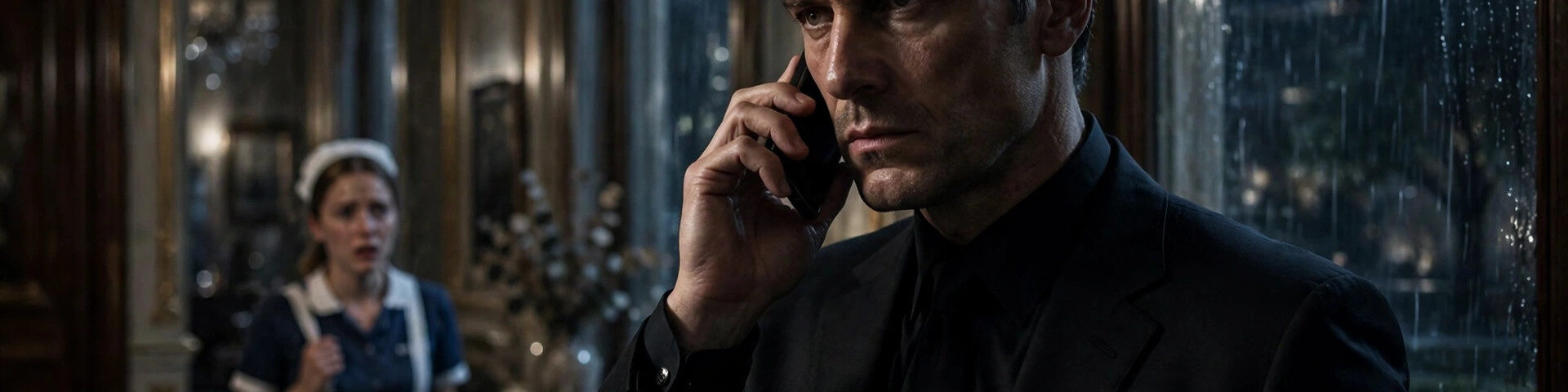
“Get to the school before Morrow’s men do.”
“No scene. No panic. No one touches the boy.”
Carlo was already opening the door before Dominic finished speaking.
Dominic turned to the driver. “Back to the mansion.”
The SUV pulled away from the curb. Only then did Dominic look at the rain again. His reflection stared back from the dark window: black suit, dark eyes, controlled face, the kind of face men feared because it gave nothing away. But beneath that stillness, something old and brutal had opened inside him.
He had built walls around his mother after the attack that stole her voice. He had filled the mansion with guards, doctors, cameras, locks, expensive specialists, and expensive silence. He had believed money could make a room safe.
Still, a woman wearing his ring had reached his mother first. Worse, she had reached her because Dominic had trusted beauty when he should have trusted fear.
By the time the SUV climbed the private road to the Virelli estate, the sky had darkened over the cliffs. The mansion rose from the rocks like a stone palace built for secrets: white columns, black iron gates, lanterns glowing in the rain, waves breaking far below against the jagged shore.
Marin Hayes had entered six months earlier through the servants’ gate with a secondhand purse, tired eyes, and a résumé folded too carefully in her hand.
She had not looked like anyone who belonged there. That was why Dominic remembered her.
The Woman Who Chose to Stay
Before the mansion, Marin’s life had been smaller and harder.
She had grown up above her aunt’s laundromat in Fall River, Massachusetts, where pipes rattled in winter and money always ran out before the month did. Her mother cleaned offices at night. Her father left when Marin was twelve and returned only twice: once to ask for money, and once to borrow a car he never brought back.
By twenty-five, Marin had built a quiet life out of ordinary sacrifices. She worked in an elder-care center, shared an apartment with her younger sister Laya, and was engaged once to a man named Andrew, who liked her softness until it became inconvenient.
Then Laya died in a car accident on a wet road outside Providence. She left behind a baby boy with dark hair and lungs too fragile for winter.
Everyone had advice. Marin’s fiancé told her they could help from a distance. His mother told Marin that motherhood would ruin her figure, her freedom, and her marriage prospects. A social worker asked whether she had considered other family placements.
Marin took Eli home. Andrew left.
Marin cried once in the bathroom while Eli slept in a laundry basket lined with towels because she could not yet afford a crib. Then she washed her face, warmed his bottle, and became a mother without asking the world’s permission.
After that, love became something she measured by what it demanded.
If a man wanted her but not Eli, he wanted the wrong woman. If a job paid well but treated her as though she had no spine, she stayed until the rent was paid and then left. If the world mocked her body, her age, or her tired eyes, she let it talk. Eli’s inhalers mattered more than strangers’ opinions.
The Virelli mansion paid better than any care home. So Marin stayed. She stayed even when the gates made her nervous, even when the guards watched too closely, even when Dominic Virelli’s presence turned every hallway into a held breath.
She stayed for Eli.
Then Vivien found that out.
The Language of Silence
The first morning Dominic saw Marin, she stood outside his mother’s bedroom with a cup of tea in one hand and a small alphabet board in the other. She was plus-size, soft around the hips and stomach, with warm brown eyes that avoided Dominic’s until she realized avoiding him made her look afraid. Then she forced herself to meet his gaze.
Most people lowered their heads around Dominic. Marin looked at him as though she was frightened, yes, but not empty.
His mother, Isabella Virelli, sat beside the window in her blue shawl, watching them both.
“Does she understand my mother?” Dominic had asked.
The housekeeper answered first. “She says she does.”
Marin’s chin lifted slightly. “I don’t say I understand her. I say I’m learning how she chooses to speak.”
The room went silent. A maid behind Marin stared at the floor. One of Dominic’s guards shifted his weight, waiting to see whether the new caregiver had just signed her own dismissal.
Dominic looked at Marin for a long second. Then his mother tapped twice against the arm of her chair.
Yes.
That had been enough. From then on, Marin became the only person in the house Isabella consistently allowed near her.
She learned that two taps meant yes. One tap meant no. A finger pressed to the silver cross at Isabella’s throat meant someone was lying. A closed fist meant pain. Her eyes shifting toward the door meant she wanted privacy. A slow blink meant a memory had found her. A hand flat on the blanket meant exhaustion.
Dominic watched Marin learn his mother’s language with a patience he had not known existed inside that mansion anymore. She never rushed Isabella. She never spoke over her. She never treated silence as absence.
Dominic, who had spent years commanding rooms with a few quiet words, began to understand that he had failed the one silence that mattered most.
At first, he told himself his attention to Marin was practical. His mother trusted her. That made Marin important. Nothing more.
Then he began noticing small things he had no reason to notice. How Marin wore the same black shoes until the heels gave out. How she brought her own lunch in containers held closed with rubber bands. How she smiled at Isabella with tired tenderness, then lost that smile the moment she entered the hallway.
Her son. Dominic heard about the boy before he ever met him. Marin rarely spoke about herself, but she spoke about Eli whenever Isabella asked about him through the board. Nine years old. Asthma. Loved ocean documentaries. Hated onions. Asked too many questions. Called the mansion “the castle where nobody laughs.”
Dominic had almost smiled when he heard that. Almost.
The Engagement
Then Vivien Morrow arrived.
Vivien was the kind of woman men confused with destiny because she knew how to enter a room as though it had been built for her. She came from an old crime family disguised behind charitable foundations and European art boards. Her father controlled ports. Her uncle controlled judges. Her cousins controlled men who wore gloves for reasons no polite person asked about.
A marriage between Dominic Virelli and Vivien Morrow would join two families that had distrusted each other for twenty years. It would calm a war and secure the harbor routes. Dominic knew better than to believe in simple peace. Still, he agreed to the engagement because his empire was tired, his men were restless, and his mother had been too quiet for too long.
He told himself marriage was strategy. Vivien was beautiful, educated, composed, useful. She did not demand tenderness from him. She seemed content with power.
When she kissed Isabella’s cheek in front of Dominic and called her “Mama Isabella,” he allowed himself the smallest and most dangerous thing. Relief.
He wanted peace in his house. He wanted to believe that one woman could sit beside his mother without becoming another threat he would eventually have to destroy.
But Isabella never touched Vivien willingly. Dominic saw that too late. Marin saw it on the first day. Vivien saw Marin see it.
That was when the war between the two women began. Not with shouting. Not with open threats. At first, it came through small cruelties. Vivien would move Isabella’s water glass two inches too far from her hand. She would ask Marin in front of others whether women of her size became tired more easily. She would touch Dominic’s arm whenever Marin translated Isabella’s refusal, as though reminding everyone in the room whose hand wore the ring.