Eli pressed his face into her side. “Mom, are the bad guys here?”
“The good guys are louder,” Marin whispered, smoothing his hair. “Listen. That’s Carlo yelling. Carlo never yells unless he’s winning.”
Isabella’s hand moved across the board. Marin leaned close to read in the dim light.
My son will come back.
Marin nodded, tears on her cheeks. “I know.”
The firefight lasted eleven minutes. When the last shot faded, the silence that followed felt heavier than the noise.
A knock came at the door. Three slow raps, then two quick ones. Their signal.
Carlo’s voice: “It’s clear. Open up.”
Marin dragged the dresser aside with shaking arms. Carlo stood in the hallway, blood on his sleeve that wasn’t his, his face grim but steady.
“Boss is fine,” he said before she could ask. “Four of theirs down, three ran, one alive. He’s in the cellar.”
Marin looked down at Eli, who was staring at Carlo with wide eyes. “Is it over?”
“The shooting’s over,” Carlo said.
The Recording
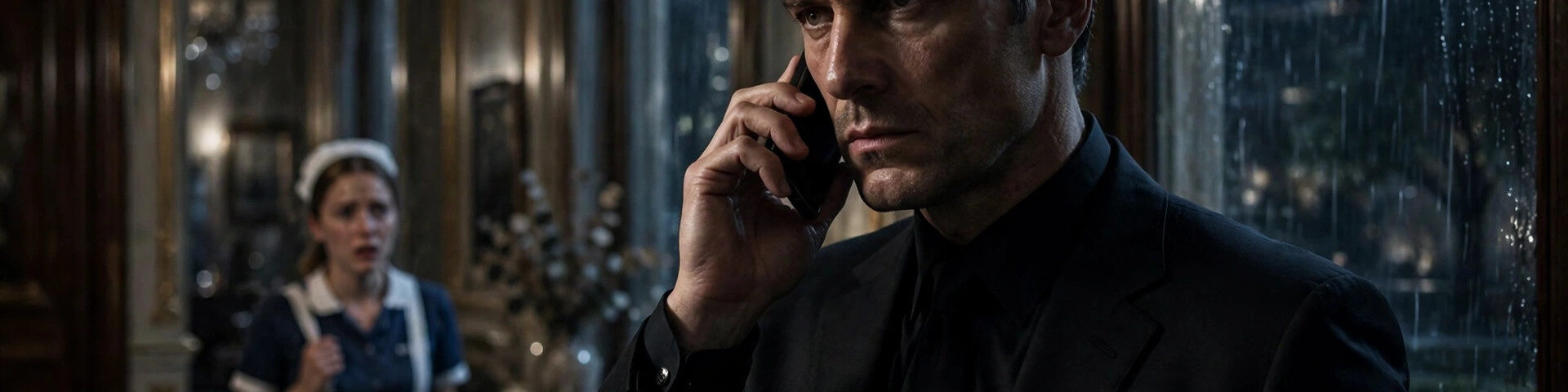
Dominic made his call at dawn.
The prisoner in the cellar had talked within the hour. The attack had been Vivien’s idea, not her father’s — a desperate move to prove she could still hurt Dominic. She had used her own men and lied to Vito Morrow about it.
That lie was the weapon Dominic needed.
He sat in his study as the sun rose over the Atlantic, the phone on speaker, the hospice schedule laid flat on the desk beside a digital recorder. On the other end of the line, Vito Morrow’s breathing was heavy with fury.
“Your daughter ordered an armed assault on my home, Vito,” Dominic said evenly. “Eight men. A truck through my gates. My people bled on my own stone.”
“That is a lie—”
“I have the driver alive in my cellar, and he has named her. But that isn’t why I’m calling.” Dominic picked up the recorder. “On Thursday at 4:17 in the afternoon, your daughter forgot to end a phone call. I heard everything she said to the woman who cares for my mother. I recorded it.”
He pressed play.
Vivien’s voice filled the study: the demand that Marin lie, the description of the blue backpack and the red inhaler, the promise that a boy would disappear from his school.
When the recording ended, the line was silent for a long time.
“She threatened a child,” Dominic said quietly. “She planned to lock my voiceless mother in a hospice and declare her unfit. And then she sent gunmen to my gates without your knowledge, Vito. Ask yourself what kind of war she would have started in your name if I had married her.”
Vito Morrow’s voice, when it came, was hollow. “What do you want?”
“An end to it,” Dominic said. “Withdraw your men from the harbor routes. Pay for my dead. And Vivien leaves Rhode Island. Tonight. If she ever sets foot in this state again, the recording goes to every family on the eastern seaboard, and your name goes with it.”
“Agreed,” Vito said. And then, quieter: “I did not raise her to be this.”
“No,” Dominic said. “You raised her to be powerful. She mistook cruelty for power. There is a difference.”
He ended the call.
By midnight, the Morrow security teams had withdrawn from the shared routes. By the end of the week, the Russians, finding no blood in the water, turned their attention elsewhere. The war that Vivien had tried to start died before it could truly begin — strangled by the sound of her own voice on a Thursday afternoon.
Vivien Morrow boarded a plane to Europe with two suitcases and no ring. She never came back.
Laughter
One month later, the mansion sounded different.
Marin was brushing Isabella’s silver hair by the window when she heard it: a bright, unrestrained peal of laughter rolling up from the courtyard below. She set down the brush and leaned toward the glass.
In the courtyard, Eli was teaching Dominic Virelli how to skip stones across the fountain. The boy’s technique was terrible and enthusiastic. Dominic’s was worse. When a stone finally skipped twice, Eli threw both arms in the air and shrieked with triumph, and Dominic laughed out loud, a deep, genuine sound that startled the birds from the hedges.
Isabella’s hand moved on her board. Marin read the words and felt her throat close.
He laughs now. You did that.
“We did that,” Marin whispered, squeezing the old woman’s hand.
That evening, Dominic came to Isabella’s room as he did every evening. He knelt beside her chair, took her frail hand, and told her about the day: the harbor routes secured, the warehouses rebuilding, Eli’s schoolwork improving now that Carlo escorted him to St. Anne’s each morning.
Isabella tapped twice on the board.
Yes. She was listening. She was proud.
Then she wrote three more words, slowly, deliberately.
Marin read them aloud, her voice trembling: “Keep her close.”
Dominic looked up. Across the room, Marin stood frozen, her heart hammering against her ribs.
He rose and crossed to her. He didn’t speak — he had learned, at last, that some things didn’t need commanding. He simply took her hand, rough palm against soft skin, and held it.
Outside, the Atlantic rolled dark and endless against the cliffs. Inside the stone palace built for secrets, the silence was no longer the kind that hid things.
It was the kind that kept them safe.
And in the castle where nobody used to laugh, somebody finally did.