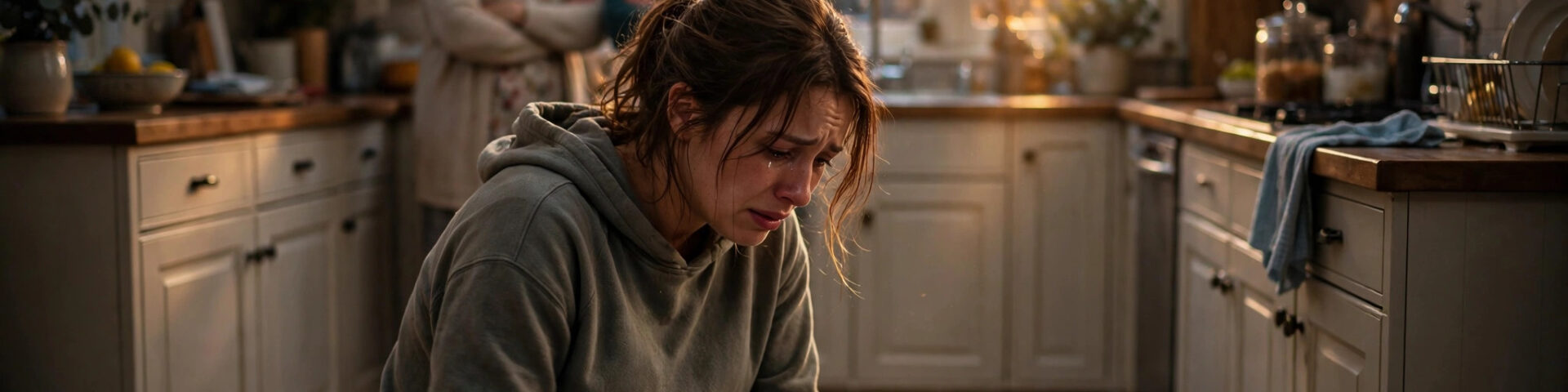
“Hannah, what are you doing?”
She glanced at the pan in her hands as if she’d forgotten what she was holding.
“Just cleaning up.” She turned the faucet slightly. “I can warm your dinner if you’re hungry. There’s still some pizza left, or I could make you something else.”
Something inside me tightened.
I looked at the dishes stacked beside the sink. I looked at the mess in the living room. Then I looked at my wife, who was standing in a puddle of dishwater with one hand pressed against her aching back, offering to make me dinner after I’d spent the day working.
“You don’t have to do any of this,” I said.
Her smile trembled.
“I know.”
But she didn’t put the pan down.
I stepped closer, and she finally looked directly at me. Her eyes filled again, and she turned her face away quickly, as though she could hide the tears by moving fast enough.
“Hannah.”
“I’m okay.”
Those two words hurt more than if she’d started screaming.
She wasn’t okay. I could see it in the way she stood, the way her shoulders sagged, the way she tried to make herself smaller even in her own kitchen.
I reached for the pan and gently took it from her.
“Talk to me.”
For a few seconds, she said nothing. The television continued roaring behind us. I could hear Brooke laughing, followed by the crinkling of the chip bag in my mother’s hands.
Hannah swallowed.
“It’s been going on for almost two months.”
I stared at her.
“What has?”
She wiped her cheek with the back of her wrist, leaving a faint streak of water across her skin.
“The comments. The way they talk to me. Everything.”
My stomach dropped.
She told me that Darlene had accused her of taking advantage of me. According to my mother, I worked myself exhausted while Hannah stayed home and complained about being tired.
My sisters had said much the same thing.
They talked as though pregnancy were an excuse Hannah had invented, as though carrying our son somehow meant she had less right to rest than anyone else in the apartment.
Tessa had told her, “Being pregnant doesn’t mean she can’t do anything.”
Darlene had compared Hannah to herself, saying she had worked while pregnant with me and had still cooked and cleaned the house.
The message was always the same: if my mother had managed everything without complaining, Hannah had no excuse.
“Wives don’t complain about taking care of a household,” Darlene had told her.
My sisters had added that women had always managed chores while pregnant, and that Hannah should be able to do the same.
I listened, and with every sentence, the exhaustion I’d carried home from the warehouse turned into something harder and colder.
“Why didn’t you tell me?” I asked.
Hannah looked down at the dishwater.
“Because you were already working so much.”
Her answer came quietly, without accusation, which somehow made it worse.
She explained that whenever she tried to sit down, someone found another task for her. If she rested, there were comments. If she looked tired, there were jokes about how easy she had it. If she asked for help, she was made to feel as though she’d requested something unreasonable.
So she’d started doing everything before I got home.
She cleaned the kitchen. She gathered the trash. She picked up the living room and washed whatever dishes had accumulated. She tried to make sure the apartment looked peaceful by the time I walked through the door.
She wanted me to come home and relax.
She didn’t want me worrying about her while I was already working myself to exhaustion.
And somewhere along the way, she had begun to believe that if she worked hard enough, stayed quiet enough, and asked for little enough, she might finally earn a place in a home that had always been hers.
I closed my eyes for a moment.
All those evenings when I’d come home and found the apartment relatively tidy, I’d assumed Hannah had been having a manageable day. I’d assumed she was resting when she needed to and that the household was getting by.
I’d never imagined that she’d been cleaning up after four other adults while carrying our son, only to have them criticize her for being tired.
I’d been working extra hours to protect my family, but I’d failed to see what was happening inside my own home.
“I’m sorry,” I whispered.
She shook her head immediately.
“Marcus, you didn’t know.”
“I should have asked.”
She looked at me then, and I saw something that made my chest ache: she was trying to comfort me.
Even now, after everything, she was worried that I’d blame myself.