At 10:15 on a Tuesday night, I came home from a fourteen-hour double shift at the warehouse near the rail yard in Kansas City, Missouri, with my boots aching, my shoulders burning, and one thought keeping me moving through the last hour of work.
I wanted to surprise my wife.
Hannah was eight months pregnant with our little boy, and lately, the days seemed to stretch longer for her than they did for me. I knew she was uncomfortable. I knew her back hurt, her feet swelled, and sleep had become something she chased in short, frustrating stretches rather than something she could count on. I also knew she missed having me home before dark.
So I’d picked up the extra hours, telling myself that every paycheck would make the final weeks easier. Every shift would mean one less thing to worry about when our son arrived. I could handle the exhaustion. I could handle the sore muscles and the cold dinners eaten standing at the kitchen counter during my ten-minute breaks.
What I couldn’t stand was the thought of Hannah feeling alone.
Usually, when I came home, I had a little ritual. I’d wash my hands, kick off my boots, and sit beside her wherever she’d settled for the evening. Sometimes she would be on the couch with a pillow behind her back. Sometimes she’d be in bed, propped up against the headboard, trying to find a position that didn’t make her hips ache.
I’d put my palm on her stomach and wait.
Our boy never seemed to care how tired I was. Some nights, he would give me a gentle nudge almost immediately, as if he recognized my hand. Other nights, I’d sit there for ten minutes, rubbing Hannah’s belly and talking to him quietly until she laughed and told me he was probably asleep.
Those little moments had become the best part of my day.
That Tuesday, I imagined walking in and finding her curled up under a blanket, maybe watching television or reading one of the baby books we’d left stacked on the coffee table. I’d tell her she didn’t need to get up. I’d ask about her day, kiss her forehead, and feel our son move beneath my hand.
I even stopped at the apartment door for a moment before unlocking it, thinking about how good it would feel to finally be home.
Then I opened the door.
The television was so loud that I could hear it before I stepped inside. Some reality show was blaring through the living room, people shouting over one another while canned laughter filled the spaces between their arguments.
Pizza boxes covered the coffee table. Paper plates were scattered across the couch, and plastic cups lay on their sides on the floor. Crumbs had been ground into the rug. A greasy napkin was stuck beneath the edge of the television stand.
The apartment smelled like cold cheese, spilled soda, and food that had been sitting out too long.
For a few seconds, I just stood there.
My mother, Darlene, was stretched across the biggest couch with a blanket over her legs, eating chips from a bag balanced against her stomach. She didn’t look up when I came in.
My sister Brooke was holding up her new phone, angling it toward herself as she took pictures. She had the kind of expression people wear when they’re trying to capture a perfect life for everyone else to see. I recognized the phone immediately because I was still paying for it.
Tessa sat nearby, laughing at something on her screen. Her laughter was sharp and carefree, the kind that filled a room without considering whether anyone else wanted to hear it.
Erin looked into one of the empty pizza boxes and sighed dramatically.
“Nobody even ordered dessert,” she complained.
Nobody asked how my shift had gone.
Nobody asked whether I was hungry.
Nobody even seemed to notice that I’d come home.
I stood there in my work clothes, feeling the weight of fourteen hours settle more heavily onto my shoulders. My feet throbbed inside my boots. My hands smelled faintly of cardboard, metal, and the industrial soap I’d used before leaving the warehouse.
I looked around the apartment again, trying to understand what I was seeing.
This place had never been meant to hold all of us.
It was a small apartment, suitable for Hannah and me, with enough room for the life we were building together. We’d arranged our furniture carefully, made space for the things we needed, and spent months turning the place into a home.
When my mother’s lease expired, I’d agreed to let her and my sisters stay with us for three weeks.
Three weeks.
That had been the promise. Darlene would have time to find another place, my sisters would help her sort things out, and nobody would be forced to make a rushed decision.
I’d said yes because she was my mother. I’d said yes because Brooke, Tessa, and Erin were my sisters. I’d said yes because I believed family helped one another when circumstances got difficult.
Four months later, their belongings had spread through our apartment, their routines had swallowed ours, and the three-week arrangement had become something nobody even bothered to discuss anymore.
I paid the rent.
I paid the electricity.
I bought the groceries. I covered my mother’s medication and my sisters’ phone bills. When they ordered food, I was usually the one whose card paid for it.
I’d been taking extra shifts and skipping lunch breaks because I wanted to keep everything afloat without making a fuss. Whenever I considered saying no, I reminded myself that they were family and that this situation wouldn’t last forever.
I had told myself that so many times that the words had almost lost their meaning.
Still, none of that prepared me for what I saw when I finally looked toward the kitchen.
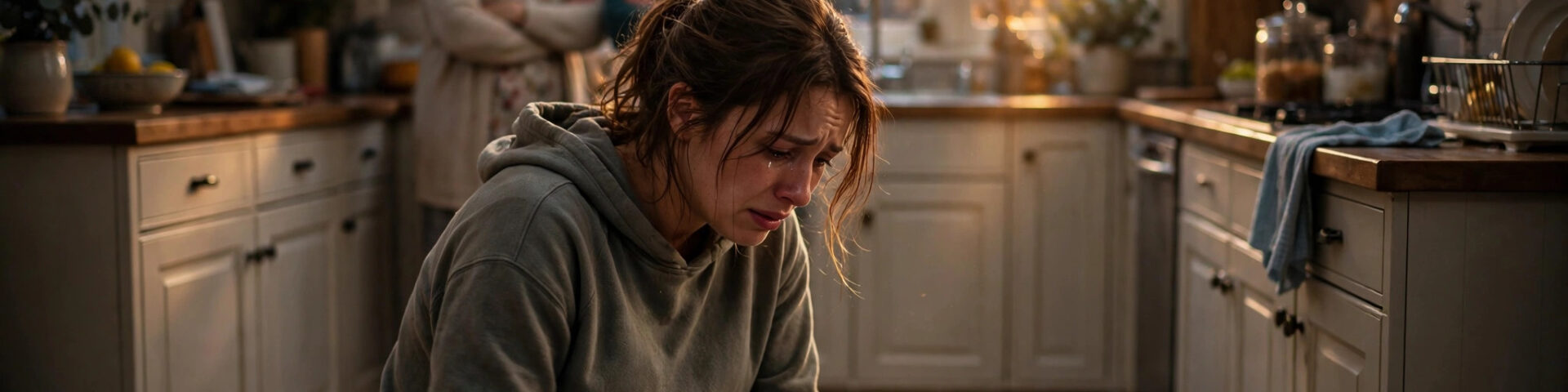
Hannah was standing at the sink.
She was barefoot, her swollen feet planted on the cold floor. Her belly barely cleared the counter as she leaned forward over a greasy pan. One hand was submerged in the dishwater, working at the stubborn residue, while her other hand pressed against her lower back.
Her shoulders were hunched.
Her hair had fallen loose around her face, and several strands clung to her damp cheeks.
For a moment, I couldn’t move.
I knew Hannah was tired. I’d seen her rub her back when she thought I wasn’t looking. I’d watched her struggle to pull on her shoes. I’d heard her wake in the middle of the night and shift restlessly, searching for a comfortable position.
But this was different.
Her feet were visibly swollen. Her eyes were red and puffy, as though she’d been crying for a long time and had tried to wash the evidence away.
She was eight months pregnant, exhausted, and standing barefoot in a kitchen full of other people’s dirty dishes.
When she noticed me, she startled.
Then she tried to smile.
It was a small, uncertain smile, the kind someone offers when they are afraid the truth might inconvenience another person.
“Marcus,” she said softly. “You’re home.”
I dropped my bag beside the door.