Not sorry for using my weekends.
Not sorry for threatening my housing.
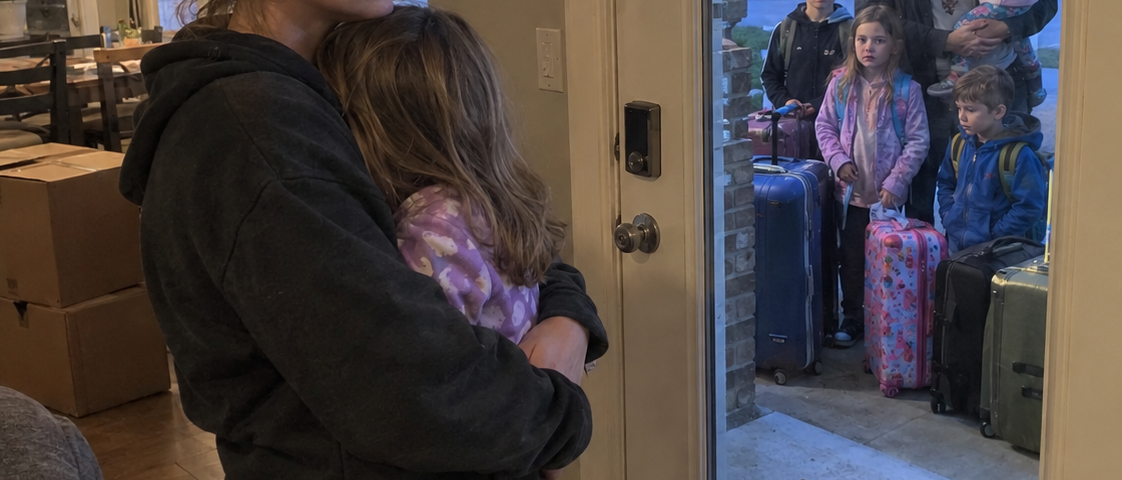
Not sorry for bringing four children and luggage to a locked door.
The apology asked for restored access without naming what had ended it.
I replied with one word.
No.
Then I blocked the address.
People often describe boundaries as walls.
That is not how mine felt.
Mine felt like a door with a lock I controlled.
A door could still open.
But someone had to knock.
They had to wait.
They had to accept that the person inside had the right to answer.
A year after our move, Chloe started preschool at the same child-care center where she had first attended through my job.
On the morning of her class photograph, she wore a yellow dress and insisted on carrying the stuffed rabbit she had held during the night Kayla came to the porch.
Before we left, she stood beside the front door.
“Aunt Kayla can’t come in,” she said casually.
“No.”
“Because she doesn’t have a key.”
“That’s right.”
“And she has to ask.”
“Yes.”
Chloe smiled.
“That’s the rule.”
It should never have been revolutionary.
But in our family, it was.
My salary increased after my first annual review. Monica promoted me to senior office manager and asked me to help revise the company’s scheduling procedures.
When she handed me the new contract, she said, “You’re good at protecting everyone’s time.”
I thought of the woman I had been in Toledo.
The one who canceled paying work because Kayla announced she was already driving over.
The one who apologized when someone entered her home without permission.
The one who believed gratitude meant surrender.
“I learned the hard way,” I said.
Monica nodded.
“Those lessons tend to hold.”
Lana visited that summer.
We sat on the apartment balcony while Chloe played with sidewalk chalk in the courtyard.
“Do you miss them?” Lana asked.
“My family?”
“Yes.”
“Some parts.”
“Which parts?”
I watched Chloe draw a large blue door on the pavement.
“Sunday dinners before everything became a negotiation. Mom’s birthday cakes. Jaden explaining video games. Mila wanting me to braid her hair.”
“You can miss people and still not reopen the arrangement.”
“I know.”
“Do you?”
I smiled.
“I’m learning.”
Kayla’s children were not responsible for what happened.
That remained one of the hardest truths.
I loved them.
I missed them.
Sometimes Jaden sent a message through Mom asking how Chloe was doing. I replied through Mom with a photograph or short note.
I did not use the children as messengers between adults.
I did not blame them for appearing on my porch.
The responsibility belonged to Kayla and Bryce.
Distance from their parents did not require cruelty toward them.
But it did require accepting that I could not maintain a close relationship with the children while their mother treated every connection as a route back into my life.
Two years after the move, Kayla wrote a longer letter.
It arrived through ordinary mail.
Mom had respected my request not to share the apartment number, but letters could be forwarded through her.
I opened it after Chloe went to bed.
Kayla wrote that she had begun counseling after problems developed in her marriage. She said Bryce had resented missing the Vegas trip, and they spent months blaming each other before admitting how much they had relied on me.
For the first time, she named specific things.
She admitted giving me no notice.
She admitted using Mom’s ownership of the duplex as pressure.
She admitted telling the children they were staying with me before asking.
She admitted that when I said no, she cared more about the lost trip than about what the conflict was doing to them.
Near the end, she wrote:
I thought being your sister meant I should always have access to you. I understand now that I confused closeness with permission.
I read that sentence several times.
Then I placed the letter in a kitchen drawer.
I did not call immediately.
A truthful apology does not create an immediate obligation to reconcile.
It creates accurate information.
What happens next depends on time, consistency, and whether the person who wrote it can live by it when access is not restored quickly.
Six months later, I agreed to a video call.
Kayla appeared on screen from her kitchen.
She looked older and less polished than I remembered. Jaden’s school calendar hung behind her. A stack of mail covered one counter.
“Hi,” she said.
“Hi.”
We spoke for twelve minutes.
No children appeared.
No one asked for a favor.
She apologized again without explaining why her circumstances had made her choices reasonable.
When the call ended, I cried.
Not because everything was fixed.
Because she had finally spoken to me as though my experience had happened.
That was the beginning of a different relationship.
Not the old one restored.
Something smaller.
Safer.
Phone calls arranged in advance.
Visits in public places.
No spare keys.
No surprise child care.
No discussion of my finances.
When she brought the children to Grand Rapids for a day trip the following summer, she asked three weeks beforehand.
She booked a hotel.
She stayed with them the entire time.
At the playground, Mila hugged me so tightly I could barely breathe.
Jaden had grown taller.
Toby talked for twenty minutes about soccer.
Rory did not remember the porch.
That was a mercy.
Before they returned to Toledo, Kayla stood beside her minivan.
“Thank you for seeing us.”
“Thank you for asking.”
She nodded.
The distinction no longer offended her.
After they left, Chloe held my hand.
“Can they come back?”
“Maybe.”
“Do they have a key?”
“No.”
She smiled.
“Good.”
Years earlier, I believed saying no would cost me my family, housing, and whatever fragile support remained after my divorce.
In some ways, it did cost me those things.
The old family arrangement ended.
The duplex disappeared from my life.
Several relatives stopped calling.
But the arrangement had required my exhaustion to continue.
Anything preserved only by one person’s silence is not peace.
It is dependence wearing a pleasant expression.
The morning of my interview, Kayla told me I had chosen to become a single mother.
She was wrong.
I did not choose abandonment.
I did not choose financial instability.
I did not choose to rebuild my life while someone else decided my weekends belonged to her.
But I did choose what happened afterward.
I chose the interview.
I chose the lock.
I chose the moving truck.
I chose the job.
I chose a small apartment in a cold city where my daughter could sleep without listening for someone else’s key.
Most importantly, I chose to believe that no was a complete answer even when the person hearing it was family.
Sometimes, I still think about that night on the porch.
Kayla pressing the bell.
Mom trying the old key.
The children standing beside their suitcases.
The moving truck turning into the driveway at exactly the moment everyone realized I was no longer negotiating.
For years, my sister had believed the door opened because she was family.
She never noticed that I had been the one opening it.
Once I stopped, the lock did not destroy our family.
It revealed which relationships knew how to knock.