The Door She Could No Longer Open
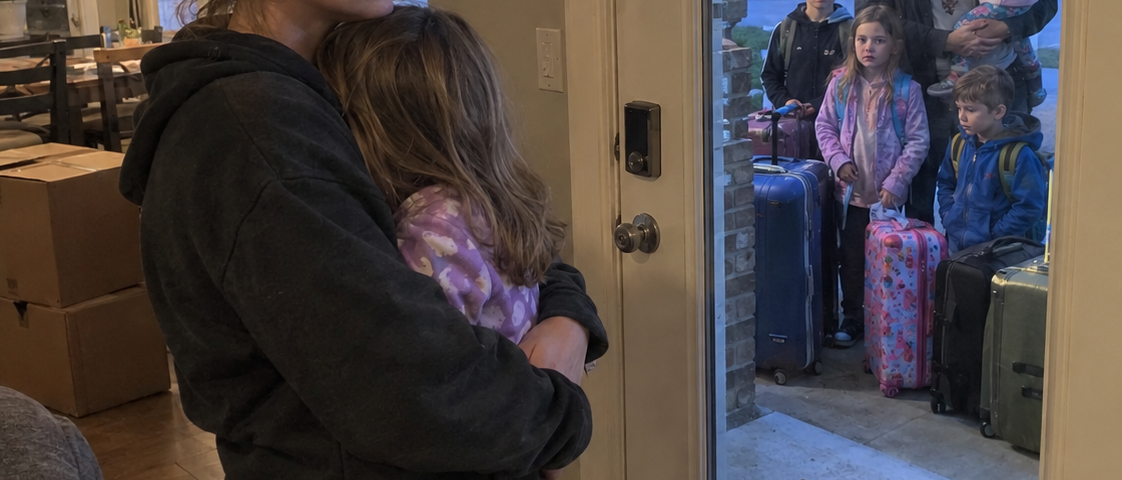
Kayla stood on my front porch with four children, five suitcases, and the absolute certainty that my front door would open simply because she wanted it to.
Through the doorbell camera, I watched her press the button three times in quick succession.
The chime echoed through the duplex.
Upstairs, my three-year-old daughter stirred in her bed.
Kayla leaned close to the camera. Her honey-blond hair was pulled into a high ponytail, and she wore the cream travel jacket she reserved for airports and photographs. Behind her, her minivan sat in my driveway with the rear hatch still raised. A bright pink suitcase rested against one porch post. Two backpacks had fallen onto the concrete steps.
“Carissa,” she called, stretching my name into a warning. “Open the door.”
I stood in the darkened kitchen with one hand around my phone and the other pressed flat against the counter.
The new deadbolt gleamed beneath the porch light.
Kayla tried the knob.
It did not move.
She frowned and tried again, harder this time, as though the lock had misunderstood her importance.
Her oldest son, Jaden, stood near the van with his shoulders bent beneath a large backpack. At nine years old, he already had the tired expression of a child who understood that the adults around him were pretending something was normal when it was not.
Seven-year-old Mila held tightly to the handle of her rolling suitcase.
Five-year-old Toby bounced from one foot to the other, overwhelmed by waiting.
Two-year-old Rory rested against Kayla’s hip, crying softly into her jacket.
Kayla looked at the camera again.
“We’re going to miss our flight.”
That was the first time she mentioned a flight.
I pressed the speaker button.
“Where are you going?”
She froze when my voice came through the small device beside the door.
Then her face rearranged itself into irritation.
“Vegas. Bryce is already heading to the airport.”
I looked at the digital clock on my stove, then at the moving boxes stacked along the dining-room wall.
“You never asked me to watch the kids.”
“I told you yesterday.”
“You sent a message saying you were bringing them. That isn’t asking.”
Her mouth tightened.
“Don’t do this in front of them.”
Behind her, Jaden looked directly at the camera.
The shame on his face was not his to carry.
I lowered my voice.
“Take them home, Kayla.”
She blinked as though I had spoken in another language.
“What?”
“I’m not available.”
“You’re inside.”
“Being home does not make me available.”
Rory’s crying grew louder.
Kayla shifted her daughter to the other hip and glanced toward the street, perhaps hoping a neighbor would appear and turn my refusal into a public embarrassment.
“You’re really going to punish four children because you’re mad at me?”
“I’m not punishing them. They belong with their parents.”
“We already paid for the trip.”
“That was your decision.”
“Bryce is at the airport.”
“Then call him.”
Her face went completely still.
For two years, Kayla had controlled my time by creating emergencies just close enough to the deadline that saying no felt cruel. She arrived after plans had been made, children had been promised, deposits had been paid, and alternatives had disappeared.
She called it needing help.
What she needed was for my consent to remain irrelevant.
Kayla lowered Rory to the porch and pulled out her phone.
“I’m calling Mom.”
“I expected that.”
“She has a key.”
“Not anymore.”
Her eyes snapped toward the deadbolt.
“What did you do?”
“I changed the locks.”
“You can’t change the locks. Mom owns this place.”
“I have a lease.”
“She’s your mother.”
“She is also my landlord.”
The words sounded almost formal through the doorbell speaker.
That was intentional.
Family language had always been soft enough for Kayla to bend. A lease was not.
She stared at the camera for several seconds.
Then she dragged the pink suitcase closer to the door and sat on it as if she intended to wait until my sense of guilt became stronger than the lock.
“Fine,” she said. “We’ll stay right here.”
I did not argue.
I did not explain.
I turned off the speaker and opened the folder on my phone labeled Kayla.
Screenshots filled the screen.
Messages.
Emails.
Missed calls.
Dates when her children had arrived without permission.
Dates when she had collected them late.
A receipt from the locksmith.
A copy of my lease.
The written notice I had sent my mother explaining that no duplicate keys could be distributed without my consent.
And at the bottom, an email from a company in Grand Rapids offering me a full-time office-management position with benefits, steady hours, relocation assistance, and access to discounted child care.
The email that would finally let me leave.
My name is Carissa Bennett. I was twenty-nine years old that spring, living in a narrow duplex in Toledo with my daughter, Chloe, and a collection of financial worries I had learned to arrange so neatly that most people assumed I was doing fine.
The duplex belonged to my mother.
That detail had shaped nearly every decision I made after my marriage ended.
My ex-husband, Darren, left when Chloe was six months old.
He did not leave dramatically. There was no shouting in the driveway or suitcase thrown into a car. He simply became quieter, spent longer evenings at a fitness studio, and eventually said he needed space to understand who he was.
Three weeks later, he moved in with a woman from his exercise group.
On social media, he began posting about growth, accountability, and choosing peace.
His support payments existed more reliably in official documents than in my bank account. Some months, the money arrived. Most months, there was an explanation.
A payroll issue.
A new job.
A banking delay.
A misunderstanding.
Chloe still needed diapers, formula, doctor visits, shoes, and a home.
So I returned to work at the front desk of a dental office during the week and accepted catering shifts whenever I could find someone to watch her.
My mother offered me the duplex shortly after the divorce.
“It’ll help you get back on your feet,” she said.
The rent was below market, though I paid it every month. I covered utilities, maintenance under a certain amount, and all ordinary household expenses. We signed a basic lease because Mom’s accountant advised her to keep rental records consistent.
At the time, I saw the duplex as protection.
Later, I understood that help can become leverage when the person offering it believes gratitude should include unlimited access.
My older sister Kayla lived fifteen minutes away with her husband, Bryce, and their four children.
Kayla was thirty-three, charming when she wanted something, and deeply skilled at making an arrangement sound mutual after she had already decided who would benefit.
The babysitting began on a Friday afternoon.
Chloe was one.
I was washing dishes when Kayla entered through the unlocked back door carrying a diaper bag.
“Good news,” she announced.
I turned from the sink.
“For who?”
“Bryce and I are bringing back date nights.”
She placed the bag on my kitchen counter and began removing Rory’s small shoes.
At the time, Rory was only a few months old. Jaden, Mila, and Toby followed Kayla into the living room as though they had been told the plan long before I heard it.
“What does that have to do with me?”
“You’re home on weekends.”
“I work some weekends.”
“But not every weekend.”
She smiled.
“You love kids.”
“I love your kids. That doesn’t mean I’m free child care.”
Her smile became patient.
“No one said free child care. It’s family helping family.”
“When are you coming back?”
“Sunday afternoon.”
I thought I had misheard her.
“You said date night.”
“We booked a hotel. Bryce’s mother gave us a gift card.”
“I can’t watch four children all weekend.”
“You already have one.”
“That is not how numbers work.”
Kayla laughed as though I had made a cute joke.
Then she kissed her children and left before I had fully understood that she was leaving.
I should have called her back.
I should have put everyone’s shoes on and driven them home.
Instead, I remembered my mother’s repeated warning that I was fortunate to have affordable housing. I remembered how often she described Kayla as overwhelmed. I remembered the family phrases used whenever I hesitated.
Be flexible.
Don’t make everything difficult.
It’s only this once.
Family shows up.
I swallowed my anger and watched five children through Sunday afternoon.
Kayla arrived four hours later than promised carrying two coffees and talking about traffic.
She did not offer payment.
She did not ask whether I had slept.
She kissed my cheek and said, “See? You survived.”
The next Friday, she sent a message at noon.
Dropping them at six.
I replied that I had not agreed.
She responded with a laughing face and wrote: