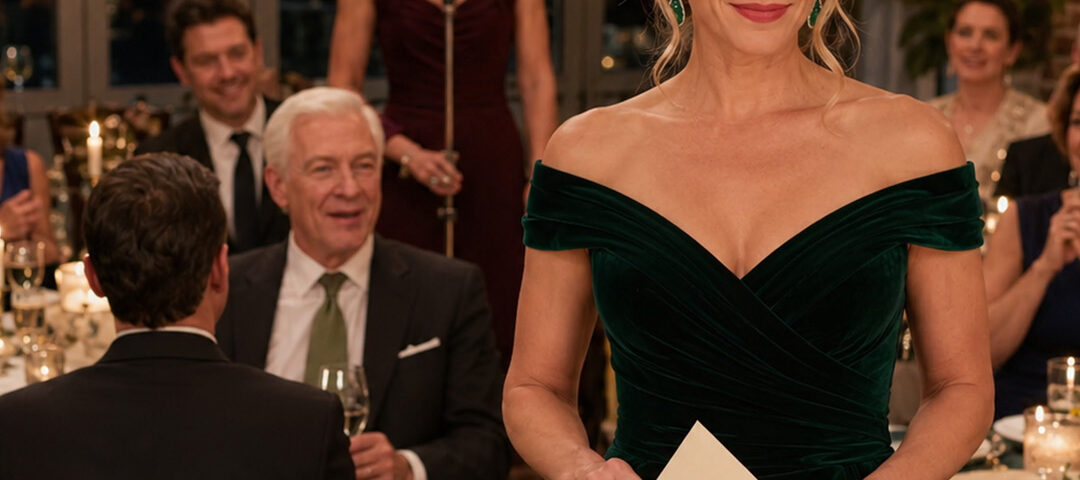
My name is Myra Anderson. I turned thirty in a private dining room at one of Boston’s most polished restaurants, surrounded by forty guests, a glowing birthday cake, white tablecloths, crystal chandeliers, and a family that had spent most of my life making me feel like I was standing just outside the doorway of my own name.
That night, my mother gave me a birthday gift I would remember for the rest of my life.
Not a necklace.
Not a toast.
Not an apology.
She gave me the truth as she wanted the room to understand it, dressed up in a smile and delivered through a microphone.
And then I gave her the truth she never expected me to have.
The Sterling had taken my breath away when I walked in. Floor-to-ceiling windows looked out over the Boston skyline, where the city glittered in cold silver and gold. Inside, everything felt expensive and carefully arranged: the folded napkins, the candles in glass holders, the polished silverware, the champagne already poured at each place setting.
A U-shaped banquet table filled the private room. At the center sat a chair wrapped in ribbon.
My chair.
For a moment, I stood in the doorway and let myself be fooled by it.
Maybe this was real. Maybe after thirty years, Patricia Anderson had decided to celebrate me without a catch. Maybe the woman who had raised me, but rarely made me feel chosen, had finally looked at me and seen a daughter.
Then I saw my sister Jenna in the corner with her phone already raised, her expression too sharp to be sentimental.
The hope in me quieted.
“Myra, birthday girl,” Patricia called, sweeping toward me in a navy dress that looked like it had been chosen to match the restaurant’s rich blue walls.
Her arms opened wide. Her smile did not reach her eyes.
“Thank you for all this,” I said as she hugged me stiffly. “It’s a lot.”
“You deserve it, sweetheart.”
Sweetheart.
She had used that word more in the past two weeks than she had in the previous thirty years. Every time she said it, something inside me tightened.
My father, Richard, appeared behind her in a gray suit. He gave me a brief hug that felt more like a polite handshake with extra steps.
“Happy birthday,” he murmured.
Before I could answer, he looked away.
Jenna didn’t bother pretending. She glanced up from her phone, gave me a smile that was more teeth than warmth, and said, “Big night.”
Then she went back to recording.
Aunt Helen was the only person whose embrace felt real. She had flown in from California, which she almost never did. She was my father’s sister, one of the few people in the family who had ever looked at me as if I was not an inconvenience placed at the wrong table.
She wrapped her arms around me tightly and whispered into my hair, “Whatever happens tonight, remember your grandmother would be proud of you.”
I pulled back.
“What do you mean?”
Before she could answer, a server called everyone to their seats.
I sat in the ribbon-wrapped chair with my clutch in my lap. Inside it was a cream-colored envelope sealed with red wax, stamped with my grandmother’s initials.
G.A.
Grace Anderson.
The corner of the envelope pressed against my thigh as if it had a heartbeat of its own.
Dinner began quietly. Salmon, asparagus, wine, small talk, polite laughter. The kind of smooth social performance Patricia had always done well. She could make discomfort look like etiquette. She could turn cruelty into a joke before anyone had time to object.
I almost relaxed.
Then she stood.
Patricia smoothed her dress, walked to the small podium near the windows, and tapped the microphone.
The room went silent.
“Thank you all for being here tonight,” she said, voice warm and polished. “We’re celebrating someone very special. Our Myra is turning thirty.”
There was applause. A few smiles. Someone lifted a glass.
I held my napkin under the table and twisted it once around my fingers.
“Thirty years,” Patricia continued. “Can you believe it? It feels like yesterday that she came into our lives.”
Something changed in her tone.
A fine edge slipped beneath the sweetness.
“I’ve been thinking a lot lately about Myra’s journey,” she said. “About where she came from. About everything this family has done for her.”
The air shifted.
I felt it before I understood it.
Across the table, Aunt Helen sat straighter. My father lowered his eyes to his plate. Jenna raised her phone a little higher.
Patricia’s smile widened.
“We supported her through school. Through her career. Through everything. We loved her like she was one of us.”
Like.
One word can open a floor beneath you.
My stomach dropped.
“But,” Patricia said, pausing just long enough to make the room lean in, “I think it is time we were honest. Don’t you?”
Murmurs moved through the guests.
I looked at my father.
He did not look at me.
Aunt Helen half rose from her chair.
“Patricia,” she said, her voice sharp. “Don’t do this.”
Patricia ignored her completely.
“Myra,” she said, turning to me with bright eyes, “sweetheart, are you ready to hear the truth?”
I did not answer.
“Myra is not our biological daughter,” she announced.
The words hit the room and scattered through it.
Gasps.
Whispers.
Chairs creaking.
Forty pairs of eyes turned toward me.
“She was adopted,” Patricia continued, her voice carrying cleanly through the microphone. “We took her in when she was two. And do you know why?”
Aunt Helen whispered, “Patricia, stop.”
But Patricia had waited too long for this stage.
She was not stopping.
“There were certain financial advantages at the time,” she said, with a little laugh meant to sound clever. “Programs. Deductions. Richard and I thought, well, why not? We could help a child, and it helped us too.”
My ears began to ring.
Not because I did not know I was adopted.
I knew.
Patricia had made sure I always knew.
She had never needed a microphone before. She had slipped it into ordinary days with extraordinary skill.
When I was ten and asked why Grandma Grace always looked sad when she watched me open gifts, Patricia said, “Some people get emotional about charity.”
When I was fifteen and a relative called me “your daughter,” Patricia smiled and corrected her with, “Well, not exactly.”
When I was eighteen, Jenna had a pool party with thirty friends, a DJ, and a photographer. I had a grocery store cake at the kitchen counter and a card that said only, “Happy birthday.”
Even when Patricia was not saying it, I heard it.
You are here because we allowed it.
You are loved because we decided to be generous.
You belong only as long as we say you do.
But hearing it like that, in that room, in front of people who had known me for years, turned the old wound into something public.
My sister’s laughter cut through the silence.
Sharp.
Bright.
Cruel enough to make several guests look down.
“So there it is,” Patricia said, spreading her hands as if she had performed a kindness. “The truth. Myra was never really part of this family. She was a financial decision.”
She turned toward me with exaggerated sympathy.
“I hope this doesn’t upset you, sweetheart. But after thirty years of pretending, I thought you deserved honesty.”
I couldn’t feel my hands.
The guests stared at me, some horrified, some pitying, some frozen by the terrible etiquette of witnessing a person’s private pain turned into dinner entertainment.
My father still had not moved.
Still had not lifted his head.
Still had not said my name.
Jenna lowered her phone just enough to smile.
“Happy birthday, sis.”
A few nervous sounds moved through the room, not quite laughter, not quite silence.
Patricia waited.
I understood then what she wanted.
She wanted me to break.
She wanted tears, a shaking voice, a chair pushed back too fast. She wanted me to leave, humiliated enough to disappear from the room, from the family, from whatever legal storm she knew was coming.
Because Patricia knew something.
Not everything.
But enough.
She knew Grandma Grace’s will was about to become public.
She knew the Anderson estate, the house she had treated as her future kingdom for twenty years, had not been left to her.
It had been left to me.
One month earlier, I had been working late at Harrison and Cole Architecture, reviewing blueprints beneath the cold glow of my desk lamp, when my phone buzzed with an unknown Boston number.
I almost ignored it.
Then I answered.
“Miss Anderson?” a man asked.
“Yes.”
“My name is Theodore Whitman. I was your grandmother’s attorney.”
I straightened immediately.
Grandma Grace had been gone six months. We had had the funeral, read the will, said our goodbyes, or so I thought.
“There is a matter I need to discuss with you in person,” he said. “It concerns documents your grandmother left specifically for you.”
“I don’t understand. The estate was already settled.”
“This is separate,” he replied. “Your grandmother left explicit instructions that no one else in your family should know about this conversation. She was very particular about that.”
Grandma Grace had been the only person in the Anderson family who made me feel wanted without conditions. At family dinners, she would squeeze my hand under the table when Patricia made a small comment that cut too deep for anyone else to notice. Once, when I cried in her garden after Patricia introduced Jenna as her daughter and me as “Myra,” Grandma Grace touched my cheek and whispered, “You belong here more than you know, sweetheart. One day you’ll understand.”
I never had.
Until the morning I walked into Theodore Whitman’s office.
His office smelled like leather, old paper, and expensive wood. He placed a large envelope on the desk between us. Cream-colored. Sealed with wax. Stamped with Grandma Grace’s initials.
“Your grandmother prepared this five years ago,” he said. “She was in perfect health and of completely sound mind. She made me promise to deliver it only to you and only after her passing.”
“What’s inside?” I asked.
“A copy of her will. A personal letter. And a smaller sealed envelope she instructed you not to open unless, in her words, absolutely necessary.”
He looked at me carefully.
“She said you would know when the time was right.”
My hands trembled as I broke the seal.
The will came first.
I scanned the legal language until my own name stopped me cold.
I hereby bequeath the Anderson estate, along with all property and contents therein, to my granddaughter, Myra Anderson.
For a few seconds, I forgot how to breathe.
The Anderson estate was not just a house. It was the house. The mansion where every holiday dinner happened, where every family photograph was staged, where Patricia had spent twenty years changing curtains, replacing rugs, discussing renovations, and moving through rooms as if she had already inherited them.
“This can’t be right,” I whispered.
“It is entirely legal,” Mr. Whitman said. “Three independent attorneys witnessed the signing. Video documentation exists.”
“Why me?”
He handed me the letter.
“Perhaps this will explain.”
Grandma Grace’s handwriting looked exactly as I remembered it, elegant and steady.
My dearest Myra,
If you are reading this, I am gone, and there are things I should have told you when I was alive. I was not brave enough then. I am sorry.
First, know this: I have loved you from the moment I first held you. Not because I had to, but because you were light in a family that had forgotten how to shine.
Second, I am sorry I could not protect you better. I watched Patricia diminish you year after year, and I should have fought harder. I should have said more.
Third, and this is the hardest part, you are not a stranger, Myra. You are not some random child adopted for convenience. You belong to this family more deeply than anyone has told you.
You are my blood. My real blood.
The small envelope contains the full truth. Documentation, proof, everything you will need when you are ready. Open it only when you must.
Be brave, my darling girl.
You are stronger than they ever allowed you to believe.
All my love forever,
Grandma Grace
I read the letter again and again that night in my small apartment, the city humming beyond the windows.
You are my blood.
I did not understand.
I was adopted. Patricia had made that the foundation of every wall between us. Yet Grandma Grace said I belonged. She said there was proof.
I locked the smaller envelope in my safe.
Something in my bones told me I would need it soon.
What I did not know then was that across town, Patricia had learned enough about the will to panic.
I pieced it together later from Aunt Helen and from the wreckage Patricia left behind. Patricia had been pacing her living room while Jenna sat on the couch scrolling through her phone.
“I found out today,” Patricia said. “About the will.”
“What will?” Jenna asked.
“Your grandmother’s. She left the estate to Myra. The house, the land, the contents. Everything.”
Jenna’s phone dropped into her lap.
“That’s impossible.”
“It’s legal. She did it years ago behind everyone’s back. And it becomes public in two weeks.”
“But that house was supposed to be yours.”
“I know,” Patricia said. “Which is why we need to act now.”
The birthday party had not been affection. It had been strategy.
Patricia knew I had spent thirty years trying to earn my seat in the family. She thought if she humiliated me publicly enough, I would run. If I disappeared, if I was too ashamed to show my face, contesting the will would be easier.
She did not know about the smaller envelope.
She did not know Grandma Grace had given me more than a house.
One week before the party, I stood in Nordstrom staring at dresses I could barely justify buying. I rarely spent money on myself that way. But if my family was actually throwing me a real birthday dinner, I wanted to walk in feeling like I deserved to be seen.
“The emerald one,” a voice said behind me. “It’ll bring out your eyes.”
I turned to find Lucas Smith, my closest friend at the firm, grinning.
“Are you stalking me now?”
“Saw you through the window. You looked like you were overthinking.”
“I always look like that.”
“Then talk to me.”
So I did. I told him about the lawyer, the will, the letter. Not everything. Not the line about blood. Not the sealed envelope. But enough.
Lucas listened without interrupting.
Then he said, “Myra, you’ve walked into that family’s traps your whole life. If there’s even a chance this party is another one, don’t go in empty-handed.”
“I don’t want to turn my birthday into a war.”
“You might not have a choice.”
That night, I laid everything on my bed. The will. Grandma Grace’s letter. The sealed envelope I still had not opened. My clutch was small, barely large enough for a phone and lipstick, but it could hold the truth.
I tucked the documents inside.
Just in case.
Now, in the Sterling’s private dining room, with Patricia standing at the podium and forty people waiting to see whether I would collapse, I understood what “just in case” meant.
I took one breath.
Then I stood.
The chair did not scrape loudly. My hands did not shake where anyone could see.
I stood in the silence long enough for everyone to understand that I was not crying, not running, not playing the part Patricia had written for me.
“Thank you, Patricia,” I said. “For that illuminating speech.”
Her smile flickered.
This was not how the scene was supposed to go.
I looked around the room. At relatives who had watched me grow up half-invited to my own family. At friends of my parents who had laughed politely through Patricia’s comments for years. At my father, who finally seemed to realize silence had a sound.
At Jenna, still recording.
Good.
Let her record.
“You’re right about one thing,” I said. “It is time for truth.”
I reached into my clutch.
Patricia’s eyes moved to my hand. Her expression shifted. Just slightly. Uncertainty.
“Myra,” she said, the microphone still carrying her voice, “this really isn’t—”
“Oh, but it is.”
I pulled out the envelope.
Cream-colored. Wax-sealed. Grandma Grace’s initials bright under the chandelier light.
“You wanted to do this publicly,” I said, “before forty witnesses. So let’s do it properly.”
The room went absolutely still.
I caught Aunt Helen’s gaze. She gave me a tiny nod.
Your grandmother would be proud.
I looked down at the envelope.
For one moment, I considered putting it away. Walking out. Taking the quiet road.
Then I remembered every Christmas dinner where I sat near the edge of the room. Every birthday treated like an obligation. Every time Patricia introduced Jenna first and let a small pause do the work of rejection before saying my name.
Thirty years of trying to belong to people who used that desire against me.
No more.
“Ready, Patricia?” I asked. “For the truth?”
Her face had gone white.
“Two weeks ago,” I began, “I received a call from Theodore Whitman. Some of you may know him. He handled my grandmother’s affairs.”
Patricia went rigid.
“He had documents for me. Documents my grandmother prepared five years ago, when she was healthy, clear-minded, and knew exactly what she was doing.”
I held up the envelope.
“This contains a certified copy of her will.”
“Myra,” Patricia said, voice strained. “This is not the place to discuss—”
“This is exactly the place,” I said. “You made it the place when you decided to turn my birthday dinner into a public lesson about where you think I belong.”
Several guests shifted in their seats.
I opened the envelope and pulled out the first document.
“Would you like to know what this says?”
Patricia’s mouth tightened.
“It says Grandma Grace left me the Anderson estate. The house, the land, the contents. Everything.”
The room erupted into whispers.
“That’s impossible,” Patricia snapped.
“It is entirely legal,” I said. “Certified, witnessed, and documented.”
Her mouth opened and closed.
Nothing came out.
I let the silence settle.
“But the house,” I said, “isn’t even the most interesting part.”
For the first time in my life, I saw fear on Patricia Anderson’s face.
My father finally lifted his head.
Jenna slowly lowered her phone.
I unfolded Grandma Grace’s letter.
“My grandmother wrote this by hand,” I said. “And it explains something that changes everything.”
The chandelier crystals seemed to tinkle in the silence.
I read aloud carefully.
“My dearest Myra, you are not a stranger who was adopted by chance. You are not some charitable act or financial arrangement. You are my blood. My real blood. You are my granddaughter, the daughter of Marcus, my firstborn son.”
The room broke open.
“Marcus?” someone whispered.
“Who is Marcus?”
Patricia gripped the podium.
“That’s a lie,” she said.
Aunt Helen stood.
“No,” she said. “It isn’t.”
Every face turned toward her.
“Marcus was Richard’s older brother,” she said. “He passed away when Myra was two. He had struggled after an accident and the family chose not to talk about him. But he had a daughter. Myra.”
My chest tightened.
For most of my life, I had imagined my origin as an empty room. A file. A name no one wanted to say.
Now Aunt Helen was placing a person there.
Marcus.
My father.
“Mother begged Richard to take Myra in,” Aunt Helen continued. “To keep Marcus’s child in the family.”
I turned to Patricia.
“You knew.”
It was not a question.
Patricia said nothing.
Her silence answered for her.
“Thirty years,” I said, and for the first time my voice shook. “You made me feel like an outsider for thirty years when you knew exactly who I was.”
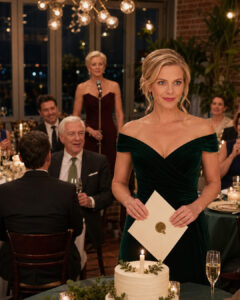
Patricia’s lips parted, but I was not finished.
“And that still isn’t everything.”
I reached back into the envelope and pulled out the smaller sealed packet.
The one Grandma Grace had marked in her own handwriting:
Only open when necessary.
If this was not necessary, nothing ever would be.
“My grandmother left me one more thing,” I said. “She told me to open it when I truly needed it.”
Patricia stepped forward.
“Myra, wait.”
The desperation in her voice made the room lean toward us.
“Whatever is in there, we can discuss it privately.”
“Privately?” I said. “Like you privately planned tonight? Like you privately arranged a room full of witnesses and a phone camera so my humiliation could be saved and shared?”
Jenna froze.
Her thumb moved quickly across the screen.
“Yes,” I said, glancing at her phone. “I figured it out.”
Patricia’s face hardened, but fear had already reached her eyes.
“What matters now,” I said, “is what’s inside.”
I broke the seal.
Inside were two items.
A DNA report dated twenty-eight years earlier.
And an old photograph faded at the edges.
A young man with paint on his shirt, holding a baby girl as if she were the entire world.
I stared at it, and something inside me shifted into place.
The same eyes.
The same crooked smile.
“Grandma Grace kept thorough records,” I said quietly. “Very thorough.”
I held up the DNA report.
“This confirms that I am Marcus Anderson’s biological daughter.”
Aunt Helen pressed a hand to her mouth.
Richard’s eyes filled with tears.
“But there is something else,” I said. “Something about Marcus himself.”
Patricia made a small sound.
I read the line carefully.
“Marcus Anderson was not biologically related to Harold Anderson, the man listed as his father.”
The room stirred in confusion.
Aunt Helen closed her eyes for a moment, then spoke.
“Mother had Marcus before she married Harold. Harold adopted him when they wed. But Marcus was Grace’s son from before the Anderson marriage.”
I let the room absorb that.
“The estate came through Grace’s family,” I said. “Not Harold’s. Not Patricia’s. Not Jenna’s. Grandma Grace left it to her bloodline.”
I lifted the photograph.
“And that bloodline is me.”
The first clap came from somewhere near the back.
Then another.
Then several more.
I did not smile.
I was not doing this for applause.
I was doing it because truth had spent too many years locked away in other people’s drawers.
Patricia tried one last time.
“This is ridiculous,” she said. “The will can be challenged. These documents could be—”
“They are not,” Aunt Helen interrupted. “I witnessed the will. I know where the originals are. And there is more than enough documentation to support everything Myra has said.”
Patricia turned to Richard.
“Are you going to sit there and let them do this?”
Richard stood slowly.
For the first time that night, he looked at her directly.
“Myra is my niece,” he said, voice low. “My brother’s daughter. She has always been family.”
Patricia stared at him as if she did not recognize him.
“And I,” Richard continued, turning toward me, “spent thirty years watching you be treated like you were less. I said nothing. I should have protected you.”
His voice broke.
“I am sorry, Myra. I am so deeply sorry.”
I nodded once.
I could not forgive him in that moment. Forgiveness was not a napkin you unfolded because dinner required it. But his words mattered because they had arrived in the room where his silence had done damage.
Patricia looked around desperately.
No one came to rescue her.
Jenna was crying quietly in the corner, though I did not yet know whether those tears were shame, fear, or the sudden collapse of a story she had been told her whole life.
“This isn’t over,” Patricia said.
“It can be,” I replied. “Or it can become more public and more expensive. That choice is yours.”
I stepped closer, my voice calm enough to make her flinch.
“You wanted to make me disappear. All you did was show everyone exactly who you are.”
For the first time in thirty years, Patricia had nothing to say.
I gathered the papers and returned them to my clutch.
“The estate is legally mine,” I said. “But I am not here to throw people into the street. That house meant something to Grandma Grace. It will be handled with respect.”
Patricia blinked as if mercy offended her more than anger.
“But everything changes now,” I said. “I will not be treated like I do not matter. Not anymore. From this moment forward, I set the boundaries.”
Then I looked around the room one last time.
“Thank you all for coming to my birthday dinner,” I said. “It has been educational.”
A nervous laugh moved through the guests.
I picked up my clutch, straightened my dress, and walked toward the exit.
Behind me, I heard heels on marble.
Fast.
Unsteady.
Patricia was leaving her own party.
I did not turn to watch her go.
I heard the restaurant door open. I heard the sharp silence that followed. Jenna hesitated for a moment, then grabbed her bag and rushed after her mother without looking at anyone.
My father approached slowly.
“Myra.”
His voice was raw.
“I don’t know what to say.”
“You don’t have to say anything right now.”
“No,” he said. “I do. Thirty years. I watched it happen for thirty years.”
He looked older than he had an hour earlier.
“I should have stopped her.”
“You should have,” I said.
He flinched.
But I did not soften the truth for him. I had spent too long making other people comfortable at my own expense.
“You spoke tonight,” I added. “That counts for something. It is not enough. Not yet. But it is a start.”
He nodded, wiping at his face.
“Marcus would have been proud of you,” he said. “I know I have no right to say that. But he would have.”
Then he left too.
For a long moment, the room did not know how to breathe.
Aunt Helen came to me and wrapped her arms around me.
“Your grandmother is smiling right now,” she whispered. “I promise you.”
That was when I cried.
Not from humiliation.
Not from defeat.
From release.
Someone began singing “Happy Birthday” softly. Another voice joined. Then another. The song trembled through the private room, awkward at first, then strangely tender.
I laughed through my tears.
For the first time in my life, my birthday felt like mine.
The party did not end after Patricia fled.
Somehow, impossibly, it began.
People approached me one by one. Mrs. Patterson, one of Grandma Grace’s oldest friends, held both my hands and said, “Your grandmother talked about you constantly. You were her joy.”
Mr. Henderson, a family friend since before I was born, shook my hand firmly.
“That took courage,” he said.
Lucas appeared at my elbow with two glasses of champagne.
“You okay?”
“Honestly?” I took the glass. “I have no idea.”
“You were phenomenal.”
“I was terrified.”
“That makes it more impressive.”
Aunt Helen sat beside me and began telling me about Marcus.
My father.
She told me he had been creative, tender, funny. That he painted more than he spoke. That when I was born, he carried my picture in his wallet and showed it to strangers. That after a car accident left him in constant pain, he began struggling in ways the family did not know how to face.
“He was not a villain,” she said quietly. “He was hurting. There is a difference.”
By midnight, the people still in the room were there because they wanted to be. Not because Patricia had arranged it. Not because the seating chart demanded it.
For me.
One week later, the fallout had spread through Patricia’s carefully curated circles.
She vanished from charity lunches, garden club meetings, and social events where she had once moved like she owned every room. Word traveled quickly through Boston’s upper-middle-class network. Someone at the party had shared what happened, and the story grew legs.
Jenna lost thousands of followers online. The brands that had sent her products and invitations became quieter. It turned out people did not respond well to a woman laughing while her sister was publicly humiliated.
Then Richard called.
We met at a coffee shop far from the family’s usual places. He looked like he had aged ten years in a week.
“I need to tell you about Marcus,” he said. “Really tell you.”
So he did.
He told me Marcus had once been the golden child. Brilliant. Artistic. Warm. The kind of person who filled a room without trying. Then the accident came, then pain, then dependency, then the family’s inability to understand suffering without turning it into shame.
“Our parents gave up on him,” Richard said. “They chose not to speak his name. Your grandmother never forgave them. Never forgave herself either.”
“She couldn’t have saved him,” I said.
“No,” he replied. “But she saved you.”
He looked at me with red-rimmed eyes.
“She made me promise to take you in. Raise you as my own. I did the legal part. I failed at the love part.”
“Why?”
“Because I was a coward,” he said. “Afraid of confrontation. Afraid of Patricia. Afraid of losing the version of my life that looked stable from the outside.”
I did not forgive him that day.
I was not ready.
But I did not walk away either.
“This is not the end,” I said. “But maybe it is a start.”
He nodded.
“Baby steps,” he whispered.
Two weeks after the party, I drove to the Anderson estate.
I had been avoiding it.
Part of me was not ready to walk through the house where I had spent so many holidays feeling invisible. The house Patricia had decorated, controlled, and discussed as if it had always been hers.
But it was mine now.
I needed to see it.
Patricia and Jenna had moved out the week before. According to Aunt Helen, they had taken their personal belongings and left the bones of the house intact.
The first thing I noticed when I stepped inside was the quiet.
Not empty quiet.
Waiting quiet.
The parlor still smelled faintly of lemon polish. The dining room table stood in its usual place, long and formal, surrounded by chairs where I had sat through countless holiday meals pretending not to notice how conversations passed around me.
The garden beyond the windows looked winter-bare, but I remembered Grandma Grace there in spring, kneeling beside roses, waving me closer.
I climbed the stairs to her bedroom.
It still smelled like lavender and old books.
I sat on the edge of her bed and let myself cry again.
Not the kind of crying that tears you apart.
The kind that returns something to you.
In her closet, behind winter coats and hat boxes, I found a cardboard box worn soft at the corners.
Inside were photographs.
Marcus as a boy.
Marcus as a teenager with paint on his hands.
Marcus at twenty, smiling sideways at whoever held the camera.
And Marcus holding a newborn baby.
Me.
On the back, in Grandma Grace’s handwriting, it said:
Marcus and Myra, my two greatest loves, 1994.
I pressed the photograph to my chest.
I had never seen my father’s face before.
But looking at him, I saw myself.
The same eyes.
The same crooked smile.
“I wish I had known you,” I whispered.
The house stayed silent.
For the first time, it felt like home.
Three weeks after the party, Jenna called.
Every instinct told me not to answer.
Curiosity won.
“Please don’t hang up,” she said immediately. “Please.”
I sat down.
“I’m listening.”
“Can we meet somewhere neutral? I need to talk.”
We met at a coffee shop on the other side of the city. Jenna looked different without the armor of perfect makeup and curated clothing. She wore jeans, a wrinkled sweater, and the exhausted expression of someone whose entire mirror had cracked.
“I’m not here to apologize,” she said first. “I mean, I should be. I know I should. But I’m not there yet.”
“Then why are you here?”
She stared at her untouched latte.
“I need to understand why Grandma loved you more.”
The question surprised me more than an apology would have.
“What?”
“She always looked at you differently,” Jenna said. “Like you were special. Mom always said it was because you were the poor orphan and Grandma felt guilty. But that wasn’t it, was it?”
“No,” I said. “It wasn’t.”
“You were actually hers,” Jenna whispered. “And I was…”
She laughed, but there was no humor in it.
“I don’t even know what I was.”
“You were her granddaughter too,” I said.
“Not the same way.”
The bitterness in her voice was old.
For the first time, I wondered what Patricia had done to both of us. She had made me the outsider and Jenna the chosen one, but neither role had been love. Both were control.
“Mom told me my whole life that I was the real daughter,” Jenna said. “That you were the interloper. But maybe I was the one who never knew where I stood.”
I did not know what to say.
“I’m not asking for forgiveness,” she continued. “I don’t deserve it. But is there any chance, someday, that we could start over?”
I considered the question carefully.
“The door is not closed,” I said. “But you will have to earn your way through it.”
She nodded.
It was not reconciliation.
Not yet.
It was the beginning of a possibility.
One month after the party, I made a list.
Not a revenge list.
A boundary list.
Patricia: no contact. Not welcome at the estate. Any communication would go through attorneys.
Richard: limited contact. Open to rebuilding, slowly. Trust would be earned, not assumed.
Jenna: wait and see. A crack in the armor was not the same as change. I would believe sustained action, not emotional speeches.
Aunt Helen: family.
Real family.
The kind I had always wanted.
I began changing the estate slowly. I did not want to erase Grandma Grace. I wanted to uncover her.
Her bedroom became a memorial space filled with her photographs, Marcus’s artwork, and the portrait he had painted of me as an infant before his life narrowed into pain and loss.
Then I did something bigger.
I created the Marcus Anderson Memorial Scholarship Fund for young people aging out of foster care who wanted to study art, design, or architecture.
“Because your father never got a second chance,” Aunt Helen said when I told her.
“But maybe someone else can,” I replied.
The first recipient was a seventeen-year-old girl named Maya.
She had been in the system since she was nine. No stable home. No family that stayed. But she could draw like nothing I had ever seen.
At the first scholarship ceremony, she tugged on my sleeve and asked, “Did you ever feel like you didn’t belong anywhere?”
“Every single day,” I told her. “Until I stopped waiting for permission.”
“Permission for what?”
“To belong. To matter. To take up space.”
She looked at me as if I had handed her something fragile and important.
“You don’t need anyone’s permission, Maya,” I said. “Neither did I. I just took thirty years to learn it.”
She hugged me.
It felt like hope.
Six months after the party, I held a memorial at the estate.
Not a funeral. We had already done that.
This was something different.
A celebration. A remembrance. A closing of chapters and an opening of new ones.
The guest list was small. Aunt Helen. Richard, who had been slowly and painfully trying to become a better man. Lucas. Mrs. Patterson. A few of Grandma Grace’s oldest friends. Maya, who had become more than a scholarship recipient to me.
No Patricia.
No Jenna.
Not yet.
Maybe not ever.
I arranged photographs on the mantel. Grandma Grace on her wedding day, young and radiant. Marcus at twenty with a paintbrush in his hand. Marcus holding me as if I were made of sunlight.
I spoke first.
“Most of my life,” I said, “I did not know who I was. I knew I was adopted. I knew I was different. I knew I did not fit. But I did not know I had a father who loved me, a grandmother who fought for me, and a history that was mine.”
My voice stayed steady.
“Grandma Grace spent her final years making sure I would learn the truth. She could not protect me completely while she lived. But she found a way after.”
I lit two candles.
One for Grace.
One for Marcus.
“I never met my father,” I said. “But he is part of me. I see him every time I look in the mirror.”
Richard wept openly. Aunt Helen held my hand.
“To Grace,” I said. “And to Marcus. I hope you are together now.”
“To Grace and Marcus,” everyone echoed.
The candles flickered like heartbeats.
The official launch of the Marcus Anderson Memorial Scholarship made the local news. The estate was transformed for the event, not into something unrecognizable, but into something warmer. A home that opened its doors instead of guarding them.
Young artists displayed their work in the rooms where I had once felt invisible.
I stood at the podium and looked out at faces full of hope.
“My father never got the second chance he needed,” I said. “When he struggled, he was treated like a problem to hide. I do not want any young person to feel hidden. I do not want any artist to believe their dreams are not worth fighting for.”
I gestured toward the scholarship recipients.
“These young people are not charity cases. They are not deductions. They are the future, and they deserve every opportunity to shine.”
A ripple of understanding moved through the crowd.
Afterward, Maya pulled me aside.
“Miss Anderson, can I ask you something?”
“Always.”
“Did you ever feel like no matter what you did, people would always see you as less?”
I knelt slightly so we were eye to eye.
“Every day of my life,” I said. “Until I learned something important.”
“What?”
“Their opinion of me was not my truth. My truth was mine to create. And so is yours.”
She hugged me fiercely.
“Thank you,” she whispered, “for making me feel like I matter.”
I held her tightly.
“You do matter,” I said. “You always have.”
That night, after everyone left, I sat alone in Grandma Grace’s room. The candles still flickered on the mantel. The photographs watched over me. Outside the window, Boston glittered against a clear winter sky.
I thought about what I had lost.
The fantasy of a loving family.
The belief that if I tried hard enough, Patricia would accept me.
The version of myself that bent and shrank and apologized for taking up space.
Then I thought about what I had gained.
Truth.
Identity.
Aunt Helen.
Lucas.
Maya.
A father figure who was imperfect but trying.
Freedom from seeking validation from people who had used my longing as leverage.
And peace.
Not the loud kind.
The quiet kind.
The kind that settles into a room after years of noise.
I looked at the photo of Marcus.
“I wish you could see me now,” I whispered. “I think you’d be proud.”
The candle flame moved slightly, as if answering.
Grandma Grace’s final gift had taught me something I had needed my whole life to understand.
You cannot force people to love you.
You cannot shrink yourself into belonging somewhere that refuses to hold space for you.
But you can build a life where you belong to yourself first.
Where your worth is not a verdict handed down by someone else.
Where family is not only the people who claim you in public, but the people who protect your name when you are not in the room.
I picked up my phone and typed a note.
Things I know for certain:
I am worthy of love, my own first.
I do not need permission to belong.
Boundaries are not cruelty. They are self-preservation.
The people who matter will choose you. Release the ones who do not.
I saved the note.
Then I stood, blew out the candles, and walked into the hallway.
Behind me, the house settled into quiet.
For the first time in thirty years, I was not waiting to be invited in.
I was home.