For several seconds, nobody spoke.
I could hear every small sound inside that private dining room.
A fork touched porcelain.
Someone cleared his throat.
A chair creaked softly against the floor.
Then Vanessa laughed.
It was not her usual bright, polished laugh.
It was thin now.
Sharp around the edges.
“An announcement?” she said. “Eleanor, please. This is embarrassing enough already.”
Her voice carried the same sugar-coated cruelty she had used all evening.
But beneath it, I heard something new.
Fear.
Not much.
Just enough.
“Nathan,” I said, “is everyone listening?”
“Yes,” he answered quietly.
His voice sounded smaller than I remembered.
When he was nine, he had sounded that way after breaking my favorite lamp.
When he was seventeen, he had sounded that way after lying about where he had been.
Tonight, he sounded like a grown man finally realizing he had not simply been silent.
He had chosen a side.
“Good,” I said.
I placed one hand over my kitchen table, steadying myself.
The apartment was dark except for the small lamp beside the window.
Outside, rain tapped softly against the glass.
I stared at my reflection in the black pane.
An old woman in a plain blouse stared back at me.
Not weak.
Not defeated.
Just tired.
“I paid for your dinner tonight,” I said.
A murmur swept through the room.
Vanessa cut through it quickly.
“What?”
“The private dining room,” I continued. “The appetizers. The wine. The buffet. The dessert table. Every arrangement.”
“That’s not possible,” Vanessa said.
Her voice rose too fast.
Too defensive.
“We booked this ourselves.”
“You chose the menu,” I said. “I paid the deposit.”
Another silence followed.
This one was heavier.
Nathan whispered my name.
“Mom…”
“No,” I said gently. “Let me finish.”
I had imagined this moment would feel powerful.
I had imagined my words landing like stones through glass.
But now, speaking into that room, I felt no joy.
Only a deep ache spreading beneath my ribs.
Because punishment is never as satisfying when the people being punished are your own family.
“I paid because I was proud of my son,” I said. “I wanted him to feel celebrated. I wanted him to walk into that room and believe his work had been seen.”
Nathan inhaled sharply.
“And I stayed quiet because I did not want credit.”
Vanessa said nothing.
I could almost see her standing there.
One hand frozen near her necklace.
Her face pale beneath expensive makeup.
“I did not come tonight to embarrass anyone,” I said. “I came because I love my son.”
My throat tightened.
I swallowed before continuing.
“But when I arrived, the only empty chair was guarded like private property. Then your wife told me to eat in a restroom.”
Someone in the room whispered, “God.”
Vanessa snapped, “Oh, please. It was a joke.”
“A joke requires everyone to laugh,” I said.
My voice remained calm.
That surprised even me.
“What you offered was humiliation.”
“Eleanor,” Vanessa said, colder now, “you always take things so personally.”
The room shifted again.
Her words had been meant to rescue herself.
Instead, they revealed her.
I heard it in the silence that followed.
People were no longer embarrassed for me.
They were embarrassed for her.
Nathan finally spoke.
“Vanessa, stop.”
Two words.
Simple words.
Words he should have said earlier.
Still, they mattered.
Vanessa made a small sound of disbelief.
“Excuse me?”
“I said stop,” Nathan repeated.
His voice shook, but it did not break.
“This is my mother.”
A strange stillness came over me.
For years, I had waited for him to say something like that without being prompted.
For years, I had watched him smile weakly through Vanessa’s little insults.
The comments about my apartment.
My clothes.
My old car.
My refusal to “act like I had money.”
He always looked uncomfortable.
But discomfort is not defense.
Tonight, for the first time, he had stepped forward.
Late.
Imperfectly.
But he had stepped.
Vanessa lowered her voice.
I could tell she had moved closer to him.
“Nathan, don’t do this in front of your coworkers.”
“Then you shouldn’t have done what you did in front of them,” he said.
A chair scraped again.
Someone murmured his name.
Maybe one of his coworkers.
Maybe the manager.
I waited.
The rain continued tapping against my window.
Then Vanessa spoke again.
This time, her tone changed.
“Fine,” she said. “You want me to apologize? I’m sorry. There. Happy?”
No one accepted it.
Not me.
Not the room.
Not even Nathan.
Because some apologies are just another insult wearing better clothes.
“I’m not asking for an apology tonight,” I said.
Vanessa gave a brittle laugh.
“Then what exactly are you asking for?”
“The truth,” I said.
That silenced her completely.
I had not planned to say it.
The words came from someplace older than anger.
A place built by months of noticing things.
Missing invoices.
Strange pauses.
Nathan’s tired eyes whenever money came up.
Vanessa’s sudden interest in my accounts.
The way she watched my handbag whenever I took out my checkbook.
“The truth about what?” Nathan asked.
His question was careful.
Worried.
I closed my eyes.
This was the part I had not expected to reach tonight.
The restaurant bill was one thing.
The chair was another.
But the truth had been waiting long before either.
“Vanessa,” I said, “why did you tell the restaurant manager not to mention my name?”
A faint sound moved through the room.
Vanessa answered too quickly.
“I have no idea what you’re talking about.”
“Yes, you do.”
My voice softened.
That made it worse.
Cruelty expects shouting.
It is less prepared for patience.
“Three weeks ago, I called the restaurant to confirm the deposit,” I said. “The manager thanked me and then apologized.”
Vanessa said nothing.
“He said you had asked the staff to refer to the payment as a corporate expense if anyone asked.”
Nathan’s breathing changed.
“Nessa?”
“She misunderstood,” Vanessa said.
Her voice cracked on the final syllable.
“She did not.”
“She’s lying,” Vanessa said suddenly.
Not loud.
Not convincingly.
Just desperate.
“I am not,” I replied.
I heard movement, then Nathan’s muffled voice.
“Vanessa, look at me.”
She did not answer him.
“You told everyone my company paid for tonight,” he said.
His voice was slow now.
Pieces were connecting inside him.
“That’s why Derek thanked me for being generous before Mom arrived.”
A man in the background said, “I thought that was odd.”
Another voice added quietly, “We all did.”
The room had become a courtroom without anyone intending it.
Vanessa was no longer performing for guests.
She was trapped among witnesses.
“I was protecting you,” she said.
The words came out suddenly.
Raw.
Everyone went quiet.
Even I sat straighter.
“Protecting me?” Nathan asked.
“Yes,” she said. “Protecting you.”
Her breath trembled.
“You think I wanted them to know your mother paid? After everything you said about earning their respect?”
“I never said I wanted to lie,” Nathan replied.
“No,” Vanessa said. “You just kept saying you couldn’t look weak.”
That landed harder than I expected.
Nathan said nothing.
Vanessa continued, faster now.
“You kept saying your team already thought you got promoted because of connections. You said Derek was waiting for you to fail. You said one mistake would prove them right.”
I heard Nathan whisper, “That was private.”
“So was my panic,” Vanessa said.
Her polished voice had vanished.
Something frightened and human stood beneath it.
“I thought if they knew your mother paid, they would laugh behind your back. I thought they would say you couldn’t even afford your own celebration.”
My hand loosened around the phone.
The twist had begun moving before I understood its shape.
Vanessa had hidden my payment, yes.
But not only for vanity.
Not only for cruelty.
There was fear under it.
Twisted fear.
Misguided fear.
Still not kindness.
But fear had a different face than malice.
“And that explains the restroom comment?” I asked.
The room held its breath.
Vanessa did not answer immediately.
When she did, her voice was barely audible.
“No.”
A long silence followed.
“No,” she repeated. “That was mine.”
For the first time all evening, she sounded ashamed.
“I saw you walk in,” she said. “I saw you in that brown coat, carrying that old handbag, smiling like none of it mattered.”
Her voice tightened.
“And I hated that.”
I did not speak.
Not because I forgave her.
Because I finally wanted to hear the whole truth.
“You never try,” Vanessa said. “You never explain yourself. You never defend yourself. You sit there calmly while people underestimate you.”
Her words came out unevenly now.
“And somehow, everyone still turns toward you. Nathan still softens when you enter a room. He still listens for your approval before he listens for anyone else’s.”
Nathan said, “Vanessa…”
“No,” she said. “Let me say it.”
The room stayed silent.
“I was jealous,” she said.
The confession was so small that it barely survived the distance through the phone.
But it changed the air.
The cruelty had not come from strength. It had come from fear of being invisible.
I looked down at my kitchen table.
There was a small scratch near the edge.
Nathan had made it as a child with a toy truck.
I had kept the table anyway.
Some things are damaged and still worth keeping.
Vanessa drew a shaky breath.
“I thought if I made you look small, I would finally stop feeling small beside you.”
No one moved.
No one laughed.
The room had been stripped of performance.
At last, only people remained.
I wanted to say something sharp.
I had earned the right.
But another voice spoke before I could.
A woman’s voice.
Older than Vanessa’s.
Firm, but kind.
“Mrs. Carter?”
“Yes?” I said.
“This is Lillian Hayes,” she said. “I’m Nathan’s department director.”
I recognized the name.
Nathan had mentioned her for years.
Careful.
Brilliant.
Impossible to impress.
“I apologize for intruding,” she said. “But I believe you should know something.”
Nathan said quickly, “Lillian, please.”
“No,” she said. “You have protected the wrong secret long enough.”
My pulse slowed.
Another secret.
Another hidden motive.
The room shifted again.
Lillian continued.
“Nathan did not invite half this table tonight because he wanted admiration. He invited us because tomorrow morning, our company board is making a decision about the regional ethics director position.”
Vanessa whispered, “What?”
Nathan made a pained sound.
“I asked him to host an informal dinner,” Lillian said. “Not to test his spending. Not to judge his status.”
She paused.
“To watch how he treated people when he thought no one important was watching.”
The words entered the room like cold water.
Vanessa stopped breathing.
I did too.
Lillian’s voice remained steady.
“The promotion we celebrated tonight was real. But the next role requires more than performance numbers. It requires judgment. Humility. Courage under social pressure.”
Nathan was silent.
“So tonight was a test?” Vanessa asked.
“No,” Lillian said. “Life was the test. Tonight only revealed the answers.”
I closed my eyes.
Earlier details rearranged themselves.
The coworkers watching too closely.
The director present at a family celebration.
The quiet guests who had stared down instead of laughing.
The strange weight in the room when no one offered me a seat.
They had not all been indifferent.
Some had been observing.
Some had been afraid to intervene.
And one woman had been measuring the cost of silence.
“Nathan,” Lillian said, “I saw your face when your wife spoke to your mother.”
He did not answer.
“I saw you freeze,” she continued. “I also saw you hate yourself for freezing.”
His voice broke quietly.
“I did.”
“That matters,” Lillian said. “But it does not excuse it.”
“I know.”
“And I saw you correct her just now,” Lillian added. “Late, yes. But sincerely.”
Vanessa made a small sound.
“What about me?” she asked.
It was not defensive now.
It was frightened.
Lillian answered with care.
“You are not my employee, Vanessa. I am not here to judge your career.”
Then her voice sharpened slightly.
“But I will tell you this. Anyone can be cruel when they feel cornered. The question is what they do after they realize it.”
The room remained silent.
My phone felt warm against my ear.
I had expected tonight to end with a bill.
Instead, it had become a mirror.
I heard Nathan speak again.
“Mom.”
His voice was rough now.
“I’m sorry.”
Two words.
But this time they were not decoration.
They were not social repair.
They came from somewhere broken open.
“I heard her say it,” he continued. “And I looked down.”
His breathing shook.
“I looked down because I was embarrassed. Not of you. Of the situation. Of what people would think. Of having everyone see how ugly things had gotten between my wife and my mother.”
He swallowed.
“But that means I let you stand alone.”
My eyes burned.
I pressed my fingers against the bridge of my nose.
“I’m not proud of myself,” he said. “I don’t expect you to make this easier for me.”
For a moment, I could not answer.
Because part of me wanted to protect him from pain.
That instinct had survived every disappointment.
It had survived his distance.
His missed calls.
His careful avoidance whenever Vanessa made her little remarks.
A mother’s love can be exhausted.
But it rarely disappears.
“You hurt me tonight,” I said.
My voice trembled for the first time.
The entire room seemed to lean into the silence.
“You watched me be humiliated, Nathan. That is not a small wound.”
“I know,” he whispered.
“No,” I said. “You don’t. Not yet.”
He stayed quiet.
“But perhaps,” I continued, “you are beginning to.”
Vanessa’s voice came through next.
Smaller than I had ever heard it.
“Eleanor.”
I almost ended the call.
I truly did.
My thumb hovered near the screen.
Then she said, “Please don’t hang up.”
There was no command in her voice now.
No polish.
Only a woman standing among the pieces of her own behavior.
“I don’t know how to apologize for what I said,” she continued.
“Start by not explaining it away,” I replied.
Another silence.
“You’re right,” she said.
The words seemed to cost her something.
“What I said was cruel. It was meant to hurt you. And it did.”
Her breath hitched.
“I am sorry.”
I stared at the rain sliding down the window.
It was not enough.
Not yet.
But it was the first honest thing she had offered me.
“And the payment?” I asked.
“I hid it,” she said.
Nathan exhaled painfully.
“I told myself I was protecting Nathan. But I was also protecting an image. Mine. Ours.”
She paused.
“I wanted everyone to think we were doing better than we were.”
That sentence changed Nathan’s tone immediately.
“What does that mean?”
Vanessa did not answer.
“Vanessa,” he said. “What does that mean?”
A chair shifted.
I heard her begin to cry.
Not loudly.
Just enough to lose control of her breathing.
“The house,” she whispered.
Nathan said nothing.
“The house?” he repeated.
“We’re behind,” she said.
The words fell one by one.
“Three months.”
A stunned silence took over the room.
My heart sank.
Nathan’s voice went hollow.
“That’s impossible.”
“I moved money,” she said. “I thought I could fix it before you noticed.”
“Moved money from where?”
No answer.
“Vanessa.”
“From the renovation account,” she whispered.
A man in the background muttered something under his breath.
Nathan sounded as if the room had tilted beneath him.
“You told me the contractor delayed.”
“He did,” she said. “At first. Then I used the delay to hide the rest.”
“Why?” Nathan asked.
It was not anger yet.
It was disbelief.
“Because you were drowning,” she said.
Her voice cracked open.
“You came home every night talking about layoffs, performance reviews, leadership tracks, image, pressure. You kept saying we had to look stable.”
“I never asked you to lie.”
“No,” she said. “You just looked relieved every time I said everything was handled.”
That wounded him.
I could hear it.
Sometimes truth does not need volume.
It only needs accuracy.
Vanessa continued through tears.
“I thought the promotion would fix it. I thought if you got the raise, I could catch everything up. Then the dinner came, and your mother offered to pay, and I hated needing her.”
She inhaled shakily.
“I hated that she solved in one phone call what I had been hiding for months.”
I sat very still.
The waterfall kitchen island.
The unread books.
The glass-and-stone showpiece.
All those details returned with new meaning.
That house had never been proof of success.
It had been a stage set.
Beautiful from the street.
Cracking behind the walls.
Nathan said softly, “Why didn’t you tell me?”
Vanessa laughed once, brokenly.
“Because I thought you’d look at me the way you’re looking at me now.”
No one spoke.
Then Nathan answered.
“I’m looking at you now because you humiliated my mother and lied to me.”
His voice shook.
“Not because we’re behind on the mortgage.”
That distinction landed.
I heard Vanessa begin to cry harder.
It would have been easy to feel victorious then.
But victory did not come.
Only sadness.
All evening, everyone had been defending an illusion.
Vanessa defended her perfect marriage.
Nathan defended his perfect career.
The guests defended their polite silence.
And I had defended my dignity by walking away.
Only now did the truth step into the room.
Messy.
Embarrassing.
Human.
Lillian spoke again, quieter now.
“I believe this conversation has become private.”
A few chairs moved.
She continued.
“Mrs. Carter, I will make sure the restaurant gives the family space.”
“Thank you,” I said.
“And Nathan,” she added.
“Yes?”
“Tomorrow’s decision can wait.”
He did not answer.
“You have a more important meeting tonight,” Lillian said.
Then the background noise shifted.
Doors opened.
Voices lowered.
One by one, people left the private room.
I imagined them walking past the gold lights and polished trays.
Carrying their coats.
Carrying their discomfort.
Carrying the memory of an old woman being denied a chair and a family being forced to tell the truth.
When the room finally quieted, only three voices remained.
Mine.
Nathan’s.
Vanessa’s.
And perhaps the manager, discreet somewhere near the door.
“Mom,” Nathan said, “I’m coming over.”
“No,” I said.
He paused.
“No?”
“Not tonight.”
The silence that followed hurt both of us.
“I need time,” I said. “And so do you.”
“Please,” he said. “I don’t want to leave it like this.”
“You already left me tonight,” I replied.
The words were not cruel.
They were true.
He absorbed them.
I heard his breath catch.
“You can come tomorrow,” I said. “Alone.”
Vanessa whispered something I could not hear.
Nathan said, “Okay.”
Then, after a moment, “What about the bill?”
There it was.
The practical world returning.
Dishes.
Receipts.
Consequences.
“The bill is yours,” I said.
He did not argue.
“Understood.”
“If you cannot pay tonight, speak honestly with the manager. Arrange payment. Leave your watch. Leave your pride. But do not call me to rescue you from a lesson you earned.”
A faint, painful laugh escaped him.
“Fair.”
Vanessa said quietly, “Eleanor?”
“Yes?”
“I know I don’t deserve anything from you.”
I waited.
“But may I come tomorrow too?”
Nathan said, “Vanessa—”
“No,” she interrupted softly. “Not to explain. Not to defend myself.”
Her voice trembled.
“To apologize without an audience.”
I looked around my small apartment.
The faded rug.
The neat stack of library books.
The framed photograph of Nathan at ten years old, missing one front tooth.
My life had never been empty.
But it had been lonelier than I admitted.
“I said Nathan comes alone tomorrow,” I replied.
Vanessa went silent.
“After that,” I added, “we will see.”
She cried quietly.
“Thank you.”
I ended the call.
For a long while, I sat without moving.
The rain thickened against the window.
My phone lay faceup on the table, dark again.
I expected to feel triumphant.
Instead, I felt old.
Not weak.
Just old enough to understand that being right does not protect your heart from breaking.
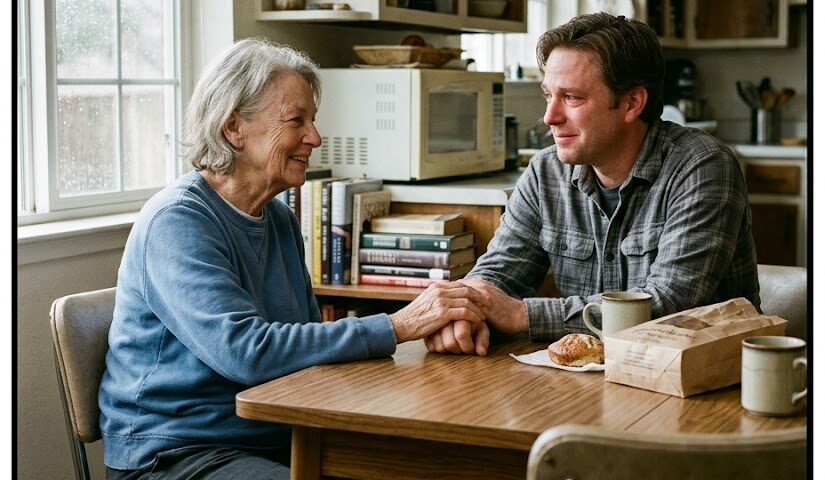
The next morning, Nathan arrived at nine.
He knocked instead of using the key I had given him years ago.
That small courtesy nearly undid me.
When I opened the door, he stood in the hallway wearing yesterday’s suit.
The collar was wrinkled.
His eyes were red.
He looked less like the polished executive from the restaurant and more like the boy who once crawled into my bed during thunderstorms.
“Hi, Mom,” he said.
“Hello, Nathan.”
He held a paper bag from the bakery near my building.
“I brought those almond rolls you like.”
I looked at the bag.
Then at him.
“You remembered.”
His face tightened.
“I remember more than I show.”
That was true.
And also not enough.
I stepped aside.
He entered quietly, as if my apartment had become sacred overnight.
He looked around.
Not with embarrassment this time.
With attention.
His gaze paused on the old table, the worn armchair, the bookshelf filled with photographs.
“I used to think you lived here because Dad left you cautious,” he said.
I closed the door.
“Your father leaving taught me caution,” I said. “But I live here because it feels like mine.”
He nodded.
We sat at the kitchen table.
For several minutes, neither of us touched the rolls.
Finally, Nathan reached into his jacket and pulled out a folded receipt.
The restaurant bill.
Paid.
There were two lines at the bottom.
One for the meal.
One for an apology note to the staff.
“I left my watch,” he said.
I looked up.
“The manager let me settle half last night and the rest this morning. I sold the watch to Derek before we left.”
“The silver one?”
He nodded.
“The one you bought yourself after your first bonus?”
“Yes.”
I studied him.
“That must have hurt.”
“It needed to.”
The answer was quiet.
Honest.
He looked down at his hands.
“I spent years telling myself I was different from people who cared about appearances.”
His mouth twisted.
“Then last night, I realized I had just chosen quieter appearances.”
I said nothing.
He continued.
“I let Vanessa manage the parts of our life that scared me. The house. The bills. The social things. The image.”
He swallowed.
“And when she became cruel, I acted surprised. But I helped build the pressure that made cruelty useful to her.”
That was not an excuse.
It was a confession.
So I listened.
“I’m angry with her,” he said. “But I’m also ashamed because I recognize the fear she described.”
His eyes lifted to mine.
“I did want them to respect me. I did worry they would think less of me if they knew you helped.”
“Nathan,” I said softly, “everyone needs help sometimes.”
“I know.”
“No,” I said. “You know the sentence. You do not yet know how to live it.”
His face crumpled.
He turned away, pressing his hand against his mouth.
I let him have the dignity of not being watched too closely.
When he looked back, his eyes were wet.
“I am sorry I made you small to feel grown,” he said.
That was the sentence that broke me.
Not completely.
Just enough.
I reached across the table and placed my hand over his.
His fingers closed around mine like a child’s.
“I forgive the son who came here this morning,” I said.
He closed his eyes.
“But I am still hurt by the son who sat at that table.”
“I know.”
“That hurt will not vanish because you brought pastry.”
A fragile smile moved through his tears.
“I figured.”
“But it is a beginning.”
He nodded.
Then he drew another envelope from his jacket.
“I need to show you something.”
My body went still.
He noticed.
“It’s not another bill,” he said quickly.
He opened the envelope and slid several pages across the table.
Bank statements.
Mortgage notices.
Credit lines.
The full ugly architecture of a beautiful life.
“I didn’t know,” he said. “But I should have.”
I reviewed them slowly.
The numbers were bad.
Not unrecoverable.
But bad enough to humble anyone.
“Vanessa has been carrying this alone?” I asked.
“Carrying it,” he said. “And creating parts of it.”
He rubbed his forehead.
“She spent too much. I ignored too much. We both performed stability instead of building it.”
That was the most adult thing I had ever heard him say.
“What will you do?” I asked.
“Sell the house.”
He said it without drama.
I watched his face.
No flinch.
No performance.
“Vanessa agreed?”
“She cried for an hour,” he said. “Then she admitted she hated the house.”
I blinked.
“She did?”
“She said every room felt like an accusation.”
His voice softened.
“She chose half of it because she thought I wanted it. I paid for half because I thought she wanted it.”
I looked toward the rain-washed window.
There it was again.
The tragedy of people too proud to ask simple questions.
“We’re meeting a realtor tomorrow,” he said.
“And your marriage?”
His jaw tightened.
“I don’t know.”
The honesty pleased me more than certainty would have.
“We’re going to counseling,” he said. “Together if we can. Separately either way.”
“And Vanessa?”
“She wrote you a letter.”
He did not hand it to me.
“She asked me not to give it unless you wanted it.”
That surprised me.
Last night’s Vanessa would have forced the letter into my hands and expected forgiveness by dessert.
This small restraint mattered.
“Leave it,” I said.
Nathan placed it on the table, unopened.
Then he glanced toward my window.
“Mom, there’s something else.”
I sighed.
“Of course there is.”
He almost smiled.
“Lillian called this morning.”
I waited.
“The ethics role is still possible,” he said. “But not now.”
“That seems wise.”
“She said the board saw something they didn’t expect.”
I raised an eyebrow.
“Humiliation?”
“Recovery,” he said.
His voice carried wonder.
“She said people reveal more after failure than before it.”
I leaned back.
“And what did you reveal?”
“That I have work to do.”
He nodded once.
“And that I’m willing to do it where people can see.”
I studied him.
For years, Nathan had chased closed-door success.
Promotions.
Titles.
Rooms where he belonged because no one questioned him.
Now he was being offered something more difficult.
Public humility.
It might save him.
If he let it.
Before leaving, he stood awkwardly near the door.
“Can I hug you?”
The question pierced me.
Because he had not assumed the right.
I stepped forward.
He held me carefully at first.
Then tightly.
His shoulders shook once.
Only once.
“I should have stood up,” he whispered.
“Yes,” I said.
He nodded against my shoulder.
“I will next time.”
I pulled back and looked at him.
“Do not wait for next time with me. Practice with everyone.”
He absorbed that.
Then he left.
The apartment felt different afterward.
Not emptier.
Not fuller.
Just shifted.
As if furniture inside my heart had been moved.
For nearly an hour, Vanessa’s letter sat on my table.
I made tea.
I washed the cups.
I straightened books that were already straight.
At last, I opened it.
Her handwriting was elegant but uneven.
Eleanor,
I am not writing to ask forgiveness.
I am writing because last night you asked for the truth, and I owe you more of it.
When I met Nathan, I thought strength meant never needing anyone.
Then I met you, and you made needing nothing look peaceful.
I mistook that peace for judgment.
Every time you declined our invitations to expensive places, I thought you were criticizing me.
Every time you praised my cooking without mentioning the house, I thought you were mocking what I cared about.
Every time Nathan relaxed around you, I felt like a guest in my own marriage.
None of that excuses me.
It only explains the small, ugly story I kept telling myself.
The worst part is that I knew you were paying for dinner.
I knew it, and I still tried to deny you a chair at your own gift.
I think I wanted to prove generosity did not give you power over me.
But you never wanted power.
You wanted family.
I am ashamed that I could not tell the difference.
I folded the letter carefully.
Then I sat very still.
The twist was not that Vanessa had secretly been kind.
She had not.
The twist was that her cruelty had been protecting a lie everyone else was helping maintain.
Nathan’s silence.
Her pride.
My secrecy.
Even my generosity had played a part.
I had hidden my wealth because I wanted peace.
But secrecy creates empty rooms where suspicion grows.
I had paid quietly out of love.
Yet quiet love can still leave people guessing at its shape.
That did not make what they did acceptable.
But it made the path forward clearer.
Boundaries first.
Then truth.
Perhaps trust later.
Two weeks passed before Vanessa came to my apartment.
She arrived alone, carrying no flowers.
No gifts.
No dramatic offering.
Just herself, without makeup sharp enough to hide behind.
When I opened the door, she looked smaller.
Not defeated.
Reduced to her actual size.
“Thank you for seeing me,” she said.
I stepped aside.
She entered and looked around my apartment.
For once, I saw no judgment in her eyes.
Only curiosity.
And shame.
We sat at the kitchen table.
The same table where Nathan had cried.
The same table where I had signed the final sale papers for the company I built over forty years.
Vanessa noticed the pen lying beside the documents.
“Did it close?” she asked.
“Yes.”
She swallowed.
“One hundred sixty-five million.”
I nodded.
She looked down.
“I knew you had money,” she said. “I didn’t know…”
“No one did.”
“Why?”
I considered lying.
Or offering something simple.
Instead, I chose the truth I had demanded from everyone else.
“Because money changes the way people sit beside you,” I said.
Vanessa flinched softly.
The chair between us seemed suddenly important.
“I spent my youth being underestimated,” I continued. “Then I spent my middle years being pursued for what I had built. After a while, I wanted one place where no one calculated my worth.”
“This place,” she said.
“Yes.”
She looked around again.
This time, she understood something.
“It isn’t modest because you’re hiding,” she said.
“It’s modest because you’re free.”
I felt that sentence settle between us.
Not as flattery.
As recognition.
Vanessa folded her hands.
“I need to apologize properly.”
“You may.”
She closed her eyes briefly.
Then opened them.
“I am sorry I humiliated you. I am sorry I used your quietness against you. I am sorry I made your gift into something shameful.”
Her voice trembled.
“I am sorry I turned my fear into cruelty and aimed it at the person helping us.”
I listened.
No interruption.
No rescue.
She continued.
“I also need to tell you something Nathan doesn’t know yet.”
I stiffened.
She noticed quickly.
“It is not another debt.”
“Then say it.”
She reached into her bag and pulled out a small folded card.
Not a bill.
Not a letter.
A seating chart.
From the restaurant.
I recognized the cream paper.
Gold lettering.
Twenty-five names.
My name had been written at the head of the table.
Beside Nathan.
I stared at it.
My breath left me slowly.
“Where did you get this?”
“I made the original arrangement,” Vanessa said.
Her face had gone pale.
“You were supposed to sit beside him.”
I looked at the chart again.
Eleanor Carter.
Head table.
Right side.
“And then?” I asked.
She swallowed.
“The morning of the dinner, Lillian called Nathan. He stepped outside to take it. I heard enough to know she was attending partly to observe him.”
Her fingers tightened.
“I panicked.”
The room sharpened around us.
“I thought if you sat beside him, everyone would see how much he depended on you. I thought Lillian would think he was still a boy waiting for his mother’s approval.”
“So you removed my chair.”
“Yes.”
The word fell like a stone.
My chest hurt.
Vanessa’s eyes filled.
“I told the restaurant we had one less guest. Then, when you arrived, the staff brought an extra chair near the doorway. I sent it away.”
I remembered the empty space.
The possessive hand on the chair.
The giggle.
The cruelty.
It had not been spontaneous.
It had been planned.
That made it worse.
And somehow cleaner.
No more confusion.
No more wondering.
“I wanted you standing,” Vanessa whispered. “So you would leave.”
I did not move.
“I thought if you left quietly, Nathan would look independent.”
Her tears spilled now.
“But when you actually walked away, he didn’t look independent. He looked hollow.”
The room blurred for a moment.
I held the seating chart carefully.
A paper witness.
A map of the place I had been meant to occupy.
“You understand,” I said slowly, “that this is worse than a careless insult.”
“I know.”
“You arranged my exclusion.”
“Yes.”
“And then mocked me for being excluded.”
Her face crumpled.
“Yes.”
I looked at her for a long time.
She did not look away.
That mattered.
Not enough.
But it mattered.
“Why show me this?” I asked.
“Because if I hide the worst part, my apology is just another performance.”
That sentence carried weight.
She had learned something.
Painfully.
But truly.
I placed the seating chart on the table.
“What do you want from me, Vanessa?”
“Nothing today,” she said.
The answer came quickly.
Too quickly to be rehearsed.
“I want to earn the right to ask for something someday.”
“What something?”
She wiped her cheek.
“To be family without pretending.”
The words entered me quietly.
I thought of Nathan at ten, pushing toy trucks across this table.
I thought of the freight company’s first leased truck.
I thought of years spent proving I could survive without anyone’s permission.
Then I thought of the chair.
The one denied.
The one planned away.
The one that somehow still sat between us.
“I will not invest in your image,” I said.
Vanessa nodded.
“I will not rescue your house.”
“I know.”
“I will not fund a lifestyle built on fear.”
“I understand.”
“But,” I said, “I will pay for a financial counselor. One year. For both of you.”
Her lips parted.
“And I will pay the therapist directly for six months.”
She began to cry again.
Not dramatically.
Quietly.
“I don’t deserve that.”
“No,” I said. “You don’t.”
She nodded through tears.
“But Nathan deserves a chance to become honest. And you deserve a chance to become better if you choose the work.”
Her hand covered her mouth.
“Thank you.”
“This is not forgiveness,” I said.
“I know.”
“It is a boundary with a door in it.”
She closed her eyes.
“That is more than I expected.”
For the first time, I believed her.
Months passed.
Not easily.
The house went on the market.
There were arguments.
Painful ones.
Nathan called after some of them, asking not for money, but for advice.
Sometimes I gave it.
Sometimes I told him to speak with his therapist.
Vanessa found work with a nonprofit that coordinated logistics for food banks.
The irony did not escape any of us.
A woman who once guarded a chair began organizing tables for strangers.
She did not mention redemption.
That made me trust it more.
Nathan accepted a delayed leadership track at his company.
Not the ethics director position.
Not yet.
Instead, Lillian assigned him to rebuild a failing internal team known for quiet resentment and poor trust.
“It feels like punishment,” he told me one evening.
“Perhaps,” I said.
Then I added, “Or practice.”
He laughed softly.
“I hate when both are true.”
So did I.
By spring, the glass-and-stone house sold at a loss.
Nathan and Vanessa moved into a smaller rental ten minutes from my apartment.
The first time I visited, there were no waterfall counters.
No untouched books staged by color.
Just a scratched dining table, two mismatched chairs, and a stack of unpaid-looking envelopes sorted neatly beside a budgeting notebook.
Vanessa saw me notice.
“We open them now,” she said.
“That helps.”
“It hurts first.”
“Yes,” I replied. “Most helpful things do.”
She smiled faintly.
One Sunday, Nathan invited me to dinner.
“Nothing fancy,” he warned.
“I prefer nothing fancy.”
Vanessa cooked soup.
She burned the bread slightly.
Nobody pretended not to notice.
That alone felt like progress.
At the table, there were three chairs.
Then Nathan brought a fourth from the corner.
I looked at it.
“Expecting someone?”
He shook his head.
“No.”
Vanessa set it beside me.
Her hands trembled a little.
“It’s for what should have been there that night,” she said.
The room became very quiet.
Nathan looked down.
Vanessa did too.
The fourth chair remained empty.
Not as performance.
As acknowledgment.
I sat beside it.
For a while, none of us spoke.
Then Nathan ladled soup into my bowl.
Vanessa placed the imperfect bread near my plate.
Rain tapped softly against the window, just as it had that night.
But this room felt different.
Smaller than the restaurant.
Less elegant.
More honest.
After dinner, Vanessa cleared the plates.
Nathan washed them.
I stood at the window and watched their reflections in the glass.
They moved awkwardly around each other.
Carefully.
Like people learning a new dance after years of stepping on each other’s feet.
Not perfect.
Not healed.
But trying.
Vanessa came to stand beside me.
“I still think about what I said,” she whispered.
“So do I.”
She nodded.
“I’m sorry.”
“I know.”
She did not ask if I forgave her.
That was another kind of progress.
Nathan joined us, drying his hands on a towel.
For a moment, the three of us simply watched the rain.
Then he reached for my hand.
After a hesitation, Vanessa reached for his.
No one made a speech.
No one declared the family repaired.
But the empty chair sat behind us, visible in the dark window’s reflection.
Not erased.
Not forgotten.
No longer denied.
And in that small, quiet apartment, with burned bread cooling on the table, my son finally stood beside me.
Not in shame.
Not in fear.
But because he chose to.
If you came here from Facebook because of this story, return to the Facebook post, tap Like, and comment exactly “Amazing” to support the storyteller. That small action means more than it seems and gives the writer genuine encouragement to keep sharing more stories about family pressure, firm boundaries, and finally protecting what you worked so hard to build.
Disclaimer: This story is a work of fiction created for entertainment purposes. Any resemblance to real persons, events, or places is coincidental.