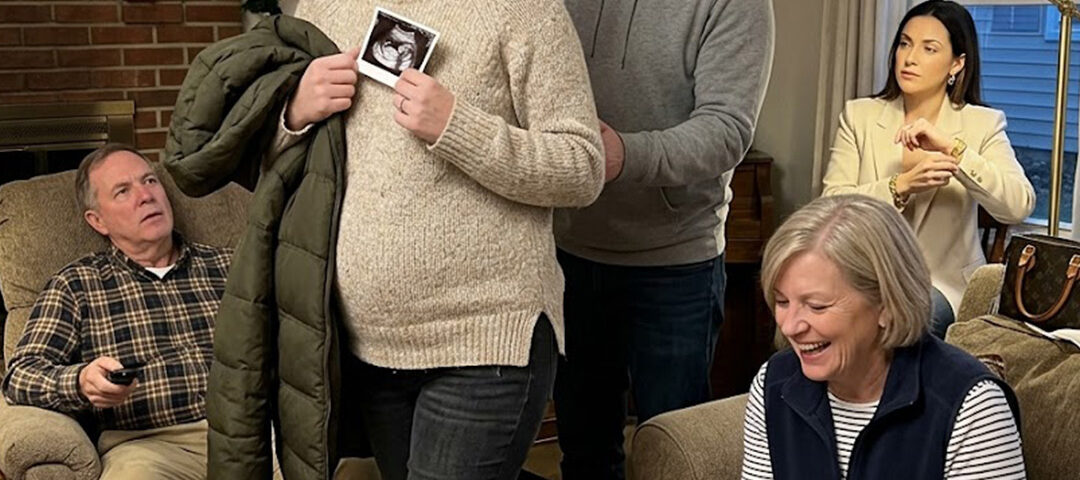
My mother laughed before the sonogram had finished sliding across the coffee table.
It was not a warm, startled laugh. It was sharp and dismissive, the kind of sound people make when something has confirmed an opinion they already held. She pinched the corner of the black-and-white photograph between two fingers, glanced at it for less than a second, and let it fall beside a stack of grocery coupons.
“Vanessa just secured her second investment property today,” she said. “That is the kind of news this family should be celebrating.”
Across the room, my older sister sat beneath the brass floor lamp with one ankle crossed over the other. Her cream blazer was still buttoned from the open house she had attended that afternoon, and a gold key-shaped charm hung from the handle of her designer handbag.
My father leaned back in his recliner and looked toward the sonogram.
“Wonderful,” he said. “Now we have one more person everyone will expect us to worry about.”
My husband, Mark, became completely still beside me.
His hand had been resting against the small of my back. I felt his fingers tighten through the fabric of my sweater, not enough to hurt, just enough to remind me that I was not alone in the room.
For thirty-three years, I had answered moments like that by explaining myself.
I would have said that the baby had been planned. I would have reminded them that Mark and I owned our home, that we both had stable careers, and that we had savings. I would have found a careful way to prove that my happiness was responsible enough to deserve respect.
That Sunday night, I said nothing.
I looked at the photograph lying beside my mother’s coffee cup. A tiny curved shape floated in the gray shadows, no larger than a lime. At the clinic two days earlier, Mark and I had watched a rapid flicker on the screen while the technician smiled and turned up the sound.
I had cried then.
Not from fear. From wonder.
Now my mother pushed the sonogram aside to make room for Vanessa’s property brochure.
The movement was small.
Something inside me shifted permanently.
I stood, reached for my coat, and picked up the photograph.
My mother frowned.
“Where are you going? We haven’t served dessert.”
“Home.”
Vanessa gave a quiet laugh and adjusted the gold bracelet at her wrist.
“Don’t be so sensitive, Waverly. Mom and Dad are only being realistic.”
Mark rose beside me.
My father lifted the television remote.
“If you walk out every time someone tells you the truth, you’re going to have a difficult time raising a child.”
I slipped the sonogram into the inner pocket of my coat.
“You may be right,” I said. “I should become more careful about who gets access to my child.”
The room went silent.
Vanessa’s smile disappeared first.
My mother’s hand froze above the dessert plates.
Mark opened the front door, and cold November air moved into the living room. We stepped onto the porch without saying goodbye.
Behind us, my mother called my name once.
I kept walking.
The drive home from my parents’ house usually took twenty-six minutes. That night it felt both shorter and endless.
Christmas lights had already appeared on several houses along the suburban streets outside Columbus. A grocery store parking lot glowed beneath tall white lamps. Families pushed carts loaded with paper towels, frozen pizzas, and early holiday decorations toward their cars.
Inside our sedan, there was only the sound of the heater and the soft movement of the sonogram photograph whenever my coat shifted.
Mark did not speak until he turned into our driveway.
He parked beside the maple tree, switched off the engine, and looked at me.
“We’re done.”
His voice was quiet, but I heard the anger beneath it.
I removed the photograph from my pocket and smoothed one bent corner.
“With Sunday dinners?”
“With all of it.”
The porch light reflected in his eyes.
“You have spent years paying their bills, solving Vanessa’s problems, and waiting for one decent moment from people who treat your help like an obligation. We are going to be parents now. We cannot build our child’s home around their approval.”
I looked toward the front window of our house.
A small lamp glowed in the living room. Two paint samples were taped to the wall because we had not yet chosen a color for the nursery. One was pale green. The other was a warm, soft blue Mark described as “cloudy morning.”
“I thought the baby might make them happy for me,” I said.
Mark’s expression softened.
“I know.”
“I knew better, and I still thought it.”
“Hope is not stupidity.”
“It feels like it tonight.”
He reached across the console and took my hand.
“No. But hope without boundaries becomes a bill you pay forever.”
That sentence followed me into the house.
I did not cry after we went inside.
I hung my coat in the hall closet, placed the sonogram on my desk, and opened my laptop.
At work, I specialized in financial auditing and property risk. My mother called it glorified bookkeeping. Vanessa described it as “the safe little job Waverly does with spreadsheets.”
In reality, I reviewed multimillion-dollar property portfolios for regional developers, traced irregular transfers, evaluated lending exposure, and found the quiet mistakes people made when they assumed no one would examine the details.
I knew how to separate emotion from evidence.
For years, I had refused to apply that skill to my own family.
That night, I opened a new spreadsheet and typed one word at the top.
Exposure.
Then I began listing every financial connection tying me to my parents and sister.
The first was my parents’ household reserve account.
Six years earlier, my father had left his sales position earlier than planned after a company restructuring. My mother worked part-time at a dental office, but her income covered little beyond groceries and health insurance premiums.
Their house was nearly paid off, yet rising taxes, deferred repairs, and ordinary monthly expenses had become difficult.
They told no one until a certified notice arrived regarding unpaid property taxes.
I paid the balance from my savings.
Afterward, I established an automatic monthly transfer of fourteen hundred dollars into a household account used for utilities, insurance, taxes, and maintenance. The account was mine. My parents had authorized cards for approved expenses.
They rarely called it help.
My mother referred to it as “the family arrangement.”
The second connection was their homeowners insurance. I paid the annual premium because Dad once allowed the policy to come within two days of lapsing.
The third was Vanessa’s company.
Vanessa had created Monroe Property Partners six years earlier after leaving a corporate leasing position. At family dinners, she told stories about negotiating deals, recognizing undervalued neighborhoods, and building an empire from nothing.
The story looked good in photographs.
The truth lived in the signatures.
When Vanessa sought financing for her first duplex, her credit profile was not strong enough and she lacked sufficient liquid reserves. The bank required additional security.
I provided a limited personal guarantee.
I also invested seventy-five thousand dollars through a family investment trust I had created with clearly written terms. In return, the trust held a minority interest in the property and received regular financial reporting.
Vanessa never mentioned that arrangement at dinner parties.
When she purchased a small commercial building two years later, she again relied on my credit and the trust’s reserves.
She spoke publicly about instinct.
I supplied the structure that allowed instinct to receive financing.
Her second investment house—the property my family had celebrated that evening—had not technically closed.
Vanessa had signed a purchase agreement and received conditional loan approval. Final funding was scheduled for the following week. The lender’s approval depended partly on a temporary liquidity certificate from the family trust and a conditional guarantee carrying my name.
I had signed that guarantee three months earlier based on financial statements Vanessa provided.
The document contained a clear condition: if her debts, obligations, or financial disclosures materially changed before funding, I could withdraw.
As I reviewed the file that night, I noticed something I had ignored during a rushed workweek.
Vanessa’s newest statement listed a renovation line of credit but did not include a separate equipment loan I knew she had taken during the spring.
I searched my emails.
There it was—a message from a contractor referencing delayed payment on a different property. Another email showed a lien notice had been sent to Vanessa’s office.
Neither liability appeared in the financial package submitted to the lender.
I stopped typing.
Mark stood in the doorway carrying two mugs of tea.
“What did you find?”
“I don’t know yet.”
He placed a mug beside me.
“That means you found something.”
“Vanessa’s disclosures may be incomplete.”
“Does that affect the new house?”
“It could.”
He pulled the desk chair beside mine.
For the next two hours, we reviewed every agreement.
I did not remove money belonging to my parents. I did not interfere with funds they had earned. I did not search for a way to punish anyone.
I identified what belonged to me, what depended on my credit, and which payments I had voluntarily chosen to provide.
Then I began separating myself.
I canceled future deposits into my parents’ household reserve account, effective at the end of the current billing cycle. There was enough money remaining to cover thirty days of normal expenses.
I removed their cards from my personal credit profile.
I scheduled a meeting with an adviser to transfer responsibility for their insurance and utilities back to them.
For Vanessa’s business, I sent the lender a formal notice requesting a review of newly identified liabilities before final funding. I did not accuse Vanessa of wrongdoing. I provided copies of the undisclosed loan references and asked that my conditional guarantee be suspended until complete statements were supplied.
At 1:18 in the morning, I drafted one final document.
It was my resignation as unpaid financial administrator for the family trust.
I would remain responsible long enough to complete an orderly transition, but I would no longer prepare Vanessa’s reports, cover shortages, or personally guarantee future transactions.
Mark read the letter over my shoulder.
“You’re sure?”
“No.”
He waited.
“I’m sure I have to do it,” I said. “That isn’t the same as feeling sure.”
He placed one hand on my shoulder.
“That is what boundaries usually feel like at the beginning.”
I saved everything inside a black leather binder.
Before closing my laptop, I looked at the sonogram photograph beside the keyboard.
The child in that image had no idea how many invisible agreements already surrounded its life.
I touched the bent corner.
“I’m going to do better for you,” I whispered.
The next morning, I went to work.
Nothing dramatic happened.
The downtown office lobby smelled like coffee and wet wool. Elevators opened and closed. My assistant placed a client file on my desk. A junior auditor asked whether a restaurant receipt qualified as a travel expense.
Ordinary life continued while my family’s financial architecture began to change.
I met with my attorney, Claire Donnelly, during lunch.
Claire had helped draft the family trust and Vanessa’s first investment agreement. She wore reading glasses on a thin chain and had a habit of tapping documents twice before making an important point.
She reviewed my binder without interruption.
When she finished, she leaned back.
“Do your parents understand how much of their monthly budget you provide?”
“They know I transfer money.”
“That was not my question.”
“No.”
“Does Vanessa understand the new property financing depends on your guarantee?”
“She understands enough to request it.”
Claire studied me.
“You cannot guarantee that withdrawing support will produce insight. It may only produce anger.”
“I know.”
“You also cannot use financial dependence to control them.”
“I don’t want to.”
“Good. Then the goal is clean separation, not humiliation.”
“That’s what I want.”
Claire tapped the lender correspondence.
“You were right to report the undisclosed liabilities. If the numbers are incomplete, your guarantee should not remain active. The lender will decide what happens to the loan.”
“And my parents?”
“You can stop voluntary support. Give reasonable notice, provide account records, and do not leave essential bills unpaid without warning.”
“I’ve funded thirty more days.”
“That is responsible.”
I looked down at my hands.
“Why does responsibility still feel cruel?”
“Because your family trained you to experience their discomfort as your wrongdoing.”
I did not answer.
Claire closed the binder.
“Waverly, removing your support is not the same as causing the situation that support concealed.”
That sentence stayed with me too.
For two weeks, no one in my family contacted me.
No apology arrived.
No one asked how the pregnancy was progressing.
The family group chat remained busy with photographs of Vanessa’s property. My mother shared paint colors for the kitchen. My father forwarded an article about rental prices. Vanessa posted a picture of herself standing on the front porch with a key borrowed from the listing agent.
My mother captioned it, Our family’s next chapter.
I did not respond.
On the second Tuesday morning, my mother called while I was reviewing a client’s maintenance expenses.
Her name lit the screen, and for one foolish second, I believed she might be calling about the baby.
I answered.
“Hello?”
“Waverly, Vanessa’s housewarming is in three weeks.”
There was no greeting.
No question about my health.
“I need you to book the caterer we used for her promotion party,” she continued. “The woman with the miniature crab cakes. Vanessa is overwhelmed with the financing paperwork, so you’ll have to handle the deposit today.”
I looked through my office window at the gray winter sky.
“I’m not organizing Vanessa’s party.”
My mother became quiet.
“What?”
“I’m also not paying for it.”
“Don’t start this again.”
“I never started anything. I told you Mark and I are focusing on our own family.”
“You are being bitter over a joke.”
I closed the file in front of me.
“Which part was the joke?”
“Your father has a dry sense of humor.”
“He called my child another problem.”
“He was teasing.”
“And you laughed at the sonogram.”
“That is not what happened.”
“I was there.”
My mother’s tone sharpened.
“Vanessa is accomplishing something important. The least you can do is support her instead of turning every family event into a competition.”
I almost admired the sentence.
Vanessa’s success had always been treated as a family victory. My pain was treated as competition.
“I will not be booking anything,” I said.
“You need to get past your jealousy.”
“This conversation is over.”
“Waverly—”
I ended the call.
Ten seconds later, my father sent a text.
If you refuse to support your sister because you’re upset about one dinner, do not expect to benefit from this family later. You need to remember your place.
I read it twice.
Then I placed the phone on my desk.
My place.
For years, my place had been behind the scenes, signing papers no one mentioned, paying bills no one thanked me for, and listening while Vanessa described herself as self-made.
My phone vibrated again.
This time the message came from the lender handling Vanessa’s property.
Review initiated. Funding temporarily paused pending updated disclosures and guarantor confirmation.
I stared at the two messages side by side.
My father warning me about my place.
The lender confirming the first real consequence of my leaving it.
I opened the family group chat.
We need a financial meeting. Saturday at ten. Please have all household bills and business documents connected to my accounts available.
Vanessa responded first.
What financial meeting?
My mother typed next.
We are not discussing private family matters over text.
I replied:
Agreed. Saturday at ten.
The typing bubbles appeared, disappeared, and returned.
No one asked why.
They assumed I would arrive to apologize.
Saturday morning was cold and bright.
Mark drove because my stomach had been unsettled since breakfast. The black binder rested on my lap. Inside were account statements, guarantee notices, trust documents, utility records, and copies of the lender’s request for updated disclosures.
“You can still postpone,” Mark said as we turned onto my parents’ street.
“No.”
“You don’t have to prove anything today.”
“I’m not proving it. I’m ending it.”
He glanced at me.
“There’s a difference.”
“I finally know.”
My parents’ brick house sat at the end of a short cul-de-sac. My father’s SUV was in the driveway beside Vanessa’s white luxury crossover. Through the dining room window, I could see three figures already seated at the table.
They had arranged the room like a hearing.
Vanessa sat at the head, her designer bag beside a folder from the lender. My mother sat to her right, arms crossed. My father had placed a yellow legal pad in front of himself, though I doubted he had written anything on it.
Mark and I removed our coats in the entryway.
My mother did not offer coffee.
“We asked you here because this behavior has gone far enough,” she said before I sat down.
“You asked me here?”
“You know what I mean.”
Vanessa tapped one manicured finger against the table.
“My loan officer called yesterday. Someone raised questions about my disclosures.”
“I did.”
The room paused.
Vanessa blinked.
“You?”
“Yes.”
“Why would you interfere with my closing?”
“I asked the lender to review liabilities you did not report before using my guarantee.”
Her eyes narrowed.
“You had no right.”
“My name is on the guarantee.”
“You signed it.”
“Conditionally.”
My father leaned forward.
“Waverly, this is business. You cannot make emotional decisions because your feelings were hurt.”
I placed the binder on the table.
The sound was soft, but everyone looked at it.
“This is not an emotional decision.”
My mother folded her arms more tightly.
“Then explain why you’re trying to take something from your sister.”
“I am not taking her property.”
“You froze the loan.”
“The lender paused funding because the financial package may be incomplete.”
Vanessa gave a short laugh.
“You are a bookkeeper, Waverly. You do not understand real estate lending.”
Mark looked at me.
I kept my eyes on Vanessa.
“I have audited property portfolios for nine years. I drafted the reporting structure your company uses. I also reviewed the documents you submitted for this loan.”
Vanessa’s smile faded.
I opened the binder and removed the first tabbed section.
“This is the equipment loan you took in April.”
She glanced at the page.
“That is business debt.”
“It is debt you did not include in the liquidity schedule.”
“It is attached to a different property.”
“The guarantee requires disclosure of all material liabilities.”
My father waved one hand.
“This is paperwork. It can be corrected.”
“Yes.”
Vanessa looked at him with relief.
I continued.
“It can be corrected by submitting complete records and qualifying without misrepresentation.”
My mother leaned toward me.
“Then sign whatever they need and stop making a scene.”
“I will not reinstate my guarantee.”
The words settled over the table.
Vanessa stared at me.
“What did you say?”
“I am withdrawing from all future guarantees and resigning as unpaid administrator of the family trust.”
“You can’t.”
“I already have.”
I slid the notice across the table.
Vanessa did not pick it up.
Her phone lit beside her handbag. She glanced down.
The color changed in her face.
“What does it say?” my mother asked.
Vanessa turned the phone facedown.
“Nothing.”
I removed another section from the binder.
“Mom, Dad, I have also ended the monthly transfers into the household reserve account.”
My father’s legal pad shifted beneath his hand.
“What transfers?”
My mother looked at him.
“Charles—”
He turned toward her.
“What transfers?”
I opened the account summary.
“For six years, I have deposited fourteen hundred dollars a month to cover the difference between your income and household expenses.”
Dad looked from the statement to my mother.
“You told me the reserve came from the refinancing.”
My mother’s mouth tightened.
“It was family money.”
“It came from my checking account,” I said.
Dad picked up the summary.
His eyes moved down the columns.
Property tax escrow.
Homeowners insurance.
Electricity.
Natural gas.
Roof repair.
Water heater.
He reached the total and stopped.
Over six years, including emergency repairs and tax payments, I had contributed more than one hundred thirty thousand dollars to their household.
My father lowered the page.
“Why didn’t I know this?”
Mom looked at me as though I had created the secrecy.
“You knew Waverly helped.”
“Not like this.”
“She offered.”
“I offered after the tax notice arrived,” I said. “Then temporary help became the budget.”
Dad’s face changed as he remembered.
Years earlier, he had called me from the kitchen, embarrassed because the tax letter used language he did not understand. I had driven over, reviewed the balance, and paid it before the deadline.
My mother had later asked me not to tell Vanessa because she did not want her worrying.
Now Vanessa sat at the head of the table, staring at the binder that contained the true cost of the family’s appearance.
My mother pushed the statement away.
“This is inappropriate. Parents do not owe their children an accounting.”
“I am not asking for repayment.”
“Then why display all of this?”
“Because Dad threatened to remove me from a family legacy I have been financing.”
My father looked down.
Mark remained silent beside me, but his knee touched mine beneath the table.
I removed two authorized cards from a white envelope.
“These are now inactive. The remaining household reserve will cover approximately thirty days of ordinary expenses. After that, the utilities, insurance, and taxes return to you.”
My mother’s composure broke slightly.
“You cannot expect us to reorganize our lives in thirty days.”
“I arranged an appointment with an independent adviser. She can help you create a budget, review the house, and decide whether downsizing makes sense.”
“You want us to sell our home?”
“I want you to support your home with your own resources.”
My father’s fingers tightened around the account summary.
“We are your parents.”
“Yes.”
“And this is how you treat us?”
“This is how I stop being your unacknowledged income.”
Vanessa’s phone vibrated again.
This time the sound seemed louder.
She looked at the screen and pushed back her chair.
“They want updated cash reserves by Monday.”
“That is standard.”
“They are asking whether the family trust is still available as collateral.”
“It is not.”
She stood.
“You promised me.”
“I promised based on complete financial disclosure.”
“You know I can’t close without it.”
“Then you were not ready to purchase the property.”
Her eyes flashed.
“I have already paid inspections, legal fees, and part of the deposit.”
“That does not create an obligation for me to guarantee undisclosed debt.”
My mother rose too.
“You are doing this because we celebrated Vanessa.”
“I am doing this because you laughed at my child while expecting me to fund the person you were praising.”
“That is not fair.”
“No,” I said. “It is accurate.”
The room changed.
For years, my family had relied on my discomfort with conflict. They expected me to retreat whenever someone accused me of jealousy, selfishness, or sensitivity.
I did not retreat.
Vanessa placed both hands on the table.
“You have always resented me.”
“I admired you.”
The answer startled her.
I continued.
“I defended you. I invested in your company. I worked late to correct reports you submitted incomplete. I allowed you to call yourself self-made because I thought family support did not need public credit.”
“You want credit now?”
“No. I want separation.”
Her expression faltered.
“That is worse.”
My father stood slowly.
“We all said things at dinner that came out wrong.”
“The sonogram was on the table for less than a minute.”
“Your mother was excited about the property.”
“So was I.”
No one spoke.
“I was excited for Vanessa,” I said. “I came ready to celebrate her. I also believed there might be room for one moment of happiness that belonged to me.”
My father’s shoulders lowered.
My mother looked toward the living room, where the coffee table was visible through the doorway.
The grocery coupons were still there.
The sonogram was not.
Mark reached into his coat pocket and placed the photograph beside my binder.
He had carried it with him.
The image lay between the account statements and loan notices.
Vanessa stared at it.
My mother looked away first.
“You are tearing this family apart over one unfortunate conversation,” she said.
“No. I am refusing to hold it together with money after years of the same conversation.”
She opened her mouth, but I continued.
“When Vanessa succeeds, it belongs to everyone. When I succeed, it becomes a resource. When she needs money, it is an investment. When I need kindness, I am being sensitive.”
My father looked toward Mark.
“Did you encourage this?”
Mark met his eyes.
“I encouraged my wife to stop purchasing the hope that you would eventually treat her well.”
My mother inhaled sharply.
Mark did not raise his voice.
“She is carrying our child. Two weeks have passed, and none of you asked whether they were healthy. Your first call was about a party deposit.”
Vanessa sat down again.
For once, she had nothing polished to say.
My father picked up the sonogram.
He held it carefully by the edges.
“When was this taken?”
“Two days before dinner.”
He studied the small white curve.
“How far along are you?”
“Fourteen weeks now.”
His expression changed, but I did not rush to comfort him.
That was another habit I was ending.
My mother remained standing.
“What happens if Vanessa loses the property?”
“That depends on Vanessa, the seller, and the lender.”
“What happens if we cannot afford this house?”
“You make a decision based on your income.”
“And you will just watch?”
“I will provide the adviser’s information. I will not continue paying the difference.”
Her eyes filled.
“You make it sound so easy.”
“It has not been easy for me.”
Vanessa finally lifted the guarantee notice.
“You are serious.”
“Yes.”
“You would let my company fail?”
“I am not ending your company. I am ending my personal exposure to it.”
“I built this for six years.”
“So did I.”
The sentence stopped her.
I had never claimed my role aloud before.
I had reviewed her first acquisition at my kitchen table. I had corrected rent projections, negotiated reporting terms, and used my credit to secure financing when hers could not.
Vanessa’s empire had not been imaginary. She worked hard. She understood properties and tenants. She could walk through a neglected duplex and see what it might become.
But she had confused talent with independence.
My support was so reliable that she erased it from her own story.
Her phone rang.
The lender’s name appeared on the screen.
No one moved.
Vanessa answered.
“This is Vanessa.”
She listened.
Her eyes shifted toward me.
“Yes, she is here.”
Another pause.
“No, I cannot confirm that today.”
Her free hand closed around the edge of the table.
“What alternatives are available?”
She walked into the living room, lowering her voice.
My mother followed her with her eyes.
“This is going to damage her reputation.”
“Submitting incomplete liabilities will damage her reputation,” I said. “Correcting the file may protect it.”
“You could fix this with one signature.”
“That is how we arrived here.”
My father sat down.
He still held the sonogram.
“What is the baby?”
“We don’t know yet.”
“Do you have names?”
“Not names we’re sharing.”
He nodded.
It was the first personal question anyone in my family had asked.
The timing made it painful rather than comforting.
Vanessa returned.
Her face looked pale beneath her makeup.
“The lender will consider restructuring if I bring in another guarantor or sell one of the existing properties.”
My mother stared at her.
“Can you?”
Vanessa looked down.
“The commercial building has less equity than you think.”
“What does that mean?”
“It means the renovation cost more.”
My father’s eyes narrowed.
“How much more?”
Vanessa’s gaze moved toward the binder.
I already knew.
The contractor lien suggested she had exceeded her renovation budget by nearly ninety thousand dollars.
She had concealed the problem because the image of unstoppable success mattered too much.
“Tell them,” I said.
Vanessa looked at me with something close to fear.
“Waverly.”
“They deserve accurate information.”
My mother sat beside her.
“What happened with the building?”
Vanessa folded her hands.
The story emerged slowly.
A tenant had left early. Renovation costs increased. A contractor demanded payment. Vanessa used the equipment loan to cover part of the shortfall, then shifted money from another property.
She had not told our parents.
She had not told the lender.
She had not fully told me.
The second investment house was supposed to create a new source of income quickly enough to hide the strain.
My mother’s expression moved from confusion to disbelief.
“But you said everything was going beautifully.”
“It was manageable.”
“With Waverly’s guarantee,” Dad said.
Vanessa did not answer.
The room grew quiet again.
The power had not shifted because I raised my voice or embarrassed anyone.
It shifted because the binder made denial expensive.
I closed it.
“My adviser will meet with Mom and Dad on Wednesday. Claire will oversee my resignation from the trust. Vanessa, your lender already has the relevant documents. I will answer factual questions, but I will not restore the guarantee.”
My mother looked toward the sonogram in Dad’s hand.
“What do you want from us?”
The question surprised me.
For most of my life, I would have had a long answer ready.
An apology.
Recognition.
A public acknowledgment of what I had done.
A place beside Vanessa rather than behind her.
That morning, I wanted something simpler.
“Nothing financial,” I said.
“That is not what I asked.”
“I know.”
She waited.
“I want distance. Mark and I need peace while we prepare for the baby.”
“You are keeping us away from our grandchild?”
“I am deciding what kind of relationship is safe for our family.”
“We are safe.”
“You laughed at the first picture you saw.”
My mother’s face tightened.
“I made a mistake.”
“You have not apologized.”
“I said it was unfortunate.”
“That is not an apology.”
She looked down at the table.
No one rescued her from the silence.
After several seconds, she said, “I am sorry I laughed.”
The words sounded difficult.
I believed they were sincere in that moment.
They were also incomplete.
I stood.
Mark gathered his coat.
My father held out the sonogram.
I looked at it, then at him.
“You can keep that copy.”
His fingers closed around the photograph.
“Why?”
“Because whether you become part of this child’s life will depend on what you do after today, not what you say in this room.”
We left the binder copies on the table and walked out.
The cold air felt clean.
Mark unlocked the car, but I remained beside the passenger door for a moment.
Through the dining room window, I saw my family still seated around the table.
Vanessa was reading the loan notice.
My mother held the household budget.
My father stared at the sonogram.
For the first time, no one was looking toward me to solve the next problem.
The weeks that followed were difficult in ordinary ways.
My parents met with the adviser.
Their house required more than they could sustainably afford. Taxes, insurance, maintenance, and utilities consumed most of their retirement income even before groceries and medical expenses.
They resisted selling.
My mother suggested I resume half the monthly transfer. My father asked whether I could cover insurance through the end of the year.
I said no.
Not angrily.
Consistently.
They listed the house in January.
It sold to a young family with two children and a golden retriever. My parents moved into a two-bedroom condominium ten minutes from their church, with lower taxes and no yard to maintain.
My mother cried on moving day.
I helped carry one box from the kitchen to the car, but I did not pay the movers or closing costs.
That distinction mattered.
Helping by choice felt different from being assigned responsibility.
Vanessa did not close on the second investment house.
She sold her duplex instead, cleared the contractor balance, and used the remaining equity to stabilize the commercial building.
For several months, she told relatives I had destroyed her expansion.
Then her new accountant completed a full review and showed that the purchase would probably have pushed her company beyond recovery.
She stopped telling that version quite so loudly.
The family trust was dissolved after existing obligations were settled. My original investment returned in part, though not entirely. I accepted the loss as the price of ending an arrangement I should never have allowed to remain so informal.
Mark and I redirected our energy toward the nursery.
We chose the pale green paint.
He assembled the crib on a Saturday afternoon while a college basketball game played quietly on the television. I folded tiny cotton clothes into the dresser and marveled that socks could be so small.
At twenty weeks, we learned we were having a boy.
We named him Caleb.
I did not tell my parents immediately.
That information felt precious, and I was learning that privacy was not punishment. It was a room where joy could grow without being evaluated.
My father began texting once a week.
Not about bills.
Not about Vanessa.
He asked how I was feeling.
At first, the messages sounded formal.
Hope today is comfortable.
Thinking of you and the baby.
No response needed.
I answered when I wanted.
My mother took longer.
Her first letter arrived in February.
It was handwritten on stationery with blue flowers along the edge. She apologized for laughing at the sonogram, but then spent three paragraphs explaining how worried she had been about Vanessa’s finances.
I put the letter away without responding.
Her second letter came a month later.
It contained no explanations.
Waverly,
I treated your reliability as if it required no care. I praised Vanessa because her success was visible and exciting, while I used your success quietly whenever the family needed something. I called that fairness because admitting the truth would have required me to change.
I am sorry for the way I treated you and for what I said about your baby.
I understand that being his grandmother is not something I automatically receive. It is something I must be safe enough to become.
Mom
I read the letter twice at the kitchen table.
Then I handed it to Mark.
“What do you think?” I asked.
“I think she finally apologized to you instead of describing herself.”
I placed one hand over the curve of my stomach.
“Does that mean we forgive her?”
“That is your decision.”
“What would you do?”
“I would let actions answer slowly.”
So we did.
My parents were not invited to the hospital when Caleb was born.
The delivery was long, exhausting, and private. Mark stayed beside me through every hour. When the nurse placed our son against my chest, the room narrowed to the warmth of his body and the soft movement of his fingers.
He opened his eyes briefly.
I thought of the photograph my mother had tossed aside.
No image could have prepared me for the weight of him.
Mark leaned close.
“You did it.”
“We did.”
Caleb made a small sound and settled beneath my chin.
In that moment, I understood that the financial meeting had never truly been about money.
It had been about deciding which patterns were allowed to reach the next generation.
My parents met Caleb three weeks later in our living room.
My mother entered carrying no gifts except a covered dish of soup. She asked before taking off her coat whether it was a good time.
My father washed his hands without being told.
Neither reached for the baby until I offered.
When I placed Caleb in my mother’s arms, she looked down at him and began to cry.
Quietly.
No dramatic apology.
No demand that the moment heal everything.
She touched one finger to his tiny hand.
“He is beautiful,” she whispered.
“Yes.”
“I’m sorry I did not understand what that picture meant.”
I looked toward the nursery hallway.
“You understood. You chose not to value it.”
She closed her eyes briefly.
“You’re right.”
That mattered more than tears.
Across the room, Dad removed something from his wallet.
The sonogram.
The edges were worn now, and the bent corner had been reinforced with a small piece of clear tape.
“I kept it,” he said.
“I see that.”
“I looked at it every day after the meeting.”
He placed it on the coffee table carefully.
Not beside grocery coupons.
Not beneath someone else’s brochure.
In the center.
Vanessa did not meet Caleb until he was almost six months old.
Her apology came without witnesses.
We met at a diner halfway between our homes. She arrived wearing jeans instead of a suit and carried a plain manila folder.
Inside were copies of the original trust statements, my guarantees, and a new business report prepared by her accountant.
“I wanted you to see that everything is separated now,” she said.
I glanced through the pages.
“You did not need to bring these.”
“I know.”
She wrapped both hands around her coffee cup.
“I spent years thinking support counted only when it came with applause. What you did was invisible, so I convinced myself it was small.”
“It was easier for you.”
“Yes.”
Her answer was immediate.
“I also knew Mom and Dad treated you differently.”
I looked at her.
“You knew?”
“I told myself it was because you didn’t need what I needed.”
“That was their excuse too.”
“I used it because it benefited me.”
The diner was busy around us. A server carried plates of pancakes toward a family near the window. Someone fed quarters into the small music machine beside the register.
Vanessa looked older than she had at the dining table, though only months had passed.
“I was angry when you withdrew the guarantee,” she said. “I thought you wanted me to fail.”
“I wanted to stop failing on your behalf.”
She nodded.
“My accountant said the second house would have stretched the company too far.”
“I know.”
“I almost lost the commercial building anyway.”
“I know that too.”
“Of course you do.”
For the first time, there was no contempt in the words.
Only recognition.
She slid a check across the table.
It was the first installment toward repaying part of the trust loss.
I did not touch it immediately.
“What do you want?”
“Nothing.”
“Vanessa.”
“I want to become someone who pays what she owes even when nobody is watching.”
I took the check.
Forgiveness did not arrive that afternoon.
But respect returned in one small piece.
Over the next year, my family learned how to relate without my money holding the structure together.
My parents lived within their new budget. Dad began working two mornings a week at a local hardware store because he liked the routine. Mom volunteered at the church pantry and stopped introducing Vanessa as “our successful daughter” in a tone that implied there was only one.
Vanessa reduced her portfolio, hired a professional bookkeeper, and stopped using the family trust as a substitute for reserves.
She remained ambitious.
That was never the problem.
The problem had been the belief that her ambition deserved everyone else’s foundation.
Mark and I created our own traditions.
Sunday dinners happened at our kitchen table, but attendance was invited, not assumed. Phones stayed in a basket near the door. No one discussed money unless the person involved raised the subject.
On Caleb’s first birthday, my parents arrived early with a small wooden train and a card.
Vanessa brought cupcakes from a neighborhood bakery.
There were no speeches about family legacy.
No one compared the party to a property closing.
Caleb covered both hands in frosting and laughed when Mark placed a paper crown on his head.
My mother stood beside me near the kitchen island.
“He has your eyes,” she said.
“Everyone says they’re Mark’s.”
“They are yours when he is deciding whether to trust someone.”
I looked at her.
She smiled carefully.
On the refrigerator behind us, the original sonogram photograph was held beneath a wooden magnet shaped like a house.
I had placed it there after Caleb was born.
Not as a reminder of the insult.
As proof of the moment I finally stopped asking people to recognize the value of what I loved.
My mother noticed it.
“I think about that dinner all the time,” she said.
“So do I.”
“I wish I could take it back.”
“You cannot.”
“I know.”
The old version of me would have rushed to soften the answer.
I did not.
She remained beside me anyway.
That was how I knew something had truly changed.
The family did not heal because everyone forgot what happened. We healed where honesty replaced convenience.
Some relationships grew closer.
Others remained careful.
Vanessa and I would never become sisters who called each other every morning or shared every secret. But she stopped treating my steadiness as proof that I required nothing, and I stopped financing her life in hopes of receiving affection in return.
My parents learned that access to Caleb depended on respect for his parents.
Mark and I learned that peace sometimes begins with paperwork.
Years later, I found the black leather binder while cleaning my office closet.
The tabs had begun to curl. The account statements no longer mattered. My parents’ old house belonged to another family. Vanessa’s second property brochure was outdated. The guarantee had expired long ago.
Caleb, now old enough to ask questions about everything, stood in the doorway holding a toy truck.
“What’s that?”
“An old family file.”
“Is it important?”
I looked at the binder.
“It was.”
He climbed into my desk chair.
“Can I draw in it?”
I laughed.
“No.”
“Why?”
“Because some lessons deserve to be kept readable.”
He accepted that answer for approximately three seconds before asking whether we could make grilled cheese.
I returned the binder to the shelf and followed him downstairs.
The sonogram was still on the refrigerator.
Its black-and-white image had faded slightly. Beside it hung Caleb’s preschool photograph, a grocery list in Mark’s handwriting, and an invitation to my parents’ fortieth anniversary dinner.
Ordinary family life surrounded it.
That felt like the real victory.
I had not removed the financial foundation to watch anyone fall.
I removed it because my child deserved a mother who did not confuse being useful with being loved.
My family learned to stand on their own.
I learned that silence could be more than submission.
Sometimes silence was the moment before a boundary.
Sometimes it was the sound of a binder opening on a dining room table.
And sometimes it was the peaceful quiet of a home where no one had to earn kindness by paying for everyone else’s comfort.
That Sunday night, my mother laughed at the first picture of my son.
She believed I would sit there, swallow the pain, and continue carrying everyone as I always had.
Instead, I picked up the photograph and walked away.
The picture she treated like junk mail became the beginning of the first decision I made entirely for my own family.
Years later, Caleb reached toward that photograph on the refrigerator and asked who the tiny shape inside it was.
I lifted him into my arms.
“That was you,” I said.
He studied it seriously.
“I was little.”
“Very little.”
“Did you love me already?”
I looked at his face, then at the bent corner I had once smoothed beside my laptop.
“Yes,” I said. “Enough to change everything.”
If you came here from Facebook because of this story, return to the Facebook post, tap Like, and comment exactly “Amazing” to support the storyteller. That small action means more than it seems and gives the writer genuine encouragement to keep sharing more stories about family pressure, firm boundaries, and finally protecting what you worked so hard to build.
Disclaimer: This story is a work of fiction created for entertainment purposes. Any resemblance to real persons, events, or places is coincidental.