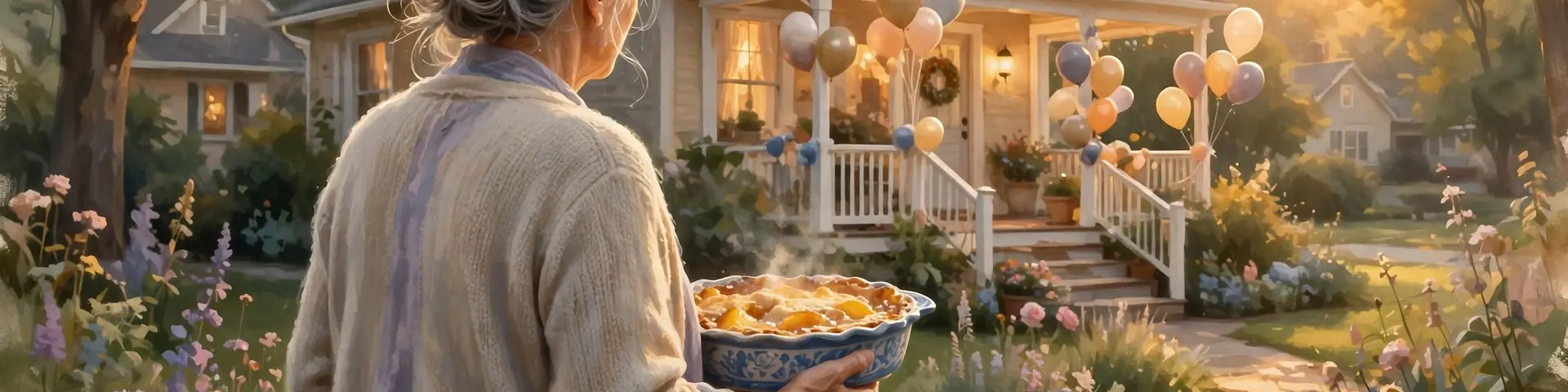
I closed the door gently. They stood on the porch another minute, then left. The peace afterward changed the feel of the house. For years every room had carried the possibility that Nathan might need something — the guest room with toys for grandchildren who rarely came, the freezer with meals for busy weeks, the calendar with weekends quietly protected in case someone called. I began emptying those spaces. Donated the toys. Stopped cooking extra portions. Removed the booster seat from the kitchen closet. Each thing I released ached a little, then relieved me.
The Sale
A week later I called a real-estate agent. The house had grown too large — I’d stayed partly for Thomas’s memory and partly for family gatherings that never happened. I listed it. The first offer came in six days from a young couple with a toddler who loved the maple tree, the built-in bookshelves, and the window seat Thomas had built for me in our tenth year of marriage. Fair offer. I accepted.
Nathan heard from a neighborhood friend and arrived alone while I was packing books, cardboard boxes lining the living room, pale rectangles on the walls where photographs had hung. “You sold the house without telling me.” “Yes.” “This is where I grew up.” “It is where I lived.” “What are you doing?” “Moving.” “Where?” “Across town.” “Why didn’t you talk to me?” I closed the box. “Would you have listened?” “I’m listening now.” “Because the house is sold and the will changed.” “That isn’t fair.” “Stop using that sentence whenever a consequence reaches you.”
He sank onto the sofa edge, and for the first time since the barbecue he looked more frightened than angry. “Are you cutting me out of your life?” “I am removing the assumption that you control mine.” “I never controlled you.” “You held my key, financial authority, medical authority, and every expectation of inheritance while offering almost no relationship in return.” “I didn’t know you felt that way.” “I told you I was lonely.” “When?” “Every time I asked to be included.”
“Mom, we didn’t intentionally exclude you.” “You laughed.” “I know.” “You did not sound uncomfortable.” “I was trying to keep the peace with Vanessa.” “By joining her.” He said nothing. “This is not about choosing between your wife and your mother. I never asked for that. It is about the kind of person you became when respect for me felt inconvenient.” His eyes filled. “What happens now?” “I move.” “And us?” “I don’t know.” He looked at the blank wall where his graduation photo had hung. “Can I help you pack?” “No.” Not cruel. Necessary. At the door he turned. “I did love you.” “I know.” “Did?” “I believe you love me. I also believe you stopped behaving as though I mattered.” He left without arguing.
My new apartment was small and bright, third floor of a quiet building near a public garden. No stairs to maintain, no roof to replace, no guest rooms waiting for people who never came. Every corner belonged to me. I kept Thomas’s desk, the blue baking dish, my favorite chair, six photographs. The rest went to storage or donation.
After the sale closed, the charitable trust received a large initial contribution — Marissa made sure I kept enough for comfortable housing, health care, and future assistance. Haven House invited me to visit. The building had moved since my time, but the feeling was familiar: coffee in the kitchen, donated coats by the entrance, a bulletin board of job listings and class schedules. A program director named Elaine showed me a small room becoming a career lab. “Your contribution will fund computers, certification courses, and transportation support.” I touched the back of a chair. “Good.” “Would you like your name on the room?” “No.” “Are you sure?” “I’ve spent enough of my life wanting people to remember my name. Let the women remember their own.”
The Knock
Nathan called repeatedly that first month. I didn’t answer. Vanessa left messages about the children missing me, though neither child contacted me directly. I didn’t block Lily or Caleb. I simply waited to see whether they’d choose something themselves.
Three months later, someone knocked on a rainy Saturday afternoon. Through the peephole: Lily, alone, holding a damp canvas backpack. I opened the door but didn’t invite her in right away. “Does your father know you’re here?” “No.” “Your mother?” “No.” “How did you find me?” “I heard Dad say the building name on a call.” She looked younger than sixteen, rain darkening her denim jacket. “Why are you here?” “To apologize.” “For what?” “Everything.” “That is too large.” She nodded. “Dad says that too now.”
“For ignoring you at the barbecue. For not saving you a seat. For pretending not to see you at my school concert last year.” “You saw me?” “Yes.” I remembered standing alone by the auditorium doors while families gathered — Lily had looked straight at me, then turned toward Vanessa’s parents. “Why did you pretend?” “Mom said you came without asking and would make everything complicated.” “And what did you think?” “I thought if I was nice to you, she’d be annoyed with me.” The honesty hurt, but it gave us somewhere real to stand. “I wanted to fit in,” Lily said. “So I acted like everyone else.”
I opened the door wider. “Come inside.” She left her wet shoes by the door and sat at the small kitchen table. I made tea; she asked for hot chocolate instead. Then she noticed the blue baking dish drying by the sink. “Is that the cobbler pan?” “Yes.” “It was really good.” “Thank you.” “I didn’t know you made it until Dad told me later.” “That sounds familiar.” “I’m sorry.” “I heard you.” “Do you forgive me?” “No.” Her eyes filled. “Forgiveness is not a button. You don’t press it because someone finally says the correct sentence.” “What do I do?” “Behave differently.” “For how long?” “As long as you want the relationship.”
She nodded, then surprised me: “Can I come back next Saturday?” “You may.” She did. We baked bread the next week; the week after, we repaired an old bicycle Elaine wanted for a Haven House resident. Lily knew nothing about tools, but she was patient, laughing when the chain slipped, grease on her sweatshirt. She told me about school, her friends, the pressure of maintaining the image Vanessa curated. “Mom cares what things look like.” “Most people do.” “She cares more than most.” “Have you told her?” “She doesn’t listen when the answer is messy.” I understood more than I wanted to.
Our relationship didn’t rebuild through grand declarations. It rebuilt through Saturdays — tea, bread dough, a bicycle chain, honest questions. When Lily finally asked about the will, I knew Nathan or Vanessa had raised it at home. “Dad says you gave everything away.” “I gave some money to Haven House.” “Are you mad at me and Caleb?” “This is not a punishment.” “But we were supposed to inherit the house.” “The house was mine.” Quiet. Then gently: “You and Caleb have education trusts, controlled by an independent trustee, for school or career training.” Her head lifted. “You still did that?” “Yes.” “Why?” “Because I love you. Love is not the same as giving your parents control of my property.” “Dad thinks you’re trying to teach him a lesson.” “I am trying to live my life.” “Isn’t that the lesson?” I smiled. “Perhaps.”
Nathan’s letter arrived seven months after the barbecue — three handwritten pages. He admitted he’d laughed because challenging Vanessa felt harder than letting me absorb the disrespect. The barbecue hadn’t created the problem; it had exposed years of accepting my support while offering less and less of himself. He apologized for using busyness as an excuse, for letting the children copy him, for asking about the will before asking whether I was all right. Near the end he wrote: I don’t know whether forgiveness is possible. I understand now that asking for it may be another way of asking you to carry something for me. I am trying to become someone whose actions make an answer unnecessary. I folded the letter into Thomas’s desk drawer. I didn’t reply. Not every apology deserves an immediate answer; some must be given time to develop into behavior.
Lily kept visiting. Caleb sent a Christmas card in uncertain handwriting: I’m sorry I didn’t talk to you. I didn’t know what to say. I hope you’re okay. I sent a book and a note: I am okay. You may call when you are ready. He called two days later. Seven minutes. A beginning.