Vanessa didn’t apologize that year. She sent one long email about her stress and responsibilities — seven paragraphs about her circumstances, one sentence about mine. I read it once and didn’t answer. Nathan started counseling, Lily said. He stopped pumping her for information about my finances, and corrected people who called me dramatic. Those changes reached me indirectly, which made them more believable.
A year after the barbecue, he asked Marissa to forward a short message: May I take you to coffee? No discussion of money, documents, or the past unless you choose it. I agreed. We met at a quiet diner near my apartment. He arrived early and stood when I approached but didn’t move to hug me. “Is it all right if I hug you?” “No.” He nodded. “Okay.” We talked about ordinary things — his work, my apartment, Lily’s college plans, Caleb’s interest in photography. Then he looked down at his coffee. “I used to think being a good son meant handling emergencies.” “You were good at emergencies.” “I ignored everything before the emergency.” “Yes.” “I thought because you were strong, you didn’t need much.” “Strong people still notice empty chairs.” “I’m sorry.” “I know.” “Do you believe me?” “I believe you regret it.” “That isn’t the same.” “No.” “What would make you believe I’ve changed?” “Time.” “How much?” “That question suggests you still think this is a transaction.” He absorbed it. “You’re right.” At the door he asked again about the hug. This time I said yes. Brief. I didn’t feel restored — cautious and sad and slightly hopeful, all three allowed.
The Birthday
On my seventy-third birthday, Lily arrived with fresh flowers. Caleb brought a framed photograph he’d taken of the public garden after rain. Ruth came with tea, Elaine with a lemon cake, and two women from Haven House joined us for dinner. No elaborate decorations, no speeches about family loyalty, nobody asking about my money. Sunlight filled the apartment as Lily set candles in the cake. Nathan stood near the kitchen doorway — I’d invited him for one hour. Vanessa didn’t come. That was her choice. After dinner Nathan washed the dishes without being asked, Lily dried, Caleb showed Ruth how to adjust her phone camera settings. I sat in my chair and watched. For the first time in years, I wasn’t working to hold a broken family together. I was letting honest relationships form at their own speed.
After everyone left, I opened my journal. The page stayed blank for several minutes. Then I wrote: They once wondered why I kept showing up. Now I know the answer. I was waiting for them to remember my worth. I crossed it out and wrote something truer beneath it: I stayed long enough to remember it myself.
The charitable trust remains in place. Much of my house’s value now supports women rebuilding lives after being treated as though their needs were inconvenient. Lily and Caleb’s education funds stay protected. Nathan is no longer my financial or medical representative, and he hasn’t asked to be restored — which may be the clearest sign he finally understands.
Our relationship isn’t what it once was. Perhaps it never will be. I no longer measure healing by whether the past can be recreated. Some things shouldn’t be recreated. Nathan calls every Sunday now; if he misses, he messages and reschedules. He asks whether I have the energy for visits instead of assuming I’m available. Vanessa and I remain distant. Months after my birthday she wrote a shorter apology with no explanations: I should never have spoken about you that way. I should never have treated your love as a burden. I understand if you do not respond. I didn’t respond. But I kept the note. Forgiveness and access are separate decisions.
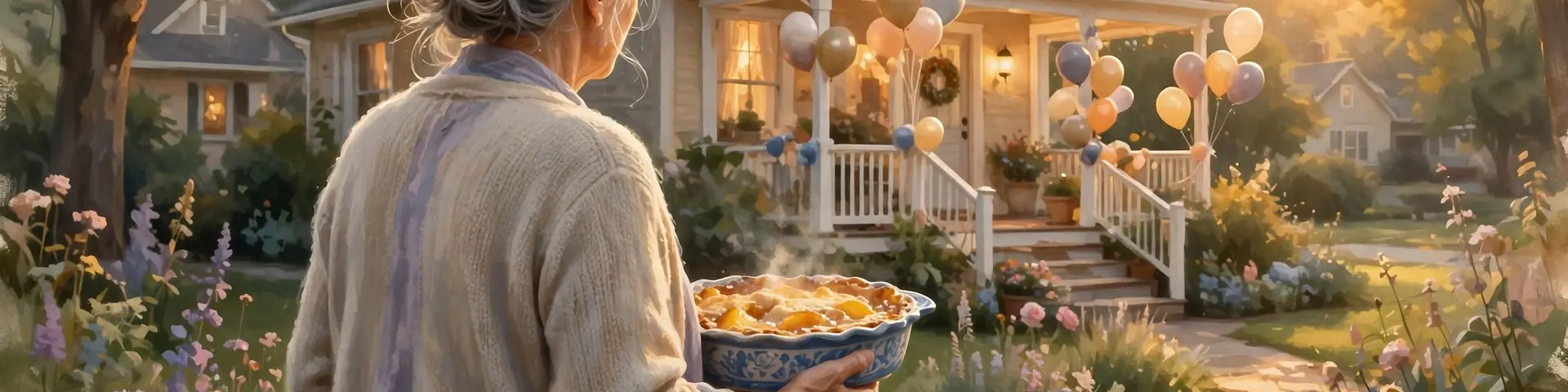
At seventy-four, I volunteer twice a week at Haven House — teaching basic budgeting, helping residents with job applications, occasionally baking peach cobbler for the communal dinner. The blue dish always comes home empty. Nobody praises an old family recipe without naming who made it.
My apartment remains small. Every corner belongs to me. There are no cold stairways, no unused guest rooms, no windows where I wait for someone to remember I exist. The photographs returned gradually — not all of them. I framed one of Thomas holding Nathan as a baby, one of Lily beside the repaired bicycle, one of Caleb’s garden photographs. They share a shelf without pretending the years between them were simple.
When I look at Nathan now, I still remember his laughter behind the fence. I also remember the man in the diner who accepted no without arguing. Both versions belong to him. People aren’t redeemed by denying who they were; they change by becoming accountable for what that person did.
I spent most of my life believing sacrifice was the purest form of love. Now I believe love without respect eventually becomes self-erasure. The barbecue didn’t destroy my family. It revealed the arrangement we’d already been living inside: I gave, they accepted, I stayed quiet, they assumed quiet meant consent. The morning I opened Thomas’s file cabinet, that arrangement ended.
I didn’t take anything from Nathan. I reclaimed decisions that had always belonged to me — the future I had saved, the home I owned, the name on my documents, the right to decide who could enter my life and on what conditions.
My son once laughed when someone asked why I kept showing up. I no longer show up where my presence is merely tolerated. I go where the chair is already waiting. Where people notice the person carrying the cobbler. Where affection doesn’t arrive attached to a request. And where love, if it hopes to survive, knows enough to bring respect with it.
— The End —
Disclaimer: This story is fictional and created for entertainment purposes only. Any names, characters, places, or events are fictitious or used fictitiously. No real person or organization is intended to be portrayed.